Free Palestine

14th October 2023

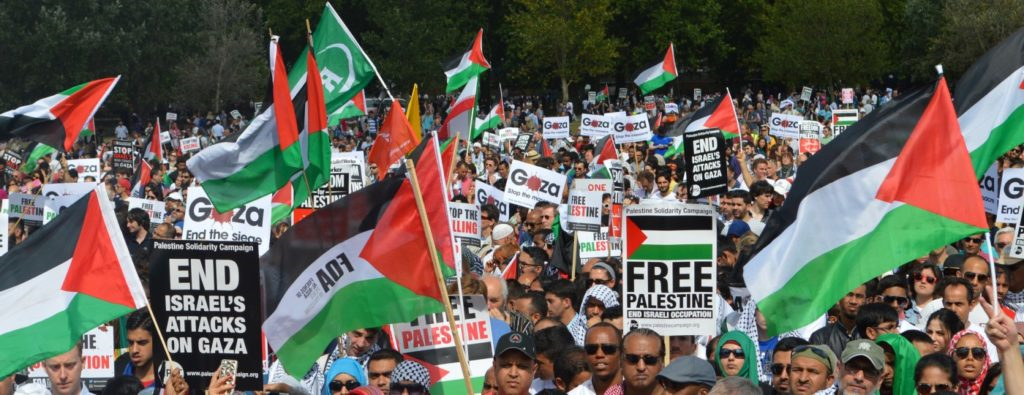
Thousands protest in London against Israeli atrocities in Gaza

Last weekend’s assault and killing of civilians in the Gaza Strip by Hamas was a response to the pent up anger of many Palestinians, frustrated by the illegal Israeli air, land and sea blockade, imposed in 2007, and the 57 year long illegal occupation by Israeli forces.  The tactics deployed by Hamas by no means have the backing of all Palestinians but the events of last weekend were triggered following a week in which Israeli ‘settlers’ ran amok throughout the occupied territories under the auspices of their government, desecrated the Al-Aqsa Mosque and carried out another pogrom in Huwara.

The Communist Party of Israel and Hadash (Democratic Front for Peace and Equality) have made clear their condemnation of the Israeli government and the ongoing provocations against the Palestinian people expressing,

 “…deep concern about the use of recent developments by the Netanyahu government to carry out a vengeful attack on the Gaza Strip and call on the international community and the countries of the region to intervene immediately to silence the drums of war and initiate moves that will lead to the promotion of a political solution.”

Israel’s Defence Minister, Yoav Gallant, ordered “a complete siege of the Gaza Strip” last Monday in response to the Hamas action.  Gallant went on to say that,

“There will be no electricity, no food, no fuel, everything is closed.  We are fighting human animals and we act accordingly.”

The Gaza Strip is home to 2.2 million Palestinians and has regularly been described as the world’s largest open air prison.  The collective punishment of the civilian population, as ordered by the Israelis is a war crime under international law.  The massive bombing campaign which has been ongoing throughout this week has not only flattened residential areas but has hit a densely populated refugee camp.

Hospitals are reported to have used a month’s worth of supplies in one day and are overwhelmed by the number of casualties.

The Israeli army is the fourth most powerful in the world.  As the Community Party of the USA has pointed out,

“The U.S. government is the main contributor to Israel’s military budget to the tune of $3.3 billion this year alone and also bears responsibility for the escalation. Adding to the danger and the region’s instability, the U.S. continues to broker unprincipled alliances and economic agreements between Israel’s reactionary anti-democratic apartheid-like state on one side, and the right-wing Arab monarchies on the other. The repressive political regimes of these two sets of states mirror one another. Their machinations undercut the Palestinian struggle for human rights and political sovereignty while bolstering U.S. political, economic and military supremacy in the region.”

The United States is reported to have moved naval assets into the Mediterranean to support the Israeli military.  British Prime Minister, Rishi Sunak, spoke with Israeli leader, Benjamin Netanyahu, earlier in the week while Foreign Secretary, James Cleverley, visited Israel to confirm British government support for the right wing, religious fundamentalist, Israeli regime.

The outcome of the Sunak/Netanyahu call was a pledge from the British government to send a significant military package to the Israeli regime, including RAF surveillance aircraft, two Royal Navy ships to patrol in the Eastern Mediterranean, three Merlin helicopters and a detachment of Royal Marines. 

US Secretary of State, Antony Blinken has pledged an “unwavering focus on halting the attacks by Hamas” while saying nothing about Israel’s ongoing flouting of international law and its declared intention to commit further war crimes.  Likewise, the British government has made no comment on the ongoing atrocities committed against the Palestinian people by the Israeli government, its illegal occupation or its ongoing contempt for United Nations resolutions and international law.

Israel’s military on Friday ordered the evacuation of northern Gaza, a region that is home to 1.1 million people, about half of the territory’s population, within 24 hours.  Many fear that this could signal an impending ground offensive. While the Israeli military has not yet confirmed a decision on this, raids have been undertaken by the Israeli Defence Force within Gaza.

The evacuation order, delivered to the United Nations was regarded by UN spokesman Stéphane Dujarric as “impossible” without “devastating humanitarian consequences.”  The order for all of the north of Gaza also applies to all UN staff and to the hundreds of thousands of people who have taken shelter in UN schools and other facilities since Israel launched round-the-clock air strikes last Saturday.

The UN is already reporting nearly 3,000 homes destroyed and nearly 1 million people, almost half of the population of the Gaza strip, displaced. These people have nowhere safe to go if Israel continues with its bombardment and launches a ground invasion.

Israel claims to have dropped 6,000 bombs on Gaza, an area roughly the size of the Isle of Wight, in the initial six days of its campaign.  So far over 2,200 Palestinians have been killed in Gaza with over 8,700 wounded.  That figure includes those fleeing to the south of Gaza following the Israeli announcement to ethnically cleanse the north.

Labour leader, Kier Starmer, has defended the ‘right’ of the Israeli regime to cut off water and electricity supplies to the population under perpetual bombardment in Gaza stating,

“I think that Israel does have that right, it is an ongoing situation, obviously everything should be done within international law but I don’t want to step away from the core principles that Israel has the right to defend herself.”

As a former human rights lawyer Starmer failed to elaborate on how collective punishment methods, such as the withdrawal of water supplies to a large urban area, could be done within international law.

A number of local councils in Britain have taken to flying the flag of Israel over civic buildings in misplaced demonstrations of ‘solidarity’, though none appear to be flying the flag of Palestine, as the right of Israel to defend itself appears not to extend in the same way to the Palestinians.

The mainstream media coverage is overwhelmingly pro-Israeli, with coverage of the Palestinian position reduced to exhortations to condemn Hamas, or the growing humanitarian crisis.  There is no attempt to analyse the underlying causes of Israeli occupation and failure to adhere to international law and UN resolutions.

A national demonstration in London on 14th October, organised by Palestine Solidarity Campaign and Stop the War amongst others, has attracted thousands in opposition to the immediate violence and the ongoing apartheid practices of the Israeli regime.  Responses are being organised across Britian in support of the Palestinian cause and must be supported in order to support the legitimate rights of the Palestinian people and condemn the Israeli regime.

The often heard diversion that opposition to the religious fundamentalists running the Israeli government is anti-semitic or a trope for anti-semitism must be rejected.  A political solution to the situation in Israel/Palestine is the only way forward and that must see both communities being able to live together without one being occupied or terrorised by another. 

Labour still not a General Election shoo in

7th October 2023

Labour leader Keir Starmer has said he will honour the oil and gas licences granted by the Tories

Labour activists will gather in Liverpool this weekend with the boost of a victory in the Rutherglen and Hamilton by election, doubling Labour’s parliamentary representation in Scotland from one to two seats.  While this has certainly generated buoyancy in the Labour leadership the result does not necessarily mean a groundswell in Labour votes amongst the Scottish working class.  If anything, the 37.2% turnout, down from over 65% in 2019, suggests that there is still a huge undecided cohort of voters to play for.  In spite of this result Labour is still far from a shoo in at the next General Election.

Labour’s retreat from championing the needs of Scotland’s working class has been a key feature of its dwindling support for decades, pushing many voters into the arms of the nationalist Scottish National Party (SNP), always ready with the illusion of the lure of independence as the promised land of prosperity.

Labour’s chances in Scotland have been enhanced, not so much by the leadership taking a stand in favour of workers’ rights, but on the recent implosion of the SNP.  This followed the resignation of erstwhile leader, Nicola Sturgeon; the police investigation into finances, under the control of Sturgeon and her SNP Chief Executive husband, Peter Murrell; and the less than enthusiastic reception accorded new SNP leader, Humza Yousaf, from sections of the party.

Like the opportunity created by the implosion of the Tories across Britain, Labour is staring into an open goal in Scotland and a tap in should ensure it a substantial increase in the number of seats in the House of Commons in 2024, potentially making a decisive contribution to the election of a Labour government.

Speeches on the conference floor and on the fringes in Liverpool will no doubt reflect this mood of optimism but Labour’s retreat from key position in recent weeks will give many cause for concern that an already weak programme will be diluted further in the election manifesto.

On the question of private schools for example, Shadow Chancellor, Rachel Reeves was quite emphatic in 2021, stating,

“Here’s the truth: private schools are not charities. And so we will end that exemption and put that money straight into our state schools.  That is what a Labour government will do.”

However, only two weeks ago, in the face of outcry from the private school sector, the Labour leadership said it no longer needed to end the charitable status of private schools to achieve its policy of charging 20% VAT on fees and ending business rates relief in England.

The Labour leadership had previously shown little backbone following Tory leader Rishi Sunak’s revision of green policies, by pushing back the ban on the production of new petrol and diesel car production from 2030 to 2035.  While Labour has supported the original position, consistent with achieving net zero carbon targets by 2050, it wobbled following Sunak’s announcements and claimed it would not reverse it if elected.

At the same time, the announcement of the development of the Rosebank oilfield, one of the biggest new oil and gas projects in years, saw further Labour equivocation.  Earlier in the year Labour shadow energy secretary, Ed Miliband, attacked the Rosebank oil field proposal as a “colossal waste of taxpayer money and climate vandalism.”   

Immediately following the announcement however Labour leader, Kier Starmer, was on the airwaves stating that “…as a matter of principle we will accept the baseline that we inherit from the government if we win that election … in order to ensure we have the stability that we desperately need in our economy.”

All of which casts some doubt on the firmness of Angela Rayner’s “cast iron commitment”, as articulated in a speech at the TUC conference in Liverpool in September, to push through an employment rights bill within 100 days of entering office if the General Election is won by Labour. 

Rayner also promised the repeal of Tory anti-trade union minimum service levels legislation, which requires minimum levels of service during a strike, characterising it as a “spiteful and bitter attack that threatens nurses with the sack”.  Labour’s New Deal for Working People would include protections against unfair dismissal, a ban on zero-hour contracts, more flexible working and ending fire and rehire. 

Labour still effectively takes the Tory whip on key foreign policy issues, such as Trident nuclear submarine replacement; fuelling the war in Ukraine; demonising China; and defending foreign interventions in general, as part of the NATO military alliance.

Left leaning delegates will have their work cut out over the weekend to make any headway on getting more progressive policy positions passed, let alone have any chance of them making a Labour manifesto.  The current right wing grip on candidate selection and policy development will ensure that, if the outcome of a General Election is a Labour victory, it will be led by a Cabinet shaped in Kier Starmer’s image.  

Should that come about the honeymoon will no doubt be short lived, as workers realise that Labour is not delivering for them, that the profits crisis that threatens workers cost of living is not resolved, and that the climate emergency is not being tackled with sufficient vigour.

The challenge to keep the Red Flag flying, “while cowards flinch and traitors sneer” will continue to be real and require both pressure upon representatives in Parliament, and mass extra parliamentary action, if any semblance of benefit for the working class is to emerge from a Labour government.    

Pushing back on the hostile environment

30th September 2023

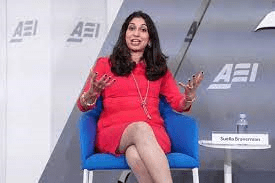
Suella Braverman – keen to maintain a hostile environment for migrants

The Tories head into their annual conference in a worse state than usual this weekend.  After 13 years in power, with nothing to show but the impact of austerity, an ongoing wave of strike action, an NHS close to tipping over, schools collapsing and a poor Brexit deal to haunt them, it is no wonder that the fissures which have been evident for years are becoming fully fledged cracks.

Rishi Sunak is attempting to stake out ground on policies he thinks will be popular, being a ‘friend to the motorist’, rolling back on green commitments and generally fanning the flames of culture wars over any subject he thinks will win him votes.  At least 30 Tory MPs, including Priti Patel and even Liz Truss, have come out to say that they will not support any policies which mean an increase in taxes.

Pretender to Sunak’s position, Home Secretary, Suella Braverman, has already set out her stall on the issue of refugees and migration policy.  In a speech this week she challenged the basis of the 1951 UN Refugee Convention, suggesting that the criteria for asylum are no longer fit for purpose and ought to be revised.  Braverman is essentially dodging the failure of the governments “stop the boats” policy by suggesting that it is the international rules that are wrong not the government policy.

Both Sunak and Braverman are keen to weaponise the issue of asylum seekers and refugees, playing upon the perceived prejudices and fears of sections of the population with whom they think a hard line on migration will win votes.  This is both the voters in the South East, in areas where asylum seekers are more likely to enter the country, and in so-called former Labour red wall seats where the assumption is that the anti-migration thrust of right wing Brexiteers delivered the anti-EU vote.

The possibility that the anti-EU vote in working class areas was as a consequence of the fact that EU membership for 40 years had done little for working class communities, while enriching the City of London and the big corporations, is one that both Labour and the Tories dodge. The lazy view that working class voters are all anti-migrant, and therefore bound to sign up to hardline policies such as “stop the boats”, shows a high degree of condescension in the leadership of both political parties.

The narrative around asylum seekers and refugees is certainly more in line with the editorial position of the Daily Mail than it is on the facts.  The reality is that, according to the Refugee Council, at the end of 2021 around 89.3 million people were forcibly displaced across the world. Of these, 27.1 million were refugees, while 53.2 million were internally displaced within their country of origin.

Far from the Britain being swamped as a consequence the Refugee Council calculate that Britain is home to around 1% of the 27.1 million refugees who were forcibly displaced across the world.

Under international law, anyone has the right to apply for asylum in any country that has signed the 1951 Convention and to remain there until the authorities have assessed their claim.  The convention also recognises that people fleeing persecution may have to use irregular means in order to escape and claim asylum in another country. 

That this is exploited by criminal gangs looking to take advantage of those seeking asylum, through the use of overcrowded boats for example, is clearly a scandal which has to be stopped.  However, given that the vast majority of refugees are from areas of conflict, where NATO military intervention has been a key factor in causing displacement, Syria and Afghanistan being the key examples, stopping displacement at source will mean a decisive shift in the Western foreign policy of military intervention.

Part of the pushback in Britain, from the Tories and their right wing supporters, is that asylum seekers should be returned to the country they first entered in order to seek asylum.  However, there is nothing in international law to say that refugees must claim asylum in the first country they reach, although a European regulation allows countries in the EU to return an adult asylum applicant to the first European country they reached.

Of the 12 countries that take in the most refugees, Germany (with a population of 1.2 million refugees) is the only high-income country, and the only one not neighbouring the countries most represented within the refugee community. Over 605,000 Syrian refugees, 147,000 Afghan refugees, and 146,000 Iraqi refugees are currently hosted in Germany.  Britain does not even make the list.

The Tories are set to make issues of taxation, the environment and migration key battlegrounds at their conference in order to perpetuate a culture wars narrative which they think will appeal to voters.  The Daily Express certainly reinforces the line taken by Suella Braverman, suggesting in a recent editorial that,

“The division between seeking asylum and economic migration has been muddied and the net result of this loose system, believes the Centre for Policy Studies think tank, is that the right to move to another country can potentially be extended to an astonishing 780 million people.”

This is scaremongering of the highest order and needs to be exposed.

While the Tories default to their standard position of blaming ‘foreigners’ for the country’s problems, the Labour leadership continues to run scared, rather than tackling the issues of the positive impact of migration, exposing Britain’s historical colonial role and present neo-colonial foreign policy positions, as being key issues to address.

These issues will continue to sharpen as the General Election approaches.  Unless Labour is prepared to take the fight to the Tories the right wing will continue to offer easy answers to complex problems, in an effort to fuel prejudice, sustain a hostile environment for migrants and instil division in working class communities.

Mass mobilisation outside Parliament, as well as continued pressure upon Labour MPs, in particular, will be vital if the perception of asylum seekers and refugees is to change and an environment of welcome, rather than hostility, created.

Pale Green

24th September 2023

Rishi Sunak – pale green policies for a dimmer future

Tory efforts to capture the headlines with popular policies took a further nosedive this week when Prime Minister, Rishi Sunak, reneged on the previous policy of halting the production of petrol and diesel cars by 2030 and pushed the date back to 2035.  Sunak’s justification was characteristic of the Tories when they attempt to present themselves as being on the side of the working class; disingenuous and mendacious.

Sunak claims that he does not want to pass additional costs onto hard pressed families, already having to deal with a cost of living crisis and struggling to meet increased energy bills.  Sunak conveniently sidesteps the fact that his rise to the dizzy heights of 10, Downing St has come during a period of 13 years of Tory led austerity, which has squeezed the working class, the services many of them rely on and the wages they earn.  Britain’s ruling class may boast of an increase in billionaires but for the working class it has been a period of seeing more people homeless and sleeping rough.

Sunak’s army of Public Relations advisors are desperate to present their man as a nice guy in a sharp suit, who only has the people’s interests at heart.  His own very comfortable millionaire status is airbrushed, as being of little or no consequence, and not a barrier to him understanding the needs of working class people.

Having to sell the third Prime Minister in less than the lifetime of a Parliament, to a population watching corporate profits rise along with prices at the till, will undoubtedly take some creative PR thinking.  Quite which bright spark pitched back pedalling on the green agenda as an idea may only be revealed in Sunak’s memoirs.  However, if the Tory ship was not holed below the waterline before this week, it has been listing significantly since Sunak’s speech.

As well as pushing back the ban on new petrol and diesel cars to 2035 Sunak’s announcement also ditches the plan to phase out gas boilers from 2035.  Even the government’s own Climate Change Commission said that the announcement, ”is likely to take the UK further away from being able to meet its legal commitments”, which are to achieve net zero by 2050.  

The British government commitments to date have been key elements of the British submissions under the 2015 Paris agreement on climate change, known as nationally determined contributions (NDCs).  Alok Sharma, Chair of the Cop26 summit in Glasgow in 2021, has criticised Sunak’s u-turn stating,

“rolling back on certain policies will mean we need to find emissions reductions elsewhere if we are to meet our legally binding near-term carbon budgets and our internationally committed 2030 emissions reductions targets.”

Sunak has not indicated how emission reductions will be met by other means and is characteristically more concerned with saving his job in the next twelve months, rather than any contribution towards saving the planet.

Shadow Energy Secretary for Labour, Ed Miliband, said in response to Sunak’s announcement that Labour would stick with the 2030 phase-out for petrol and diesel cars but that the party would look at the other ones. He suggested the boiler targets could be revisited by Labour but wanted to stick to the previous plan on energy efficiency.

The fear of being accused of putting people’s bills up means that Labour are pussyfooting around the issues rather than coming up with a comprehensive plan to support the transition to greener travel and energy.  Such an approach is in danger of playing into Sunak’s hands as he seeks to weaponise climate issues ahead of a General Election next year.

A bold plan to meet the cost of heat pumps from a windfall tax on oil companies or have a more generous scheme for scrappage and replacement of non-electric vehicles would be a starting point.  Tackling the issues head on may also help to generate greater understanding of the risks of inaction.

Across Europe only 2% of people live in areas deemed safe by the World Health Organisation, measured by the presence of tiny particles (known as PM2.5s) that cause significant diseases.  This applies equally to rural areas as well as urban centres, with a major source of dangerous particles coming from ammonia from farms.  Farm ammonia contributes 25% of these particles in London, 32% in Birmingham and 38% in Leicester.  

The farming and food lobby, like those of oil and fossils fuels, has significant sway with politicians so these realities and swept under the carpet, while the Tory press focus on the impact of Ultra Low Emission Zones on the few individuals who may feel a negative financial impact.

Such divide and rule tactics are fundamental to capitalism, the drive to prioritise profit over the needs of the people, to allow the dictates of the market to rule over a socialist planned approach to issues of the environment.

Sunak’s pale green choices now will not win him a General Election but there is every chance that they will cow the Labour Party into shying away from any pronouncements deemed to be too radical.    The need for extra parliamentary action over issues of the environment and the future of the planet has never been greater. 

A clear programme which puts people before profit and articulates the political need to change the pollution driven capitalist system is vital.  The next General Election in Britain may be the short term focal point but the impact of choices made now have repercussions far beyond that.

Labour – keeping the front bench warm for the Tories?

17th September 2023

Labour leader Kier Starmer – Tory policies in a Labour wrapper?

With the looming political party conference season likely to be the last before a General Election in 2024 there will be a strong pre-manifesto air as the main contenders set out their stalls.

Not exactly contenders but the Liberal Democrats, in Bournemouth from 23rd September, will still be hopeful of increasing their vote share and MP representation by pedalling their usual bland Tory-lite fare, in an effort to take seats from the Tories in the South.  With no hope of actually forming a government, the Lib Dems will be hoping to swing enough votes to be part of a balance of power negotiation, should neither of the two main contenders manage a clear majority. Given how well that went for them, getting into bed with the Tories in 2010, expect some grass roots scepticism about the prospect.

The Tories stray into Northern territory, holding their conference in Manchester on 1st – 4th October. Already bookended by rail strikes on 30th September and 5th October the symbolism of the Tories being hemmed in by working class discontent is not difficult to read.  With disputes having rumbled across the rail network, the NHS, schools, the postal service and others over the past year the fact that the Tories are not delivering for working people could hardly be clearer.

Led by a multi-millionaire, bankrolled by big business and with a Cabinet straight out of the public school sector, the sense of the Tories being the party of the ruling class, seeking to protect the privileges of the ruling class could hardly be stronger.  Nevertheless, Tory divisions continue to reflect the tug of war within the capitalist class in Britain as to whether their best interests lie in an alignment with the European Union or in forging an independent path outside of the constraints of the EU, while still being governed by the economic strictures which twenty first capitalism implies.

It is an irony that it may be Labour who save the Tories’ bacon, by settling some of these issues, should Kier Starmer end up with the keys to number 10, Downing St.  For the Labour leadership there is no dispute about membership of NATO; fuelling the ongoing NATO inspired war in Ukraine; wasting public money on weapons of mass destruction, such as Trident nuclear submarines; or ramping up anti-China rhetoric which could ultimately lead to a war in South East Asia.

On the issue of Europe Starmer is currently making conciliatory noises about greater cross border co-operation and having a closer ongoing relationship with the EU.  Shadow Foreign Secretary, David Lammy, has also been very clear, stating,   

“We want to approach the review of our trade arrangements in a very constructive manner, and we want to build on the partnership that we have seen on Ukraine.  That is why we are proposing a new security pact.”  

While some of the more rabid right wing Tories, locked in their Eurosceptic world may balk at such talk, there is nothing here to scare off many Tories.  If such arrangements were in place by the time a 2029/30 General Election came around the Tories would be unlikely to want to unpick them, should they end up back in Downing St.

With Starmer and his cohorts already having form for doing the Tories dirty work, by torpedoing the prospects for change which Jeremy Corbyn’s leadership held out, it would be a small step for them to continue down that road should they find themselves in government.

The Labour Party conference, in Liverpool from 8th – 11th October, will be the most significant of those coming up in 2023.  Having nailed their colours to the Tory mast in the field of foreign policy the hope is, as ever, that Labour’s domestic agenda will at least make some difference to the working class after what will have been 14 years of Tory austerity.

The investment in green infrastructure, borrowed from but not credited to the Corbyn manifestos of 2017 and 2019, offers some hope of industrial modernisation and new jobs as a consequence.  Angela Rayner has made much rhetorical play of the workers’ rights agenda that Labour propose, without any concrete promise to reverse the avalanche of anti-union laws the Tories have enacted over the past forty years.

The need to invest in local government, on the brink of bankruptcy; rebuild local services, including crumbling schools and social housing; and properly fund the NHS, through investment in fair wages and a long term training infrastructure; are all shrouded in talk of fiscal rules and finances being tight, though not too tight to spend on weapons of mass destruction or the war in Ukraine, both of which remain Labour commitments.

Unless Labour’s conference does see a dramatic shift in policy direction the coming General Election is going to offer little difference of substance for working class voters.  The pressures upon the working class will remain and the development of mass parliamentary action, to force change within the system but ultimately to change the system itself, will only grow. 

If Labour continue to see themselves as merely keeping front bench seats warm for the return of the Tories that will not be enough to move towards real transformational change .  

Trade union action over the past year has shown that action on the economic level can force concessions but in itself this will not be enough, important as victories in the wages struggle may be.  A wider political agenda for change is required and a further Labour term in office, which fails to deliver for the working class, will only sharpen the urgent need for revolutionary change and organisational structures fit for purpose in the twenty first century to fulfil this role.

Chile – 50 years on from ‘the eleventh’

9th September 2023

Salvador Allende gives his inaugural address as President of Chile in 1970

Long before 9/11 became the widely accepted shorthand for the events of 11th September 2001 in the United States, “the eleventh” (el once) had for many years been the phrase used by the people of Chile, to refer to the CIA backed coup d’etat on 11th September 1973, the 50th anniversary of which falls this week. 

The Popular Unity (Unidad Popular) government, led by Salvador Allende, had been elected in September 1970 on a programme of agrarian, industrial and educational reform aimed at moving the Chilean economy away from its reliance upon the international finance capital of the United States and towards a more self sufficient socialist economic model. 

The electoral arithmetic was finely balanced from the first days of the new government with none of the three contesting parties having an overall majority.  However, as head of the biggest coalition Allende was confirmed as President by Congress.  This did not stop an immediate fall in share prices on the Santiago stock exchange, a run on the banks and an increase in the purchase of gold by those who could afford it.

The entrenched wealthy elite in Chile clearly feared the prospect of increased social spending, higher wages for the poor and new initiatives in health and nutrition, to improve the lives of those whose labour they previously exploited with impunity.  Which is not to say that opposition to inequality in Chile only appeared on the day of Allende’s election.   On the contrary, active trade unions, supported by a strong Communist Party and socialist activists, had made gains for Chilean workers and were part of the groundswell that provided the basis for Allende’s electoral success.

Copper was Chile’s most valuable resource, providing more that 70% of the country’s foreign exchange and was thus at the top of the new government’s list for nationalisation.  The ownership of copper was in the hands of two corporations, Kennecott and Anaconda, who were asked to pay nearly $400 million between them to compensate the Chilean people for the excess profits they had made.

The two companies, having no recourse in the Chilean courts, resorted to suing the Chilean government in France, Germany, Sweden, Italy and in New York.  The law suits undermined Chilean copper on the world market and the credit squeeze initiated by the US government, through discouraging international institutions and American banks from lending funds to Chile, put further pressure on the Chilean government. The fall in the world copper price by 35 cents per pound between 1970 and 1973 was a further disadvantage to the Allende government’s ability to raise revenue.

Agrarian reform proved a challenge for the new government, not least due to resistance organised through the opposition Christian Democrats, resulting in a variety of different levels of agrarian infrastructure.  However, the feudal hacienda of old was deconstructed remarkably quickly by the new government.  Farms of 80 hectares or more accounted for 55% of the land in 1965 and this was reduced to a figure of 3% by 1972, indicating a significant redistribution of land and power in rural areas.

Alongside the nationalisation of copper, the government was also committed to bringing major companies in key economic sectors under government control.  By 1973 the state controlled 80% of the country’s industrial output, over 400 enterprises, and around 60% of Gross National Product.    This was achieved in spite of the nationalisation programme being the most strongly resisted aspect of the government programme, particularly by the powerful financial conglomerates with entrenched interests in exploiting the Chilean economy.

Although the credit squeeze by the US was countered by bank credits from Western Europe, and loans and credits from China, the Soviet Union and Latin America, internal resistance to Allende’s programme continued to undermine efforts to stabilise the economy and move it more decisively in a socialist direction.

Pressure from the right wing, the Catholic church and the military mounted in 1973, particularly in opposition to education reforms, which aimed to provide education towards development in a non-capitalist society recognising, “the proletarian struggle for sovereignty and independence which have been virtually ignored in traditional teaching, which serves the class interests of the oligarchy.”   For the church in particular this was seen as a departure from “Christian values”, while military officers denounced the measure as an attempt to indoctrinate their children.

The political climate was further destabilised by the covert actions of the CIA, bankrolled to the tune of $8 million by the US government, to support its operations and fund the opposition.  By August 1973 this had resulted in a shift in personnel at the top of the armed forces, with General Augusto Pinochet being installed as Commander in Chief by the end of the month.  By early September, with the green light they required from the United States, the generals had agreed to overthrow the democratically elected government of Salvador Allende.

The tone of the Pinochet regime was set early on by the regime’s first Interior Minister, General Oscar Bonilla, who told trade unionists “Stop using the word ‘demand’; don’t forget that this is a dictatorship.”

The dictatorship quickly moved to round up the members of the socialist and communist parties which had formed Popular Unity.  Thousands were herded into the national stadium in Santiago, many were summarily murdered by the regime, detention camps were opened, up and down the country, and many were forced to flee the terror into exile.  By the end of the decade hundreds of thousands of Chileans had left the country.

By the end of 1973 Pinochet had instituted a new secret police force, the Directorate of National Intelligence (DINA), under his direct command, targeting communists in particular and setting up torture centres across the country.  Although disbanded in 1977, to be replaced by the scaled down National Information Centre (CNI), the DINA had done its job in stamping terror as a key feature of the new regime.  Not that the CNI let up on the work of the DINA entirely as murder, torture and disappearances continued to be a feature of life in Chile until the end of the military regime.

The physical brutality of the Pinochet regime was quickly matched by its economic brutality.  Drawing upon the new monetarist orthodoxy emerging from the economics department of the University of Chicago, led by Prof Milton Friedman, Pinochet instituted a programme of neo-liberal austerity which resulted in rising prices and rampant unemployment, in an attempt to apply “shock treatment” to eliminate inflation.   Public spending was reduced by more than a quarter, interest rates more than trebled and real wages crashed to 60% of their 1970 levels.  The same economic model was adopted in Britain by the Thatcher government from 1979 onwards with devastating consequences.

Chile returned to democratic elections free of military involvement in 1990.  The heroic efforts of the Chilean people to free themselves from the control of the US financial institutions and international corporations from 1970-73 ultimately ended in defeat, due to the strength of the forces ranged against them.  Their efforts should not be forgotten however.

The experience of Chile demonstrates both the possibility of mounting a challenge to capitalism as a system of economic organisation but also the extent to which imperialism will marshal its forces in order to resist such a challenge.   

The Chilean experience contains many lessons but key are the need to combine electoral activity with mass extra-parliamentary action and, crucially, to either neutralise or maintain control of the military if sustained change is to be effective.  The struggle to overcome the economic difficulties and even mobilise the population to resist external interference may have been possible in Chile.  In the final analysis however, the armed forces backing for the opposition to the government proved decisive, heralding the tragedy of the 17 year long Pinochet dictatorship.

Britain should admit role in the coup that overthrew democracy in Iran

19th August 2023

(L to R) Mossadegh supporters in Tehran on August 16 1953; Mohammed Mossadegh, 1951

The 19th August marks the 70th anniversary of the 1953 coup d’etat in Iran which brought down the government of democratically elected Dr Mohammed Mossadegh.  Steve Bishop explores Britain’s role in the coup and why demands for an apology continue to be made.

The deposing of Mohammed Mossadegh by a combination of the United States CIA and British security forces was not an overnight event.  As far back as 1951 there were ‘concerns’, as British Foreign Secretary at the time, Anthony Eden, later wrote in his memoirs,

“When I assumed the post of the Foreign Ministry on October 27, 1951, the worrying prospect I was thinking about was this: we had left Iran. We had lost Abadan and our power and prestige throughout the Middle East had been severely shaken. … I had to decide how to deal with this situation. … I thought that if Mossadegh fell it was quite possible that he would be replaced by a wiser government that would make it possible to conclude a satisfactory agreement.”

The ”wiser government” which the actions of the US and British brought about was that of the Shah Mohammad Reza Pahlavi, heralding in a period of tyranny and oppression which lasted until his overthrow in 1979, but has since been tragically continued through the theocratic dictatorship of the Islamic Republic. 

Mossadegh’s popularity in 1953 was on the back of a wave of disputes with the Anglo-Iranian Oil Company (AIOC), established by the British to exploit Iran’s vast oil reserves, but increasingly dictatorial with its workforce.   In April 1951, in opposition to the decision of the Anglo-Iranian Oil Company to drastically reduce the cost of workers housing allowance, there were massive strikes in the industry. Mossadegh proposing a plan to the Oil Commission in Parliament for the nationalisation of oil.

In March 1951 the Iranian Parliament voted to nationalise oil operations, take control of the Anglo–Iranian Oil Company and expropriate its assets.  In May, Mohammed Mossadegh, the leader of Iran’s social-democratic National Front Party, was elected as prime minister and immediately implemented the bill. 

Britain responded by withdrawing the AIOC’s technicians and announcing a blockade on Iranian oil exports. Moreover, it also began planning to overthrow Mossadegh. 

“Our policy”, a British official later recalled, “was to get rid of Mossadegh as soon as possible”.

Mossadegh’s move was a popular one, especially in the context of the revenues from oil being greater than that of the whole of Iran but not benefitting the people of Iran.

The Mossadegh government had the tacit support of Iran’s communists in the form of the Tudeh Party of Iran and the government had cordial ties with the Soviet Union, a significant neighbour and trading partner.  The plotting against Mossadegh inevitably used these facts as leverage.  The British, in particular, saw that playing up the ‘communist threat’ would be more likely to engage US support than simply wanting to restore British control of the oil industry.

By November 1952 a joint MI6 and CIA team was proposing the overthrow of Mossadegh and initiated actions to arm religious opposition groups to that end. Tribal leaders in the north of Iran were provided with weapons.  A combination of activities by British agents provocateurs on the ground and religious forces opposed to Mossadegh resulted in riots in Tehran in February 1953, including attacks upon Mossadegh’s home.

The British utilised the anti-communist card to great effect in attempting to scare Iranians into thinking support for Mossadegh was part of a communist takeover.

C.I.A. officer Richard Cottam later observed that the British

“saw the opportunity and sent the people we had under our control into the streets to act as if they were Tudeh. They were more than just provocateurs, they were shock troops, who acted as if they were Tudeh people throwing rocks at mosques and priests.”

A secret U.S. history of the coup plan, drawn up by C.I.A. officer Donald Wilber in 1954, and published by The New York Times in 2000, relates how C.I.A. agents gave serious attention to alarming the religious leaders in Tehran by issuing black propaganda in the name of the Tudeh Party of Iran, threatening these leaders with savage punishment if they opposed Mossadegh.

The final go-ahead for the coup was given by the US in June 1953 with a date set for mid-August.  Thousands of dollars were provided to opposition groups to fund mass demonstrations in central Tehran and the military, sympathetic to the Shah, took control of the radio station, army headquarters and Mossadegh’s home.

The Shah soon assumed all powers and the following year a new consortium was established, controlling the production and export of Iranian oil, in which the U.S. and Britain each secured a 40 percent interest — a sign of the new order, the U.S. having muscled in on a formerly British preserve.

The coup and the resultant Shah’s dictatorship not only overthrew the functioning parliamentary democracy in Iran but completely derailed democratic politics.  The Shah established a reactionary political system where his own devotees, along with a pliant Islamic clerical hierarchy, determined the composition of the parliament.  All progressive political parties, including the Communist Tudeh Party of Iran, were banned and forced to undertake clandestine activities. 

By 1979 the Islamic institutions were in effect the only players freely operating on the political scene in Iran.  The Islamists exploited the monopoly of their legally operating mosques in all towns and cities to ensure that they had absolute control over shaping the new regime.  The Left and progressive forces were violently suppressed and their impact marginalised.  A new dictatorship was in total control by 1983.    

The US formally admitted its role in the 1953 coup 10 years ago with the declassification of a large volume of intelligence documents, which made clear that the ousting of the elected prime minister, Mohammed Mossadegh, 70 years ago this week was a joint CIA-MI6 endeavour. The formal UK government position is to refuse to comment on an intelligence matter.

This article first appeared in the Morning Star https://www.morningstaronline.co.uk/

Avanti Populo will be taking a short summer break – back in September.

South America – finding the people’s voice

12th August 2023

Venezuela’s President Nicolas Maduro (left) and Brazilian President Lula da Silva held talks in May

Brazilian President, Lula da Silva, this week took a huge step towards positioning his nation at the forefront of the climate emergency by setting out an ambitious programme to fight environmental crime in the Amazon.  Lula pledged to restore Brazil’s environmental and international reputation after four years under his predecessor, Jair Bolsonaro, had seen the rainforest and Indigenous communities come under increasing attack.

In an address to South American leaders of the Amazon Cooperation Treaty Organisation (Acto,) in the Brazilian city of Belém, Lula committed to a “new Amazon dream”, stating,

“The Amazon can be whatever we want it to be: an Amazon with greener cities, with cleaner air, with mercury-free rivers and forests that are left standing; an Amazon with food on the table, dignified jobs and public services that are available to all; an Amazon with healthier children, well-received migrants [and] Indigenous people who are respected … This is our Amazon dream.”

The vision was part of a pledge to achieve zero deforestation by 2030.

The Acto meeting was the first in 14 years and highlighted the fight against illegal mining and organised crime, which is gripping the rainforest region by operating across national borders to evade detection.

While the 113 point Belém Declaration, which emerged from the meeting, has been criticised by some environmental groups for not being strong enough, the fact that eight South American presidents spent two days discussing issues relating to the environment was a huge step forward from the recent past. 

The Amazon is home to an estimated 400bn trees belonging to 16,000 different species, more than 1,300 species of birds, tens of thousands of species of plant,and 20% of the world’s freshwater resources. It is also estimated to contain more than 120bn tonnes of carbon, making it a vital carbon sink.  In short, its significance for the planet and the climate change agenda cannot be overstated.

President Lula acknowledged the necessity of international support and stressed the need for regional unity ahead of the Cop28 summit in Dubai in November, “so that rich countries which have already destroyed their forests take responsibility for funding our development”.

The Amazon summit is the latest step in helping turn the tide towards progressive politics in South America, since Lula took office in January.  In May, Lula held talks with his Venezuelan counterpart, when Nicolas Maduro made his first visit to Brazil in eight years, as a first step towards increasing ties between the two nations.  Lula’s right-wing predecessor, Jair Bolsonaro, had banned Maduro from entering Brazil in 2019.  Under Bolsonaro, Brazil recognised CIA puppet Juan Guaido as the legitimate president of Venezuela.

At the end of May a meeting of the Union of South American Nations (UNASUR) took place in Brazil’s capital, Brasilia, where leaders from 12 South American nations agreed to revive regional integration mechanisms.  The body was originally created in 2008 and successfully implemented cooperation initiatives in areas such as healthcare, infrastructure, defence and trade, reducing historical inequalities.

As President Lula stressed,

 “Unfortunately, these advances have been interrupted in recent years. If today we take the first steps to resume dialogue as a region, the context we face is even more challenging.”

Lula cited the current climate crisis and the human suffering and economic hardships left by the Covid-19 pandemic as key challenges but added that a new roadmap for regional integration will be created by the countries’ foreign affairs ministers and presented in 120 days for approval.

The summit concluded with the Brasilia Consensus a document gathering nine agreements to advance the region’s efforts for unity. This includes maintaining regular dialogue among countries and promoting cooperation initiatives that prioritise health, food security, the environment, trade, migration, border security and integration.

As the people of Cuba know too well, having suffered for over 60 years under an illegal blockade by the United States, any progress in Latin America is always under the shadow of US imperialism to the North. 

However much they may wish to disguise it, US foreign policy is still governed by the nefarious nineteenth century Monroe doctrine, which effectively means the United States regards anything south of the Mexican border as its ‘backyard’ and a legitimate area for political interference.  The people of Chile, Nicaragua, Venezuela and many others have been victims of the dead hand of US imperialism as a result.

Unity between nations in South America is a vital first step.  The strength of that unity however must be underpinned by unity of the peoples of the whole of Latin America, to ensure that the progressive goals which are achieved are not subsequently reversed.

Ultimately the road to progress will be through socialist development across the continent and collective solidarity in the face of pressure from the US.  International solidarity with the initial steps outlined by the nations of South America will be vital too, as US regional hegemony is challenged, and the peoples of the region, once again, strive to find their voice.

Niger and imperialism in Africa

5th August 2023

Protests in Niger have already targeted the French Embassy

The state of Niger garners little in the way of international headlines and for many is not likely to be on the political radar. The recent coup d’etat has changed that and Niger now finds itself the focus of international attention, not least in the context of the intentions of imperialism to redivide the African continent and extend its spheres of influence.

In terms of natural resources, political and economic control of Africa is a huge prize.  The continent has 30% of the world’s mineral reserves, crucial components in the manufacture of electronic goods and armaments. Africa also has 8% of the world’s natural gas and 12% of the world’s oil. In a period where energy costs are soaring and control over energy resources is at a premium, reserves on such a scale are significant.

Not surprisingly the United States has been at the head of the Western charge to gain or retain control of African resources. While neo-colonial pressure has consistently undermined the efforts of African nations to fully assert their independence, in the past the presence of the former Soviet Union was a significant counter weight to the machinations of imperialism to fully dominate the continent.

The political and material support of the Soviet Union to many national liberation movements, struggling to free themselves from colonial domination, was often a crucial factor in many African nations gaining and sustaining their independence.

While the demise of the Soviet Union has by no means meant African allegiance has transferred to the nationalist oligarchy in Russia, it nevertheless ensured a strong anti-imperialist legacy in many African states, determined to be free of the neo-liberal diktats of the International Monetary Fund and World Bank. For example, trade between Africa and China rose to a record high in 2021. The jump was massive: 35% between 2020 and 2021, reaching a total of $254 billion. China is by far Africa’s biggest trade partner.

It is increasingly clear that, given the West’s colonial past, and Russia’s historic association with various liberation movements on the continent, in many African states, intelligentsia and ordinary people are eager to break free from the grip of western hegemony.

However, Western interference in the affairs of African nations continues to hamper development in many parts of the continent.  There is growing evidence that the United States is attempting to increase its hegemony in Africa, with a significant presence of the US Africa Command (AFRICOM), with 29 bases across the continent, and military drills, often in cooperation with the EU and NATO. France also continues to have a military presence in about ten countries on the continent.

The US has two military bases in Niger, with an estimated 1,100 soldiers, while the French presence in the country is estimated at 1,500 military personnel.

According to the latest report from the World Bank, Niger has a poorly diversified economy, with agriculture accounting for 40% of its GDP. More than 10 million persons (41.8% of the population) were living in extreme poverty in 2021.  Niger is one of the poorest countries in the world, receiving close to $2 billion a year in official development assistance.

Niger is also grappling with an influx of refugees fleeing conflicts in Nigeria and Mali. As of 31 August 2022, the United Nations High Commissioner for Refugees (UNHCR) had identified 294,467 refugees and almost 350,000 displaced persons in the country.

While President Mohamed Bazoum, was successful in elections held in December 2020 and February 2021, marking the first democratic transfer of power in the country’s history, Niger remains at the mercy of former colonial power France and the United States, which have sought to use the country as a regional base, supposedly for the purposes of safeguarding the area from and countering the threat of Islamist insurgent groups, in West and Central Africa’s wider Sahel region.

Niger also struggles with a security crisis in the areas bordering Nigeria, Burkina Faso, and Mali, where armed groups carry out repeated attacks against the security forces and civilians.

The coup d’etat initiated by the military on 26 July has resulted in the arrest of Mohamed Bazoum and the declaration of Colonel Major Abdourahmane Tiani as the country’s new leader, the closure of all land and air borders and the establishment of a curfew.

The United States has called for the release of President Bazoum, describing Niger as “a crucial partner” for the United States.  Former colonial power France, which relies upon Niger as the main source of uranium for its nuclear power plants, has condemned the coup and demanded the release of President Bazoum.

There is the clear danger that destabilisation in Niger could extend to further uncertainty in the wider Sahel region.  While the coup or the suspension of constitutional processes is not a solution to Niger’s desperate situation, nor is the continuation of the situation in Niger before the coup, as one of the most destitute and impoverished sovereign nations in the world, remotely tenable.

The people of Niger, already facing a desperate situation, are now further threatened due to the withdrawal of vital humanitarian aid from the country in response to the latest developments.  France has cut financial support, and the European Union has suspended security aid.  This is clearly a case of exploiting the aid as leverage, even though such considerations should be entirely independent of the political developments in the country.

This undermines the very notion that the provision of such aid should only be conditional on whether there exists a humanitarian need for it and it can be provided safely, as opposed to being used as a tool of punishment by Western powers.  However the political situation in Niger unfolds, the humanitarian needs of the people must be addressed independently of any geo-political considerations.

There is also danger of an armed intervention, which must be rejected, as must any foreign interference in the sovereign affairs of Niger, whether by former colonial power France, the US, EU or NATO.   The main regional bloc, the Economic Community of West African States, gave Tiani a week to restore Bazoum, or it would consider using force.

The governance of Niger and the course of its future development are the sole remit of the long-suffering people of Niger.  In the short term a political resolution of the current crisis, brokered by the United Nations, is paramount.  This must put front and centre the needs of the Nigerien people as well as urgently addressing the dire humanitarian situation which has been allowed to go on unchecked in Niger for far too long.

Laughing all the way to the bank?

30th July 2023

Peter Flavel – former Coutts Bank Chief Executive. Nigel Farage – former Ukip leader

NatWest Bank and its subsidiary for the rich, Coutts, have managed to get themselves into major difficulties over the past couple of weeks.  The Chief Executive of NatWest, Dame Alison Rose, was forced to give up her £5m per annum post for blabbing to the BBC about the closure of former Ukip leader, Nigel Farage’s Coutts account.  She was swiftly followed by Coutts Chief Executive, Peter Flavel, who claimed that the handling of the case “fell below Coutts high standards.”

All of which begs the question, what are these high standards which Coutts and NatWest are keen to defend?

For starters, you need to be rich enough to have an account and that means holding at least £3m in savings or borrow or invest at least £1m.  Established in 1692 Coutts has been the bank of choice for every unelected head of state in Britain since George IV and prides itself on catering to the ultra-wealthy.

Edwin Smith, editor in chief of Spears wealth management magazine is clear that “Coutts is not a regular bank” and sums up its role in saying that,

“It is not unusual to have a high net worth individual come to the UK, open an account with a private bank, and their banker will help secure them expertise across other elements of their life. They will find them a property agent to help find a house, another to help with private schools.”

Nigel Farage, described by Coutts in internal documents as “xenophobic and racist” and a “grifter” was clearly deemed to be a stain on the bank’s reputation.  Given that many would argue xenophobia and racism have been Farage’s stock in trade for many years, the question may be asked as to how he measured up to Coutts “high standards” in the first place.

There has been no suggestion from Coutts that it is seeking to flush out other xenophobes or racists in its ranks.  Nor is there any likelihood that it will feel itself tarnished by the wealth of the unelected Royal Family, who continue to enjoy privilege at the expense of working class taxpayers while providing nothing in return.

Details of the Coutts client base are not freely available but the NatWest Group, Coutts’ parent company, is still owned 39% by the taxpayer, a consequence of the government having to bail out the banks gambling debts, following the financial crash of 2008, so you might expect there to be some level of accountability to the people who saved their shirts.

Not so of course.  The banking sector is part of the closed circle of capitalism’s financial, military and industrial networks, designed to ensure that so called “high net worth individuals” are looked after as part of the ruling class strategy of ensuring that power, influence and privilege remains in their hands.

In the meantime, the true high net worth individuals in Britain continue to struggle to make ends meet.  Nurses, junior doctors, rail workers, teachers, local government workers are all in various stages of pay negotiation or direct dispute, in an effort just to keep their pay in line with inflation.  The Bank of England base rate is currently 5%, the highest in 15 years.  This week the Bank is expected to put interest rates up by another one-quarter percent, piling the pressure on those with mortgages and giving landlords an excuse to increase rents further for those in the private sector.

Economic pundits, regularly wheeled out by the BBC and quoted in the media, continue to blame wage increases for inflation, pushing the pressure back upon the victims of British capitalism’s crisis to not make too many demands.

The reality however is that food prices have been rising sharply over the past year and were 17.3% higher in June 2023 compared with a year before, down from the 45-year high of 19.1% set in March 2023. Over the two years from June 2021 to June 2023 food prices rose by 28.8%. It previously took over 13 years, from March 2008 to June 2021, for average food prices to rise by the same amount.

In addition, the sharp increase in energy prices has been a key driver of inflation, with household energy tariffs and road fuel costs increasing. Gas prices increased to record levels and continued to rise during much of 2022 due to cuts in Russian supply. Electricity prices are linked to gas prices and have followed a similar trend. From June 2022 to June 2023, domestic gas prices increased by 36% and domestic electricity prices by 17%.

As a consequence, the energy giants continue to profit.  While Shell profits were down in the second quarter this year, they still amounted to a staggering $5 billion and were in line with the same quarter prior to 2022, which was a bumper profit year.  

In case anyone was deluded into thinking that with great profits comes social responsibility in June, Shell Chief Executive Officer, Wael Sawan, outlined plans to boost shareholder returns and improve performance, including by keeping oil output steady, growing natural gas output and slowing down investments in lower-return renewable energy.

BP also made a tidy $5 billion profit this quarter and, looking forward, “expects oil prices to remain elevated” due to a recent decision by OPEC+ to restrict production, combined with strengthened Chinese demand.

Once again, while those earning wages struggle and the planet suffers the consequences of global warming, the energy giants laugh all the way to the bank.  It may even be Coutts, assuming they meet their exacting “high standards.”

Until banking arrangements are subject to a planned, structured approach to investment, as part of a socialist economy, their primary function will be to service capitalism and protect the interests of the ruling class.  That planned economy will of necessity have public control of energy resources and supply at its heart, so that all profit is returned to the people in the form of lower bills or investment in cleaner energy options.

On both questions the current Labour leadership is supine.  The time is rapidly coming when it will need to both stand up and be counted.