

30th July 2026
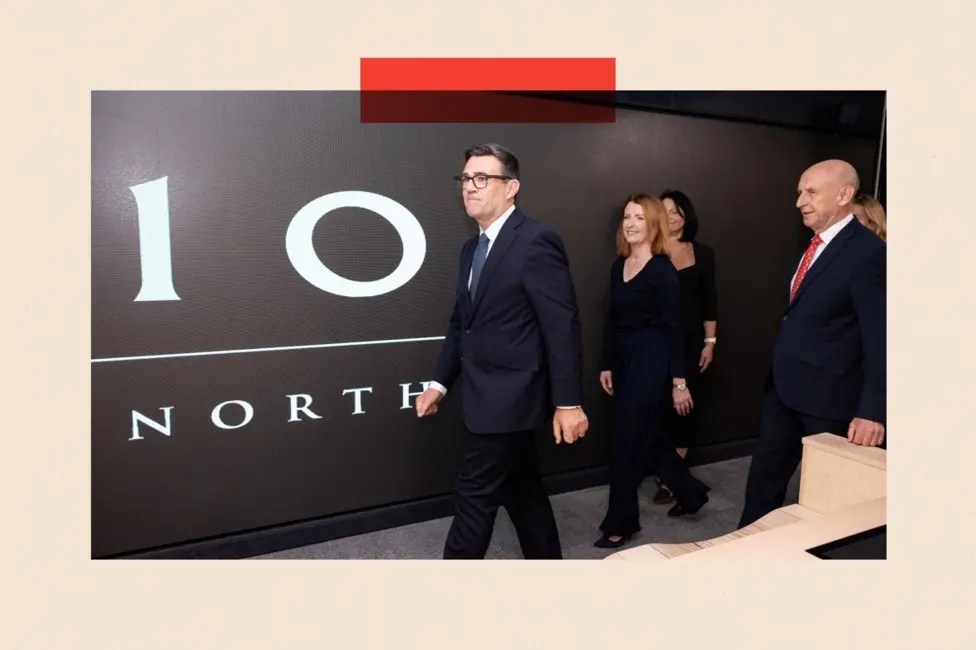
Prime Minister, Andy Burnham, at No10 North
Almost two weeks into his Premiership the key outlines of Andy Burnham’s priorities are taking shape. The hope that Burnham becoming Prime Minister would not be the continuation of Kier Starmer with a Northern accent looked shaky after the initial announcement of Cabinet appointments.
The appointments of John Healey as Chancellor of the Exchequer and Wes Streeting as Defence Secretary set immediate alarm bells ringing. Healey resigned from Kier Starmer’s Cabinet because a £13.5 billion increase in the military budget was deemed to be, in his view, not enough. Healey was after an additional £5 billion on top of that, enthusiastically backed by the military establishment.
Wes Streeting is widely known to have actively supported Labour Friends of Israel throughout his career and has been less than forthcoming on the need to stop the genocide in Gaza. The current commitment to meet the NATO target of 3.5% of GDP spent on the military is not something either Healey or Streeting are likely to challenge.
Burnham has played a positive role in the regeneration of Manchester and provided support for working class families, even though the rough sleeping he has pledged to eradicate nationally still persists in Manchester. However, this pledge, along with commitments to social care reform and the emphasis on training and employment for technical skills, are genuine. The cap on bus fares has been widely welcomed and relocating some government services to No10 North shows some capacity for change.
The problem is that, in spite of Burnham’s commitment to tackling the cost of living issues facing working families and to create greater job opportunities, the anticipated spend on more weapons is likely to do exactly the opposite. The commitment to fiscal rules imposed by former Chancellor Rachel Reeves is a financial straitjacket which will not give Burnham any economic leverage.
While reform of social care is likely to require greater revenue, there is an argument that the billons wasted on a system which is wholly inefficient could be spent more effectively, rather than throwing more good money after bad. The report commissioned from Louise Casey to address systemic health and social care reforms will give more clues when the Casey Commission concludes in July 2027.
On the international front Burnham has already pledged “steadfast and resolute” support for the right wing nationalist government of Ukraine, with Britain having been spent £21.8 billion so far. The commitment to spend £3 billion a year in military aid to Ukraine was reaffirmed after Burnham’s meeting with President Zelensky. The NATO proxy war with Russia, for which Ukraine is a front, will continue to drain the economy and narrow the options Burnham has to spend on socially useful programmes at home.
Also, while Burnham has stated that he will explore further sanctions and trade bans on illegal settlements in relation to Israel’s genocide in Gaza, no firm commitments have been made and British arms sales to Israel look set to continue.
In his first major interview with the BBC last week Burnham would not condemn the US/Israeli axis war against Iran as illegal and British bases are still being used, supposedly in a ‘defensive’ capacity, for US planes to fly missions which are killing thousands of Iranian people.
A government led by Andy Burnham is displaying all of the usual characteristics of Labour in office. A sympathetic ear to social concerns is evident but Burnham presents no challenge to the military industrial complex or the financial establishment in the City of London. That may be too much to expect after two weeks but there is no indication that it will be any different after two months or even two years.
The hope, as ever, is that a Burnham government may be open to more organised working class pressure than one led by Kier Starmer. However, that pressure must be applied from the grass roots up in order to prevent the dead hand of the City and the military industrial complex forcing Burnham down the path of even greater military spend, rather than focussing on the needs of working people for schools, hospitals and decent jobs.
That will require progressive trade union action, the pressure of the peace movement and all of those committed to lasting long term change of the kind that capitalism simply cannot deliver. Andy Burnham is, for now, the more human face of British social democracy but nothing suggests that he will, unless compelled, take any steps towards socialism. A Northern accent is all very well but action to support the working class is the real test.

