Nobel Provocation

11th October 2025

It is hard to think of a worse candidate for the Nobel Peace Prize than US President, Donald Trump.  Not just because of the brazen campaign run by him and his supporters to try and secure the award.  The ongoing role of the US in selling arms and fuelling conflicts around the world is an even more significant factor.

Benjamin Netanyahu, given his role in the genocide perpetrated in Gaza, would be as bad a candidate.  The actual recipient of the Nobel Peace Prize 2025, Maria Corina Machado, was a shock to progressive movements arond the world, as she also has no claim to the award.  The opinion piece below by Michelle Ellner, for Venezuela Analysis, explains why.

Machado certainly wasted no time in trying to take advantage of the profile associated with the award. Her first call was to Donald Trump, to thank him for his support in stationing US warships off the coast of Venezuela. Trump’s pretext for such action has been to allegedly stop drug traffiking but the US has been looking to take advantage of Venezuela’s oil reserves for some time and is clearly stepping up the pressure now that Trump has returned to the Presidency.

Details of the aggressive nature of US actions and the fear for direct military intervention have been raised in Britain by the Venezuela Solidarity Campaign. Find out more here

https://www.venezuelasolidarity.co.uk/2025/10/08/we-will-blow-you-out-of-existence-trumps-caribbean-spectacle/

When Maria Corina Machado Wins the Nobel Peace Prize, ‘Peace’ Has Lost Its Meaning

by Michelle Ellner

Maria Corina Machado is known for her incendiary speeches 

When I saw the headline Maria Corina Machado wins the Peace Prize, I almost laughed at the absurdity. But I didn’t, because there’s nothing funny about rewarding someone whose politics have brought so much suffering. Anyone who knows what she stands for knows there’s nothing remotely peaceful about her politics.

If this is what counts as “peace” in 2025, then the prize itself has lost every ounce of credibility. I’m Venezuelan-American, and I know exactly what Machado represents.

She’s the smiling face of Washington’s regime-change machine, the polished spokesperson for sanctions, privatization, and foreign intervention dressed up as democracy.

Machado’s politics are steeped in violence. She has called for foreign intervention, even appealing directly to Benjamin Netanyahu, the architect of Gaza’s annihilation, to help “liberate” Venezuela with bombs under the banner of “freedom,” She has demanded sanctions, that silent form of warfare whose effects – as studies in The Lancet and other journals have shown – have killed more people than war, cutting off medicine, food, and energy to entire populations.

Machado has spent her entire political life promoting division, eroding Venezuela’s sovereignty and denying its people the right to live with dignity.

This is who Maria Corina Machado really is:

  • She helped lead the 2002 coup that briefly overthrew a democratically elected president, and signed the Carmona Decree that erased the Constitution and dissolved every public institution overnight.
  • She worked hand in hand with Washington to justify regime change, using her platform to demand foreign military intervention to “liberate” Venezuela through force.
  • She cheered on Donald Trump’s threats of invasion and his naval deployments in the Caribbean, a show of force that risks igniting regional war under the pretext of “combating narcotrafficking.” While Trump sent warships and froze assets, Machado stood ready to serve as his local proxy, promising to deliver Venezuela’s sovereignty on a silver platter.
  • She pushed for the U.S. sanctions that strangled the economy, knowing exactly who would pay the price: the poor, the sick, the working class. 
  • She helped construct the so-called “interim government” a Washington backed puppet show run by a self-appointed “president” who looted Venezuela’s resources abroad while children at home went hungry.
  • She vows to reopen Venezuela’s embassy in Jerusalem, aligning herself openly with the same apartheid state that bombs hospitals and calls it self-defense.
  • Now she wants to hand over the country’s oil, water, and infrastructure to private corporations. This is the same recipe that made Latin America the laboratory of neoliberal misery in the 1990s.

Machado was also one of the political architects of La Salida, the 2014 opposition campaign that called for escalated protests, including guarimba tactics. Those weren’t “peaceful protests” as the foreign press claimed; they were organized barricades meant to paralyze the country and force the government’s fall. Streets were blocked with burning trash and barbed wire, buses carrying workers were torched, and people suspected of being Chavista were beaten or killed. Even ambulances and doctors were attacked. Some Cuban medical brigades were nearly burned alive. Public buildings, food trucks, and schools were destroyed. Entire neighborhoods were held hostage by fear while opposition leaders like Machado cheered from the sidelines and called it “resistance.”

She praises Trump’s “decisive action” against what she calls a “criminal enterprise,” aligning herself with the same man who cages migrant children and tears families apart under ICE’s watch, while Venezuelan mothers search for their children disappeared by U.S. migration policies.

Machado isn’t a symbol of peace or progress. She is part of a global alliance between fascism, Zionism, and neoliberalism, an axis that justifies domination in the language of democracy and peace. In Venezuela, that alliance has meant coups, sanctions, and privatization. In Gaza, it means genocide and the erasure of a people. The ideology is the same: a belief that some lives are disposable, that sovereignty is negotiable, and that violence can be sold as order.

If Henry Kissinger could win a Peace Prize, why not María Corina Machado? Maybe next year they’ll give one to the Gaza Humanitarian Foundation for “compassion under occupation.”

Every time this award is handed to an architect of violence disguised as diplomacy, it spits in the face of those who actually fight for peace: the Palestinian medics digging bodies from rubble, the journalists risking their lives in Gaza to document the truth and the humanitarian workers of the Flotilla sailing to break the siege and deliver aid to starving children in Gaza, with nothing but courage and conviction.

But real peace is not negotiated in boardrooms or awarded on stages. Real peace is built by women organizing food networks during blockades, by Indigenous communities defending rivers from extraction, by workers who refuse to be starved into obedience, by Venezuelan mothers mobilizing to demand the return of children seized under U.S. ICE and migration policies and by nations that choose sovereignty over servitude. That’s the peace Venezuela, Cuba, Palestine, and every nation of the Global South deserves.

Tell the Nobel Committee: The Peace Prize belongs to Gaza’s journalists, not María Corina Machado!

The views expressed in this article are the author’s own and do not necessarily reflect those of the Venezuelanalysis editorial staff.

Ten keys to the Constituent Assembly in Venezuela

6th August 2017

While the Western media make great play about recent developments in Venezuela, and the alleged anti-democratic nature of the new Constituent Assembly, an alternative view is offered by Granma the Official Voice of the Communist Party of Cuba Central Committee.

Ten keys to the Constituent Assembly in Venezuela

The massive turnout for the July 30 vote offers several lessons regarding the complex scenario facing the country and the evolution of events

Author: Sergio Alejandro Gómez | informacion@granma.cu

august 4, 2017 14:08:41

Venezuela

Photo: TELESUR

Nicolás Maduro went for broke. “Come rain or shine, there will be a National Constituent Assembly,” the Venezuelan President stated. And so it was.

July 30, 2017, marked a historic date, not only for the Bolivarian Revolution, which came to power less than two decades ago, but for a nation that has been struggling for its independence and self-determination for over 200 years.

The vote that day offered us several lessons to understand the complex scenario facing the country, and the possible evolution of events:

  1. Venezuela has a Constituent Assembly. Despite the boycott declared by the right wing and the international maneuvers against it, the support of more than eight million Venezuelans at the polls endows the constitutional mechanism activated by the Bolivarian government with legitimacy. The opposition’s bid was to prevent the Constituent Assembly by all means and it failed. They now run the risk of being left out of the Assembly that will shape the future of the country, although few doubt that some kind of dialogue is essential to resume the road to peace.
  2. The elections were held amid relative calm. The number of people killed during the day varies according to the source.

Most speak of at least ten dead. However, after more than a hundred victims in the past few months, some of them burned alive by opposition extremists, the election day balance sheet was far from the “bloodbath” predicted by some international analysts.

  1. The Armed Forces are committed to constitutional order. The plan to preserve the integrity of polling stations, for which more than 230,000 troops were deployed, as well as the extraordinary measures taken by authorities, were key to ensuring Venezuelans’ democratic exercise of the right to vote. In addition, this is a further sign that, unlike in the past, the current Bolivarian Armed Forces of Venezuela are committed to constitutional order and are the main guarantors of the country’s stability.
  2. The right has less strength than had appeared. The opposition coalition Democratic Unity Roundtable (MUD), the main instigator of the violence, promised to hold the “mother of all protests” to prevent the Constituent Assembly. Its limited rallying power in the days leading up to the elections, and the impotence of its leaders faced with the popular mobilization to vote, are proof that it overestimated its forces.
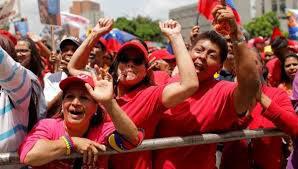
  3. The mass media were left without news. Venezuela was, until the vote, one of the topics receiving most coverage in the international media. Hundreds of journalists from the most important chains are present in the South American country. However, when the reality was different from the coverage they had prepared (a pitched battle and the beginning of civil war), they offered a revealing silence. Instead, they devoted themselves to reporting minor issues and so far practically no outlet has provided coverage of the massive turnout of eight million Venezuelans, who had to cross rivers or stay up through the night, in order to exercise their right at the polls.
  4. The turnout exceeded expectations. Amid the polarization of the country and the instability provoked by the extreme right, the number of Venezuelans who went out to vote was not envisaged by the opposition or their international backers. Even the Bolivarian authorities recognized that the figure was a pleasant surprise. As a means of comparison, the more than eight million votes cast on July 30 exceeded the 7.7 million obtained by the MUD in the legislative elections that gave it control of the National Assembly in 2015.
  5. There is a concerted strategy to disregard the democratic process in Venezuela. The United States, Spain, and several Latin American nations, including Mexico, Colombia, Argentina, Paraguay, Guatemala, and Panama, did not even wait for the results of the elections before refusing to recognize them and the new Constituent Assembly.
  6. The United States is actively working to destabilize Venezuela. Before the elections, Washington sanctioned 13 Bolivarian officials with the aim of intimidating the government in the lead-up to the Constituent Assembly vote. After learning of the results, the U.S. government announced another series of measures including sanctions against President Nicolás Maduro. Some U.S. media have speculated regarding possible sanctions on the Venezuelan oil sector, which has been in the White House’s sights from the start.
  7. A significant number of citizens gave Chavismo another vote of confidence. In the midst of the economic war, the decline in international oil prices, and internal destabilization, the popular support received shows just how much the Venezuelan people appreciate the transformations initiated by Hugo Chávez. It is difficult to think of another government in Venezuelan history that would have resisted a similar onslaught.
  8. The Constituent Assembly alone can not solve underlying problems such as the economic crisis, inflation, shortages, and violence. However, the constitutional powers with which the Assembly is invested constitute a platform to call for dialogue between the different actors in the country’s political and social life, to ensure justice for the victims of the crimes committed by violent sectors, and to once again put the country on the path to progress and peace.