Venezuela: Communist leaders assassinated

4th November 2018

 fajardo

Luis Fajardo (centre) and Javier Aldana – murders condemned

Two campesino leaders and members of the Communist Party of Venezuela (PCV) were assassinated on Wednesday in Nueva Bolivia, Merida State.

A press release from PCV Secretary-General Oscar Figuera revealed that central committee member Luis Fajardo had been assassinated along with his brother-in-law, Javier Aldana. According to reports, the two men were making their way home on a motorbike, when they were killed by a burst of gunfire from a moving car.

Figuera added that the party held landowners, as well as corrupt personnel of the National Guardsmen and politicians, responsible for the crime, while demanding that the state carry out a thorough investigation of the case.

Multiple organizations in Venezuela, including the Tupamaros and elements within the ruling United Socialist Party of Venezuela (PSUV), have condemned the episode and expressed their condolences.

The local branch of the PCV in Merida also put out a press statement on Thursday, recalling that Fajardo and Aldana’s activities in defence of campesino rights had made them a target for landowners and that Fajardo’s numerous public denunciations of the threats made against his life and his family had been ignored by authorities. The PCV called on President Maduro and Attorney General Tarek William Saab to ensure that justice is served in this case.

The incident comes just weeks after a similar assassination attempt targeting Barinas-based PCV campesino leader Robinson Garcia, who came under fire from several motorcyclists on October 9, but managed to escape with his life.

Nueva Bolivia is located in the so-called Sur del Lago region, south of Venezuela’s lake Maracaibo, which extends along the states of Merida and Zulia. Fajardo was spearheading the claims of some 250 campesino families to the Cano Rico ranch, which was being occupied and utilized by the campesinos whilst they awaited legal adjudication of the lands.

The lake region has seen some of the most intense land struggles by small farmers, to which large landholders have responded with deadly force, often taking the form of paramilitary violence. This past July’s Admirable Campesino March, which covered more than 400 km on foot to demand a meeting with President Maduro, presented several grievances from Sur del Lago. In one of the latest examples of violence against campesinos, teenager Kender Garcia was murdered on September 19.

For their part, the Venezuelan communists have also repeatedly drawn attention to the violence taking place in the countryside and what they deem a complicit lack of response from authorities.

Earlier this month, Figuera had called for an urgent meeting with President Maduro in the context of the electoral agreement between the ruling United Socialist Party (PSUV) and the PCV, signed before the May 20 presidential elections.

The communist leader accused the government of not fulfilling any of the agreed-upon points, among them, addressing the campesino demands and putting an end to violent evictions and targeted killings in the Venezuelan countryside.

This article is taken from https://venezuelanalysis.com/news/14128


A “People’s Vote” for the people?

27th October 2018

BREXIT-VOTE-MARCH-29

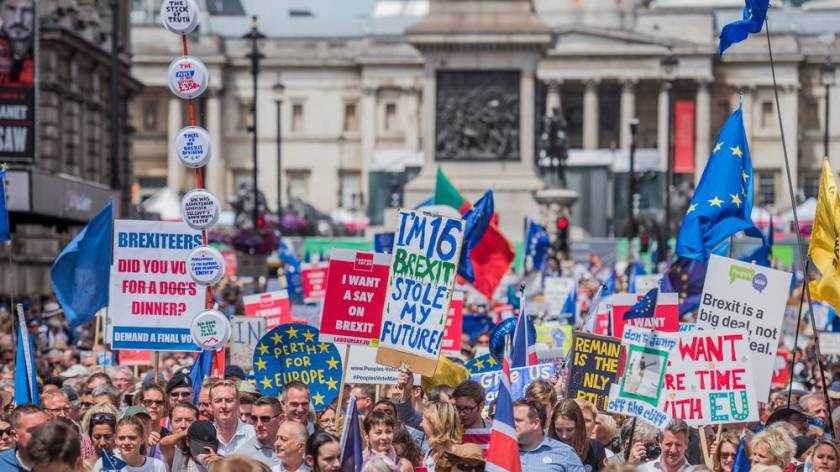
 A people’s vote? Protesters in London march against Brexit

Over half a million people descended upon the streets of London last weekend to demonstrate in favour of a vote on whatever Brexit deal is finally agreed, the hidden agenda clearly being to campaign against any deal and force a rethink on the whole Brexit process.  The People’s Vote campaign brings together Tories, right wing Labour, Greens and Liberal Democrats in a coalition of those disaffected with the outcome of the June 2016 referendum.

The organisers have made much of the lack of media coverage, given the scale of the demonstration and have, justifiably, criticised the BBC for its reporting priorities and adherence to ‘balance’, which saw a minor gathering in Harrogate, featuring Nigel Farage, gain airtime alongside the bigger London protest.

However dubious the BBC’s editorial approach, and they do love any opportunity to give Farage airtime, in this instance two wrongs do not make a right.

The People’s Vote campaign premise is based upon the assumption that the EU is a good thing and the equally questionable presumption that a second referendum would lead to a vote in favour of remaining in the EU.

The June 2016 referendum itself, although close, did result in a vote to leave and there is nothing to suggest that the conditions which led to large parts of the country expressing their disaffection and voting that way has changed significantly.  With millions living below the poverty line, public services crumbling, transport infrastructure in disarray and austerity continuing to bite, whatever Theresa May might say, there is nothing to suggest that turning back the clock to the day before the 2016 referendum would improve life for the majority of people in the UK.

On the contrary, 40 years of EU membership, compounded by the 2008 banking crisis has brought the UK and much of Europe, to the position it is now facing.

The People’s Vote campaign reflects much of the post war social democratic consensus that capitalism can somehow be made to work for all of the people, not just the few at the top and, that by clubbing together in an ever expanding union of European states, this goal will somehow be achieved.  Currently on their third tranche of bail out and having to sack thousands of public sector workers in order to meet payments to the international banks, it is unlikely that the people of Greece would agree.

The 40% of young people under the age of 25 who are unemployed in Spain would probably have a different view.

Having been signed up to a failed consensus it is little wonder that voters across Europe are turning to parties which promise to deliver on their behalf, provide easy ‘answers’ to their problems, such as blaming immigrants for lack of opportunity, and generally take a critical view of the EU hierarchies and bureaucracy.

People know from their own experience that their lives have not improved greatly over the past 40 years.  In the UK alone, we have seen the demise of comprehensive education, underfunding of the NHS, the selling off of council houses, mass unemployment, zero hours contracts, university tuition fees.  The list goes on.  Being in the EU has not stopped any of that. Why should people believe that sticking with the same deal will make it better over the next forty years?

If the demagogues of the so called populist parties, such as the Front National in France, the Five Star Movement in Italy and right wing government in Hungary and Poland, are not to consolidate their positions the Left needs to articulate credible alternatives to their views and those of the EU bureaucracy.

The EU will remain for as long as it suits the interest of the banks and corporations which back it.  As we saw with tragic consequences in the 1930’s they are quick enough to change allegiance if they see a new centre of power emerging.  The only way to stop history repeating is to make that alternative centre of power a true expression of people power.  That will take more than a so-called people’s vote, it will take the people demanding a real people’s socialist alternative to the both the EU and the right wing demagogues.


Brutality of Saudi regime exposed

20th October 2018

bin Salman

Saudi Crown Prince Mohammed bin Salman – the mask slips

The toxic Saudi dictatorship, not content with routinely abusing human rights, suppressing democracy, oppressing women and being responsible for the massacre of innocent civilians in Yemen, now appears to be implicated in the assassination of a journalist.  Crown Prince Mohammed bin Salman, friend of Prince Charles, adored by Donald Trump and recipient of millions of pounds worth of UK weapons, is desperately struggling to cover this one up.

Washington Post journalist and prominent critic of the Saudi dictatorship, Jamal Khashoggi, was last seen alive entering the Saudi consulate in Istanbul, Turkey.  He has not been seen since.  That was two weeks ago.

The Saudi response has metamorphosed over the past fortnight as pressure has grown upon them to reveal the facts.  At first the Saudis claimed that Khashoggi was the victim of an interrogation which had gone wrong.  Presumably, this was not as a result of him being shouted at too loudly, so the Saudis were implicitly admitting to the use of torture.

Next tack was to fall back on the old ‘rogue elements’ routine, suggesting that Khashoggi had fallen prey to a maverick strand in the Saudi security services, not sanctioned by the government, who just happened to silence one of its most vocal critics.

More recently the Saudi authorities are suggesting that Khashoggi was killed in a fight with an interrogator.  These explanations would be implausible under most circumstances but are further undermined by the evidence from Turkish security, that a team of up to 15 Saudi agents were seen to be entering the Saudi consulate not long after Khashoggi.

The whole affair has had US President Donald Trump desperately back peddling.  On the one hand he does not want to offend the Saudis, as key Middle East allies in his warmongering against Iran.  Trump is also conscious of both US economic interests in Saudi Arabia and the fact that he personally has made a fortune from dealings with the dictatorship.  After all, he may not be president forever and why burn such lucrative bridges?

Quite apart from the scale of UK weapons sales to Saudi Arabia, well documented by the Campaign Against the Arms Trade, a wide range of UK companies are implicated in trying to mask the image of the dictatorship, with London being described as “a hub for global Saudi PR and media influence campaigns.” (The Guardian 20/10/18)

The network of companies with their noses in the Saudi trough, either now or in recent years include Freuds, a major PR company and a number of other London based PR firms. The Independent newspaper has recently decided to partner with Saudi publisher, Saudi Research and Marketing Group (SRMG) to produce its Middle East editions.  SRMG, which has close links to the Saudi government, has made significant donations of £7.6m to the Tony Blair Institute for Global Change, in exchange for his advice on the dictatorship’s so called ‘modernisation’ programme.

The furore over the Khashoggi affair is not yet spent but there is no doubt that the Saudis will be doing all in their power to make it yesterday’s news as quickly as possible.  What the Saudis no doubt regard as a blot on their international media campaign is in fact a reflection of the brutality at the heart of the regime.

The Saudi reach into the UK and US state clearly runs deep but the extent of their malign influence needs to be continually exposed.  Immediate support for the Campaign Against the Arms Trade is a start but campaigning for a UK government with a foreign policy not dependent on the sales of weapons of mass destruction would be a massive step forward.

Brazil – Lawfare the new warfare

13th October 2018

Bolsonaro supporters

 Bolsonaro supporters celebrate after the first round in Brazil’s elections

Elections held in Brazil on 7th October have given the candidate of the right wing, the banks and the transnational corporations, Jair Bolsonaro the edge after the first round of voting.  Workers Party candidate, Fernando Haddad, backed by former President Lula de Silva, ousted in a right wing constitutional coup, is still in the race however, giving Brazilians some hope.

Bolsonaro gained 46% of the votes in the first round with Haddad gaining 29% of the share.  As the top two candidates, both will contest a second round run off on 28th October.

On the basis of first round evidence the odds are stacked against Haddad.  Workers Party leader and former President, Lula de Silva, is serving a prison sentence for trumped up corruption charges.  Dilma Rouseff, who succeeded Lula, was impeached in 2016 under equally questionable circumstances.

The Workers Party and Bolsonaro’s Social Liberal Party (PSL), a misleading name given its policies, are almost neck and neck with 56 and 52 seats respectively in elections to the Chamber of Deputies.  However, this slight edge may not benefit the Workers Party greatly, as many of the other deputies to the 119 member Chamber are from an assortment of right wing parties, likely to provide backing for Bolsonaro’s anti-people agenda should he win the second round.

The incoming congress is widely regarded as the most conservative since the end of dictatorship in 1985.

While the tenure of the Workers Party under both Lula and Rouseff did much to shift power away from the corporations and provide opportunities for Brazil’s poor, an incoming Bolsonaro administration would be avowedly free market.  Chief economic adviser to Bolsonaro, Paulo Guedes, is already limbering up to reduce state pension contributions, privatise state owned companies and give greater freedom for the Central Bank to interfere in the economy.

On the plus side Guedes is being investigated for fraud and the many military and police officers in the PSL ranks will not want their pensions affected adversely.  However, this will be scant compensation for the opening up of South America’s largest economy to the many US corporations who will no doubt be desperate to take advantage of a Bolsonaro victory.

The social agenda espoused by Bolsonaro is, unsurprisingly, equally reactionary promising a crackdown on crime, usually a euphemism for more authoritarian measures, and a return to “traditional family values.” He enjoys support from Edir Macedo, the owner of television station Record and head of the Universal Church of the Kingdom of God, one of Brazil’s biggest evangelical churches.

Haddad who does not enjoy such corporate or institutional backing has been clear that,

“We go to the democratic field with just one weapon — with argument.  We will not carry arms, us no . . . we will go with the force of argument to defend Brazil and its people.”

The campaign against the Workers Party is part of a trend which has been happening across progressive Latin America, dubbed “lawfare.” The political subjection of the judiciary to the right wing has resulted in legal proceedings against a number of progressive leaders of the region, which are rigged beforehand.  The objective is to discredit these figures and the political forces they represent, equating them with common criminals and disqualifying them electorally.

Lawfare is being waged with increasing intensity in the region, accompanied by neoliberal forces that define the new strategy against leftist political movements.  This judicial war represents a serious setback in the pursuit of progressive policies in the countries of the region.

As former Ecuadorian President Rafael Correa has stated,

“In Latin America, there are no longer solely military uprisings to replace governments, as happened in the past, but now there are coups in court that seek to undermine the progressive groups that have legitimately gained power.”

The chance to halt the tide of lawfare is still in the hands of the Brazilian people.  In two weeks’ time they could cast their vote for Fernando Haddad.  A Bolsonaro government would certainly be a disaster for both the people of Brazil and Latin America.  The odds against Haddad are high, given the current balance of forces, but the struggle is by no means over.


Sending Out an SOS

7th October 2018

MayQueen

Sending out an SOS – Theresa May dances to the wrong tune

The embarrassing spectacle of UK Prime Minister, Theresa May, sashaying onto the platform for her closing speech to Tory conference last week, to the strains of the Abba hit Dancing Queen, has induced laughter in living rooms cross the country.  As embarrassing images for the Tories go, in a disastrous conference week, it is rivalled only by the sight of great leadership pretender, Boris Johnson, running through a field of wheat, an apparent homage to the only naughty thing his leader can remember doing as a schoolgirl.

That Johnson is a buffoon is well established but, in a party composed largely of buffoons, it is not impossible for the biggest amongst them to rise to the top.  Having said that, Johnson’s fringe speech, albeit to a packed house, was characteristically high on bombast and low on practical actions.

More telling still is the lack of any actual challenge for the leadership of the Tories, either from Johnson or the eighteenth century tendency led by Jacob Rees Mogg.  All of which suggests that the hardline Brexit faction in the Tory party continue to be happy to let May get on with the dirty work of negotiation with the EU while they snipe from the sidelines.

May’s response to her internal detractors this weekend is to pay an homage of her own, to the success and the policies of Labour under Jeremy Corbyn.  May is careful to be clear that she does not agree with a word Corbyn says stating,

“Millions of people who have supported Labour all their lives are appalled by what has happened to a once great party under the leadership of Jeremy Corbyn.”

It would be interesting to know in which period of its history May acknowledges that Labour was, in her opinion, ‘great’ however….

The Comment & Analysis piece by May appears in The Observer (7/10/18) under the title Labour voters should look again at my Tory Party, here for the many and purports to be a pitch for the so called centre ground in order to tempt voters away from Labour.

May resorts to the time honoured tactic of raising spurious fears in order to knock them down and set up her own alternatives.  She is forced to acknowledge that “…some markets are still not working in the interests of ordinary people”, an understatement if ever there was one, given the ten years of austerity which have followed the banking collapse and the bailing out of the banks by “ordinary people.”

May claims to want “…to help people with the cost of living” adding disingenuously that “too many people have not had a decent pay rise.”  Perhaps her own party’s desire to drive down wages, reduce trade union influence and encourage a low pay zero hour contract economy might be a factor in this respect?  May seems to be oblivious to the irony.

May does concede that the past ten years have “meant sacrifices for the British people”, although she fails to point out that the sacrifices have not affected those with tax dodge arrangements and offshore accounts.

However, without defining quite where we are going or how we may get there, other than “when we have secured a good Brexit deal for Britain”, the Prime Minister is insistent that “…the British people need to know that the end is in sight.”   If only she were referring to the timescale left for her own government but May has never been blessed with self awareness, otherwise choosing SOS rather than Dancing Queen from the Abba back catalogue would have been more a more apt conference opener.

May further promises to “…build an economy that works for every community”, presumably as an apology for the destruction wrought upon communities across the country, by the devastation of public services to pay off the bankers’ gambling debts. She does not say that of course, she says,

“In the past economic change has left some communities behind.  This time it will be different.”

That May believes that anyone can truly be convinced by this, given the record of her party and government, is remarkable.  She does however conclude with a recognition that unless she attempts to tackle the toxic image of the Tories her fate at the next general election with be sealed.  In a direct reference to the Labour promise to be the party of the many, not the few, May concludes,

“The British people are not bound by ideology and there has never been a time when party labels have counted for less.  This presents an opportunity Conservatives must seize – to be the party not for the few, not even for the many, but for everyone in our country who works hard and plays by the rules.”

That should have tax dodgers quaking in their boots but they will be doing no such thing.  They know that their offshore accounts are safe under the Tories, that corporation tax will stay at tax haven levels and that with enough cash in Tory Party coffers a knighthood or lordship could be a possibility.

May’s article follows revelations earlier in the week that the Tories have been in secret talks with some Labour MPs over voting for a Brexit deal, under certain conditions, rather than risk a government defeat, which could lead to a General Election and a Labour government led by Jeremy Corbyn.  That Labour has such a fifth column should come as no surprise but those who choose to sleep with the enemy should be prepared for the consequences.

Labour, under Jeremy Corbyn for the past three years, have been quite clear that their appeal is to the people, that they will govern for the many, not the few.  May’s advisers have clearly recognised that, in spite of the establishment and media campaign against Corbyn, his approach and polices remain popular.  They are trying you steal enough of the rhetoric to encroach on this territory.  As ever with the Tories, it is nothing but a confidence trick.  They must not be allowed to succeed.

Trust

30th September 2018

jeremy-corbyn-labour-conference

 Jeremy Corbyn – a triumphant speech to Labour conference

Trust is a most sought after commodity in politics.  Trust between candidates and voters.  Trust between colleagues within political parties, particularly if they are in government.  Trust in the system to deliver opportunity and reward for those prepared to work hard.  Peace, health, homes, and jobs continue to be the things that people need now and have needed since time immemorial.  People need to be able to trust in a system that will make these things attainable.

There is a growing narrative on the Left that trust has been eroded over the past decade.  The banking crisis of a decade ago not only exposed the precarious nature of the casino economy of the banks but rubbed salt into the wound, when taxpayers had to pay the gambling debts for bets that did not pay off.

The past decade has also seen the series of scandals associated with TV personalities, their ability to get away with sexual abuse, and the complicity of the authorities in covering up such abuse.  The LIBOR rate fixing scandal, another banking scam, was exposed in the past decade.  Broken promises to address tuition fees for students and a decade of politically driven austerity, punishing the poor while the rich continue to thrive, are part of the legacy of the 2010 – 15 Tory led coalition government.

Sexual revelations have generated the #MeToo movement, seen US entertainer Bill Cosby imprisoned and Donald Trump’s candidate for the Supreme Court, Judge Brett Kavanaugh, on the ropes over his sexual activities. Trump will no doubt find an equally right wing candidate, should Kavanaugh’s nomination be rejected.  However, as well as the issues raised about how victims of sexual assault are treated publicly, the power of the Supreme Court and its role in shaping life in the US have been questioned.

Who can we trust?

The answer to this question is too often framed narrowly by both academics and pundits.  They will implicitly accept that capitalism, as a system, is worthy of trust and with a few modifications is capable of delivering on the needs of the people.  What is required, such commentators argue, is a rebuilding of trust.  We need to reshape and rebuild trust in the banks, trust in the government, trust in the systems and institutions to provide for the many.

A variant of this debate is articulated by Will Hutton in The Observer (30th September 2018) in setting out the case for “stakeholder capitalism”, described by Hutton as,

“…a self-standing, distinct set of interlinked propositions about how capitalism can be made to work for all, requiring a radical change of mindset from the traditional left and libertarian right alike.”

Hutton welcomes the commitment by Shadow Chancellor, John McDonnell, at Labour Party conference last week to demand that every company with more than 250 employees allocate 10% of shares to employees, up to an individual benefit of £500 per person.  Hutton however suggest that MacDonnell should go further and,

“…declare that his aim is to create a new generation of British companies whose strength will be built on the new communities of interest between repurposed trade unions, customers and long term shareholders.”

Hutton is arguing for belief and trust in corporations to act in the public good in order to benefit us all.  He wants us to accept that trust in corporate magnanimity, with some modifications to control their excesses, will reshape capitalism for the benefit of all.  The ‘repurposed’ trade union will presumably be one designed to put the company interest before that of employees and avoid confrontation at all costs.

This is the usual sophistry of the soft Left, faced with the prospect of a Labour government which might actually take some radical steps. MacDonnell’s plan is about sending out a message to companies that they will not have everything their own way under a Labour government. They will have to consider their employees, their rights and to a certain extent give them some stake in the company.  However, a few company shares is not the point.  The main beneficiary of the MacDonnell plan will be the Treasury, which will raise an estimated £1.2bn from the private sector to invest in roads, schools and hospitals rather than going into the pockets of shareholders.

Capitalists are not co-operators.  They are connivers and dodgers.  They will pay employees as little as they can get away with, they will pay as little tax as they can get away with, they will play the system for as much advantage as they can extract from it.  It is naïve to think otherwise.  A programme for a radical Labour government has to be about outsmarting the corporations and, in the first instance, harnessing the resources of the state to support people’s basic needs.

That will involve public investment in roads, transport and housing.  It will require the rebuilding of the devasated public sector infrastructure, modernising the communications infrastructure and diverting funding for weapons of mass destruction into socially useful production.

Ironically, for Will Hutton and commentators of his ilk, the real upsurge in trust in recent years has been the growth of Labour as a mass party and the widespread belief in the trustworthiness and integrity of its leader, Jeremy Corbyn.

Some of those who should be Labour’s allies fail to see this but for the enemies of Labour it is clear.  The orchestrated smear campaigns against Corbyn, from press, media, government and the weak kneed within his own party, are all designed to present an image of Corbyn as incompetent and his ideas as unacceptable.

The real lives of people however cannot be manipulated by social media and press commentary.  The reality of austerity, zero hours jobs, spiralling housing costs and dwindling life chances may not be obvious to the friends of Theresa May, or even Will Hutton, but for many in the so called United Kingdom it is the stuff of their daily lives.

Corbyn, in his speech at Labour conference last week, laid out a vision that can begin to shift that balance.  We all need to get behind it.   We need to trust that with the collective will of the people we can make change happen.


Actually existing and imaginary anti semitism

22nd September 2018

CorbynSept

Jeremy Corbyn

✔@jeremycorbyn

Ten years ago today the financial crash began.

The people who caused it now call me a threat. They’re right.

Labour is a threat to a damaging and failed system rigged for the few.


Actually existing and imaginary anti semitism

by Nick Wright

It was with a sense of relief that I caught Jeremy Corbyn’s tweet marking the tenth anniversary of the financial crash and setting out Labour’s plans to deal with irresponsible speculative banking practices. This is real substantial politics that goes to the core of the choices facing people in Britain and provides a welcome respite from the highly concocted ‘debate’ around alleged antisemitism in the Labour Party.

Such naivety!

But Stephen Pollard, editor of the Jewish Chronicle misses no opportunity. In response to the video he tweeted the following: “Been hesitating to tweet this bevause (sic) I keep thinking it can’t be, surely it can’t be.

But the more I think about it, the more it seems it really is. This is ‘nudge, nudge, you know who I am talking about don’t you?’

And yes I do. It’s appalling.”

As Pollard undoubtedly anticipated this set off a twitter storm in which the more rabid critics of Corbyn made explicit what he implied. Nudge, nudge, know what I mean.

Equally predictable was the response of many people who allowed themselves to be tangled up in his twitter train. Comments ranged from sheer misbelief that even a notably partisan Tory like Pollard could concoct such a thing to a world-weary recognition that nothing less can be expected from the man.

For readers whose mind does not run on the twisted tracks that Pollard lays let me explain. Pollard is saying that in criticising bankers and the banking system Corbyn is giving voice to an age-old antisemitic trope.

There is, of course, no basis for Pollard’s slur. But let us deconstruct this narrative a little.

Bankers are rarely popular and in times of capitalist crisis less so especially among petty-bourgeois commercial interests and small business people whose dependence on credit is nowadays increasingly shared by all working people enmeshed in a tangle of mortgages, credit card debt and borrowing.

Of course, there does exist a subterranean antisemitic trope that conflates bankers with Jewish people. In the inflationary panics of the Weimar Republic, the Nazis played it to the deluded whose votes they sought. But far from challenging the power of finance, Hitler sought its support, and when the foundations of capitalist rule were in danger he found both German and (to the extent they could be separated) international finance willing partners.

Banker Kurt Baron von Schröder’s account of how he hosted the critical meeting between Hitler and Reich Chancellor von Papen is revealing.

“…This meeting between Hitler and Papen on 4 January 1933 in my house in Cologne was arranged by me after Papen had asked me for it on about 10 December 1932. Before I took this step I talked to a number of businessmen and informed myself generally on how the business world viewed a collaboration between the two men. The general desire of businessmen was to see a strong man come to power in Germany who would form a government that would stay in power for a long time. [ . . . ]

And it was international bankers and Montague Slater, governor of the Bank of England, who facilitated the transfer of Czechoslovakia’s gold reserves to Hitler the better to aid his war plans. (The Independent 30 March 1997: The Nazis’ British bankers, Secret war documents may reveal that Germany had staunch allies at the Bank of England).

If some Jewish banking dynasties exist today it is precisely because institutional antisemitism by medieval state and church confined Jews to certain trades including money lending, and these traditions were maintained through the development of mercantile capitalism and are now embedded in the present system of state monopoly capitalism. But in today’s politics, no great explanatory power is mobilised by a futile attempt to separate out “Jewish” capital from capital as a whole or find class interests that distinguish Jewish bankers from others.

For those early socialists who failed to break free from the then prevalent forms of antisemitism the German social democrat, August Bebel defined such beliefs as ‘The socialism of fools.”

It has always been necessary for socialists to make explicit the ways in which occupation and social positioning reveal how successive social systems organise classes. At the beginning of the twentieth century, the vast bulk of Jewish people in Britain were super-exploited workers, in the main garment workers, furniture workers and craftsmen. And if the vast majority of Jewish people in Britain have improved their conditions of life they are as far from the centres of wealth and power occupied by the financial elite as any other British person.

So who is propagating this equation – Jews as bankers. Bankers as Jews.

It is Stephen Pollard who is playing with this antisemitic trope. He does it knowingly precisely in order to mobilise the discourses that present-day social media make possible conscious that this profoundly dishonest tweet will provoke.

But he miscalculated and instead drew criticism down on his own head. His tweet answering the overwhelmingly negative response he provoked is revealing in its faux self-criticism

“I accept all the criticism of this tweet, and that I may be way off beam. But this is what happens when antisemitism is allowed to flourish — and when an antisemite leads a party. You start to read his every word through that prism. Even if the words aren’t about Jews.”

So there you have it. Jeremy Corbyn is responsible for Stephen Pollard’s capitulation to an antisemitic trope.

The public service union leader Mark Serwotka, this year’s president of the Trade Union Congress, made an entirely reasonable point when he suggested that the Israeli State might be interfering in British politics.

A leader in the online newspaper The Independent described this as “the stuff of historical antisemitic tropes” and suggested that now  “If Mr Serwotka is a dedicated anti-racist, he should at least ask himself why he has fallen into this manner of thinking.”

One might ask Stephen Pollard the same question.

Of course, unlike Jeremy Corbyn’s alleged antisemitism Israeli State interference in British public life is not imaginary but rather established fact. It was only a short while back that the Israeli State was compelled to recall a member of its embassy staff here after he was caught on camera discussing — with allies in British political life — how to take down a politician. (In this case, a Conservative deemed to be too much an Arabist.)

In conflating Mark Serwotka’s well-founded comments — which amount to nothing more than straight forward criticism of actions by the Israeli State – with hostility to Jews as such the Independent has given some credence to the narrative upon which reactionary Zionist opinion trades.

Not all bankers are Jewish, not all Jews are bankers. Not all Jews are Zionists, not all Zionists are Jewish. Stephen Pollard might have capitulated to an anti-semitic trope, Mark Serwotka hasn’t.

This original article is from the following site

https://21centurymanifesto.wordpress.com/2018/09/19/actually-existing-and-imaginary-anti-semitism/


Anti-Semitism row reflects media bias

7th September 2018

jeremy-corbyn-press

Jeremy Corbyn – under siege by a biased media

The demonisation of Labour Party leader, Jeremy Corbyn, by the British government, media and factions within his own party, continues apace as the return to Westminster after the summer recess precedes the party conference season.

The damage inflicted upon Labour by the almost certainly Mossad inspired debate over anti Semitism is hard to calculate.  It has undoubtedly muddied the waters in the fight against racism in the UK.  It has given succour to those who believe that any criticism of the Israeli government and its policies is anti Semitic.  It has proven to be a rallying point for those opposed to a Corbyn government at all costs.

In spite of the fact that Corbyn has overseen the development of the largest mass based social democratic party in Western Europe, boasting more members than the Conservatives, Liberal Democrats and Scottish Nationalists combined, the UK media continue to characterise the policies of the Labour opposition and the leadership of Corbyn in particular as unpopular.

A report published in The Independent (19th July 2016) indicated that in the first two months of Corbyn becoming Labour leader,

“Over half of the news articles were critical or antagonistic in tone, compared to two thirds of all editorials and opinion pieces. Besides the almost total lack of support in the latter, especially in the rightwing media, the high level of negativity in the news reporting struck us as noteworthy here….Corbyn’s voice is often absent in the reporting on him, and when it is present it is often presented in a highly distorted way. In terms of the news sources used in the articles, the civil war within Labour is very enthusiastically amplified.”

Ongoing monitoring of the UK media suggests that this has not changed in the two years.  Media coverage of Labour in general and Corbyn in particular remains overwhelmingly negative.  The showing made by Labour in the June 2017 General Election has, if anything, exacerbated this trend as right wing fury at Corbyn’s increased popularity, and the failure of the Theresa May government to rise above the level of debacle, is reflected in the BBC and popular press.

Corbyn is not corrupt, racist or prone to publicly bad mouthing those who oppose him.  He has a long and distinguished history of standing up for the rights of oppressed minorities.  Prominent Middle East author and journalist, Jonathan Cook, has recently commented that in relation to Corbyn,

“It is a sign both of their desperation and their weakness that they have had to resort to the nuclear option, smearing him as an anti-semite.  Other, lesser smears were tried first: that he was not presidential enough to lead Britain; that he was anti-establishment; that he was unpatriotic; that he might be a traitor.  None worked.  If anything, they made him more popular.”

Cook has also highlighted documentary work undertaken by TV channel Al-Jazeera, looking at the work of Israeli lobbyists in the UK and US to interfere in the politics of each country.  The US series has not been aired.  The UK version shows Israeli embassy official, Shai Masot, helping to create an anti-Corbyn front organisation in the Labour Party and working closely with the pro-Israeli Jewish Labour Movement and Labour Friends of Israel.

Labour Friends of Israel (LFI) boasts a membership of some 80 Labour MPs, many of whom have been wined and dined on all expenses paid trips.  As a result, the widespread international condemnation of the Israeli killings of unarmed demonstrators in Gaza in May, led LFI to take to Twitter to condemn Hamas, not Israel, for the killings.

Former Chief Rabbi, Jonathan Sacks, disgraced himself recently by comparing a passage in a speech by Corbyn to that of Tory racist Enoch Powell in 1968, telling the New Statesman that it was,

“the most offensive statement made by a senior British politician since Enoch Powell’s 1968 ‘Rivers of Blood’ speech”

If Sacks really believes this then he is living in a world far removed from the realities faced by most of the UK’s black and ethnic minority population and has a poor grasp of the depth of the endemic institutionalised racism of the British state.

Corbyn’s offence was to be critical of a group of hardline pro-Israel partisans who had disrupted a Palestinian solidarity meeting, referring to them, in accurate political terms, as Zionists.  The rightwing media have pounced upon this to suggest that Zionist is simply a code word for all Jews and therefore use of the term is anti-Semitic.  This is nonsense of the highest order, not least because not all Zionists are Jews and by no means are all Jews Zionists.  As Corbyn stated in his defence he was using the term “in the accurate political sense and not as a euphemism for Jewish people”.

Political journalists of any nous will of course understand this.  However, they appear to be either incapable of articulating it, or are unwilling to let the truth get in the way of a good story.

With the conference season up and coming leadership issues, analysis and challenges are always a great media talking point.  Boris Johnson appears to be lining up a tilt at Theresa May’s job and Vince Cable has announced he will, gradually, stand down as Liberal Democrat leader.  Is there an obvious challenger to Corbyn? Not yet but with the British media and establishment firmly in the “anyone but Corbyn” camp, and a chunk of the Parliamentary Labour Party leaning the same way, anything is possible.

Whoever emerges and wherever they emerge from, you can bet there is a good chance they will be a Labour Friend of Israel.


Sanctions step up threat of war

26th August 2018

Donald-Trump-Iran-1000286

 Donald Trump continues to ramp up tensions with Iran

The next step in the undeclared war on Iran has been taken by the United States, with the first wave of sanctions in place, following the unilateral withdrawal of the US from the Joint Comprehensive Plan of Action (JCPOA).  Jane Green reports on the short term impact and possible long term consequences.

The JCPOA, widely known as the Iran nuclear deal, was agreed in 2015 by the United States, Russia and the European Union to halt the domestic uranium enrichment programme in Iran, in exchange for the relaxation of previously imposed sanctions.  The deal was being monitored by the International Atomic Energy Agency (IAEA) and, up until the most recent inspection earlier in 2018, Iran was deemed to be following the terms of the agreement.

US President Donald Trump has never been a fan of the deal and promised to withdraw as part of his election campaign rhetoric.  For Trump, relaxing sanctions on Iran simply allows the regime in Tehran to draw down international resources which it can then use to support its adventurous foreign policy, through what the US deems to be its proxies in the Middle East.

There can be no doubt about the anti-people credentials of the Iranian regime.  For over 40 years the Islamic Republic has been to the forefront in its abuse, arrest and torture of the political opposition, trade unionists, women’s organisations and in suppressing student protests.  The regime in Iran is only matched in its vicious response to internal criticism by the United States’ key allies in the region, Israel and Saudi Arabia.

However, the sanctions imposed last week by the United States, which will be further intensified on 4th November, are not about acting in the interests of the Iranian people and freeing them from an oppressive regime.  The US sanctions are entirely about the power balance in the Middle East, with the US seeking to impose its will and maximise control of the region’s resources.

Ironically, the path being pursued by Trump was initiated under President Obama, as part of the United States’ New Middle East Plan, to reassert influence and bolster resource control in the region.  Obama’s version of the Plan resulted in the JCPOA, a more nuanced approach to containing the perceived threat of Iran to the regional power balance.

For Trump there are no such niceties.  To all intents and purposes, the gloves are off and the New Middle East Plan mark 2 is simply to bring Iran to its knees, whatever the cost to the prospects for peace in the region or to the plight of the people of Iran.

The latest round of US sanctions has resulted in those European companies which had begun to re-engage with Iran, in putting plans on hold.  German car and truck manufacturer, Daimler, has dropped plans to expand its business in Iran.  French companies, Peugeot and Renault, have suspended operations in Iran and have said they will comply with the US sanctions.

French energy giant, Total, has said it will quit the multibillion-dollar South Pars gas project if it cannot secure a waiver from the U.S. sanctions.

Total signed a contract in 2017 to develop Phase II of the South Pars field with an initial investment of $1 billion and has not yet said what it will do with its 30 percent stake should it pull out. It has until 4th November to wind down its Iran operations, barring any surprise exemption.

The widespread withdrawal and suspension of economic activity by European companies is remarkable because the US sanctions have no international force and no United Nations backing.  The US strategy is essentially that of the playground bully.  Companies are free to deal with Iran if they choose but they may find it difficult to do business in markets with the US.  For most companies the choice between sticking with Iranian business or losing access to the US market is no choice at all.  The United States knows this and the international community appears powerless to prevent it.

The latest round of sanctions will cripple even further an already crumbling Iranian economy.  The confrontational position taken by the US is encouraging the hardliners in Iran to feel emboldened.  Former president Ahmadinejad has recently called upon current President Rouhani to resign.  Those who have always opposed the JCPOA are now regarding the word of the US as valueless and are seeking to turn the current turmoil to their advantage.

Further information at www.codir.net


Antisemitism smokescreen for the right wing

12th August 2018

israel_soldiers_gaza.png_1718483346

Israeli Defence Force tackle Palestinian militancy in Gaza

If the Israeli secret service, Mossad, are not behind the current antisemitism smear campaign against Jeremy Corbyn and the Labour Party, they ought to be ashamed of themselves.  More than that, they ought to be paying whoever is behind it for doing their job for them, as the ongoing slurs against Corbyn and his allies continue to give the UK media an excuse not to report on the real chaos in the country and the economy.

If Mossad wanted to take attention away from the atrocities committed by the Israeli Defence Force for decades in the West Bank and Gaza Strip, they could not be doing a better job.  If they wanted to cover up the ongoing illegal land grab by Israeli occupiers, euphemistically referred to as settlers, who steal land from the Palestinian people, they could not wish for more.  If Mossad wanted to bury the fact that the actions of Israel in the occupied territories are illegal, and in contravention of international law and countless United Nations resolutions for over fifty years, they could not hope for a better smokescreen.

Racist action against Palestinians, it would appear, is not racism at all.  It would appear that it is especially not racism if perpetrated by those whose parents and grandparents have been victims of the racist atrocity of the Holocaust, carried out by the Nazis in Europe in the 1930s and 40s.

Inside the Labour Party it would appear that any family tie with victims of Nazism is enough to give your words a vicarious authenticity in the eyes of the UK media.  Dame Margaret Hodge is a case in point.  Her Jewish roots, in spite of a limited record in fighting racism at home, appear to give her more credibility than lifelong anti-racist campaigner Jeremy Corbyn, to the extent that Hodge gets away with calling Corbyn an antisemite and racist.

Deputy Labour Leader, Tom Watson, added fuel to the fire this week by suggesting that without tacking the issues of antisemitism Labour would be facing ‘eternal shame’ over the issue.  Watson had clearly failed to read the articles published by Jeremy Corbyn or the video he released last weekend, which were absolutely categorical in their opposition to antisemitism and all forms of racism, in the Labour Party and in society in general.

No such statement in defence of Palestinian rights, as endorsed by almost the entire international community in accordance with international law, has been forthcoming from any of those critical of Corbyn in recent weeks.

Instead the focus has been upon the Labour National Executive Committee not adopting the exact wording of the International Holocaust Remembrance Alliance (IHRA) definition of antisemitism when debating the issue and how to address it recently.  Unlike the Israeli government’s ignoring of the resolution of the United Nations regarding its occupation of Palestine, the IHRA definition has no legal standing.

In fact the author of the definition, Kenneth Stern, regards it as a working proposal, not a legal or disciplinary definition.

This weekend twenty four Constituency Labour Party activists have put their names to a letter to The Observer (12/08/18) in an attempt to redress the balance of debate within the Labour Party.  They focus fire upon Watson in particular for laying the grounds for a further leadership coup against Corbyn stating,

“Is this another attempted coup against the leadership of Jeremy Corbyn gathering force and is the issue of antisemitism being weaponised to that end?  Watson seems oblivious to the many organisations such as Jews for Justice for Palestinians and Jewish Voice for Labour, which believe that the IHRA definition needs further work to ensure defence of free speech.”

The signatories go on to point out that there is a “wider and worrying under reporting of the growing threat from the racist far right”, while the media choose to focus upon manufactured divisions within the Labour Party.

With the Tories in disarray over Brexit, facing the possibility of a leadership challenge and the possibility of being forced into a General Election, there is the distinct prospect of a UK government led by Jeremy Corbyn.   The anti-Corbyn right wing in the Labour Party would not like that, the ruling class in the UK would be unnerved by an actual socialist, who may event try to translate policies into action, with the keys to 10, Downing Street.

You can be sure that the conservative Israeli lobby and Mossad would not like it either.