Strategic Defence or weapons wish list?

2nd June 2025

British troops – in even greater danger following defence review

Within days of taking office last July one of the first acts of Keir Starmer’s government was to commission a Strategic Defence Review (SDR).  Today that review, headed up by former NATO General Secretary, Lord Robertson, has been published.  On one level it holds no surprises, though the suggestion that Britain needs to move to “war fighting readiness” may come as a shock to many.  The review is predicated on the assumption that Britain faces “a new era of threat” as justification for its belligerent tone.

As a nuclear power, a big spender on the military, a permanent member of the UN Security Council and with pretentions of still playing an imperial role in the world, the British ruling class has for decades been eager to bolster its ailing power and influence over global affairs.

The Empire upon which the sun never set, and the blood never dried, may be no more but Britain still exercises a powerful neo-colonial reach through the Commonwealth, as well as being one of NATO’s  two European nuclear powers, alongside France.

No Labour government has ever challenged this so called defence framework, designed by the ruling class, for the ruling class and benefiting the ruling class and their cronies in the military industrial complex.  There has broadly been bi-partisan agreement between the leadership of Labour and the Tories that the military is untouchable and, however inefficient its use of resources, its budget is maintained.

With Labour elected on a commitment to increase the military budget to 2.5% of GDP, increasing to 3% it is no surprise that likely spend by 2034 is predicted to be 3.5% of GDP.  Six new munitions factories are proposed to facilitate making weapons to meet this upsurge in spend, billions will be wasted on renewing the pointless and US controlled Trident nuclear submarine fleet and, as part of the AUKUS agreement with the US and Australia, Britain will maintain an aircraft carrier presence in the South China Sea, to help defend against the ‘threat’ posed by China.   

The SDR also commits Britain to building 12 nuclear-powered attack submarines as part of the AUKUS alliance, the first of which will launch in the late 2030s, replacing seven Astute-class submarines, tasked to operate around the world.

According to a report in The Guardian (2/6/25),

“Ministers are also considering whether to restore an air-launched nuclear deterrent by buying F-35A aircraft which have been certified to carry the US B61-12 gravity bomb, which has a maximum explosive yield of 50 kilotons, more than three times the size of the 15kT bomb that was dropped on Hiroshima in 1945.”

China, along with Russia, Iran and North Korea are cited as the main reason behind this arms spending spree, with China deemed to be a “sophisticated and persistent challenge” to Western ‘interests’. 

As ever, a bogie is needed to justify spending more on weapons rather than schools, hospitals, housing, roads and green infrastructure, all of which would be of direct benefit to working class families.  The Cold War template of accelerating arms spending to counter the mythical Soviet threat is tried and tested, so is being dusted down once again and given a further airing with the assistance of a supine press and BBC.   

One sided and clearly partisan reporting of the Russian intervention in Ukraine has heightened public alarm, while the Chinese ‘threat’ to Taiwan, internationally recognised as part of China, is being prepared as justification for intervention in South East Asia.

At a recent summit in Singapore US Defence Secretary, Pete Hegseth, stated that “any attempt by Communist China to conquer Taiwan by force would result in devastating consequences for the Indo-Pacific and the world.”  Hegseth further called for other countries in the region to boost their military spending, though this has met with a mixed response, given widespread scepticism in the region regarding the Trump administration’s assessment of the degree of threat China poses.

Only fourteen nations internationally recognise Taiwan and the US is not one of them, so the interest which the US has in Taiwan is merely as a possible stick with which to beat China and to ramp up tensions in the region.

That the British government should be complicit in the misinformation drive to demonise China, Russia and others is ultimately a betrayal of Labour’s working class roots and a drain on even the remote possibility that a capitalist economy could continue to provide anything of significance for the working class.

Warmongering while wrapped in the Union Jack may have a patriotic ring but it will sound increasingly hollow when the consequence of more weapons is the shrinking of the health, education and housing infrastructure even further than they have been reduced over the past 30 years.

Labour’s so called Strategic Defence Review is little more than a wish list for weapons, none of which will defend working class communities but, deployed in other parts of the world, will make working class men and women targets. Continued support for movements such as CND and Stop the War will be essential to try and stem the tide of Labour’s warmongering stance.

The case for a non-nuclear, non-NATO, non-aligned foreign policy could not be clearer.  Increasing the stockpiles of weapons of mass destruction will only benefit the arms manufacturers and do nothing but make working class communities potential targets.

Coalition of the Wilting

20th March 2025

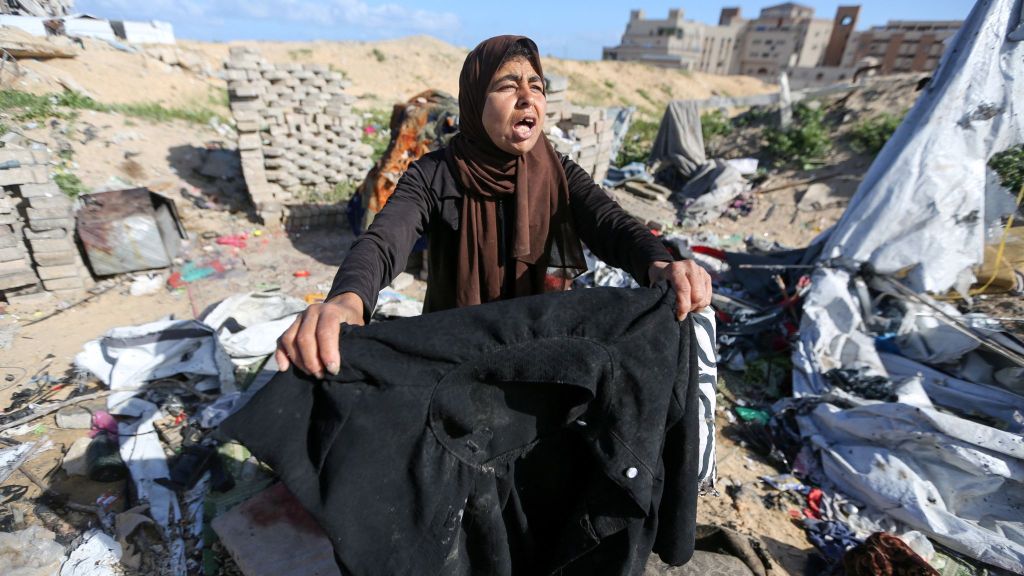
Israeli action in Gaza continues to hit civilian targets

While the Israeli Defence Force (IDF) resumes its genocidal bombing campaign against the people of Gaza, the leaders of European nations gather to work out how they can protect the right wing nationalist government of Volodymyr Zelensky from the Russian ‘threat’ in Ukraine. 

Israel has treated international law with impunity for decades while the West has not just turned a blind eye to the treatment of Palestinians but has armed Israel to the teeth in the process.  The United States has by far been the biggest arms supplier to Israel but Britain has provided more than its fair share of weapons used to keep the Palestinian population under the jackboot of the IDF.

As the Campaign Against the Arms Trade (CAAT) indicate,

“By the end of 2023, the USA had delivered 39 F-35 Joint Strike Fighters to Israel. Israel has a further 36 on order.  Israel has been using the F-35s extensively to bomb Gaza, operating them at a far higher rate than normal. This has depended on a constant supply of spare parts from the US and other countries producing components, including the UK.”

Working out direct British involvement can be complex as CAAT point out that licences for components go via the US for use in weapons manufactured by them.  While the government has instituted a partial suspension of export licences “it left in place licences for equipment such as components for trainer aircraft and naval vessels, as well as for components going to Israel’s arms industry to be included in equipment for onward export.” (https://caat.org.uk/data/countries/israel/)

By comparison to the actions of the IDF, the Russian action in Ukraine has not involved the subjection of an entire population, is not aimed at eradicating a nation, or displacing its population from their land.  On the contrary, the action of Ukrainian forces against the largely Russian speaking population of the Donbas region, which resulted in 14,000 civilian deaths between 2014 and 2022, precipitated the Russian action but has gone largely unreported by the Western media.

This version of events, does not fit the NATO narrative of an expansionist Russia looking to swallow up the neighbouring states, in advance of an onward march towards Western Europe.  NATO bosses would have us believe that the only possible defence against such an eventuality is to spend more on weapons to guard against the so called Russian threat.  The British government is committed to increasing spend on the military to 2.5% of GDP with a rise to 3% being mooted.  Calls have come from the US for NATO nations to be committing to 5% of GDP spend on the military.

It is hard to see this as anything other than a drive to war and certainly a drive towards greater profits for arms manufacturers who must be rubbing their hands with glee.

The right wing Polish government are asking for nuclear weapons to be stationed in Poland, minutes away from a strike on Moscow, to ‘defend’ against Russian invasion.  This in spite of the fact that as a member of NATO any attack on Poland would, under article five of the NATO Treaty, bring the whole of NATO to its defence.  Nuclear weapons in Poland will not add to that capability.

In spite of the Western commitment not to move NATO one inch eastwards the incorporation of Eastern Europe nations into NATO has effectively completed the encirclement of Russia over the past thirty years, with Ukraine being virtually the last piece in that jigsaw.

The ‘Russian threat’ bogie is a repackaging of the old Soviet threat myth from the days of the Cold War, when the NATO bloc had to have an ‘enemy’ to defend against, in order to justify its proliferation of nuclear and conventional weapons.

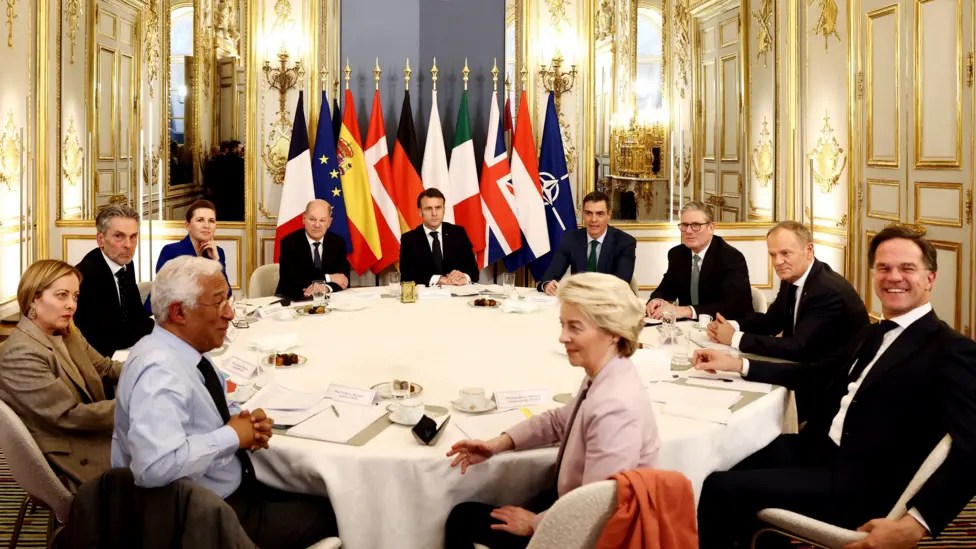
If history is played out first time as tragedy and second as farce then the so called Coalition of the Willing, convened by British Prime Minister, Kier Starmer, should be in the running for a comedy award.  Having been cut loose by the US, in relation to the strategy of defending Ukraine at any price, European leaders are scrambling around like latter day Keystone Cops wondering which way to turn.

However, it will be no joke should they make good on their threat to increase spending on weapons, which will only impoverish the European working class further and rob them of much needed social provision in the form of homes, schools, medical provision and transport infrastructure.  It will be less than amusing for working class families if their sons and daughters are sent to the frontline in ‘defence’ of Ukraine and find themselves embroiled in an unwinnable conflict.

The grandstanding of Starmer and Macron, the main drivers of the wilting European coalition, needs to be exposed and the priorities for a just settlement in Palestine and an end to war in Ukraine emphasised, as the key foreign policy objectives.

The drive to sustain the war in Ukraine, while ignoring Israeli genocide in Gaza, is a double threat to world peace.  Mass action on both fronts must continue while being linked to the struggle for jobs, health and homes, all of which will be threatened by the drive to war.

Redrawing the map

18th February 2025

European leaders ponder what to do as the US pushes for a deal with Russia

European leaders have been in Paris this week wondering what to do about the apparent maverick actions of the United States, in relation to the NATO proxy war in Ukraine.  What at first seemed like a straightforward NATO vs Russia scenario, in defence of right wing nationalist Ukraine, has been complicated by the return to office of Donald Trump.  Not that Trump’s attitude to Ukraine should come as a surprise, he has been trailing it on his campaign journey for over a year, but Europe, including Britain, has been taking an ostrich like approach to the possibility of Trump’s return and they are now having to face the consequences.

The US has signalled bi-lateral discussions with Russia, underway in Saudi Arabia, in order to achieve a settlement, no doubt to be followed by conversations with Ukraine to persuade them to accept any deal.  There will inevitably be a quid pro quo in terms of US arms being sold to Ukraine, in exchange for access to resources such as mineral wealth.  Russia will incorporate the Crimea and Donetsk regions, in line with the stated wishes of those populations.

The European Union plus Britain may tub thump about the prospect of Russia extending its reach and invading the Baltic states and Moldova etc but this is largely a bogie of NATO’s own creation for internal consumption, to justify the persistent increase in arms spending.  The likelihood of Russia precipitating a response from NATO by overstepping its existing boundaries must be rated as very small in reality.  Europe’s Cold War anti Russia scaremongering is likely to wear thin as US priorities change.

So what is the endgame of US imperialism?  Russia, as it has been historically, is the weak link in the imperialist chain.  While rich in resources and still a significant nuclear power it does not pose a direct threat to the dollar based economic order.  However, in alliance with China, an actual economic threat to the US, and the wider BRICS network of nations, the role of Russia is more significant.

It is certainly in the interests of the US to drive a wedge between the current alliance of Russia and China.   Trump has also made it clear that the aim of the BRICS nations to move away from the dollar as the default international currency is not something he will tolerate.  Bearing in mind that Trump speaks, not purely as an individual but as the mouthpiece of US imperialism, his words take on greater significance.

The potential market which Russia represents for US firms, and the resources which it controls, are vastly greater than anything Ukraine can offer and certainly more than the European Union can lay claim to. 

European leaders in Paris have continued to bleat about the abandonment of Ukraine, British Prime Minister, Kier Starmer, referring to a “generational” security challenge posed by Russia and reiterating his commitment to deploying British troops if necessary.  The continued warmongering on the part of Starmer and other European leaders, with talk of a 5% of GDP spend on the military, is a recipe for a massive crackdown on public services which will hit working class families hard.  The economics of war may work for the military industrial complex, it will not work for the working class citizens of Europe.

Against this backdrop it may just be that the US has its eye on the bigger goal of competing with the rising economic might of China and positioning itself to reassert its grip on the international economy.

Ironically, it may be that Zelensky’s wild call for a European army, at the Munich Security Conference last week, may be the first recognition of this possibility.  While the media, as ever, portray things in terms of personalities it is not a Trump/Putin love in that we should be wary of but a strategic US/Russia alliance which would truly redraw the map and reshape the international order, creating a powerful economic and military bloc containing most of the planet’s nuclear arsenal.

What the EU/Britain could do in the face of this would be very tame and even China’s economic strength would pale by comparison.  They could huff and they could puff but it would be quite a house to try and blow down.

Silence the drums of war

13th December 2024

Mark Rutte, Secretary General of NATO, beating the drums of war

Mark Rutte, recently appointed Secretary General of NATO, is saying today that the military alliance should shift to a “wartime mindset”, as Russia “is trying to crush our freedom and way of life” and could be in a position by 2029 to invade NATO countries.  In order to combat this so called ‘threat’ spending on weapons of destruction should be increased to at least 3% of GDP, the current target for NATO members being 2%, which many struggle to achieve.

Britain currently spends 2.3% of GDP on the military and is committed to increase that to 2.5% ‘when economic conditions allow’.  Military spending is not, however, primarily about economic conditions, it is about the political vision, assessment and understanding of where threats come from and how they are countered.  The outcomes of such political assessments certainly have economic consequences.  The more that is spent on tanks, guns and nuclear submarines, the less there is for roads, schools, hospitals and local government services.

Successive governments, Tory and Labour, have tried to mask their excessive spending on weapons by arguing that the first duty of government is to keep its citizens safe, to defend the nation.  This argument is as bogus as that of the National Rifle Association (NRA) in the United States who insist that the constitutional right to bear arms is about keeping citizens safe.  The death toll in US schools over recent years should be enough to counter that argument but gun control is shied away from by Republicans and Democrats afraid to lose the gun lobby vote.

Manufacturers of military weapons hate a vacuum, they want to see their goods tested in real battlefield scenarios.    The people of Iraq, Afghanistan, Yemen, Libya, Gaza, Lebanon and Syria can testify to the impact of this approach over the recent years.  The supply of weapons to Ukraine, fuelling a conflict which could be settled by peaceful means, continues this strategy.

The reality is that the more arms there are in circulation the more likely someone is to use them.   That is true at the individual level and is equally true at an international level, either by design or by accident.  The Cold War doctrine of Mutually Assured Destruction (MAD) may have held a precarious post war balance between the Soviet Union and United States but the real drive from a US perspective was to keep the pressure upon the Soviet economy, diverting resources from socially useful production, till it reached breaking point.

That goal having been achieved, with the active support of counter revolutionary elements inside the Soviet Union, the United States was left with a highly armed gangster capitalist economy in the form of post Soviet Russia which, given the nature of capitalism, soon developed ambitions of its own and did not just fit neatly into the concept of unipolar world dominance the US desired.  

The European Union proved a useful tool with which to absorb Eastern European nations into the orbit of the West, as both new markets and sources of cheap labour. For most, NATO membership followed quickly on, tying them economically and militarily to the Western ‘alliance’ in every way.   

That Russia should perceive this encirclement as a threat is no surprise and the belligerent tone of much of the rhetoric from Western leaders has only reinforced such perceptions.  The anti-Soviet rhetoric of the post war years quickly translated into anti Russian rhetoric, when it became clear that the post Cold War scenario was not one of Russian resources being absorbed into the coffers of Western corporations but one of inter-imperialist rivalry. The current conflict in Ukraine is a direct result of over 30 years of Western belligerence and provocation, in an effort to bring Russia to its knees and ensure Western access to its vast market and resources.

The warmongering comments of Mark Rutte are a continuation of this process.  His appeal to NATO members to provide the arms industry with “the big orders and long term contracts they need to rapidly produce more and better capabilities” is a clear signal that as far as NATO is concerned any form of détente is off the agenda. 

Rutte’s comments should be a clarion call to the peace movement to redouble efforts to demand that Western governments do the exact opposite of what Rutte is urging.  In Britain Labour should be pursuing policies based upon the peaceful co-existence of states, with mutual co-operation between them to address the climate emergency and ensure the long term safety of the planet.

Building more weapons, being part of the ‘nuclear club’, is not going to achieve anything other than Britian being a target, if NATO’s provocations do lead to a wider conflagration in Europe. There is evidence enough in the Middle East alone in recent years, that a policy of trying to resolve issues through military means only leads to the destruction of states and societies, along with the exacerbation of the international refugee crisis.  

Mass extra Parliamentary action, along with the mobilisation of progressive MPs and opinion in the Labour and peace movements, must be mobilised if those beating the drums of war are to be silenced  and the voice of the people, desperate for peace, is to prevail.

War Shadows Darken

21st November 2024

British PM, Kier Starmer, grandstands at the G20 Summit in Brazil

NATO’s undeclared war on Russia, fought through its proxy in Ukraine, took further steps towards escalation this week.  In the final desperate weeks of his presidency Joe Biden has upped the ante in the conflict in Ukraine by giving the go ahead for US missiles, with a range of up to 300 km, to be fired into Russian territory. Biden has also sanctioned the use of anti-personnel mines, widely discredited and subject to international agreements to prohibit their use, through the Anti-Personnel Mine Ban Convention, though neither the US or Russia are signatories.

Reports also suggest that British supplied Storm Shadow missiles have been used in recent days to hit targets inside Russia, increasing the danger of Britain becoming a target for retaliatory action.  The West continues to ignore peace proposals put forward by China and persists in pouring more fuel onto the fire of the conflict, through the continued supply of arms and aid to Ukraine. 

Britain alone has committed £12.8 billion to Ukraine since 2022 of which £5bn is financial support and £7.8bn is for military purposes.  Britain is the third largest donor of military equipment after the US and Germany.

Speaking at the recent G20 Summit in Brazil Prime Minister, Keir Starmer, said that there had already been “1,000 days of sacrifice” but that Britain would continue to ensure Ukraine has what it needs to fight the war “for as long as it needs”.

Without any apparent hint of irony Starmer went on to say,

“In this moment when global challenges are affecting us at home, I take the view that British leadership matters.”

The character of that “leadership” would appear to be little more that to kowtow to the diktats of US foreign policy, by supporting the war against Russia, rather than addressing the real needs of working class communities in Britain.  The billions that are going to pay for weapons of destruction in Ukraine could  more usefully be spent on winter fuel payments for the elderly, investing in support for the health and care services, or supporting the crumbling schools infrastructure across the country.

As priorities go the idea of  “British leadership” on the global scale is merely empty rhetoric as the Western military alliance, NATO, dances to the tune dictated by who pays the piper.  By far and away NATO’s biggest paymaster is the US and there is no way that the British tail will be allowed to wag that dog!

What Starmer really needs to address are the challenges “affecting us at home”, with the emphasis on the “us” being working class families and communities, who inevitably shoulder the burden of imperialist wars and the waste of public money on weapons of mass destruction, rather than socially useful programmes which will support well paid jobs and help communities thrive.  That however would require a true socialist perspective with planning for people at the forefront and the needs of the many put before the greed of the profit hungry few.

Instead the lobby for more money to be spent on the military is already underway with British chief of defence staff, Sir Tony Radakin, stating when interviewed by the BBC’s Laura Kuenssberg that the government should provide more money for defence.

Interviewed on the same programme Treasury minister, Darren Jones, said the government wanted to increase defence spending from 2.3% to 2.5% of the national income but that the government would not commit to a deadline until it had completed its strategic defence review.

The review, led by former Labour minister and NATO head George Robertson, is examining the current state of the armed forces, the supposed threats that Britain faces and the capabilities needed to address them. It is due to be completed in the spring of 2025.  It is unlikely that Robertson’s review will conclude that threats could be minimised by not spending billions on fuelling conflicts, or by not renewing the Trident nuclear submarine programme, which will waste billions in public funds.

In a classic piece of government euphemism Jones in his interview went on to warn that increasing defence spending would mean “trade offs” with other areas of public spending.  It hardly needs spelling out that trade offs will mean cuts in those other areas of public spending which will impact upon the services that people really need, such as health and social care, housing, education and transport.  Having a few overpriced and essentially useless nuclear submarines at sea will not help any of that.

Starmer may feel his ego is boosted by puffing out his chest and grandstanding about supporting Ukraine at the G20 Summit.  He may think that is “leadership” but the reality is that such a position is one of supine surrender to the drive of US imperialism, to escalate the conflict with Russia and ultimately to turn its sights towards China. 

Working class communities in Britain will pay a heavy price if Starmer continues down that road.  The work of Stop the War, CND and those sections of the Labour Movement committed to peace and social justice is more vital than ever in mobilising opposition to the growing threat of increased military activity in Ukraine, the Middle East and the Far East.  The pro-war lobby must be stopped and it must be stopped now before the current conflicts truly do become worldwide.

Ukraine – adding fuel to the fire

15th June 2024

It’s a deal – Zelensky and Biden, partners in crime

The recently signed 10 year security pact, agreed between the United States and Ukraine marks a further ramping up of NATO’s proxy war against Russia.  The deal, signed on the sidelines of the G7 summit in Italy last week, aims to commit future US administrations to support Ukraine, even if former President Donald Trump wins November’s election.  The G7 nations also agreed to a $50 billion loan for Ukraine backed by profits from frozen Russian assets.  US President, Joe Biden, asserted that the G7’s message to Russian President, Vladimir Putin, is “You cannot wait us out. You cannot divide us.”

The deal is widely seen as a step towards NATO membership for Ukraine and a further move towards the encirclement of Russia by NATO nations.  Ukrainian President, Volodymyr Zelensky, has been pushing for full NATO member ship for some time.  NATO regards any attack launched on one of its 32 members as an attack on all, under its Article Five clause, so membership is seen as a trump card by Ukraine in pressurising Russia.

Even without NATO membership the deal contains some clauses which point to potential US intervention in the current conflict.  For example, in the event of an armed attack or threat of such against Ukraine, top US and Ukrainian officials will meet within 24 hours to consult on a response and determine what additional defence needs are required for Ukraine.  Under the agreement, the United States restates its support for Ukraine’s defence of its sovereignty and territorial integrity. The agreement also outlines plans to develop Ukraine’s own defence industry and expand its military.

The text of the deal allows the two countries to share intelligence, hold training and military education programmes and combined military exercises, which will clearly be a provocation to Russia.  The deal also asserts that Ukraine needs a “significant” military force and sustained investments in its defence industrial base, consistent with NATO standards. All of which is tantamount to a blank cheque for the US military industrial complex to make massive profits from the arrangement.

The deal also comes against the backdrop of Biden having recently shifted US policy against allowing Ukraine to use American weapons for attacks inside Russia, in effect permitting Kyiv to fire long-range US missiles against Russian targets near the Ukrainian city of Kharkiv.

In the press conference convened to announce the deal Biden said arrangements were being made to provide Ukraine with five Patriot missile defence systems, saying: “Everything we have is going to Ukraine until its needs are met.”  Biden also added that his administration is “intensifying” its pressure on Moscow, including by warning banks earlier this week that they risk US sanctions should they do business with Russia.

The agreement between the US and Ukraine is the 16th such bilateral agreement Ukraine has now reached. As an executive order, it could be undone by a Trump administration, should Joe Biden fail to win the US election in November.  However, the intention of the current US administration is that the accumulation of agreements collectively adds up to a form of security assurance that, although short of full NATO membership, will strengthen the hand of the military alliance in its provocations against Russia.

A unilateral so called, Global Peace Summit, takes place in Switzerland this weekend (15/16 June), initiated by Ukraine, to which Russia is not invited.  The summit is little more than a vanity project initiated by President Zelensky in an attempt to galvanise international support around his right wing nationalist agenda.  US President, Joe Biden, will not attend, sending Vice President Kamala Harris.  China will not attend, as the Chinese Foreign Ministry has said it believes a peace conference should involve both Russia and Ukraine.  Under half of the 193 United Nations member countries are planning to attend.

Russia remains keen to build upon a draft peace agreement negotiated in the early days of the war that included provisions for Ukraine’s neutral status and put limits on its armed forces.  Ukraine continues to focus upon a 10 point plan drafted by Zelensky in 2022, which focuses upon the withdrawal of Russian troops and denial of the legitimacy of  Crimea being part of Russia.

Mark Cancian, senior adviser for the International Security Programme at the Centre for Strategic and International Studies, said he expects many attendees to remain neutral on the war.

“Zelensky will want to turn the conference into an anti-Russian coalition,” he said. “However, some of the attendees may want to explore end states that are short of what Ukraine wants — for example, some sort of in-place cease-fire.”

While the summit is unlikely to achieve anything significant, without the participation of Russia or China, the signing of the 10 year deal between the US and Ukraine will ensure that the NATO strategy of encircling and provoking Russia remains in place and that the suffering of both the Russian and the Ukrainian people continues.

Peace proposals put forward by both Russia and China have been rejected out of hand by the West, which continues to increase the militarisation of Ukraine and pour weapons into the conflict, adding fuel to an already raging regional fire and increasing the threat of global war.