Real change needed

5th May 2025

Nigel Farage – delighted to see Reform UK take over Durham County Council

After UKIP and the Brexit Party, the latest incarnation led by right wing nationalist, Nigel Farage, is Reform UK.  As with the previous manifestations of the Farage ego, Reform UK is a party of the rich, for the rich, run by the rich, masquerading as the voice of the people.  The Farage brand, the ordinary bloke down the pub with common sense opinions, is as phoney as any marketing ploy adopted by the leaders of other parties to try and burnish their fading fortunes.

Like US President Donald Trump, Farage presents himself as an outsider, the scourge of the establishment, the man with a mission to ‘drain the swamp’, stop the waste of taxpayers money, root out corruption, a real man of the people.  All part of the branding.

Farage, like Trump, is not against the establishment he is just another, more vicious manifestation of it.  The attacks upon concepts of equality, diversity and inclusion; the trashing of targets for net zero carbon emissions;  the anti trade unions stance; the attacks upon local government; and the massive emphasis upon reducing migration to Britain are all simply extensions of policies which have been lurking on the right wing of the Tory Party for years and sound like easy solutions to the deepening crisis of capitalism in Britain today.

In taking over control of Durham County Council in the North East of England Farage was quick to pronounce that any staff working on equality schemes or the green agenda should be looking for new career paths.  The idea that money spent in such areas of local government activity could be diverted to address the problem of potholes in roads was flagged by Durham CC Reform Cllr Darren Grimes, a man who has recently posted,

“Not a chance I’ll support migrants getting keys to homes while locals get kicked to the kerb.”

This posing of one issue against another, equality work versus potholes, migrants versus homelessness, is classic right wing demagoguery, which is a cover for not wanting to reveal the fact that the entire capitalist system is failing working people  and needs to be overthrown in its entirety.

The rise of Farage and his ilk is only possible because the party with the deepest roots in the working class and trade union movement, the Labour Party, has abandoned any notion of tackling head on the real issues faced by working class people in Britain.  The shrinking of opportunities through advancement in education; the decimation of local government services on which the most vulnerable rely; the creeping privatisation of the NHS; the waste of money on weapons of mass destruction; the need to invest in green infrastructure in order to create jobs and prosperity.

The Labour Party leadership is afraid of its own shadow, is afraid to stand up and say that we do not have a migration crisis in Britain, that the numbers of migrants is small and can easily be accommodated.  The Labour leadership is afraid to say that weapons of mass destruction do not create jobs, they simply divert resources away from more socially useful production while making Britain a target.   The Labour leadership is more concerned with clinging to its illusion of power than making the case for real change for the working class of Britain.  It’s not that they won’t go down without a fight, it’s that they won’t put up a fight in the first place.

All of which leaves a void to be filled by the ‘bloke down the pub’ politics of the likes of Farage, with no-one piping up to point out that the bloke down the pub is usually half tanked and talking bollocks.

Reform UK gaining 677 councillors and control of eight local authorities, as well as overturning a 14,000 strong Labour majority in the Runcorn and Helsby by-election has to be awake up call.  Whether the Labour leadership has the political acumen or nous to realise this is another matter.  They clearly have no understanding of the depth of the crisis US imperialism faces globally, with the growing efficiency of the Chinese economic model, even less understanding of that for the British economy and seemingly no clue as to how to begin the process of carving out a place for an independent socialist Britain which could truly address people’s needs.

Pundits across the press and media have been proclaiming the end of the two party system in Britain over the past few days, following the 1st May election results.  What they fail to realise is that, whether there are two parties or five, what is broken is the entire system which, whatever combination of parties make up the House of Commons, remains geared to serve the interests of the banks, corporations, the City of London and the military industrial complex.

Begin to challenge that and real change may then be possible.

Wealth tax reform not welfare cuts

13th March 2025

Work and Pensions Secretary, Liz Kendall, ignoring UN warnings on poverty in Britain

In April 2024 the United Nations Committee on the Rights of Disabled People (UNCDRP) published a report into its findings regarding provision for disabled people in Britain, including the impact of welfare reform.  The UN found that  Britain has ‘failed to take all appropriate measures to address grave and systematic violations of the human rights of persons with disabilities and has failed to eliminate the root causes of inequality and discrimination.’

As signatories to the UN Convention on the Rights of Disabled People the British government agrees to periodic reviews of its provision for people with disabilities, the latest being initiated in 2023 and its report concluding in 2024 finding that  ‘grave and systematic violations’ of disabled persons rights had taken place since 2010 and that welfare reform had “disproportionally and adversely” affected the rights of people with disabilities. 

The report concludes that there has been no significant progress with independent living rights and active regression in relation to work and social security rights, recommending urgent measures be taken in relation to improvements in these areas. 

Given that much of the period of the review was covering the 14 years of Tory government such harsh attacks upon the rights of people with disabilities comes as no surprise.  The ‘skivers not strivers’ narrative is one that the Tories and their right wing media allies in the Mail, Express and Telegraph have been pursuing for some time, in order to deflect attention away from the obscene profits made by the super rich and the increased wealth of billionaires in Britain, which rose by £35 million a day last year.

This month the UN Committee on Economic, Social and Cultural Rights (CESCR) issued a series of recommendations to tackle poverty in the Britain.  The report urged Keir Starmer to reverse the five-week wait for universal credit in a warning that the British government is infringing human rights with the ongoing poverty crisis.

The report highlighted  fears over the Department for Work and Pensions’ (DWP) welfare reforms that have resulted in severe economic hardship, increased reliance on food banks, homelessness, negative impacts on mental health and the stigmatisation of benefit claimants.  It further urged government to up spending on benefits, remove the benefit cap and scrap the two-child limit, which prevents parents from claiming child tax credit or universal credit for more than two children.

Labour’s Work and Pensions Secretary, Liz Kendall, does not seem too perturbed by the UN’s findings.  With a Spring statement from Chancellor Rachel Reeves due on 26th March welfare reform, a euphemism for cuts to benefits, is clearly high on the agenda of both Kendall and Reeves.

Kendall’s stated position is that,

“I think the only way that you get the welfare bill on a more sustainable footing is to get people into work. And you know, we will be bringing forward big reforms that actually support people into work, that get them on a pathway to success.”

All of which may sound fine in a press conference but in the real world of de-industrialised, zero hour contract, low wage economy Britain it has a hollow ring.

Labour’s claim is that welfare reform is necessary to fill the fiscal black hole Reeves has discovered due to the economy not growing fast enough.  Kendall has refused to deny that the Treasury is looking for £5 billion of cuts to her budget. 

As ever, government economic decisions are about political choices, whatever issues may arise in relation to the world economy.  The current Labour government has ditched the notion of ‘jobs not bombs’ and gone for bombs, £12.8 billion to Ukraine alone, before the cost of supporting Israeli genocide in Gaza is factored in, or weapons sales to dictatorships such as Saudi Arabia.

There is clearly a case for reform of the welfare system in Britain, as the UN has pointed out, but that is not the same as making a case for swingeing cuts which will plunge people into further poverty.  There is certainly a case for reform of how the wealthy are taxed in Britain.  As Nadia Whittome MP for Nottingham East has pointed out,

“If we implemented something very moderate, like a 2% tax, a threshold of assets over £10m a year, that would only impact an estimated 20,000 people in the UK but would raise £24bn.”

These are the real choices a Labour government faces, yet again.  War or peace, rich or poor, capitalism or socialism?   Currently Keir Starmer and the Labour leadership are getting it wrong on all three counts.  There is clearly some pressure from progressive Labour MPs within Parliament but only mass extra parliamentary action will apply sufficient pressure to move the Labour leadership.  Putting wealth tax reform ahead of welfare cuts would be a step in the right direction.

Popular policy to put people first

5th January 2025

Cuban medical workers – under pressure but an example to the world

The year begins with much media speculation about the collapse in popularity of the Labour government and its leader, Keir Starmer.  The economy is not showing signs of recovery. The winter fuel allowance issue is returning to haunt Starmer and Chancellor Rachel Reeves, as the cold weather kicks in.  The much trumpeted review of the NHS does not report until the Spring and the reform of social care will take until 2028.  Business leaders continue to use the increase in employers national insurance as an excuse not to recruit, or to resist wage increases, in spite of hefty profits going to shareholders.

Public services are struggling with the need for investment to function efficiently or, in the case of the energy sector, with the obscene profits made by companies failing to deliver an effective service to communities.  The water industry is the biggest offender  but others in the sector are equally guilty of milking profits from hard pressed working class families while not addressing the need for investment in modernisation.

The crisis in the NHS is a major case in point.  Recent reports suggest that every acute hospital trust in England is failing to hit the target to treat 92% of patients within 18 weeks.  There are 7.5 million people on the waiting list for treatment.  The government did promise a £22.6 billion increase for the NHS in the last budget plus an additional £3.1 billion for capital investment.  This is welcome and, with the hard work and dedication of staff in the NHS, may result in some short term improvement.

However, even these figures are a sticking plaster over a gaping wound.  Britain currently spends £64.6 billion per annum on weapons of mass destruction and the military.  Labour is committed to increasing that figure to £87.1 billion to meet its commitment to spending 2.5% of GDP on the military.  The equipment plan alone for the Ministry of Defence over the period 2021-31equates to £238 billion plus, according to official forecasts, £117.8 billion on nuclear weapons.  CND estimate that the latter figure will in fact be nearer £205 billion. (see The Fight for Peace and Disarmament by Gary Lefley – Socialist Correspondent Issue 53 Winter 2024)

The obscene spend on the military is argued for by the ruling class, with Labour support, as being necessary for defence but in fact just makes Britain a potential target.  Given the craven support of the British ruling class for US wars of intervention across the world, including the Ukraine and Israeli genocide in the Middle East, and the backing given to US sabre rattling over China, this danger is likely to increase.

Meanwhile, ambulances are queued outside of hospitals waiting to register patients, who cannot be admitted because beds are occupied by people without any social care arrangements, and emergency calls suffer as a consequence.  It is a vicious circle and one which will undoubtedly impact disproportionately upon working class communities.

If Starmer and the Labour government want to increase their popularity, shifting the balance of resources from weapons of mass destruction to investment in health, social care and education would be a progressive step. Shifting the emphasis in both foreign and domestic policy onto improving the lives of working class communities, rather than put them under threat would be a huge leap forward.

At present the health service, in spite of the emphasis upon community health, aimed at preventing hospital admissions and promoting healthier lifestyles, cannot cope with the needs it has to address at the acute end of the healthcare spectrum.  Any additional resources inevitably go into trying to prop up the needs of the most vulnerable and little is left for prevention work.

In a socialist system this would be different.  This is not theory, there is a practical example in the form of Cuba.   In spite of the 60 year long illegal economic blockade, imposed by the United States, the Cuban healthcare system is an example to the world in terms of its approach.    Community based care and access to local medical centres are key  but struggle because of the lack of resources due to the US blockade.  The Cuba Vive Medical Aid Appeal is currently crying out for sutures, syringes, catheters, antibiotics, butterfly needles and paracetamol. These are just a few of the items on the list of needs for Cuban hospitals and polyclinics.  https://www.cubavive.org.uk/donate/

The resources available in Britain however means that there is no excuse not to invest and properly resource the NHS, as well as the social care system.  It is an act of state negligence not to do so.  Labour would do well to look less towards supporting the imperial ambitions of the United States and more towards the needs of working class communities in Britain.   That would be popular in every sense.

Superficial change

5th July 2024

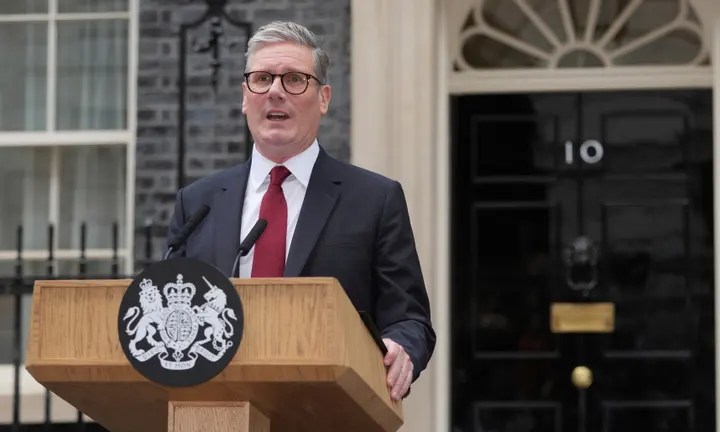
The keys to the door – Kier Starmer about to enter 10, Downing St

Having smuggled the metaphorical Ming vase across the threshold of 10, Downing St, Kier Starmer and his team need to decide whether its fragility is worth preserving or whether they just smash it and take advantage of their massive 170 seat majority to effect real change.  Given the character of Starmer and his team the prospect is that the vase will sit quietly on the mantelpiece ready to be dusted off in 2029.

The scale of the Labour majority may give the illusion that the politics of Starmer and the Labour leadership have swept the country and that they expect to be hoist aloft on the shoulders of the people.  The reality is not so clear cut.

Interviewed on Radio Four today architect of New Labour, right wing Labour henchman Peter (now Lord) Mandelson, described the Labour victory as ‘efficient’.  Mandelson pointed out that Labour did not just stack up votes in safe constituencies but managed to gain seats in more marginal areas too.  However, much of this was as a result of Reform splitting the Tory vote in some areas with the Lib Dems taking votes from the Tories in others.  The collapse of the fractured and fractious SNP in Scotland was also a contributory factor.

The national turnout was low at 60% with Labour only gaining 35% of the votes across the country, slightly up on the 33% achieved under Jeremy Corbyn’s leadership in 2019 but well down on the 40% share Corbyn achieved in the 2017 General Election.   Jeremy Corbyn retaining his seat as an Independent in Islington North was a small victory for the Left and the election of four other Independents on the back of Labour’s weak position on Israeli genocide in Gaza signalled to Starmer that there will be more progressive voices of dissent in the House of Commons.

The single word which characterised Labour’s campaign and was the title of its manifesto was Change.  Starmer spent much of the campaign not just emphasising the word change in the context of change for the country but change in the context of the Labour Party itself.  The purge of many on the Left, over recent years, is certainly testament to Starmer’s efforts at internal change.  This was characterised by the imposition of Starmer friendly candidates in many constituencies, ensuring a House of Commons that will be largely compliant and reliant on the largesse of the leader.

The reality of the next five years is going to be one in which the adjective ‘superficial’ could precede the change mantra which is Starmer’s watchword.   The pledge of Starmer to ‘unite the country’, in his first speech outside Downing Street, presupposes that the country can be united, Irish Republicans and Scottish Nationalists will disagree, or that the interests of conflicting classes can be harmonised.  There is no evidence that Labour will do anything to stop the rich getting richer or that they will fundamentally challenge the causes of poverty which are endemic to capitalism as a system.

For the working class however, there is no doubt that getting the Tories out of government is a step forward.  A Labour government at least gives the possibility of more progressive policies with the prospect of influence from the Left, from the trade union movement and from mass extra parliamentary action, potentially shifting Labour in a more positive direction.

Once the flurry of excitement about the Tory meltdown subsides the job of ensuring Labour is more focused on the issues in towns and backstreets, rather than the City of London, must be a priority.  The rise of so-called populism, in the form of the Reform vote, offering the illusion of easy answers to complex problems, will need to be tackled in working class communities. 

The importance of the need for real change, socialist change, as the only answer to really address the needs of working class communities will need to be articulated.   There is certainly no sense that the Labour leadership under Starmer will do this but until it is part of Labour campaigning, simply repeating the mantra ‘change’ will not be enough to make it happen.

Ambition for real change?

9th June 2024

On the buses – but will Labour commitments short change?

While the political boomerang that is Nigel Farage, newly re-installed as leader of the Reform Party, wants the looming General Election to be about immigration, that will not be the major issue concerning working class people in Britain.  Farage has for many years now pedalled his own xenophobic agenda and, while he has succeeded in fooling some of the people, some of the time, he will not fool all of the people all of the time.

Net migration into the UK is running at around 650,000, hardly a massive issue for a nation with a 65 million population and a responsibility to those it has forced to become migrants due to its complicity in bombing Afghanistan, Syria, Libya and Iraq in recent years.  The least the British government can do is to give those displaced due to imperialist wars a place of shelter.

The real issue underlying everything facing the British electorate is, as ever, the economy.  Capitalism is not a system designed to help, support or alleviate the suffering of the working class.  It is a system based upon the exploitation of that class by a property and land owning autocracy, fronted by the Church of England and the Monarchy.   Its representation in Parliament is ostensibly through the Conservative Party, although the occasional safe Labour administration is allowed to slip through the net, while the Tories untangle themselves from a political mess of their own making, or have simply been in government so long that people desire a change.  The current point finds the Tories under pressure for both reasons, hence the likelihood of a Labour government on 5th July.

In which case, what will Labour do about the economy?  The Labour leadership is absolutely committed to capitalism, so that will not change.  The Labour leadership is committed to renewing Britain’s weapons of mass destruction, in the form of the Trident nuclear submarine programme, so less scope for spending on desperately needed schools and hospitals. 

Labour’s manifesto will commit to the creation of GB Energy, a publicly owned green power company.  It will commit to 40,000 more NHS appointments per week and the recruitment of 6,500 new teachers to shore up the flagging education workforce. It will even contain a commitment to recognising a Palestinian state, as part of the peace process.

Yet as positive as these pledges sound, there is still no real commitment to invest in order to grow the economy or address the issues of job insecurity faced by working class families.  Sharon Graham, general secretary of UNITE, one of Labour’s biggest trade union backers, has said that she cannot endorse the document as the union has reservations about Labour’s position on hire and fire practices and zero hours contracts.

Shadow Chancellor, Rachel Reeves, has been the standard bearer of economic caution, promising not to spend more than the economy can allegedly afford and not to boost public spending.  The reality is however that to address the needs of working class people, in order to improve their lives, public spending is essential.

A recent report by the Resolution Foundation think tank suggests that the next government will have to make £19 billion of annual cuts to unprotected departments by 2028-29 if budgets are to be sustained without new tax rises.  Both the Tories and Labour are committed to military spending increasing to 2.5% of GDP, an area both will protect, while local government, the deliverer of key services to help working class families survive is afforded no such protection. 

There are ways to raise additional funds, quite apart from not buying weapons of mass destruction in the first place.  A wealth tax of 1% to 2% on those with assets of more than £10 million, just 0.04% of the population, would raise £22 billion annually.  That would pay for 75% of the entire social care bill for a year.  In 2020 the Wealth Commission recommended a one off wealth tax for five years, which could raise a tidy £260 billion.  Recent YouGov polling suggests that 78% of people support an annual wealth tax on the super rich.  Clearly not a vote loser!

No one is expecting a Labour government led by Kier Starmer, Angela Rayner and Rachel Reeves to make a call to build the barricades and tear down the capitalist system.  However, it is disingenuous of all three to suggest that there is not money there to support working class people and to make their lives more bearable.

Electing a Labour government on 4th July remains a necessity but, with a majority which could be nothing short of monumental, that government ought to be firmer in its commitment to challenging the clear inequities in the system and putting in place policies to challenge them.  Such a small step would make a minor dent in the edifice of capitalism but could make a huge difference to the lives of many working class families.  Pressure must remain upon the Labour leadership to be more radical and to see getting the keys to 10, Downing St as the beginning of an ambition for real change, not the conclusion.

Resisting the call up

26th May 2024

Rishi Sunak in Belfast this week – life jacket essential!

The decision by British Prime Minister, Rishi Sunak, to call a General Election for 4th July has been greeted with bemusement, not least within his own Party.  The merest hint of economic good news, that prices continue to rise but by 2.3% rather than the double figures of a year ago, seemed to be enough to fire the starting gun for the campaign trail.

However, given the predictions of the International Monetary Fund (IMF) and the Organisation for Economic Co-operation and Development (OECD), neither of which hold out much hope for growth in the British economy over the next year, July may be Sunak’s best, if still slim, hope.

The OECD see growth at 0.4% this year with the IMF suggesting 0.7%.  The IMF went on to suggest that the government’s sums for the next five years would see a £30 billion gap between what it proposed to spend and the amount it expected to raise in revenue.  True to form the IMF suggested that the government would need to increase borrowing, raise taxes or cut public spending to meet these targets.  With Chancellor Jeremy Hunt ruling out more borrowing, proposing to cut taxes, that just leaves another assault on public services in prospect if the Tories did pull off the minor miracle of re-election.

While Sunak pores over economic spreadsheets and concerns himself with the opinion of the Financial Times readership, the outlook in the real world is quite different.  Quite apart from the catastrophe of 14 years of Tory government, with the damage inflicted upon public services and working class communities, there is the fact that since the calamity of the Liz Truss mini-budget alone shop prices are 20% higher than they were in 2021.  For families eking out a living on the margins, forced to make the dreaded choice of whether to heat or eat, these figures have a massive impact.  Inflation reducing to 2.3% will make little difference.

The first few days of campaigning have reinforced the sense that Sunak is out of touch with the real world.  His initial announcement outside 10, Downing St in a torrent of rain, was to a serenade of Things Can Only Get Better, quite audible in the background.  As the rain poured and the music blared, Sunak did not look like a man with any grip on his destiny.

The week has continued with a visit to the Titanic museum in Belfast, prompting a journalistic wit to ask if Sunak was the captain of a sinking ship.  One senior Tory has been quoted as saying,

“It’s quite staggering that we’ve managed to call a snap election that took ourselves by surprise.”

Not exactly a vote of confidence.   Former leadership candidates, Andrea Leadsom and Michael Gove have announced that they will not be standing for re-election.  Gove is misleadingly described as a ‘big beast’ in the Tory ranks, though the only jungle creature he shares traits with is of the distinctly reptilian variety.

The latest Tory attempt at a vote winning campaign wheeze has been the announcement to bring back National Service, compelling all 18 year olds to serve a year in the armed forces or be engaged in some form of community service.    Clearly Tory focus groups have not included anyone in the youth demographic, for whom this suggestion will have all of the buoyancy of a lead balloon.  No doubt young people will already be mobilising to resist the call up.  Another five weeks of this and Labour’s strategy of saying as little as possible will begin to look astute!

The Guardian columnist, Marina Hyde, has characterised the approach of Kier Starmer as being like “watching a very buttoned up man try not to have an accident.”   It is certainly true that the Labour leadership could be more adventurous and that the commitment to supporting working class communities and trade union rights could be more robust.  The six point plan announced by Kier Starmer is very much a dilution of the platform upon which he was elected leader and has been countered by the Left in the form of the Socialist Correspondent, which has suggested the following 6 steps towards peace and socialism:-

  • Peace and Non-Alignment
  • Sustainability
  • Health and Education
  • Public Ownership
  • Public Housing
  • Democratic and Workers’ Rights

The full article articulating the case for the above points can be found here https://www.facebook.com/story.php?id=100064546488320&story_fbid=846049760889899&__n=K

A vote for Labour will be essential in order to get the Tories out.  A Labour government led by Kier Starmer however, will need to be kept under constant pressure not to succumb to the demands of the City of London and big business, not to make working class communities pay for the failings of the capitalist system and to begin the process of real, not just superficial, change in the interests of the working class. 

The next five weeks will be crucial in ensuring the election of a Labour government; the following five years will be even more crucial, in ensuring that a government serving the interests of the working class emerges.

Shadow and substance – Labour’s six point plan

19th May 2024

Starmer drama but where is the plot?

Much of the presentation of political debate in Britain, by political parties and the news media, is couched as theatre.  Clashes at Prime Minister’s Questions in the House of Commons are regularly reported in dramatic terms.  Head to head television debates at election times pit candidates against one another with billings worthy of heavyweight boxing title fights. Personalities, rather than policies become the stuff of tabloid headlines as the popularity of TV soap opera is translated into political drama.

Presentation has become as important as content for those seeking the keys to 10, Downing St.  With a General Election just months away the respective teams of Kier Starmer and Rishi Sunak are developing their communications plans and public relations strategies with a vengeance, in the hope of getting their man more media time, more positive coverage and more votes when it comes to the crunch of an actual election.

This week’s set piece from Kier Starmer was the presentation of Labour’s six point plan, an event which could not have been more theatrical.  With a team of Shadow Cabinet colleagues behind him and an audience in front Starmer, in rolled up shirt sleeves, no jacket or tie, was presenting as a man who just wanted to get on with the job and get things done.  TV cameras and news media were there of course to capture the key moments and translate them into the headlines such dramatic presentation was deemed to warrant.

The six points were emblazoned above Starmer,

  • Crackdown on anti-social behaviour
  • Launch a new Border Security Command
  • Deliver economic stability
  • Set up Great British Energy
  • Cut NHS waiting times
  • Recruit 6,500 new teachers

All very rehearsed and choreographed, no doubt tested through focus groups and with a certain type of Labour activist, but does this list represent the concerns of working class communities, where parents may be working two jobs to pay the bills, where the cost of childcare may mean the difference between taking a job or not, where Carer’s Allowance is being clawed back if earnings creep a penny over the princely sum of £151 per week?

Apparently, Kier Starmer does not mind being compared to former Labour Prime Minister, Tony Blair, because Blair was a three times General Election winner, and who would not want that comparison?  Which gives away Starmer’s philosophy entirely.  Winning elections only matters if changes are made as a result of election victories, the winning in itself is unimportant otherwise.

Blair’s three election victories did not result in reversing the anti trade union laws of the Thatcher years.  They did not abolish the right to buy which has seen the run down of Council housing stock and the decline of affordable homes.  They did not reverse the privatisation of water and energy companies and prevent private shareholders from reaping vast dividend payouts while bills soared.  They did not reverse the break up of the comprehensive education system, abolish university fees or impose greater regulation upon the City of London, to prevent the gambling, greed and speculation which led to the 2008 financial crash.

The Blair/Brown years of Labour government did not see a reversal of the damage done by the Thatcher/Major Tory governments but a consolidation of the errors, an acceptance of neoliberal economics and the cult of the individual as being of key importance, rather than the collective wellbeing of the community.

There is nothing in the six points outlined by Starmer that Rishi Sunak would not sign up to or disagree with.  There is nothing which suggests a challenge to the status quo or any shift in the balance of power from the entitled few to the downtrodden many.  Starmer describes the plan as Labour’s first steps on a mission towards change but after 15 years of Tory imposed austerity working class communities are crying out for giant strides not baby steps.

Is it possible to be a mere shadow of something which does not have substance?  If so, Starmer fits the bill as being a mere shadow of Tony Blair who, in spite of his election victories, did nothing to improve the lives of working class communities.  Starmer is set on the same course, in danger of taking working class votes for granted, an election victory for granted and hoping that a programme which does nothing to scare the King’s horses will be enough to get him there.

It is said that history may at first play out as tragedy but repeats itself as farce.  The Blair/Brown Labour governments tragically let down the working class, keeping capitalism safe for the ruling class and the return of the Tories in 2010.  While voting Labour at the General Election will be necessary, after so many years of Tory austerity, we must resist the danger of a Keir Starmer government keeping the seats at the Cabinet table warm for the return of the Tories in five years time.

Mass extra Parliamentary action to compel a Labour government to act in the interests of the working class and to develop a manifesto for real change is vital in the run up to the General Election and beyond.  Without it we will have a Tory-lite, Blair-lite episode from Labour and it may matter little who wins an election in five years time.

Starmer commits to weapons of mass destruction

13th April 2024

Kier Starmer at BAE Systems in Barrow

Labour leader, Kier Starmer, this week committed Labour to an additional £10 – £12 billion spend on weapons of mass destruction if elected.  Writing in the house journal of the Tory petit bourgeoisie, the Daily Mail, Starmer described his commitment to British nuclear weapons as “unshakeable” and “absolute”.  Starmer went so far as to describe the creation of the NHS and the British nuclear programme as “towering achievements” of the Labour government elected in 1945.

Starmer stated that he wants to raise military spending to 2.5% of GDP “as soon as resources allow”, echoing the commitment of Tory Chancellor, Jeremy Hunt, to raise military spending to 2.5% of GDP “as soon as economic conditions allow”.  Government spending is currently at 2.3% of GDP.

Of the 30 countries which are part of NATO Britain is currently tenth in terms of its percentage spend on its military budget by GDP.  A rise to 2.5% would take Britain to sixth position.  The other nuclear powers in NATO, the United States and France, spend 3.49% and 1.9% respectively on their military.

All NATO members have pledged to spend at least 2% of GDP on their military by 2024.

In a visit to Barrow-in-Furness where British nuclear submarines are built, Starmer said that Labour was making a “generational commitment”, stressing that this was to the,

“…Dreadnought submarines, to the continuous at sea deterrent, and to the upgrades that are needed over time.  And of course there is AUKUS in there as well.”

AUKUS is the military pact agreed by Britain with Australia and the United States to provoke China in the Indo-Pacific region, under the pretext of a Chinese military threat to US ‘interests’ in the region.

The announcement by Starmer follows hard on the heels of Labour backtracking on its investment to develop green technologies; the commitment of Shadow Chancellor, Rachel Reeves, not to bail out bankrupt local councils; and the claim that there is no money to introduce universal free school meals, a measure which would benefit working class families and those facing the sharp end of the capitalist economic crisis.

Commenting on the plans, CND general secretary Kate Hudson said: “Putting billions of pounds into the pockets of arms companies and their investors will not reinvigorate the economy in any meaningful way.

“Instead, it takes vital funds and skills away from what could be spent on the just transition: like energy-efficient homes, better public transport and a public health service that saves lives and heals people.

“By committing to the modernisation and expansion of Britain’s nuclear arsenal Labour is contributing to the global arms race and tensions that we are currently seeing.”

She added that if Labour wanted to offer a positive option to the electorate, “it would commit to scrapping Trident and its replacement, and put nuclear disarmament at the forefront of its foreign policy agenda.”

The idea that the possession of nuclear weapons makes Britian safer, or sustains a world power status, is an illusion fed by the military-industrial establishment; the Tory Party and its backers; and the right wing press.  The basis of the nuclear programme is that, if Britain was under nuclear attack, it could launch a retaliatory strike, based upon the concept of mutually assured destruction, appropriately given the acronym MAD.  Destruction of any kind is hardly a guarantee of safety, destruction that is mutually assured is clearly mad in every sense.

Starmer has shifted Labour so far into Tory territory that the distinction between what each would deliver, following a General Election, is becoming almost impossible to distinguish.  Given the abysmal record of the past 14 years it is almost inconceivable that the Tories could be returned to office.  The character of any Labour administration however remains very much in doubt.

Unless mass extra Parliamentary pressure can persuade the current leadership to change course the dangers of Labour being little more than Tory-lite when in government remain real.    

New definition, old habits

24th March 2024

Just Stop Oil protests – extremist activity?

The British government’s New definition of extremism (2024) published in mid March may not establish a House Committee on un-British Activities but is certainly a step in the direction of the anti-communist witch hunts which were a feature of life in the post war United States.  Michael Gove is unlikely to be in office as long as US witch finder general, Senator Joseph McCarthy, but his ‘new definition’ is certainly a step in the direction of McCarthyism, smuggling in a number of constraints under the umbrella of tackling Islamist or neo-Nazi extremism.

In defining behaviour that could constitute extremism the new definition includes,

“Attempts to undermine, overturn, or replace the UK’s system of liberal parliamentary democracy and democratic rights.” 

This definition of necessity presumes acceptance of the implied interpretation of ‘liberal parliamentary democracy’ as well as a shared understanding of what constitute ‘democratic rights’.

The terminology is typical of the smokescreen used under capitalism to shroud its illiberal and anti-democratic core in language designed to make the system appear fair and just.

The capitalist system will allow liberalism up to the point at which it sees the danger of exposure or any threat to the status quo.  The various tools at its disposal, including the press and social media, smear campaigns, use of the security services, and ultimately the threat or use of force, can be deployed in varying ways to head off any perceived danger.

The recent period of Jeremy Corbyn’s leadership of the Labour Party from 2015 -19 is a case in point.  Although representing a relatively mild threat to the established order the popularity of Corbyn’s message, highlighting glaring disparities between rich and poor; inequalities across class, race and gender; and the concentration of power and influence in the hands of a few corporations and bankers in the City of London, was deemed to be too close to the truth to be allowed to take root.

The systematic character assassination of Corbyn, and the subsequent eradication of any radical dimension to Labour policy under Kier Starmer, illustrates the establishment response to even a mild threat. 

The presentation of politics as a choice of who governs, between the Tories and Labour, with perennial pro-capitalist Liberal Democrats occasionally called upon to prop up the system, makes a mockery of the idea of ‘liberal democracy’ as there is essentially no choice to be made.  Capitalism, which is the system of the ruling class, run by the ruling class, for the ruling class, will always win on these terms!

Labour administrations have provided nuance, at least in domestic policy.  However, even the most democratic achievement of Labour, the National Health Service, is under threat from the intrusion of the private sector and the danger of healthcare not being free at the point of use, or at least more difficult to access.  In foreign policy there has been universal consensus between the leadership of the main political parties on all major issues from the invasion of Iraq to the deployment of Trident nuclear submarines.

When it comes to ‘democratic rights’ there is an equivalent sleight of hand in defining terms and emphasis.  Democratic rights under capitalism are usually reduced to being able to vote for the political party of your choice with some degree of freedom of expression and assembly permitted.  There is no right to employment however, or housing, as the jobless and homeless will testify.  The NHS may be the pride of social policy in Britain but access to healthcare in the United States for example, self styled leaders of the ‘free world’, is very much dependent upon ability to pay.  Democratic rights are defined in terms which suit the ruling class and do not challenge its endemic failings, to be able to feed, house and employ its citizens.

The ‘new definition’ claims that the first duty of government is “to keep our citizens safe and our country secure”.  Citizens sleeping on the streets, going hungry for lack of food, or struggling to find work are hardly ‘safe’.    Nor is a country secure that makes itself a potential target by cravenly supporting the militarist adventures of the United States and NATO, or positioning itself as the enemy of progress by supporting the ongoing massacre of Palestinians in Gaza by the Israeli Defence Force.

The Tories and the main architect of the ‘new definition’, Michael Gove, will no doubt claim that the intention of the guidance is not to target those with strong opposition views but only those seeking to promote “violence, hatred or intolerance”.  The Left, it is claimed, should have no fear for they are not the objects of the guidance, being neither Islamist nor neo-Nazi extremists.

However, little more than a few strokes of the proverbial pen could see that position change.  Given the more draconian powers the police have under the Public Order Act 2023, which bans any act “which interferes with the use or operation of any key national infrastructure in England and Wales”, which could include protest on the public highway, taking the ‘new definition’ at face value would appear to be naïve at best.

Not surprisingly the Labour leadership have made no commitment to repeal the legislation, being afraid that they will be characterised as not being tough enough on crime if they commit to do so. With a General Election looming the issues of tackling extremism and public order are likely to be played up by the Tories, who see these as issues on which they can win votes.  Labour simply aping the Tories will convince no-one but is likely to alienate many.    

Pressure upon Labour when in opposition or in office, from mass extra Parliamentary action and from the wider labour movement, will be vital if there is to be any prospect of changing the legislative landscape for political activity in Britain.  That such action could be deemed ‘extremist’ may deter the fainthearted but without such action there is every prospect that worse will follow.  There may be a ‘new definition’ but for the British ruling class, old habits die hard.

Exposing the real ‘extremists’

3rd March 2024

Prime Minister Rishi Sunak gives an address outside 10 Downing Street on Friday, where he said the country’s democracy was under threat

The phoney ‘address to the nation’ by British Prime Minister, Rishi Sunak, on Friday night was both pathetic and dangerous.  Pathetic that a Prime Minister should be so threatened by the election of narcissist George Galloway in Rochdale that he felt compelled to use it as an excuse to demonise those opposed to the ongoing genocide committed by the Israeli state in Gaza.  Dangerous because by effectively characterising those protesting in favour of Palestinian rights as anti-democratic ‘extremists’, Sunak moves Britian closer to being a fully fledged police state.

The way for Galloway’s victory had been paved by the Labour Party who initially rushed their selection process to ensure a popular Muslim candidate, then just as quickly disowned him for overheard comments about the nature of the Israeli action in Gaza, deeming them anti-semitic.  Without a Labour candidate Galloway was able to galvanise the pro-Palestinian vote amongst Rochdale’s Muslim population while also tapping into the general discontent with Labour’s line on Gaza amongst many other voters in the constituency.

Sunak’s address followed closely upon the massacre of 100 Palestinians in a single day by the Israeli Defence Force (IDF), for the crime of being hungry and crowding an aid convoy.  The United Nations have clarified that many of those injured suffered gunshot wounds, others were trampled in the confusion as the IDF clearly lost control and resorted to their tried and tested gung ho methods.

Sunak mentioned none of this in his address, instead focussing upon criticising the democratic objections raised by thousands of people week in, week out across Britain, reflecting the majority of world opinion, that an immediate ceasefire in Gaza must be implemented.  Instead of backing the majority view Labour leader, Kier Starmer, sided with Sunak saying that he was right to call for ‘unity’. 

That Starmer should give Sunak’s comments any credence, in a week when Sunak failed to call out his Party former Vice Chairman, Lee Anderson, for racist remarks about London Mayor, Sadiq Khan, is alarming but sadly not surprising.  The Tory record on racism and Islamophobia is far worse than Labour’s has ever been on the manufactured anti-semitism charges, yet Starmer seems unable or unwilling to land punches in this regard.

It is little wonder that Starmer was the focus of George Galloway’s comments after winning in Rochdale stating,

“I want to tell Mr Starmer, above all, that the plates have shifted tonight. This is going to spark a movement, a landslide, a shifting of the tectonic plates in scores of parliamentary constituencies, beginning here in the north-west, in the West Midlands, in London, from Ilford to Bethnal Green and Bow.”

This is typical Galloway bluster and there is little real indication that tectonic plates have shifted, or even that Galloway would retain his Rochdale seat at a General Election.  However, the Rochdale result does send a message to both major parties that their line on Israel and the attack on the Palestinian people is not playing well with the broader public.  The Tories openly pro-Israeli line clearly marks them as being on the side of a regime willing to treat international law with impunity, trample upon human rights and continue to justify arming the regime guilty of such crimes.

It is ironic that the second anniversary of the Russian intervention in Ukraine was marked by nationalist leader Volodymyr Zelensky bemoaning the loss of 31,000 lives over the two year period.  The same number have been killed by the IDF in Gaza in less than five months.

The Labour leadership position of equivocation and studious avoidance of backing the cause of Palestinian rights has left them looking as unprincipled as the Tories.  Desperate to say what they think people want to hear, based on the editorial positions of the right wing media, the Labour leadership lack any sense of cohesion on Middle East policy other than hanging onto the coat tails of the Tories.

The protests in support of the rights of the Palestinian people will and must continue.  The over policing of such demonstrations, designed to suggest that they pose a threat, must stop.  The Labour leadership must unequivocally back the international call for an immediate ceasefire in Gaza.

While Rishi Sunak may characterise those protesting for Palestinian rights as extremists, the real extremists are the religious fundamentalists in the Israeli leadership, those who continue to back them and those who profit from ongoing arms sales to the apartheid regime.

Sunak’s attempt to characterise the election of George Galloway and the groundswell of support for Palestinian rights as a threat to democracy and ‘our shared values’ must be exposed for the opportunist sham that it is.  The only values recognised by Sunak and his cronies are to keep their corrupt leadership in positions of power and influence.  Those are not, and will never be, values shared by the working class in Britian or the people of Palestine.