Nobel Provocation

11th October 2025

It is hard to think of a worse candidate for the Nobel Peace Prize than US President, Donald Trump.  Not just because of the brazen campaign run by him and his supporters to try and secure the award.  The ongoing role of the US in selling arms and fuelling conflicts around the world is an even more significant factor.

Benjamin Netanyahu, given his role in the genocide perpetrated in Gaza, would be as bad a candidate.  The actual recipient of the Nobel Peace Prize 2025, Maria Corina Machado, was a shock to progressive movements arond the world, as she also has no claim to the award.  The opinion piece below by Michelle Ellner, for Venezuela Analysis, explains why.

Machado certainly wasted no time in trying to take advantage of the profile associated with the award. Her first call was to Donald Trump, to thank him for his support in stationing US warships off the coast of Venezuela. Trump’s pretext for such action has been to allegedly stop drug traffiking but the US has been looking to take advantage of Venezuela’s oil reserves for some time and is clearly stepping up the pressure now that Trump has returned to the Presidency.

Details of the aggressive nature of US actions and the fear for direct military intervention have been raised in Britain by the Venezuela Solidarity Campaign. Find out more here

https://www.venezuelasolidarity.co.uk/2025/10/08/we-will-blow-you-out-of-existence-trumps-caribbean-spectacle/

When Maria Corina Machado Wins the Nobel Peace Prize, ‘Peace’ Has Lost Its Meaning

by Michelle Ellner

Maria Corina Machado is known for her incendiary speeches 

When I saw the headline Maria Corina Machado wins the Peace Prize, I almost laughed at the absurdity. But I didn’t, because there’s nothing funny about rewarding someone whose politics have brought so much suffering. Anyone who knows what she stands for knows there’s nothing remotely peaceful about her politics.

If this is what counts as “peace” in 2025, then the prize itself has lost every ounce of credibility. I’m Venezuelan-American, and I know exactly what Machado represents.

She’s the smiling face of Washington’s regime-change machine, the polished spokesperson for sanctions, privatization, and foreign intervention dressed up as democracy.

Machado’s politics are steeped in violence. She has called for foreign intervention, even appealing directly to Benjamin Netanyahu, the architect of Gaza’s annihilation, to help “liberate” Venezuela with bombs under the banner of “freedom,” She has demanded sanctions, that silent form of warfare whose effects – as studies in The Lancet and other journals have shown – have killed more people than war, cutting off medicine, food, and energy to entire populations.

Machado has spent her entire political life promoting division, eroding Venezuela’s sovereignty and denying its people the right to live with dignity.

This is who Maria Corina Machado really is:

  • She helped lead the 2002 coup that briefly overthrew a democratically elected president, and signed the Carmona Decree that erased the Constitution and dissolved every public institution overnight.
  • She worked hand in hand with Washington to justify regime change, using her platform to demand foreign military intervention to “liberate” Venezuela through force.
  • She cheered on Donald Trump’s threats of invasion and his naval deployments in the Caribbean, a show of force that risks igniting regional war under the pretext of “combating narcotrafficking.” While Trump sent warships and froze assets, Machado stood ready to serve as his local proxy, promising to deliver Venezuela’s sovereignty on a silver platter.
  • She pushed for the U.S. sanctions that strangled the economy, knowing exactly who would pay the price: the poor, the sick, the working class. 
  • She helped construct the so-called “interim government” a Washington backed puppet show run by a self-appointed “president” who looted Venezuela’s resources abroad while children at home went hungry.
  • She vows to reopen Venezuela’s embassy in Jerusalem, aligning herself openly with the same apartheid state that bombs hospitals and calls it self-defense.
  • Now she wants to hand over the country’s oil, water, and infrastructure to private corporations. This is the same recipe that made Latin America the laboratory of neoliberal misery in the 1990s.

Machado was also one of the political architects of La Salida, the 2014 opposition campaign that called for escalated protests, including guarimba tactics. Those weren’t “peaceful protests” as the foreign press claimed; they were organized barricades meant to paralyze the country and force the government’s fall. Streets were blocked with burning trash and barbed wire, buses carrying workers were torched, and people suspected of being Chavista were beaten or killed. Even ambulances and doctors were attacked. Some Cuban medical brigades were nearly burned alive. Public buildings, food trucks, and schools were destroyed. Entire neighborhoods were held hostage by fear while opposition leaders like Machado cheered from the sidelines and called it “resistance.”

She praises Trump’s “decisive action” against what she calls a “criminal enterprise,” aligning herself with the same man who cages migrant children and tears families apart under ICE’s watch, while Venezuelan mothers search for their children disappeared by U.S. migration policies.

Machado isn’t a symbol of peace or progress. She is part of a global alliance between fascism, Zionism, and neoliberalism, an axis that justifies domination in the language of democracy and peace. In Venezuela, that alliance has meant coups, sanctions, and privatization. In Gaza, it means genocide and the erasure of a people. The ideology is the same: a belief that some lives are disposable, that sovereignty is negotiable, and that violence can be sold as order.

If Henry Kissinger could win a Peace Prize, why not María Corina Machado? Maybe next year they’ll give one to the Gaza Humanitarian Foundation for “compassion under occupation.”

Every time this award is handed to an architect of violence disguised as diplomacy, it spits in the face of those who actually fight for peace: the Palestinian medics digging bodies from rubble, the journalists risking their lives in Gaza to document the truth and the humanitarian workers of the Flotilla sailing to break the siege and deliver aid to starving children in Gaza, with nothing but courage and conviction.

But real peace is not negotiated in boardrooms or awarded on stages. Real peace is built by women organizing food networks during blockades, by Indigenous communities defending rivers from extraction, by workers who refuse to be starved into obedience, by Venezuelan mothers mobilizing to demand the return of children seized under U.S. ICE and migration policies and by nations that choose sovereignty over servitude. That’s the peace Venezuela, Cuba, Palestine, and every nation of the Global South deserves.

Tell the Nobel Committee: The Peace Prize belongs to Gaza’s journalists, not María Corina Machado!

The views expressed in this article are the author’s own and do not necessarily reflect those of the Venezuelanalysis editorial staff.

Trump turns up heat on ‘allies’

17th April 2025

US President Donald Trump pointing in which direction the US economy is heading

In the midst of the apparently chaotic approach to the international economy taken by United States President Donald Trump, there is an underlying objective which was made clear by the Wall Street Journal this week.  The newspaper cited internal sources in the Trump administration confirming that the plan is for the US to use “ongoing tariff negotiations to pressure US trading partners to limit their dealings with China.”

The Wall Street Journal states that,

“U.S. officials plan to use negotiations with more than 70 nations to ask them to disallow China to ship goods through their countries, prevent Chinese firms from locating in their territories to avoid U.S. tariffs, and not absorb China’s cheap industrial goods into their economies.”

The so called Liberation Day ‘reciprocal’ tariffs, announced on 2nd April, saw the US propose a wide range of tariffs upon trading partners based upon the trade deficit they had with the US, a methodology which famously included the Heard and McDonald Islands, only inhabited by penguins.

The British government, far from being outspoken in opposition to the tariffs, expressed relief at only being in the 10% tariff band, a category which is now occupied by everyone but China, faced with an outrageous 145% tariff on goods exported to the US.  The 90 day hiatus on implementation of the tariff bands subsequently announced by Trump is supposedly to give countries the opportunity to negotiate.

What this means in reality is that those countries who rely significantly on trade with the US are expected to bend the knee to US imperialism or be hit with more punitive action once the 90 days is up.  In particular, the negotiations will be a means by which the US tries to compel nations to limit their dealings with China.

The US is used to getting its own way, either through economic manipulation of international bodies such as the International Monetary Fund (IMF) and World Bank, or through the use of military force.  

The clearest example of economic pressure is the illegal blockade of Cuba, which has stood up to US imperialism for over 60 years and continues to survive in spite of the attempts of the US to strangle its economic development.   

More recently the US has adopted similar tactics in relation to Venezuela in an effort to enforce regime change.  Threats to annexe the Panama Canal and take over Greenland are current indicators of US intentions, while the people of Libya, Iraq, Afghanistan and Syria can attest to the fallout of direct US military intervention in the Middle East.  The people of Gaza and the West Bank are the ongoing victims of the genocide perpetrated by the US’s proxy in the Middle East, Israel.

The unipolarity which US imperialism enforced following the defeat of the Soviet Union in the early 1990’s  is now threatened by the rapid economic development of the Chinese economy.

The latest World Economic Outlook data, published by the IMF in January 2025, indicates growth of 2.7% for the US in 2024, the EU at 0.8%, Britain at 0.9% and China at 4.8%.  While this only provides a snapshot it is indicative of the trend globally, that capitalism as a model is failing and that economies structured with more centralised state control are on the ascendant.

In recognising this the US trade war, launched by Trump, is a clear attempt by the US to bully so called ‘allies’ back into the US camp.  The pressure upon members of the NATO Alliance to increase their military spending to 5% of GDP is also part of this strategy.  Not only will public services across much of Europe be impoverished but the main beneficiaries will be the US arms dealers who have access to the most up to date weapons technology.

China’s response to US tariffs has been to impose tariffs of its own, at 125%, on US goods imported into China.  Chinese President, Xi Jinping, has undertaken a tour of Southeast Asia this week, as part of an anti-tariff campaign and offering a more stable alternative trading partner to US uncertainty.

As part of the BRICS (Brazil, Russia, India, China, South Africa) Alliance, China is already engaged in a process of exploring alternatives to the US dollar as the default international currency measure.  The Global South generally is suspicious of US actions and intentions in relation to both economic issues and military threats.

While tariffs will undoubtedly hit the Chinese economy the capacity of China to withstand the impact is arguably greater, as it can more easily replace what it imports from the US from other sources.  US exports to China are heavily agriculture focused such as soya beans, cotton, beef and poultry.  Conversely the US relies on China for imports of electronics, machinery and processed minerals, far more difficult to source from elsewhere.

Also, as a result of tariffs imposed upon China in Trump’s first term, China has consciously reduced its share of imports from the US, down from 21% in 2016 to 13.4% in 2024, all of which underlines why the US is also putting pressure upon so-called allies to reduce trade with China.

China controls more than two thirds of global rare earth production and more than 90% of processing capacity.  The US relies on China for many rare earth metals, essential for electric vehicle batteries for example, which means Trump’s trade war could well backfire even more spectacularly than it already has.

The real danger for the world is that if the economic arm twisting tactics of US imperialism do not work the usual recourse is to military force.  Anti-Chinese propaganda is now widespread across Western media and the possibility of action over Taiwan could well be the occasion for a military flashpoint.  The peace, trade union and labour movement need to be alert to this possibility and be ready to expose the machinations of US imperialism rather than be fooled by the illusion of a US/Britain ‘special relationship’, which will certainly not be special for the working class if world war is the outcome.

Warning signs – First week of Trump 2.0 spells out dangers

22nd January 2025

Mass opposition to Trump underway in the USA

At the victory rally held in advance of his official inauguration, US President Donald Trump vowed to get rid of the “radical Left woke” which he saw as dominating American life and culture.  For Trump the term encompasses a whole range of progressive policies and positions that working class organisations have fought for and won over many years but Trump and his cronies see as an impediment to the realisation of their particular version of the American Dream, to make the rich even richer.

In less than a week Trump has signed orders to withdraw from the Paris climate agreement; withdrawn the US from the World Health Organisation (WHO); declared a national emergency on the US/Mexico border, in order to not only halt migration into the US, but initiate the biggest mass deportations in US history; declared that children of migrants, born in the US, will no longer be deemed to have automatic rights to US citizenship, contrary to the 14th amendment of the US constitution; and granted pardons to nearly 1600 of his followers who stormed the Capitol building in January 2021, in spite of them having been convicted following due process in US courts.

Trump has also issued an executive order calling for an end to what he describes as “dangerous, demeaning and immoral”, diversity, equity and inclusion schemes, putting all staff overseeing such programmes on paid leave with immediate effect.  Consistent with this approach Trump has declared that in relation to gender in the US there, ”will be two sexes, male and female”, clearly a swipe at the transgender and LGBT communities.

In the US the People’s World noted that Trump has also “ended the Biden administrations Justice40 initiative, which set a policy that 40% of the benefits of federal investment must go to disadvantaged communities and repealed an executive order setting up a national goal for electric cars to make up half of new cars and truck sales by 2030.”

Flying in the face of all of the evidence that the planet faces a climate emergency, Trump’s response has been, ‘drill baby, drill’, and a promise of more permissions for oil and gas exploration to be granted.  Tariffs on imported goods from Canada and Mexico it has been suggested could be at 25% while a trade war with China, imposing tariffs on Chinese goods is in Trump’s sights, with a 10% tariff likely to be imposed as early as next week.  The mobilisation of the US military in the South China Sea and the possibility of Taiwan being a provocation for military action against China cannot be ruled out.

While Trump has already made belligerent noises in relation to Greenland and Panama, allegedly in the interests of economic and military security, some form of action against Iran is also a likely scenario, either directly or through proxy Israel, and there is almost certain to be an even greater intensification of the illegal blockade against Cuba.  Newly sworn in Secretary of State, Marco Rubio, is known for his vicious anti-Cuban views.

While there is a degree of naivety amongst some on the Left that Trump can only serve one term and sense will prevail in 2028, there is no indication that the Democrats have either a strategy for winning back working class votes or a credible candidate to front a campaign.  There is also the possibility that the constitutional constraint on Presidents only serving two terms could be overturned and a Trump Presidency extended into the 2030’s.

In any event, based upon the first week in office it is clear that there is no room for complacency.  Progressive trade union, women’s and civil rights groups, along with the Communist Party USA, are organising resistance at local, state and national levels to challenge Trump every step of the way, opposing both domestic policy and the imperialist designs of the US across the world.  

Supporting these efforts will become increasingly important as Trump’s term progresses.  That will include putting pressure upon the British government not to kowtow to the agenda of racism, imperialism and the threat of war which Trump’s second term will undoubtedly herald.  Trade unions, the Labour Party and progressive campaigns such as Stop the War and CND must ensure that mass extra Parliamentary action is used effectively to press for an independent British foreign policy, free of US diktat, leaving NATO and reducing military spending.   

US election – Resistance is vital

7th November 2024

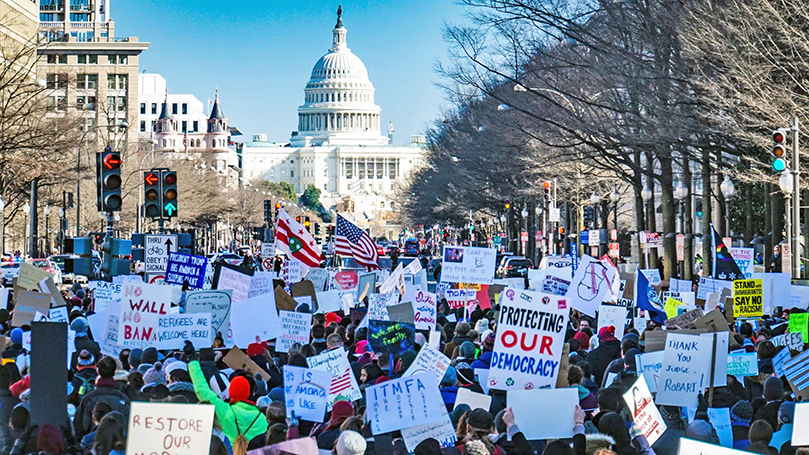
Demonstrations will continue to oppose the reactionary policies of President Trump

The election of a new President in the United States is always a moment of international significance, given the role the US plays in world politics.  The Presidential election of 2024 has been described as the most consequential in a generation and there is no doubt that the re-election of Donald Trump will have profound repercussions both in the US and internationally.

Trump’s first term appointments of reactionary judges to the Supreme Court has already led to the reversal of Roe v Wade and the attack on reproductive rights in the US.  While each State can at the moment determine its own position there is no guarantee that Trump will not introduce nationwide anti-abortion legislation, under pressure from the hardline Christian evangelist lobby.

The belligerent stand taken by Trump in relation to the Black Lives Matter Movement also does not augur well for progress in the discrimination and treatment of the Black and Latino communities in the US.  While the media are making much out of the increase in Trump’s vote share amongst these communities, over the more socially liberal Kamala Harris, work is still needed to analyse the pattern of voting and the impact of many who stayed at home.

As a long standing advocate of gun laws being as relaxed as possible, US citizens cannot look forward to any action to restrain the gun lobby in the US, led by the fanatical National Rifle Association (NRA).  The consequence of lack of control over gun law in the US  saw nearly 43,000 people die from gun related violence in 2023 and any hope for that number to drop significantly under Trump is slim.

Trump has the backing of a shady grouping around the Make America Great Again (MAGA) campaign, called Project 2025: The Presidential Transition Project.

The blurb on their website states it’s mission:

“ It is not enough for conservatives to win elections. If we are going to rescue the country from the grip of the radical Left, we need both a governing agenda and the right people in place, ready to carry this agenda out on Day One of the next conservative Administration.

This is the goal of the 2025 Presidential Transition Project. The project will build on four pillars that will, collectively, pave the way for an effective conservative Administration.”

Trump has also called for thousands of federal employees to be fired and to be replaced by workers who are appropriately vetted on the basis of their ideological belief in the limited role of federal government and personal loyalty to him, stating,

“I will require every federal employee to pass a new civil service test, demonstrating an understanding of our constitutional limited government.”

Tax cuts for the rich and cuts in public services for the rest are likely to be the reality of Trump’s policies.

On the world stage the US military industrial complex will be looking forward to continued profits as Trump will undoubtedly continue promoting the sales of US weapons and technology worldwide.

In relation to the ongoing Israeli action in the Middle East, in Gaza, the West Bank, Lebanon and Iran, Trump has made clear his unswerving support for Benjamin Netanyahu and the ongoing incursions by the Israel Defence Force (IDF), resulting in thousands of deaths over the past year.  Trump’s election victory was greeted enthusiastically by Netanyahu and his supporters in Tel Aviv.

In his first term as President, Trump tore up the Joint Comprehensive Plan of Action (JCPOA) in relation to Iran, which constrained Iran’s nuclear programme in exchange for a relaxation of sanctions.  Given Trump’s belligerent tone towards Iran, allied with his support for Israel, there is a clear danger of escalation of the conflict in the Middle East.  

In relation to Ukraine Trump has been more ambivalent but the strategic objectives of the US and NATO, in encircling Russia in order to contain its influence, remain real.  However any settlement regarding Ukraine is arrived at in the short term, this wider objective will remain.

In the Indo-Pacific the military built up to counter the so called ‘threat’ of China continues, with ongoing economic and military support for Taiwan being key, along with the threat to peace in the region posed by the AUKUS alliance of the US, UK and Australia.

Any moves towards rapprochement with Cuba, mild as they were under the Obama administration, were ditched during Trump’s first term.  Cuba was added to the US state sponsors of terrorism list.  To the shame of the Biden administration this position was not reversed and the ongoing illegal blockade against Cuba, imposed by the US, will continue under a new Trump Presidency.

The ongoing CIA campaign to undermine progress in Venezuela, a long running effort to install a US friendly regime in that country, is unlikely to change under Trump,  while a clampdown upon migration from Latin America in general will reinforce the jingoism which has been a hallmark of Trump’s policies.  Trump has vowed to oversee the largest mass deportation in US history for example and has repeatedly stated that immigrants are “poisoning the blood” of the country.

The Trump administration may not be characterised as fascist yet but Trump does have form.   According to John Kelly, former White House Chief of Staff, during a 2018 trip to Paris to commemorate the end of World War I, Trump told him that Hitler “did a lot of good things.”

Much of the United States will be waking up to the hangover of a second Trump administration.  The broad anti-MAGA coalition will continue to mobilise against the reactionary legislation Trump is bound to introduce. The Communist Party USA is calling for a renewed resistance movement to build the anti-fascist front that has been developing over recent years.  Resistance is not only possible but vital, for the people of the US and the world.

Protesters press for change in Iran

15th December 2018

Iran protests

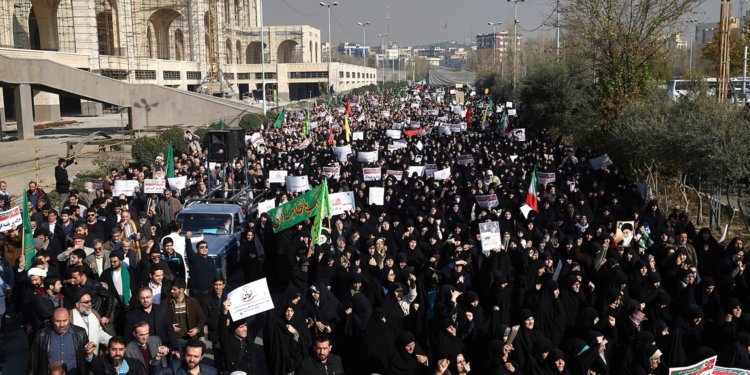
 Protests continue to engulf Iran

A wave of protests has gripped Iran throughout 2018 since demonstrations engulfed 85 cities across the country last January.  The protests are engaging the low paid, underemployed and disenfranchised, through to industrial workers in the steel and sugar industries and professional workers such as teachers.  There is no strand of Iranian society which has not been touched by the protests.  The regime is struggling to contain nationwide discontent. 

At the beginning of November teachers went on strike for two consecutive days across 27 major cities in Iran. The action was the second round of strikes since mid-October, aimed at putting pressure upon the government to carry out educational reforms and end mismanagement. The teachers’ action is also protesting against low wages and the violations of the educational rights of students and minorities.

Teachers are also demanding the release of imprisoned teacher trade unionists, an end to indiscriminate investigations and the ongoing arrests of union activists.

The protests by teachers have been supported by students who are increasingly recognising that the circumstances of their educators will impact upon their learning and future job opportunities.  Support has included student protesters at Tehran University, holding pictures of imprisoned teachers, interrupting a speech being delivered by Iranian President Hassan Rouhani.  The fact that students and teachers are feeling sufficiently emboldened to take action, which would have been unheard of just a few years ago in Iran, underlines the extent of the growing crisis inside the country.

Unrest has also been long running in the steel industry in Iran.  Workers at the Iran National Steel Industry Group (INSIG), in Ahwaz, have gone on strike numerous times in recent months to demand overdue wages. In June, many workers were rounded up by security forces and freed only when other workers launched protests.

As well as their immediate economic demands, steel workers are increasingly linking their situation to corruption at the highest levels of the Islamic Republic and articulating demands for political change.  This reflects many of the slogans echoed by teachers and students, adding to the growing sense of a crisis of political legitimacy in the country.

The same pattern is evident at the Haft Tapeh sugar cane facility, where workers went on ten continuous days of strike action in November, in protest at months of unpaid wages.  The political nature of the dispute was reflected in the chanting of slogans such as “hail to the workers, down with the dictator.”

The response of the Islamic Republic’s Supreme Leader, Ayatollah Ali Khamenei, to nationwide unrest among the millions of ordinary workers is that there is a “foreign plot” to overthrow the regime.

Since the US pulled out from the Iran nuclear deal in May and re-instituted two sets of sanctions targeting the Islamic Republic’s economy, the currency in Iran has been nosediving, affecting the value of wages and impacting upon the purchasing power of ordinary Iranians.

The deepening of sanctions by the United States, which came into play on 5th November, will only exacerbate this situation. The ability of Iran to trade on international markets is being restricted to the point where the US is effectively implementing a trade embargo.

There can be no doubt about the anti-people credentials of the Iranian regime.  For over 40 years the Islamic Republic has been to the forefront in its abuse, arrest and torture of the political opposition, trade unionists, women’s organisations and in suppressing student protests.  The regime in Iran is only matched in its vicious response to internal criticism by the United States’ key allies in the region, Israel and Saudi Arabia.

However, the sanctions imposed by the United States are not about acting in the interests of the Iranian people and freeing them from an oppressive regime.  The US sanctions are entirely about the power balance in the Middle East, with the US seeking to impose its will and maximise control of the region’s resources.

Ironically, the path being pursued by Trump was initiated under President Obama, as part of the United States’ New Middle East Plan, to reassert influence and bolster resource control in the region.  Obama’s version of the Plan resulted in the nuclear deal in 2015 and a more nuanced approach to containing the perceived threat of Iran to the regional power balance.

Not surprisingly, for Trump there are no such niceties.  To all intents and purposes, the gloves are off and the New Middle East Plan mark 2 is simply to bring Iran to its knees, whatever the cost to the prospects for peace in the region or to the plight of the people of Iran.

The worst case scenario, a military strike on Iran, is something many in the US administration have not taken off the table.  Western foreign policy, specifically that of the United States, is currently treading a very fine line from which one slip could plunge the region into war.

It is vital however, that whatever form change in Iran takes, it is based on the will of the Iranian people, not the will of external forces.  Solidarity with the people of Iran in their struggle for peace, human rights and democracy is more vital now than ever.

A democratic Iran would still face the threat of political sanctions and the ongoing danger of military intervention, by the US or one of its proxies in the region, but would nevertheless be a huge step forward for democracy in the Middle East.


Sanctions step up threat of war

26th August 2018

Donald-Trump-Iran-1000286

 Donald Trump continues to ramp up tensions with Iran

The next step in the undeclared war on Iran has been taken by the United States, with the first wave of sanctions in place, following the unilateral withdrawal of the US from the Joint Comprehensive Plan of Action (JCPOA).  Jane Green reports on the short term impact and possible long term consequences.

The JCPOA, widely known as the Iran nuclear deal, was agreed in 2015 by the United States, Russia and the European Union to halt the domestic uranium enrichment programme in Iran, in exchange for the relaxation of previously imposed sanctions.  The deal was being monitored by the International Atomic Energy Agency (IAEA) and, up until the most recent inspection earlier in 2018, Iran was deemed to be following the terms of the agreement.

US President Donald Trump has never been a fan of the deal and promised to withdraw as part of his election campaign rhetoric.  For Trump, relaxing sanctions on Iran simply allows the regime in Tehran to draw down international resources which it can then use to support its adventurous foreign policy, through what the US deems to be its proxies in the Middle East.

There can be no doubt about the anti-people credentials of the Iranian regime.  For over 40 years the Islamic Republic has been to the forefront in its abuse, arrest and torture of the political opposition, trade unionists, women’s organisations and in suppressing student protests.  The regime in Iran is only matched in its vicious response to internal criticism by the United States’ key allies in the region, Israel and Saudi Arabia.

However, the sanctions imposed last week by the United States, which will be further intensified on 4th November, are not about acting in the interests of the Iranian people and freeing them from an oppressive regime.  The US sanctions are entirely about the power balance in the Middle East, with the US seeking to impose its will and maximise control of the region’s resources.

Ironically, the path being pursued by Trump was initiated under President Obama, as part of the United States’ New Middle East Plan, to reassert influence and bolster resource control in the region.  Obama’s version of the Plan resulted in the JCPOA, a more nuanced approach to containing the perceived threat of Iran to the regional power balance.

For Trump there are no such niceties.  To all intents and purposes, the gloves are off and the New Middle East Plan mark 2 is simply to bring Iran to its knees, whatever the cost to the prospects for peace in the region or to the plight of the people of Iran.

The latest round of US sanctions has resulted in those European companies which had begun to re-engage with Iran, in putting plans on hold.  German car and truck manufacturer, Daimler, has dropped plans to expand its business in Iran.  French companies, Peugeot and Renault, have suspended operations in Iran and have said they will comply with the US sanctions.

French energy giant, Total, has said it will quit the multibillion-dollar South Pars gas project if it cannot secure a waiver from the U.S. sanctions.

Total signed a contract in 2017 to develop Phase II of the South Pars field with an initial investment of $1 billion and has not yet said what it will do with its 30 percent stake should it pull out. It has until 4th November to wind down its Iran operations, barring any surprise exemption.

The widespread withdrawal and suspension of economic activity by European companies is remarkable because the US sanctions have no international force and no United Nations backing.  The US strategy is essentially that of the playground bully.  Companies are free to deal with Iran if they choose but they may find it difficult to do business in markets with the US.  For most companies the choice between sticking with Iranian business or losing access to the US market is no choice at all.  The United States knows this and the international community appears powerless to prevent it.

The latest round of sanctions will cripple even further an already crumbling Iranian economy.  The confrontational position taken by the US is encouraging the hardliners in Iran to feel emboldened.  Former president Ahmadinejad has recently called upon current President Rouhani to resign.  Those who have always opposed the JCPOA are now regarding the word of the US as valueless and are seeking to turn the current turmoil to their advantage.

Further information at www.codir.net


Fooling no-one

14th July 2018

BabyTrump

Protesters in London object to the visit of US President, Donald Trump

The current UK heatwave, or what used to be known in the past as Summer, seems to have addled the brains of both inhabitants and visitors to these sceptre isles over the past week.  As TV drama it would have been reviewed as far-fetched, implausible and unworthy of the high standards we have come to expect from British TV culture.

Yet the improbable political soap around Brexit continues to throw up new plot lines and unlikely character twists on a daily basis.  A bit like the most intricate Scandi noir, it is not always possible to know what is going on exactly, but it is still sufficiently gripping to make you want to know the outcome.

UK Prime Minister, Theresa May, must have thought last week that the main drama was behind her and she could look forward to a satisfactory denouement.   At a four hour session in her country retreat at Chequers last Friday, May cajoled and coaxed agreement from a recalcitrant Cabinet around her Brexit ‘vision’, published later in the week as the White Paper, The Future Relationship Between the United Kingdom and the European Union.

The news on Friday night was that they had all signed up and yes, May was right, this is the way forward to an acceptable UK Brexit.  By midnight on Sunday the Secretary of State with responsibility for Brexit, David Davies, had resigned from the Cabinet, unable to sign up to May’s vision.

Unable to miss a ride on any passing political merry go round, bungling Foreign Secretary, Boris Johnson, decided to catch a ride out of the Cabinet chamber and back onto the Tory backbenches, proclaiming in characteristically histrionic style that the ‘Brexit dream is dying’….

May attempted to swat aside the loss of two Cabinet ministers in less than 24 hours and published the White Paper anyway.   Dominic Raab was appointed as the new Brexit Secretary and given orders to get the White Paper up and running in the House of Commons.  MPs who dutifully assembled to hear the new boy on his first day in the job were disappointed to find that, while the Secretary of State was about to make a statement, there were no copies of the White Paper for them to scrutinise.

The Speaker suspended the session and MPs rushed off to scurry around the darkest corners of the House of Commons print room (or wherever White Papers emerge from) before emerging with boxes full of the worthy document.  Distribution followed and scrutiny ensued…..

Enter stage right, the fool….

A stock element of Elizabethan drama first time round, the Fool seems to have taken on a new lease of life in the second Elizabethan age, not least in the form of the current President of the United States, Donald Trump.

Trump arrived in the UK with all of the pomp and ceremony a non-State visit allowed, which included meeting the Prime Minister, taking tea with the Head of State and having dinner with business leaders.  Quite how this will be topped if there is a formal state visit remains to be seen.  In any event it appears that the UK is all too willing to suffer fools gladly, especially if they are going to make a trade agreement.

However, this fool was not going to do that, according to an interview he gave to that high powered journal of record, The Sun, because Theresa May’s White Paper was rubbish and left the UK too close to the EU for comfort.  He also thought Boris Johnson would make a good Prime Minister and did not think that Theresa May was any good a negotiating deals.  That sorted, the fool, who had already told NATO leaders that they did not spend enough on weapons for his liking, set off for tea and cake with the Queen, making sure he and his wife got a nice pic for the photo album.

The joint press conference between Trump and Theresa May, looking as though she could be sick at any moment, saw Trump proclaim that all of the bad things he had said about May were simply ‘fake news’ and that the UK/US relationship was ‘super special’.  He also said she would do a good Brexit deal, so it turns out that he was just kidding about the other stuff all along.  That’s alright then…..

Trump is such a fool that he believes, in spite of the thousands on the streets protesting against his presence, that the people of the UK love him, so he jetted off to Scotland to play golf, in preparation for his summit in Helsinki with Russian President Vladimir Putin.

Somewhere in the middle of all of this there is a discussion going on about the White Paper, the UK’s negotiating position on Brexit and whether the EU will even tolerate it.  Maybe some rain in the coming weeks will help dampen things and proper political discourse will emerge.  Unfortunately, history suggests that the Summer is not the time for that.

Trump’s America Poles Apart

30th June 2018

Trump protest

 Further anti-Trump protests scheduled for 13th July in the UK

A divided nation and a divisive President pretty much sums up the position in the United States of America at the moment.  Well into the second year of his presidency, Donald Trump is showing no sign of being any less idiosyncratic in his behaviour or any less unpredictable in his policy pronouncements.   His arrival in the UK on Friday, 13th July for a three day “working visit”, will nevertheless involve him meeting the Queen, as Head of State in the UK’s archaic system, as well as meeting Theresa May at the PM’s country retreat, Chequers.

Protests are being organised across the UK, with the focus being upon London, to mobilise opposition to the politics of xenophobia, race hate and bigotry which Trump represents.  In the past six weeks almost 2,000 children have been forcibly separated from their parents at the US-Mexico border.  While their parents have taken the decision to flee their countries of origin for a variety of reasons, associated with drug cartel killings and the lawlessness which still characterises parts of Central America, this is no reason to criminalise four year olds who have no choice but to flee with their families.

Typically, the US has a different approach to migrants arriving from El Salvador, Guatemala or Mexico to those arriving from Cuba, who are greeted as anti-Communist heroes.  If the resources currently directed towards undermining democracy in Cuba were used to restrict the supply lines and activities of the drug barons in other parts of Latin America the flow of migrants at the US border would be stemmed.

For Trump though the numbers are not necessarily the issue.  Blaming immigrants for the problems of crime, social disorder and the economy is the last resort of every fascist scoundrel in history, so for Trump any level of migration would be deemed undesirable in his quest, as characterised by House Democratic leader, Nancy Pelosi, to “make America white again.”

Trump’s UK visit will be preceded by a NATO summit in Brussels on 12th July and followed by a meeting with Russian President, Vladimir Putin, in Helsinki on 16th July.  It promises to be an interesting few days.  Trump has made clear on many occasions his contempt for NATO, regarding it as an organisation into which the US pays too much and gets too little back in return.  The expectation on NATO members is that they spend 2% of their GDP on ‘defence’, a target which the UK is the only European government fool enough to meet, part of the reason for its crumbling transport infrastructure and public services.

It is anyone’s guess how Trump will play his hand at the NATO meeting but his discussions with Vladimir Putin, following close on, have made NATO generals nervous that Trump will make a major concession to Putin on arms or troop deployments, in order to grandstand on the world stage.  Both the NATO generals and US security services are well aware that Putin’s greater nous, political experience and KGB training are likely to mean he is more disciplined in any negotiation and capable of getting the upper hand over the bungling game show host.

Meanwhile, back in Trump heartland, where even the east coast is regarded as a foreign land, a storm has broken out over the actions of a small town restaurant in Lexington, Virginia.  Last Friday night Trump’s press secretary, Sarah Sanders, was half way through her meal at the Red Hen in Lexington when owner Stephanie Wilkinson asked her to leave.  This was based upon a staff vote in protest at the president’s policy of separating children from their parents at the Mexican border.

The Red Hen has been bombarded with eggs and excrement, besieged by angry protesters and as a result has been forced to close.  “Bikers for Trump” (not the environmentally friendly cyclist type) are planning a rally outside the restaurant.  A Greek restaurant next door, not involved in the original incident, has received a bomb threat.  The wine store next door has received abusive phone calls, including one suggesting that the owners should “rot in hell”.  At the same time the Red Hen has been inundated by flowers from those supporting the stance of the staff.

This is the politics of Trump’s America at the moment.  The Red Hen incident has prompted a national debate on civility and politics.  Needless to say, the positions taken on the issue are poles apart.  The debate will no doubt continue to rage back home, while Trump takes to Airforce One and pedals his poison overseas.  For action in the UK, in order to make 13th July a day for Trump to remember,  go to https://www.stoptrump.org.uk/


Pouring gasoline on the fire

7th May 2018

netanyahu(2)

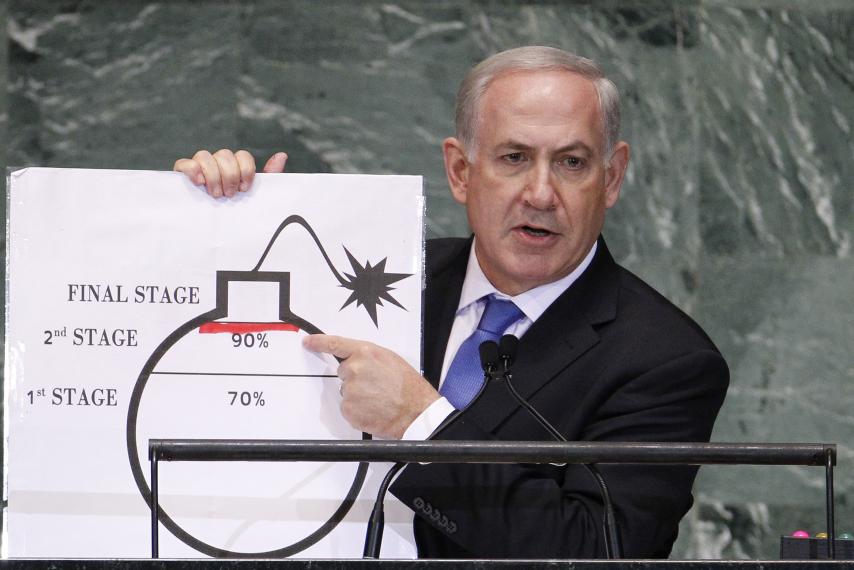
Netanyahu alleges Iranian nuclear capability

Events in the Middle East are building towards a critical point over the coming days with a combination of key decisions and key anniversaries combining to make what could be a potentially explosive mix of circumstances.  Added to which is the volatility of the key protagonists, not least US President, Donald Trump and Israeli Prime Minister, Benjamin Netanyahu, who have done their best to ramp up tensions in recent weeks.

Further uncertainty, provided by the theocratic dictatorships of Saudi Arabia and Iran, locked in a struggle for supremacy in the Muslim world, means that the chances of emerging from the next fortnight without a significant flashpoint are precarious.

The first key date is 12th May, when Donald Trump has a deadline by which to decide whether the US will continue to adhere to the terms of the Joint Comprehensive Plan of Action (JCPOA), which limits the capacity for Iran to develop nuclear technology.  The deal was signed in 2015 under the Obama administration and engaged the key EU nations along with the US, China and Russia.  In spite of the fact that the deal has barely made an impact upon the international sanctions imposed upon the Iranian regime, Trump regards the deal as “the worst deal in history” and has pledged to pull the US out of it.

The Israelis and Saudis, in a somewhat unholy alliance, back the US on the basis that anything which brings pressure to bear upon Iran, weakening the chances of Iranian economic recovery, is in their interest.   In a bizarre television performance last week Netanyahu took to the airwaves in Israel to allegedly reveal evidence of Iran’s development of nuclear weapons technology.

Quite where Netanyahu sourced his information is unclear, as the inspection regime headed by the International Atomic Energy Agency (IAEA), as part of the JCPOA, has verified 10 times, most recently in February of this year, that Iran is in compliance.

Netanyahu has stated that Israel is prepared to go to war with Iran in order to stop Iranian influence in the war of intervention in Syria, stating,

“We are determined to block Iran’s aggression against us even if this means a struggle. Better now than later.  Nations that were unprepared to take timely action to counter murderous aggression against them paid much heavier prices afterwards. We do not want escalation, but we are prepared for any scenario.”

Iran’s aggression against Israel appears to be the support provided to the government of President Assad in Syria.  This has resulted in the striking of Iranian targets inside Syria, by the Israelis, several times in recent weeks.

The provocation from Netanyahu and Trump is matched in kind by Iranian President Hassan Rouhani, who has pitched in to suggest that,

“If the United States leaves the nuclear agreement, you will soon see that they will regret it like never before in history.  Trump must know that our people are united, the Zionist regime (Israel) must know that our people are united.”

Iran has said that if the US reimposes sanctions it may resume enriching uranium.

Israel on the other hand has an undeclared nuclear arsenal of an estimated 200 nuclear warheads and is not a signatory to the international non-proliferation treaty.

The next date of significance, 14th May, is the 70th anniversary of the founding of the state of Israel.  It is closely followed by the day commemorated by Palestinians as the Nakba or ‘catastrophe’ on 15th May when thousands were driven from their land to make way for the Israeli state.

The wave of protests building up to these dates has already seen the Israeli Defence Force shoot dead 40 Palestinian protesters and injure countless others, as peaceful protests have been targeted by the Israeli state with live ammunition.

Jerusalem’s status has been a major obstacle in peace negotiations.  The international community, through the United Nations, hold that sovereignty over the city should be agreed between the two sides. Palestinians claim East Jerusalem as a capital of a future independent state, but Israel captured it in 1967. It later annexed the city and claims the entire area as its “eternal and undivided” capital.

During the course of this week of significant anniversaries the contribution of the US will be to move its embassy from Tel Aviv to Jerusalem.  Writing in Israeli paper Haaretz, Ilan Goldenberg, who was part of the US team during the 2013-14 Israeli-Palestinian negotiations stated that the embassy move,

“…could explode – and we could find ourselves in the middle of a new war between Israel and Hamas in Gaza. Nobody knows, but it is irresponsible for the US to be dumping gasoline on this potential fire.”

European leaders, Emmanuel Macron of France, Angela Merkel of Germany, even UK Foreign Secretary, Boris Johnson has attempted to persuade Donald Trump this week not to cut loose from the Iran deal and open the pandora’s box which would follow.  Will Trump listen to reason?  The track record so far is not good.  The clock is ticking….