Spring statement: For the few, not the many

27th March 2025

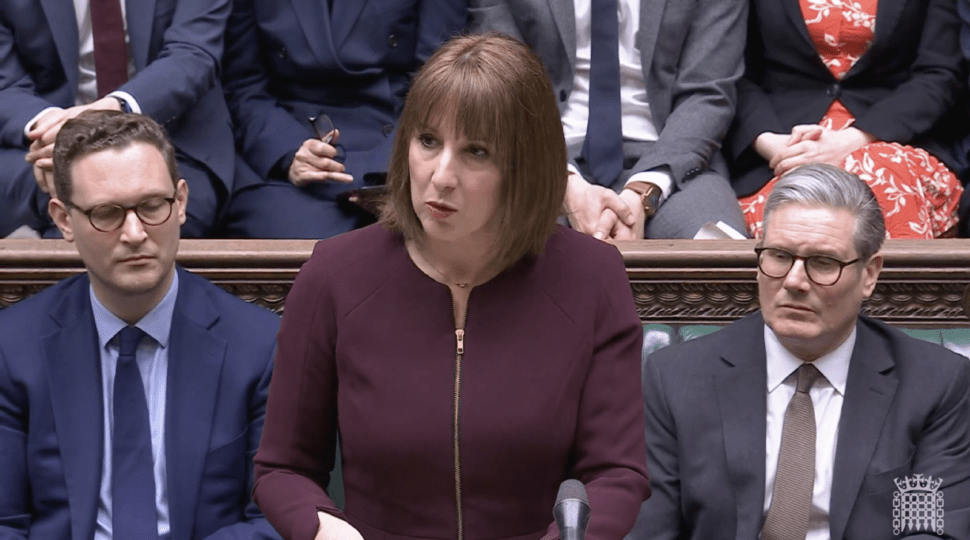
Chancellor Rachel Reeves – not winning friends amongst the working class

In a classic guns not butter statement yesterday Britain’s Chancellor, Rachel Reeves, hammered the poor in order to enrich the arms industry.  To add to the £2.9 billion already earmarked for the military budget next year Reeves found a further £2.2 billion, a grand total of £5.1 billion extra next year alone, with the promise of more to come.

In order to build this additional military capacity, to defend against a mythical Russian threat, Reeves not only hammered the poor in Britain with welfare cuts but cut the overseas aid budget further, just to ensure that the pain was spread at an international level.

Reeves claims to have cut welfare in Britain by £4.8 billion but the Resolution Foundation think tank calculates that  about 800,000 claimants will have reduced personal independence payments, saving the government £8.1bn by 2029-30.  It is estimated that this will affect 3 million families.

While Reeves pins her hopes on economic growth and getting people into jobs to offset the slashing of welfare, the Office for Budget Responsibility (OBR) halved Britain’s economic growth forecast for next year from 2% to 1%, which hardly suggests a boom in employment of any kind, let alone one which could compensate for the ripping away of the welfare safety net for many.

A recent economic analysis by the Joseph Rowntree Foundation, projects that living standards for families in Britian will be worse in 2030 than in 2025, with those on the lowest incomes declining twice as fast as middle and high earners.  The report indicates that the poorest third are being disproportionately affected by rising housing costs, falling real earnings and frozen tax thresholds.  Increased military spending, along with the other measures in the Spring statement, will further exacerbate this trend.

Even the Treasury’s own impact assessment estimates that  250,000 more people, including 50,000 children, will be left in relative poverty after housing costs by the end of the decade as a result of the government’s squeeze on welfare.

Just to add to the wider uncertainty about the economy US president, Donald Trump, this week announced a 25% levy on car imports to the US, with the possibility of further measures to come.  The danger of being sucked into a trade war, due to the actions of Trump, will further undermine the notion that Britain has a ‘special relationship’  that will allow it to be excluded from Trump’s wider tariff war.

However, speaking on Sky News, Reeves was firmly wedded to her deluded projections saying,

“I am absolutely certain that our reforms, instead of pushing people into poverty, are going to get people into work. And we know that if you move from welfare into work, you are much less likely to be in poverty.”

Given the nature of capitalism, as an exploitative system dominated by private sector companies whose main objective is to increase profit, not wages, Reeves vision is at best utopian, at worst simply an attempt to mislead and dissemble her way out of the fact that the cuts proposed are not out of necessity but are from political choice.

Of course, Reeves is not a one woman band.  She has the full backing of Labour leader Kier Starmer, the Cabinet and a majority of Labour MPs, so responsibility runs deep within the Parliamentary Labour Party, even though approval for the actions of Labour’s leadership is not shared by many trade union affiliates or local party activists.

Unite leader, Sharon Graham, condemned Reeves for rigidly sticking to her self imposed financial rules with the evidence of ruin in working class communities all around, stating,

“Rachel Reeves is right; the world has changed but why is it always everyday people that have to pay the price. They paid the price after the 2008 crash, the Covid pandemic and are now expected to pay the price again. It is simply wrong.”

Unfortunately Graham is unable to make the link between attacks on working class communities and the increase in military spending, going on to congratulate the government for  pledging to “invest in our defence in an uncertain global world”.

GMB General Secretary, Gary Smith, was more succinct stating,

“Tackling huge economic problems is a historic challenge. That’s why we need proper investment in key industries – and must nationalise them if necessary.”

On behalf of the TUC General Secretary, Paul Novak, took issue with the Office for Budget Responsibility (OBR), stating,

“It is time to review both the role of the OBR and how it models the long-term impacts of public investment. Short-term changes in forecasts should not be driving long-term government decision-making.”

Posting on X former Labour leader and Independent MP, Jeremy Corbyn, was absolutely clear,

“This Labour government could have taxed the wealthiest in our society.  It is disgraceful that they are choosing to go after the poor and disabled instead.”

Unity around the concepts of jobs not bombs, welfare not warfare and organising society in the interests of the many, not the few, are key to moving towards lasting socialist change.  There is clearly still work to be done across the Labour movement and within working class communities to  build support which recognises that these issues are linked and the common denominator is capitalism.

Ongoing mass extra Parliamentary action will play a key role in building that support  and that political understanding, vital in the progress towards a socialist future.

Kickstart or stalling?

4th February 2025

Reeves on economic growth – kickstart or cold start?

British Prime Minister, Keir Starmer, and Chancellor, Rachel Reeves, are in danger of having to eat humble pie when it comes to their ability to deliver on the promise of economic growth.  The mission of the present government has been made clear, economic growth, but simply repeating the mantra does not deliver the desired outcome. 

The keynote speech on the subject by Reeves  last week has only succeeded in re-opening the 20 year long debate about a third runway at Heathrow Airport; whether or not this will actually deliver growth anyway; how it will help Britain meet its net zero carbon targets; and why so much emphasis on investment in the South East when the rest of the country is crying out for economic support.  The aspiration to turn the corridor between Oxford and Cambridge into Britain’s Silicon Valley just reinforced this point.

Reeves claims that 60% of the benefits of a third runway at Heathrow will be felt in areas other than London and the South East, though without giving details as to precisely how.  The geographic distribution of investment may in any case be an academic point as the accumulation of wealth in the hands of a small minority, rather than ownership and production being in the hands of the people, will ensure the maintenance of Britain’s class system.  The working class are not going to be the ultimate beneficiaries, whether in John O’Groats, Land’s End or anywhere in between.

Socialism, or any aspiration towards it, is not on the agenda of this government, in common with all previous Labour governments, so tweaks to how capitalism functions is the best that they hope to deliver.  Even in those terms however, Reeves does not seem to have won any allies.

What used to be regarded as the environmental lobby but is actually articulating the interests of many in saving the planet, has been up in arms about the third runway proposal, as well as the possibility of the government consenting to the Rosebank development, Britain’s biggest untapped oilfield. 

The project is being led by Norwegian company, Equinor, and having had a consent application rejected in Scotland recently they are  expected to return with  a further proposal later in the year, claiming that “Rosebank is critical for the UK’s economic growth”, a euphemism for Rosebank being critical for Equinor’s profits and its shareholder’s dividends.

There are potential routes to economic growth, even in the short term, within the straitjacket of capitalist economics.  Investment in renewable energy technology would be an option that would both promote growth and contribute to net zero carbon targets.  Diverting spending away from the cost of weapons of mass destruction and nuclear submarines would free up resources, which could begin to address the crumbling schools and hospital infrastructure.  Investment in renewing the health and education systems would in itself help promote economic growth.

A renewal of the national rail network, charging point infrastructure to encourage the take up of electric vehicles, more resources for the creative industries, proper financing of local government, all of these things would contribute to economic growth, as well as providing the platform for arguing that public, and ultimately the people’s, ownership and control is the key to lasting economic change.

Sadly Starmer, Reeves and the Labour Cabinet have no such vision and remain trapped within the confines thinking that reform within capitalism is a sufficient goal.  Clearly it is no such thing, as working class families continue to grapple with rising water and energy costs, rising food costs, rising housing costs and deteriorating local services.  That was never going to be reversed in six months but a roadmap towards it could have been outlined and a vision fought for.

As it stands the demagogues of the far right are making up ground in Britain and across Europe; Zelensky in Ukraine, Meloni in Italy, Le Pen in France, Alternative fur Deutschland in Germany, to name a few. 

It is not impossible to see Reform UK taking seats off both Labour and the Tories at the next General Election  and shifting the political landscape in Britain even further to the right.   A YouGov poll published in The Times today (4th February) puts Reform on 25%, Labour on 24% and the Tories further behind on 21%.  While Britain is still a long way from a General Election if this trend continues Labour’s dream of a second term could easily be wiped out.

A response to such polling figures should be to mount a robust challenge to the politics of Reform and the Tories.  However, too many in the Labour Movement are afraid of being accused of being “woke”, a term that has become a pejorative in the hands of the right wing media to demonise anyone with progressive ideas or left wing politics.  The fact is that anyone not woke is, by definition, asleep and that will usually come with being bigoted, xenophobic, homophobic and in denial of the climate emergency.

Capitalism as a system, designed to serve the interests of the rich and powerful, cannot be modified in the interests of the working class, it must be overthrown.  The more the Left pussyfoots around this reality the more emboldened the right wing will be to push their simple answers to complex solutions.  This is the message the Labour and peace movements in Britain need to grasp and campaign upon, before the world is reshaped entirely in the image of Donald Trump or Elon Musk.   These are the people who must be stopped.  Theirs are the ideas that must be quashed.