Spring statement: For the few, not the many

27th March 2025

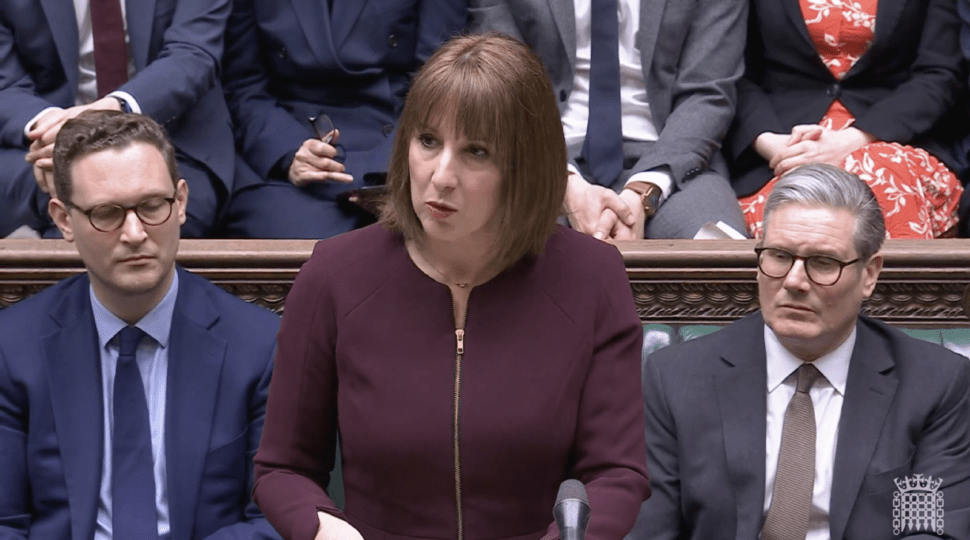
Chancellor Rachel Reeves – not winning friends amongst the working class

In a classic guns not butter statement yesterday Britain’s Chancellor, Rachel Reeves, hammered the poor in order to enrich the arms industry.  To add to the £2.9 billion already earmarked for the military budget next year Reeves found a further £2.2 billion, a grand total of £5.1 billion extra next year alone, with the promise of more to come.

In order to build this additional military capacity, to defend against a mythical Russian threat, Reeves not only hammered the poor in Britain with welfare cuts but cut the overseas aid budget further, just to ensure that the pain was spread at an international level.

Reeves claims to have cut welfare in Britain by £4.8 billion but the Resolution Foundation think tank calculates that  about 800,000 claimants will have reduced personal independence payments, saving the government £8.1bn by 2029-30.  It is estimated that this will affect 3 million families.

While Reeves pins her hopes on economic growth and getting people into jobs to offset the slashing of welfare, the Office for Budget Responsibility (OBR) halved Britain’s economic growth forecast for next year from 2% to 1%, which hardly suggests a boom in employment of any kind, let alone one which could compensate for the ripping away of the welfare safety net for many.

A recent economic analysis by the Joseph Rowntree Foundation, projects that living standards for families in Britian will be worse in 2030 than in 2025, with those on the lowest incomes declining twice as fast as middle and high earners.  The report indicates that the poorest third are being disproportionately affected by rising housing costs, falling real earnings and frozen tax thresholds.  Increased military spending, along with the other measures in the Spring statement, will further exacerbate this trend.

Even the Treasury’s own impact assessment estimates that  250,000 more people, including 50,000 children, will be left in relative poverty after housing costs by the end of the decade as a result of the government’s squeeze on welfare.

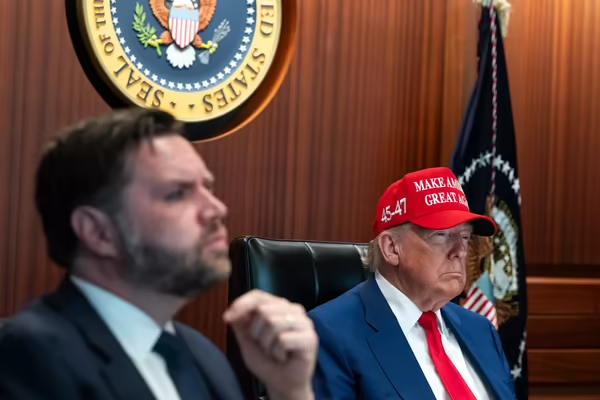
Just to add to the wider uncertainty about the economy US president, Donald Trump, this week announced a 25% levy on car imports to the US, with the possibility of further measures to come.  The danger of being sucked into a trade war, due to the actions of Trump, will further undermine the notion that Britain has a ‘special relationship’  that will allow it to be excluded from Trump’s wider tariff war.

However, speaking on Sky News, Reeves was firmly wedded to her deluded projections saying,

“I am absolutely certain that our reforms, instead of pushing people into poverty, are going to get people into work. And we know that if you move from welfare into work, you are much less likely to be in poverty.”

Given the nature of capitalism, as an exploitative system dominated by private sector companies whose main objective is to increase profit, not wages, Reeves vision is at best utopian, at worst simply an attempt to mislead and dissemble her way out of the fact that the cuts proposed are not out of necessity but are from political choice.

Of course, Reeves is not a one woman band.  She has the full backing of Labour leader Kier Starmer, the Cabinet and a majority of Labour MPs, so responsibility runs deep within the Parliamentary Labour Party, even though approval for the actions of Labour’s leadership is not shared by many trade union affiliates or local party activists.

Unite leader, Sharon Graham, condemned Reeves for rigidly sticking to her self imposed financial rules with the evidence of ruin in working class communities all around, stating,

“Rachel Reeves is right; the world has changed but why is it always everyday people that have to pay the price. They paid the price after the 2008 crash, the Covid pandemic and are now expected to pay the price again. It is simply wrong.”

Unfortunately Graham is unable to make the link between attacks on working class communities and the increase in military spending, going on to congratulate the government for  pledging to “invest in our defence in an uncertain global world”.

GMB General Secretary, Gary Smith, was more succinct stating,

“Tackling huge economic problems is a historic challenge. That’s why we need proper investment in key industries – and must nationalise them if necessary.”

On behalf of the TUC General Secretary, Paul Novak, took issue with the Office for Budget Responsibility (OBR), stating,

“It is time to review both the role of the OBR and how it models the long-term impacts of public investment. Short-term changes in forecasts should not be driving long-term government decision-making.”

Posting on X former Labour leader and Independent MP, Jeremy Corbyn, was absolutely clear,

“This Labour government could have taxed the wealthiest in our society.  It is disgraceful that they are choosing to go after the poor and disabled instead.”

Unity around the concepts of jobs not bombs, welfare not warfare and organising society in the interests of the many, not the few, are key to moving towards lasting socialist change.  There is clearly still work to be done across the Labour movement and within working class communities to  build support which recognises that these issues are linked and the common denominator is capitalism.

Ongoing mass extra Parliamentary action will play a key role in building that support  and that political understanding, vital in the progress towards a socialist future.

Coalition of the Wilting

20th March 2025

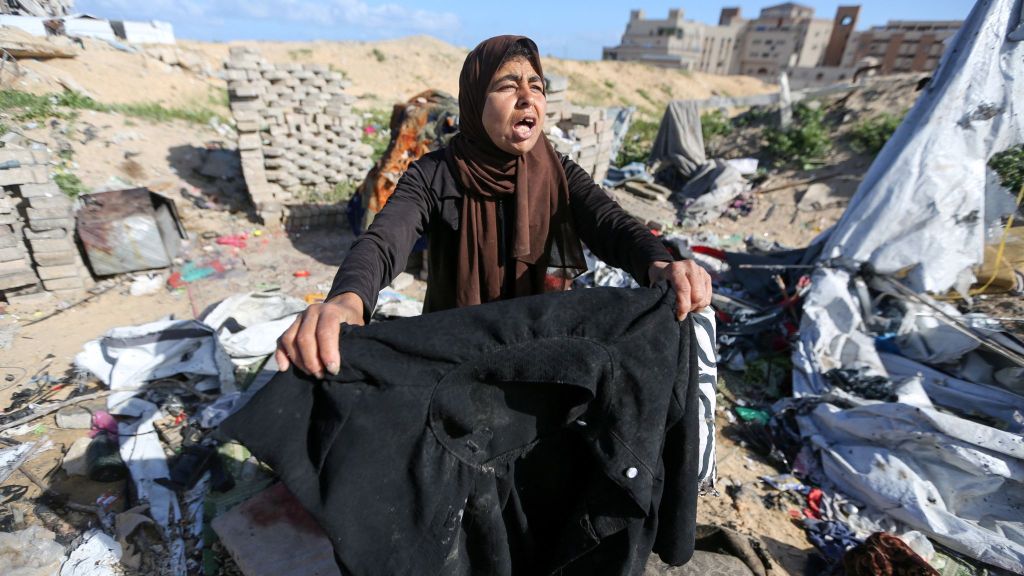
Israeli action in Gaza continues to hit civilian targets

While the Israeli Defence Force (IDF) resumes its genocidal bombing campaign against the people of Gaza, the leaders of European nations gather to work out how they can protect the right wing nationalist government of Volodymyr Zelensky from the Russian ‘threat’ in Ukraine. 

Israel has treated international law with impunity for decades while the West has not just turned a blind eye to the treatment of Palestinians but has armed Israel to the teeth in the process.  The United States has by far been the biggest arms supplier to Israel but Britain has provided more than its fair share of weapons used to keep the Palestinian population under the jackboot of the IDF.

As the Campaign Against the Arms Trade (CAAT) indicate,

“By the end of 2023, the USA had delivered 39 F-35 Joint Strike Fighters to Israel. Israel has a further 36 on order.  Israel has been using the F-35s extensively to bomb Gaza, operating them at a far higher rate than normal. This has depended on a constant supply of spare parts from the US and other countries producing components, including the UK.”

Working out direct British involvement can be complex as CAAT point out that licences for components go via the US for use in weapons manufactured by them.  While the government has instituted a partial suspension of export licences “it left in place licences for equipment such as components for trainer aircraft and naval vessels, as well as for components going to Israel’s arms industry to be included in equipment for onward export.” (https://caat.org.uk/data/countries/israel/)

By comparison to the actions of the IDF, the Russian action in Ukraine has not involved the subjection of an entire population, is not aimed at eradicating a nation, or displacing its population from their land.  On the contrary, the action of Ukrainian forces against the largely Russian speaking population of the Donbas region, which resulted in 14,000 civilian deaths between 2014 and 2022, precipitated the Russian action but has gone largely unreported by the Western media.

This version of events, does not fit the NATO narrative of an expansionist Russia looking to swallow up the neighbouring states, in advance of an onward march towards Western Europe.  NATO bosses would have us believe that the only possible defence against such an eventuality is to spend more on weapons to guard against the so called Russian threat.  The British government is committed to increasing spend on the military to 2.5% of GDP with a rise to 3% being mooted.  Calls have come from the US for NATO nations to be committing to 5% of GDP spend on the military.

It is hard to see this as anything other than a drive to war and certainly a drive towards greater profits for arms manufacturers who must be rubbing their hands with glee.

The right wing Polish government are asking for nuclear weapons to be stationed in Poland, minutes away from a strike on Moscow, to ‘defend’ against Russian invasion.  This in spite of the fact that as a member of NATO any attack on Poland would, under article five of the NATO Treaty, bring the whole of NATO to its defence.  Nuclear weapons in Poland will not add to that capability.

In spite of the Western commitment not to move NATO one inch eastwards the incorporation of Eastern Europe nations into NATO has effectively completed the encirclement of Russia over the past thirty years, with Ukraine being virtually the last piece in that jigsaw.

The ‘Russian threat’ bogie is a repackaging of the old Soviet threat myth from the days of the Cold War, when the NATO bloc had to have an ‘enemy’ to defend against, in order to justify its proliferation of nuclear and conventional weapons.

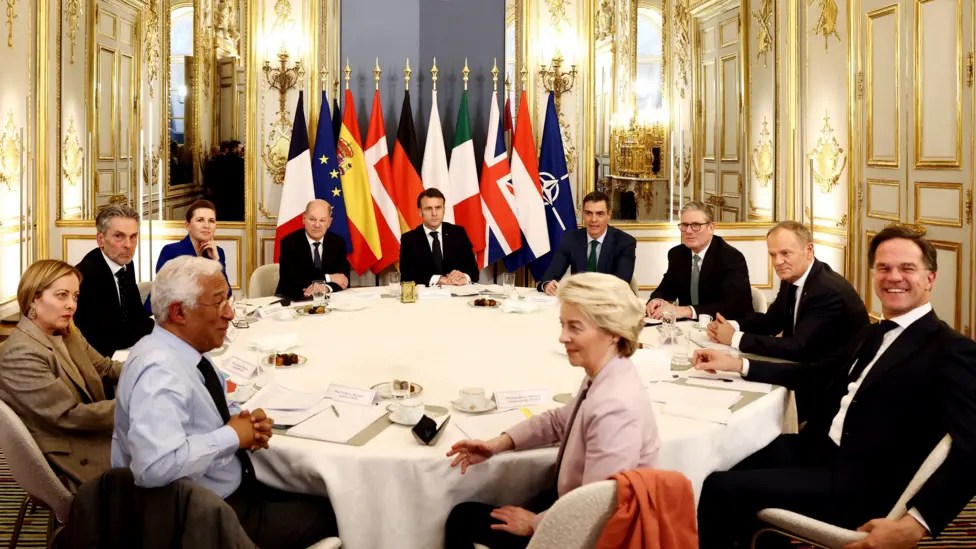
If history is played out first time as tragedy and second as farce then the so called Coalition of the Willing, convened by British Prime Minister, Kier Starmer, should be in the running for a comedy award.  Having been cut loose by the US, in relation to the strategy of defending Ukraine at any price, European leaders are scrambling around like latter day Keystone Cops wondering which way to turn.

However, it will be no joke should they make good on their threat to increase spending on weapons, which will only impoverish the European working class further and rob them of much needed social provision in the form of homes, schools, medical provision and transport infrastructure.  It will be less than amusing for working class families if their sons and daughters are sent to the frontline in ‘defence’ of Ukraine and find themselves embroiled in an unwinnable conflict.

The grandstanding of Starmer and Macron, the main drivers of the wilting European coalition, needs to be exposed and the priorities for a just settlement in Palestine and an end to war in Ukraine emphasised, as the key foreign policy objectives.

The drive to sustain the war in Ukraine, while ignoring Israeli genocide in Gaza, is a double threat to world peace.  Mass action on both fronts must continue while being linked to the struggle for jobs, health and homes, all of which will be threatened by the drive to war.

Wealth tax reform not welfare cuts

13th March 2025

Work and Pensions Secretary, Liz Kendall, ignoring UN warnings on poverty in Britain

In April 2024 the United Nations Committee on the Rights of Disabled People (UNCDRP) published a report into its findings regarding provision for disabled people in Britain, including the impact of welfare reform.  The UN found that  Britain has ‘failed to take all appropriate measures to address grave and systematic violations of the human rights of persons with disabilities and has failed to eliminate the root causes of inequality and discrimination.’

As signatories to the UN Convention on the Rights of Disabled People the British government agrees to periodic reviews of its provision for people with disabilities, the latest being initiated in 2023 and its report concluding in 2024 finding that  ‘grave and systematic violations’ of disabled persons rights had taken place since 2010 and that welfare reform had “disproportionally and adversely” affected the rights of people with disabilities. 

The report concludes that there has been no significant progress with independent living rights and active regression in relation to work and social security rights, recommending urgent measures be taken in relation to improvements in these areas. 

Given that much of the period of the review was covering the 14 years of Tory government such harsh attacks upon the rights of people with disabilities comes as no surprise.  The ‘skivers not strivers’ narrative is one that the Tories and their right wing media allies in the Mail, Express and Telegraph have been pursuing for some time, in order to deflect attention away from the obscene profits made by the super rich and the increased wealth of billionaires in Britain, which rose by £35 million a day last year.

This month the UN Committee on Economic, Social and Cultural Rights (CESCR) issued a series of recommendations to tackle poverty in the Britain.  The report urged Keir Starmer to reverse the five-week wait for universal credit in a warning that the British government is infringing human rights with the ongoing poverty crisis.

The report highlighted  fears over the Department for Work and Pensions’ (DWP) welfare reforms that have resulted in severe economic hardship, increased reliance on food banks, homelessness, negative impacts on mental health and the stigmatisation of benefit claimants.  It further urged government to up spending on benefits, remove the benefit cap and scrap the two-child limit, which prevents parents from claiming child tax credit or universal credit for more than two children.

Labour’s Work and Pensions Secretary, Liz Kendall, does not seem too perturbed by the UN’s findings.  With a Spring statement from Chancellor Rachel Reeves due on 26th March welfare reform, a euphemism for cuts to benefits, is clearly high on the agenda of both Kendall and Reeves.

Kendall’s stated position is that,

“I think the only way that you get the welfare bill on a more sustainable footing is to get people into work. And you know, we will be bringing forward big reforms that actually support people into work, that get them on a pathway to success.”

All of which may sound fine in a press conference but in the real world of de-industrialised, zero hour contract, low wage economy Britain it has a hollow ring.

Labour’s claim is that welfare reform is necessary to fill the fiscal black hole Reeves has discovered due to the economy not growing fast enough.  Kendall has refused to deny that the Treasury is looking for £5 billion of cuts to her budget. 

As ever, government economic decisions are about political choices, whatever issues may arise in relation to the world economy.  The current Labour government has ditched the notion of ‘jobs not bombs’ and gone for bombs, £12.8 billion to Ukraine alone, before the cost of supporting Israeli genocide in Gaza is factored in, or weapons sales to dictatorships such as Saudi Arabia.

There is clearly a case for reform of the welfare system in Britain, as the UN has pointed out, but that is not the same as making a case for swingeing cuts which will plunge people into further poverty.  There is certainly a case for reform of how the wealthy are taxed in Britain.  As Nadia Whittome MP for Nottingham East has pointed out,

“If we implemented something very moderate, like a 2% tax, a threshold of assets over £10m a year, that would only impact an estimated 20,000 people in the UK but would raise £24bn.”

These are the real choices a Labour government faces, yet again.  War or peace, rich or poor, capitalism or socialism?   Currently Keir Starmer and the Labour leadership are getting it wrong on all three counts.  There is clearly some pressure from progressive Labour MPs within Parliament but only mass extra parliamentary action will apply sufficient pressure to move the Labour leadership.  Putting wealth tax reform ahead of welfare cuts would be a step in the right direction.

Recognising the Stranger

On Palestine and Narrative  

by Isabella Hammad

Book Review

A sense of timing and an eye for synchronicity are common concepts deployed by authors in the construction of  a narrative.  On 28 September 2023 the British-Palestinian novelist, Isabella Hammad, gave the Edward W Said Memorial Lecture at Columbia University, now published as Recognising the Stranger: On Palestine and Narrative.

Hammad could not have foreseen that only a week later, on 7 October 2023, the Qassam Brigades of Hamas would, in response to the ongoing Israeli occupation and blockade of Gaza, launch a military attack upon Israeli military bases and kibbutzim.  The attack resulted in over 1,000 deaths and the taking of over 200 hostages, to be held until the 5,000 Palestinian political prisoners held in Israeli jails were released.

Hammad’s lecture would have been relevant and a percipient insight into the situation of the Palestinian people had the events of 7 October and their aftermath, not have happened.  However, given the Israeli response to the Hamas attack, Hammad’s lecture and subsequent Afterword: On Gaza, written in January 2024, take on added relevance.

In her original lecture Hammad is concerned with considering turning points, ostensibly in literature but also in the personal and political spheres.  Those points in a fictional narrative when characters have moments of recognition, when an aspect of the plot, which may have been clear to the reader, is revealed to the characters and what has been, up until then, a mystery falls into place.

Hammad suggests that in the personal and political spheres the concept of a turning point is “a human construction, something we identify in retrospect” (p.2) but that the moment in which we now live “feels like one of chronic ‘crisis’” (p.2).

Hammad explores the role and function of the novel in the contemporary world, competing against the wide range of other ‘entertainments’ on offer, yet still powerful and relevant enough to find a mass audience and speak to the need for narrative, storytelling and a search for meaning.

Hammad links the concept of turning points in literature to those in real life through the example of writers visiting the Palestine Festival of Literature and experiencing for themselves the reality of life for the Palestinian people under Israeli occupation.

“They visited Hebron, and saw the soldiers patrolling, guarding settlers;  they visited the destroyed town of al-Lydd; they navigated checkpoints; they travelled through Jerusalem and crossed in and out of the West Bank; they listened to statistics of killings and imprisonments and night time raids and asked careful questions.”  (p.21)

Hammad goes on to analyse the wider international debate regarding the position of the Palestinian people, the incremental retreat from insistence upon a two state solution, with Palestinians having a right to their own state, while the international community in the Global North, largely accept and reinforce the state propaganda and Zionist supremacist ideology of the Israeli regime.

Hammad does recognise that there is a shift in awareness amongst many ordinary people across the world, including amongst Israelis, a recognition that Palestinians have human rights.  She cites what co-founder of the Boycott, Disinvestment and Sanctions (BDS) movement, Omar Barghouti, calls an aha moment,

“…talking specifically about the moment when an Israeli realises, in a turning point of action, that a Palestinian is a human being, just like him or her.” (p.25)

While Hammad’s lecture inevitably focuses upon the work of Edward Said, as a prominent Palestinian intellectual, his literary criticism and her own practice as a writer, she does not shy away from exploring the reality of the stateless position in which Palestinians are forced to exist and the implications of this for their culture.

In her Afterword: On Gaza Hammad is clear that the action of 7 October in itself represents a turning point, comparing it to “an incredibly violent jailbreak” and asserting that,

“It also signified a paradigm shift: it showed that a system in which one population  is afforded rights that the other population is denied will be safe for neither.” (p.61)

Hammad robustly condemns the Israeli response to 7 October stating starkly that,

“Ten thousand dead children is not self defence.” (p.62)

A figure which has escalated significantly in the year since her afterword was written.  Hammad condemns the extent to which the Western powers, the United States in particular, have supplied Israel with weapons to continue the bombardment of Gaza and the role of the US in vetoing ceasefire arrangements.  This position may have changed for the moment but there is no guarantee that Israel will maintain it.

As Hammad states, as she moves towards a conclusion,

“The possibilities faced by the Israeli state for at least twenty years have been: maintain apartheid and forfeit the claim to being a democracy; return to the pre-1967 state borders and allow for the creation of a Palestinian state; break down the system of apartheid and enfranchise the Palestinians in a one-state reality; or conduct large scale ethnic cleansing.  They are choosing the last option.” (p.75)

Just over a year since that Afterword was written, it is clear that this is precisely the path that the Israeli regime has taken and that solidarity with the Palestinian people is more vital now than ever.

Isabella Hammad is the award winning author of ‘The Parisian’ and ‘Enter Ghost’.  In 2023, she was included as one of Granta’s Best of Young British Novelists.

Redrawing the map

18th February 2025

European leaders ponder what to do as the US pushes for a deal with Russia

European leaders have been in Paris this week wondering what to do about the apparent maverick actions of the United States, in relation to the NATO proxy war in Ukraine.  What at first seemed like a straightforward NATO vs Russia scenario, in defence of right wing nationalist Ukraine, has been complicated by the return to office of Donald Trump.  Not that Trump’s attitude to Ukraine should come as a surprise, he has been trailing it on his campaign journey for over a year, but Europe, including Britain, has been taking an ostrich like approach to the possibility of Trump’s return and they are now having to face the consequences.

The US has signalled bi-lateral discussions with Russia, underway in Saudi Arabia, in order to achieve a settlement, no doubt to be followed by conversations with Ukraine to persuade them to accept any deal.  There will inevitably be a quid pro quo in terms of US arms being sold to Ukraine, in exchange for access to resources such as mineral wealth.  Russia will incorporate the Crimea and Donetsk regions, in line with the stated wishes of those populations.

The European Union plus Britain may tub thump about the prospect of Russia extending its reach and invading the Baltic states and Moldova etc but this is largely a bogie of NATO’s own creation for internal consumption, to justify the persistent increase in arms spending.  The likelihood of Russia precipitating a response from NATO by overstepping its existing boundaries must be rated as very small in reality.  Europe’s Cold War anti Russia scaremongering is likely to wear thin as US priorities change.

So what is the endgame of US imperialism?  Russia, as it has been historically, is the weak link in the imperialist chain.  While rich in resources and still a significant nuclear power it does not pose a direct threat to the dollar based economic order.  However, in alliance with China, an actual economic threat to the US, and the wider BRICS network of nations, the role of Russia is more significant.

It is certainly in the interests of the US to drive a wedge between the current alliance of Russia and China.   Trump has also made it clear that the aim of the BRICS nations to move away from the dollar as the default international currency is not something he will tolerate.  Bearing in mind that Trump speaks, not purely as an individual but as the mouthpiece of US imperialism, his words take on greater significance.

The potential market which Russia represents for US firms, and the resources which it controls, are vastly greater than anything Ukraine can offer and certainly more than the European Union can lay claim to. 

European leaders in Paris have continued to bleat about the abandonment of Ukraine, British Prime Minister, Kier Starmer, referring to a “generational” security challenge posed by Russia and reiterating his commitment to deploying British troops if necessary.  The continued warmongering on the part of Starmer and other European leaders, with talk of a 5% of GDP spend on the military, is a recipe for a massive crackdown on public services which will hit working class families hard.  The economics of war may work for the military industrial complex, it will not work for the working class citizens of Europe.

Against this backdrop it may just be that the US has its eye on the bigger goal of competing with the rising economic might of China and positioning itself to reassert its grip on the international economy.

Ironically, it may be that Zelensky’s wild call for a European army, at the Munich Security Conference last week, may be the first recognition of this possibility.  While the media, as ever, portray things in terms of personalities it is not a Trump/Putin love in that we should be wary of but a strategic US/Russia alliance which would truly redraw the map and reshape the international order, creating a powerful economic and military bloc containing most of the planet’s nuclear arsenal.

What the EU/Britain could do in the face of this would be very tame and even China’s economic strength would pale by comparison.  They could huff and they could puff but it would be quite a house to try and blow down.

Towers of Ivory and Steel

13th February 2025

Review by Steve Bishop

Maya Wind’s detailed and incisive study, Towers of Ivory and Steel, charts the role of Israeli universities in systematically denying Palestinian freedom.  It should be a wake up call for any British university engaged in collaboration with Israeli counterparts, urging them to address distortions of academic practice and acknowledge the internationally recognised rights of Palestinians to equality of access to education.

British universities will not see themselves as colluding in the settler colonialism of the apartheid Israeli state.  They will rationalise any joint work as being on a purely academic basis, not part of a systemic exclusion of Palestinians from access to intellectual expression and freedom.

Maya Wind’s analysis debunks such liberalism and demonstrates how the Israeli university system is an embedded part of the apartheid state of Israel, actively supporting the settler colonial narrative of Zionist supremacy, and denying any Palestinian historical agency in land they have farmed, worked and lived on for generations.

Since October 2023 the world has once again seen the sheer scale of Israeli brutality towards the Palestinian population through the genocide in Gaza, backed by support from the United States, Britain and the European Union, culminating in the proposal of US President Donald Trump to ethnically cleanse Gaza of Palestinians.

This is the undeniably savage side of the Israeli Defence Force (IDF), the consequences of its actions filling news broadcasts around the world.  However, as Wind demonstrates, behind the smokescreen of liberalism in Israel’s universities there lies an ongoing and pervasive denial of access for Palestinians, a denial of study of their history, suppression of any student activism and an active collusion with the Israeli military and state by the university authorities.

In disciplines which under any circumstances should require objectivity and academic rigour, Wind shows how Palestinian dimensions are excluded.  Archaeological excavations led by Israeli academics at a site in Susiya, for example, revealed evidence of a synagogue and a mosque, illustrating both Jewish and Muslim heritage, yet as Wind notes,

“Ruins of a mosque were also found on the very same site as the synagogue, yet these were swiftly erased from the historical record; there is no mention of them in the official documentation or at the site itself.”  (p.26)

Wind demonstrates how legal studies are skewed to justify the actions of the IDF and the Israeli government in the international arena, “constructing interpretations that justify Israeli state and military policies” (p.40) while routinely processing arrested Palestinians under the Israeli military court system, rather than a civilian legal process.

In the field of Middle East Studies, Israeli universities actively collaborate with the state and the military, to reinforce a particular version of history.  The forced exclusion of over 700,000 Palestinians from their land, in the Nakba in 1948, is not covered for example.  As Wind indicates,

“What began as repression of academic research on the Nakba and Israel’s founding has since expanded into public scrutiny of syllibi addressing Israel’s military occupation and apartheid and, most recently, into a broader purge of any critical discourse on the military and the racial violence of the Israeli state.” (p128)

Any attempt by Palestinian students to commemorate the events of 1948 are violently shut down.  Such actions are facilitated by having uniformed soldiers on campus, as part of their training in military and intelligence work.  This presence is inevitably intimidating for the few Palestinian students tolerated at Israeli universities and reinforces the close links between university hierarchies and the military.

Wind provides detailed evidence of how Palestinian students are subject to arrest, incarceration, and torture for engaging in what would be regarded in most parts of the world as routine student activism.  For the Israeli state any degree of activism or expression of support for Palestinian statehood is treated with suspicion.

Launched in 2004 the Palestinian Campaign for the Academic and Cultural Boycott of Israel (PACBI) has worked to raise awareness of the role of Israeli universities in the repression of Palestinians and to call on “international scholars to initiate a boycott of Israeli academic institutions”. 

Closely allied is the Boycott, Disinvestment and Sanctions (BDS) Campaign launched in 2005 to exert pressure on Israel to meet its obligations under international law to, “first, end the colonization of Arab lands and dismantle the military occupation and the wall; second, recognise the right to full equality of Palestinian citizens of Israel; and third, respect and promote the right of Palestinian refugees to return.” (p.5)

Maya Wind is clear that support for the PACBI and BDS campaigns is a necessary step on the road to justice for the Palestinian people.  The research and analysis provided in Towers of Ivory and Steel is an important contribution to moving forward on that journey.

Kickstart or stalling?

4th February 2025

Reeves on economic growth – kickstart or cold start?

British Prime Minister, Keir Starmer, and Chancellor, Rachel Reeves, are in danger of having to eat humble pie when it comes to their ability to deliver on the promise of economic growth.  The mission of the present government has been made clear, economic growth, but simply repeating the mantra does not deliver the desired outcome. 

The keynote speech on the subject by Reeves  last week has only succeeded in re-opening the 20 year long debate about a third runway at Heathrow Airport; whether or not this will actually deliver growth anyway; how it will help Britain meet its net zero carbon targets; and why so much emphasis on investment in the South East when the rest of the country is crying out for economic support.  The aspiration to turn the corridor between Oxford and Cambridge into Britain’s Silicon Valley just reinforced this point.

Reeves claims that 60% of the benefits of a third runway at Heathrow will be felt in areas other than London and the South East, though without giving details as to precisely how.  The geographic distribution of investment may in any case be an academic point as the accumulation of wealth in the hands of a small minority, rather than ownership and production being in the hands of the people, will ensure the maintenance of Britain’s class system.  The working class are not going to be the ultimate beneficiaries, whether in John O’Groats, Land’s End or anywhere in between.

Socialism, or any aspiration towards it, is not on the agenda of this government, in common with all previous Labour governments, so tweaks to how capitalism functions is the best that they hope to deliver.  Even in those terms however, Reeves does not seem to have won any allies.

What used to be regarded as the environmental lobby but is actually articulating the interests of many in saving the planet, has been up in arms about the third runway proposal, as well as the possibility of the government consenting to the Rosebank development, Britain’s biggest untapped oilfield. 

The project is being led by Norwegian company, Equinor, and having had a consent application rejected in Scotland recently they are  expected to return with  a further proposal later in the year, claiming that “Rosebank is critical for the UK’s economic growth”, a euphemism for Rosebank being critical for Equinor’s profits and its shareholder’s dividends.

There are potential routes to economic growth, even in the short term, within the straitjacket of capitalist economics.  Investment in renewable energy technology would be an option that would both promote growth and contribute to net zero carbon targets.  Diverting spending away from the cost of weapons of mass destruction and nuclear submarines would free up resources, which could begin to address the crumbling schools and hospital infrastructure.  Investment in renewing the health and education systems would in itself help promote economic growth.

A renewal of the national rail network, charging point infrastructure to encourage the take up of electric vehicles, more resources for the creative industries, proper financing of local government, all of these things would contribute to economic growth, as well as providing the platform for arguing that public, and ultimately the people’s, ownership and control is the key to lasting economic change.

Sadly Starmer, Reeves and the Labour Cabinet have no such vision and remain trapped within the confines thinking that reform within capitalism is a sufficient goal.  Clearly it is no such thing, as working class families continue to grapple with rising water and energy costs, rising food costs, rising housing costs and deteriorating local services.  That was never going to be reversed in six months but a roadmap towards it could have been outlined and a vision fought for.

As it stands the demagogues of the far right are making up ground in Britain and across Europe; Zelensky in Ukraine, Meloni in Italy, Le Pen in France, Alternative fur Deutschland in Germany, to name a few. 

It is not impossible to see Reform UK taking seats off both Labour and the Tories at the next General Election  and shifting the political landscape in Britain even further to the right.   A YouGov poll published in The Times today (4th February) puts Reform on 25%, Labour on 24% and the Tories further behind on 21%.  While Britain is still a long way from a General Election if this trend continues Labour’s dream of a second term could easily be wiped out.

A response to such polling figures should be to mount a robust challenge to the politics of Reform and the Tories.  However, too many in the Labour Movement are afraid of being accused of being “woke”, a term that has become a pejorative in the hands of the right wing media to demonise anyone with progressive ideas or left wing politics.  The fact is that anyone not woke is, by definition, asleep and that will usually come with being bigoted, xenophobic, homophobic and in denial of the climate emergency.

Capitalism as a system, designed to serve the interests of the rich and powerful, cannot be modified in the interests of the working class, it must be overthrown.  The more the Left pussyfoots around this reality the more emboldened the right wing will be to push their simple answers to complex solutions.  This is the message the Labour and peace movements in Britain need to grasp and campaign upon, before the world is reshaped entirely in the image of Donald Trump or Elon Musk.   These are the people who must be stopped.  Theirs are the ideas that must be quashed.

Warning signs – First week of Trump 2.0 spells out dangers

22nd January 2025

Mass opposition to Trump underway in the USA

At the victory rally held in advance of his official inauguration, US President Donald Trump vowed to get rid of the “radical Left woke” which he saw as dominating American life and culture.  For Trump the term encompasses a whole range of progressive policies and positions that working class organisations have fought for and won over many years but Trump and his cronies see as an impediment to the realisation of their particular version of the American Dream, to make the rich even richer.

In less than a week Trump has signed orders to withdraw from the Paris climate agreement; withdrawn the US from the World Health Organisation (WHO); declared a national emergency on the US/Mexico border, in order to not only halt migration into the US, but initiate the biggest mass deportations in US history; declared that children of migrants, born in the US, will no longer be deemed to have automatic rights to US citizenship, contrary to the 14th amendment of the US constitution; and granted pardons to nearly 1600 of his followers who stormed the Capitol building in January 2021, in spite of them having been convicted following due process in US courts.

Trump has also issued an executive order calling for an end to what he describes as “dangerous, demeaning and immoral”, diversity, equity and inclusion schemes, putting all staff overseeing such programmes on paid leave with immediate effect.  Consistent with this approach Trump has declared that in relation to gender in the US there, ”will be two sexes, male and female”, clearly a swipe at the transgender and LGBT communities.

In the US the People’s World noted that Trump has also “ended the Biden administrations Justice40 initiative, which set a policy that 40% of the benefits of federal investment must go to disadvantaged communities and repealed an executive order setting up a national goal for electric cars to make up half of new cars and truck sales by 2030.”

Flying in the face of all of the evidence that the planet faces a climate emergency, Trump’s response has been, ‘drill baby, drill’, and a promise of more permissions for oil and gas exploration to be granted.  Tariffs on imported goods from Canada and Mexico it has been suggested could be at 25% while a trade war with China, imposing tariffs on Chinese goods is in Trump’s sights, with a 10% tariff likely to be imposed as early as next week.  The mobilisation of the US military in the South China Sea and the possibility of Taiwan being a provocation for military action against China cannot be ruled out.

While Trump has already made belligerent noises in relation to Greenland and Panama, allegedly in the interests of economic and military security, some form of action against Iran is also a likely scenario, either directly or through proxy Israel, and there is almost certain to be an even greater intensification of the illegal blockade against Cuba.  Newly sworn in Secretary of State, Marco Rubio, is known for his vicious anti-Cuban views.

While there is a degree of naivety amongst some on the Left that Trump can only serve one term and sense will prevail in 2028, there is no indication that the Democrats have either a strategy for winning back working class votes or a credible candidate to front a campaign.  There is also the possibility that the constitutional constraint on Presidents only serving two terms could be overturned and a Trump Presidency extended into the 2030’s.

In any event, based upon the first week in office it is clear that there is no room for complacency.  Progressive trade union, women’s and civil rights groups, along with the Communist Party USA, are organising resistance at local, state and national levels to challenge Trump every step of the way, opposing both domestic policy and the imperialist designs of the US across the world.  

Supporting these efforts will become increasingly important as Trump’s term progresses.  That will include putting pressure upon the British government not to kowtow to the agenda of racism, imperialism and the threat of war which Trump’s second term will undoubtedly herald.  Trade unions, the Labour Party and progressive campaigns such as Stop the War and CND must ensure that mass extra Parliamentary action is used effectively to press for an independent British foreign policy, free of US diktat, leaving NATO and reducing military spending.   

The noxious smell of Musk

12th January 2025

Musk and Farage – potential partners in crime

The whiff of musk which followed Donald Trump around the campaign trail in his bid to return to the White House in the United States has become an acrid and pervasive smell.  Worse still, the odour has been caught on the Atlantic winds and made its way across the ocean to become a stench in danger of immobilising further the political life of Britain.

The world’s richest man, Elon Musk, has an estimated worth of US$421 billion.  Not content with a role gifted by Donald Trump to run a Department of Government Efficiency, effectively Trump outsourcing cuts in public services, Musk has recently been intervening in British politics on the subject of grooming gangs, which has stirred considerable controversy, and his on again off again threat to fund Nigel Farage’s Reform Party to the tune of $100 million.

Since acquiring the media platform formerly known as Twitter, now X, in October 2022, Musk has diluted verification measures on the site and, according to a wide range of campaign groups, has overseen a growth in racist hate speech, homophobic slurs and antisemitic comments on the platform.  In November 2023, the Centre for Countering Digital Hate released a new report claiming 98% of misinformation, antisemitism, Islamophobia, and other hate speech, in relation to the Israeli genocide in Palestine, remained on X after 7 days of reporting, generating over 24 million views. 

To say that Musk has significant power and influence would be an understatement.  That this influence is being used in an attempt to distort the political landscape in Britain, consistent with the distortions already evident in the US, would be hard to deny.

The recent controversy around grooming gangs, repeated in a wave of social media posts, including some amplified by Musk, allege that a 2008 Home Office document advised police not to intervene in child grooming cases because victims had “made an informed choice about their sexual behaviour”.

The unfounded claim about a Home Office circular to police stems from an interview Nazir Afzal, former Crown Prosecution Service chief prosecutor for North West England, gave to the BBC on 19 October 2018. He now admits that he had not seen any such circular himself, despite apparently stating its existence as fact.

In a statement to the BBC, the Home Office said it had never instructed police not to go after grooming gangs:

“There has never been any truth in the existence of a Home Office circular telling police forces that grooming gangs should not be prosecuted, or that their victims were making a choice, and it is now clear that the specific circular which was being referred to does absolutely no such thing.”

However, none of this has gained traction on X, though Musk’s suggestions that Keir Starmer failed to prosecute gangs and that Home Office minister Jess Phillips “deserves to be in prison”, as well as being described by Musk as  a “rape genocide apologist”, have gained widespread coverage.

The Child Sexual Abuse Inquiry, which published its findings in 2022, makes clear that  “abuse must be pursued and challenged everywhere with no fear or favour”.  Professor Alexis Jay, who led that inquiry, has said that she felt “frustrated” that none of its 20 recommendations to tackle abuse had been implemented more than two years later.

However, none of this makes it an issue for Elon Musk, and his intervention has only accelerated disinformation around this issue.  The far right have pounced upon the issue of child sexual exploitation (CSE) to suggest that grooming is predominantly an issue of race or religion, citing the fact of men of Pakistani heritage being involved in cases in Rochdale, Rotherham and Telford.  However, Home Office research published in 2020 draws no such conclusion, in fact stating that “Research has found that group-based CSE offenders are most commonly White.” (Group-based Child Sexual Exploitation Characteristics of Offending – December 2020)

Clearly the Tories, who have also jumped on this bandwagon, failed to do anything about the Jay Inquiry when in office.  In fact Tory leader Kemi Badenoch opted this week to try and stop Labour’s Bill aimed at protecting children.  Labour have the opportunity to consider and implement the Jay recommendations.  This must be a priority as a minimum in relation to this issue.

To add to the looming disinformation wars Meta boss, Mark Zuckerberg, announced this week that the third party fact checking network set up in 2016, in relation to Facebook and Instagram is to be dismantled, accusing them of being “politically biased”.  How effective the network has been is open to debate but the fact that Zuckerberg sees fit to jettison it, just as Donald Trump calls in the removers for his return to the White House and Elon Musk decides on the arrangement of furniture, is further cause for concern.

Zuckerberg has stated that he will,

“work with President Trump to push back on governments around the world that are going after American companies and pushing to censor more.”

Lies, deceit and disinformation are an endemic part of the capitalist system and core to its functioning to discredit the Left and any opposition.  The smear campaigns run against Jeremy Corbyn as Labour leader may yet come back to haunt Starmer as the world wide bastions of right wing authoritarianism mobilise around Trump’s return to the White House.

Labour may have been seen as a safer pair of hands than the Tories in the short term as far as British capital was concerned but US imperialism may not see things the same way.  Toying with funding for Farage sends just such a signal.

We have already heard threats against, Greenland, Panama and the desire for Canada to become the 51st US state coming from the President Elect.  Some of this may be bluster but may equally be laying the ground for the looming conflict with China, which the US is keen to engineer.  If that does happen there could be many innocent victims but there is a guarantee that for Trump and his international media cronies, truth will certainly be one of them.

Popular policy to put people first

5th January 2025

Cuban medical workers – under pressure but an example to the world

The year begins with much media speculation about the collapse in popularity of the Labour government and its leader, Keir Starmer.  The economy is not showing signs of recovery. The winter fuel allowance issue is returning to haunt Starmer and Chancellor Rachel Reeves, as the cold weather kicks in.  The much trumpeted review of the NHS does not report until the Spring and the reform of social care will take until 2028.  Business leaders continue to use the increase in employers national insurance as an excuse not to recruit, or to resist wage increases, in spite of hefty profits going to shareholders.

Public services are struggling with the need for investment to function efficiently or, in the case of the energy sector, with the obscene profits made by companies failing to deliver an effective service to communities.  The water industry is the biggest offender  but others in the sector are equally guilty of milking profits from hard pressed working class families while not addressing the need for investment in modernisation.

The crisis in the NHS is a major case in point.  Recent reports suggest that every acute hospital trust in England is failing to hit the target to treat 92% of patients within 18 weeks.  There are 7.5 million people on the waiting list for treatment.  The government did promise a £22.6 billion increase for the NHS in the last budget plus an additional £3.1 billion for capital investment.  This is welcome and, with the hard work and dedication of staff in the NHS, may result in some short term improvement.

However, even these figures are a sticking plaster over a gaping wound.  Britain currently spends £64.6 billion per annum on weapons of mass destruction and the military.  Labour is committed to increasing that figure to £87.1 billion to meet its commitment to spending 2.5% of GDP on the military.  The equipment plan alone for the Ministry of Defence over the period 2021-31equates to £238 billion plus, according to official forecasts, £117.8 billion on nuclear weapons.  CND estimate that the latter figure will in fact be nearer £205 billion. (see The Fight for Peace and Disarmament by Gary Lefley – Socialist Correspondent Issue 53 Winter 2024)

The obscene spend on the military is argued for by the ruling class, with Labour support, as being necessary for defence but in fact just makes Britain a potential target.  Given the craven support of the British ruling class for US wars of intervention across the world, including the Ukraine and Israeli genocide in the Middle East, and the backing given to US sabre rattling over China, this danger is likely to increase.

Meanwhile, ambulances are queued outside of hospitals waiting to register patients, who cannot be admitted because beds are occupied by people without any social care arrangements, and emergency calls suffer as a consequence.  It is a vicious circle and one which will undoubtedly impact disproportionately upon working class communities.

If Starmer and the Labour government want to increase their popularity, shifting the balance of resources from weapons of mass destruction to investment in health, social care and education would be a progressive step. Shifting the emphasis in both foreign and domestic policy onto improving the lives of working class communities, rather than put them under threat would be a huge leap forward.

At present the health service, in spite of the emphasis upon community health, aimed at preventing hospital admissions and promoting healthier lifestyles, cannot cope with the needs it has to address at the acute end of the healthcare spectrum.  Any additional resources inevitably go into trying to prop up the needs of the most vulnerable and little is left for prevention work.

In a socialist system this would be different.  This is not theory, there is a practical example in the form of Cuba.   In spite of the 60 year long illegal economic blockade, imposed by the United States, the Cuban healthcare system is an example to the world in terms of its approach.    Community based care and access to local medical centres are key  but struggle because of the lack of resources due to the US blockade.  The Cuba Vive Medical Aid Appeal is currently crying out for sutures, syringes, catheters, antibiotics, butterfly needles and paracetamol. These are just a few of the items on the list of needs for Cuban hospitals and polyclinics.  https://www.cubavive.org.uk/donate/

The resources available in Britain however means that there is no excuse not to invest and properly resource the NHS, as well as the social care system.  It is an act of state negligence not to do so.  Labour would do well to look less towards supporting the imperial ambitions of the United States and more towards the needs of working class communities in Britain.   That would be popular in every sense.