Stop Arming Israel

12th July 2025

The persistence of the genocide carried out on behalf of the Israeli government by the Israeli Defence Force (IDF) continues at a staggering level.  The IDF show no remorse for the killing of innocent civilians, 15 of whom died queueing to access food this week.  The IDF claim to have been targeting a Hamas ‘terrorist’ so the loss of civilian life was simply collateral damage. 

This weekend has seen a further 50 deaths including 10 at a water collection point which saw 6 children killed. This follows the killing of 110 people on Saturday including 34 at a food collection point in Rafah. Since 7th October 2023 the IDF has killed at least 57,882 people and wounded 138,095, according to Gaza’s Health Ministry.

According to the United Nations an estimated 800 Palestinians, many children, have died while seeking food at the so called Gaza Humanitarian Foundation (GHF) distribution points.  The GHF is run by the United States, using American mercenaries, and backed by Israel.  GHF has four distribution points, compared to the 400 previously operated by the UN, which Israel will no longer permit to operate.

Random killing was also the approach applied by the IDF in the recent Israeli bombing of Iran, which resulted in the assassination of a number of leading figures in the Iranian armed forces as well as key nuclear scientists.  Western media reports played down the fact that in many instances it was not only the military and scientific targets who were murdered but many of their families, innocent of any ‘crime’ as deemed by the Israelis.

Such atrocities are often mis-reported, under reported or not reported at all by the media, keen to play down the extent of Israel’s flouting of international law but also uncomfortable covering any British government complicity in the genocide.

Palestinian deaths certainly don’t warrant the attention any criticism of the IDF does for the British media.  Punk rap act Bob Vylan became the all round media villain recently when his Glastonbury set included him chanting “Death to the IDF”.  The Mail on Sunday saw fit the following day to go with the banner headline “NOW ARREST PUNK BAND WHO LED ‘DEATH TO ISRAELIS’ CHANTS AT GLASTONBURY”. 

The bandwagon rolled on into Monday with the Sun, Daily Mail, Daily Telegraph and the Daily Express weighing in and Kier Starmer proclaiming the comments “appalling hate speech”, stronger language than he uses when mentioning IDF atrocities.

Quite apart from the inaccuracy of the original Mail on Sunday headline, the claim made by the paper, that this was “antisemitic chanting”, was simply not true.  The IDF, being the military wing of the Israeli state, does not represent all Israelis, any more than the government of Benjamin Netanyahu, which continues to face internal criticism for its policy and actions in relation to Gaza and the West Bank.  Criticism of the IDF or the Israeli government is not antisemitic, it is a perfectly legitimate political stand to take in the face of their ongoing actions against the Palestinian population.

That Kier Starmer, as Prime Minister and Leader of the Labour Party, should join in such baying for blood along with the right wing media is a disgrace.  Starmer and the government’s complicity in crimes against the Palestinian people is underlined by the Campaign Against the Arms Trade (CAAT) which, in relation to British arms sales to Israel,

“…estimates that between October 2023 and May 2024, over 100 new licences were issued, with a total estimated value of at least £100 million in military equipment since October 7th, 2023. These sales include components for F-35 combat aircraft, which CAAT estimates account for approximately 15% of the value of each F-35 and are used in ongoing conflicts, including those in Gaza.”

The government defends its position by claiming that  “no evidence has been seen that Israel is deliberately targeting civilian women or children”. It further claims that “there is also evidence of Israel making efforts to limit incidental harm to civilians”.

The actual evidence, coming back from the UN, Médecins Sans Frontieres and Palestinian people themselves suggests that the British government is either being extremely naïve, or is simply lying.

The latest Israeli proposal, to create a concentration camp for Palestinians on the ruins of Rafah in the south of Gaza, would be a further crime against humanity.

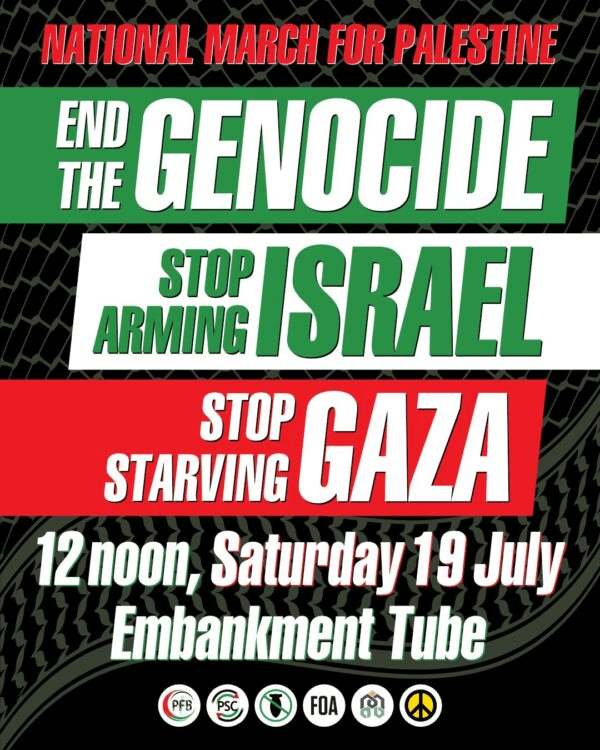
The latest National March for Palestine, organised by Palestine Solidarity Campaign and its allies takes place on 19 July in London.  The pressure on the British government to stop arming Israel and stop the starvation in Gaza must continue.

US and Israel complicit in war crimes

5th June 2025

Out on a limb – the US once again vetoes a ceasefire in Gaza at the United Nations

The so-called Gaza Humanitarian Foundation (GHF) is nothing more than a trojan horse created by the United States and Israel to facilitate the ethnic cleansing of Palestinians from Gaza.  The BBC and international media continue to report on its activities as if it had some credibility when in reality it has none.

Established two weeks ago, the GHF was set up to bypass the work of the United Nations and other international aid agencies, who have tried and tested methods of delivering international aid through well established local networks.

The Israelis claim that aid through these routes is being hi-jacked by Hamas and is not reaching the people who need it.  They have produced no evidence whatsoever to back up such claims.  The GHF, which is not run by experienced aid workers, but is staffed by private US security agencies, lacks local knowledge, local networks and has only four centres from which aid can be accessed.

The UN and international aid agencies have 400 sites across Gaza from which aid could be accessed should the Israeli military allow.  The GHF have a limited number of sites in the south of Gaza, where the Israelis are attempting to drive the Palestinian population, and they are only accessible by civilians going through known combat zones.  Nearly one hundred civilians have been killed by Israeli troops and hundreds more wounded in the past two weeks, attempting to access aid at GHF hubs.

The hubs are located in Israeli military zones, where journalists have no access.

To reach the sites in Rafah, Palestinians must walk for miles along a designated route where GHF says the Israeli military keeps security. In statements to the public, GHF has warned people to stay on the road, saying leaving it “represents a great danger.”

Distribution usually starts at 5 a.m. each day but thousands of Palestinians start walking hours earlier, desperate not to miss out on food. That means large crowds passing by Israeli troops in the dark.

Israel admitted on Tuesday for the first time that its forces shot at Palestinians. In a statement, the Israel Defence Forces (IDF) said troops fired shots near a food distribution complex after noticing “a number of suspects moving towards them”.

This was the third time civilians had been killed by the IDF in three days.

Mirjana Spoljaric, the president of the International Committee of the Red Cross (ICRC), told the BBC on Wednesday that conditions in Gaza had become “worse than hell on earth” and that states are not doing enough to end the war, end the suffering of Palestinians and secure the release of Israeli hostages.

The recent killings has resulted in at least one of the GHF hubs being closed temporarily.

That Israel is pursuing a policy of starvation, ethnic cleansing and genocide in Gaza, in addition to approving more illegal West Bank settlements, is clear to the world.  The British government’s continued complicity in the war crimes carried out by the Israeli regime was challenged in the House of Commons this week, in a Bill presented by Independent MP, Jeremy Corbyn, calling for a public inquiry into Britain’s “military, economic, or political co-operation with Israel since October 2023.”  The Bill was endorsed but has little chance of being translated into action without government backing.

This week the United States, for the fifth time, vetoed a United Nations Security Council resolution calling for an “immediate, unconditional and permanent ceasefire” in Gaza.  All other 14 countries on the security council voted in favour, including Russia, China, France and Britain.  The resolution also called for the “immediate and unconditional lifting of all restrictions on the entry of humanitarian aid into Gaza and its safe and unhindered distribution at scale, including by the UN and humanitarian partners”.

US secretary of state Marco Rubio said in a statement after the vote,

“The United States will continue to stand with Israel at the UN.”

Israel’s Minister of Foreign Affairs, Gideon Saar, thanked the US “for standing shoulder to shoulder with Israel and vetoing this one-sided resolution in the UN Security Council.”

Both countries are clearly guilty of direct engagement and active support for war crimes and international pressure must continue to be brought to bear, in order to bring them to justice for their actions.

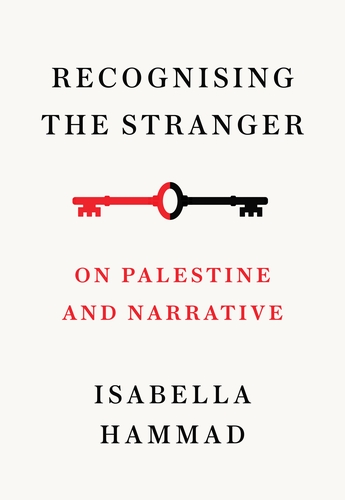
Recognising the Stranger

On Palestine and Narrative  

by Isabella Hammad

Book Review

A sense of timing and an eye for synchronicity are common concepts deployed by authors in the construction of  a narrative.  On 28 September 2023 the British-Palestinian novelist, Isabella Hammad, gave the Edward W Said Memorial Lecture at Columbia University, now published as Recognising the Stranger: On Palestine and Narrative.

Hammad could not have foreseen that only a week later, on 7 October 2023, the Qassam Brigades of Hamas would, in response to the ongoing Israeli occupation and blockade of Gaza, launch a military attack upon Israeli military bases and kibbutzim.  The attack resulted in over 1,000 deaths and the taking of over 200 hostages, to be held until the 5,000 Palestinian political prisoners held in Israeli jails were released.

Hammad’s lecture would have been relevant and a percipient insight into the situation of the Palestinian people had the events of 7 October and their aftermath, not have happened.  However, given the Israeli response to the Hamas attack, Hammad’s lecture and subsequent Afterword: On Gaza, written in January 2024, take on added relevance.

In her original lecture Hammad is concerned with considering turning points, ostensibly in literature but also in the personal and political spheres.  Those points in a fictional narrative when characters have moments of recognition, when an aspect of the plot, which may have been clear to the reader, is revealed to the characters and what has been, up until then, a mystery falls into place.

Hammad suggests that in the personal and political spheres the concept of a turning point is “a human construction, something we identify in retrospect” (p.2) but that the moment in which we now live “feels like one of chronic ‘crisis’” (p.2).

Hammad explores the role and function of the novel in the contemporary world, competing against the wide range of other ‘entertainments’ on offer, yet still powerful and relevant enough to find a mass audience and speak to the need for narrative, storytelling and a search for meaning.

Hammad links the concept of turning points in literature to those in real life through the example of writers visiting the Palestine Festival of Literature and experiencing for themselves the reality of life for the Palestinian people under Israeli occupation.

“They visited Hebron, and saw the soldiers patrolling, guarding settlers;  they visited the destroyed town of al-Lydd; they navigated checkpoints; they travelled through Jerusalem and crossed in and out of the West Bank; they listened to statistics of killings and imprisonments and night time raids and asked careful questions.”  (p.21)

Hammad goes on to analyse the wider international debate regarding the position of the Palestinian people, the incremental retreat from insistence upon a two state solution, with Palestinians having a right to their own state, while the international community in the Global North, largely accept and reinforce the state propaganda and Zionist supremacist ideology of the Israeli regime.

Hammad does recognise that there is a shift in awareness amongst many ordinary people across the world, including amongst Israelis, a recognition that Palestinians have human rights.  She cites what co-founder of the Boycott, Disinvestment and Sanctions (BDS) movement, Omar Barghouti, calls an aha moment,

“…talking specifically about the moment when an Israeli realises, in a turning point of action, that a Palestinian is a human being, just like him or her.” (p.25)

While Hammad’s lecture inevitably focuses upon the work of Edward Said, as a prominent Palestinian intellectual, his literary criticism and her own practice as a writer, she does not shy away from exploring the reality of the stateless position in which Palestinians are forced to exist and the implications of this for their culture.

In her Afterword: On Gaza Hammad is clear that the action of 7 October in itself represents a turning point, comparing it to “an incredibly violent jailbreak” and asserting that,

“It also signified a paradigm shift: it showed that a system in which one population  is afforded rights that the other population is denied will be safe for neither.” (p.61)

Hammad robustly condemns the Israeli response to 7 October stating starkly that,

“Ten thousand dead children is not self defence.” (p.62)

A figure which has escalated significantly in the year since her afterword was written.  Hammad condemns the extent to which the Western powers, the United States in particular, have supplied Israel with weapons to continue the bombardment of Gaza and the role of the US in vetoing ceasefire arrangements.  This position may have changed for the moment but there is no guarantee that Israel will maintain it.

As Hammad states, as she moves towards a conclusion,

“The possibilities faced by the Israeli state for at least twenty years have been: maintain apartheid and forfeit the claim to being a democracy; return to the pre-1967 state borders and allow for the creation of a Palestinian state; break down the system of apartheid and enfranchise the Palestinians in a one-state reality; or conduct large scale ethnic cleansing.  They are choosing the last option.” (p.75)

Just over a year since that Afterword was written, it is clear that this is precisely the path that the Israeli regime has taken and that solidarity with the Palestinian people is more vital now than ever.

Isabella Hammad is the award winning author of ‘The Parisian’ and ‘Enter Ghost’.  In 2023, she was included as one of Granta’s Best of Young British Novelists.

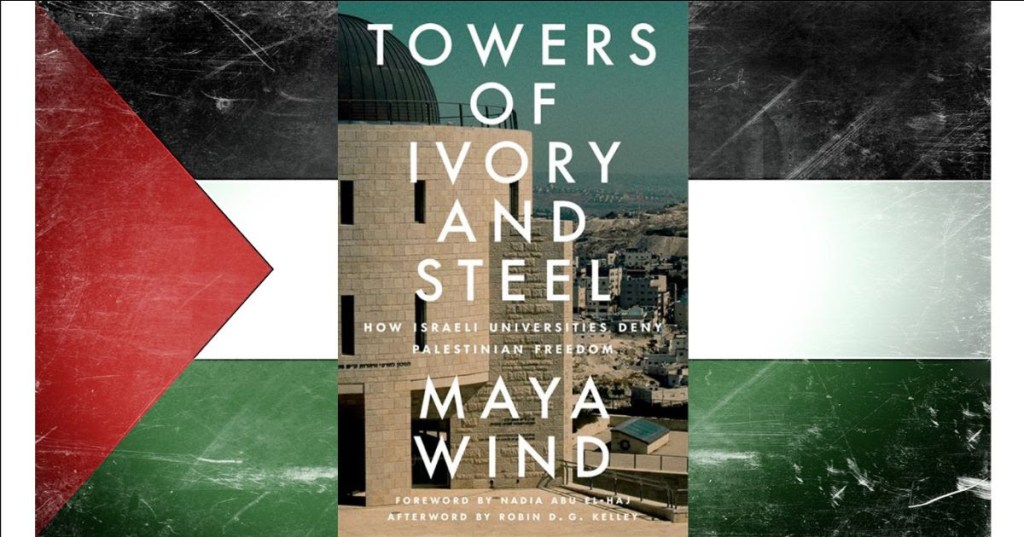
Towers of Ivory and Steel

13th February 2025

Review by Steve Bishop

Maya Wind’s detailed and incisive study, Towers of Ivory and Steel, charts the role of Israeli universities in systematically denying Palestinian freedom.  It should be a wake up call for any British university engaged in collaboration with Israeli counterparts, urging them to address distortions of academic practice and acknowledge the internationally recognised rights of Palestinians to equality of access to education.

British universities will not see themselves as colluding in the settler colonialism of the apartheid Israeli state.  They will rationalise any joint work as being on a purely academic basis, not part of a systemic exclusion of Palestinians from access to intellectual expression and freedom.

Maya Wind’s analysis debunks such liberalism and demonstrates how the Israeli university system is an embedded part of the apartheid state of Israel, actively supporting the settler colonial narrative of Zionist supremacy, and denying any Palestinian historical agency in land they have farmed, worked and lived on for generations.

Since October 2023 the world has once again seen the sheer scale of Israeli brutality towards the Palestinian population through the genocide in Gaza, backed by support from the United States, Britain and the European Union, culminating in the proposal of US President Donald Trump to ethnically cleanse Gaza of Palestinians.

This is the undeniably savage side of the Israeli Defence Force (IDF), the consequences of its actions filling news broadcasts around the world.  However, as Wind demonstrates, behind the smokescreen of liberalism in Israel’s universities there lies an ongoing and pervasive denial of access for Palestinians, a denial of study of their history, suppression of any student activism and an active collusion with the Israeli military and state by the university authorities.

In disciplines which under any circumstances should require objectivity and academic rigour, Wind shows how Palestinian dimensions are excluded.  Archaeological excavations led by Israeli academics at a site in Susiya, for example, revealed evidence of a synagogue and a mosque, illustrating both Jewish and Muslim heritage, yet as Wind notes,

“Ruins of a mosque were also found on the very same site as the synagogue, yet these were swiftly erased from the historical record; there is no mention of them in the official documentation or at the site itself.”  (p.26)

Wind demonstrates how legal studies are skewed to justify the actions of the IDF and the Israeli government in the international arena, “constructing interpretations that justify Israeli state and military policies” (p.40) while routinely processing arrested Palestinians under the Israeli military court system, rather than a civilian legal process.

In the field of Middle East Studies, Israeli universities actively collaborate with the state and the military, to reinforce a particular version of history.  The forced exclusion of over 700,000 Palestinians from their land, in the Nakba in 1948, is not covered for example.  As Wind indicates,

“What began as repression of academic research on the Nakba and Israel’s founding has since expanded into public scrutiny of syllibi addressing Israel’s military occupation and apartheid and, most recently, into a broader purge of any critical discourse on the military and the racial violence of the Israeli state.” (p128)

Any attempt by Palestinian students to commemorate the events of 1948 are violently shut down.  Such actions are facilitated by having uniformed soldiers on campus, as part of their training in military and intelligence work.  This presence is inevitably intimidating for the few Palestinian students tolerated at Israeli universities and reinforces the close links between university hierarchies and the military.

Wind provides detailed evidence of how Palestinian students are subject to arrest, incarceration, and torture for engaging in what would be regarded in most parts of the world as routine student activism.  For the Israeli state any degree of activism or expression of support for Palestinian statehood is treated with suspicion.

Launched in 2004 the Palestinian Campaign for the Academic and Cultural Boycott of Israel (PACBI) has worked to raise awareness of the role of Israeli universities in the repression of Palestinians and to call on “international scholars to initiate a boycott of Israeli academic institutions”. 

Closely allied is the Boycott, Disinvestment and Sanctions (BDS) Campaign launched in 2005 to exert pressure on Israel to meet its obligations under international law to, “first, end the colonization of Arab lands and dismantle the military occupation and the wall; second, recognise the right to full equality of Palestinian citizens of Israel; and third, respect and promote the right of Palestinian refugees to return.” (p.5)

Maya Wind is clear that support for the PACBI and BDS campaigns is a necessary step on the road to justice for the Palestinian people.  The research and analysis provided in Towers of Ivory and Steel is an important contribution to moving forward on that journey.

Turning Points

29th September 2024

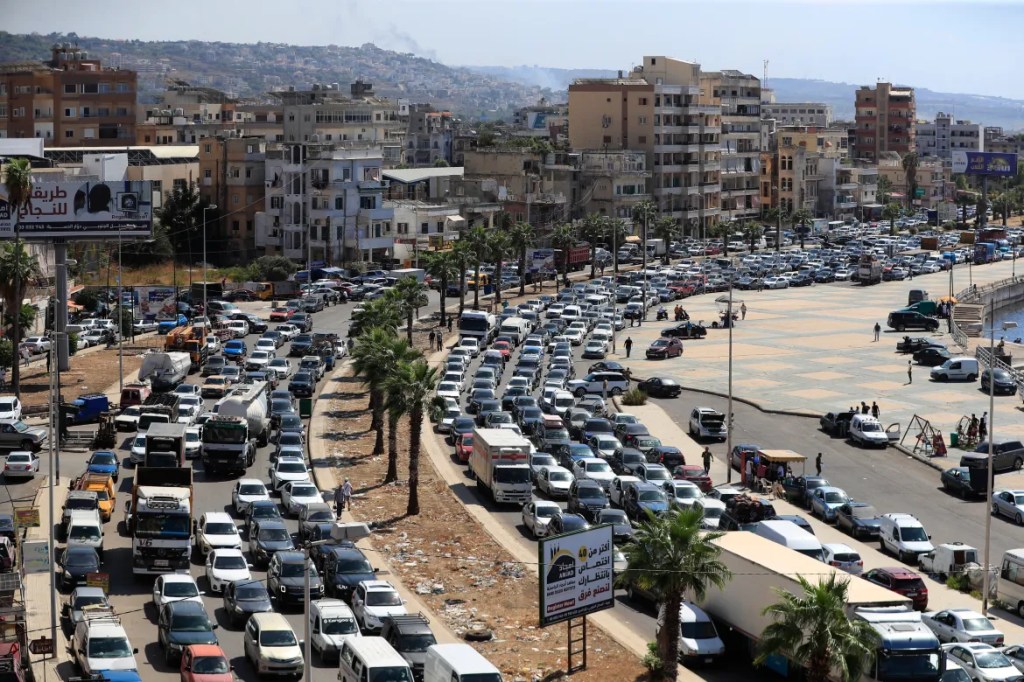
Thousands flee Lebanon to escape Israeli air strikes

The assassination of Hezbollah leader, Hassan Nasrallah, has been described by Israeli Prime Minister, Benjamin Netanyahu, as a ’turning point’, describing Nasrallah as “the axis of the axis, the central engine of Iran’s axis of evil”.

The killing and the ongoing bombing of civilian areas of Beirut may well prove to be a turning point but not necessarily in the way that Netanyahu means.  Iran’s leader, Ayatollah Ali Khamenei has called for five days of mourning following Nasrallah’s death and vowed that his ”blood will not go unavenged.”

Lebanon’s Health Ministry has estimated that 800 are dead so far as a result of the actions of the Israeli Defence Force (IDF), while 50,000 people are estimated to have fled to Syria and an estimate 1 million are displaced, many having to sleep on the streets.

The bombings follow on from the indiscriminate attacks, not denied by the Israelis, upon Lebanese citizens by planting explosives in electronic communication devices, which killed 37 and injured thousands.  This action has been widely condemned as a war crime precisely due to its indiscriminate nature. 

While the IDF claim that the current bombing campaign consists of precision strikes, the reduction to rubble of buildings in clearly civilian areas gives the lie to this claim, costing the lives of non-combatant women and children  in the process.

The latest strikes have even seen surprise expressed by the United States, Israel’s staunchest ally, with President Joe Biden claiming that the US had no prior knowledge of the attacks.  Efforts by US Secretary of State, Antony Blinken, to engage Israel in the search for a diplomatic solution have so far abjectly failed.

It is becoming increasingly clear that the Israeli government, under the leadership of Benjamin Netanyahu, is out of control and driven by its own religious fundamentalist agenda.  Devastating strikes on Beirut followed on almost immediately from Netanyahu’s widely boycotted speech at the UN General Assembly in New York and flew in the face of widespread calls for a negotiated settlement and ceasefire to be discussed.

Israel’s contempt for the will of the international community, as articulated by the UN, has been evident for decades in its illegal treatment of the Palestinian people and their just demand for national self determination  and a fully sovereign state of their own.  It is evident in its recent action in Gaza and the West Bank and is becoming  more flagrant in its attacks upon the Lebanese capital.

Such actions increase the threat of widening the conflagration in the region, with escalation beyond the Middle East into a global war within the realms of possibility.

With the presidential election in the United States looming Netanyahu is clearly taking advantage of the hiatus this represents to press home his fundamentalist agenda, to the detriment of the people of the region and in spite of the opposition from many of his own citizens.   Parliamentary elections in Israel are not scheduled until October 2026 and Netanyahu is gambling that he can hold together his right wing fundamentalist coalition at least that long, to present himself as a victor in the fight against both Hamas and Hezbollah.

The fate of the Palestinian people and the people of the Middle East generally should not rest upon the political survival and opportunism of one man.

Pressure upon Israel to come to the negotiating table must be increased through concrete actions.  The British government must immediately cease all arms sales to Israel.   Trade union and cultural organisations should support the Boycott, Disinvestment and Sanctions (BDS) campaign to isolate Israel internationally, until it is prepared to negotiate meaningfully on a way forward.  

The US, as Israel’s major ally, must take a stronger line in bringing the IDF to heel and opening the way for negotiations.  The turning point in the current conflict has to be to turn back.  The coming days could well be crucial in determining the future of the Middle East  and whether or not the world is plunged into a wider conflict.

Israeli assassins escalate conflict

1st August 2024

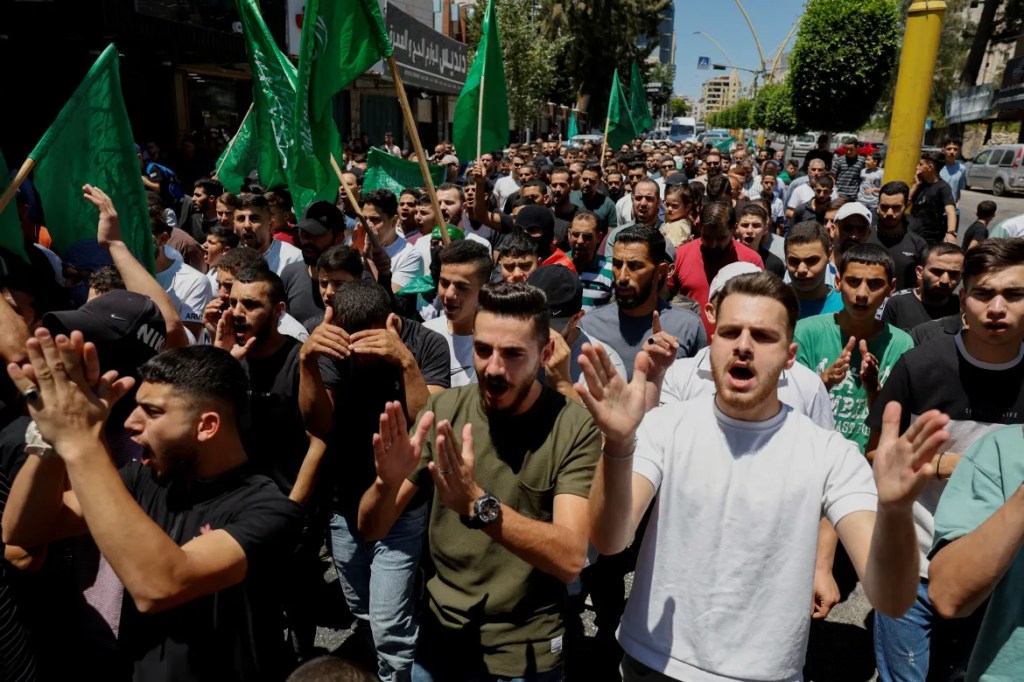
Palestinians in Hebron in the occupied West Bank protest against the assassination of Hamas political leader Ismail Haniyeh.

The assassination of Hamas leader Ismail Haniyeh, in Tehran two days ago, is a major escalation in the growing conflict in the Middle East.  While Israel has not claimed responsibility for the killing there can be little doubt that the nature and precision of the operation has the fingerprints of Mossad all over it.  That the killing took place just after the inauguration of a new Iranian president, Massoud Pezeshkian, and in the heart of Tehran itself will have been designed to cause maximum embarrassment to the Iranian regime.

The assassination also appears to be designed to torpedo the peace talks in relation to Gaza, as Haniyeh was the leading Hamas negotiator.  As the Qatari Prime Minister, a key player in the peace mediation process pointed out, “Political assassinations and continued targeting of civilians in Gaza while talks continue leads us to ask, how can mediation succeed when one party assassinates the negotiator on the other side? Peace needs serious partners.”

Israel is the most well armed and efficient military state in the Middle East, massively supported by the United States and to a lesser extent by Britain.  It has a clandestine nuclear weapons capability, rarely mentioned in the media but real all the same.  It has a government propped up by right wing religious fundamentalists, every bit as zealous in their mistaken belief in their own supremacy as the theocrats who have been murdering their way across Iran for over forty years.  That the response of the international community to assassination in a foreign capital has been little more than mild rebuke is nothing short of a scandal.

The killing of Haniyeh comes shortly after Israel claimed to have killed a senior military commander of Hezbollah in Beirut.  There can be no doubt that this has exacerbated the crisis in the region, bringing it to the brink of an extremely dangerous and widespread military conflict.

The response from the theocratic dictatorship in Iran was predictable.  Supreme Leader, Ayatollah Ali Khamenei, stated that Israel “by assassinating Ismail Haniyeh, has paved the way for a severe punishment” adding that “we consider it our duty to avenge his blood, shed in the territory of the Islamic Republic of Iran.”

The world awaits the consequences of the adventurist action of the Israelis.  There can be little doubt however that Iran will galvanise it’s so called Axis of Resistance, through Hamas, Hezbollah and Houthis to strike back in some way shape or form.  This is unlikely to be a mere symbolic action, as with the pre-warned missile strikes on Israel in April, responding to another Israeli act of international terror, when sixteen people were killed in the Iranian embassy in Damascus in Syria.   

While hitting an embassy is technically still a strike on domestic territory it does not carry the symbolism of a strike in the heart of Tehran.

The US government has taken its usual line in defence of Israel expressing “ignorance” about the assassination and “not being involved” in it, yet at the same time warning that it would defend Israel if it were attacked.  Suspicions have been raised that the attack, coming so close to the recent visit of Israeli Prime Minister Netanyahu to the United States, will have been given the green light by the US.  Any evidence to suggest that would certainly put the US back in the dock in the eyes of the international community as being complicit in acts of terror and actively escalating conflict in the region.

The corruption at the heart of the Iranian regime was further exposed recently in the report of the United Nations Special Rapporteur on atrocity crimes committed in Iran in the 1980’s, following the hijacking of the national democratic revolution by the Islamic theocracy.

In his analysis of the first decade of the Islamic Republic, following the 1979 revolution Special Rapporteur, Javaid Rehman, details the summary, arbitrary and extra-judicial executions of thousands of political opponents of the regime, amounting to the crimes against humanity of murder and extermination.  Significantly for the current regime and its apologists Rehman concludes that,

“…those with criminal responsibility for these grave and most serious violations of human rights and crimes under international law remain in power and control; the international community has been unable or unwilling to hold these individuals accountable.”

The assassination of Ismail Haniyeh in Tehran has raised serious questions about the state of Iran’s security apparatus, this not being the first time that Israeli security forces have been able to easily carry out terrorist operations on Iranian soil. This assassination highlights the extensive infiltration of imperialist intelligence agencies into Iran’s security apparatus.

The corruption at the heart of the Iranian regime is only matched by the religious fundamentalist cabal currently running the Israeli government.  Opposition in both countries is either actively suppressed or given little media exposure, though under both regimes there is significant internal opposition to their respective government’s actions.

For there to be any prospect of heading off the imperialist drive to war in the Middle East the peace movements in both Iran and Israel, as well as in the imperialist centres of the US, Britain and the EU need to grow stronger and voice their opposition to the growing conflict.  The Labour government in Britain needs to be pressured to adopt an independent foreign policy, not dependent upon the diktats of the US, or the pressures of its military proxy NATO.

Labour needs to take a stand which puts peace before conflict escalation and the interests of the people of the Middle East before those of imperialism.  That will only be possible through mass extra parliamentary action and through the peace and labour movements making those demands.   Labour should not be allowed to settle for carrying on the foreign policy positions of the Tories, as has happened in the past.  Given current developments the need for an independent peace oriented stand is greater than ever.

US/Saudi pact a prospect?

31st May 2024

All eyes on Rafah – Palestinians survey the damage done by an Israeli strike

As the Israeli Defence Force (IDF) assault on the civilian population of Rafah continues, under the thinly veiled excuse of rooting out Hamas fighters, behind the scenes discussions are ongoing to reshape the map of the Middle East.

The prospect of an historic pact between the United States and Saudi Arabia is gathering momentum with the carrot of access to the latest US military technology being dangled before the Arab dictatorship.

The deal could be part of a package to extend US influence in the Middle East by including a pathway to diplomatic ties with Israel.  The quid pro quo would be that the Israelis halt the genocide in Gaza.

Negotiations between Washington and Riyadh have accelerated recently, with some reports that a deal could be reached within weeks. 

An agreement would undoubtedly aim to reshape the Middle East in favour of the United States, reinforcing the ongoing support for its long term regional proxy, Israel, while bolstering influence in the Arab world by increasing weapons sales to the Saudi dictatorship.  The US is keen to strengthen its position in the region, which it sees as being threatened by Iran and China.

The rumoured pact is thought to offer Saudi Arabia access to advanced US weapons that were previously off-limits. The dictatorship would then agree to limit Chinese technology from the nation’s most sensitive networks in exchange for major US investments in artificial intelligence and quantum-computing, as well as getting American assistance to build its civilian nuclear programme.

The conclusion of a US and Saudi Arabia agreement would, it is suggested, be followed by forcing Israeli Prime Minister Benjamin Netanyahu to make a choice.  Netanyahu would be offered the opportunity to join the deal, which would entail formal diplomatic ties with Saudi Arabia for the first time.  Israel would also be offered more investment and regional integration. The challenge for Netanyahu would be to end the slaughter in Gaza and agree to a pathway for Palestinian statehood.

In such a scenario Netanyahu would clearly face the ire of the right wing religious fundamentalists who currently prop up his government and are determined not to see an independent Palestine.  However, a pact with the US and Saudi Arabia could also be seen by Netanyahu as a counter to Iran’s growing influence in the region and a potential restraint on attacks by Iran backed militias such as Hezbollah.

With a US election only months away President Joe Biden is desperate for a foreign policy breakthrough and the issue of Gaza has proven divisive amongst Democrats domestically.  Student protests on university campuses across the US have exposed a fault line between those calling for a harder line to be taken with the Israelis over the action in Gaza and those more inclined to back the apartheid regime at all costs.

The thousands killed by the Israelis in Gaza are widely seen as a disproportionate response to the attacks by Hamas on 7th October 2023 and the recent vote by the United Nations General Assembly, to increase the status of the Palestinian state, although dismissed by Israel, has added to the international pressure for a lasting ceasefire.  Subsequent recognition of Palestine by Ireland, Spain and Norway has increased the pressure upon the apartheid Israeli regime.

“We have done intense work together over the last months,” U.S. Secretary of State Antony Blinken claimed recently, while in Saudi Arabia. “The work that Saudi Arabia and the United States have been doing together in terms of our own agreements, I think, is potentially very close to completion.”  Saudi Foreign Minister Faisal bin Farhan has also said that an agreement was “very, very close.”

However, while Blinken and Biden may be making positive noises about a deal there is scepticism, not only from the right wing in Israel, but also in the US.  Republicans are unlikely to countenance a deal which does not give Israel sufficient guarantees, in particular Saudi recognition of Israel, even of it does mean an increase in arms sales to the Saudi dictatorship.

For their part the Saudis are keen to get as strong a deal with the US as possible, the aim being a formal defence pact which would bring the US military into play should the dictatorship be attacked.

While Saudi Arabia and Iran have been moving to normalise relations recently, with the signing of a deal in March 2023, the two Islamic dictatorships remain wary of one gaining more influence than the other in the region. For the Saudis, a defence deal with the United States needs to be sufficiently robust to send a message to Tehran without alienating the Iranians. For Riyadh to decide to openly bolster its security cooperation with Washington the reward would have to be worth the risk. In effect, Saudi Arabia seeks a defence pact with the United States that is credible enough in the eyes of both friends and foes.

The escalating violence in Gaza and Israeli intransigence on the question of a two state solution for Palestine is likely to undermine previous US diplomatic initiatives such as the Abraham Accords, signed in 2020, which established diplomatic relations between Israel and the United Arab Emirates, Bahrain and Morocco. 

While hailed by the US as a means to encourage Israel to take positive steps toward ending its occupation and annexation of Palestinian territory, the real premise of the Accords was to prove that the Palestinian issue was no longer an obstacle for Israel’s relationships in the region, as Arab states dropped their demand for a Palestinian state as a condition to normalising ties with Israel.

Far from curbing Israeli abuses the Accords have emboldened successive Israeli governments to further ignore Palestinian rights. In the first year after the Accords, settler violence dramatically increased in the West Bank. Following the election of Israel’s most right-wing government in history in 2022, cabinet ministers openly called for the annexation of the West Bank and announced massive settlement expansions. 

The United States does not have a great diplomatic track record in the Middle East, putting its own imperialist interests ahead of those of the people of the region.  There is little indication that current initiatives will see different results.

More Casualties in a Series of Israeli Attacks Across Gaza

(report from the Communist Party of Israel)

Israeli occupation forces continued their airstrikes and artillery shelling across the Gaza Strip on Friday, April 5, resulting in numerous casualties among Palestinian its 182nd day in a row. In a preliminary toll, the ongoing Israeli onslaught on Gaza since October 7 of last year has resulted in 33,037 documented Palestinian fatalities, mostly children and women, while the number of injuries has reached 75,668. 

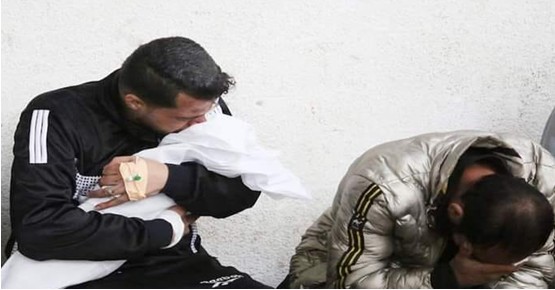
Grieving Palestinian father Ashraf Abu Daraa bids a farewell for his two kids and pregnant wife who were killed last night in an Israeli airstrike targeting their home in Rafah (Photo: WAFA)

WAFA correspondents reported that Israeli artillery shelling targeted the central and western parts of Khan Yunis province, as well as the eastern part of Rafah city in southern Gaza.  Additionally, a fierce airstrike hit the vicinity of Sheikh Zayed City in northern Gaza, while several areas in the central governorate of the Strip were subjected to Israeli artillery fire.

Simultaneously, local sources reported that Israeli warplanes targeted Tal al-Hawa west of Gaza before midnight, while artillery and aerial bombardments hit the southwestern and southeastern neighborhoods of Khan Yunis city, and the eastern part of Al-Maghazi refugee camp in central Gaza. Earlier, Israeli artillery fire targeted the Qleibo and Sheikh Zayed areas in Beit Hanoun in the northern Gaza Strip, coinciding with the ongoing destruction of residential homes in central and western Khan Yunis by the occupation forces.

According UN reports, since October 7 and as of April 1, 428 Palestinians, including 110 children, have been killed by Israeli forces across the occupied West Bank, including occupied East Jerusalem, of whom 131 were killed since the start of 2024. In addition, nine were killed by Israeli settlers and three by either Israeli forces or settlers. Four additional Palestinians from the West Bank have been killed while perpetrating attacks in Israel. During the same period, some 4,760 Palestinians have been injured, including at least 739 children, the majority by Israeli forces. According to the Palestinian Prisoners Club, 11 Palestinians have additionally died in Israeli prisons since 7 October 2023, mainly due to reported medical negligence or abuse.  

Related: https://maki.org.il/en/?p=31724

Israel is not above the law

28th January 2024

Supporters of a free Palestine demonstrate outside The Hague

The measures outlined by the International Court of Justice (ICJ), which has ruled that Israel’s actions in Gaza are plausibly genocidal, must be welcomed by all who support the cause of Palestinian liberation.

The ruling is a landmark in the search for justice for the Palestinian people.  The ICJ decision will be relayed to the United Nations Security Council for consideration.  The ruling orders Israel to prevent acts of genocide against Palestinians and to do more to help civilians, who are currently suffering under daily bombardment by the Israeli Defence Force (IDF).  However, the ICJ stopped short of ordering a ceasefire as requested by the plaintiff South Africa.

Although the ruling contained no binding order upon Israel to stop the war in Gaza it is nevertheless a legal setback for Israel. The Palestinian Foreign Ministry said the decision was a welcome reminder that “no state is above the law”.

The ruling not only obliges Israel to stop all acts which are plausibly genocidal but equally obliges all states to cease funding and facilitating Israel’s military offensive in Gaza.  The measures, all backed by at least 15 judges, also required Israel to ensure the preservation of evidence of alleged genocide and report to the court within a month.

In coming to its decision the ICJ did not have to find whether Israel had committed genocide, which will be determined at a later date, but only that its acts were capable of falling within the convention, which defines the war crime as “acts committed with intent to destroy, in whole or in part, a national, ethnical, racial or religious group”.

Nevertheless, the United States made its position clear ahead of the judgement, describing South Africa’s case at the ICJ as “meritless, counterproductive, completely without any basis in fact whatsoever.”

Israeli Prime Minister, Benjamin Netanyahu, proclaimed in response to the ICJ ruling,

“Israel’s commitment to international law is unwavering. Equally unwavering is our sacred commitment to continue to defend our country and defend our people. Like every country, Israel has an inherent right to defend itself,” he said. “The vile attempt to deny Israel this fundamental right is blatant discrimination against the Jewish state, and it was justly rejected.”

As ever the scared right to self defence is, for Netanyahu, one which applies to Israel but not to the Palestinians, whom Israel has been oppressing in the West Bank and Gaza for decades.  The mantra that ‘Israel has the right to defend itself ‘ is increasingly seen as  a right wing trope for justifying the Israeli regime treating Palestinians with impunity.

Solidarity organisations across the world have called upon all states to commit to upholding the ICJ decision to protect the rights, including the fundamental right to life of Palestinians in Gaza.  The death of over 25,000 people, over 70% of whom are women and children according to the United Nations, cannot be justified by the IDF as a response to the actions of Hamas on 7 October 2023.

Such a disproportionate response, having been condemned by the ICJ, must now be condemned by the entire international community and every effort made towards supporting the call for an immediate ceasefire, a negotiated solution to end Israeli action and free hostages held by Hamas.

Most importantly the resolutions of the United Nations on the need for a two state solution, realising the right of the Palestinian people to self-determination and the establishment of a Palestinian state within agreed international borders, must be acted upon by all member states.

The ICJ ruling is to be welcomed as a vital step towards the realisation of the need to stop the current genocide in Gaza and take the first steps towards the establishment of an independent state for the people of Palestine.

However, the ongoing commitment of the United States and Britain to arm Israel, not take the Israeli government to task for its flouting of international law and to be, at best, lukewarm about the necessity of a Palestinian state, remain significant barriers to progress.  In the short term the failure of either state to recognise the need to support the call for a ceasefire, in spite of the mounting death toll, is scandalous.

The fact that this shame is cross party, with the Labour leadership in Britian continuing to back the government’s position, including being in favour of air strikes against Yemen, adds urgency to the need to campaign for a change in British foreign policy.

As the Jewish diaspora gather to mark Holocaust Memorial Day over this weekend many are rightly appalled by the action of the IDF and the religious zealots around Benjamin Netanyahu in Gaza.  Opposition to the religious fundamentalists in the Israeli regime is growing both inside and outside Israel, many in the Jewish community increasingly regard the actions of Netanyahu and his war cabinet as not being carried out in their name.

The working class movement in Britain and across the world needs to stand in solidarity with those opposing religious fundamentalism in Israel, just as they support those opposing the theocratic dictatorship in Iran and religious zealotry in Saudi Arabia.  The fate of the people of Palestine and the people of Israel may depend upon it.