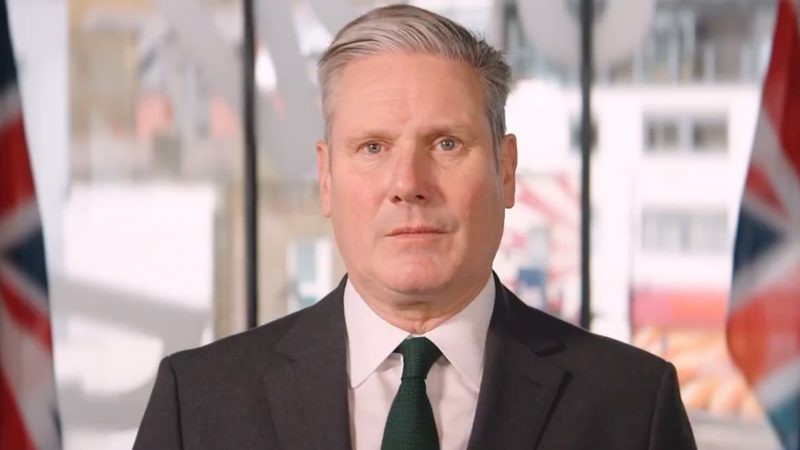
Starmer commits to weapons of mass destruction

13th April 2024

Kier Starmer at BAE Systems in Barrow

Labour leader, Kier Starmer, this week committed Labour to an additional £10 – £12 billion spend on weapons of mass destruction if elected.  Writing in the house journal of the Tory petit bourgeoisie, the Daily Mail, Starmer described his commitment to British nuclear weapons as “unshakeable” and “absolute”.  Starmer went so far as to describe the creation of the NHS and the British nuclear programme as “towering achievements” of the Labour government elected in 1945.

Starmer stated that he wants to raise military spending to 2.5% of GDP “as soon as resources allow”, echoing the commitment of Tory Chancellor, Jeremy Hunt, to raise military spending to 2.5% of GDP “as soon as economic conditions allow”.  Government spending is currently at 2.3% of GDP.

Of the 30 countries which are part of NATO Britain is currently tenth in terms of its percentage spend on its military budget by GDP.  A rise to 2.5% would take Britain to sixth position.  The other nuclear powers in NATO, the United States and France, spend 3.49% and 1.9% respectively on their military.

All NATO members have pledged to spend at least 2% of GDP on their military by 2024.

In a visit to Barrow-in-Furness where British nuclear submarines are built, Starmer said that Labour was making a “generational commitment”, stressing that this was to the,

“…Dreadnought submarines, to the continuous at sea deterrent, and to the upgrades that are needed over time.  And of course there is AUKUS in there as well.”

AUKUS is the military pact agreed by Britain with Australia and the United States to provoke China in the Indo-Pacific region, under the pretext of a Chinese military threat to US ‘interests’ in the region.

The announcement by Starmer follows hard on the heels of Labour backtracking on its investment to develop green technologies; the commitment of Shadow Chancellor, Rachel Reeves, not to bail out bankrupt local councils; and the claim that there is no money to introduce universal free school meals, a measure which would benefit working class families and those facing the sharp end of the capitalist economic crisis.

Commenting on the plans, CND general secretary Kate Hudson said: “Putting billions of pounds into the pockets of arms companies and their investors will not reinvigorate the economy in any meaningful way.

“Instead, it takes vital funds and skills away from what could be spent on the just transition: like energy-efficient homes, better public transport and a public health service that saves lives and heals people.

“By committing to the modernisation and expansion of Britain’s nuclear arsenal Labour is contributing to the global arms race and tensions that we are currently seeing.”

She added that if Labour wanted to offer a positive option to the electorate, “it would commit to scrapping Trident and its replacement, and put nuclear disarmament at the forefront of its foreign policy agenda.”

The idea that the possession of nuclear weapons makes Britian safer, or sustains a world power status, is an illusion fed by the military-industrial establishment; the Tory Party and its backers; and the right wing press.  The basis of the nuclear programme is that, if Britain was under nuclear attack, it could launch a retaliatory strike, based upon the concept of mutually assured destruction, appropriately given the acronym MAD.  Destruction of any kind is hardly a guarantee of safety, destruction that is mutually assured is clearly mad in every sense.

Starmer has shifted Labour so far into Tory territory that the distinction between what each would deliver, following a General Election, is becoming almost impossible to distinguish.  Given the abysmal record of the past 14 years it is almost inconceivable that the Tories could be returned to office.  The character of any Labour administration however remains very much in doubt.

Unless mass extra Parliamentary pressure can persuade the current leadership to change course the dangers of Labour being little more than Tory-lite when in government remain real.    

Poverty and pyrrhic victories

1st April 2024

Poor families with children suffer more than most

In Britain, one of the world’s richest countries, one in six children in 2023 lived in families deemed to be suffering food insecurity, in plain terms, they did not have enough to eat.  One in 40 children lived in a family that had accessed a food bank in the previous thirty days.

Relative poverty is defined as households with incomes of less than 60% of the median.  Almost one in three children live in relative poverty in Britain.  Absolute poverty is defined as households with less than 60% of the median income in 2011.  One in four children live in such households in Britain.  This represents the fastest rise in child poverty in almost 30 years.

Figure published by UNICEF show that last year child poverty in Britian rose fastest between 2012 and 2021 out of 39 OECD and EU counties, many of which actually succeeded in reducing child poverty over the same period.

At the same time the Sunday Times Rich List for 2023 identified 171 billionaires in Britain, their wealth having grown by £31 billion.  For the Tories and the British ruling class this is no doubt something to herald as a success.  That ‘success’ however is built at the expense of working class families who suffer disproportionately under capitalism.  Not only is their labour exploited in order to extract the surplus value which results in the obscenity of billionaires, the tax and benefit systems designed by successive governments plunge them further into poverty and debt.

Tory tax and benefit reforms between 2010 and 2019 saw the poorest 10% of households lose 10% of their income, the biggest impact being felt by children with families, losing £4,000 per year over the period, or 20% of their income.

While local government services are starved of resources, and Councils around the country face draconian cuts or bankruptcy, the rich continue to rake it in.  In the recent budget Chancellor, Jeremy Hunt, announced further tax cuts which will benefit middle and high income earners the most, taking the amount forecast to be spent on tax cuts over the next five years to £65 billion.  This is hardly surprising coming from a man who has recently stated that a salary of £100,000 a year is not such a high income.  Tell that to the families in poverty losing £4,000 a year!

While inflation may now be at 3.4%, which only means that prices are going up by slightly less than they were before, a wide range of basic services are set to see price rises this month.  The increase in Council tax, forced upon local authorities by cuts from central government, will be 5% on average.  Broadband and phone contracts, now essential for most people, are set to rise by an average 8% while car tax and TV licence fees are also set to rise.  Dental charges, for those lucky enough to be registered with a dentist, are also set to go up.

In spite of the scandalous profits and management failings of the water companies, bills are set to go up, in order to cover their losses and lack of investment.  Instead of spending on renewed infrastructure and modernising ageing systems, shareholders have leeched billions in dividends out of the water companies over the years, while ordinary consumers are left to pay the bill. Added to the scandalous rise in the cost of other utilities, while the energy giants continue to make eye watering profits, it is easy to see how working class families are struggling to survive.

This is the true face of capitalism, where the many suffer and pay, while the few get richer and make hay.  Previous Labour governments have attempted to mitigate the worst excesses of capitalism by introducing social programmes, improving access to education and having a less punitive benefit regime, while not presenting any fundamental challenge to capitalism as a system. 

An incoming Labour government, led by Kier Starmer, is not even likely to go this far.  There will certainly be no challenge to capitalism, that is guaranteed, but there will be little by way of mitigation either.  Shadow Chancellor, Rachel Reeves, has made it clear that she will not help Councils facing bankruptcy, for example.  The commitment to investment in green infrastructure to create jobs and boost the economy has been diluted to virtual insignificance.  There is no commitment to take back control of the key utilities, to prevent profiteering in essential services and exploitative bill rises.  

With a General Election looming, getting rid of the corrupt Tory government must always be a priority.  More than ever, that goal needs to be allied to mass extra Parliamentary action to pressurise the Labour leadership into actively pursuing policies, which will not just bolster the position of Britain’s billionaires, but address the needs of those accessing food banks, struggling to feed their families and being forced in the winter months to choose between heating and eating.  Anything less and a Labour victory will be nothing more than pyrrhic.

New definition, old habits

24th March 2024

Just Stop Oil protests – extremist activity?

The British government’s New definition of extremism (2024) published in mid March may not establish a House Committee on un-British Activities but is certainly a step in the direction of the anti-communist witch hunts which were a feature of life in the post war United States.  Michael Gove is unlikely to be in office as long as US witch finder general, Senator Joseph McCarthy, but his ‘new definition’ is certainly a step in the direction of McCarthyism, smuggling in a number of constraints under the umbrella of tackling Islamist or neo-Nazi extremism.

In defining behaviour that could constitute extremism the new definition includes,

“Attempts to undermine, overturn, or replace the UK’s system of liberal parliamentary democracy and democratic rights.” 

This definition of necessity presumes acceptance of the implied interpretation of ‘liberal parliamentary democracy’ as well as a shared understanding of what constitute ‘democratic rights’.

The terminology is typical of the smokescreen used under capitalism to shroud its illiberal and anti-democratic core in language designed to make the system appear fair and just.

The capitalist system will allow liberalism up to the point at which it sees the danger of exposure or any threat to the status quo.  The various tools at its disposal, including the press and social media, smear campaigns, use of the security services, and ultimately the threat or use of force, can be deployed in varying ways to head off any perceived danger.

The recent period of Jeremy Corbyn’s leadership of the Labour Party from 2015 -19 is a case in point.  Although representing a relatively mild threat to the established order the popularity of Corbyn’s message, highlighting glaring disparities between rich and poor; inequalities across class, race and gender; and the concentration of power and influence in the hands of a few corporations and bankers in the City of London, was deemed to be too close to the truth to be allowed to take root.

The systematic character assassination of Corbyn, and the subsequent eradication of any radical dimension to Labour policy under Kier Starmer, illustrates the establishment response to even a mild threat. 

The presentation of politics as a choice of who governs, between the Tories and Labour, with perennial pro-capitalist Liberal Democrats occasionally called upon to prop up the system, makes a mockery of the idea of ‘liberal democracy’ as there is essentially no choice to be made.  Capitalism, which is the system of the ruling class, run by the ruling class, for the ruling class, will always win on these terms!

Labour administrations have provided nuance, at least in domestic policy.  However, even the most democratic achievement of Labour, the National Health Service, is under threat from the intrusion of the private sector and the danger of healthcare not being free at the point of use, or at least more difficult to access.  In foreign policy there has been universal consensus between the leadership of the main political parties on all major issues from the invasion of Iraq to the deployment of Trident nuclear submarines.

When it comes to ‘democratic rights’ there is an equivalent sleight of hand in defining terms and emphasis.  Democratic rights under capitalism are usually reduced to being able to vote for the political party of your choice with some degree of freedom of expression and assembly permitted.  There is no right to employment however, or housing, as the jobless and homeless will testify.  The NHS may be the pride of social policy in Britain but access to healthcare in the United States for example, self styled leaders of the ‘free world’, is very much dependent upon ability to pay.  Democratic rights are defined in terms which suit the ruling class and do not challenge its endemic failings, to be able to feed, house and employ its citizens.

The ‘new definition’ claims that the first duty of government is “to keep our citizens safe and our country secure”.  Citizens sleeping on the streets, going hungry for lack of food, or struggling to find work are hardly ‘safe’.    Nor is a country secure that makes itself a potential target by cravenly supporting the militarist adventures of the United States and NATO, or positioning itself as the enemy of progress by supporting the ongoing massacre of Palestinians in Gaza by the Israeli Defence Force.

The Tories and the main architect of the ‘new definition’, Michael Gove, will no doubt claim that the intention of the guidance is not to target those with strong opposition views but only those seeking to promote “violence, hatred or intolerance”.  The Left, it is claimed, should have no fear for they are not the objects of the guidance, being neither Islamist nor neo-Nazi extremists.

However, little more than a few strokes of the proverbial pen could see that position change.  Given the more draconian powers the police have under the Public Order Act 2023, which bans any act “which interferes with the use or operation of any key national infrastructure in England and Wales”, which could include protest on the public highway, taking the ‘new definition’ at face value would appear to be naïve at best.

Not surprisingly the Labour leadership have made no commitment to repeal the legislation, being afraid that they will be characterised as not being tough enough on crime if they commit to do so. With a General Election looming the issues of tackling extremism and public order are likely to be played up by the Tories, who see these as issues on which they can win votes.  Labour simply aping the Tories will convince no-one but is likely to alienate many.    

Pressure upon Labour when in opposition or in office, from mass extra Parliamentary action and from the wider labour movement, will be vital if there is to be any prospect of changing the legislative landscape for political activity in Britain.  That such action could be deemed ‘extremist’ may deter the fainthearted but without such action there is every prospect that worse will follow.  There may be a ‘new definition’ but for the British ruling class, old habits die hard.

Cracked Actors

10th March 2024

Smug Chancellor, Jeremy Hunt, prepares to reveal a pointless budget

A Tory budget could never be expected to deliver anything of significance for the working class or families living in areas of the highest deprivation across Britain.   In that respect alone Tory Chancellor, Jeremy Hunt, deserves top marks for consistency, as the heavily trailed pre-election budget revealed on Wednesday (6th March) gave no hope of any alleviation of pain from 14 years of Tory rule for those most in need.

The Institute for Fiscal Studies (IFS) has calculated that while Hunt’s budget contained an estimated £9 billion in tax reductions, previous budgets have increased the tax burden by £27 billion, scheduled to kick in from next year.

Not that there is anything inherently wrong with raising taxes, if the revenue collected is spent correctly.  A commitment to investment in research, development and production of green technologies to reduce the amount of carbon pouring into the atmosphere would be a start.  Greater investment in the training, retention and pay of NHS staff with a boost in emphasis upon Creative Health to reduce the burden at the acute end of the medical spectrum would be welcomed by most.  

Abolishing the ‘right to buy’ for council housing, which sees any investment made by local authorities to increase the stock of affordable housing effectively privatised after a short period, would be welcome.  The Chancellor could have considered the proper funding of local government as an area worthy of investment, given the growing number of local Councils posting section 114 notices, effectively declaring bankruptcy and having to limp along with under resourced statutory services only.  

While Councils like Birmingham are cutting £300 million and Nottingham £53 million from their budgets the government are heralding Mayoral Combined Authority deals, creating a new tier of regional government with economic development, transport and housing powers but little to directly offer local communities.  The North East Mayoral Combined Authority (NEMCA) is the latest recipient of this form of government largesse, covering an area from Berwick upon Tweed to Bishop Auckland, and able to access £4.2 billion in spend over 30 years.

The fact that the NEMCA budget is a drop in the ocean compared with the cuts endured by local authorities in the North East over the past 30 years is largely overlooked by local politicians desperate to sell the deal as good news.  Local authorities overall  have faced a 40% cut since the Tories lit the austerity bonfire in 2010, cheered on by their Liberal Democrat partners for the first five years.

Meanwhile local leisure, library, arts and museum provision continue to face significant reductions, or even closure, not being high on the government’s agenda.  It is no surprise that they are services mainly accessed by communities in areas of high deprivation who are less likely to vote Tory or, increasingly, to vote at all.

The Daily Mail meanwhile sidesteps these concerns and bemoans the lack of any further money for the military in the budget, citing a report by the Public Accounts Committee that suggests the military is £29 billion short due to overspends, mismanagement and inflation.  The Mail’s response to this has been to launch a campaign, Don’t Leave Britain Defenceless, calling on ministers to increase funding for the Armed Forces “in response to the growing threats around the world.” 

The Ministry of Defence has always been famous for its poor budget management but to pour good money after bad to prop it up and to waste millions on more weapons of mass destruction when people are homeless and starving beggars’ belief. 

Hunt’s big ‘rabbit out of the hat’ moment was a 2p reduction in the rate of National Insurance, in an attempt to grab the headlines of the Tory press.  The reality is that the NI cut will be fine if you earn over £50,000 a year; you will save £1310 per annum. This is five times more than a worker on £20,000 and 15 times more than someone on £15,000 a year.  So, the Tory position remains as ever, the well off do well, while the poor get punished!

Hunt was also keen to try and steal what few clothes Labour have by announcing the abolition of non-dom tax relief for those in Britian whose permanent address is elsewhere.  However, there is the caveat of a five year transition period, so no doubt the tax dodgers at the top of the tree will, as usual, find new ways to avoid paying their fair share before this measure hits.  

Whatever the Tories, the Daily Mail or its readers may think, the threat to Britian does not come from Russia or China, or even maverick international terrorism.  The enemy, to coin a phrase, is within.  The Tory Party, the billionaires and corporations which fuel and fund them, the military industrial complex which feeds off the belligerent pro-US foreign policy, are all the enemies of progress, enemies of the working class and enemies of change.

A budget by Jeremy Hunt or any other Chancellor, Tory or Labour, will not change this reality.  Only mass extra parliamentary pressure for socialist change can begin the process of really transforming Britain in the interests of the working class.  As Canadian poet and songwriter, Leonard Cohen, famously wrote “there is a crack in everything/it’s where the light gets in”.  There is certainly a crack in capitalism and it is the light of socialism which needs to pour in.  

Exposing the real ‘extremists’

3rd March 2024

Prime Minister Rishi Sunak gives an address outside 10 Downing Street on Friday, where he said the country’s democracy was under threat

The phoney ‘address to the nation’ by British Prime Minister, Rishi Sunak, on Friday night was both pathetic and dangerous.  Pathetic that a Prime Minister should be so threatened by the election of narcissist George Galloway in Rochdale that he felt compelled to use it as an excuse to demonise those opposed to the ongoing genocide committed by the Israeli state in Gaza.  Dangerous because by effectively characterising those protesting in favour of Palestinian rights as anti-democratic ‘extremists’, Sunak moves Britian closer to being a fully fledged police state.

The way for Galloway’s victory had been paved by the Labour Party who initially rushed their selection process to ensure a popular Muslim candidate, then just as quickly disowned him for overheard comments about the nature of the Israeli action in Gaza, deeming them anti-semitic.  Without a Labour candidate Galloway was able to galvanise the pro-Palestinian vote amongst Rochdale’s Muslim population while also tapping into the general discontent with Labour’s line on Gaza amongst many other voters in the constituency.

Sunak’s address followed closely upon the massacre of 100 Palestinians in a single day by the Israeli Defence Force (IDF), for the crime of being hungry and crowding an aid convoy.  The United Nations have clarified that many of those injured suffered gunshot wounds, others were trampled in the confusion as the IDF clearly lost control and resorted to their tried and tested gung ho methods.

Sunak mentioned none of this in his address, instead focussing upon criticising the democratic objections raised by thousands of people week in, week out across Britain, reflecting the majority of world opinion, that an immediate ceasefire in Gaza must be implemented.  Instead of backing the majority view Labour leader, Kier Starmer, sided with Sunak saying that he was right to call for ‘unity’. 

That Starmer should give Sunak’s comments any credence, in a week when Sunak failed to call out his Party former Vice Chairman, Lee Anderson, for racist remarks about London Mayor, Sadiq Khan, is alarming but sadly not surprising.  The Tory record on racism and Islamophobia is far worse than Labour’s has ever been on the manufactured anti-semitism charges, yet Starmer seems unable or unwilling to land punches in this regard.

It is little wonder that Starmer was the focus of George Galloway’s comments after winning in Rochdale stating,

“I want to tell Mr Starmer, above all, that the plates have shifted tonight. This is going to spark a movement, a landslide, a shifting of the tectonic plates in scores of parliamentary constituencies, beginning here in the north-west, in the West Midlands, in London, from Ilford to Bethnal Green and Bow.”

This is typical Galloway bluster and there is little real indication that tectonic plates have shifted, or even that Galloway would retain his Rochdale seat at a General Election.  However, the Rochdale result does send a message to both major parties that their line on Israel and the attack on the Palestinian people is not playing well with the broader public.  The Tories openly pro-Israeli line clearly marks them as being on the side of a regime willing to treat international law with impunity, trample upon human rights and continue to justify arming the regime guilty of such crimes.

It is ironic that the second anniversary of the Russian intervention in Ukraine was marked by nationalist leader Volodymyr Zelensky bemoaning the loss of 31,000 lives over the two year period.  The same number have been killed by the IDF in Gaza in less than five months.

The Labour leadership position of equivocation and studious avoidance of backing the cause of Palestinian rights has left them looking as unprincipled as the Tories.  Desperate to say what they think people want to hear, based on the editorial positions of the right wing media, the Labour leadership lack any sense of cohesion on Middle East policy other than hanging onto the coat tails of the Tories.

The protests in support of the rights of the Palestinian people will and must continue.  The over policing of such demonstrations, designed to suggest that they pose a threat, must stop.  The Labour leadership must unequivocally back the international call for an immediate ceasefire in Gaza.

While Rishi Sunak may characterise those protesting for Palestinian rights as extremists, the real extremists are the religious fundamentalists in the Israeli leadership, those who continue to back them and those who profit from ongoing arms sales to the apartheid regime.

Sunak’s attempt to characterise the election of George Galloway and the groundswell of support for Palestinian rights as a threat to democracy and ‘our shared values’ must be exposed for the opportunist sham that it is.  The only values recognised by Sunak and his cronies are to keep their corrupt leadership in positions of power and influence.  Those are not, and will never be, values shared by the working class in Britian or the people of Palestine.

All change but no difference?

7th January 2024

Labour leader Kier Starmer – “credible hope” his best offer to date

Elections will dominate the political narrative on both sides of the Atlantic in 2024.  In the United States the Presidential election scheduled for 5 November is already being dominated by the prospect of another run by the narcissist, Donald Trump, with many predicting a victory over Joe Biden a distinct possibility if Trump wins the Republican nomination.

At present two states, Colorado and Maine, have disqualified Trump from the Republican ballot on the grounds of inciting insurrection.  Whether such a judgement will pass the test with the Supreme Court, where it is currently heading, remains to be seen.  However, should Trump clear these hurdles he is a racing certainty to be the Republican nominee based on current polling estimates.

That does not make a Trump second term a certainty by any means but it does raise it as a distinct possibility.  Such constraints as there were during Trump’s first term would undoubtedly be swept aside as the team around Trump are already making clear.  The independence of the judiciary and decisions on who does and does not get prosecuted are already in Trump’s sights.  This would raise the prospect of Trump being able to pardon himself and his cronies, as well as launching investigations into his enemies.

Trump’s take on whether he planned to rule as a dictator when asked by Fox News was telling,

“Except for day one”, he said, “After that, I’m not a dictator.”

Which begs the question as to how long ‘day one’ will last.

Trump’s take on foreign policy has been famously myopic.  Fears within the US political establishment centre around Trump abandoning NATO and, for some Democrats, cutting off the weapons supply to Ukraine.  However, there is nothing to suggest that Trump would not remain gung ho in relation to US attitudes towards China, Iran or the wider Middle East, with support for Israel not likely to be up for discussion.

Biden has actively embraced the role of the US as the world’s policeman, ready to intervene whenever or wherever perceived US ‘interests’ are at stake.  While Trump’s rhetoric may sound different, to keep on board his home crowd, the forces which shape the wider objectives of US imperialism will not be so easily persuaded to change course.

Democracy US style has always been an illusion, being based on the bankrolling of candidates by private individuals and corporations seeking to gain the most influence.  A Biden/Trump face off in November will be no different.  However, while a Trump return to the White House would signal a further shift to the right in the political centre of gravity in the US, would wider policy objectives for US imperialism change fundamentally?.

November is still a long way off and a lot can happen in US politics over the months till then.  Writing off Trump being back in the White House in January 2025 though is not something which should be contemplated yet.

In Britain lame duck Prime Minister, Rishi Sunak, has indicated that a General Election will not take place until the second half of the year.  The timing of the election is up to Sunak however, so the option of a snap May election cannot be ruled out, depending upon how Sunak and his cohorts see the political landscape as shaping.  With a first draft of the Covid19 Inquiry report being promised by the summer for example, Sunak may want to cut and run before Tory failings during the pandemic become too exposed.

So far Sunak has pinned his hopes on achieving the five pledges he made last year being, halving inflation; stopping the boats; growing the economy; cutting NHS waiting lists; and reducing the national debt.

While inflation has reduced, prices remain high and continue to be a burden for many working class families. Also, a multiplicity of factors contribute to the inflation figures, of which government action is only one.  Most factors are beyond immediate government control.  Attacks on merchant shipping in the Red Sea, which may force trade to take longer routes and push up the price of goods, being a case in point.

Sunak’s desire to ‘stop the boats’, the Tories jingoistic excuse for a comprehensive policy on migration, continues to be mired in controversy, not least the forcible repatriation to Rwanda scheme, which has so far cost £240 million without a plane taking off.

The economy is in such a parlous state, due to years of Tory austerity and underinvestment, that growth is flatlining and Britain is on the brink of being declared officially in recession.  NHS waiting lists are exacerbated by the government’s refusal to negotiate seriously with junior doctors, who have effectively been forced into further industrial action in pursuit of their pay claim.  While the Tories and right wing media do their best to blame cancelled operations and waiting lists on the doctors action the government’s intransigence is widely seen as the real source.

As for reducing the national debt, this hit its highest level of 2023 in November, the latest month for which data is available, at 97.5% of gross domestic product (GDP).  This is expected to rise to 97.9% by the end of the financial year in March.

All of which should leave the Labour Party shooting into an open goal and hitting the back of the net with a series of clear policies for change.  So far however the Labour leadership’s position has been hedged by uncertainty and a lack of clear commitments.

The £28bn per year pledge to invest in green technologies has been diluted to a desire to hit that target in the second half of a Parliament, hardly transformational change.  The promise to abolish university fees has become one to make student fees fairer and more “progressive”.  Any tax cuts for working class people are dependant upon economic growth and there are no plans to increase the taxes upon the rich.

On the subject of the junior doctors action, when pressed as to whether he would make a higher offer Starmer responded with,

“I don’t want these strikes to go ahead.”

Hardly a recognition of the justified action of NHS staff in the face of government intransigence.

As the election approaches Labour’s position will have to become clearer.  The fear for many on the Left and in working class communities is that the clarity will not be coupled with a sharpened attack on the underlying inequities which are endemic to capitalism and the need for transformational change in favour of working class communities.   The best Kier Starmer could offer in his recent New Year speech was “credible hope”, hardly a fiery rallying cry!

On both sides of the Atlantic this year elections may bring about the appearance of change but there is little sign that they will make a huge difference.