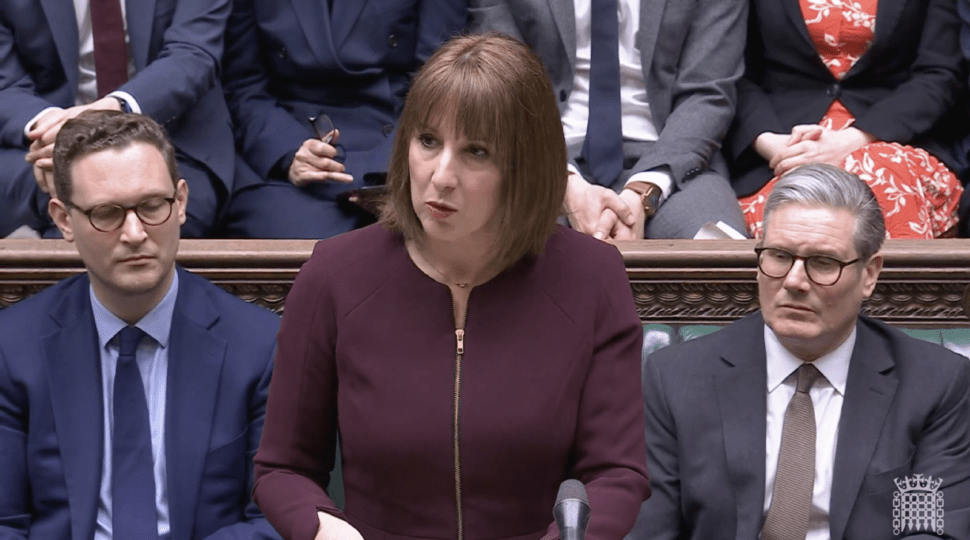
Spring statement: For the few, not the many

27th March 2025

Chancellor Rachel Reeves – not winning friends amongst the working class

In a classic guns not butter statement yesterday Britain’s Chancellor, Rachel Reeves, hammered the poor in order to enrich the arms industry.  To add to the £2.9 billion already earmarked for the military budget next year Reeves found a further £2.2 billion, a grand total of £5.1 billion extra next year alone, with the promise of more to come.

In order to build this additional military capacity, to defend against a mythical Russian threat, Reeves not only hammered the poor in Britain with welfare cuts but cut the overseas aid budget further, just to ensure that the pain was spread at an international level.

Reeves claims to have cut welfare in Britain by £4.8 billion but the Resolution Foundation think tank calculates that  about 800,000 claimants will have reduced personal independence payments, saving the government £8.1bn by 2029-30.  It is estimated that this will affect 3 million families.

While Reeves pins her hopes on economic growth and getting people into jobs to offset the slashing of welfare, the Office for Budget Responsibility (OBR) halved Britain’s economic growth forecast for next year from 2% to 1%, which hardly suggests a boom in employment of any kind, let alone one which could compensate for the ripping away of the welfare safety net for many.

A recent economic analysis by the Joseph Rowntree Foundation, projects that living standards for families in Britian will be worse in 2030 than in 2025, with those on the lowest incomes declining twice as fast as middle and high earners.  The report indicates that the poorest third are being disproportionately affected by rising housing costs, falling real earnings and frozen tax thresholds.  Increased military spending, along with the other measures in the Spring statement, will further exacerbate this trend.

Even the Treasury’s own impact assessment estimates that  250,000 more people, including 50,000 children, will be left in relative poverty after housing costs by the end of the decade as a result of the government’s squeeze on welfare.

Just to add to the wider uncertainty about the economy US president, Donald Trump, this week announced a 25% levy on car imports to the US, with the possibility of further measures to come.  The danger of being sucked into a trade war, due to the actions of Trump, will further undermine the notion that Britain has a ‘special relationship’  that will allow it to be excluded from Trump’s wider tariff war.

However, speaking on Sky News, Reeves was firmly wedded to her deluded projections saying,

“I am absolutely certain that our reforms, instead of pushing people into poverty, are going to get people into work. And we know that if you move from welfare into work, you are much less likely to be in poverty.”

Given the nature of capitalism, as an exploitative system dominated by private sector companies whose main objective is to increase profit, not wages, Reeves vision is at best utopian, at worst simply an attempt to mislead and dissemble her way out of the fact that the cuts proposed are not out of necessity but are from political choice.

Of course, Reeves is not a one woman band.  She has the full backing of Labour leader Kier Starmer, the Cabinet and a majority of Labour MPs, so responsibility runs deep within the Parliamentary Labour Party, even though approval for the actions of Labour’s leadership is not shared by many trade union affiliates or local party activists.

Unite leader, Sharon Graham, condemned Reeves for rigidly sticking to her self imposed financial rules with the evidence of ruin in working class communities all around, stating,

“Rachel Reeves is right; the world has changed but why is it always everyday people that have to pay the price. They paid the price after the 2008 crash, the Covid pandemic and are now expected to pay the price again. It is simply wrong.”

Unfortunately Graham is unable to make the link between attacks on working class communities and the increase in military spending, going on to congratulate the government for  pledging to “invest in our defence in an uncertain global world”.

GMB General Secretary, Gary Smith, was more succinct stating,

“Tackling huge economic problems is a historic challenge. That’s why we need proper investment in key industries – and must nationalise them if necessary.”

On behalf of the TUC General Secretary, Paul Novak, took issue with the Office for Budget Responsibility (OBR), stating,

“It is time to review both the role of the OBR and how it models the long-term impacts of public investment. Short-term changes in forecasts should not be driving long-term government decision-making.”

Posting on X former Labour leader and Independent MP, Jeremy Corbyn, was absolutely clear,

“This Labour government could have taxed the wealthiest in our society.  It is disgraceful that they are choosing to go after the poor and disabled instead.”

Unity around the concepts of jobs not bombs, welfare not warfare and organising society in the interests of the many, not the few, are key to moving towards lasting socialist change.  There is clearly still work to be done across the Labour movement and within working class communities to  build support which recognises that these issues are linked and the common denominator is capitalism.

Ongoing mass extra Parliamentary action will play a key role in building that support  and that political understanding, vital in the progress towards a socialist future.

Kickstart or stalling?

4th February 2025

Reeves on economic growth – kickstart or cold start?

British Prime Minister, Keir Starmer, and Chancellor, Rachel Reeves, are in danger of having to eat humble pie when it comes to their ability to deliver on the promise of economic growth.  The mission of the present government has been made clear, economic growth, but simply repeating the mantra does not deliver the desired outcome. 

The keynote speech on the subject by Reeves  last week has only succeeded in re-opening the 20 year long debate about a third runway at Heathrow Airport; whether or not this will actually deliver growth anyway; how it will help Britain meet its net zero carbon targets; and why so much emphasis on investment in the South East when the rest of the country is crying out for economic support.  The aspiration to turn the corridor between Oxford and Cambridge into Britain’s Silicon Valley just reinforced this point.

Reeves claims that 60% of the benefits of a third runway at Heathrow will be felt in areas other than London and the South East, though without giving details as to precisely how.  The geographic distribution of investment may in any case be an academic point as the accumulation of wealth in the hands of a small minority, rather than ownership and production being in the hands of the people, will ensure the maintenance of Britain’s class system.  The working class are not going to be the ultimate beneficiaries, whether in John O’Groats, Land’s End or anywhere in between.

Socialism, or any aspiration towards it, is not on the agenda of this government, in common with all previous Labour governments, so tweaks to how capitalism functions is the best that they hope to deliver.  Even in those terms however, Reeves does not seem to have won any allies.

What used to be regarded as the environmental lobby but is actually articulating the interests of many in saving the planet, has been up in arms about the third runway proposal, as well as the possibility of the government consenting to the Rosebank development, Britain’s biggest untapped oilfield. 

The project is being led by Norwegian company, Equinor, and having had a consent application rejected in Scotland recently they are  expected to return with  a further proposal later in the year, claiming that “Rosebank is critical for the UK’s economic growth”, a euphemism for Rosebank being critical for Equinor’s profits and its shareholder’s dividends.

There are potential routes to economic growth, even in the short term, within the straitjacket of capitalist economics.  Investment in renewable energy technology would be an option that would both promote growth and contribute to net zero carbon targets.  Diverting spending away from the cost of weapons of mass destruction and nuclear submarines would free up resources, which could begin to address the crumbling schools and hospital infrastructure.  Investment in renewing the health and education systems would in itself help promote economic growth.

A renewal of the national rail network, charging point infrastructure to encourage the take up of electric vehicles, more resources for the creative industries, proper financing of local government, all of these things would contribute to economic growth, as well as providing the platform for arguing that public, and ultimately the people’s, ownership and control is the key to lasting economic change.

Sadly Starmer, Reeves and the Labour Cabinet have no such vision and remain trapped within the confines thinking that reform within capitalism is a sufficient goal.  Clearly it is no such thing, as working class families continue to grapple with rising water and energy costs, rising food costs, rising housing costs and deteriorating local services.  That was never going to be reversed in six months but a roadmap towards it could have been outlined and a vision fought for.

As it stands the demagogues of the far right are making up ground in Britain and across Europe; Zelensky in Ukraine, Meloni in Italy, Le Pen in France, Alternative fur Deutschland in Germany, to name a few. 

It is not impossible to see Reform UK taking seats off both Labour and the Tories at the next General Election  and shifting the political landscape in Britain even further to the right.   A YouGov poll published in The Times today (4th February) puts Reform on 25%, Labour on 24% and the Tories further behind on 21%.  While Britain is still a long way from a General Election if this trend continues Labour’s dream of a second term could easily be wiped out.

A response to such polling figures should be to mount a robust challenge to the politics of Reform and the Tories.  However, too many in the Labour Movement are afraid of being accused of being “woke”, a term that has become a pejorative in the hands of the right wing media to demonise anyone with progressive ideas or left wing politics.  The fact is that anyone not woke is, by definition, asleep and that will usually come with being bigoted, xenophobic, homophobic and in denial of the climate emergency.

Capitalism as a system, designed to serve the interests of the rich and powerful, cannot be modified in the interests of the working class, it must be overthrown.  The more the Left pussyfoots around this reality the more emboldened the right wing will be to push their simple answers to complex solutions.  This is the message the Labour and peace movements in Britain need to grasp and campaign upon, before the world is reshaped entirely in the image of Donald Trump or Elon Musk.   These are the people who must be stopped.  Theirs are the ideas that must be quashed.

Popular policy to put people first

5th January 2025

Cuban medical workers – under pressure but an example to the world

The year begins with much media speculation about the collapse in popularity of the Labour government and its leader, Keir Starmer.  The economy is not showing signs of recovery. The winter fuel allowance issue is returning to haunt Starmer and Chancellor Rachel Reeves, as the cold weather kicks in.  The much trumpeted review of the NHS does not report until the Spring and the reform of social care will take until 2028.  Business leaders continue to use the increase in employers national insurance as an excuse not to recruit, or to resist wage increases, in spite of hefty profits going to shareholders.

Public services are struggling with the need for investment to function efficiently or, in the case of the energy sector, with the obscene profits made by companies failing to deliver an effective service to communities.  The water industry is the biggest offender  but others in the sector are equally guilty of milking profits from hard pressed working class families while not addressing the need for investment in modernisation.

The crisis in the NHS is a major case in point.  Recent reports suggest that every acute hospital trust in England is failing to hit the target to treat 92% of patients within 18 weeks.  There are 7.5 million people on the waiting list for treatment.  The government did promise a £22.6 billion increase for the NHS in the last budget plus an additional £3.1 billion for capital investment.  This is welcome and, with the hard work and dedication of staff in the NHS, may result in some short term improvement.

However, even these figures are a sticking plaster over a gaping wound.  Britain currently spends £64.6 billion per annum on weapons of mass destruction and the military.  Labour is committed to increasing that figure to £87.1 billion to meet its commitment to spending 2.5% of GDP on the military.  The equipment plan alone for the Ministry of Defence over the period 2021-31equates to £238 billion plus, according to official forecasts, £117.8 billion on nuclear weapons.  CND estimate that the latter figure will in fact be nearer £205 billion. (see The Fight for Peace and Disarmament by Gary Lefley – Socialist Correspondent Issue 53 Winter 2024)

The obscene spend on the military is argued for by the ruling class, with Labour support, as being necessary for defence but in fact just makes Britain a potential target.  Given the craven support of the British ruling class for US wars of intervention across the world, including the Ukraine and Israeli genocide in the Middle East, and the backing given to US sabre rattling over China, this danger is likely to increase.

Meanwhile, ambulances are queued outside of hospitals waiting to register patients, who cannot be admitted because beds are occupied by people without any social care arrangements, and emergency calls suffer as a consequence.  It is a vicious circle and one which will undoubtedly impact disproportionately upon working class communities.

If Starmer and the Labour government want to increase their popularity, shifting the balance of resources from weapons of mass destruction to investment in health, social care and education would be a progressive step. Shifting the emphasis in both foreign and domestic policy onto improving the lives of working class communities, rather than put them under threat would be a huge leap forward.

At present the health service, in spite of the emphasis upon community health, aimed at preventing hospital admissions and promoting healthier lifestyles, cannot cope with the needs it has to address at the acute end of the healthcare spectrum.  Any additional resources inevitably go into trying to prop up the needs of the most vulnerable and little is left for prevention work.

In a socialist system this would be different.  This is not theory, there is a practical example in the form of Cuba.   In spite of the 60 year long illegal economic blockade, imposed by the United States, the Cuban healthcare system is an example to the world in terms of its approach.    Community based care and access to local medical centres are key  but struggle because of the lack of resources due to the US blockade.  The Cuba Vive Medical Aid Appeal is currently crying out for sutures, syringes, catheters, antibiotics, butterfly needles and paracetamol. These are just a few of the items on the list of needs for Cuban hospitals and polyclinics.  https://www.cubavive.org.uk/donate/

The resources available in Britain however means that there is no excuse not to invest and properly resource the NHS, as well as the social care system.  It is an act of state negligence not to do so.  Labour would do well to look less towards supporting the imperial ambitions of the United States and more towards the needs of working class communities in Britain.   That would be popular in every sense.

Ambition for real change?

9th June 2024

On the buses – but will Labour commitments short change?

While the political boomerang that is Nigel Farage, newly re-installed as leader of the Reform Party, wants the looming General Election to be about immigration, that will not be the major issue concerning working class people in Britain.  Farage has for many years now pedalled his own xenophobic agenda and, while he has succeeded in fooling some of the people, some of the time, he will not fool all of the people all of the time.

Net migration into the UK is running at around 650,000, hardly a massive issue for a nation with a 65 million population and a responsibility to those it has forced to become migrants due to its complicity in bombing Afghanistan, Syria, Libya and Iraq in recent years.  The least the British government can do is to give those displaced due to imperialist wars a place of shelter.

The real issue underlying everything facing the British electorate is, as ever, the economy.  Capitalism is not a system designed to help, support or alleviate the suffering of the working class.  It is a system based upon the exploitation of that class by a property and land owning autocracy, fronted by the Church of England and the Monarchy.   Its representation in Parliament is ostensibly through the Conservative Party, although the occasional safe Labour administration is allowed to slip through the net, while the Tories untangle themselves from a political mess of their own making, or have simply been in government so long that people desire a change.  The current point finds the Tories under pressure for both reasons, hence the likelihood of a Labour government on 5th July.

In which case, what will Labour do about the economy?  The Labour leadership is absolutely committed to capitalism, so that will not change.  The Labour leadership is committed to renewing Britain’s weapons of mass destruction, in the form of the Trident nuclear submarine programme, so less scope for spending on desperately needed schools and hospitals. 

Labour’s manifesto will commit to the creation of GB Energy, a publicly owned green power company.  It will commit to 40,000 more NHS appointments per week and the recruitment of 6,500 new teachers to shore up the flagging education workforce. It will even contain a commitment to recognising a Palestinian state, as part of the peace process.

Yet as positive as these pledges sound, there is still no real commitment to invest in order to grow the economy or address the issues of job insecurity faced by working class families.  Sharon Graham, general secretary of UNITE, one of Labour’s biggest trade union backers, has said that she cannot endorse the document as the union has reservations about Labour’s position on hire and fire practices and zero hours contracts.

Shadow Chancellor, Rachel Reeves, has been the standard bearer of economic caution, promising not to spend more than the economy can allegedly afford and not to boost public spending.  The reality is however that to address the needs of working class people, in order to improve their lives, public spending is essential.

A recent report by the Resolution Foundation think tank suggests that the next government will have to make £19 billion of annual cuts to unprotected departments by 2028-29 if budgets are to be sustained without new tax rises.  Both the Tories and Labour are committed to military spending increasing to 2.5% of GDP, an area both will protect, while local government, the deliverer of key services to help working class families survive is afforded no such protection. 

There are ways to raise additional funds, quite apart from not buying weapons of mass destruction in the first place.  A wealth tax of 1% to 2% on those with assets of more than £10 million, just 0.04% of the population, would raise £22 billion annually.  That would pay for 75% of the entire social care bill for a year.  In 2020 the Wealth Commission recommended a one off wealth tax for five years, which could raise a tidy £260 billion.  Recent YouGov polling suggests that 78% of people support an annual wealth tax on the super rich.  Clearly not a vote loser!

No one is expecting a Labour government led by Kier Starmer, Angela Rayner and Rachel Reeves to make a call to build the barricades and tear down the capitalist system.  However, it is disingenuous of all three to suggest that there is not money there to support working class people and to make their lives more bearable.

Electing a Labour government on 4th July remains a necessity but, with a majority which could be nothing short of monumental, that government ought to be firmer in its commitment to challenging the clear inequities in the system and putting in place policies to challenge them.  Such a small step would make a minor dent in the edifice of capitalism but could make a huge difference to the lives of many working class families.  Pressure must remain upon the Labour leadership to be more radical and to see getting the keys to 10, Downing St as the beginning of an ambition for real change, not the conclusion.

Starmer commits to weapons of mass destruction

13th April 2024

Kier Starmer at BAE Systems in Barrow

Labour leader, Kier Starmer, this week committed Labour to an additional £10 – £12 billion spend on weapons of mass destruction if elected.  Writing in the house journal of the Tory petit bourgeoisie, the Daily Mail, Starmer described his commitment to British nuclear weapons as “unshakeable” and “absolute”.  Starmer went so far as to describe the creation of the NHS and the British nuclear programme as “towering achievements” of the Labour government elected in 1945.

Starmer stated that he wants to raise military spending to 2.5% of GDP “as soon as resources allow”, echoing the commitment of Tory Chancellor, Jeremy Hunt, to raise military spending to 2.5% of GDP “as soon as economic conditions allow”.  Government spending is currently at 2.3% of GDP.

Of the 30 countries which are part of NATO Britain is currently tenth in terms of its percentage spend on its military budget by GDP.  A rise to 2.5% would take Britain to sixth position.  The other nuclear powers in NATO, the United States and France, spend 3.49% and 1.9% respectively on their military.

All NATO members have pledged to spend at least 2% of GDP on their military by 2024.

In a visit to Barrow-in-Furness where British nuclear submarines are built, Starmer said that Labour was making a “generational commitment”, stressing that this was to the,

“…Dreadnought submarines, to the continuous at sea deterrent, and to the upgrades that are needed over time.  And of course there is AUKUS in there as well.”

AUKUS is the military pact agreed by Britain with Australia and the United States to provoke China in the Indo-Pacific region, under the pretext of a Chinese military threat to US ‘interests’ in the region.

The announcement by Starmer follows hard on the heels of Labour backtracking on its investment to develop green technologies; the commitment of Shadow Chancellor, Rachel Reeves, not to bail out bankrupt local councils; and the claim that there is no money to introduce universal free school meals, a measure which would benefit working class families and those facing the sharp end of the capitalist economic crisis.

Commenting on the plans, CND general secretary Kate Hudson said: “Putting billions of pounds into the pockets of arms companies and their investors will not reinvigorate the economy in any meaningful way.

“Instead, it takes vital funds and skills away from what could be spent on the just transition: like energy-efficient homes, better public transport and a public health service that saves lives and heals people.

“By committing to the modernisation and expansion of Britain’s nuclear arsenal Labour is contributing to the global arms race and tensions that we are currently seeing.”

She added that if Labour wanted to offer a positive option to the electorate, “it would commit to scrapping Trident and its replacement, and put nuclear disarmament at the forefront of its foreign policy agenda.”

The idea that the possession of nuclear weapons makes Britian safer, or sustains a world power status, is an illusion fed by the military-industrial establishment; the Tory Party and its backers; and the right wing press.  The basis of the nuclear programme is that, if Britain was under nuclear attack, it could launch a retaliatory strike, based upon the concept of mutually assured destruction, appropriately given the acronym MAD.  Destruction of any kind is hardly a guarantee of safety, destruction that is mutually assured is clearly mad in every sense.

Starmer has shifted Labour so far into Tory territory that the distinction between what each would deliver, following a General Election, is becoming almost impossible to distinguish.  Given the abysmal record of the past 14 years it is almost inconceivable that the Tories could be returned to office.  The character of any Labour administration however remains very much in doubt.

Unless mass extra Parliamentary pressure can persuade the current leadership to change course the dangers of Labour being little more than Tory-lite when in government remain real.