Israeli assassins escalate conflict

1st August 2024

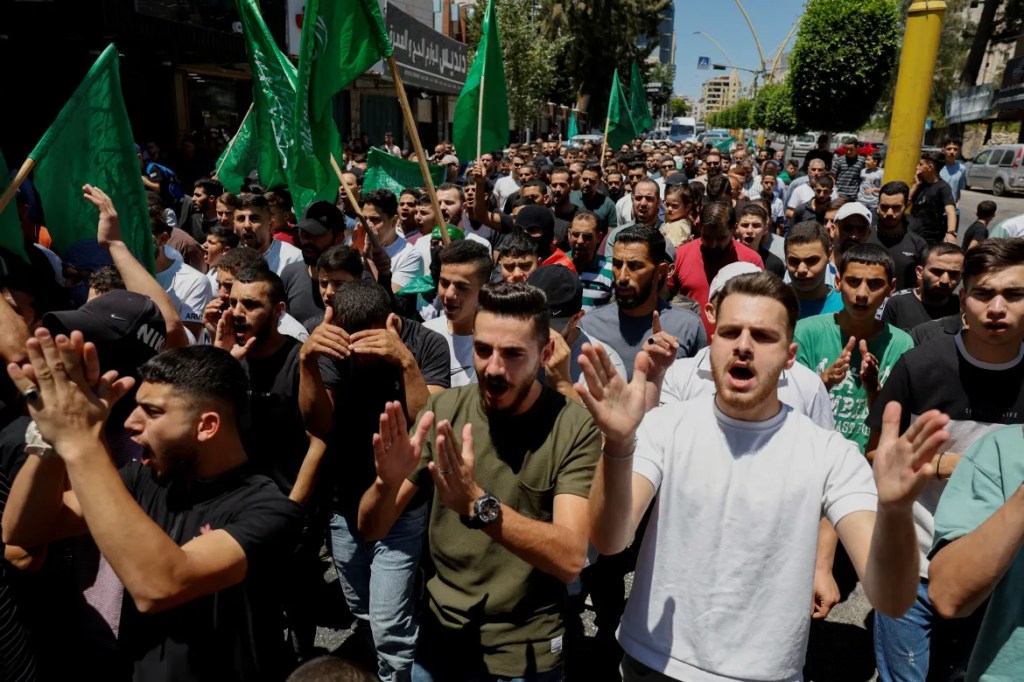
Palestinians in Hebron in the occupied West Bank protest against the assassination of Hamas political leader Ismail Haniyeh.

The assassination of Hamas leader Ismail Haniyeh, in Tehran two days ago, is a major escalation in the growing conflict in the Middle East.  While Israel has not claimed responsibility for the killing there can be little doubt that the nature and precision of the operation has the fingerprints of Mossad all over it.  That the killing took place just after the inauguration of a new Iranian president, Massoud Pezeshkian, and in the heart of Tehran itself will have been designed to cause maximum embarrassment to the Iranian regime.

The assassination also appears to be designed to torpedo the peace talks in relation to Gaza, as Haniyeh was the leading Hamas negotiator.  As the Qatari Prime Minister, a key player in the peace mediation process pointed out, “Political assassinations and continued targeting of civilians in Gaza while talks continue leads us to ask, how can mediation succeed when one party assassinates the negotiator on the other side? Peace needs serious partners.”

Israel is the most well armed and efficient military state in the Middle East, massively supported by the United States and to a lesser extent by Britain.  It has a clandestine nuclear weapons capability, rarely mentioned in the media but real all the same.  It has a government propped up by right wing religious fundamentalists, every bit as zealous in their mistaken belief in their own supremacy as the theocrats who have been murdering their way across Iran for over forty years.  That the response of the international community to assassination in a foreign capital has been little more than mild rebuke is nothing short of a scandal.

The killing of Haniyeh comes shortly after Israel claimed to have killed a senior military commander of Hezbollah in Beirut.  There can be no doubt that this has exacerbated the crisis in the region, bringing it to the brink of an extremely dangerous and widespread military conflict.

The response from the theocratic dictatorship in Iran was predictable.  Supreme Leader, Ayatollah Ali Khamenei, stated that Israel “by assassinating Ismail Haniyeh, has paved the way for a severe punishment” adding that “we consider it our duty to avenge his blood, shed in the territory of the Islamic Republic of Iran.”

The world awaits the consequences of the adventurist action of the Israelis.  There can be little doubt however that Iran will galvanise it’s so called Axis of Resistance, through Hamas, Hezbollah and Houthis to strike back in some way shape or form.  This is unlikely to be a mere symbolic action, as with the pre-warned missile strikes on Israel in April, responding to another Israeli act of international terror, when sixteen people were killed in the Iranian embassy in Damascus in Syria.   

While hitting an embassy is technically still a strike on domestic territory it does not carry the symbolism of a strike in the heart of Tehran.

The US government has taken its usual line in defence of Israel expressing “ignorance” about the assassination and “not being involved” in it, yet at the same time warning that it would defend Israel if it were attacked.  Suspicions have been raised that the attack, coming so close to the recent visit of Israeli Prime Minister Netanyahu to the United States, will have been given the green light by the US.  Any evidence to suggest that would certainly put the US back in the dock in the eyes of the international community as being complicit in acts of terror and actively escalating conflict in the region.

The corruption at the heart of the Iranian regime was further exposed recently in the report of the United Nations Special Rapporteur on atrocity crimes committed in Iran in the 1980’s, following the hijacking of the national democratic revolution by the Islamic theocracy.

In his analysis of the first decade of the Islamic Republic, following the 1979 revolution Special Rapporteur, Javaid Rehman, details the summary, arbitrary and extra-judicial executions of thousands of political opponents of the regime, amounting to the crimes against humanity of murder and extermination.  Significantly for the current regime and its apologists Rehman concludes that,

“…those with criminal responsibility for these grave and most serious violations of human rights and crimes under international law remain in power and control; the international community has been unable or unwilling to hold these individuals accountable.”

The assassination of Ismail Haniyeh in Tehran has raised serious questions about the state of Iran’s security apparatus, this not being the first time that Israeli security forces have been able to easily carry out terrorist operations on Iranian soil. This assassination highlights the extensive infiltration of imperialist intelligence agencies into Iran’s security apparatus.

The corruption at the heart of the Iranian regime is only matched by the religious fundamentalist cabal currently running the Israeli government.  Opposition in both countries is either actively suppressed or given little media exposure, though under both regimes there is significant internal opposition to their respective government’s actions.

For there to be any prospect of heading off the imperialist drive to war in the Middle East the peace movements in both Iran and Israel, as well as in the imperialist centres of the US, Britain and the EU need to grow stronger and voice their opposition to the growing conflict.  The Labour government in Britain needs to be pressured to adopt an independent foreign policy, not dependent upon the diktats of the US, or the pressures of its military proxy NATO.

Labour needs to take a stand which puts peace before conflict escalation and the interests of the people of the Middle East before those of imperialism.  That will only be possible through mass extra parliamentary action and through the peace and labour movements making those demands.   Labour should not be allowed to settle for carrying on the foreign policy positions of the Tories, as has happened in the past.  Given current developments the need for an independent peace oriented stand is greater than ever.

Iranian election sham will not fool the people

30th June 2024

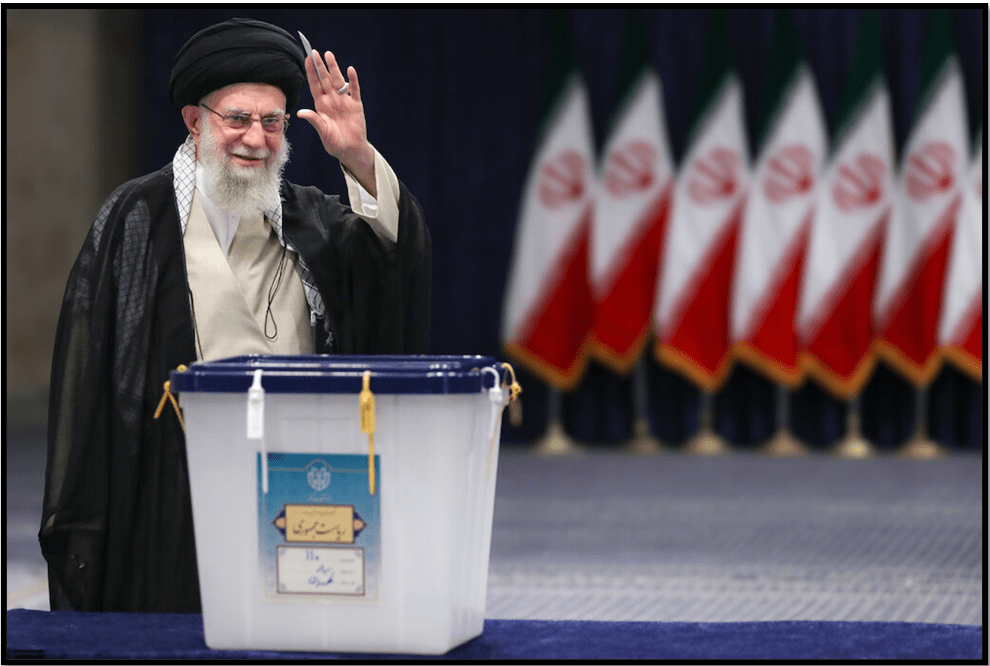
‘Supreme Leader’ Khamenei votes in Iran’s election sham

The Presidential election in Iran, following the death in a helicopter crash of President Raisi in May, has borne all the hallmarks of manipulation by the theocratic dictatorship under the Islamic Republic’s Supreme Leader, Ayotollah Ali Khamenei.

The death of Raisi, along with the ongoing wave of protests against inflation, poverty and corruption across Iran, have wrongfooted the regime.  While the hardline Raisi maintained his position through the force of the Islamic Revolutionary Guard Corps (IRGC) and his close relationship with Khamenei, popular support was always at a low ebb.

The response of the regime, in an election where all candidates are closely vetted by the Guardian Council, was to come up with a ‘safe’ candidate to add to the ballot paper, in order to appease so called moderates within the regime, and to head off any further protests from excluded opposition parties, trade unions, women and youth groups. 

To that end the inclusion of 69 year old former Health Minister, Masoud Pezeshkian, in the list of candidates approved by the regime was a calculated and deliberate tactic, in order to create a superficial and cosmetic change, without affecting the power structure based on the theory of “political Islam”.

The reformist faction within the regime urged public participation in the election and encouraged people to vote for Pezeshkian.  Their rationale is that the prospect of “building trust with the regime” is one which has more chance if a less hardline candidate occupies the presidency.  However, such tactics have proven to have failed in the past, with so called reformist candidates such as Muhammad Khatami (1997-2005) and Hassan Rouhani (2013-2021) failing to make any significant difference to the theocratic power structure which underpins the Islamic Republic.

Decades of experience with reformist movements, including the Green Movement for political and cultural openness and the teachers, workers, and retirees movements for better wages, livelihoods, and working and living conditions, have shown that hoping for the possibility of reform within the ruling structure is unrealistic. The emergence of the Women, Life, Freedom movement, in response to the murder in detention of Mahsa Amini in September 2022, has been the latest expression of this desire for structural, rather than cosmetic, change in Iran.

In spite of the efforts of the regime’s public relations machine in the lead up to the poll last Friday, desperate to increase participation in the election given the less than 50% turnout in recent votes, only 40% of voters turned out.  The depth of opposition supporting the boycott of candidates was widespread, further undermining the regime’s claims that the elections demonstrate democratic legitimacy. 

A run off vote with the two highest polling candidates, Pezeshkian and Saeed Jalili will be held on 5th July. However, with ultimate control over foreign and military policy remaining in the hands of the Supreme Leader the role of President in Iran can often be little more than ceremonial.

There is certainly no chance of either candidate challenging the corruption which is an endemic part of Iran’s economy, addressing the increasingly adventurist foreign policy in the Middle East, reflected in support for Hamas and Hezbollah, or addressing the lack of political and social rights of the Iranian people.

The scale of discontent within the country is underlined by the reports from the Union of Metalworkers and Mechanics of Iran (UMMI) that outsourced project workers in the country’s refineries, oil and gas installations and power plants have walked out in protest at their wages and conditions of service.  The workers are demanding a change in shift patterns including a ‘14 days on, 14 days off’ rotation for oil and gas workers and to “de-casualise” workers’ contracts.

An estimated 3,000 workers joined the strike on the first day and the ongoing action may well inform attitudes towards the Presidential election.  More recent reports suggest that the number of companies and workplaces affected by the action now stands at 80, involving at least 18,000 striking workers.

The scale of the suppression of political, democratic and human rights in Iran continues to be widespread an is an endemic feature of the regime.  Activists across the spectrum of the protest movements in Iran do not see either of the presidential election candidates having a plan to respond to their real democratic and just demands.  Even if this were the case, the theocratic structure would not allow for the opportunity to realise the implementation of democratic reforms.

Activists across the progressive opposition in Iran, who continue to advance democratic demands, continue to call for a country wide boycott of the election, in order to show that neither candidate represents the will or the aspirations of the Iranian people.

Progressive activists in Iran will continue to call for the development and deepening of the protest movements, seeking greater co-operation which can lead to the integration and convergence of different sectors.

Such a development will allow the true voice of the Iranian people to come through, not simply an echo manipulated through a sham election process.

US/Saudi pact a prospect?

31st May 2024

All eyes on Rafah – Palestinians survey the damage done by an Israeli strike

As the Israeli Defence Force (IDF) assault on the civilian population of Rafah continues, under the thinly veiled excuse of rooting out Hamas fighters, behind the scenes discussions are ongoing to reshape the map of the Middle East.

The prospect of an historic pact between the United States and Saudi Arabia is gathering momentum with the carrot of access to the latest US military technology being dangled before the Arab dictatorship.

The deal could be part of a package to extend US influence in the Middle East by including a pathway to diplomatic ties with Israel.  The quid pro quo would be that the Israelis halt the genocide in Gaza.

Negotiations between Washington and Riyadh have accelerated recently, with some reports that a deal could be reached within weeks. 

An agreement would undoubtedly aim to reshape the Middle East in favour of the United States, reinforcing the ongoing support for its long term regional proxy, Israel, while bolstering influence in the Arab world by increasing weapons sales to the Saudi dictatorship.  The US is keen to strengthen its position in the region, which it sees as being threatened by Iran and China.

The rumoured pact is thought to offer Saudi Arabia access to advanced US weapons that were previously off-limits. The dictatorship would then agree to limit Chinese technology from the nation’s most sensitive networks in exchange for major US investments in artificial intelligence and quantum-computing, as well as getting American assistance to build its civilian nuclear programme.

The conclusion of a US and Saudi Arabia agreement would, it is suggested, be followed by forcing Israeli Prime Minister Benjamin Netanyahu to make a choice.  Netanyahu would be offered the opportunity to join the deal, which would entail formal diplomatic ties with Saudi Arabia for the first time.  Israel would also be offered more investment and regional integration. The challenge for Netanyahu would be to end the slaughter in Gaza and agree to a pathway for Palestinian statehood.

In such a scenario Netanyahu would clearly face the ire of the right wing religious fundamentalists who currently prop up his government and are determined not to see an independent Palestine.  However, a pact with the US and Saudi Arabia could also be seen by Netanyahu as a counter to Iran’s growing influence in the region and a potential restraint on attacks by Iran backed militias such as Hezbollah.

With a US election only months away President Joe Biden is desperate for a foreign policy breakthrough and the issue of Gaza has proven divisive amongst Democrats domestically.  Student protests on university campuses across the US have exposed a fault line between those calling for a harder line to be taken with the Israelis over the action in Gaza and those more inclined to back the apartheid regime at all costs.

The thousands killed by the Israelis in Gaza are widely seen as a disproportionate response to the attacks by Hamas on 7th October 2023 and the recent vote by the United Nations General Assembly, to increase the status of the Palestinian state, although dismissed by Israel, has added to the international pressure for a lasting ceasefire.  Subsequent recognition of Palestine by Ireland, Spain and Norway has increased the pressure upon the apartheid Israeli regime.

“We have done intense work together over the last months,” U.S. Secretary of State Antony Blinken claimed recently, while in Saudi Arabia. “The work that Saudi Arabia and the United States have been doing together in terms of our own agreements, I think, is potentially very close to completion.”  Saudi Foreign Minister Faisal bin Farhan has also said that an agreement was “very, very close.”

However, while Blinken and Biden may be making positive noises about a deal there is scepticism, not only from the right wing in Israel, but also in the US.  Republicans are unlikely to countenance a deal which does not give Israel sufficient guarantees, in particular Saudi recognition of Israel, even of it does mean an increase in arms sales to the Saudi dictatorship.

For their part the Saudis are keen to get as strong a deal with the US as possible, the aim being a formal defence pact which would bring the US military into play should the dictatorship be attacked.

While Saudi Arabia and Iran have been moving to normalise relations recently, with the signing of a deal in March 2023, the two Islamic dictatorships remain wary of one gaining more influence than the other in the region. For the Saudis, a defence deal with the United States needs to be sufficiently robust to send a message to Tehran without alienating the Iranians. For Riyadh to decide to openly bolster its security cooperation with Washington the reward would have to be worth the risk. In effect, Saudi Arabia seeks a defence pact with the United States that is credible enough in the eyes of both friends and foes.

The escalating violence in Gaza and Israeli intransigence on the question of a two state solution for Palestine is likely to undermine previous US diplomatic initiatives such as the Abraham Accords, signed in 2020, which established diplomatic relations between Israel and the United Arab Emirates, Bahrain and Morocco. 

While hailed by the US as a means to encourage Israel to take positive steps toward ending its occupation and annexation of Palestinian territory, the real premise of the Accords was to prove that the Palestinian issue was no longer an obstacle for Israel’s relationships in the region, as Arab states dropped their demand for a Palestinian state as a condition to normalising ties with Israel.

Far from curbing Israeli abuses the Accords have emboldened successive Israeli governments to further ignore Palestinian rights. In the first year after the Accords, settler violence dramatically increased in the West Bank. Following the election of Israel’s most right-wing government in history in 2022, cabinet ministers openly called for the annexation of the West Bank and announced massive settlement expansions. 

The United States does not have a great diplomatic track record in the Middle East, putting its own imperialist interests ahead of those of the people of the region.  There is little indication that current initiatives will see different results.

More Casualties in a Series of Israeli Attacks Across Gaza

(report from the Communist Party of Israel)

Israeli occupation forces continued their airstrikes and artillery shelling across the Gaza Strip on Friday, April 5, resulting in numerous casualties among Palestinian its 182nd day in a row. In a preliminary toll, the ongoing Israeli onslaught on Gaza since October 7 of last year has resulted in 33,037 documented Palestinian fatalities, mostly children and women, while the number of injuries has reached 75,668. 

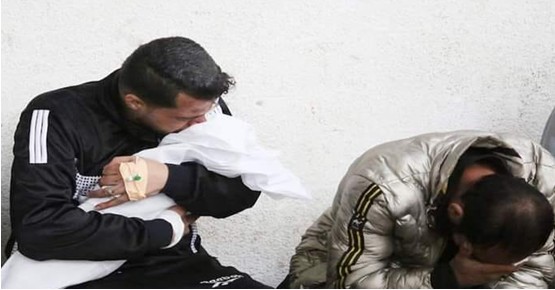
Grieving Palestinian father Ashraf Abu Daraa bids a farewell for his two kids and pregnant wife who were killed last night in an Israeli airstrike targeting their home in Rafah (Photo: WAFA)

WAFA correspondents reported that Israeli artillery shelling targeted the central and western parts of Khan Yunis province, as well as the eastern part of Rafah city in southern Gaza.  Additionally, a fierce airstrike hit the vicinity of Sheikh Zayed City in northern Gaza, while several areas in the central governorate of the Strip were subjected to Israeli artillery fire.

Simultaneously, local sources reported that Israeli warplanes targeted Tal al-Hawa west of Gaza before midnight, while artillery and aerial bombardments hit the southwestern and southeastern neighborhoods of Khan Yunis city, and the eastern part of Al-Maghazi refugee camp in central Gaza. Earlier, Israeli artillery fire targeted the Qleibo and Sheikh Zayed areas in Beit Hanoun in the northern Gaza Strip, coinciding with the ongoing destruction of residential homes in central and western Khan Yunis by the occupation forces.

According UN reports, since October 7 and as of April 1, 428 Palestinians, including 110 children, have been killed by Israeli forces across the occupied West Bank, including occupied East Jerusalem, of whom 131 were killed since the start of 2024. In addition, nine were killed by Israeli settlers and three by either Israeli forces or settlers. Four additional Palestinians from the West Bank have been killed while perpetrating attacks in Israel. During the same period, some 4,760 Palestinians have been injured, including at least 739 children, the majority by Israeli forces. According to the Palestinian Prisoners Club, 11 Palestinians have additionally died in Israeli prisons since 7 October 2023, mainly due to reported medical negligence or abuse.  

Related: https://maki.org.il/en/?p=31724

Israel is not above the law

28th January 2024

Supporters of a free Palestine demonstrate outside The Hague

The measures outlined by the International Court of Justice (ICJ), which has ruled that Israel’s actions in Gaza are plausibly genocidal, must be welcomed by all who support the cause of Palestinian liberation.

The ruling is a landmark in the search for justice for the Palestinian people.  The ICJ decision will be relayed to the United Nations Security Council for consideration.  The ruling orders Israel to prevent acts of genocide against Palestinians and to do more to help civilians, who are currently suffering under daily bombardment by the Israeli Defence Force (IDF).  However, the ICJ stopped short of ordering a ceasefire as requested by the plaintiff South Africa.

Although the ruling contained no binding order upon Israel to stop the war in Gaza it is nevertheless a legal setback for Israel. The Palestinian Foreign Ministry said the decision was a welcome reminder that “no state is above the law”.

The ruling not only obliges Israel to stop all acts which are plausibly genocidal but equally obliges all states to cease funding and facilitating Israel’s military offensive in Gaza.  The measures, all backed by at least 15 judges, also required Israel to ensure the preservation of evidence of alleged genocide and report to the court within a month.

In coming to its decision the ICJ did not have to find whether Israel had committed genocide, which will be determined at a later date, but only that its acts were capable of falling within the convention, which defines the war crime as “acts committed with intent to destroy, in whole or in part, a national, ethnical, racial or religious group”.

Nevertheless, the United States made its position clear ahead of the judgement, describing South Africa’s case at the ICJ as “meritless, counterproductive, completely without any basis in fact whatsoever.”

Israeli Prime Minister, Benjamin Netanyahu, proclaimed in response to the ICJ ruling,

“Israel’s commitment to international law is unwavering. Equally unwavering is our sacred commitment to continue to defend our country and defend our people. Like every country, Israel has an inherent right to defend itself,” he said. “The vile attempt to deny Israel this fundamental right is blatant discrimination against the Jewish state, and it was justly rejected.”

As ever the scared right to self defence is, for Netanyahu, one which applies to Israel but not to the Palestinians, whom Israel has been oppressing in the West Bank and Gaza for decades.  The mantra that ‘Israel has the right to defend itself ‘ is increasingly seen as  a right wing trope for justifying the Israeli regime treating Palestinians with impunity.

Solidarity organisations across the world have called upon all states to commit to upholding the ICJ decision to protect the rights, including the fundamental right to life of Palestinians in Gaza.  The death of over 25,000 people, over 70% of whom are women and children according to the United Nations, cannot be justified by the IDF as a response to the actions of Hamas on 7 October 2023.

Such a disproportionate response, having been condemned by the ICJ, must now be condemned by the entire international community and every effort made towards supporting the call for an immediate ceasefire, a negotiated solution to end Israeli action and free hostages held by Hamas.

Most importantly the resolutions of the United Nations on the need for a two state solution, realising the right of the Palestinian people to self-determination and the establishment of a Palestinian state within agreed international borders, must be acted upon by all member states.

The ICJ ruling is to be welcomed as a vital step towards the realisation of the need to stop the current genocide in Gaza and take the first steps towards the establishment of an independent state for the people of Palestine.

However, the ongoing commitment of the United States and Britain to arm Israel, not take the Israeli government to task for its flouting of international law and to be, at best, lukewarm about the necessity of a Palestinian state, remain significant barriers to progress.  In the short term the failure of either state to recognise the need to support the call for a ceasefire, in spite of the mounting death toll, is scandalous.

The fact that this shame is cross party, with the Labour leadership in Britian continuing to back the government’s position, including being in favour of air strikes against Yemen, adds urgency to the need to campaign for a change in British foreign policy.

As the Jewish diaspora gather to mark Holocaust Memorial Day over this weekend many are rightly appalled by the action of the IDF and the religious zealots around Benjamin Netanyahu in Gaza.  Opposition to the religious fundamentalists in the Israeli regime is growing both inside and outside Israel, many in the Jewish community increasingly regard the actions of Netanyahu and his war cabinet as not being carried out in their name.

The working class movement in Britain and across the world needs to stand in solidarity with those opposing religious fundamentalism in Israel, just as they support those opposing the theocratic dictatorship in Iran and religious zealotry in Saudi Arabia.  The fate of the people of Palestine and the people of Israel may depend upon it.