Iran – reform becoming radicalised

18th February 2026

As discussions continue between the United States and Iran over the Islamic Republic’s nuclear enrichment programme, the suppression of internal dissent by the theocratic dictatorship grows. 

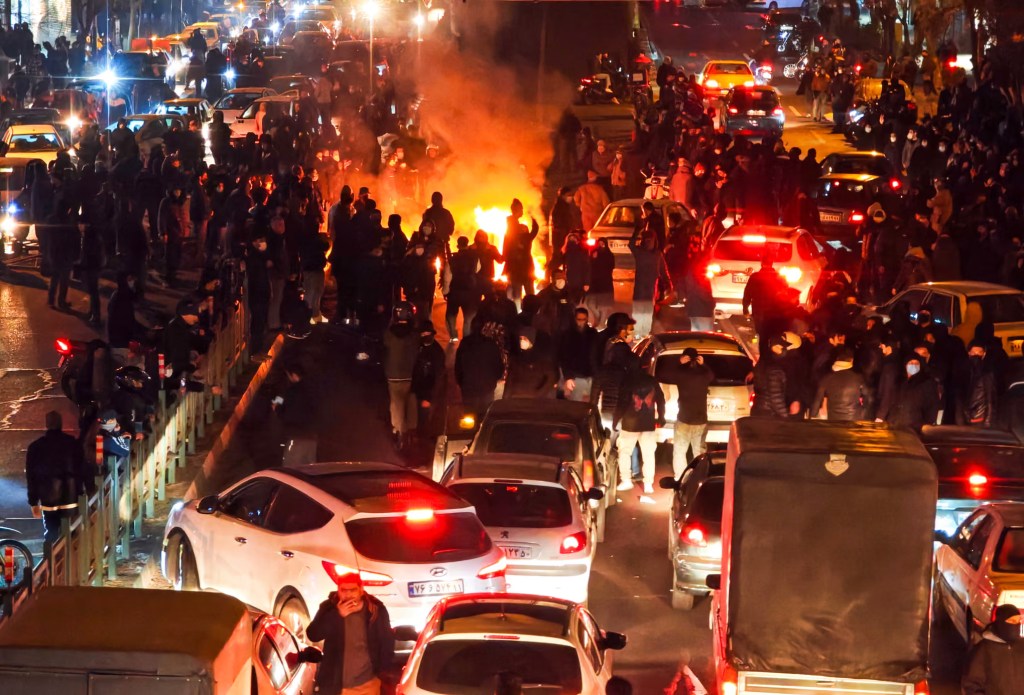
Protests across Iran last month took on an increasingly anti-regime character

It is hard to believe that the leadership of the Islamic Republic of Iran do not take the threats issued by US President Donald Trump seriously.  After the unprovoked attack on Iran by Israel in June 2025, followed by the US bombing of Iran’s nuclear facilities, it should be clear that the actions of the US are a real danger to the Iranian people.

However, it is not the Iranian people which are the primary concern of the theocratic leadership, or the military circle of the Islamic Revolutionary Guards Corps (IRGC) which protects them. Both the theocracy and the military in Iran are mired in corruption, presiding over a failing state, which they sustain in order to protect their own interests rather than those of the people of Iran.

The moribund theocracy refuses to shoulder any blame for the state of the Iranian economy or the increasing poverty of the population.  International sanctions, outside forces, Mossad agents are, in their view, all to blame for the fomenting of unrest and its causes, which have led to mass protests and outbreaks of anti-regime slogans over recent months.  If the Iranian leadership is to be believed they do not bear any responsibility for the current crisis, hoping to hide behind a fig leaf of anti-imperialist rhetoric by placing the blame for all things on the US and Israel.

That there is truth in the belligerence of the US and Israel towards Iran gives the pleas of the Iranian leaders a veneer of plausibility but it is no more than a surface sheen.  The religious zealotry which drives the fundamentalists in the current Israeli government is simply the other side of the coin from the religious zealotry which has been characteristic of the Iranian regime for the past  47 years.

Israel’s desire for dominance in the Middle East is backed by the might of the United States.  Iran’s attempts to dominate the region have been through the creation of the so called Axis of Resistance, united by an antipathy towards Israel and its fundamentalist tendencies towards greater territorial expansion in the region.

On the international front, talks continue between the US and Iran regarding its nuclear enrichment and ballistic missile programmes.  In recent days however, the Islamic Republic has launched a new wave of arrests targeting prominent figures of the Reform Front and domestic critics, charging them with “establishing subversive mechanisms.”  Arrests include those of Javad Imam, the spokesperson for the Reform Front, and Hossein Karroubi, the son of Mehdi Karroubi, a dissident cleric and leader of the Green Movement.

This is a pattern of behaviour which goes back over forty years as the Islamic Republic has resorted to the arrest, imprisonment, torture and execution of political opponents, trade union activists, women’s rights campaigners and academics who have voiced opposition to the regime and its policies.

With reference to the recent protests against the regime, in January of this year, the judiciary in Iran justified arrests on the basis that members of a ‘circle’ consisting of ‘extremist elements’ took action to ‘incite the country’s domestic atmosphere’ and were ‘acting to destroy national cohesion by levelling accusations and publishing false positions against the country.’

The arrests come at a time when the Reform Front, which previously viewed the existing regime as one which could be modified, has moved to a more radical position, recognising that the regime as it stands is beyond reform.

Ardeshir Amir-Arjomand, a legal expert and advisor to Mir-Hossein Mousavi, one of the leaders of the Green Movement, in a recent interview with Euronews, viewed the arrests as a result of the existing regime’s fear that an internal opposition in Iran could grow and demonstrate popular support which would undermine the Islamic Republic, stating,

“Khamenei has a clear red line: a prominent, independent national opposition must not be allowed to form within the country. An independent opposition that simultaneously opposes foreign military strikes, recommends non-violent solutions, and maintains a clear stance against authoritarianism is completely unacceptable to Khamenei.”

The fear of a growing opposition to the sectarianism of the Islamic Republic was the driving force behind the mass imprisonment, torture, execution and exile of opposition activists in the 1980’s, including Iran’s Communists and other Left wing opponents of the regime.  While the Reform Front does not by any means represent a revolutionary alternative to the existing regime its growing radicalism is seen as a threat by the ruling theocracy.

Ardeshir Amir-Arjomand, summarised the position as he sees it,

“I believe the regime fears domestic movements more than anything else and has exerted every effort in recent years to discredit them and alienate them from their popular base.”

It is clear from the actions of the regime and the assessment of those close to the Iranian opposition that any limited tolerance of reform, which the Iranian regime may have had, is rapidly disappearing.

The lack of trust which the Iranian leadership has in its own people is evident in the number of deaths and arrests immediately following the protests in January.  The recent arrests suggest that the  regime is not letting up in its suppression of opposition.  The rhetoric of Donald Trump, in relation to coming to the rescue of protesters, is clearly regarded as hollow in this regard. Although further strikes on Iran’s nuclear capability have not been signalled by Washington in the short term, they cannot be ruled out depending upon the outcome of talks.

The Iranian people once again find themselves between a rock and a hard place, hesitant to sustain protest on the streets, for fear of shooting and arrest, but with no desire to rely upon external intervention to bring about regime change. It is a situation which cannot be sustained indefinitely and one which must be resolved by the Iranian people, in the interests of the Iranian people in their desire for peace, democracy and social justice.

(This is an edited version of an article which first appeared in the Morning Star 13 February 2026)

 Keep up to date at www.codir.net

CODIR welcomes protests demanding democratic change in Iran 

10th January 2026

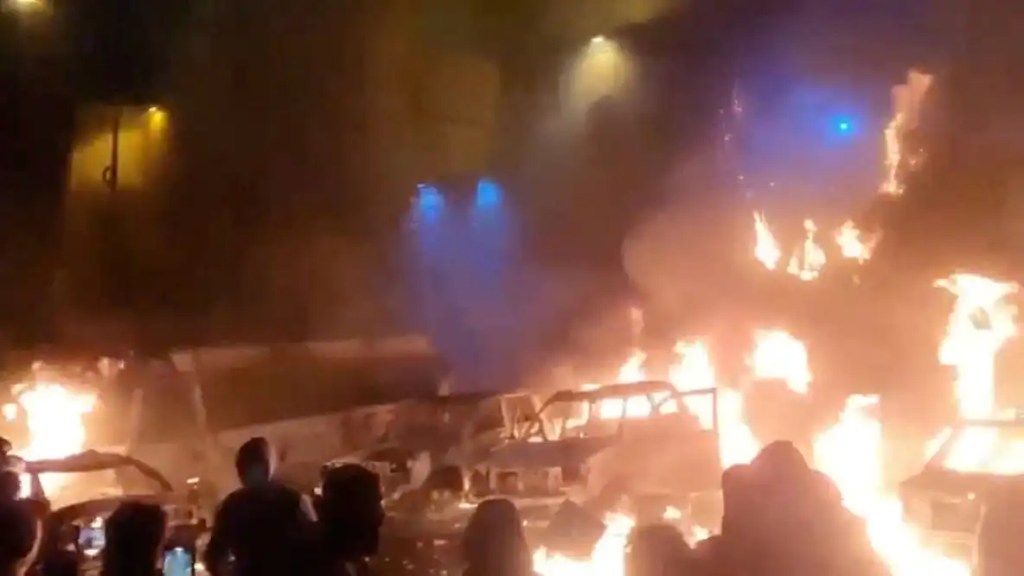
 Vehicles burn in Tehran as anti-government protests continue

The Committee for the Defence of Iranian People’s Rights (CODIR) has today welcomed demonstrations across Iran, which have put pressure upon the theocratic dictatorship, but warned against intervention by the United States to force Iran in a particular direction.

CODIR General Secretary, Gawain Little, reiterated the solidarity organisation’s position of opposition to the dictatorship while opposing outside intervention today.

“These protests underline the fragility of the regime and how narrow its base of support has become”, said Mr. Little, “the impact of international sanctions, the collapse of the Iranian currency and widespread corruption at every level of government have combined to make it almost impossible for the working people of Iran to live above the poverty line.  The current demonstrations indicate real disillusionment with the current regime and that is only likely to grow. However, these protests need to be driven and decided by the Iranian people, not the diktats of outside forces such as the United States.”

While the BBC and Western media report backing for the deposed monarchy is a feature of the protests, CODIR’s sources inside Iran suggest that this is not a view which enjoys widespread popular support.  At present the protests are focussed on opposing the existing regime without any clear coalescence around an alternative.  Given the repression of opposition groups under the former Shah, a factor leading to the 1979 revolution, there is widespread scepticism that a return to monarchy in Iran would bring any improvement in the lives of working people.

In a recent interview in the United States the former Shah’s son, Reza Pahlavi, was clear that he does not see his future as being based in Iran, given that his life, family and friends have been based in the United States for the past 40 years.

CODIR welcomed the support of European Parliament President, Roberta Metsola, who has paid tribute to the street protesters praising a “generation  who want to tear off the shackles of oppression.”

Other European leaders have so far been more cautious while US President, Donald Trump, has repeated his threat to intervene if  more people are killed as a result of the protests, having stated last week that the US will “come to their rescue”. Reports suggest that so far, the regime has killed at least 38 people while more than 2,200 others have been detained. 

The current level of protests match those which followed the rigged Presidential election in 2009 and surpass those following the death in custody of Mahsa Amini in September 2022.

As well as the usual show of force the Iranian regime has imposed a countrywide internet shutdown in an attempt to close down channels of communication and prevent protests becoming even more widespread.

CODIR Assistant General Secretary, Jamshid Ahmadi, outlined the dire situation within Iran, stating,

“Widespread strike action has greeted the government’s failure to tackle the issues facing the Iranian people, with protests in the oil industry, the public sector and from pensioners all demonstrating against poor working conditions and a deterioration in the value of earnings. Iranian trade unions and trade unionists are supporting the demand for democratic change in the country. The current wave of protests builds upon these actions and stresses the extent of the Iranian people’s suffering under the dictatorship.” 

CODIR is calling upon all affiliates and the British government to show support for the protesters, in the face of the dictatorial actions of the regime, while opposing any foreign intervention, stressing that the future of Iran must be determined by the Iranian people.

Contact Information for CODIR:-

Postal Address:
B.M.CODIR
London
WC1N 3XX
UK
Website: www.codir.net
E-mail: codir_info@btinternet.com

Further information on CODIR

CODIR is the Committee for the Defence of the Iranian People’s Rights.  It has been established since 1981 and has consistently campaigned to expose human rights abuses in the Islamic Republic of Iran.

CODIR has worked closely with the trade union movement in the UK, the peace movement, all major political parties and Amnesty International to press the case for an end to torture in Iran’s prisons.  Major trade unions in Britain are affiliated to CODIR and support its campaign for peace, human and democratic rights, and social justice in Iran.

CODIR has published Iran Today, its quarterly journal, since 1981, explaining the latest developments in Iran and the most effective way that the British public opinion could demonstrate its solidarity with the people of Iran.

In recent years CODIR has worked closely with Stop the War Coalition and has been vocal against any form of foreign intervention in the internal affairs of the nation.