Trump 2.0 – resistance is growing

20th January 2026

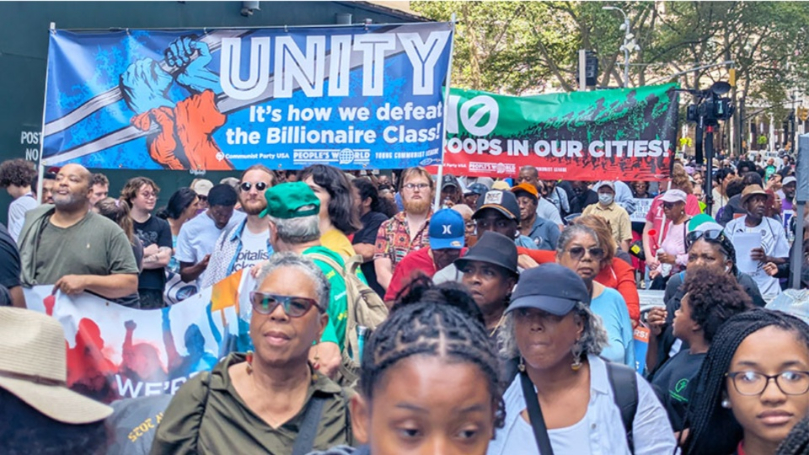
Demonstrations are growing across the United States

It would be easy to see the outcomes of the first year in office of Donald Trump’s second term as President of the United States as the rantings of an unhinged narcissist.  While this may be a true reflection of the character of Trump as an individual the agenda for US imperialism is not just about Donald Trump.

Although the most highly weaponised, aggressive and interventionist nation in history, the US feels threatened by the rising economic power and influence of China, the potential for a resurgent capitalist Russia and the challenge to the supremacy of the dollar from the nations of the Global South, coalescing around the BRICS movement.

While developments in all of these areas are uneven, they nevertheless represent a rejection of the notion of US world leadership and are open to alternative ways to tackle political, economic and environmental concerns.

The BRICS countries certainly do not share common political or ideological objectives but generally have an interest in loosening the grip of the US in the international banking system and establishing fairer trade relationships. 

Any expansionist ambitions the Russian ruling class harbour have been effectively hemmed in by the NATO encirclement over the past thirty years.  Ukraine is the last piece in that jigsaw and one which Russia is seeking to avoid falling into place.

The endgame for the West is clearly to have a Russia compliant with the NATO alliance and a source of cheap labour and exploitable natural resources for the Western market.  The real driver behind Trump and US imperialism’s belligerence over Greenland, for example, has little to do with the defence issues touted and much more to do with access to rare earth minerals for American companies to exploit.

China is regarded as the biggest threat by US imperialism, due to its obvious economic strength, its rich natural resources and its growing influence in the Global South, based upon its non-exploitative economic relationships.  China’s military expenditure is paltry compare to the US and the Communist Party leadership are clearly reluctant to engage in the arms race the US would like to entice them into, at the expense of the wider economic benefits for the Chinese people.

The continued provocation to China, around the status of Taiwan, internationally recognised as part of China, is the potential flashpoint which the West may use in its attempts to undermine Chinese economic growth and international credibility.

While Trump has declared that the Western Hemisphere is the US’s to police, a licence to piracy, kidnap and invasion, the imperial ambitions of the US are by no means confined to its self styled ‘backyard’.  The patrolling of the South China Seas through the AUKUS alliance is clearly a provocation to China.  The fuelling of weapons to Israel, to prolong the genocide in Gaza, along with the bombing of Iran are clearly sending messages to the countries of the Middle East that US imperialism sees its own interests as being primary, above those of the people of the region.

The kidnapping of Venezuela’s President Maduro, the threats against Cuba, Colombia and Mexico, even the continued threat to annexe Canada, are all part of the US strategy of flexing its military and economic might in the hemisphere it regards as its own.

Trump 2.0 may be restrained by poor mid term election results in November but the forward path of US imperialism in the 21st century is well and truly established.  It is unlikely that a few changes of Congressional seats or even a change of Presidency are going to alter that in the short term.

Resistance within the US is becoming more visible however.  The Immigration and Customs Enforcement (ICE) service shooting of civilian Renee Nicole Good in Minnesota recently has led to widespread protest.  The election of New York Mayor, Zohran Mamdani, an avowed Democratic Socialist, is a step in the right direction.  Resistance to the Trump administration’s attempts to overturn the gains of the Civil Rights Movement in the US is growing, while attacks on workers rights to organise and to collective bargaining are bringing more into struggle.

The first year of Trump 2.0 has certainly had many moments of concern, both domestically and internationally, but US imperialism cannot simply be allowed to get its own way and people are recognising this in US cities and across the globe.  The fightback must be sustained and resistance built upon at every opportunity.

Trump turns up heat on ‘allies’

17th April 2025

US President Donald Trump pointing in which direction the US economy is heading

In the midst of the apparently chaotic approach to the international economy taken by United States President Donald Trump, there is an underlying objective which was made clear by the Wall Street Journal this week.  The newspaper cited internal sources in the Trump administration confirming that the plan is for the US to use “ongoing tariff negotiations to pressure US trading partners to limit their dealings with China.”

The Wall Street Journal states that,

“U.S. officials plan to use negotiations with more than 70 nations to ask them to disallow China to ship goods through their countries, prevent Chinese firms from locating in their territories to avoid U.S. tariffs, and not absorb China’s cheap industrial goods into their economies.”

The so called Liberation Day ‘reciprocal’ tariffs, announced on 2nd April, saw the US propose a wide range of tariffs upon trading partners based upon the trade deficit they had with the US, a methodology which famously included the Heard and McDonald Islands, only inhabited by penguins.

The British government, far from being outspoken in opposition to the tariffs, expressed relief at only being in the 10% tariff band, a category which is now occupied by everyone but China, faced with an outrageous 145% tariff on goods exported to the US.  The 90 day hiatus on implementation of the tariff bands subsequently announced by Trump is supposedly to give countries the opportunity to negotiate.

What this means in reality is that those countries who rely significantly on trade with the US are expected to bend the knee to US imperialism or be hit with more punitive action once the 90 days is up.  In particular, the negotiations will be a means by which the US tries to compel nations to limit their dealings with China.

The US is used to getting its own way, either through economic manipulation of international bodies such as the International Monetary Fund (IMF) and World Bank, or through the use of military force.  

The clearest example of economic pressure is the illegal blockade of Cuba, which has stood up to US imperialism for over 60 years and continues to survive in spite of the attempts of the US to strangle its economic development.   

More recently the US has adopted similar tactics in relation to Venezuela in an effort to enforce regime change.  Threats to annexe the Panama Canal and take over Greenland are current indicators of US intentions, while the people of Libya, Iraq, Afghanistan and Syria can attest to the fallout of direct US military intervention in the Middle East.  The people of Gaza and the West Bank are the ongoing victims of the genocide perpetrated by the US’s proxy in the Middle East, Israel.

The unipolarity which US imperialism enforced following the defeat of the Soviet Union in the early 1990’s  is now threatened by the rapid economic development of the Chinese economy.

The latest World Economic Outlook data, published by the IMF in January 2025, indicates growth of 2.7% for the US in 2024, the EU at 0.8%, Britain at 0.9% and China at 4.8%.  While this only provides a snapshot it is indicative of the trend globally, that capitalism as a model is failing and that economies structured with more centralised state control are on the ascendant.

In recognising this the US trade war, launched by Trump, is a clear attempt by the US to bully so called ‘allies’ back into the US camp.  The pressure upon members of the NATO Alliance to increase their military spending to 5% of GDP is also part of this strategy.  Not only will public services across much of Europe be impoverished but the main beneficiaries will be the US arms dealers who have access to the most up to date weapons technology.

China’s response to US tariffs has been to impose tariffs of its own, at 125%, on US goods imported into China.  Chinese President, Xi Jinping, has undertaken a tour of Southeast Asia this week, as part of an anti-tariff campaign and offering a more stable alternative trading partner to US uncertainty.

As part of the BRICS (Brazil, Russia, India, China, South Africa) Alliance, China is already engaged in a process of exploring alternatives to the US dollar as the default international currency measure.  The Global South generally is suspicious of US actions and intentions in relation to both economic issues and military threats.

While tariffs will undoubtedly hit the Chinese economy the capacity of China to withstand the impact is arguably greater, as it can more easily replace what it imports from the US from other sources.  US exports to China are heavily agriculture focused such as soya beans, cotton, beef and poultry.  Conversely the US relies on China for imports of electronics, machinery and processed minerals, far more difficult to source from elsewhere.

Also, as a result of tariffs imposed upon China in Trump’s first term, China has consciously reduced its share of imports from the US, down from 21% in 2016 to 13.4% in 2024, all of which underlines why the US is also putting pressure upon so-called allies to reduce trade with China.

China controls more than two thirds of global rare earth production and more than 90% of processing capacity.  The US relies on China for many rare earth metals, essential for electric vehicle batteries for example, which means Trump’s trade war could well backfire even more spectacularly than it already has.

The real danger for the world is that if the economic arm twisting tactics of US imperialism do not work the usual recourse is to military force.  Anti-Chinese propaganda is now widespread across Western media and the possibility of action over Taiwan could well be the occasion for a military flashpoint.  The peace, trade union and labour movement need to be alert to this possibility and be ready to expose the machinations of US imperialism rather than be fooled by the illusion of a US/Britain ‘special relationship’, which will certainly not be special for the working class if world war is the outcome.

Warning signs – First week of Trump 2.0 spells out dangers

22nd January 2025

Mass opposition to Trump underway in the USA

At the victory rally held in advance of his official inauguration, US President Donald Trump vowed to get rid of the “radical Left woke” which he saw as dominating American life and culture.  For Trump the term encompasses a whole range of progressive policies and positions that working class organisations have fought for and won over many years but Trump and his cronies see as an impediment to the realisation of their particular version of the American Dream, to make the rich even richer.

In less than a week Trump has signed orders to withdraw from the Paris climate agreement; withdrawn the US from the World Health Organisation (WHO); declared a national emergency on the US/Mexico border, in order to not only halt migration into the US, but initiate the biggest mass deportations in US history; declared that children of migrants, born in the US, will no longer be deemed to have automatic rights to US citizenship, contrary to the 14th amendment of the US constitution; and granted pardons to nearly 1600 of his followers who stormed the Capitol building in January 2021, in spite of them having been convicted following due process in US courts.

Trump has also issued an executive order calling for an end to what he describes as “dangerous, demeaning and immoral”, diversity, equity and inclusion schemes, putting all staff overseeing such programmes on paid leave with immediate effect.  Consistent with this approach Trump has declared that in relation to gender in the US there, ”will be two sexes, male and female”, clearly a swipe at the transgender and LGBT communities.

In the US the People’s World noted that Trump has also “ended the Biden administrations Justice40 initiative, which set a policy that 40% of the benefits of federal investment must go to disadvantaged communities and repealed an executive order setting up a national goal for electric cars to make up half of new cars and truck sales by 2030.”

Flying in the face of all of the evidence that the planet faces a climate emergency, Trump’s response has been, ‘drill baby, drill’, and a promise of more permissions for oil and gas exploration to be granted.  Tariffs on imported goods from Canada and Mexico it has been suggested could be at 25% while a trade war with China, imposing tariffs on Chinese goods is in Trump’s sights, with a 10% tariff likely to be imposed as early as next week.  The mobilisation of the US military in the South China Sea and the possibility of Taiwan being a provocation for military action against China cannot be ruled out.

While Trump has already made belligerent noises in relation to Greenland and Panama, allegedly in the interests of economic and military security, some form of action against Iran is also a likely scenario, either directly or through proxy Israel, and there is almost certain to be an even greater intensification of the illegal blockade against Cuba.  Newly sworn in Secretary of State, Marco Rubio, is known for his vicious anti-Cuban views.

While there is a degree of naivety amongst some on the Left that Trump can only serve one term and sense will prevail in 2028, there is no indication that the Democrats have either a strategy for winning back working class votes or a credible candidate to front a campaign.  There is also the possibility that the constitutional constraint on Presidents only serving two terms could be overturned and a Trump Presidency extended into the 2030’s.

In any event, based upon the first week in office it is clear that there is no room for complacency.  Progressive trade union, women’s and civil rights groups, along with the Communist Party USA, are organising resistance at local, state and national levels to challenge Trump every step of the way, opposing both domestic policy and the imperialist designs of the US across the world.  

Supporting these efforts will become increasingly important as Trump’s term progresses.  That will include putting pressure upon the British government not to kowtow to the agenda of racism, imperialism and the threat of war which Trump’s second term will undoubtedly herald.  Trade unions, the Labour Party and progressive campaigns such as Stop the War and CND must ensure that mass extra Parliamentary action is used effectively to press for an independent British foreign policy, free of US diktat, leaving NATO and reducing military spending.