

https://liberationorg.co.uk/book-review/syria-civil-war-to-holy-war-review/
Category: Uncategorized
Real change needed
5th May 2025

Nigel Farage – delighted to see Reform UK take over Durham County Council
After UKIP and the Brexit Party, the latest incarnation led by right wing nationalist, Nigel Farage, is Reform UK. As with the previous manifestations of the Farage ego, Reform UK is a party of the rich, for the rich, run by the rich, masquerading as the voice of the people. The Farage brand, the ordinary bloke down the pub with common sense opinions, is as phoney as any marketing ploy adopted by the leaders of other parties to try and burnish their fading fortunes.
Like US President Donald Trump, Farage presents himself as an outsider, the scourge of the establishment, the man with a mission to ‘drain the swamp’, stop the waste of taxpayers money, root out corruption, a real man of the people. All part of the branding.
Farage, like Trump, is not against the establishment he is just another, more vicious manifestation of it. The attacks upon concepts of equality, diversity and inclusion; the trashing of targets for net zero carbon emissions; the anti trade unions stance; the attacks upon local government; and the massive emphasis upon reducing migration to Britain are all simply extensions of policies which have been lurking on the right wing of the Tory Party for years and sound like easy solutions to the deepening crisis of capitalism in Britain today.
In taking over control of Durham County Council in the North East of England Farage was quick to pronounce that any staff working on equality schemes or the green agenda should be looking for new career paths. The idea that money spent in such areas of local government activity could be diverted to address the problem of potholes in roads was flagged by Durham CC Reform Cllr Darren Grimes, a man who has recently posted,
“Not a chance I’ll support migrants getting keys to homes while locals get kicked to the kerb.”
This posing of one issue against another, equality work versus potholes, migrants versus homelessness, is classic right wing demagoguery, which is a cover for not wanting to reveal the fact that the entire capitalist system is failing working people and needs to be overthrown in its entirety.
The rise of Farage and his ilk is only possible because the party with the deepest roots in the working class and trade union movement, the Labour Party, has abandoned any notion of tackling head on the real issues faced by working class people in Britain. The shrinking of opportunities through advancement in education; the decimation of local government services on which the most vulnerable rely; the creeping privatisation of the NHS; the waste of money on weapons of mass destruction; the need to invest in green infrastructure in order to create jobs and prosperity.
The Labour Party leadership is afraid of its own shadow, is afraid to stand up and say that we do not have a migration crisis in Britain, that the numbers of migrants is small and can easily be accommodated. The Labour leadership is afraid to say that weapons of mass destruction do not create jobs, they simply divert resources away from more socially useful production while making Britain a target. The Labour leadership is more concerned with clinging to its illusion of power than making the case for real change for the working class of Britain. It’s not that they won’t go down without a fight, it’s that they won’t put up a fight in the first place.
All of which leaves a void to be filled by the ‘bloke down the pub’ politics of the likes of Farage, with no-one piping up to point out that the bloke down the pub is usually half tanked and talking bollocks.
Reform UK gaining 677 councillors and control of eight local authorities, as well as overturning a 14,000 strong Labour majority in the Runcorn and Helsby by-election has to be awake up call. Whether the Labour leadership has the political acumen or nous to realise this is another matter. They clearly have no understanding of the depth of the crisis US imperialism faces globally, with the growing efficiency of the Chinese economic model, even less understanding of that for the British economy and seemingly no clue as to how to begin the process of carving out a place for an independent socialist Britain which could truly address people’s needs.
Pundits across the press and media have been proclaiming the end of the two party system in Britain over the past few days, following the 1st May election results. What they fail to realise is that, whether there are two parties or five, what is broken is the entire system which, whatever combination of parties make up the House of Commons, remains geared to serve the interests of the banks, corporations, the City of London and the military industrial complex.
Begin to challenge that and real change may then be possible.
Trump turns up heat on ‘allies’
17th April 2025

US President Donald Trump pointing in which direction the US economy is heading
In the midst of the apparently chaotic approach to the international economy taken by United States President Donald Trump, there is an underlying objective which was made clear by the Wall Street Journal this week. The newspaper cited internal sources in the Trump administration confirming that the plan is for the US to use “ongoing tariff negotiations to pressure US trading partners to limit their dealings with China.”
The Wall Street Journal states that,
“U.S. officials plan to use negotiations with more than 70 nations to ask them to disallow China to ship goods through their countries, prevent Chinese firms from locating in their territories to avoid U.S. tariffs, and not absorb China’s cheap industrial goods into their economies.”
The so called Liberation Day ‘reciprocal’ tariffs, announced on 2nd April, saw the US propose a wide range of tariffs upon trading partners based upon the trade deficit they had with the US, a methodology which famously included the Heard and McDonald Islands, only inhabited by penguins.
The British government, far from being outspoken in opposition to the tariffs, expressed relief at only being in the 10% tariff band, a category which is now occupied by everyone but China, faced with an outrageous 145% tariff on goods exported to the US. The 90 day hiatus on implementation of the tariff bands subsequently announced by Trump is supposedly to give countries the opportunity to negotiate.
What this means in reality is that those countries who rely significantly on trade with the US are expected to bend the knee to US imperialism or be hit with more punitive action once the 90 days is up. In particular, the negotiations will be a means by which the US tries to compel nations to limit their dealings with China.
The US is used to getting its own way, either through economic manipulation of international bodies such as the International Monetary Fund (IMF) and World Bank, or through the use of military force.
The clearest example of economic pressure is the illegal blockade of Cuba, which has stood up to US imperialism for over 60 years and continues to survive in spite of the attempts of the US to strangle its economic development.
More recently the US has adopted similar tactics in relation to Venezuela in an effort to enforce regime change. Threats to annexe the Panama Canal and take over Greenland are current indicators of US intentions, while the people of Libya, Iraq, Afghanistan and Syria can attest to the fallout of direct US military intervention in the Middle East. The people of Gaza and the West Bank are the ongoing victims of the genocide perpetrated by the US’s proxy in the Middle East, Israel.
The unipolarity which US imperialism enforced following the defeat of the Soviet Union in the early 1990’s is now threatened by the rapid economic development of the Chinese economy.
The latest World Economic Outlook data, published by the IMF in January 2025, indicates growth of 2.7% for the US in 2024, the EU at 0.8%, Britain at 0.9% and China at 4.8%. While this only provides a snapshot it is indicative of the trend globally, that capitalism as a model is failing and that economies structured with more centralised state control are on the ascendant.
In recognising this the US trade war, launched by Trump, is a clear attempt by the US to bully so called ‘allies’ back into the US camp. The pressure upon members of the NATO Alliance to increase their military spending to 5% of GDP is also part of this strategy. Not only will public services across much of Europe be impoverished but the main beneficiaries will be the US arms dealers who have access to the most up to date weapons technology.
China’s response to US tariffs has been to impose tariffs of its own, at 125%, on US goods imported into China. Chinese President, Xi Jinping, has undertaken a tour of Southeast Asia this week, as part of an anti-tariff campaign and offering a more stable alternative trading partner to US uncertainty.
As part of the BRICS (Brazil, Russia, India, China, South Africa) Alliance, China is already engaged in a process of exploring alternatives to the US dollar as the default international currency measure. The Global South generally is suspicious of US actions and intentions in relation to both economic issues and military threats.
While tariffs will undoubtedly hit the Chinese economy the capacity of China to withstand the impact is arguably greater, as it can more easily replace what it imports from the US from other sources. US exports to China are heavily agriculture focused such as soya beans, cotton, beef and poultry. Conversely the US relies on China for imports of electronics, machinery and processed minerals, far more difficult to source from elsewhere.
Also, as a result of tariffs imposed upon China in Trump’s first term, China has consciously reduced its share of imports from the US, down from 21% in 2016 to 13.4% in 2024, all of which underlines why the US is also putting pressure upon so-called allies to reduce trade with China.
China controls more than two thirds of global rare earth production and more than 90% of processing capacity. The US relies on China for many rare earth metals, essential for electric vehicle batteries for example, which means Trump’s trade war could well backfire even more spectacularly than it already has.
The real danger for the world is that if the economic arm twisting tactics of US imperialism do not work the usual recourse is to military force. Anti-Chinese propaganda is now widespread across Western media and the possibility of action over Taiwan could well be the occasion for a military flashpoint. The peace, trade union and labour movement need to be alert to this possibility and be ready to expose the machinations of US imperialism rather than be fooled by the illusion of a US/Britain ‘special relationship’, which will certainly not be special for the working class if world war is the outcome.
US/Iran talks finely balanced
12th April 2025
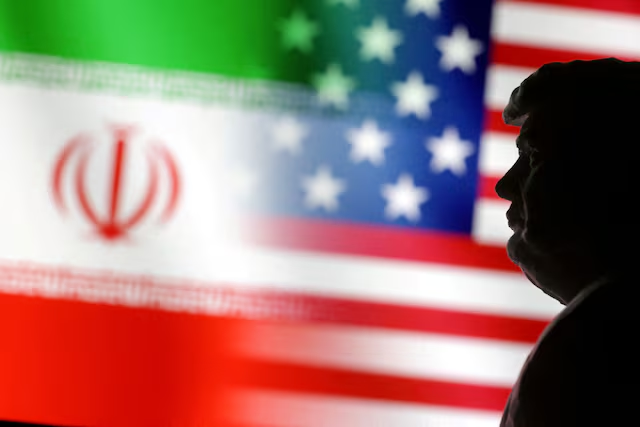
US President, Donald Trump, will cast a long shadow over US/Iran talks
While US President, Donald Trump, continues to play ping pong with the world economy representatives from the US and Iran will meet in Oman this weekend to explore the prospect of a deal between the two countries, which could raise the possibility of de-escalating tension in the region.
The Committee for the Defence of Iranian People’s Rights (CODIR) has welcomed the proposed talks between the United States and Iran as a possible first step towards relieving the pressure upon the Iranian people, caused by ongoing sanctions against the country.
While the solidarity organisation continues to highlight the human rights abuses of the theocratic dictatorship in Iran, CODIR also recognises that the sanctions regime, which is crippling the economy, is a massive pressure upon the Iranian people.
“We are under no illusions that the engagement of the Iranian regime in talks with the US is about little more than self preservation”, said CODIR General Secretary, Gawain Little, “but any opportunity for dialogue which will reduce tension in the region and avert the possibility of military intervention in Iran must be welcomed, however cautiously.”
The latest report from Amnesty International concerning executions worldwide, Death Sentences and Executions 2024 identifies over 1,500 executions worldwide in 2024, the highest figure since 2015, with Iran, Iraq and Saudi Arabia being the main offenders.
In Iran alone executions increased by 119 from the previous year, a total of 972, accounting for 64% of all known executions.
The Secretary General of Amnesty International, Agnès Callamard, was trenchant in her opposition to the death penalty, stating,
“The death penalty is an abhorrent practice with no place in today’s world. While secrecy continued to shroud scrutiny in some countries that we believe are responsible for thousands of executions, it’s evident that states that retain the death penalty are an isolated minority. With just 15 countries carrying out executions in 2024, the lowest number on record for the second consecutive year, this signals a move away from this cruel, inhuman and degrading punishment.”
However, the Islamic Republic of Iran appears to be going against this trend, not only with increasing executions, but also continued extra judicial torture and imprisonment without access to legal counsel.
This has particularly been the case in the last two years with the rise of the “Women, Life, Freedom” movement, which has seen mass protests throughout Iran, as well as the wave of industrial action across the country, in response to the impact of state corruption and the repressive sanctions regime imposed by the West.
The Amnesty report goes on to indicate that over half of the executions in Iran are for offences that should not result in the death penalty under international law, such as drug related offences. Also, there is clear evidence that the use of forced confessions has been widespread and that trials carried out by the Revolutionary Courts are grossly unfair and likely to have been based upon torture tainted confessions.
The talks in Oman will not focus upon Iran’s human rights record but will primarily be concerned with reaching agreement around Iran’s uranium enrichment programme for nuclear power generation. However, the reality is that arrest torture and execution remain key tools used by the regime to silence opposition and are an indication of its narrow public support.
The current tension in the region, due to the Israeli genocide in Gaza and the weakening of Iran’s so called Axis of Resistance of Hamas, Hezbollah and Houthi organisations, has increased the likelihood of a further military strike against Iran, either directly by the US or by Israel.
With regard to talks with the US, Iran’s Foreign Minister, Abbas Araghchi, was sounding bullish a couple of weeks ago, saying,
“Our policy is still not to engage in direct negotiations while under maximum pressure and military threats, however, as it was the case in the past, indirect negotiations can continue.”
However, the discussions in Oman will clearly be more direct than Araghchi suggests.
While Iran may grandstand to impress its regional allies, it remains in a relatively weak position. While a strategic partnership treaty was signed with Russia in January, it does not obligate either side to support the other if under military attack, only an agreement not to help any country that attacked the other.
The so called Axis of Resistance has been significantly weakened by the actions of the Israeli Defence Force (IDF). The demise of the Assad regime in Syria has robbed Iran of a key regional ally. Close relations with China, based upon a twenty five year agreement signed in March 2021, does not imply any military support and has yet to yield any significant boost to the Iranian economy.
While links with Russia and China can by no means be dismissed, and a direct attack upon Iran could change the dynamics of those alliances, the Iranian regime cannot expect military support as a matter of course.
Added to the relative isolation of Iran on the international stage is the growing internal pressure, arising from the economic crisis resulting from sanctions, endemic corruption and economic mismanagement. Increased production was once again a theme of the address by Khamenei to mark the Iranian new year in March but this has been rhetoric from the dictatorship for many years, without any significant investment or strategy for increased industrial production materialising.
While the Iranian regime seeks to avert any military conflict to save itself, the US will also recognise that being embroiled in an overseas war in Iran will bring no advantage while a deal, which opens up access to the potentially lucrative Iranian market, would be of far greater benefit to US capital.
As the US relationship with Saudi Arabia shows, the US is by no means adverse to doing deals with theocratic dictatorships if the calculation is that it will bring a strategic advantage for US imperial ambitions.
Further info at http://www.codir.net
Spring statement: For the few, not the many
27th March 2025
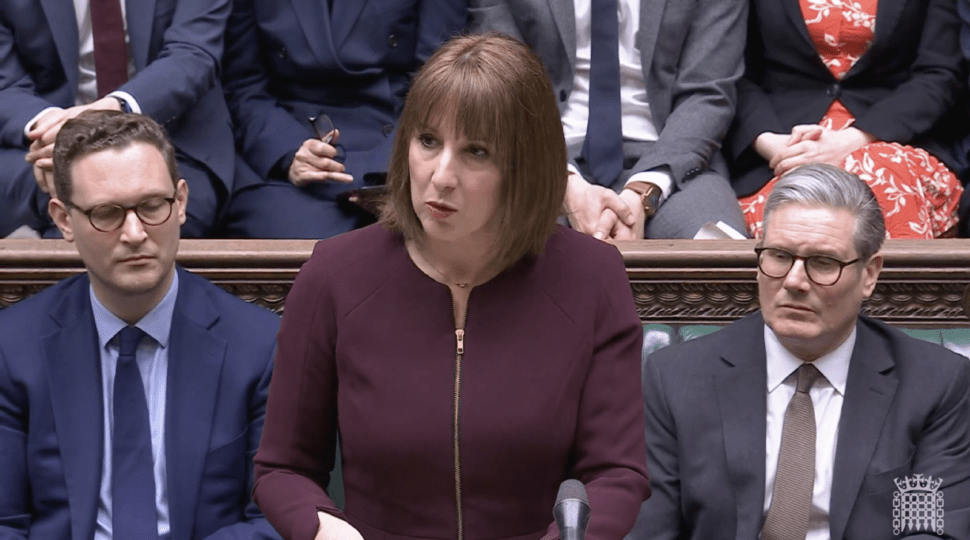
Chancellor Rachel Reeves – not winning friends amongst the working class
In a classic guns not butter statement yesterday Britain’s Chancellor, Rachel Reeves, hammered the poor in order to enrich the arms industry. To add to the £2.9 billion already earmarked for the military budget next year Reeves found a further £2.2 billion, a grand total of £5.1 billion extra next year alone, with the promise of more to come.
In order to build this additional military capacity, to defend against a mythical Russian threat, Reeves not only hammered the poor in Britain with welfare cuts but cut the overseas aid budget further, just to ensure that the pain was spread at an international level.
Reeves claims to have cut welfare in Britain by £4.8 billion but the Resolution Foundation think tank calculates that about 800,000 claimants will have reduced personal independence payments, saving the government £8.1bn by 2029-30. It is estimated that this will affect 3 million families.
While Reeves pins her hopes on economic growth and getting people into jobs to offset the slashing of welfare, the Office for Budget Responsibility (OBR) halved Britain’s economic growth forecast for next year from 2% to 1%, which hardly suggests a boom in employment of any kind, let alone one which could compensate for the ripping away of the welfare safety net for many.
A recent economic analysis by the Joseph Rowntree Foundation, projects that living standards for families in Britian will be worse in 2030 than in 2025, with those on the lowest incomes declining twice as fast as middle and high earners. The report indicates that the poorest third are being disproportionately affected by rising housing costs, falling real earnings and frozen tax thresholds. Increased military spending, along with the other measures in the Spring statement, will further exacerbate this trend.
Even the Treasury’s own impact assessment estimates that 250,000 more people, including 50,000 children, will be left in relative poverty after housing costs by the end of the decade as a result of the government’s squeeze on welfare.
Just to add to the wider uncertainty about the economy US president, Donald Trump, this week announced a 25% levy on car imports to the US, with the possibility of further measures to come. The danger of being sucked into a trade war, due to the actions of Trump, will further undermine the notion that Britain has a ‘special relationship’ that will allow it to be excluded from Trump’s wider tariff war.
However, speaking on Sky News, Reeves was firmly wedded to her deluded projections saying,
“I am absolutely certain that our reforms, instead of pushing people into poverty, are going to get people into work. And we know that if you move from welfare into work, you are much less likely to be in poverty.”
Given the nature of capitalism, as an exploitative system dominated by private sector companies whose main objective is to increase profit, not wages, Reeves vision is at best utopian, at worst simply an attempt to mislead and dissemble her way out of the fact that the cuts proposed are not out of necessity but are from political choice.
Of course, Reeves is not a one woman band. She has the full backing of Labour leader Kier Starmer, the Cabinet and a majority of Labour MPs, so responsibility runs deep within the Parliamentary Labour Party, even though approval for the actions of Labour’s leadership is not shared by many trade union affiliates or local party activists.
Unite leader, Sharon Graham, condemned Reeves for rigidly sticking to her self imposed financial rules with the evidence of ruin in working class communities all around, stating,
“Rachel Reeves is right; the world has changed but why is it always everyday people that have to pay the price. They paid the price after the 2008 crash, the Covid pandemic and are now expected to pay the price again. It is simply wrong.”
Unfortunately Graham is unable to make the link between attacks on working class communities and the increase in military spending, going on to congratulate the government for pledging to “invest in our defence in an uncertain global world”.
GMB General Secretary, Gary Smith, was more succinct stating,
“Tackling huge economic problems is a historic challenge. That’s why we need proper investment in key industries – and must nationalise them if necessary.”
On behalf of the TUC General Secretary, Paul Novak, took issue with the Office for Budget Responsibility (OBR), stating,
“It is time to review both the role of the OBR and how it models the long-term impacts of public investment. Short-term changes in forecasts should not be driving long-term government decision-making.”
Posting on X former Labour leader and Independent MP, Jeremy Corbyn, was absolutely clear,
“This Labour government could have taxed the wealthiest in our society. It is disgraceful that they are choosing to go after the poor and disabled instead.”
Unity around the concepts of jobs not bombs, welfare not warfare and organising society in the interests of the many, not the few, are key to moving towards lasting socialist change. There is clearly still work to be done across the Labour movement and within working class communities to build support which recognises that these issues are linked and the common denominator is capitalism.
Ongoing mass extra Parliamentary action will play a key role in building that support and that political understanding, vital in the progress towards a socialist future.
Coalition of the Wilting
20th March 2025
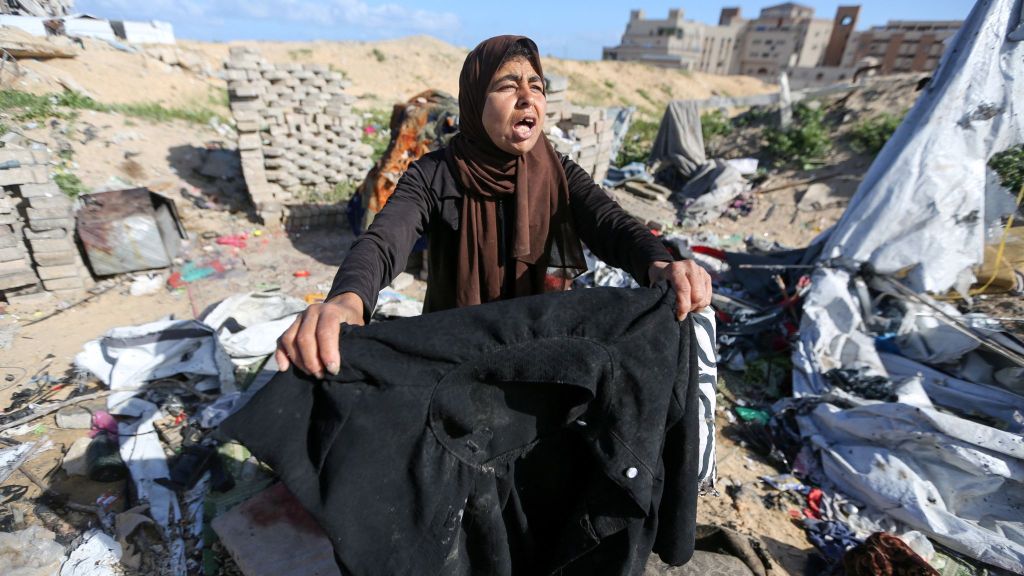
Israeli action in Gaza continues to hit civilian targets
While the Israeli Defence Force (IDF) resumes its genocidal bombing campaign against the people of Gaza, the leaders of European nations gather to work out how they can protect the right wing nationalist government of Volodymyr Zelensky from the Russian ‘threat’ in Ukraine.
Israel has treated international law with impunity for decades while the West has not just turned a blind eye to the treatment of Palestinians but has armed Israel to the teeth in the process. The United States has by far been the biggest arms supplier to Israel but Britain has provided more than its fair share of weapons used to keep the Palestinian population under the jackboot of the IDF.
As the Campaign Against the Arms Trade (CAAT) indicate,
“By the end of 2023, the USA had delivered 39 F-35 Joint Strike Fighters to Israel. Israel has a further 36 on order. Israel has been using the F-35s extensively to bomb Gaza, operating them at a far higher rate than normal. This has depended on a constant supply of spare parts from the US and other countries producing components, including the UK.”
Working out direct British involvement can be complex as CAAT point out that licences for components go via the US for use in weapons manufactured by them. While the government has instituted a partial suspension of export licences “it left in place licences for equipment such as components for trainer aircraft and naval vessels, as well as for components going to Israel’s arms industry to be included in equipment for onward export.” (https://caat.org.uk/data/countries/israel/)
By comparison to the actions of the IDF, the Russian action in Ukraine has not involved the subjection of an entire population, is not aimed at eradicating a nation, or displacing its population from their land. On the contrary, the action of Ukrainian forces against the largely Russian speaking population of the Donbas region, which resulted in 14,000 civilian deaths between 2014 and 2022, precipitated the Russian action but has gone largely unreported by the Western media.
This version of events, does not fit the NATO narrative of an expansionist Russia looking to swallow up the neighbouring states, in advance of an onward march towards Western Europe. NATO bosses would have us believe that the only possible defence against such an eventuality is to spend more on weapons to guard against the so called Russian threat. The British government is committed to increasing spend on the military to 2.5% of GDP with a rise to 3% being mooted. Calls have come from the US for NATO nations to be committing to 5% of GDP spend on the military.
It is hard to see this as anything other than a drive to war and certainly a drive towards greater profits for arms manufacturers who must be rubbing their hands with glee.
The right wing Polish government are asking for nuclear weapons to be stationed in Poland, minutes away from a strike on Moscow, to ‘defend’ against Russian invasion. This in spite of the fact that as a member of NATO any attack on Poland would, under article five of the NATO Treaty, bring the whole of NATO to its defence. Nuclear weapons in Poland will not add to that capability.
In spite of the Western commitment not to move NATO one inch eastwards the incorporation of Eastern Europe nations into NATO has effectively completed the encirclement of Russia over the past thirty years, with Ukraine being virtually the last piece in that jigsaw.
The ‘Russian threat’ bogie is a repackaging of the old Soviet threat myth from the days of the Cold War, when the NATO bloc had to have an ‘enemy’ to defend against, in order to justify its proliferation of nuclear and conventional weapons.
If history is played out first time as tragedy and second as farce then the so called Coalition of the Willing, convened by British Prime Minister, Kier Starmer, should be in the running for a comedy award. Having been cut loose by the US, in relation to the strategy of defending Ukraine at any price, European leaders are scrambling around like latter day Keystone Cops wondering which way to turn.
However, it will be no joke should they make good on their threat to increase spending on weapons, which will only impoverish the European working class further and rob them of much needed social provision in the form of homes, schools, medical provision and transport infrastructure. It will be less than amusing for working class families if their sons and daughters are sent to the frontline in ‘defence’ of Ukraine and find themselves embroiled in an unwinnable conflict.
The grandstanding of Starmer and Macron, the main drivers of the wilting European coalition, needs to be exposed and the priorities for a just settlement in Palestine and an end to war in Ukraine emphasised, as the key foreign policy objectives.
The drive to sustain the war in Ukraine, while ignoring Israeli genocide in Gaza, is a double threat to world peace. Mass action on both fronts must continue while being linked to the struggle for jobs, health and homes, all of which will be threatened by the drive to war.
Wealth tax reform not welfare cuts
13th March 2025

Work and Pensions Secretary, Liz Kendall, ignoring UN warnings on poverty in Britain
In April 2024 the United Nations Committee on the Rights of Disabled People (UNCDRP) published a report into its findings regarding provision for disabled people in Britain, including the impact of welfare reform. The UN found that Britain has ‘failed to take all appropriate measures to address grave and systematic violations of the human rights of persons with disabilities and has failed to eliminate the root causes of inequality and discrimination.’
As signatories to the UN Convention on the Rights of Disabled People the British government agrees to periodic reviews of its provision for people with disabilities, the latest being initiated in 2023 and its report concluding in 2024 finding that ‘grave and systematic violations’ of disabled persons rights had taken place since 2010 and that welfare reform had “disproportionally and adversely” affected the rights of people with disabilities.
The report concludes that there has been no significant progress with independent living rights and active regression in relation to work and social security rights, recommending urgent measures be taken in relation to improvements in these areas.
Given that much of the period of the review was covering the 14 years of Tory government such harsh attacks upon the rights of people with disabilities comes as no surprise. The ‘skivers not strivers’ narrative is one that the Tories and their right wing media allies in the Mail, Express and Telegraph have been pursuing for some time, in order to deflect attention away from the obscene profits made by the super rich and the increased wealth of billionaires in Britain, which rose by £35 million a day last year.
This month the UN Committee on Economic, Social and Cultural Rights (CESCR) issued a series of recommendations to tackle poverty in the Britain. The report urged Keir Starmer to reverse the five-week wait for universal credit in a warning that the British government is infringing human rights with the ongoing poverty crisis.
The report highlighted fears over the Department for Work and Pensions’ (DWP) welfare reforms that have resulted in severe economic hardship, increased reliance on food banks, homelessness, negative impacts on mental health and the stigmatisation of benefit claimants. It further urged government to up spending on benefits, remove the benefit cap and scrap the two-child limit, which prevents parents from claiming child tax credit or universal credit for more than two children.
Labour’s Work and Pensions Secretary, Liz Kendall, does not seem too perturbed by the UN’s findings. With a Spring statement from Chancellor Rachel Reeves due on 26th March welfare reform, a euphemism for cuts to benefits, is clearly high on the agenda of both Kendall and Reeves.
Kendall’s stated position is that,
“I think the only way that you get the welfare bill on a more sustainable footing is to get people into work. And you know, we will be bringing forward big reforms that actually support people into work, that get them on a pathway to success.”
All of which may sound fine in a press conference but in the real world of de-industrialised, zero hour contract, low wage economy Britain it has a hollow ring.
Labour’s claim is that welfare reform is necessary to fill the fiscal black hole Reeves has discovered due to the economy not growing fast enough. Kendall has refused to deny that the Treasury is looking for £5 billion of cuts to her budget.
As ever, government economic decisions are about political choices, whatever issues may arise in relation to the world economy. The current Labour government has ditched the notion of ‘jobs not bombs’ and gone for bombs, £12.8 billion to Ukraine alone, before the cost of supporting Israeli genocide in Gaza is factored in, or weapons sales to dictatorships such as Saudi Arabia.
There is clearly a case for reform of the welfare system in Britain, as the UN has pointed out, but that is not the same as making a case for swingeing cuts which will plunge people into further poverty. There is certainly a case for reform of how the wealthy are taxed in Britain. As Nadia Whittome MP for Nottingham East has pointed out,
“If we implemented something very moderate, like a 2% tax, a threshold of assets over £10m a year, that would only impact an estimated 20,000 people in the UK but would raise £24bn.”
These are the real choices a Labour government faces, yet again. War or peace, rich or poor, capitalism or socialism? Currently Keir Starmer and the Labour leadership are getting it wrong on all three counts. There is clearly some pressure from progressive Labour MPs within Parliament but only mass extra parliamentary action will apply sufficient pressure to move the Labour leadership. Putting wealth tax reform ahead of welfare cuts would be a step in the right direction.
Culture funding – mere crumbs from the Cabinet table
26th February 2025

Culture Secretary, Lisa Nandy, gathering the crumbs from the table
Culture Secretary, Lisa Nandy, was last week showered in plaudits for announcing investment of £270 million into the cultural sector. The occasion was the 60th anniversary of Jennie Lee’s landmark White Paper, A Policy for the Arts: The First Steps, published in 1965, which set the framework for the establishment of Arts Council England, regional arts boards and investment in arts and education.
Lee’s paper was undoubtedly significant. What is equally significant is that no Labour government since has produced a further White Paper on culture, or given it such prominence. The only government White Paper on Culture to emerge in the last 60 years in fact came from the Tories, in 2016, when Ed Vaizey was briefly Culture Secretary.
Vaizey’s paper, given its Tory provenance, was not a bad stab at summarising the cultural landscape at the time but did not come with the necessary cash to follow through with any significant change. Also, coming up against the buffers of the Brexit debate, the debacle of the Boris Johnson government and the pandemic, it had little chance of making any headway.
Nandy’s announcement was accompanied by a press release quoting a wide range of luminaries from the cultural sector falling over themselves to welcome the new money. You can find it here https://www.gov.uk/government/news/major-investment-to-boost-growth-and-cement-britains-place-as-cultural-powerhouse
The general view across the cultural world is to be thankful for any investment that comes along. However, it would have been good to see a more critical view, deploring the paltry sum as merely crumbs from the Cabinet table, which will barely scratch the surface of what the cultural sector needs to survive, let alone thrive. Much of the announced investment will go to further rounds of existing capital programmes, for which the cultural sector has to compete and secure local authority match funding. Given the devastating impact of Tory austerity on local government finance over the past 14 years that will be a challenge.
In any event, such funding largely goes to retain existing infrastructure and does nothing to support the revenue streams needed to sustain actual creative work in such spaces. Funding channelled through Arts Council England and National Lottery are, in any case, only part of the cultural funding landscape. Much community investment in activity in the cultural sector has been through local authorities. However, the requirement to maintain a library service is the only cultural responsibility local councils have which has a statutory basis. That means cultural budgets have been hammered as Councils are forced into prioritising areas of adult and children’s social care, where they have clear statutory obligations.
It is no surprise that access to culture for working class communities is being choked off or that the majority of those currently working in the cultural sector have had the privilege of a private education. A recent Guardian survey shows that “…17.5% of artistic directors and more than a quarter (26%) of Chief Executives went to Oxford or Cambridge, compared with less than 1% of the general public.” This narrowing of the life experience of those working in the sector inevitably narrows the range of cultural output. The same survey also found that, since 2010, enrolment in arts GCSEs has fallen by 40% and the number of arts teachers declined by 23%, areas where working class children may have been able to access the arts.
The latest challenge to the sector comes from the potential change to Britain’s copyright laws in order for AI companies to harvest creative work without permission, acknowledgement or payment. The proposal has been out to consultation and has met with a robust response from the Creative Rights in AI Coalition, but for a government which claims to be serious about stating that,
“Arts and culture are a vital part of our first-class creative industries and are a key part of what makes Britain so great.”
this proposal should not even be on the table.
Labouring under the delusion that investment will unlock private sector money for regional cultural activity Nandy claimed,
“Small amounts of government money can unlock much larger sums. Over the last decade and a half, we’ve seen philanthropy step in to fill the gap that’s been lost from some government funding. But the problem is so much of that has been targeted towards a handful of major institutions, mostly in London.”
This is clearly wishful thinking of the highest order. If the Culture Secretary is serious about getting investment into the sector in a way that will make significant change she will need to go into arms manufacturing.
In another part of the government forest it is possible to find the UK support for Ukraine: factsheet, which identifies £12.8 billion which has been committed to Ukraine, £7.8 billion of which is for military support. It can be found in full here https://www.gov.uk/government/publications/uk-support-to-ukraine-factsheet/uk-support-to-ukraine-factsheet
To suggest that this dwarfs Lisa Nandy’s £270 million is not only an understatement, it is a scandal. That the Labour leadership have been actively supporting the right wing nationalists in Kyiv is bad enough but that billions are being poured into that support, at the expense of the vital needs of working class communities, is scandalous.
The list of possible ways to spend £12.8 billion is long, from hospitals to schools to green infrastructure to housing. However, there is no reason why culture should not be on that list too. Even within the constraints of a capitalist economy there are political choices to be made. The government’s prioritising of weapons of destruction over creativity is another stark example of where those choices can go badly wrong.
Keir Starmer’s announcement that military spending will rise to 2.5% of GDP by 2027, by robbing the foreign aid budget, adds to the pressure upon other budgets aimed at addressing social issues. The pursuit of war rather than peace presents a danger to all.
Recognising the Stranger
On Palestine and Narrative
by Isabella Hammad
Book Review

A sense of timing and an eye for synchronicity are common concepts deployed by authors in the construction of a narrative. On 28 September 2023 the British-Palestinian novelist, Isabella Hammad, gave the Edward W Said Memorial Lecture at Columbia University, now published as Recognising the Stranger: On Palestine and Narrative.
Hammad could not have foreseen that only a week later, on 7 October 2023, the Qassam Brigades of Hamas would, in response to the ongoing Israeli occupation and blockade of Gaza, launch a military attack upon Israeli military bases and kibbutzim. The attack resulted in over 1,000 deaths and the taking of over 200 hostages, to be held until the 5,000 Palestinian political prisoners held in Israeli jails were released.
Hammad’s lecture would have been relevant and a percipient insight into the situation of the Palestinian people had the events of 7 October and their aftermath, not have happened. However, given the Israeli response to the Hamas attack, Hammad’s lecture and subsequent Afterword: On Gaza, written in January 2024, take on added relevance.
In her original lecture Hammad is concerned with considering turning points, ostensibly in literature but also in the personal and political spheres. Those points in a fictional narrative when characters have moments of recognition, when an aspect of the plot, which may have been clear to the reader, is revealed to the characters and what has been, up until then, a mystery falls into place.
Hammad suggests that in the personal and political spheres the concept of a turning point is “a human construction, something we identify in retrospect” (p.2) but that the moment in which we now live “feels like one of chronic ‘crisis’” (p.2).
Hammad explores the role and function of the novel in the contemporary world, competing against the wide range of other ‘entertainments’ on offer, yet still powerful and relevant enough to find a mass audience and speak to the need for narrative, storytelling and a search for meaning.
Hammad links the concept of turning points in literature to those in real life through the example of writers visiting the Palestine Festival of Literature and experiencing for themselves the reality of life for the Palestinian people under Israeli occupation.
“They visited Hebron, and saw the soldiers patrolling, guarding settlers; they visited the destroyed town of al-Lydd; they navigated checkpoints; they travelled through Jerusalem and crossed in and out of the West Bank; they listened to statistics of killings and imprisonments and night time raids and asked careful questions.” (p.21)
Hammad goes on to analyse the wider international debate regarding the position of the Palestinian people, the incremental retreat from insistence upon a two state solution, with Palestinians having a right to their own state, while the international community in the Global North, largely accept and reinforce the state propaganda and Zionist supremacist ideology of the Israeli regime.
Hammad does recognise that there is a shift in awareness amongst many ordinary people across the world, including amongst Israelis, a recognition that Palestinians have human rights. She cites what co-founder of the Boycott, Disinvestment and Sanctions (BDS) movement, Omar Barghouti, calls an aha moment,
“…talking specifically about the moment when an Israeli realises, in a turning point of action, that a Palestinian is a human being, just like him or her.” (p.25)
While Hammad’s lecture inevitably focuses upon the work of Edward Said, as a prominent Palestinian intellectual, his literary criticism and her own practice as a writer, she does not shy away from exploring the reality of the stateless position in which Palestinians are forced to exist and the implications of this for their culture.
In her Afterword: On Gaza Hammad is clear that the action of 7 October in itself represents a turning point, comparing it to “an incredibly violent jailbreak” and asserting that,
“It also signified a paradigm shift: it showed that a system in which one population is afforded rights that the other population is denied will be safe for neither.” (p.61)
Hammad robustly condemns the Israeli response to 7 October stating starkly that,
“Ten thousand dead children is not self defence.” (p.62)
A figure which has escalated significantly in the year since her afterword was written. Hammad condemns the extent to which the Western powers, the United States in particular, have supplied Israel with weapons to continue the bombardment of Gaza and the role of the US in vetoing ceasefire arrangements. This position may have changed for the moment but there is no guarantee that Israel will maintain it.
As Hammad states, as she moves towards a conclusion,
“The possibilities faced by the Israeli state for at least twenty years have been: maintain apartheid and forfeit the claim to being a democracy; return to the pre-1967 state borders and allow for the creation of a Palestinian state; break down the system of apartheid and enfranchise the Palestinians in a one-state reality; or conduct large scale ethnic cleansing. They are choosing the last option.” (p.75)
Just over a year since that Afterword was written, it is clear that this is precisely the path that the Israeli regime has taken and that solidarity with the Palestinian people is more vital now than ever.
Isabella Hammad is the award winning author of ‘The Parisian’ and ‘Enter Ghost’. In 2023, she was included as one of Granta’s Best of Young British Novelists.
Redrawing the map
18th February 2025
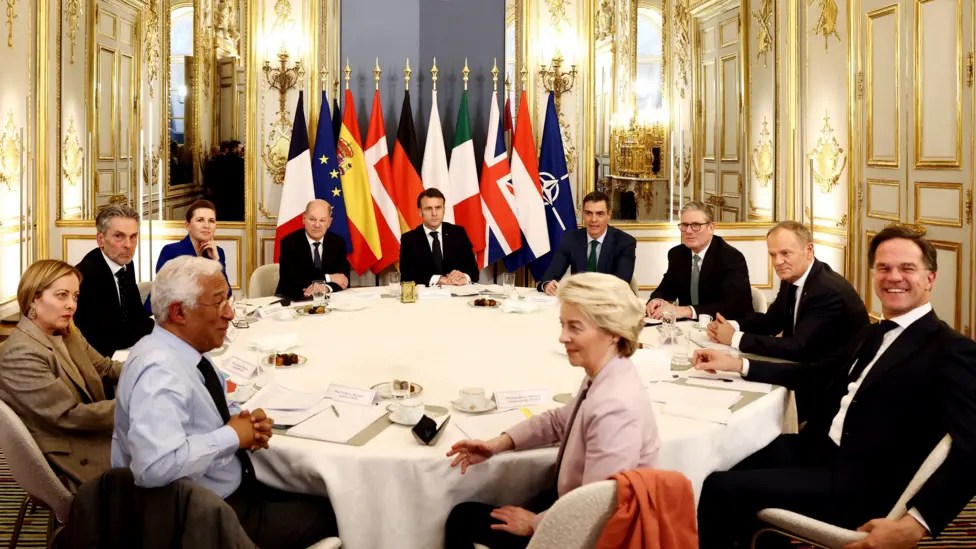
European leaders ponder what to do as the US pushes for a deal with Russia
European leaders have been in Paris this week wondering what to do about the apparent maverick actions of the United States, in relation to the NATO proxy war in Ukraine. What at first seemed like a straightforward NATO vs Russia scenario, in defence of right wing nationalist Ukraine, has been complicated by the return to office of Donald Trump. Not that Trump’s attitude to Ukraine should come as a surprise, he has been trailing it on his campaign journey for over a year, but Europe, including Britain, has been taking an ostrich like approach to the possibility of Trump’s return and they are now having to face the consequences.
The US has signalled bi-lateral discussions with Russia, underway in Saudi Arabia, in order to achieve a settlement, no doubt to be followed by conversations with Ukraine to persuade them to accept any deal. There will inevitably be a quid pro quo in terms of US arms being sold to Ukraine, in exchange for access to resources such as mineral wealth. Russia will incorporate the Crimea and Donetsk regions, in line with the stated wishes of those populations.
The European Union plus Britain may tub thump about the prospect of Russia extending its reach and invading the Baltic states and Moldova etc but this is largely a bogie of NATO’s own creation for internal consumption, to justify the persistent increase in arms spending. The likelihood of Russia precipitating a response from NATO by overstepping its existing boundaries must be rated as very small in reality. Europe’s Cold War anti Russia scaremongering is likely to wear thin as US priorities change.
So what is the endgame of US imperialism? Russia, as it has been historically, is the weak link in the imperialist chain. While rich in resources and still a significant nuclear power it does not pose a direct threat to the dollar based economic order. However, in alliance with China, an actual economic threat to the US, and the wider BRICS network of nations, the role of Russia is more significant.
It is certainly in the interests of the US to drive a wedge between the current alliance of Russia and China. Trump has also made it clear that the aim of the BRICS nations to move away from the dollar as the default international currency is not something he will tolerate. Bearing in mind that Trump speaks, not purely as an individual but as the mouthpiece of US imperialism, his words take on greater significance.
The potential market which Russia represents for US firms, and the resources which it controls, are vastly greater than anything Ukraine can offer and certainly more than the European Union can lay claim to.
European leaders in Paris have continued to bleat about the abandonment of Ukraine, British Prime Minister, Kier Starmer, referring to a “generational” security challenge posed by Russia and reiterating his commitment to deploying British troops if necessary. The continued warmongering on the part of Starmer and other European leaders, with talk of a 5% of GDP spend on the military, is a recipe for a massive crackdown on public services which will hit working class families hard. The economics of war may work for the military industrial complex, it will not work for the working class citizens of Europe.
Against this backdrop it may just be that the US has its eye on the bigger goal of competing with the rising economic might of China and positioning itself to reassert its grip on the international economy.
Ironically, it may be that Zelensky’s wild call for a European army, at the Munich Security Conference last week, may be the first recognition of this possibility. While the media, as ever, portray things in terms of personalities it is not a Trump/Putin love in that we should be wary of but a strategic US/Russia alliance which would truly redraw the map and reshape the international order, creating a powerful economic and military bloc containing most of the planet’s nuclear arsenal.
What the EU/Britain could do in the face of this would be very tame and even China’s economic strength would pale by comparison. They could huff and they could puff but it would be quite a house to try and blow down.
 Avanti Populo