The hollow sound of crisis

23rd July 2022

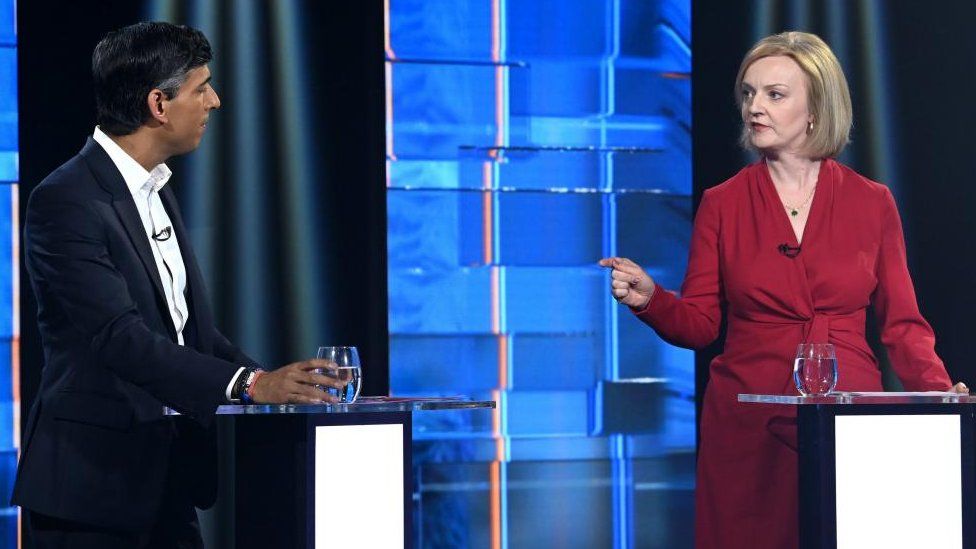
Hollow sounds – Sunak and Truss seek to further their political ambitions

The war between factions in the Conservative Party, fronted by leadership contenders Rishi Sunak and Liz Truss, continues on in its avoidance of addressing any of the issues which will improve the lives of working class people.

Debates around income tax, corporation tax, even national insurance levels, important though they are, will not tackle the structural issues which face many suffering at the sharp end of the capitalist system.  The Tories, whoever is leader, have no strategy for tackling the housing crisis, driven by escalating prices and the ongoing desire for profit from house sales.

The de-population of many rural areas, is an increasing concern, as houses bought for holiday homes puts them beyond the reach of young people, who might otherwise want to stay in the area in which they were born.   High rents make saving for a deposit challenging, especially with house prices artificially high, and with the Air B&B market for staycations expanding.

The urban alternative is often houses in multiple occupation and restricted disposable income, with salaries eaten by rent and transport costs.  This situation often prevails in London but is becoming true of many other metropolitan centres.  With job insecurity, temporary contracts and the gig economy on the increase the danger of homelessness is often just around the corner for many young people.

The new Tory leader may or may not stick with the ‘levelling up’ concept, beloved of Boris Johnson as a means to keep so-called ‘red wall’ seats, mainly made up of working class voters, onside with false promises before the next General Election.  It is quite possible that Sunak and Truss would find it expedient to do so.  History shows however that Tory promises are not only cheap but easily broken, sacrificed in the name of some other, more pressing crisis.

The housing charity, Shelter, is clear on the needs any new Prime Minister should address, stating,

“There has to be a plan to make sure local people benefit from the growth that comes from levelling up. And that means investing in good quality, energy-efficient social homes. Social homes with rents pegged to local incomes that stay affordable over time.”

Setting to one side the assumption that growth will come from levelling up, the rest of the Shelter statement makes perfect sense.  Good quality local homes for local people at rents they can afford.  It would not be a bad start.  Add to that the repeal of the government’s right to buy legislation, which obliges local authorities to sell off Council housing stock, and a significant start to tackling the housing crisis would be underway.

The right to a home should be a guaranteed human right and in the world’s fifth largest economy it is a scandal that anyone should be homeless.

This situation is consistent with the privatisation of social provision, which has been key to the Tory agenda since the 1970’s.  Comprehensive education has been replaced by the private sector driven academy system.  Care for children and the elderly is run by private companies, primarily interested in profit rather than the people they are supposed to look after. There is no indication that either Sunak or Truss would seek to reverse any of that.  On the contrary they are falling over themselves to prove who is the most consistent Thatcherite.

The BBC reported only this week on the scandal of children in care being housed in temporary accommodation, including boats and caravans, exploiting a legislative loophole that permits the use of such locations as ‘holiday accommodation’.

Carolyne Willow, director of the children’s charity, Article 39, stated in response,

 “A young child moving from caravan to caravan defies understanding of what a holiday is.  The government needs to amend the legislation to make it absolutely clear what constitutes holiday accommodation for children in care.”

Sunak and Truss have made no attempt to out compete each other in promises to more effectively support social care provision, through the proper funding of local authorities, or tackle the crisis in hospital waiting lists through making social care free at the point of use and NHS staffing levels realistic.

Both will bleat that this is all unaffordable, as they do when it comes to decent pay rises for rail, postal and public sector workers.  That this will fuel inflation and worsen the economic crisis.  It is convenient in many ways that the pandemic over the past two years allows the Tories to reference only recent history when it comes to the reasons for the looming recession.  The fact is that the crisis runs far deeper and is a consequence of Tory economic mismanagement over the past decade.

Liz Truss did appear to break with convention this week when she stated that,

“We have had a consensus of the Treasury, of economists, with the Financial Times, with other outlets, peddling a particular type of economic policy for 20 years. It hasn’t delivered growth.”

However, her recipe to tackle this was an entirely conventional Tory play; cut personal taxes, cut corporation tax, reverse the increase in national insurance, suspend green levies on energy bills.  All of which may put some money in the pockets of some individuals but will not address the structural problems born of the capitalist system, that the drive for personal wealth and corporate profit is always at the expense of the public good.

The leadership contest gives the Tories a chance to spread disinformation about the economy and dodge the hard measures required to address social need.  The reality is that neither candidate has the answers because they remain beholden to maintain the system, which only ever operates in the interests of the ruling class and their cronies.  For the working class, promises from the Tories will only ever have a hollow ring.

Labour has a great opportunity to expose the Tories lies, exploit their divisions and put forward a real alternative in favour of the working class.  An agenda for the many, not the few perhaps?

Biden on the offensive

17th July 2022

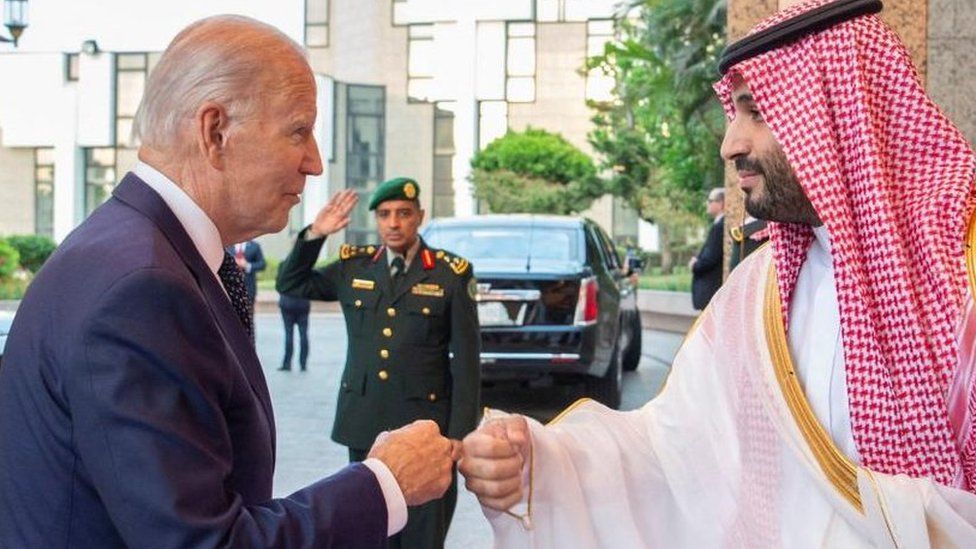
US President Joe Biden and Saudi Crown Prince Mohamed bin Salman – who is the pariah?

To suggest that US President Joe Biden is speaking with a forked tongue on his current propaganda tour of the Middle East is an understatement.  The fist bump, with Saudi Crown Prince, Mohamed bin Salman, who even the famously mendacious CIA regard as having given the order for the execution of journalist Jamal Khashoggi, made a lie of Biden’s promise to treat bin Salman as a pariah following the journalist’s murder.

Clearly, such considerations cannot be allowed to obstruct the desire to persuade the Saudis to free more oil onto the world market, to compensate for the shortfall in Russian supplies, or to continue to build rapprochement between Saudi Arabia and the region’s other US client state, Israel, in opposition to the perceived threat from Iran.

Leaders of six countries of the Gulf Cooperation Council (GCC) – Saudi Arabia, Qatar, Bahrain, Kuwait, Oman and the United Arab Emirates – plus Jordan, Egypt, and Iraq held talks on regional security and bilateral relations with the US at a summit in Jeddah over the weekend. Biden pledged that the US “will not walk away” from the Middle East and leave a vacuum to be filled by Russia, China or Iran.   Biden also told the summit that the US is committed to ensuring Iran never gets a nuclear weapon.

Biden is in the region to sell the repackaging of US Middle East policy which has been outlined by National Security Advisor Jake Sullivan, who emphasised Washington’s desire to promote “regional stability” through diplomacy.  Top White House official on the Middle East, Brett McGurk, has talked of a desire for “returning to basics” through the “3D approach” of deterrence, diplomacy and de-escalation.

Considering the extent to which the US has destabilised the region, through promoting Islamic fundamentalists in Afghanistan, to invading Iraq, Syria and Libya, while arming the Saudi state to bombard Yemen, many in the region would welcome the US walking away.

However, the right of nations to self determination and the principles of non-interference in the affairs of sovereign states, are not values that the US has even deigned to pay lip service to over the years and are certainly not ones which fit into the US imperialist unipolar world view.

It is in the strategic interests of the US to see an expansion and strengthening of the Abraham Accords, agreements between Arab countries and Israel, initiated under former President, Donald Trump, which seek to deepen Israeli influence over the Arab world.   Biden is using his visit to press this agenda through promises of security and technology investments.

Biden will use all of his political charisma to make these promises sound magnanimous but, in effect, they are about consolidating the role of the US as the main arms supplier to the region and clearing a path for US technology companies to be the region’s main supplier of communications infrastructure.

On the question of Palestine, Biden is paying lip service to a two state solution while at the same time bolstering Israel’s military capability and effectively turning a blind eye to the atrocities committed against the Palestinian population on a daily basis.  In the effort to airbrush the question of Palestine from the international agenda the Saudis are complicit.  They are keen to ensure both Israel and the US remain on board with their virulent anti—Iran position, born out of the Sunni/Shia schism in the Muslim world, but increasingly hardening into a classic nationalist power struggle.

While the Saudis and Israelis in many ways appear to be unlikely allies, their mutual perception of Iran as an existential threat brings them together.  The US desire for regime change in Tehran means that they are happy to both encourage and arm any Israeli/Saudi alliance.  While Biden professes to want to win over the Iranian theocracy by diplomacy, some state of the art weaponry under US control in the region is seen as a minimum backstop.

While the Iranian dictatorship struggles to free itself from US sanctions imposed when Donald Trump reneged on the Iran nuclear deal in 2018, resulting in more trade with Russia and China, Saudi Arabia enjoys the largesse of the US and its allies on a number of fronts.  The recent Saudi backed LIV Golf tour, which has generated such controversy in the sports world, continues the Saudi sportswashing agenda, following the recent bankrolling of Newcastle United.

The Saudi Public Investment Fund (PIF), chaired by Crown Prince Mohamed bin Salman, has bought shares worth £78m in Aston Martin, adding to its investment in other blue chip companies and car makers including Lucid electric start up and McLaren.

Western arms manufacturers continue to see the Saudi dictatorship as a lucrative customer and weapons continue to pour into the kingdom.   Campaign Against the Arms Trade (CAAT) noted that the published value of UK arms licensed for export to the Saudi-led coalition since the bombing of Yemen began in March 2015 is £8.6 billion (including £7.1 billion to Saudi Arabia alone); however, CAAT estimates that the real value of arms to Saudi Arabia is over £23 billion, while the value of sales to the Coalition as a whole (including UAE and others) is nearly £25 billion.

As staggering as those figures are Britain is, as ever, a junior partner when it comes to any relationship with the US.  A total of 73% of Saudi Arabia’s arms imports come from the US and 13% from Britain.  The Saudis annual spend on weapons is close to $50bn.  Lucrative business indeed.

Biden’s visit will do little to assuage the fears of many people in the region that the US has its own military and economic interests to the forefront, while the interests of the people of the Middle East are not a significant concern.  US military interventions and backing for unelected dictatorships has often been at the root cause and, at the very least, fuelled conflict in the Middle East.

Biden may see his four day tour of the region as part of a charm offensive but for the people of the Middle East, until the US allows them to determine their own futures, free from domestic dictators or foreign intervention, the presence of a US President in the region will simply be offensive.

Into the revolving door

11th July 2022

The rogue’s gallery line up for the keys to No.10

It should come as no surprise that the leadership of the Conservative Party is a revolving door. Since the knives were sharpened for the hapless William Hague, in 2001, the Tories have had a further five leaders since the turn of the millennium.  Whoever succeeds Boris Johnson as Tory leader will be the seventh this century.   Not so much no win, no fee with the Tories as no win, no job. 

Not that any of the former leaders have had to sign on for Job Seekers Allowance or Universal Credit.  A cushy number in the House of Lords is the worst that happens, or a lightly taxing round of after dinner speeches to feather the retirement nest egg if they are lucky.  Johnson’s particular Tory form of backslapping bonhomie and camaraderie will probably see him earn a fortune with the latter.

The current rogue’s gallery, lining up for the keys to No.10 as it currently stands, does raise one or two questions.  Like, who is Rehman Chishti?  Is Jeremy Hunt seriously running again?  Would Liz Truss just be the continuation of Boris Johnson by other means?  Will any of them improve the lives of working class people?  That one is rhetorical, and finally, where is Defence Secretary, Ben Wallace?

The last question is intriguing as Wallace has all of the key credentials to be a Tory leader.  An anti working class, jingoist, militarist and ex-soldier, popular with the Tory rank and file, you would expect him to at least be in the running.  That he is not could suggest a lack of ambition.  It could equally suggest that Wallace is playing a political long game.  Whoever takes over now will not only have to clear up the mess created by Johnson, and the previous ten yars of austerity, but turn the Tories into an election winning prospect in the space of two years.

Given the wooden nature of the opposition they are facing with Kier Starmer’s leadership of Labour, that is not impossible, but it is still a challenge.  Johnson’s successor may get the keys to No.10 for a mere two years, hardly time to change the wallpaper, before they are out on their ear.  Not a great look for the political CV, and Tories are not known for hanging on to election losers, so the party leadership would soon be up for grabs again.

It may simply be that Wallace does not have the ambition, it may be that there are skeletons in his closet that he does not want a leadership context to expose.  It may also be calculated that a Labour government under Kier Starmer would simply keep the seat warm for an incoming Tory leader, while not breaking anything as far as the ruling class were concerned. 

Quite a lot of Tories could live with the breathing space Starmer would bring while they reorganise.  It may not be Johnson’s successor who is key for the Tories longer term, but their successor, as the leadership door revolves once more.

NATO’s strategic con trick

2nd July 2022

The NATO military alliance last week published its Strategic Concept 2022 document, outlining the objectives and priorities of the alliance over the coming decade.  The document was agreed at a meeting of NATO leaders in Madrid on 29th June.  The Strategic Concept is reviewed and updated regularly. Since the end of the Cold War, it has been updated approximately every 10 years to take account of changes to the global security environment and, in NATO’s own words, “to make sure the Alliance is prepared for the future.”  The previous Strategic Concept was adopted at the NATO Lisbon Summit in 2010.

NATO sees the document as one which describes the security environment facing the Alliance, reaffirms values, and spells out NATO’s self proclaimed key purpose of ensuring collective defence. It further sets out what NATO sees as its three core tasks, those being, deterrence and defence; crisis prevention and management; and cooperative security.

In terms of where NATO sees the major threat to “collective defence” over the next decade the Strategic Concept is categorical,

“The Russian Federation is the most significant and direct threat to Allies’ security and to peace and stability in the Euro-Atlantic area. It seeks to establish spheres of influence and direct control through coercion, subversion, aggression and annexation.”

This assessment is based on the recent Russian action in Ukraine, an action NATO fails to acknowledge as one in response to increasingly provocative acts on the part of NATO itself.  The quid pro quo between NATO and the Russian Federation at the end of the Cold War was that NATO would not seek to extend its influence into the former Socialist states bordering upon Russia.  The Russians saw such expansion as potentially posing a threat to their own security and, in a world supposedly free from mutual enmity, argued that NATO had no need to extend its sphere of influence.

However, the period since 1995, when NATO published a Study on NATO Enlargement, has seen significant expansion of the military alliance’s membership and sphere of influence.  In fact, since its inception in 1949 NATO has expanded from 12 to 30 countries, with 5 others on the waiting list, including Ukraine.

In 1999 NATO saw the accession of the Czech Republic, Hungary and Poland.  Five years later Bulgaria, Estonia, Latvia, Lithuania, Romania, Slovakia and Slovenia joined NATO’s ranks.  Five years after that, Albania and Croatia.  None of this was in response to any Russian “coercion, subversion, aggression and annexation”, it was purely about ensuring military dominance on the European continent and making sure NATO had key strategic bases for its operations beyond Europe’s borders.

NATO has certainly taken every opportunity to flex its muscles in that regard, from the dismemberment of Yugoslavia, the invasions of Iraq, Afghanistan and Libya, followed by the fuelling of opposition and direct intervention in undermining the government of Syria.

As threats “to peace and stability in the Euro-Atlantic area” go, the Russians certainly have a lot to do to catch up with NATO’s record!  This is in spite of the unsupported statement in the Strategic Concept that,

“Moscow’s behaviour reflects a pattern of Russian aggressive actions against its neighbours and the wider transatlantic community.”

From a Russian perspective it is not hard to see how the scale of NATO’s interventions, combined with its creeping presence up to the borders of Russia itself, may be seen as threatening.

The dismemberment of the Soviet Union, following the Cold War, inevitably resulted in anomalies across the former Soviet states, with historically Russian speaking areas finding themselves in post Soviet arrangements which did not necessarily accord with their history or their future desires.  The so called annexation of Crimea in 2014, following a referendum vote to cede from Ukraine and become part of Russia, of which Crimea had been a part for 300 years prior to a Soviet administrative change in the 1950’s, is one such example.

The mainly Russian speaking Donbas region of Ukraine, the area which is the focus of much of the current fighting, is another. The Minsk agreement of 2015 saw all sides agree to a ceasefire in Donbas but in reality, Ukrainian forces have continued with their offensive in the area, resulting in over 14,000 deaths over the seven year period.  The desire of the governments of the Donbas to resist this ongoing aggression precipitated the current Russian intervention. 

NATO however is not only concerned about Russia, it also has China in its sights, stating that,

“The People’s Republic of China’s (PRC) stated ambitions and coercive policies challenge our interests, security and values. The PRC employs a broad range of political, economic and military tools to increase its global footprint and project power, while remaining opaque about its strategy, intentions and military build-up. The PRC’s malicious hybrid and cyber operations and its confrontational rhetoric and disinformation target Allies and harm Alliance security.”

It is not hard to see where this is going and true to form NATO pitch straight into the international conspiracy playbook with,

“The deepening strategic partnership between the People’s Republic of China and the Russian Federation and their mutually reinforcing attempts to undercut the rules-based international order run counter to our values and interests.”

It is without any hint of irony that NATO makes reference to the “rules-based international order”, which they have transgressed on multiple occasions, yet still want the world to believe that they regard it as the touchstone of how to behave in the international arena.

It would be too much to expect NATO to come straight out and say that their Strategic Concept is in fact world domination for the “values and interests” it seeks to defend; the banks, corporations and military industrial complex of Western imperialism.  Yet that is clearly the objective.  A unipolar world in which US military might, backed by the economic strength of the dollar, dominates is clearly at the heart of where NATO wants to be.

An impoverished Russia and an economically and militarily constrained China would certainly be at the top of NATO’s wish list for the next ten years and beyond.  The encirclement of Russia, the weapons being poured into Ukraine and the warning signals sent out to China, over that country’s legitimate claim to Taiwan, are all indications of NATO’s aggressive posture.

Strategic Concept 2022 can put the gloss on portraying NATO as “a defensive Alliance” but the realities of its actions give the lie to that claim.  Far from being a force for peace, NATO remains a major threat to world peace and a drain on resources, which could be used for the benefit of the people of Europe, rather than lining the pockets of the arms industry and escalating the arms trade.

Reversing the right to choose

25th June 2022

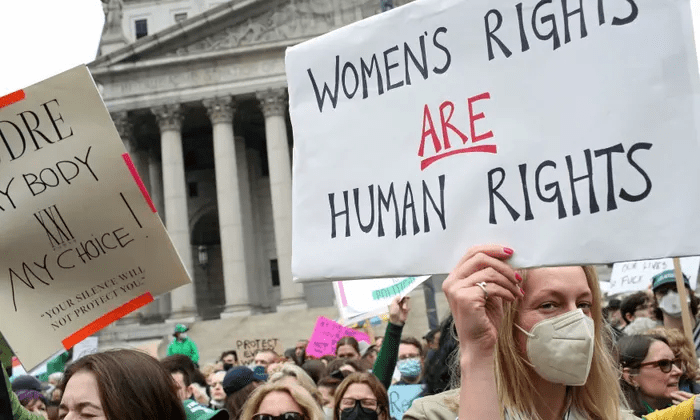
Protests against the Supreme Court ruling will not end in the US

Few works of fiction truly deserve the epithet ‘prophetic’ but yesterday’s Supreme Court ruling in the United States is in danger of tipping Margaret Atwood’s The Handmaid’s Tale into that category.  The decision to overturn the Roe vs Wade ruling in 1973, which guaranteed a woman’s constitutional right to abortion, means that abortion rights will be determined by individual states in the US.  Thirteen of the 50 US states already have so called ‘trigger laws’ in place in anticipation of the Supreme Court ruling, making abortion instantly illegal.  A further thirteen are expected to follow soon.

The medievalist Bible belt in the United States, opposing a woman’s right to choose at all costs, have vowed to continue the fight until abortion is outlawed in all states in the US.  The ruling provides no mitigation in cases of rape or incest.  The fight is already on to ensure that women in need of treatment can travel to states where abortion is not banned.  It is estimated that at least 36 million women will find themselves in states where they have no right to abortion.

As those defending the right to choose have pointed out, the ruling will not prevent abortion happening, it will simply increase the likelihood of illegal abortions and women dying as a result of having to resort to back street medical interventions. 

The new abortion bans will make the US one of just four nations to roll back abortion rights since 1994, by far the wealthiest and most influential nation to do so, with Poland, El Salvador and Nicaragua being the others.

The ruling flies in the face of public opinion in the US where it is estimated that 85% of Americans believe abortion should be legal.  State abortion bans can be overturned at a national level if there is majority support of the House of Representatives, a 60-vote majority in the Senate, and endorsement from US President, Joe Biden.

However, Republicans will block abortion rights laws in the Senate, which is evenly split with Democrats. One Democratic senator, Joe Manchin of West Virginia, has crossed party lines to vote against abortion rights. That would leave just 49 Democrats, far short of the support needed to pass such a measure.

Joe Biden has stated categorically that he is not in favour of the Supreme Court decision and urged the US public to make their votes count in the up and coming mid term elections in November.  However, this would require Democrats to win landslide victories, including taking conservative states, an outcome which is not regarded as being very likely.

The reactionary forces in the United States, which coalesced around the election of Donald Trump in 2016, will scent a further victory with this Supreme Court ruling.  Joe Biden’s selection for the Democratic candidacy was only ever going to be a stopgap and was successful insofar as it stopped a second Trump term. 

Biden has attempted to shore up his position with more conservative voters by showing himself to be as reactionary as most of his predecessors in foreign policy, failing to address the crime of Guantanamo Bay or the 60 year long illegal blockade of Cuba; failing to address the issue of Palestinian rights for fear of antagonising the Israeli lobby in the US; and pouring fuel on the fire of the conflict in Ukraine, by promising increasing supplies of US weapons, rather than working towards a negotiated settlement.

Ultimately though, this is the default position expected of any US President, and is unlikely to cut any ice with the base who supported Trump, or those on the conservative margins.  Biden’s position on social issues and his strong position on Roe vs Wade will certainly galvanise some Democrat support but it will equally harden the position of many Republicans.  A second Democrat term, whoever the candidate may be, is by no means guaranteed.

It is ironic that so many so called pro-life Republican Senators are the very people who are opposed to gun control, blocking measures to stop the highest source of child deaths in the US.  The right to bear arms, as enshrined in the Second Amendment, is regarded as an inalienable right, whereas a woman’s right to choose is denied.

The illusion of democracy in the US has for decades been that of choice with the same outcomes.  The differences have been of nuance between Democrat and Republican presidential candidates.  The difference being that a Democrat president would at least be expected to be a little more progressive on social issues.  The Supreme Court ruling has however made those fault lines sharper and put the already uneasy consensus around some social issues in the US, in danger of fracturing entirely.  Ongoing protests overnight across the US, against the Supreme Court decision, are the latest manifestation of that division.

Trump’s election in 2016 exposed the polarisation of much of the United States.  The presidential election in 2024, whatever happens in the mid terms, is likely to see that polarisation exacerbated even further.  In the meantime the poor, the hungry, the dispossessed and those women who cannot afford to travel for abortion treatment will be the ones who suffer.

Stop the extradition of Julian Assange

19th June 2022

Protesters oppose the extradition

Yesterday (18th June) was a tricky day for newspaper headline writers.  What to go with? The economy continues to go downhill; rail strikes look set to proceed next week; Boris Johnson had left the Northern Research Group of Tory MPs in the lurch in Doncaster, to fly off to Kyiv for a photo opportunity with  Ukrainian President, Volodymyr Zelensky.

Johnson made the front page in the FT Weekend and Daily Express but the economy tended to dominate.

Big wage increases too risky, bosses told, made it for The Times.

We must not bow to strikers, says Treasury, was the call from The Daily Telegraph.

Public tell Johnson: Act now to help UK economy, was the i weekend call.

Rate rises send global stocks diving, alarmed the FT Weekend.

The Guardian went with Schools, pools and libraries face massive cuts, drawing attention to the potential local government crisis looming from next April, as inflation bites into already tight Council budgets.

Only the Morning Star went with the headline, A Dark Day for Justice, highlighting the decision of Home Secretary, Priti Patel, to extradite journalist and WikiLeaks founder, Julian Assange, to the United States where he will face charges of espionage for exposing US war crimes in Iraq and Afghanistan.

Assange spent seven years of imposed exile in the Embassy of Ecuador in London, after which he was arrested by British police in 2019 when Ecuador withdrew his asylum status. Since then, Assange has spent nearly three years in Belmarsh prison, fighting a lengthy battle against extradition.  The Home Office said the courts found extradition would not be “incompatible with his human rights” and that while in the US “he will be treated appropriately”.

“The UK courts have not found that it would be oppressive, unjust or an abuse of process to extradite Mr Assange,” the Home Office added.

Given that Assange’s alleged ‘crime’ is to have exposed documents revealing how the US military had killed hundreds of civilians in unreported incidents during the war in Afghanistan, and that leaked Iraq war files showed 66,000 civilians had been killed, and prisoners tortured, by Iraqi forces, it is shuddering to think what the US may regard as “appropriate” treatment.  The leak in 2010 included 250,000 US diplomatic cables containing classified diplomatic analysis from world leaders.

Amnesty International said enabling the extradition of Assange to take place “would put him at great risk and sends a chilling message to journalists”.  General Secretary, Agnes Callamard added, “Diplomatic assurances provided by the US that Assange will not be kept in solitary confinement cannot be taken on face value given previous history.”

Assange now has 14 days in which to appeal and WikiLeaks has released a statement saying it will appeal the decision stating,

“Today is not the end of the fight.  It is only the beginning of a new legal battle. We will appeal through the legal system; the next appeal will be before the high court.”

Beyond that there is already talk of a further appeal to the European Court of Human Rights.

The implications of Assange being convicted in the US, given that he has committed no crime are profound, especially for investigative journalists and whistleblowers.   In effect, any journalist seeking information that governments do not want to disclose for reasons that have little to do with “national security” could be indicted and prosecuted under the criminal law.  This could apply to any government and any journalist. Assange, is Australian, not an American citizen, yet may face extradition and trial in the US.

In an interview with Nils Melzer, the UN’s Special Rapporteur on Torture, published on 31st January 2020, Melzer states,

 “In 20 years of work with victims of war, violence and political persecution I have never seen a group of democratic states ganging up to deliberately isolate, demonize and abuse a single individual for such a long time and with so little regard for human dignity and the rule of law.”

The ‘democratic states’ in question being the US, the UK, Australia, Sweden and, latterly, Ecuador.

That the Assange case is not getting the coverage in the UK press that it deserves is a scandal in itself.  Given the implications that the extradition and any outcome in the US, should it get that far, would have for investigative journalism, outrage from journalists across the spectrum should be the minimum response.

The National Union of Journalists have taken a clear position of support for Assange with General Secretary, Michelle Stanistreet condemning the decision of Priti Patel, stating,

“Any journalist who is handed a classified US document, or is contacted by a whistleblower to expose criminality and wrongdoing will now fear that they too will be extradited, and put at risk of spending the rest of their lives in prison.”

The International Federation of Journalists has described the decision as “vindictive and a real blow to press freedom.”

In France where parliamentary elections are taking place over the weekend, Jean-Luc Melenchon, leader of the left-wing La France Insoumise, told a press briefing,

“If I am Prime Minister on Monday Julian Assange will be made a naturalised French citizen and given a medal.”

The real ‘crime’ which Assange has committed is to expose the realities of imperialist engagement in foreign wars where the manipulation and suppression of information is the norm.  WikiLeaks exposed the reality of that in Iraq and Afghanistan but similar tactics continue to be employed in relation to Libya, Syria and especially at present in Ukraine.  The misinformation campaign around the war in Ukraine may be the biggest the West has yet undertaken, given the ubiquity of social as well as traditional forms of media.

Preventing the extradition of Assange would at least indicate that resistance to such manipulation will continue and, with enough pressure, at least send a message to imperialist powers engaged in conflicts that any cover ups they attempt, will eventually be found out.  

Blustering in Blackpool

12th June 2022

Johnson blusters in Blackpool, without illumination

It is said that the Roman Emperor Nero played upon his violin while Rome burned around him.  Hence the phrase, ‘fiddling while Rome burns’.  Whether the phrase does Nero an injustice or not, it can certainly be applied quite accurately to the attitude of British Prime Minister, Boris Johnson, with regard to the economy.  Johnson, who it is now evident only enjoys the support of 59% of his own MPs, many of whom will be on the payroll, attempted to dodge his recent tribulations with a set piece speech in Blackpool on Thursday.  However, anyone looking for illumination will have been left pretty much in the dark as to what Johnson’s solution to the economic crisis might be.

“Sometimes the best way that government can help is simply to get out of the way”, blustered Johnson at one point, ironically echoing the views of millions that the sooner his administration gets out of the way, the better.  The Tories do not do irony though and Johnson, in true blue fashion, was talking about that old chestnut, deregulation.  Less state intervention, less regulation for the private sector, more cutting corners on health and safety.

Tax cuts, aways the cornerstone of Tory populist rhetoric were promised at some point, in an attempt to appease the 148 MPs who voted no confidence in Johnson.  The revival of an irresponsible Thatcherite policy, the right to buy, extended to housing associations was also trailed.  The dire consequences of Thatcher’s 1980’s policy, of taking significant amounts of housing stock out of the Council sector and into the market place, are still being felt in communities across Britain, where the concept of ‘affordable’ housing is for many a pipe dream.

In a further example of Johnson’s distance from reality he suggested that those on housing benefit should be able to use those benefits to get mortgages and buy their own homes.  Clearly Johnson has not had to deal with the realities of the property market recently, the difficulty of saving for a deposit while paying exorbitant rent, or the likelihood of lenders committing to support a mortgage application based upon your housing benefit income!

There is also the small matter of banks overreaching themselves, by lending to those who could not actually afford to pay, being a key factor in the 2008 financial crash.  Not a detail to concern Johnson though nor was the fact that it has been twelve years of Tory government, as the architects of austerity, which has seen the economy tank in such a way.

The OECD predicts that, of the world’s twenty leading economies, only Russia will have weaker growth than Britain next year.  In the face of this Johnson claims that voters can be “confident that things will get better, that we will emerge from this as a strong country with a healthy economy.”

As ever with Johnson, the detail was thin.  Quite who would emerge and in what state from ‘this‘ was left to the collective imagination, though it is a fair bet that it will be Johnson’s cronies who come out of it in better shape than most working families.   

With petrol heading for £2 a litre and energy bills set to soar further in the autumn it is hard to see where any real solace for working class families will come.  Where efforts to improve terms and conditions are made, as with rail strikes called by the RMT union at the end of June, workers are immediately demonised by the right wing press and the political establishment as ‘irresponsible’.  The action of the 50,000 RMT members could be joined by members of the clerical and professional staff union in the rail industry, TSSA, who are soon to take a vote in opposition to compulsory redundancies and in support of a cost of living pay increase.

A leader who has presided over the highest pandemic death rate in Europe, while throwing house parties; extended Tory mismanagement of the economy; is prepared to tear up international treaties to appease Unionists in Northern Ireland; and who is incapable of sticking to a policy line from one week to the next is apparently good enough for 211 Tory MPs. 

There should be scope for Labour to tear apart a Tory Party so divided that it cannot find an alternative leader more coherent than that.  However, Labour led by Kier Starmer has hardly strayed into such territory.  While Johnson was backing the architecture of austerity for the past decade, Starmer was one of the architects of Jeremy Corbyn’s demise, as Labour sought to make itself safe for the political establishment once again.

So, Labour is not proposing to reverse the disastrous ‘right to buy’ policy and insist on new council housing being built.  Labour is not proposing to stop pouring weapons in to the right wing nationalist government of Ukraine in order to de-escalate the conflict with Russia and seek a peaceful solution.  Labour is not proposing to nationalise energy companies in order to take back control and moderate prices for the consumer.  Labour is not proposing to nationalise the entire rail network in order to ensure health and safety standards are met for staff and the travelling public.  Labour is certainly not likely to be supporting striking rail workers.

All of these things are just modest adjustments within the terms of the capitalist economy.  They are not revolutionary, though a commitment to them might at least indicate a willingness to contemplate such a path. 

With a leader like Johnson it is little surprise that the Tories fiddle while Rome burns but for Labour simply playing second fiddle should not be good enough.  A plan to rise from the ashes of austerity is required, a sense of purpose, which will galvanise extra-Parliamentary action to force the Tories out and demand real change.  A manifesto for the many, not the few.

The heavy price of US hegemony

5th June 2022

US advanced missiles to fuel the conflict in Ukraine

The closer the foreign policy of the United States can be made to appear like the plot of a Hollywood Western or modern action movie, the better the White House likes it.  Complex issues can be reduced to simple black and white options, good guys vs bad guys, the old style cowboys and Indians.  How the West was won.  How the US and its allies continue to maintain it.  Conveniently air brushed from history is the fact that the West was only won through genocide and enslavement.  It is also not in the script that similar methods are deployed as the means for the West to continue the defence of its privilege.

The methods are not always as direct.  If it has learned nothing else over the course of decades imperialism has certainly learned the art of subterfuge.  Direct military intervention, while still in the tool box, is seen as a position of last resort when economic coercion, stranglehold or blockade have failed.  Ostensibly benign front institutions, such as the World Bank and International Monetary Fund (IMF) are the initial troop deployments, imposing neo-liberal policies of privatisation, wage restraint, free rein for Western corporations, as the price of financial support for struggling economies.

The economies continue to struggle but are beholden to the US and the vagaries of the dollar as the international currency for their survival. Very often economic support is followed through with the siting of US military bases, along with further financial inducements and the promise of the protection of US arms.

The absorption of the former socialist states of Eastern Europe into both the European Union and NATO, over the past 30 years, has been such a process of inducement in both economic and military terms.  For the West there could be no ambivalence.  Any states not directly part of the NATO/EU alliance would be in danger of being sucked into a Russian sphere of influence and potentially undermine the US position as the world’s single superpower.

Alongside the fear of perceived growing Russian influence the West has also had to consider the reality of the economic growth of China over the same period.  Worst case scenario for the West would be any potential co-operation, political, economic or military, between the two states that could challenge the pre-eminence of the dollar, or result in the formation of an alternative power bloc to the NATO/EU alliance.

Both Russia and China are the source of massive natural resources.  In the case of Russia there is also the question of its significant nuclear arsenal.  In relation to China there is the growing challenge to the West in the field of technology, hence the exclusion of Huawei from any 5G technology consortia.  This means that neither state can be ignored and economic relations cannot be entirely severed.

Reliance on Russian fuel and gas has been key to recent debates on EU sanctions in relation to the war in Ukraine.  The EU position adopted recently to end reliance on imports of Russian energy, with some exclusion for Hungary and Slovakia, flies in the face of the calculations of the German Central Bank’s recent assessment.  That suggested that a complete halt to energy imports from Russia could result in an annual deficit to the German economy of 180 billion Euros.  Such an impact upon the EU’s most powerful economy could only mean dire consequences for the rest of the bloc.

Meanwhile US President, Joe Biden, has approved a further escalation of arms to Ukraine, including long-range precision rockets.  Ukraine will be provided with a mobile rocket artillery launcher by the Pentagon. The weaponry has a 40-mile range, compared to the U.S.-provided M777 howitzers with a range of under 20 miles.  Other western allies have provided similar howitzers, also known as High Mobility Rocket Systems.

The rocket systems are part of a new $700m tranche of security assistance for Ukraine from the United States that will include helicopters, Javelin antitank weapon systems, tactical vehicles, spare parts and more.

In a piece for the New York Times Biden attempted to justify his decision claiming that it is in “our vital national interests” to make sure Russia pays “a heavy price for its actions.”

The US cannot have any “vital national interests” in Ukraine, other than its desire to maintain and extend its economic and political control in the area, to complete the military encirclement of Russia in order to contain any perceived expansion of Russian influence.

Similarly, the US is already making clear to China that any attempt to ‘reclaim’, Taiwan, legitimately a part of China, will meet with resistance.  The US State Department in its official documents is clear that,

“Consistent with the Taiwan Relations Act, the United States makes available defense articles and services as necessary to enable Taiwan to maintain a sufficient self-defense capability -– and maintains our capacity to resist any resort to force or other forms of coercion that would jeopardize the security, or the social or economic system, of Taiwan.”

The current conflict in Ukraine may just turn out to be one step in the US bid to maintain its status as the world’s only economic and military superpower.  The “heavy price” Biden intends to make Russia pay has yet to be worked out, other than in the suffering of the people of Russia and Ukraine, the victims of US ambition.  The price of a direct or proxy US conflict with China, to maintain US hegemony, could be heavier still.

Twenty first century capitalism – lies and deception

28th May 2022

Boris breaks the law – bring your own boos

In 2012 the total wealth of billionaires in the UK was estimated at £211.7bn.  By 2022 that figure had more than tripled to £653.1bn.  Over roughly the same period the New Economics Foundation, in a paper published in February 2021, found that the poorest 20% of households were worse off by £750 a year (6%) than they were in 2010, adding that,

“We’ve found that if the system inherited by the coalition government had been maintained, 1.5 million fewer people would be in poverty. Maintaining the £20 uplift in universal credit and tax credits would go some way to reversing the reduction in payments to households over the past 10 years — but even with the uplift, the poorest households will still be on average £260 a year (2%) worse off than they would have been under the 2010 system, whether in or out of paid work.” https://neweconomics.org/2021/02/social-security-2010-comparison

As we now know, the £20 universal credit uplift was not maintained, thus plunging the poorest families into deeper poverty and facing a greater struggle to tackle the cost of living crisis.

It is against this background that Chancellor, Rishi Sunak’s “temporary, targeted energy profits levy”, or a windfall tax in plain English, needs to be measured.  The package includes a £650 one-off payment for families on means-tested benefits, and an extra £200 for all energy bill payers that will not have to be repaid.  All of which just about puts back the £750 a year these families have already lost, without actually addressing inflation currently at 9% and set to rise further.

So, the Tories hand back part of what they have already robbed from the poor, and dress it up as magnanimity, while the billionaire rich are able to sit back and watch the wealth pile up!

Crocodile tears poured forth from the Rich Listed Chancellor who claimed that, the public would understand that ministers could not offset all of the increase in prices but,

 “This government will never stop trying to help people.” 

What is increasingly apparent to most is that the people the government are trying to help are the rich and entitled.

With the price cap on household energy bills having risen by £700 in April energy regulator, Ofgem, expect it to rise by another £800 in October.  It is clear that Sunak’s intervention, however he tries to dress it up, is going to result in little more than small change rattling around in the pockets of Britain’s poorest families.

The one rule for the rich and entitled, while the actual law of the land applies to the rest, was underlined this week with the publication of the Sue Gray report into shenanigans in 10, Downing St, during periods of Covid restriction for the majority of the population.  Prime Minister, Boris Johnson, brushed aside any criticism of his participation in these Downing St soirees by suggesting that it was a quality of great leadership to appear at leaving parties! 

Further justification was forthcoming when Johnson addressed the 1922 Committee of backbench Tory MPs this week and allegedly claimed that Britain wouldn’t have won the second world war if Churchill hadn’t been pissed.  Quite a lot to unpack in that one, not least the issue of who played the major role in defeating the Nazis (Battle of Stalingrad anyone?), and which particular war Johnson thinks he has won, having just presided over the highest pandemic death count in Europe.

Still, what is a little lying, cheating and deception at the heart of government? After all, this has been the Tories stock in trade for decades, Johnson is simply more flagrant than his predecessors.  He has also taken steps to ensure the bar is lowered for his successors by rewriting the Ministerial code rules.  These previously suggested that any minister breaching the code of conduct, for misleading parliament for example, should resign.  Under Johnson’s new improved version they could just apologise or temporarily lose their pay. 

A government statement justifying the new code suggested that it was,

“disproportionate to expect that any breach, however minor, should lead automatically to resignation or dismissal.”

It is surely pure coincidence that Johnson faces an inquiry by the privileges committee into whether he misled parliament over lockdown parties in Downing St…..

While the bastions of British capital continue to ensure that every aspect of the system is rigged in their favour the situation is no less alarming in the self-styled world’s greatest democracy, the United States of America.

It would be remiss not to mention the murder of 19 school children and two teachers in the city of Uvalde, Texas this week.  Sadly, in the so-called home of the brave, democracy US style does appear to emanate from the barrel of a gun.  The National Rifle Association (NRA) also held its annual meeting this week in Houston, Texas and in reflecting on the Uvalde killings suggested that the arming of more citizens to combat evil was required.

Keynote speaker, one Donald Trump suggested that,

“The only way to stop a bad guy with a gun is a good guy with a gun.”

Trump echoed measures other Republicans had proposed at the conference including schools with a single entryway, with armed guards stationed there, and exit-only fire escapes. He also said some teachers should be allowed to carry firearms.

Republican Texas Senator, Ted Cruz, blamed a “cultural sickness,” including fatherless children and video games, for mass shootings. He said schools should have a single entry point defended by multiple armed guards.  Just in case anyone was in any doubt about the extremism of the NRA, South Dakota Gov. Kristi Noem, in defending the constitutional second amendment which gives Americans the right to bear arms, attacked advocates of gun safety legislation, stating,

“Let me tell you the truth about the enemies of the Second Amendment. They are schooled in the ways of Marx and Lenin,” she said. 

The NRA remains a powerful lobby in US politics, effectively blocking any real attempt to legislate to introduce restraints on gun ownership.  Until that issue is addressed, the killings of innocent children as happened in Uvalde, will continue.

Twenty first century capitalism, on both side of the Atlantic, remains mired in a culture of lies and deception. The alternative, which the ruling class in all capitaist economies cannot countenance, is that working people may realise that they are the real wealth creators, that they are the mainstay of the communities in which we live and that, one day, they realise that they should be the ones who are in control.

Worlds apart

22nd May 2022

Sunak at the CBI – tough times ahead for those not on the rich list

Having scraped through the so-called party gate farrago with only one fixed penalty notice and most of the hit being taken by his office juniors, Boris Johnson and his Cabinet cronies have yet to wake up to the cost of living crisis which is engulfing the country.  Not the country they live in of course, with Rishi Sunak and his wife having just made the Sunday Times rich list, and most of the Cabinet being financially well cushioned from any prospect of having to sell The Big Issue on street corners any time soon.     

Out in the real world though, things are a little different.  Inflation has hit a 40 year high of 9% this week.  The Bank of England expects it to go higher.  Food bank queues are expected to grow longer.  The cost of energy and fuel will continue to soar.  Heating or eating may no longer be a choice for many, who may struggle to do either without significant financial support.

As ever the Tories have imaginative solutions.  Buy basic food brands, stay on the bus all day to keep warm, learn how to make a meal for just 30p at your local food bank.  Finally, and this is the clincher, one Tory even suggested that people ought to go out and get better paid jobs!  If they were joking there would be little enough cause for laughter but the fact is they are not.  These are all serious suggestions from Tory MPs.

Speaking at a CBI business dinner this week Chancellor Rishi Sunak warned that “the next few months will be tough”, before proceeding to give no clues as to what he or the government propose to do about it, suggesting,

“There is no measure any government could take, no law we could pass, that can make these global forces disappear overnight.”

The debate continues about a possible windfall tax on the profits of energy companies, which Sunak suggested he may impose unless they come up with credible investment plans, but the weeping of shareholders, desperate for their dividend pay out, may yet trump the needs of the average consumer.  Labour continue to press for a windfall tax which, while bringing some short term relief to consumers, falls far short of the real need to nationalise the energy and utilities sector, in order to ensure that it is managed in the interests of the people and not the bank balance of shareholders.

On which note, the Institute for Fiscal Studies (IFS) this week illustrated the extent to which the rise in energy prices meant inflation was much higher for poorer households, as they spend more of their household income on gas and electricity than the rich.  In effect this means that inflation for the poorest 10% of households was at 10.9% in April compared to 7.9% for the richest 10% of households.  Add to this the fact that state benefits only rose by 3.1% in April, most likely less than many shareholder dividends, and the real terms cut to living standards is clear.

Like the government, the Bank of England this week also shrugged its shoulders in the face of the cost of living crisis with Bank Governor, Andrew Bailey, saying that, in the face of the global shocks he blamed for rising prices, that there was “not a lot we can do about it.”   Bailey went on to suggest that food price rises in the months ahead would be “apocalyptic”, blaming the war in Ukraine for that one, and that the Bank felt “helpless” in the face of price growth.

In the short term the government must be pressed to find more support for the poorest and do more to mitigate the rising cost of food and energy.  Once the winter months approach this will become even more urgent.

The Covid 19 pandemic and the war in Ukraine are convenient excuses for the current crisis and the government is quick to use them at every opportunity.  However, the fact of 12 years of Tory government, much of which has been driven by an austerity programme designed to squeeze the public sector, drive down wages and attack workplace terms and conditions, cannot simply be airbrushed away.  While scandalous levels of profit have been made at one end of the social spectrum, abject poverty for many has been the reality at the other.

As the Institute for Public Policy Research have observed,

“Now there are more billionaires in the UK than ever before and the collective wealth of the richest has grown again.”

The only mitigation for the apparent helplessness of the government in the face of global forces is the reality that there is much that they cannot directly control.  Capitalism is a system within which inequality is endemic.  Overproduction will result in crises and waste, inter-imperialist rivalries will result in wars, all of which will generate migrant crises and the familiar boom and bust cycles to which capitalist economics is prone.

No amount of fiddling with policy levers and proclamations to be levelling up will change these fundamentals.  Of necessity short term measures must be fought for, such as more support for those on benefits and the struggle for better wages and conditions.  The real struggle however remains that of exposing the capitalist system for what it is, one driven by the need to maximise the profits of the few at the expense of the many.

The real struggle is that for an altogether different approach, a socialist economy, where the needs of the people come first and any profit generated in reinvested for the social good.  Until then we will continue to live under a system where the richest and poorest in society remain worlds apart.