Blog

Trump threatens democracy with militarized police

2nd August 2020

By Juan Lopez

(from People’s World July 27 2020)

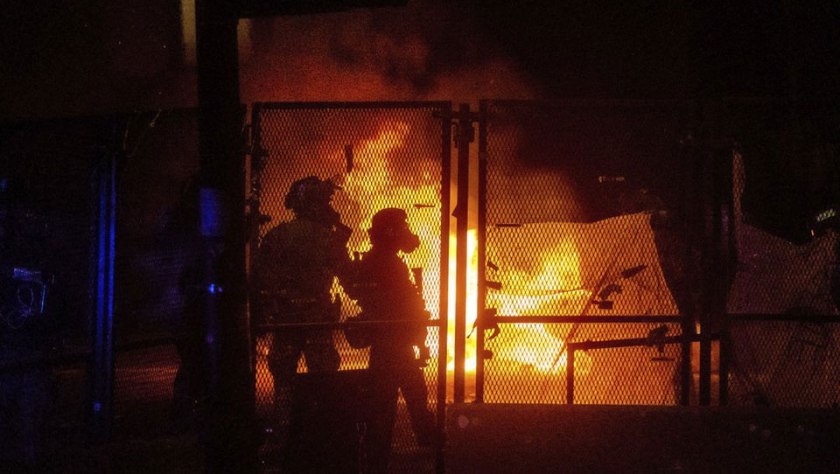
PortlandORFederal officers in Portland, July 25, 2020.
By sending federal militarized units in fascist-like fashion into major cities to attack peaceful Black Lives Matter demonstrators, President Donald Trump is assaulting democracy and setting a dangerous precedent less than 100 days before the November elections.

Clearly, it is a desperate move to shore up his far-right base and divert public attention away from his criminal mishandling of the coronavirus pandemic and the resulting economic crisis, both of which are costing him politically. Poll numbers, for now, show him badly trailing his Democratic rival, former Vice President Joe Biden.

The response by public officials, civic leaders, and civil rights groups in these Democratic-controlled cities and states has been swift and forceful, with pledges to take legal and legislative action to stop the unwelcomed and undemocratic intrusion into local jurisdictions.

In letters fired off to the administration and congressional leaders on July 20, the mayors of 15 cities charged: “Unilaterally deploying these paramilitary-type forces into our cities is wholly inconsistent with our system of democracy and our most basic values.”

Citing federal forces’ actions in Portland in recent weeks, the mayors told Attorney General William Barr and Acting Homeland Security Secretary Chad Wolf that “use of significant force against protesters on a nightly basis,” including snatching protesters off the streets and putting them in unmarked vehicles, and wounding one demonstrator in the head, “are tactics we expect from authoritarian regimes.”

The mayors called on the Trump administration instead to focus on battling the pandemic and providing relief to workers, businesses, and cities, which they characterized as totally inadequate.

“But,” they said, “The irresponsible actions of your agencies threaten community safety and progress on policing in our communities.”

In a second letter to leaders of the U.S. House and Senate, the mayors said Trump’s unilateral deployment of paramilitary forces into cities was tyrannical and called on congressional leaders to “immediately investigate the President and his administration’s actions.”

Philadelphia District Attorney Larry Krasner went so far as to threaten that “anyone, including federal law enforcement, who unlawfully assaults and kidnaps people will face criminal charges from my office.”

In the 2018 midterm elections, Democrats swept to victory in a number of formerly Republican-controlled congressional districts, senate races, and down-ballot contests. Several new progressives were ushered into office.

Currently, the electoral map is looking even more promising for Democrats, as the poll figures show Trump and Republican Senate and congressional candidates trailing or barely hanging on in a number of formerly Republican strongholds.

Last week, the Cook Political Report said six of the U.S. Senate seats currently held by Republicans are in the “toss-up” category while one leans Democratic. Only two Senate seats held by Democrats appear vulnerable.

There are still months to go before the election, and opponents to Trump can’t let their guard down, but these numbers, if they hold, open the possibility that the nation’s Senate majority would flip from Republican to Democratic hands. At the same time, Democrats retaining their majority in the House of Representatives at this point appears assured.

While I am not in the habit of quoting right-wing Republicans, it is worth noting the alarm with which key Republicans view their electoral chances at this time.

Sen. Mitch McConnell, the majority leader, is in the battle of his political career—so much so that he broke with Trump on nearly every major issue related to the coronavirus, including stressing the importance of wearing a mask.

Former House Speaker Republican Paul Ryan, speaking at an event hosted by Solamera, a company with close ties to Republican Utah Sen. Mitt Romney, said that Trump was losing key voting blocks, namely among suburban voters, across the Midwest and in Arizona, a Republican-leaning state “presently trending against us,” the New York Times reported.

Ryan pointed out that “Biden is winning over Trump in this category of voters 70 to 30, and if that sticks, he cannot win Wisconsin, Michigan, and Pennsylvania.”

In a sign of how enduring the Black Lives Matter movement has been, Republicans in Congress are also joining with Democrats in a direct challenge to the president as they back legislation that would force removal of Confederate names from Army bases. On July 23, the Republican-controlled U.S. Senate passed defense policy legislation containing that provision by an 86-14 majority. The House has also passed legislation with a similar provision by a veto-proof majority.

Targeting cities with large communities of color in his dispatch of quasi-military forces shows the patent racist nature of Trump’s intentions. Furthermore, he is trying to suppress the role of a Black-led movement that is challenging systemic racism and demanding democratic reforms that are bound to benefit society as a whole.

What’s more, the movement has awakened communities, concentrated in the suburbs and smaller cities, which in the past have tended Republican but are now moving into the Democratic camp just as the nation is headed towards one of the most, if not the most, consequential election in history.

It is important to note here that the transformation of politics in the suburbs and smaller cities is a reflection of the antipathy with which an ever increasing section of the population has come to view the political actions of Trump, his far-right cabal, and Republican political figures. But, also noteworthy, is the changing composition of the populace in these areas, which has become more multiracial and liberal as the cost of housing and living has forced many out of the central cities.

Now, as we move toward the November elections, the challenge is to organize and mobilize voters and potential voters everywhere, but especially in electoral swing regions and states.

Find out more about the situation in the United States at https://peoplesworld.org/article_category/news/


Over “in time for Christmas”

26th July 2020

Boris press

Boris Johnson – still “guided by the science”?

The scramble to find a COVID-19 vaccine is now the major priority of Big Pharma in the West, with the potential long term profits being as much a lure as that of addressing the public health issues concerned.  The much vaunted Oxford vaccine, developed at Oxford University with Swedish company AstraZeneca, of which the government has allegedly bought 100 million doses, is relatively untried and untested.  It has certainly not undergone the rigorous testing regime required before drugs usually reach the market. There is also no evidence yet that any immunity generated will last and if so, for how long.

So far the tests in Oxford have involved 1,077 people and have been described as “extremely promising initial results” but much more work is to be done, testing at higher doses with a greater sample population in Brazil and South Africa, where COVID-19 outbreaks remain high.

As Max Nisen, writing in the online journal Bloomberg has pointed out however,

“Immune responses measured in the lab don’t always correlate to real-world protection, a risk that’s especially acute for rapidly developed vaccines against a novel virus.”

Professor Sarah Gilbert, of the University of Oxford, said: “There is still much work to be done before we can confirm if our vaccine will help manage the COVID-19 pandemic, but these early results hold promise.”

The reported pace of the vaccine development however has the advantage of fitting in with Boris Johnson’s political narrative that it will all be over by Christmas.   As someone who prides himself on his historical knowledge you would expect him to be cautious about reaching for such claims.  The right wing press, including Johnson’s house journal the Daily Telegraph, the Daily Mail and the Express are all backing Johnson’s “Plan for the worst, hope for the best” strategy outlined last week.

At the Downing Street press conference to announce new measures, Johnson outlined plans for local authorities to have new powers to close specific premises, shut outdoor spaces and cancel events. In addition, regulations set out in draft in parliament this week will allow central government to intervene in local areas by issuing “stay-at-home” orders, limit the numbers at gatherings beyond national rules and restrict transport.

Johnson went on to say that,

“It is my strong and sincere hope that we will be able to review the outstanding restrictions and allow a more significant return to normality from November, at the earliest, possibly in time for Christmas.”

Johnson has also outlined plans to allow people to return to work from 1st August, with the permission of their employer.  This goes against the previous advice to work from home unless absolutely impossible not to and passes responsibility from the state to enforce a clear position addressing public safety, to employers concerned about their profit margins.  The history of the private sector delivering in the service of the public, as the NHS and local government have found to their cost over the years, is not good.

In spite of Johnson’s ongoing claim to be “guided by the science”, the new advice flies in the face of the view of the government’s chief scientific adviser, Sir Patrick Vallance, who told the science and technology committee,

“I think my view on this, and I think this is a view shared by Sage, is that we’re still at a time when distancing measures are important. And, of the various distancing measures, working from home for many companies remains a perfectly good option because it’s easy to do.”

As ever, Johnson’s bluster and desire to promote the optimistic soundbite, outweighs the real concerns for public health and safety which should be driving the government’s approach.  There is little dispute that, in the early days of the pandemic, the UK made massive errors of judgment.  These include sending people with coronavirus into care homes, not locking down early enough, and not having any real kind of test and trace capability whatsoever.

Those errors undoubtedly cost thousands of lives.  There is every danger that too rapid an easing of lockdown measures could cost thousands more lives.  Government strategy continues to be driven by private wealth ahead of public health.  Johnson may still be good for the occasional soundbite for a sycophantic press but a reckoning is yet to come.  The public may not go as easy on the Tories as their mates in the media.


China Crisis?

19th July 2020

Xi Jinping

Xi Jinping – spearheading China’s economic development

The anti-Chinese rhetoric of the United States, effectively the declaration of a second Cold War by President Donald Trump, has taken grip in the UK this week with the decision to cut investment from Chinese firm Huawei in the UK’s 5G network.

A report by the European Commission published in March last year indicated that across the European Union, of which the UK was then a member, Chinese investment totalled 9.5%, up from 2.5% in 2007.  This compared to investment from US and Canadian companies, which stood at 29.5% down from 42% in 2007.

The amount of Chinese foreign direct investment in the EU was rising rapidly, peaking at €37.2bn in 2016.  However, it has since fallen away following a slowdown in Chinese investment globally.  Nevertheless, China now owns, or has a stake in, four airports, six maritime ports and 13 professional soccer teams in Europe.  It estimated there has been 45% more investment activity in 30 European countries from China than from the US, since 2008.

Across Europe the major focus of Chinese investment is in the UK, Germany, Italy and France.  In addition, the new Silk Road programme, the Belt and Road Initiative (BRI), which aims to invest in major infrastructure programmes to increase trade between China and Europe, has twenty European countries on board, including Italy and Russia.

The reason cited for the Huawei ban in the UK is security.  Making the UK 5G network so dependent upon Chinese technology, it is argued, poses a risk as the company is allegedly controlled by the Chinese state.

However, the UK has been keen to encourage Chinese investment in other areas, including the proposed Hinkley Point C nuclear power plant in Somerset, and in a wide range of businesses in the manufacturing and financial sectors, totalling over $20 billion in 2017.

The real story in terms of foreign direct investment into the UK is that the United States by far and away tops the list, with over 23% of foreign direct investment in the UK in 2017 coming from the US.  The UK government is keen to keep the US on board, especially to negotiate a post Brexit trade deal, so compliance US foreign policy remains a priority for the Tories.

The situation is further complicated by the situation in Hong Kong.  The reluctant return of Hong Kong to the Chinese in 1997 has long been a sore point in British ruling circles who see the city as a financial haven and a bridgehead into China, both economically and politically.  Hong Kong was seized by the British in the mid nineteenth century and Britain was subsequently granted a 99 year lease on the colony in 1898 by a weakened and corrupt Chinese state.

The turnover of the island back to China in 1997 came with an agreement to preserve Hong Kong’s capitalist system, the One Country, Two Systems agreement, an attempt by a struggling imperialism to keep a foothold in China and use Hong Kong as a focal point of opposition to the Chinese state.  Recent democracy protests, aimed at securing the secession of Hong Kong from China appear to have been part of this long term strategy.

Not surprisingly the reaction of China has been robust, with the passing of new national security legislation, while the US response has been to ramp up the odds as Donald Trump heads towards a November presidential election.  Latest reports suggest not only an increase in sanctions on Chinese goods by the US but travel restrictions on Chinese Community Party members. The mindset of the US administration was outlined by US Attorney General, William Barr, recently who accused China of conducting,

“…economic blitzkrieg – an aggressive, orchestrated, whole of government, and indeed, whole of society campaign to seize the commanding hights of the global economy and to surpass the US as the world’s preeminent superpower.”

This is the real threat as far as the United States is concerned.  The hegemony of the dollar as the international default currency; the loss of political and economic influence in South East Asia, Africa and Latin America, as developing countries find the terms of trade with China to be less exploitative than those with the West; the loss of influence and investment opportunities in Europe as Chinese technology makes inroads into areas previously dominated by US technology giants.

Concerns about human rights and democracy may look good for the headlines and make Donald Trump feel and, to some, appear righteous ahead of the election in November.  The real deal for the US however, with the UK hanging on its coattails is, as ever, about the cash.  Expect the anti-Chinese rhetoric to continue in the coming months but expect deals to be done behind the scenes all the same.

Like it or not, the West cannot ignore China as an emerging superpower.  Plotting to undermine China will no doubt continue but in the short term the West will have to learn to live with the reality of China’s place in the world.


Levelling up looks hollow

13th July 2020

Boots

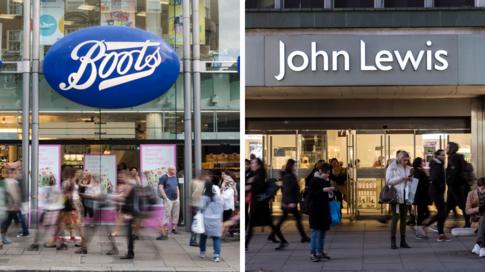
Boots and John Lewis – over 5,000 jobs to go

The seemingly inexorable march towards a second spike in the COVID-19 pandemic in the UK continues apace, with shops, pubs, cafes, restaurants, cinemas, libraries, leisure centres all opening to some degree and, to a huge extent, relying upon the public to operate within and observe the rules of social distancing.

The promise of UK Prime Minister, Boris Johnson, to ‘put the brakes on’ if people do not behave sensibly is lost beneath the deluge of welcomes from services desperate to get customers back across the doors and to see income start flowing again.

At the same time, in the space of three months, decisions have been made in boardrooms across the country to cut back the workforce, operate at reduced or minimal levels and hold back on investment until there is a significant sign of upturn in demand. Major High Street names, John Lewis and Boots, are the latest in a long line of companies taking the opportunity to reduce costs by making workers redundant.

The elderly, the poor, black and ethnic minority communities are being hardest hit by the pandemic in terms of the impact upon health.  They are also the most likely to be hit due to their lack of wealth, working in low paid jobs, on zero hours contracts and being disproportionately reliant on struggling public services and the NHS.

It is reported in The Observer this weekend that the government have already drawn up a list of the top twenty Councils in England where the worst levels of coronavirus are located and deemed to need “enhanced support”.  Top of the list are Bradford, Sheffield and Kirklees with the prospect of local lockdowns, similar to that imposed in Leicester recently, being on the cards.

However, these rankings are based on testing which took place between the 21st June and 4th July, before the fuller easing of lockdown took effect. The next two weeks will be critical in terms of assessing what impact the relaxation measures will have on the transmission of the virus.  The COVID Symptom Study, undertaken by King’s College London, indicates that, based upon data up to the 4th July, rates of new COVID cases in the UK have stopped declining, with over 23,000 suspected cases in total.

It is clearly the case that what little disposable income workers have is being drained by the pandemic, as job loss or insecurity means less spending power and certainly less outlay on major items, while people wait to see how their futures are going to work out.  Even the increasing shift to online purchasing, one of the reasons cited by John Lewis Chief Executive, Sharon White, for reducing store numbers, relies on people having money in the bank to pay.

The pandemic has exposed some of the contradictions inherent in capitalism, underlining that it is moribund as an economic system capable of providing for the needs of the people.

At times of crisis the workforce will always be the first to bear the brunt.  Company executives will receive their bonuses, shareholders will receive dividend payments, the banks will call in their loans.  However, without money in the pockets or the bank balances of the workforce consumption, therefore demand, is flat.

Production for greed, not need, demands a level of capacity on the part of the consumer to actually consume.  Low pay, no pay, or the uncertainty of furlough, is not going to encourage the consumer boom the Tories are hoping will pull them through the crisis.

There has been much talk of the coronavirus pandemic exposing another pandemic, that of endemic racism, following the killing of George Floyd and the increased profile of the Black Lives Matter movement. That is undoubtedly the case.  It is also true however that the pandemic is exposing the depths of the disease at the heart of society, the disease of obscene levels of private wealth, which creates billionaires on the one hand and condemns others to sleep on the street.

The government’s measures to address the pandemic may bring short term economic relief for a few but it remains to be seen at what price, in terms of further lives lost.  Even that relief is likely to be short lived as job losses blamed on the pandemic become consolidated, local authorities struggle to deal with the consequences of mass unemployment, homelessness and poverty and the NHS is overwhelmed by the deterioration in physical and mental health in the population.

The Johnson mantra of ‘levelling up’ is looking increasingly hollow.

The power of working class people taking to the streets, combined with resistance such as the Black Lives Matter movement, in opposition to the cutbacks, job losses and austerity which is inevitably coming, will be vital if a powerful force for change is to be developed, a force which challenges the very raison d’etre of capital itself, putting the real solution, socialism, firmly on the agenda.


Unlocked…but for how long?

4th July 2020

Boris blagBoris Johnson – another day, another blag

Unlocked, unleashed and out on the lash.  If the government was still holding its daily coronavirus propaganda briefings this could be the new slogan, as the shackles come off bars, cafes and restaurants from today.   UK Prime Minister, Boris Johnson, could shuffle up to a lectern emblazoned with the slogan, flanked by nervous scientists, Patrick Valance and Chris Whitty, hoping for at least a place in the House of Lords out of this but knowing they are more likely to take the rap in any future public inquiry, almost certainly designed to incinerate their reputations.

The government has faced a lot of criticism for its dithering, delay and general tardiness in implementing the necessary measures to stem the tide of deaths arising from the pandemic, now inching towards 45,000 on official figures and counting.

In one respect though the government has been perfectly consistent.  That is in its overarching policy objective of putting private wealth ahead of public health.  Governments over the past forty years have progressively shifted the UK economy away from production and towards consumption.

The UK is over reliant upon the financial services in the City of London, being a corporate tax haven and international money laundering operation.  It is over reliant on capital hungry but socially useless investment in weapons of mass destruction.  It is over reliant on the low paid service sector and tourism economy to bring in foreign spending.

Donning a hard hat and dashing off to Dudley in the West Midlands, in order to proclaim a ‘new deal’ in infrastructure investment, Boris Johnson once again this week used a compliant media to spin his message that Britain will ‘build back better’ and that, in spite of still having the highest death rate in Europe, he could proclaim a form of victory in defeating the virus.

The BBC continues to go along with this nonsense, even though the Tories will rip up the Charter and abolish the licence fee anyway.  Like Johnson’s delusions of taking up the mantra of Churchill and Roosevelt, the BBC appears to be deluded enough to think that its state broadcaster status gives it a form of immunity from prosecution.

Life in the real world is, as ever, a little different to that in the Downing Street rose garden or in the cloistered corridors of Broadcasting House.  People continue to struggle with what may be life and death decisions about whether they can go to the supermarket, visit family or venture to a beach.

Listening to UK Chancellor, Rishi Sunak, this weekend, he is clearly trying to convey the impression that it is the patriotic duty of the nation to indulge in these activities.  Corporate profits need to be protected after all, even at a social distance, and that will not happen if people simply choose to stay at home and stay safe when they now have so many more opportunities to spend their money.

Of course, the proverbial pound in the pocket has diminished somewhat for much of the population.  Those on furlough face increasing uncertainty, as the scheme changes and employers have to contribute more.  Many others have already had to join the swelling dole queues with redundancies across a range of sectors, from airlines to retail, being announced daily.

As with many aspects of capitalism, the government’s strategy is about gambling.  Just as the bankers gambled incorrectly that the sub prime housing market would not collapse prior to the 2008 crash, a roll of the dice we are still paying for, so Johnson and his cronies are hoping that a second wave of the virus will not kill off any hope of economic recovery.  Johnson is gambling that those who still have money to spend will do so in sufficient numbers to be enable him to talk up the economy and justify his policy choices.

Unfortunately for Johnson, he may be able to blag some of the people some of the time but he will not blag the virus, ever.  The government has presided over far more deaths than necessary already.  It seems set to preside over many more because of pressure from the banks, the corporate sector and the hospitality industry to unlock too many sectors of the economy too soon.

Public buildings are going to be lit blue and another round of applause is planned this weekend to mark the 72nd anniversary of the NHS, which the Tories opposed setting up in 1948 and have clobbered with austerity cuts over the past decade.  It will look good on TV, no doubt.

However, doctors, nurses, other health care professionals and workers in the care sector generally, both in care homes and local government, will need more than a token round of applause to get them through.  There is undoubtedly more work to be done.

The media, the Parliamentary opposition and, most importantly, the people out on the streets need to be galvanised to expose the ineptitude of this government and put forward an alternative which puts public health first; argues the case for properly structured planned public investment, not phoney rhetoric; exposes the lunacy of buying Trident nuclear weapons, when hospitals are underfunded and people are dying; and gives local Councils the powers to build houses for the homeless and modernise ailing public housing stock.

Most importantly, none of this should be couched in the language of reviving capitalism.  Capitalism would be one coronavirus fatality no-one would mourn.  It needs to be argued as the first steps on the journey towards socialism, a journey which puts the people first and, ultimately, takes obscene levels of private wealth entirely out of the equation.


Real zero tolerance

27th June 2020

StarmerLongBaileyBetter Days? Starmer and Long Bailey pre sacking

It was only ever going to be a question of time before Kier Starmer found a pretext to remove Rebecca Long Bailey from the Shadow Cabinet.  While Long Bailey’s leadership campaign lacked spark, she nevertheless found herself in the somewhat unlikely role of standard bearer for the Left and, as a member of the Shadow Cabinet, at least provided some link with the progressive policies Labour developed under Jeremy Corbyn.

The excuse for Long Bailey’s sacking gives significant cause for concern and is an indicator of the likely direction of both domestic and international policy under Kier Starmer.  Long Bailey re-tweeted an article from The Independent, an interview with the actor, Maxine Peake, in which Peake makes clear her view on a range of political issues, including a trenchant defence of Jeremy Corbyn and the policies developed under his leadership.

That is not why Long Bailey was sacked, apparently.  In the interview Peake also asserts that,

“The tactics used by the police in America, kneeling on George Floyd’s neck, that was learnt from seminars with Israeli secret services.”

The article goes on to add the caveat that the Israeli police deny this stating that, “there is no tactic or protocol that calls to put pressure on the neck or airway.”

In some circles this may be regarded as journalistic ‘balance’.

Long Bailey’s initial re-tweet simply carried the endorsement,

“Maxine Peake is an absolute diamond”

and she has subsequently clarified her position by stating,

“I retweeted Maxine Peake’s article because of her significant achievements and because the thrust of her argument is to stay in the Labour Party.  It wasn’t intended to be an endorsement of all aspects of the article.”

Starmer’s justification for Long Bailey’s sacking is given as retweeting an article which contains an “antisemitic conspiracy theory”.

Marie van der Zyl, president of the Board of Deputies of British Jews, the self styled leading voice of Jewish opinion but actually the voice of Jewish conservatism, welcomed Starmer’s sacking of Rebecca Long-Bailey, stating,

“Keir Starmer has made a very good start, we said, on tackling anti-Semitism in the party.  We had a meeting with him only last Friday and we have made it clear that we judge what he does, what his actions are.  And in this case, he’s absolutely acted decisively and has taken very swift action and it’s very reassuring to the Jewish community.”

The article, in fact an interview with Peake, does not contain an anti-Semitic reference, quote or trope.  It is clearly critical of the Israeli Secret Services and makes a specific allegation relating to the exchange of tactics and methods between the Israelis and the United States, whom no one is denying are very close allies.

Whether Peake’s observation is accurate or not, it is clearly a political point, not a racist one.  She has, in any event, apologised for making an “assumption” in relation to the links between the US and Israel but this still does not make her statement anti-Semitic.  The policies and practices of any state are surely open to comment or criticism.  The anti-Semitism witchhunt within the Labour Party is designed precisely to stifle any criticism of the policies of the Israeli government, which has been illegally occupying Palestinian land since 1967, and to justify not acting decisively enough to enforce Israeli compliance with United Nations resolutions.

At present the Israeli state is engaged in plans to annexe more of the West Bank in order to further squeeze out the scope for Palestinians to create and develop an independent state.    Israel’s Prime Minister, Benjamin Netanyahu, has suggested that the annexation will write another “glorious chapter in the history of Zionism.”

The Israeli move stems from US Donald Trump’s so-called peace plan, which would see 30% of the West Bank come under Israeli sovereignty, giving recognition to all of the illegally established settlements on Palestinian land and Israeli control of the strategically vital Jordan Valley, even before the Palestinians get to the negotiating table.

The Israelis are already engaged in the biggest boom in infrastructure projects in the West Bank for twenty years, laying the basis for a significant growth in settler numbers.

Kier Starmer has made much noise about zero tolerance of anti-Semitism within the Labour Party, a position he inherited from his predecessor, Jeremy Corbyn.  However, unlike Corbyn, Starmer has not been so decisive in making clear his opposition to the flaunting of UN resolutions by the Israelis or the trampling of the rights of Palestinians.

The prospect of Starmer going back to the pre-Corbyn days of Labour simply kowtowing to the establishment agenda, rather than taking a principled stand for the rights of the disadvantaged and disenfranchised, is a very real danger.

Jonathan Freedland, writing in The Guardian, under the byline, “At last, Labour is getting serious about antisemitism” applauds Starmer’s response and goes on to suggest that the Conservatives will be worried because,

“…after five years believing themselves essentially unopposed, and therefore able to get away with anything, now recognise they are up against someone serious about power.”

As is so often the case, Freedland spectacularly misses the point.  Corbyn was serious about power, Starmer is only serious about being in office.  The two are not the same.  Real zero tolerance means zero tolerance of inequality, privilege, prejudice, systematic exploitation and oppression, whether it is in the UK, US, Israel or elsewhere in the world.

Starmer needs to get his priorities in order.  Sacking Rebecca Long Bailey is a victory for intolerance, not a stand for zero tolerance in any way, shape or form.


Crashing Symbols

20th June 2020

Churchill

Protesters make their view of Churchill known

There are many arguments for and against the withdrawal from public view of symbols of imperialism, racism and slavery across the UK.  The most pressing and obvious is that these statues memorialise men who made vast fortunes from the ‘ownership’ and enslavement of others and should not, in accordance with our current realisation and values, be on display.

Another view suggests that we should leave the statues in situ but revise the interpretation associated with them, so that people can understand why they may have been regarded as ‘great men’ in their day but should be viewed differently now.

A third option suggests gathering such statues and symbols into a national museum of slavery, as a means of educating the public about these individuals and the role of Britain in initiating and sustaining the international slave trade.

The statues however are the tip of a substantial iceberg and the issues beneath the surface are beginning to show.  Oriel College, Oxford this week backed the campaign to remove the statue of white supremacist, Cecil Rhodes, from outside the college.  The Rhodes Must Fall campaign have welcomed the move, with some caution as the college have been down this road before and not removed the statue, but recognise that it is a step in the right direction.

Simukai Chigudu, an associate professor of African politics at the University of Oxford and a founding member of the campaign said,

“This statement bears some resemblance to the first statement they issued in 2016, but it includes the crucial, additional detail that the governing body itself has voted for the statue to be removed.  I think that’s a substantial shift.”

This contrasted with the opinion of Universities Minister, Michelle Donelan, who called the campaign “short sighted” adding that we should “remember and learn” from the past rather than “edit” it.

Donelan will no doubt be aware that her view chimes neatly with that of her boss, Prime Minister, Boris Johnson, who wrote in The Telegraph earlier in the week that,

“If we start purging the record and removing the images of all but those whose attitudes conform to our own, we are engaged in a great lie, a distortion of our history”.

This is of course classic dissembling from Johnson, setting up a view that no-one is suggesting, then knocking it down in defence of his own opinion.  No one is suggesting that the record is purged but it is vital that the record is set straight.  That is not distorting history, it is correcting the current distortions, which glorify those who benefited from exploitation and slavery while ignoring the voices of the victims.

Not even Johnson however is concerned about the condemning of slave traders and acknowledging the injustice and brutality of the trade they were engaged in, even he would sign up for that.  His defence of Winston Churchill however is more telling, with Johnson fulminating that it was “absurd and deplorable” that Churchill’s statue should have been defaced and that,

“He was a hero, and I expect I am not alone in saying that I will resist with every breath in my body any attempt to remove that statue from Parliament Square, and the sooner his protective shielding comes off the better,” he said.

Churchill’s heroics are based upon his World War 2 record, where he was one of three leaders, along with Roosevelt and Stalin, who were allied against the Axis powers of Germany, Italy and Japan in the fight to defeat fascism.  While Britain played its role in the defeat of Nazism there is little doubt that the lion’s share of the struggle to liberate Europe was borne by the Soviet Union.

Churchill’s record as a politician in the early twentieth century was a died in the wool anti-working class imperialist.  Churchill’s role as Liberal Home Secretary in 1910, in sending troops to break a strike of miners in Tonypandy in South Wales, is hotly contested but he was never a supporter of trade union rights.  His role in relation to women’s suffrage during this period is also ambivalent at best.

There is no doubt that Churchill’s opposition Conservative Party did not support the setting up of the NHS following WW2, resisted the key nationalisation of coal , rail and steel as part of the post war reconstruction effort and was  instrumental in escalating the coup d’etat planning against the democratic government of Iran in 1953, while continuing UK support for the US intervention in Korea.

Churchill is just one symbol, the one that Johnson chooses to defend.  What Johnson really fears is that, once the surface is scratched, the whole edifice of the British state begins to unravel.  Is there any aspect, from the Royal Family to the Church of England to the House of Lords which is not built upon exploitation, expropriation and oppression?

How about a history which reflects the history of class struggle, the major engine of progress which has seen the franchise extended, trade unions established and working class representation in Parliament?  How about a history of the struggle for the emancipation of women, the fight for equal rights and against sex discrimination?  How about a history of the black and ethnic minority experience of life in the UK from slavery to the Irish starvation, from Windrush to Black Lives Matter?

Some histories are still deemed to be more important than others, precisely because they are the history of the class in power, and the statues and symbols they choose to erect are memorials to that power.  Some of that history is causing them embarrassment now because it is being challenged but they would not be questioning it otherwise.

Without that challenge there will not be change.  If that means a few more statues end up on riverbeds then so be it.  Hopefully it marks the beginning of a more significant re-evaluation of history, a correcting of distortions which reinforce class power and, ultimately, a challenge to the system itself.  Only then will history be on the right track.


Shackle the dogs of war

12th June 2020

blacklivesmatterBlack lives continue to matter, young people continue to protest

Capitalism has had free reign over the world economy, with the exception of China and notable smaller scale economies such as Vietnam and Cuba, for the best part of thirty years.  The defeat of the Soviet Union; the fall of the Berlin Wall; German ‘unification’; the swift dismemberment of Yugoslavia; and the annexation of the former socialist countries into the European Union, were all meant to herald a brave new world.

As ever, capitalism is the consummate conjuring trickster, now you see it, now you don’t.  Better jobs, better pay.  Better housing, lower rents.  Better healthcare, healthier lives.  Greater freedom, less oppression.  All of which has been promised then veiled with the usual capitalist sleight of hand.

The billionaire Russians laundering their ill gotten gains through the London property market are no doubt very happy with the arrangements.  German industrialists, with an untapped source of cheap labour on their doorstep in Eastern Europe have had little cause for complaint.

The reality however is that the whole system is creaking like never before.

The latest Economic Outlook from the capitalist club, the Organisation for Economic Co-operation and Development (OECD), makes grim reading, describing the world economy as being “on a tightrope.”   The OECD predict that the recession following the impact of the COVID-19 pandemic will be the worst for 100 years, with the UK being hit the hardest.  The OECD predict a 6% shrinkage in the global economy with unemployment nearly doubling from 5.4% to 9.2% in OECD nations.

After the 2008/9 bankers gambling debt crisis global economic activity fell by only 0.1% and even that was used as an excuse to herald a decade of austerity, as the poor were punished across the Western world for the banker’s failings.

Worse still, the OECD 6% prediction is the best case scenario.  Should the world be hit by a second wave of COVID-19, as many predict, a staggering 7.6% contraction is anticipated.  The UK is expected to see GDP fall by 11.5%, compared to 11.4% in France, 11.3% in Italy and 11.1% in Spain.  A massive hit across Europe, however you measure it.

The obvious conclusion to be drawn from the current economic and social crises faced by the West is that the system is not fit for purpose.  It is not just the COVID-19 crisis which highlights this reality.  The migrant crisis continues to be an ongoing issue which the European Union fails to face up to. Unemployment was rife across the EU even before COVID-19.  It can only get worse.  The killing of George Floyd in the United States has generated international activism under the Black Lives Matter banner and highlighted the economic apartheid which is endemic to the US state.

Many politicians are attempting to turn Floyd’s killing into an issue about police reform.  That is only one piece in a much bigger jigsaw however.   The persistent racism in policing in the US is a symptom of deeply engrained prejudice at every level of society in the US.  It is not the cause of that prejudice, it is a reflection of it.    To varying degrees the same deeply held prejudices are reflected across the Western world and the issues are systemic to capitalist economies.  Inequality, exploitation and prejudice are endemic.

Billionaires are on the increase across the Western world, while more people are forced to sleep on the street.  The promised land of milk and honey is just not delivering.  This is the outcome of thirty years of the attack dogs of capitalism being off the leash.  The reality of what that means is hitting home to a new generation, as more and more young people take to the streets, recognising that their hopes and dreams cannot be realised under the current system, understanding that tinkering around the edges will not bring lasting change.

Arguments for social justice, economic change, racial equality and, ultimately, socialism are more relevant than ever now.  We must encourage the tearing down of symbols of slavery and oppression.  We must shackle the dogs of war who want to spend billions on nuclear weapons technology.  We must challenge the imperialist history taught to our children.  We must root out institutional racism, sexism and defence of class interests at all levels of society.  There is nothing to lose, there is a world to win.

The profit dash continues

6th June 2020

Out of touchBoris Johnson – increasingly out of touch

It is hard to believe, with the UK death rate from COVID-19 the second highest in the world, topping the 40,000 mark according to official figures, that Prime Minister, Boris Johnson, can declare himself “very proud” of the government’s record on reducing the spread of the virus.

No one but a dyed in the wool Tory MP, financial backer or voter can believe such nonsense when the government approach to the pandemic has been calamitous from the start.  The World Health Organisation declared a global pandemic on 11th March.  The very next day, 12th March, the UK government stopped the limited test and trace programme it had in place, then proceeded to wait until 23rd March before introducing any significant lock down measures.

This was in spite of having the advantage of seeing what was happening in China, South Korea and Italy, giving the government time to respond and put measures in place quickly.  Part of the abject failure of the Tories’ response to the crisis is purely ideological.  Local government officers in public health and environmental health teams have well established test and trace practices which could have been activated at a local level quickly and efficiently.

The government however chose to go with a centralised approach, looking to by pass local government, and hand out contracts to its private sector pals.  Millions have been spent on private sector contracts without any assessment of value or capability in order to be seen to be acting quickly.  The UK death rate is the grim reality of the outcome of that approach.

The current test and trace system, which the government is now heralding as being central to its strategy, is a case in point.  Private sector company Serco is one of several firms employed to recruit a network of 25,000 tracers as part of the government scheme.  The programme is already way behind time and is not expected to be at “world class level” until September or October.

It is critical that test results are turned around in 24 hours if contacts are to be traced in order to isolate the virus.  The government continues to equivocate on the percentage of tests returned in that timescale, though it claims 92% are back within 48 hours.  Even if that is the case, all the evidence suggests that it is simply not fast enough.

Serco Chief Executive, Rupert Soames, seems less concerned about the death rate than the prospect of future profits from NHS contracts.  In an e mail to staff this week Soames said,

“If it succeeds…it will go a long way in cementing the position of private sector companies in the public sector supply chain.  Some of the naysayers recognise this, which is why they will take every opportunity to undermine us.”

As an opportunity to undermine, Soames’ e mail is something of a gift!  The purpose of test and trace is to save lives, not to boost the bank balance of the Serco shareholders.

In an attempt to bring attention to the human loss in the pandemic 27 eminent health professionals, in a letter to The Guardian this weekend, question the validity of the government’s approach, stating,

“If, as seems probable, there is a second wave this winter, many more will die unless we find quick, practical solutions to some of the structural problems that have made implementing an effective response so difficult.  These include the fragmentation, in England, of the NHS, public health and social care; the failure of those in Westminster to engage with local government and devolved nations; the channels by which scientific evidence feeds into policy; and an inability to plan for necessary goods and services, and procure them.”

As an indictment of the government’s approach this could hardly be more comprehensive.  Yet Boris Johnson is “very proud” and Rupert Soames has his eye on the company balance sheet.

Quite why this is not proclaimed as a national scandal from every news bulletin and newspaper headline is a scandal in itself.  However, the Tory press cannot bring themselves to face the reality of the government’s incompetence, while the BBC continues to play a role which can only be described as supine when it comes to journalistic credibility.

On the day the official death toll passed the 40,000 people, on the official count, the BBC reflected nothing by way of outrage but instead leavened its reporting with an emphasis on the falling rate of infections in the community.

The government has lost further credibility with the health sector, should that be possible, by unilaterally announcing that from 15th June, hospital visitors and outpatients must wear face coverings and staff must use surgical masks.  A major operational challenge for NHS Trusts around the country about which they were not consulted.

The dash to shore up company profits rather than save lives will take another step on 15th June with non-essential shops being allowed to open, as long as COVID secure measures are in place.  Following the easing of restrictions on outdoor activity, which saw many rush to the beaches in May, and the option to open schools from 1st June, there is a growing sense that the government is going too far, too soon.

The science around the pandemic is still too uncertain to proceed with anything but extreme caution.  The evidence already is that there are disproportionate impacts upon black and ethnic minority and disadvantaged communities.  Poorer housing conditions, fewer life opportunities and, as a consequence, a greater incidence of underlying health conditions, all play a part in the disproportionate impact of the virus.

It’s a fair bet not many Serco shareholders will fall into this bracket.   We can only hope that Boris Johnson’s ‘pride’ is of the variety which precedes a fall.


“I Can’t breathe…”


…these were the last words of George Floyd, killed in Minneapolis while not resisting arrest, the latest in a long line of African Americans murdered by the US police state.  The protests that have followed the murder of Floyd have exposed once again the deep divisions in the so-called “land of the free”, where apartheid may no longer be enshrined in law but is very much the reality of the day to day lives of the black population.

Minneapolis(2)

Protests mount against apartheid policing in the United States

Floyd was handcuffed on the ground for 11 minutes with a police officer pressing his knee into his neck, while three other officers stood by.  An ambulance was finally called when Floyd lost consciousness but he died later in hospital.  The public prosecutor has charged one officer, Derek Chauvin, with murder in the third degree.  That is killing without intent.  The other officers have so far not been charged.

There is a point after which, pressing your knee into the neck of a man who is protesting that he cannot breathe, especially when he is handcuffed on the ground, becomes intent.  The fact that video of the action went viral left the officers involved with nowhere to hide but behind the time honoured fortress of white privilege.  The killing has resulted in protests across the city, with a predictably robust police response.

Ilhan Omar, congressional representative for Minnesota’s 5th District, which includes Minneapolis, tweeted:

“Shooting rubber bullets and tear gas at unarmed protesters when there are children present should never be tolerated. Ever. What is happening tonight in our city is shameful. Police need to exercise restraint, and our community needs space to heal.”

The protests in Minneapolis are a reflection of the outrage relating to the death of George Floyd but are now spreading to cities throughout the United States.  The murder resonates throughout the black community.  Do black lives matter? Not very much as far as the United States is concerned.

Apart from the lived experience of the Black community and nationwide initiatives such as Black Lives Matter, studies have shown that across the country, Black people face intense bias in the criminal justice system. Minneapolis city data shows that Black residents are more likely than others to be stopped and searched by police as well as to be the targets of police use of force.

Floyd’s death is similar to that of another Black man who died as a result of police misconduct, Eric Garner.  Garner was killed when a New York City police officer, Daniel Pantaleo, put him in an illegal chokehold that resulted in his death. The officer was never brought up on charges.

Inevitably President Trump has weighed into the controversy with a helpful tweet, “when the looting starts, the shooting starts.”  It is not surprising that civil rights activists have seen such an intervention as provocation.  In an election year though Trump’s only agenda is to play to his base and he knows that the African-American vote is never going to swing his way.

Trump’s response is in stark contrast to his attitude to armed nationalist white militias groups who have been protesting against COVID-19 lockdown restrictions in recent weeks.  In effect Trump has conceded to the business lobby to open up large sections of the economy whether it is safe for workers to return to work or not.  Threats to withdraw unemployment benefit are being used to force workers back to the workplace, whatever the consequences for their safety.

Mainstream US media is inevitably focussing upon the damage and allegations of looting which have followed the protests since Floyd’s murder.  Whatever the truth of these reports, the reality remains that the world’s richest state and self styled defender of democracy, treats a huge section of its population as second class citizens based purely on the colour of their skin.

That is the real scandal, that is the real injustice which needs to be addressed.