Blog

Levelling up or just another bumpy ride?

5th February 2022

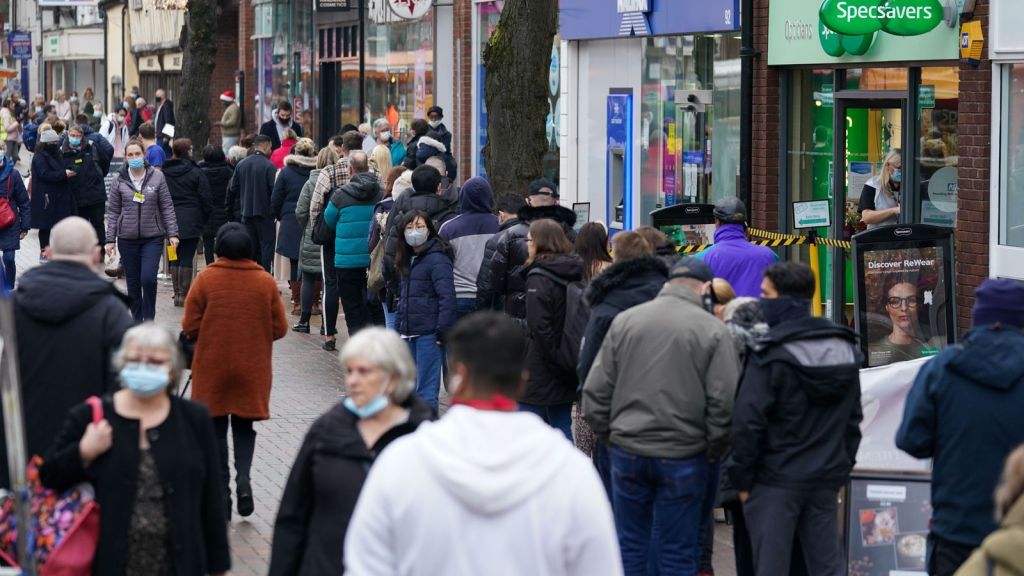
Shoppers search for that levelled up bargain

If the policies and practices of the British government were not littered with such tragic outcomes for working class people they would have to be regarded as a comedy.  Schooled in the finest and most expensive institutions the ruling class can muster, the Eton heavy Cabinet, having rid themselves of Head Girl, Theresa May, could do no better than put the boy who sniggers at the back of the classroom in charge, in the form of Boris Johnson.

For those who do not move in such ‘enlightened’ circles it was clear from the off that Johnson, as with any other Tory Prime Minister, would have nothing to offer the working class other than poverty, insecurity and broken promises.  In this, if in nothing else, Johnson and his diminishing band of cohorts, can at least claim to be consistent.

Yet they still attempt to pedal the illusion that, if they are patently not of the people, they can be trusted to be for the people.   That this is nonsense, propagated by every Tory huckster since time began, is unfortunately no guarantee that some will not fall for it.  Sadly, Johnson would not have an 80+ majority in the House of Commons without that being the case.

The Levelling Up White Paper, published this week, is the latest Tory attempt to hoodwink the people.  The Minister in charge of this nonsense is Levelling Up Secretary, Michael Gove, who has claimed that the British economy had been ‘like a jet firing on only one engine’.

Gove goes on to proclaim the virtues of the strategy claiming that,

“This White Paper is about ending this historic injustice and calling time on the postcode lottery.  This will not be an easy task and it won’t happen overnight, but our 12 new national levelling up missions will drive real change in towns and cities across the UK so that where you live will no longer determine how far you can go.”

Gove fails to point out however that ‘how far you can go’ will still depend upon which class you are born into and how fast a car, helicopter or private jet, presumably with more than one engine, that you can afford!

So, what does this marvel of modern equality contain?

First off there is more bureaucratic dismantling of local government through an expansion of the Heseltine style city Mayor idea, imported from the US.  This will consist of nine county deals, two new combined authorities and a host of new powers for existing metro mayors in England.

The Government has also pledged a ‘simplified, long-term funding settlement’ for devolution while the UK Shared Prosperity Fund, the replacement for European regional development funds, will be decentralised across the whole of the country.

In existing mayoral areas, Greater Manchester and the West Midlands will become ‘trailblazers’ with extended powers, providing a blueprint for others to follow.  The North East Combined Authority is also due to expand. 

For all of those huddled up in a rented flat, faced with the choice of whether to heat or eat, this will all surely come as a welcome relief!  A new layer of government with an Elected Mayor should be just the ticket!

In addition to the devolution plans the White Paper outlines proposals, marketed as 12 ‘missions’ to be met by 2030, to increase education and skills attainment, boost research and development, improve transport and broadband, and improve pay and employment.  In theory, tackling all of the things which have been cut back or reduced following more than a decade of Tory austerity.

Of course, with inflation now bordering on rampant levels the Bank of England is already whimpering about pay deals being too high, so it will be no surprise if that one is the first to go out of the window.  Let’s face it, why would levelling up prioritise giving people better pay and conditions?

There is little in the government’s levelling up missions to disagree with.  Who does not want increased life expectancy, better schools, better transport, better housing, better broadband connectivity?  In short it is a wish list of things that obviously need to be addressed but have suffered because the private sector has been more concerned with making profits for shareholders than meeting people’s needs.

Nothing in the proposals suggest that putting the private sector first will change.  Nothing suggests that the energy companies, making vast profits on the back of hiked up energy prices, will be nationalised.  Nothing suggests a more effective and efficient rail network, publicly owned rather than in private hands.  Nothing suggests the return of local housing control to local authorities and the abolition of the iniquitous ‘right to buy’ scheme.   

Nothing suggests that the private school system, with the sham of educational establishments for the rich being able to claim charitable status, will change.  There is no mention of abolishing university fees, the introduction of which has become a barrier to access for working class students.  While we are on, anyone care to look at the gender equality pay gap?

For most ordinary people the promise of levelling up looks a lot like being just another bumpy ride from the Tories.

It is safe to say that there is more levelling up to be done than is dreamed of in Michael Gove’s philosophy.  In fact, there is more levelling up to be done than is possible under any capitalist philosophy as inequality, exploitation and expropriation are at the core of the system.   Levelling up, in any real sense, is a socialist proposition and can only be delivered when the system is under the control of the people, run by a government for the people and committed to meeting the needs of the people.

Anything less than that, including the government’s White Paper, is little more than hot air and will not change the real balance of power one jot.

Remembering Bloody Sunday

30th January 2022

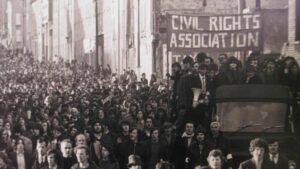
Peaceful demands for civil rights, undermined by Bloody Sunday

The history of the British presence in Ireland has always been one of violence, oppression and exploitation.  For centuries Ireland only mattered to the British ruling class as a source of cheap food, feeding the British army during the Napoleonic wars and being turned into a largely corn growing economy as manufacturing began to grow in Britain in the early nineteenth century.

The struggle for control of the land was integral to the national struggle in Ireland throughout the nineteenth century.  English landlords profited from the extortionate rents charged to the Irish peasantry, who were forced to either pay up or be evicted.  Essentially the peasant grew wheat to pay the rent and potatoes for food.

When the potato crop failed, leading to the so called Irish famine of 1845 – 1850, food to the value of £17m was exported from the country, in 1847 alone, under the protection of English troops.  As A. L. Morton observes,

“The million and a half people who died in these years did not die of famine but were killed by rent and profit.”  (A People’s History of England – Lawrence and Wishart 1938)

Different movements including the Young Ireland Movement, the Fenian Society and the Land League attempted at various times to defend the economic interests of the peasants, fight evictions and foment risings against English exploitation without significant lasting success.

The parliamentary route was represented through the Home Rule Party, formed in 1872, which quickly found an able leader in the form of Charles Stuart Parnell.  Parnell had some success in delivering a significant body of nationalist MPs into the Westminster Parliament.  However, even this route was barred when Parnell was discredited as part of a conspiracy to successfully split the nationalist position, and any attempts to introduce Home Rule for Ireland were blocked by the landlords, keen to hold onto their profits.

By the time of the Easter Rising in 1916 it was clear that significant sections of the Irish working class were against both English domination and participation in the Imperialist war.  While the rising itself was unsuccessful, and its leaders, including James Connolly, executed by the British, the rebellion triggered a steady growth of labour and nationalist activity. 

The guerrilla warfare against the English which lasted from 1919 – 1921 resulted in the establishment of the Irish Free State but at the expense of the annexation of the six counties which became Northern Ireland, incorporated into the so-called United Kingdom.

Northern Ireland itself was essentially an enclave of English occupation, managed on behalf of the English industrialists who controlled the economy, by the Protestant majority at the expense of the Catholic minority.    Working class Protestants, who should have had more in common with their working class Catholic counterparts, were bought off by preferential access to jobs, housing and dominance of the police and security services.  Voting rights for Catholics were also restricted in order to ensure an inbuilt Protestant majority in any governance arrangements in the province.

Catholic areas were regularly under attack and resistance was met by the British state with a policy of internment, arrest without evidence or trial, which further inflamed Catholic and nationalist sentiment.

Internment was, in effect, the repressive response by the British state to the growing challenge of popular resistance to defend nationalist areas from assault by sectarian Protestant forces.  It was also the British state’s attempt to stem the rising tide of a civil rights movement demanding their rights against decades of repression, discrimination, and gerrymandering.

As the Communist Party of Ireland (CPI) note,

“The British and Orange state saw the resistance of the people and continued demands for civil rights as a direct challenge to the very existence of the British-imposed political settlement of 1922, which partitioned Ireland.”

The civil rights march in Derry, which took place on 30th January 1972, fifty years ago today, was called to protest against the policy of internment which had been introduced in August 1971.

As the CPI go on to point out,

“The activities of the Parachute Regiment in Derry on 30 January 1972 followed the state-organised killing of at least nine people in Ballymurphy in Belfast between 9 and 11 August 1971, all part of Britain’s military strategy of “low-intensity conflict,” a strategy for quelling and subduing local working-class resistance to its political, economic and military strategies of control.”

The ’activities of the Parachute Regiment’ on 30 January were the murder of 13 unarmed civilian protesters, as the British soldiers opened fire on a peaceful demonstration.  A fourteenth innocent victim died later as a result of injuries inflicted on the day, which has gone down in history as Bloody Sunday.

The actions of the British state on Bloody Sunday undermined the peaceful protests and class solidarity being built through the civil rights movement and drove many nationalists into the arms of the Irish Republican Army (IRA). 

The misguided guerrilla campaign of the IRA, targeting civilian as well as economic and military targets, played into the hands of the British state.  It was easy for the media to whip up opposition to IRA ‘atrocities’ and difficult for the Left in Britain to generate solidarity with those seeking a genuine working class solution to the partition of Ireland, achieving unity across all 32 counties.

The violence of British imperialism in Ireland did not end with Bloody Sunday and the economic grip upon the six counties of the Northern Ireland statelet continues to this day.  The debate over the border in the Irish Sea, which has erupted as a result of Brexit, has underlined ruling class differences over the statelet’s position as part of the increasingly fragmenting United Kingdom, or whether it can be incorporated into the safe hands of the Irish ruling class and be absorbed into the neo-liberal arms of the EU as part of a united Ireland.  

Neither solution will benefit the Irish working class in the short term but an Ireland united will at least have the opportunity to shape its own future on its own terms rather than having to fight on two fronts.  As the CPI conclude,

“The best way to remember the victims of imperialism is to struggle to end imperialist control and domination, to take up the challenge and struggle bequeathed to us by James Connolly, to struggle for and build a Workers’ Republic, from Derry to Kerry.”

For more info go to https://communistparty.ie/en/2022/01/bloody-sunday-1972-statement/

Stop the NATO war drive!

22nd January 2022

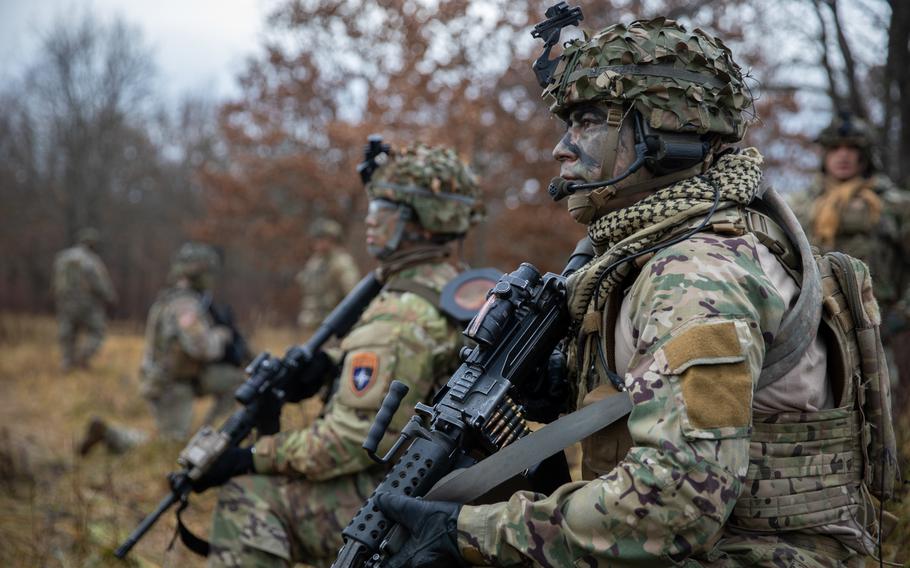
Ukrainian soldiers practice with US weaponry – January 2022

Ever since the defeat of the Soviet Union in 1991, followed by the slide of the Russian Federation into gangster capitalism and the rightward shift of many former Soviet and Eastern European states, there has been the potential for conflict with the West.  Inter-imperialist rivalry has been a key feature of world politics since before World War 1 and however it is currently dressed, in talk of globalisation for example, it has not fundamentally changed.

Capitalism is driven by expansion, whether that is through territory, economic influence, strategic resource control or sheer military force, new conquests and new markets are always on the agenda.

The opening up of markets and influence which ‘victory’ in the Cold War afforded Western capitalists has been reflected in the incorporation of former socialist states into both the European Union and NATO; the annexation of the former German Democratic Republic into a ‘unified’ German state; and the creeping economic and military encirclement of Russia.

The flaw in the West’s plan for the post Soviet era was a failure to recognise that the beast it had unleashed in the East, in the form of the gangster capitalists of Russia, may have demands of their own and may not take kindly to the diktats of the West.  There is also the fact that Russia’s new regime inherited a substantial military arsenal, as well as a not insignificant economic capability and major geo-politically important resources, in the form of oil and gas reserves.

Inheriting the Soviet Union’s seat as a permanent member of the UN Security Council also meant that, whoever was in the post Soviet driving seat in Russia, was always going to be a key strategic player. In European terms Germany, always keen to maintain its economic and political dominance of the EU, does not seek an economically strong rival to the East.

Germany has been well placed to benefit from the pool of cheap labour, which the incorporation of the former socialist states in Eastern Europe was designed to achieve for the EU.   The free movement of labour has merely been a cover for the easier exploitation of cheap labour by the established EU states.

This has also allowed German market expansion into Poland, Romania, Bulgaria, Czech Republic and the Balkan states, with Ukraine firmly in the sights, as both a key market and source of strategic resources.  

NATO troops and heavy weaponry are already positioned as far forward as Poland and in the Baltic states, with military exercises in those countries having been a key feature of recent years.  Additional Western firepower has been provided to the Ukrainian government today, to counter the much hyped ‘threat’ of a Russian invasion.

Russian President Vladimir Putin is by no means an innocent player, as Andrew Murray states,

“…he presides over an authoritarian regime run mainly in the interests of the oligarchic groups which have seized the wealth of the USSR.  It is a brazenly corrupt system, which has concocted an ideology mixing Russian chauvinism and Orthodox-influenced social conservatism…” (The Empire and Ukraine Manifesto Press 2015)  

For Putin though, a Ukraine on the Russian border, as a member of the EU and armed by NATO, is regarded as unacceptable, the equivalent of Russia forging an alliance and stationing troops in Mexico.

The relative decline of the United States as the world’s dominant economic force, challenged by China on that front; the struggle of the EU to maintain both political unity and economic influence; and the reassertion of Russia as a force on the European front, make Ukraine a very real potential flashpoint, in both economic and military terms.  

The ever compliant Western media focus upon the number of Russian troops on the border with Ukraine, failing to point out that these troops are actually in Russia, unlike the troops and weaponry which NATO has been amassing for years in countries neighbouring Russia, as part of its strategy of encirclement.

The roots of the current crisis run deep. In November 2013 the elected president of Ukraine at the time, Victor Yanukovych, was negotiating with the EU to move Ukraine closer to the EU but not by directly joining. His aim was to broker an economic deal that would benefit Ukraine, the EU and Russia, if possible. Via Ukraine, the EU could access Russian energy resources and Russia would gain new customers. As the intermediary, Ukraine could win financially by playing the pipeline middle man and getting cheaper gas for itself.

However, the EU wanted Ukraine to keep paying inflated prices and to stick to a burdensome debt repayment schedule. Putin then offered Ukraine a better deal than what the EU was offering, with Russian gas for up to a third less and help paying off debt. Yanukovych, who did not want to impose the austerity on his people that the EU was demanding, accepted Putin’s offer.

In response, the nationalist right wing in Ukraine, led by openly fascist organisations, began to whip up protests. Yanukovych overreacted with police violence against demonstrators, and many were killed. Things spiralled out of control, and he fled to Russia as a fascist coup openly backed by the U.S. seized control in Kiev under the guise of “restoring law and order.” Again, EU and NATO expansionist desires were resulting in bloodshed.

Clearly a military conflict will not benefit the people of Ukraine, Russia or the West, as any escalation is in danger of degenerating quickly into a Europe wide conflict or worse.  The moves towards more arms and ammunition being supplied to Ukraine by the West must be stopped and exposed as the provocation they clearly are. 

Opposition to further imperialist war must be the priority for progressive organisations across the world.  Opposing NATOs war drive is by no means an endorsement of Putin but mass opposition to it may just save thousands of lives.

The position of the Stop the War Coalition should be widely circulated, stating,

“Stop the War demands an end to the relentless expansion of NATO, which has only added to international tension, particularly as NATO has played a more aggressive role internationally in the Balkans, the Middle East and South Asia. We oppose the deployment of British forces to the borders of Russia as a pointless provocation. “

For more info go to https://www.stopwar.org.uk/article/stop-the-war-statement-on-tensions-around-ukraine/

Dancing in the dark

15th January 2022

Hard ‘at work’ in the Downing St garden, May 2020

The news this week has been dominated by narcissists trying to wriggle off the hook.  In Australia, tennis star, Novak Djokovic, has been wrangling with the immigration authorities about his vaccination status, or rather his entitlement to an exemption, given his widely known anti-vaccination views.

Djokovic is aiming to win his tenth Australian open and surpass the world record by recording his 21st Grand Slam, remarkable achievements by any measure, but not ones which entitle him to be treated differently to the average Australian citizen.  Australia in general, and Melbourne in particular, has seen some of the most severe lockdown restrictions during the pandemic and many are justifiably outraged that Djokovic is trying to flaunt the rules and trade on his status.

The Australian government have finally seen sense and withdrawn Djokovic’s visa, an action which should send a message to anyone in the sports and entertainment world that fame should not be an assumption of entitlement.  Nevertheless, the Serb’s legal team are launching a final appeal which may yet take the saga into early next week.

The British national embarrassment which is the Royal Family compounded its anachronistic status this week with the Queen being compelled to strip her son, Prince Andrew, of a slew of military honours and to withdraw use of his His Royal Highness (HRH) status.  Quite what the Prince had done to accumulate his military accolades is a moot point.  Given a life of sponging off the hard earned taxes of the working class, which continue to bankroll the pampered lifestyle of the aristocracy, it is hard to see what useful purpose Andrew and his retinue serve.

Without any real purpose, and no challenge to earn a living, the Prince has indulged himself as an international playboy, using his royal status as a passport to the closed world of the rich and famous.  Whether Andrew is guilty of sex trafficking or sex with children will be for the US courts to decide but, whatever the outcome of the case brought against him, associating with criminals of the nature of Jeffrey Epstein and Ghislaine Maxwell shows, at the very least, poor judgement.

The Prince’s legal team have jumped through every possible hoop to prevent the case coming to court, all of which gives off the smell of something rotten being hidden.  Another narcissist, another week of squirming and months more ahead.

Then there is serial liar and narcissist in charge of the British government, Boris Johnson.  It is becoming increasingly difficult to enumerate with any brevity the catalogue of lies, misdirections and disasters which characterise Johnson’s premiership.  Not long after the official pandemic death toll in the UK passed 150,000 it turns out that Johnson and his cronies have been cavorting around the garden at 10, Downing St, enjoying the “lovely weather” while others could not visit dying relatives.

To date at least 13 parties have been identified as having taken place at Downing St when lockdown rules covered the rest of the country.  Johnson’s miserable excuse for an apology, that he stumbled upon a ‘works event’ on 20th May, with his fiancé, stayed for 25 minutes then went back to work in his Downing St office is paper thin. In any event, stumbling upon 30 people boozing in your back garden when you were only allowed to meet one person outdoors should have elicited a slightly different response, whether or not the boozing was ‘work related’.

The Metropolitan Police, the ones who famously do not investigate past illegal acts, no wonder their reputation is in tatters, are awaiting the outcome of PM appointed bureaucrat Sue Gray’s investigation before deciding whether to act.  Tory MPs are similarly sitting on their hands, waiting for the outcome of Gray’s report before deciding which way to jump, though their local parties may be sending them a more robust message.

Most bizarrely, Boris Johnson is awaiting the outcome of Gray’s pontification, before deciding how badly he or his staff may have behaved and whose head may have to roll as a consequence.  Martin Reynolds, the bureaucrat who sent out the e mail invite to the infamous 20th May party, looks like his punishment will be an ambassadorship in the Middle East. That will top up his Civil Service pension nicely no doubt.

While the noise around parties and personalities continued the real judgement on the government’s monumental pandemic money laundering operation sneaked out almost unnoticed.   The billions of pounds worth of contracts awarded through the VIP fast lane during the pandemic, many to Tory friends, donors or associates was deemed illegal in the High Court.

An estimated 32 billion items of PPE, worth in the region of £14 billion, were bought through VIP fast lane contracts to companies given preferential treatment due to their political connections.  To add insult to injury, many of the materials supplied by these companies were unsuitable for use in the NHS or were defective.

Jo Maugham, Director of the Good Law Project, one of the companies which brought the case commented,

“Never again should any government treat a public health crisis as an opportunity to enrich its associates and donors at public expense.”

Dancing in the dark at parties in Downing St is just the tip of an iceberg.  Lurking beneath the surface is the real world of the political establishment, a closed world of back handers and back scratching, which keep the pampered and privileged in their positions and makes sure that it is the rest of us who pay.

Johnson’s error, and the reason why his head may be on the block as Tory leader, is not that he has departed from the expected norms of his peer group but that he has made this too obvious.  There has been too much braggadocio for many beyond his diehard supporters and those on his payroll to defend.

To do this in a pandemic, when people are dying; your inept procurement is increasing the chance that more will die; and you do it while flaunting your own rules by indulging in back garden boozing is beyond the pale.

Johnson clearly has to go but his departure will only lance a boil, it will not cut out the cancer.  The political establishment in Britain truly is rotten to the core, however much they try to mask or masquerade.  Getting to the root will take time but the reality is gradually being exposed and the need for fundamental change will resurface.  The Left must continue to make that case and continue to argue for a system which works to the benefit of the many, not the few.  

Wallpapering over the cracks

8th January 2022

Lytle cause for concern in Downing Street

The long running farrago over who paid for what, when and what they received in exchange, to redecorate Boris Johnson’s Downing Street flat came to a head this week.  In typical fashion it did not conclude in the colourfully bold, some may say garish, style of the Johnsons’ chosen decorator, Lulu Lytle, but settled into the usual whitewash of bluster and apology which has characterised Johnson’s premiership.

In a series of WhatsApp exchanges it is clear that Johnson was prepared to accept cash from one of his cronies, Lord Brownlow, in exchange for entertaining Brownlow’s pitch to stage a Great Exhibition 2 in 2022.  Brownlow’s cash was to be laundered through a so-called blind trust, thus washing it through a ‘legitimate’ route which could not be construed as a donation or, worse still, a bribe.

When the whole scam came to light, last April, Johnson appointed another pal, Christopher Geidt as an ethics adviser and suggested that he look into whether or not Johnson had acted in breach of the ministerial code.  It was no surprise to anyone that Geidt did not find any breach and assured the public that Johnson did not know where the cash was coming from.

The Electoral Commission also got involved and launched its own inquiry, finding that the Tories should have reported Lord Brownlow’s donation and fined the Conservative Party £17,000, a notional slap on the wrists.

In the meantime, it turns out that Johnson had not come clean with Lord Geidt and had forgot to mention a couple of WhatsApp exchanges with Brownlow, which were clear evidence that he had a very good idea of where the cash was coming from, how it would be laundered and what Brownlow was after as a pay off.

Geidt subsequently took the hump and accused Johnson of acting “unwisely”; Johnson offered a “humble and sincere apology”; Brownlow did not get GE2 but a diluted version branded as Unboxed, which will be rolled out over 2022; and Lulu Lytle oversaw the £58,000 flat redecoration, including the now famous £800 per roll gold wallpaper – tasteful.

Out in the real world, the pandemic continued to rage, the body count in Britain continued to outstrip most of the rest of Europe and the new Omicron variant had made its appearance, just when everyone thought that some degree of normality was on the horizon.  

While Johnson shrugs off justifying his £58,000 flat refurbishment many across the country are struggling to feed and clothe their children, or meet the rising cost of energy bills, which impact disproportionately upon poorer families.

The average annual salary for workers in North East England in 2021 was £27,500, the lowest in the UK and less than half of the cost of Johnson’s designer flat makeover.  Once tax and national insurance contributions are deducted take home pay is likely to be less than £2,000 per month, which is how much the average annual energy bill is likely to be from April, according to recent estimates.

Take that calculation down to the level of part time work and those surviving on Universal Credit and the impact of energy costs alone looks alarming.  Add to that rising national insurance costs for those in work, inflation across the economy, leading to rising costs for food and fuel, and the cost of living crisis begins to take on real shape.

Chancellor Rishi Sunak has immunity to the impact of these changes, due to his millionaire status, but has said that the Treasury are looking at ways to mitigate the impact of rising prices.  The Treasury do not appear to be open to that mitigation including a windfall tax upon the profits of the major energy companies or a wealth tax on profits and property ownership, or even making the major beneficiaries of the pandemic, in the form of Google and Amazon, pay their fair share of the tax burden.

Still, we must not lose heart.  The Secretary of State for Levelling Up, Michael Gove, has written to all local authority Chief Executives this week encouraging them to begin planning for the Queen’s Platinum Jubilee, with a four day Bank Holiday weekend scheduled for the 2nd – 5th June and extended pub opening hours in prospect for the first three nights.

Beacons will be lit, music will be commissioned, street parties will be organised and much alcohol will be consumed, in a collective effort of the will by the ruling class to keep us believing that we really do need a monarch, “long to reign over us”.

Whatever state the British economy is in by June we can be sure that the rich will continue to get richer and the poor will continue to pay the price.  Playing the patriotic card is often the last refuge of the few in diverting the people’s attention away from the day to day realities of life in capitalist Britain for the many.

The bigger reality is that no amount of wallpaper will cover the cracks in the capitalist edifice, even at £800 a roll, and the corruption that is at the heart of the system.  That is a system which is designed to maintain power and privilege in the hands of those who continue to own and control the means of production, distribution, exchange and communication. 

That must change, the whole structure which sustains such inequality must be challenged and the emergence of the people as citizens, not subjects, with control over their own destiny, will be the measure of a real shift in the balance of power. That would really be a step towards levelling up.

Light in the darkness

1st January 2022

Brexit – getting Johnson done?

Historically, capitalism has so far found ways to reinvent itself, intensify its exploitation of human, animal and material resources across the world and still exert control over large swathes of the planet.  The heroic efforts of the Soviet Union and its allies, to take human history in a more progressive direction, lasted little more than seventy years.  The defeat of that effort has undoubtedly set the clock back and, despite the growing economic power of China as a counter weight to US imperialism, the momentum of the Soviet alliance through the world communist movement has clearly been diminished.

That is not to say that all is lost.  Capitalism is inherently a cutthroat business made up of shifting and unstable alliances, with each player out to gain the upper hand.  The banks falling over themselves to lend more and generate more profit led to the 2008 financial crash and the subsequent austerity drive to make the working class pay off the banks’ gambling debts.  That scramble saw some banks go to the wall while others had to rely on state bail outs.  The free market is ultimately only as free as the capitalist system wants it to be.

Similarly, the British exit from the neoliberal strait jacket of the European Union has not only exposed the faux internationalism of the bloc but also illustrated that international relations must be based upon mutual respect if they are to work.  The British position in recent negotiations has been to get one over on the EU while, likewise, the EU cannot be seen to let Brexit work.  The impasse means that the British people end up with the worst of both worlds, unable to be fully free of the EU, while equally failing to carve out an independent position in the world, based on mutual respect and a true socialist internationalism.

The British political establishment has been divided over Brexit for a long time.  Up and coming challenger to Boris Johnson, the recently appointed Foreign Secretary, Liz Truss, was a pre-referendum Remainer but has since reinvented herself as a darling of the Tory right wing with growing support amongst grass roots membership.  Far from ‘Getting Brexit Done’ as Johnson proclaimed at the 2019 General Election, it may yet be that Brexit gets Johnson done, sooner than he would have liked.

The assertion of foreign policy independence by the Johnson government, through proclaiming its Global Britain policy, would be laughable if it were not so tragic.  The only sense in which Britain is remotely global is in tying itself to US foreign policy objectives and tagging along as a junior partner.  This has been the case for many years, with Britain functioning as little more than a US airbase and a forward base for US nuclear weapons, through the Trident nuclear submarine programme.

The lunacy of the so called independent nuclear deterrent is only surpassed by the billions it is proposed to spend to replace Trident.  More money in the pockets of the US military industrial complex, less in the Treasury pot for schools, housing and the NHS, surely all more pressing priorities for the British people.

Just as the Tories do not speak with one voice on EU membership, the military establishment is similarly divided over Trident.  Not that the Chiefs of Staff are arguing for more hospitals, they would much rather see increased spend on conventional weapons, but there are divisions there which a skilled Opposition could exploit.

Sadly, the major skill the Opposition appear to possess at the moment is that of supporting the Tory line on most major questions.  Certainly, there is no dissent on the Labour Front Bench regarding spending billions on Trident.  There is no departure from the Tory line on NATO membership and kowtowing to the United States in foreign policy priorities.

Having conspired to lose the 2019 General Election, through ditching Labour policy to honour the referendum outcome, as well as playing a leading role in the so-called People’s Vote campaign, Kier Starmer is looking increasingly well placed to play a caretaker role as Prime Minister, should the Tories not sort out their leadership issues in time for the next General Election.

The Labour Front Bench does not however reflect wider opinion in the Labour Party, with a range of more progressive policies being adopted at Labour Conference providing the basis for a continued push from the Left, for policies which will serve the interests of the people and challenge the vested interests at the heart of the political system in Britain.

The broader international picture also holds out some hope.  China continues to travel an anti-imperialist path of development, as does Vietnam and, in spite of the ongoing illegal US blockade, so too does Cuba.  The wider picture in Latin America remains encouraging with progressive governments continuing to hold sway in Venezuela, Bolivia, Nicaragua and more recently Chile.

The surge in Labour membership in the 2015-17 period in particular, with progressive policies being articulated during Jeremy Corbyn’s leadership, also shows that policies in favour of the many, not the few can gain traction beyond the confines of Party conference, even in reactionary Conservative Britain.

The year ahead will certainly hold challenges for those arguing for a shift in the balance of power in Britain in favour of the working class.  In spite of the positions taken by the Labour Front Bench there remain key allies in Parliament among progressive Labour MPs.  Their voices, combined with mass extra Parliamentary action, will be vital in shifting the debate towards the real needs of the British people, rather than continuing to defend the interests of the banks and corporations which the Tories represent.

Now is no time to dwell in darkness, it is time to shine a light into the murky corners the Tories wish to hide and flush them out!

Avanti in 2022!

A Year Without Sundays

23rd December 2021

Literacy brigades celebrate in the Plaza de la Revolucion, Havana, 22nd December 1961

On the 22nd December 2021, Cuba marked the 60th anniversary of the literacy campaign initiated following the 1959 revolution which rid the island of the US backed dictator, Batista.  Very early on in the revolution the Cuban leaders realised that without literacy there could be no progress, that the defence of the revolution and the possibilities for social and economic progress depended upon a literate and educated population.

The Year of Literacy was declared in 1961 and an army of young people and students, mainly from Cuba’s cities who had some literacy skills, were transformed into an army of volunteers deployed across Cuba.  Organised into four brigades, to target both urban and rural areas in Cuba, the volunteers were up against more obstacles than just the endemic illiteracy which years of dictatorship had caused.

The defence of the country was a major concern, with counter-revolutionary groups active in the mountains of Las Villas and Oriente, in what turned out to be preparation for the US led Bay of Pigs invasion of Cuba in April 1961.  Not all of the literacy teachers and students survived the counter-revolutionary activity with a number being murdered by the reactionaries, determined to turn back the clock in Cuba.

Nevertheless, a teaching force of 268,420 people were organised across the four brigades with a mission to tackle the 14% illiteracy rate, consisting of almost 1 million people, throughout 1961.  By the end of that year the brigadistas had brought that rate down to just 3.9%, teaching over 700,000 Cubans to read and write during the course of the campaign.

One student pronounced that,

“It was a year without Sundays or parties: it was a year for the literacy campaign.”

It was a year which transformed the lives of many of Cuba’s young people and laid the basis for the survival of the revolution, in spite of the 60 year long illegal economic blockade by the United States, which has slowed Cuba’s development.

Cuba’s leaders recognised that without a literate population it was not possible to train people as teachers, scientists, doctors or engineers.  It was not possible to generate great art, music or literature.  The Year of Literacy was one of the key building blocks which has led to Cuba’s healthcare provision being famed across the world, for its infant mortality rate being lower than that of the United States, for the international campaign to award the Henry Reeves Medical Brigades the Nobel Peace Prize, for their work in supporting other developing countries at times of epidemic or catastrophe.

The emphasis which Cuba has placed upon the development of the biotech sector, at the encouragement of the late Fidel Castro in the 1980’s, has resulted in Cuba being the only developing nation to have produced its own vaccines against the Covid-19 virus, vaccines that it is prepared to share, without profit, with other under resourced and developing nations.

Cuba has vaccinated more of its citizens against Covid-19 than most of the world’s largest and richest nations.  Over 90% of the population have received at least one dose and 83% are now fully inoculated.  Infections and deaths have reduced significantly in recent weeks, falling to just 1% of their peak in August.        

“It is a truly remarkable accomplishment, given the size of Cuba and also the US embargo that restricts their ability to import”, said William Moss, Director of the John Hopkins International Vaccine Access Center, a US based university group that works to ensure equitable access for low-income countries.

Like elsewhere, the Omicron variant means that Cuba faces a new challenge.  The ongoing embargo by the US does not help, as access to vital resources remain limited and costly, through having to trade through third parties.  The battle may not be over, but the struggle continues.

There can be no doubt that Cuba’s current struggles will take heart and inspiration from the Year of Literacy in 1961 and the campaign which helped shaped modern Cuba.

On 5th November 1961 Melena del Sur was proclaimed the first town free of illiteracy, followed by municipalities and provinces across the nation.  On 16th December the literacy teachers began arriving in Havana from across Cuba.  On the 22nd December, at a massive rally in the Plaza de la Revolucion, Cuba was proclaimed a territory free of illiteracy.

Gambling with the health of the nation

Lies, damned lies and parties – another bad week for Johnson

The only thing as certain as the inexorable spread of the Omicron variant of Covid 19 is the lengths to which the Tories will go to cover up their lying and deceit, which has characterised every stage of the pandemic.  It is getting difficult to keep track of the number of parties which occurred in government departments or Downing Street itself, either last Christmas or during lockdown in May last year.

The latest revelation, that the government’s most senior civil servant, Simon Case, allowed a gathering to go ahead in his office, is the icing on the cake.  Case is meant to be investigating the allegations of goings on at 10, Downing St, a brief which is now fatally compromised.

If it was possible to be charged with reckless endangerment when in charge of pandemic, the Tories would be bang to rights.  Apart from the obvious dangers of virus spread from the plethora of office parties and gatherings, which are making the news headlines daily, there is the shattering of public confidence in vital public health messages, which could keep the death count down and reduce pressure on the NHS by controlling hospitalisations.

The Tories one rule for the rich and another for the rest approach however is leading many to forget that two wrongs do not make a right.  Just because the Tories adopt a cavalier attitude towards the health of the nation does not mean that we should all fall into the same trap.  The temptation for many to adopt an attitude that ‘they don’t obey the rules so why should we?’ is great but it is ultimately a self defeating one.

The UK Health Security Agency (UKHSA) estimate that in most regions Omicron infections are doubling in less than every two days, suggesting that cases could reach a million a day by the end of the month.

Dr Susan Hopkins, Chief Medical Advisor at UKHSA said last week,

“The biggest worry is that if we have very high numbers of people getting infected at the same time, with the doubling rate that we are seeing at the moment.  Then it will find all those people who had less immune responses or those people who have yet to get their booster dose or have not been vaccinated yet, remembering that there are still significant numbers in the population – more than 5 million in England – who have not yet received a single dose of vaccine.”

The Tories are doing all that they can to avoid bringing in any restrictions they would regard as unpopular before Christmas.  At the same time they know that, as scientific advisers on SAGE point out, failing to impose any additional measures will undoubtedly lead to a spike in infections in the New Year, resulting in further disease, hospitalisation and death.  The NHS is already creaking, as the unvaccinated take up bed space across the country, and Covid cases displace the health service from giving attention to vital operations and long term conditions such as cancer.

Giving in to the Tories’ relaxed approach to public health will ultimately backfire this time, as it has at every stage of the pandemic so far.  Covid 19 is not a phenomenon which the Tories can simply bluster their way out of, try as they might.  Each stage of the pandemic is just another roll of the dice for the Tories, as they gamble with the health of the nation. The UK’s position as the Covid sick man of Europe, such that the French have now closed borders to British tourists, is the latest testament to this.

It is already clear from the Tories’ catastrophic showing in the North Shropshire by-election, losing a seat they had held for 200 years, that the double standards are hitting home, even with voters who would historically never vote anything but Conservative.

In response, knives are being sharpened inside the Tory Party for Boris Johnson, now being seen as more of an electoral liability than electoral asset.  The focus upon Johnson, bumbling and incompetent as he may be, is nevertheless a diversion.  The Tories will always elect a leader they see as best fitted to serving the interests of the ruling class at any given time and just as quickly dispense with them when they have served their purpose.

Johnson’s mission was simply to ensure the defeat of Jeremy Corbyn at the 2019 General Election and get a Tory shaped Brexit deal across the line, whatever the cost.  He has served that purpose and the pandemic has exposed his failings as a Party leader and Prime Minister.

Johnson’s departure, whenever that may come, will not change the fundamental mission of the Tories or signal any departure from their core modus operandi; to defend the interests of the rich and privileged and use any subterfuge necessary to defend capitalism.    

Getting Johnson out may give the appearance of being a step forward but getting rid of the Tories and the whole rotten system which supports them has to remain the ultimate goal, for the good of the nation’s health.

Action for human rights in Iran

11th December 2021

On the occasion of United Nations Human Rights Day (10th December) the human rights situation in the Islamic Republic of Iran continues to be a desperate one for anyone opposed to the regime.  Jane Green reports on the current situation.

Protests in Iran – regularly met with force

Human rights abuse in Iran continues to be an issue for young people, women, trade unionists and the political opposition. The regime does not see the judiciary as being independent from the ruling theocracy in the country.  The Islamic Republic’s judicial system criminalises dissent and even imprisons lawyers for doing their job. Few lawyers will continue to take on human rights cases due to the level of intimidation by the regime and its security services.

Anyone remotely critical of the regime is usually tried under trumped-up “national security” charges.  Cases often involve individuals who have been targeted by the state’s sprawling security establishment for publicly criticising the government and it is the state security agencies, not the rule of law, that dictates the outcome of the cases.

In effect, in the Islamic Republic, those detained under trumped-up national security charges are guilty until proven innocent.  Intelligence agents carry out the arrests and fabricate the charges. The judicial process becomes a means to settle political scores.

The targeting of lawyers in order to weaken the chances of effective legal representation is underlined by the fact that, as of November 2021, at least five defence lawyers had confirmed prison sentences based on false charges

Another three human rights lawyers are awaiting trial on trumped-up charges because they tried to sue the government for its failed COVID-19 response.

The case of Iranian-British dual national, Nazanin Zaghari-Ratcliffe, is a further example of the Iranian government’s use of imprisonment for political purposes.  Ms. Zaghari-Ratcliffe is effectively being held hostage as part of negotiations for money owed to Iran by the British government for a weapons deal in the 1970s.  

A recent report from Amnesty International has highlighted the ongoing issue of the unlawful killing of at least 324 members of the public in mass protests which swept Iran in November 2019.  There is no evidence that those engaged in the protests possessed firearms or posed any threat to life, yet the security forces still engaged in the unwarranted use of lethal force.

Two years on from the protests, the families of victims continue their campaign for truth and justice in the face of ongoing harassment and intimidation from the authorities.  The regime has undertaken a ruthless campaign to intimidate families and prevent them from speaking out.  The regime persists in its refusal to reveal the truth about the death toll; conduct thorough, independent and impartial criminal investigations; and bring to justice those responsible for ordering and carrying out these killings.

Given the gravity of the human rights violations in Iran, Amnesty International has reiterated its call to member states of the UN Human Rights Council to mandate an inquiry into the killings, and identify pathways for truth, justice and reparations.

The assault on human rights also extends into the cultural sector with Baktash Abtin a poet, documentary filmmaker and a member of the Iranian Writers’ Association, being imprisoned on charges of “gathering and colluding with the intention of committing acts against national security” and “propaganda against the state.  Abtin, along with two other members of the Iranian Writers’ Association’s board of directors, Reza Khandan Mahabadi and Keyvan Bajan, were sentenced to 6 years each in prison.

The evidence to support the accusations were the books published by the Iranian Writers’ Association, including the commemorative work “Fifty Years of the Writers’ Association of Iran,” statements by the Writers’ Association and articles and content published on Abtin’s personal social media accounts.

The rise of labour strikes, including in the automobile maker Iran Khodro, mines, and manufacturing industries, along with popular protests across the country, reflects the deepening crisis in Iran.  The regime is increasingly seen by the vast majority of the people in Iran as a major barrier to progress and the establishment of freedom, democracy, and social justice.

The experience of recent years in Iran is that the macro-economic policies of the Islamic regime have resulted in the destruction of the infrastructure of manufacturing and driven millions of people below the poverty line and into deprivation. This situation is further exacerbated by widespread corruption within the regime, which sees millions of dollars syphoned out of the economy into private hands.

The necessity of expressing solidarity and continuing to publicly challenge and defy the government, is increasingly seen by many as the only means to move away from a regime whose continuation is synonymous with that of disaster, poverty, deprivation, and misery in the country.

In the UK major trade unions unions have added their voices to expressions of support for the Iranian people and in condemnation of the human rights record of the Iranian government.  It is vital that such support continues to build and extends across the labour and peace movement. 

Such solidarity, especially articulated on UN Human Rights Day, will send a clear message to the Iranian people that they continue to have international support in their struggle for peace, human rights and democracy.

For the full version of this article visit www.codir.net

Party on with Omicron

4th December 2021

Keep calm and carry on says the British government

As the Omicron variant of the Covid-19 virus begins its inexorable journey around the globe the British government insists upon taking up its usual pandemic position of being just behind the curve.  While public health and World Health Organisation (WHO) advice at every stage of the pandemic has been to take hard measures quickly and early, to contain infection spread, the British government continues to adopt an attitude of ‘let’s see how much longer we can spend down the pub’.

Such an approach is fuelled by a beleaguered hospitality sector, less concerned with getting jabs in arms than getting arms pulling pints, and the usual trio of Tory cheerleaders in the right wing press, the Mail, the Express and the Telegraph. 

Keen to undermine the evidence that Omicron is highly transmissible and socially mixing will only accelerate the spread, the Tory press trio are more concerned to demonise the so called ‘cancel Christmas’ brigade.  The message is wrapped in the usual phoney rhetoric of plucky Brits seeing it through, with a liberal draping of Union Jack iconography, just in case the message is not clear that the ‘cancel Christmas’ crowd are not real patriots and are simply out to undermine British tradition.

As more cases of the Omicron variant are identified, the government is pinning its hopes on an acceleration of the vaccine booster programme which it hopes will “buy the time” needed to further assess the impact of the Omicron variant.

British Prime Minister, Boris Johnson, has said everyone who is eligible will be offered a booster jab by the end of January.  The government is hoping this, coupled with new mask measures and restrictions on travel from countries in southern Africa, will be enough to contain the variant.

Minutes from the Sage Advisory Group have suggested that there is a danger of the government “putting all its eggs in one basket” by relying on the booster programme without taking any measures to reduce social mixing.  In particular it has been suggested that working from home would be a minimum measure that could enhance infection control with one adviser stating,

“Working from home is substantially less intrusive as an intervention.  If you can easily do your job from home until Christmas, to me that seems a very proportionate thing to do right now.”  

The government position however remains to sideline such advice and adopt a “keep calm and carry on” approach, a phrase actually used by Conservative Party Chairman, Oliver Dowden, when asked about private parties at No 10 Downing St this year.  Dowden insisted that people should,

“…keep calm and carry on with your Christmas plans.  We’ve put the necessary restrictions in place but beyond that keep calm and carry on.”

Downing St is already on the defensive, having been found to be the venue for parties during lockdown last November, once again exposing the government’s one rule for them and another for the rest, approach to the pandemic.

The Tories’ position is at odds with that of Jenny Harries, Chief Executive of the UK Health Security Agency who made clear on BBC Radio 4 that,

“Of course our behaviours in winter – and particularly around Christmas – we tend to socialise more, so I think all of those will need to be taken into account.  So I think we need to be careful, not socialising when we don’t particularly need to, and particularly going and getting those booster jabs.”

Concerns about the capacity of GPs and the NHS to step up the rate of vaccination to deliver the booster programme are also very real with services already struggling to cope due to reduced capacity.  The NHS has announced it would need an army of 10,000 volunteers and 1,500 new sites to help offer the required 25m vaccines over the next two months.

Prof Andrew Hayward, co-director of the UCL Institute of Epidemiology and Health Care, said,

“I am concerned that the intensification of mixing at Christmas social events will provide a boost to transmission at just the time when the Omicron variant will probably be picking up speed, potentially leading to an earlier peak in the new year before we have an opportunity to counteract this through boosters. Such a peak could seriously affect the ability of an already struggling NHS to provide adequate care.”

The determination to put private wealth ahead of public health has been the only consistent position taken by the British government throughout the pandemic, allied with the desire not to take any decisions which may prove unpopular.   

With the UK death rate now past the 145,000 mark and daily infections in their thousands, the government is once again taking a massive gamble with the lives of those who are most vulnerable and have least capacity to fight off infection, in spite of the vaccination programme.  

The government may not be brave enough to take any decisions which could be characterised as ‘cancelling Christmas’, leaving most to have to take the decision themselves when deciding just what level of celebration is safe.