Blog

COP out 27

12th November 2022

Hollow words – are US climate change promises to be believed?

“Pushing through the market square, so many mothers sighing.

News had just come over, we had five years left to cry in.

News guy wept and told us, Earth was really dying.

Cried so much his face was wet, then I knew he was not lying.”

The opening lines of Five Years by David Bowie from The Rise and Fall of Ziggy Stardust and the Spiders from Mars (1972).  Nothing coming out of the COP27 conference in Egypt this week suggests that Bowie’s dystopian vision has been consigned to the realms of twentieth century musical theatre, as opposed to being a prescient narrative for our twenty first century future.

The recently published, Global Carbon Budget, an annual assessment of how much the world can afford to emit to stay within its warming targets, found that greenhouse gas pollution will hit a record high this year.  Much of the growth comes from a 1% increase in carbon dioxide from burning fossil fuels. Emissions in both the United States and India have increased compared to last year, while China and the European Union will probably report small declines.

The report indicates that nations are likely to burn through their remaining carbon budget in less than a decade, if they do not significantly reduce greenhouse gas pollution.  This will result in the world passing the critical warming threshold of 1.5C above pre-industrial levels in a mere nine years, resulting in catastrophic climate impacts.

Far from backing the call for greater investment in renewable and alternative energy sources, leaders at COP27 have been advocating natural gas as a transition fuel, from fossil based energy to renewables.  At least four new gas projects have been announced recently, with African nations looking to export to Europe to plug the gap in supply, as a result of the reduction in supply from Russia.

A study by the research group Climate Action Tracker shows that currently planned projects would more than double the world’s current liquefied natural gas capacity, generating roughly 47 billion tons of carbon dioxide equivalent between now and 2050.  While burning gas for energy emits about half as much carbon dioxide equivalent as burning coal, that is still a significant amount of carbon dioxide generation.

Climate scientists have stressed that planned expansion goes beyond what is needed to replace interrupted Russian fuel supplies. The proposals also fly in the face of findings by the Intergovernmental Panel on Climate Change and the International Energy Agency that there can be no new gas, oil and coal development if humanity wants to prevent dangerous warming beyond 1.5 degrees Celsius.

While an initial group of more than 20 countries had pledged to stop public investments in overseas fossil fuel projects by the end of this year, some are backsliding as the hunt for alternatives to Russian gas continues.  The credibility of the COP27 process is further undermined by the significant presence of representatives from fossil fuel companies.  An estimated 200 people connected to oil, gas and coal are included in country delegations, with another 236 with trade groups and other nongovernmental organisations.

Lorraine Chiponda, an environmental justice activist from Zimbabwe who co-facilitates a coalition of advocacy groups, called Don’t Gas Africa, summed up the fears of many climate change activists stating,

 “This is supposed to be a space to discuss climate solutions, but instead it’s being used to drive fossil fuels.”

COP27 has also seen increasing pressure from developing nations for a loss and damage fund, through which large emitters would pay for irreversible climate harms like Pakistan’s recent floods.  The demand however is struggling to make headway, meeting resistance from the United States and other industrialised countries.  In addition, wealthy nations have not fulfilled their promise to provide $100 billion to help vulnerable areas reduce emissions and adapt to warming that is already underway.

It inspires little confidence that COP28 will be hosted by the United Arab Emirates, whose President has pledged to continue providing oil and gas “for as long as the world is in need.”  Or at least for as long as the fossil fuel rich sheikhs can continue to make a profit!

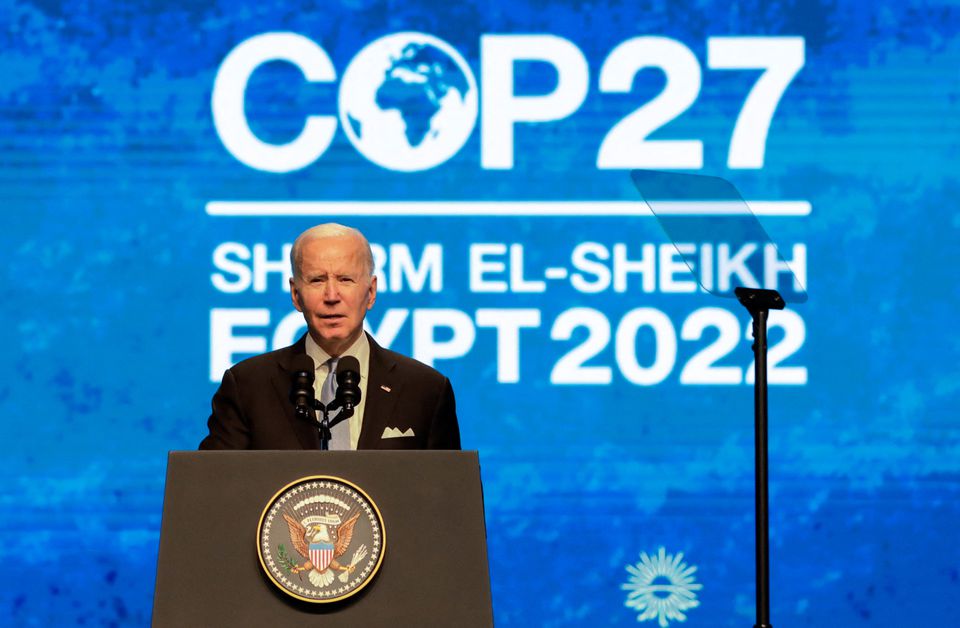
US President Joe Biden addressed the conference on Friday.  With the nuclear codes in one pocket and a first use of nuclear weapons policy in the other, Biden still had the audacity to suggest that the US was showing leadership on the question of climate change, stating,

“Countries that are in a position to help should be supporting developing countries so they can make decisive climate decisions, facilitating their energy transitions, building a path to prosperity compatible with our climate imperative.”

All of which is very well but ironic coming from the world’s most highly armed nuclear state and the world’s biggest exporter of weapons to anti-democratic forces and regimes worldwide.  As far as saving the planet goes Biden’s words ring hollow.

The climate change process will only succeed with international co-operation but while resources are in the hands of profit hungry energy corporations the desire to make more money and avoid regulation will win out.  Under capitalism the existential threat to profit still overrides the existential threat to the planet. 

Only a revolutionary shift in thinking and economic systems can bring about the necessary changes. Until the world’s energy resources can be planned and investment in renewables agreed on a co-operative, socialist basis the dangers continually raised at COP gatherings will persist and the time for effective climate action will continue to get shorter.   

Unity, solidarity, internationalism

5th November 2022

A victory for Lula in Brazil – resistance is possible

Capitalism has always sold itself to the public as being a system based upon democracy.  In spite of the vast differences in wealth between the rich and the poor; the huge gulf in life opportunities; the systemic prejudices which working class people, ethnic minorities, women and others have to deal with; in spite of these things, capitalism is heralded by its apologists as the apogee of democracy.

The basis of this claim is that there are regular elections.  Voters have the chance to change the party or President in office and return an alternative. The models across capitalist states vary.  The British state has an unelected Head, in the form of King Charles III, who occupies that position across 14 Commonwealth countries.

The United States and France have Presidential systems with degrees of power federated to States or Departments.  Germany has a President as Head of State but the real power lies with the Chancellor, usually the leader of the biggest party in the Parliament following an election and, in most cases, coalition negotiations.  The system in Italy is similar.

Whichever version of ‘democracy’ capitalist states adopt, the underlying principle is that the system itself must not change or be challenged.  The fact that there are elections gives the illusion of choice and possible change, so long as the edifice of capital itself is not challenged.

Any challenge from the Left is routinely dealt with by a mobilisation of state media to vilify or even criminalise leaders.  The experience of Lula da Silva in Brazil, jailed for trumped up corruption charges, is one example.  The anti-Semitism smear campaign launched against former Labour leader, Jeremy Corbyn, is another.

The prospect of the threat of disinvestment, a run on the banks and general economic chaos, is usually part of the armoury of the political establishment, seeking to head off any threat to their wealth and privilege.

The return to the Presidency of Lula da Silva in Brazil is a major step forward for the Left, consistent with much of Latin America, but outgoing President Jair Bolsonaro was slow to concede defeat and his supporters have continued to protest against the result.   The forces behind Bolsonaro will no doubt be threatened by Lula’s pledge to end deforestation in the Amazon as well as shifting the emphasis of state policy towards helping the poor.

The forces of the Left, the poor and the dispossessed in Brazil will need to be highly organised to resist the inevitable challenges there will be to Lula’s return to the Presidency.  The fact that Lula clearly won the election for the Presidency will not prevent the right wing from questioning his authority or seeking to overturn the result.

Other recent and up and coming elections challenge the claim of capitalism to be democratic in different ways.  The neo-fascist Brothers of Italy polled the highest number of votes in recent Italian elections and, in coalition with the Forza Italia party of discredited playboy, Silvio Berlusconi, and the right wing League, now boast Italy’s Prime Minister in the form of Giorgia Meloni. 

Meloni is an open admirer of former fascist dictator, Benito Mussolini, and her presence will strengthen a growing right wing bloc within the European Union.  Meloni’s right wing agenda will do nothing to help Italy’s working class as well as actively pursuing an agenda which puts in question LGBT rights, abortion rights and immigration policies.   Meloni was a protégé of Republican strategist and Donald Trump ally, Steve Bannon, who headlined her party conferences in Italy before the Covid-19 pandemic.  Meloni may have won an election but can her rise to the top in Italian politics really be seen as a victory for democracy?

Similar questions arise from the return to the Premiership of Benjamin Netanyahu in Israel where recent elections have put a right wing bloc in power.  The grouping includes Religious Zionism, the third biggest party in the Knesset.  Its leaders, Itamar Ben-Gvir and Bezalel Smotrich, are known for their anti-Arab rhetoric. The former has called for the deportation of citizens deemed “disloyal”, while the latter has called for Arab political parties to be outlawed.  

Netanyahu himself has never taken a progressive line on the question of Palestine but the inclusion of Religious Zionism in the new government will not only alarm many left-wing and centrist Israelis, but also Israeli Arabs, who make up a fifth of the population.   That it will add to already tense relationships with the Palestinian Authority, due to Israel’s illegal occupation and settlement programme, is an understatement.  Once again, an election victory, but a step forward for democracy?

The up and coming mid-term elections in in the United States will take place in the shadow of the attempted coup by Donald Trump supporters in January 2020.  The Make America Great Again movement is still alive and is given ‘intellectual’ cover through the right wing America First Policy Institute (AFPI) think tank.  In their own words AFPI priorities include “finish the wall, deliver peace through strength, make America energy independent, make it easy to vote and hard to cheat, fighting government corruption by draining the swamp.”   The AFPI claim to have put ‘boots on the ground’ in 32 US states in advance of the mid-term elections in order to pursue its right wing agenda.

The right wing surge in the US is also characterised by the movement to ‘take America back for God’, a coalition of Christian nationalists, explicitly endorsed by Trump and, unsurprisingly, pursuing a similar right wing agenda.   Victory for the Republicans in the mid-term, or worse still 2024 presidential elections, will see the US move even further to the right.  The threat to workers and minorities rights will be significant, the threat to world peace will increase dramatically.  Elections will ostensibly be the route to power but will this improve democracy?

These are not places which capitalism has not already visited, with tragic consequences.  The rise of the Axis powers of Germany, Italy and Japan culminated in World War 2 when these creatures of the most reactionary elements of international capital slipped the leash.  Capitalism is not adverse to toying with, or openly endorsing fascism, if it will serve its short term purpose.

That may involve using the path of elections to give a veneer of democracy.  It may result in the more open use of force to assert its power against the challenge of the people.  The Palestinians know this.  Black and ethnic minority communities and migrants to the US know this.  The migrants fleeing NATO sponsored wars to what they assume will be a safe haven in Europe know this.

Working class unity, solidarity and true internationalism of the people, not the phoney internationalism of the EU leaders and others, is the route to overcoming such outcomes.  Building that unity, solidarity and internationalism is one of the most pressing tasks of the Left if a shift to the Right is to be resisted and ultimately defeated.

Stormy waters

29th October 2022

Sunak – the Tories’ latest hope to save the sinking ship

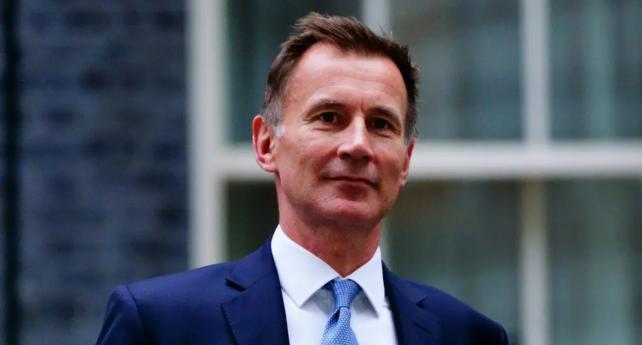
A week may well be a long time in politics but two weeks is not long enough in which to fix a broken economic system.  The decision of Chancellor, Jeremy Hunt, with the backing of Prime Minister, Rishi Sunak, to delay the Autumn Budget statement from 31st October until 17th November smacks of desperation.

They claim that the economic indicators will look more favourable then.  That markets will have settled following the ‘good news’ of Sunak’s ascension to the Premiership.  That the Office for Budget Responsibility (OBR) will be able to make a more informed assessment of the economic future.

All of which is simply so must smoke and mirrors, characteristic of capitalist economics.  The British economy has been unravelling due to a lack of strategic investment since the late 1970’s, a trend which has accelerated since the financial crash of 2008, since when the levels of productivity in the British economy have declined year on year.

While the gambling dens of the City of London have sucked the British economy into a false sense of reliance upon financial services and trading, the manufacturing base has either been closed down or sold off to overseas buyers, keen to take advantage of the capital friendly regime successive British governments have encouraged.

The current crisis is blamed, by the Tories, upon the war in Ukraine and the mistakes made by overnight Premier, Liz Truss, in her mini-budget of 23rd September.  Labour routinely add Brexit to this list, not to criticise the Tories mishandling of the exit from the EU, but to suggest that leaving the monetarist straitjacket of the EU was, in itself a mistake.

All of which feeds the illusion that with some adjustments or a different set of policies, or even by re-joining the EU, that the system can in some way shape or form be ’fixed’.  The ruling class, as part of their response to the crisis, need to feed this illusion or the reality that the crisis is in fact a systemic one may gain sufficient prominence to pose a threat.  This was a strain of public realisation which Labour touched upon under the leadership of Jeremy Corbyn, hence the need for it to be ruthlessly crushed.

It is a strain which is resurfacing in the wave of strikes and strike ballots amongst workers demanding, not only wage rises to keep pace with inflation, but the maintenance of safe working conditions for themselves and the public. 

These demands contrast sharply with the announcement of profits by energy giants such as Shell, reporting a record $30 billion profit in the year so far, and Exxon Mobil posting a quarterly profit of nearly $20bn.  Shell has paid no windfall tax on the profit by exploiting a loophole which exempts companies that invest their surplus in increasing oil and gas extraction.

Clearly such investment will be with a view to increasing profits further.  It will not contribute to the net carbon zero commitments of the government, a target of 100% clean energy by 2035, or do anything to support the necessary investment in renewable energy sources.   The fact that multi billion dollar profiteering companies can get away with dodging tax, while contributing to the destruction of the planet, at a time when those responsible for rail, NHS, mail and other services struggle to get a decent pay rise, is not lost on the general public.

This level of hypocrisy is characteristic of the Tories in particular but is symptomatic of a system which has the defence of the banks, corporations and aristocracy as its raison d’etre.  There is no doubt that the Tories have sailed the economy into stormy waters but however Hunt and Sunak choose to reshuffle the deck chairs in two weeks time, there is no avoiding the fact that, with them at the helm, the ship is sinking.

Resistance must continue to build to expose Tory lies, Tory hypocrisy and Tory economic mismanagement.  Arresting the economic decline which has been the hallmark of the Tories over the past 12 years by investing for the public good, both in people and infrastructure, will only be the first step.  A revolutionary reshaping of political, economic and environmental priorities is required to begin to turn around the damage done by capitalism.

It is not only desirable, it is possible, with collective action, a socialist programme, with mass popular backing, and the will to succeed.  That message must be the one that is repeated to force Labour off the fence.  It is vital that we continue to apply pressure for a manifesto which is not primarily aimed at assuaging the markets but is aimed at challenging the immediate inequalities in the system, which a view to overhauling it entirely.  A manifesto for the many, not the few.

Anything to please the markets?

22nd October 2022

Kier Starmer – pleasing the markets not enough

The chaos in British ruling circles took another turn towards pantomime this week, with Liz Truss emerging from under her desk to resign as Prime Minister and the will he, won’t he speculation about the possible return of Boris Johnson.  The fact that Johnson’s last stint ended ignominiously and that he is still under investigation for misleading Parliament, barely seems to be touching the radar.   Add to that his mishandling of the pandemic, presiding over the highest death rate from COVID 19 in Europe, and any rational person would not rate his chances highly.

However, Tory MPs and the membership at large, if 160,000 members can be described as large, do not do rational.  Otherwise, why elect Johnson in the first place?  Why go on to elect Liz Truss as his replacement?  Why even contemplate Johnson’s return?

The main driving force for Tory MPs is to retain their seats in Parliament.  They will not vote according to anything resembling conscience or principle, anathema to Tory MPs anyway, but purely out of self interest.  With a General Election little more than two years away the Parliamentary Conservative Party will be looking to the candidate who can best please the markets, the real power behind the British economy, and who can best translate the current mess into a recovery narrative which can be sold to the British public, in the face of the ongoing economic crisis.

Johnson has won elections before, many will think he can win them again.

Other hats are likely to be in the ring, with Penny Mordaunt and Rishi Sunak being the main potential contenders, alongside a possible return for Johnson.  Whatever the uncertainties currently swirling around the party of the ruling class there are some certainties which the majority of the country can be sure will take centre stage.

The crisis in social care continues to deepen, with a shortage of 300,000 staff nationally and hospital beds taken up with many who are medically fit but cannot leave, due to the lack of availability of care packages.  The squeeze on public spending is set to continue which will mean little respite for the NHS in real terms and none for local government, traditionally at the sharp end of Tory spending cuts. 

Between 2010 and 2020 councils did most of the heavy lifting in terms of public sector cuts with a £15 billion real terms reduction in their budgets.  The Local Government Association (LGA) estimate that,

“Spiralling inflation, increases to the National Living Wage and higher energy costs have added at least £2.4 billion in extra costs onto the budgets councils set in March this year. Since then, inflation has risen further.”

The LGA go on to point out that, if nothing changes, “councils are facing a funding gap of £3.4 billion in 2023/24 and £4.5 billion in 2024/25.”

Massive figures for sure but how do they translate in terms of real services to communities?  The day to day work of emptying bins; filling pot holes in roads; providing arts, library and sports facilities; addressing social care for adults and children; and tackling homelessness, all become threatened once more.

Chancellor Jeremy Hunt, the last roll of the dice by Liz Truss, has already indicated that public spending cuts are coming.  Whether or not Hunt survives in the Treasury makes no difference.  The Tories are not going to tax the rich, nationalise the energy sector, railways or mail services to make them more efficient, or impose any constraints on the gambling activities of the City of London.  They are not even going to cut the basic rate of income tax by 1p!

While inflation ramps up to 10.1% and energy bills soar for the winter, there can be little doubt that for many people who leads the Tory Party and, for that matter, who is Prime Minister is nothing more than a sideshow.  The party of the rich, for the rich, run by the rich, will continue to do what it must to keep the rich in their positions of privilege, while the majority struggle to make ends meet.

Calls for a General Election are growing but it is hard to see why the Tories would concede this, unless they are set on political suicide, based upon current poll ratings.  That can only mean that mass extra parliamentary action is more important than ever, to support the growing wave of strike action against meagre pay offers, to resist the looming cuts in public services, and to pressurise the Labour Party into taking a more radical stand in defence of the working class.

As things stand the manifesto of Labour going into a General Election could be summed up in one line, ‘Anything to please the markets’.  When it comes to the crunch that will not be good enough.  What is needed for the benefit of the working class is not pleasing the markets but radical action to transform the economy towards investment in health, homes, schools and jobs. 

It will mean ditching the wasteful spending on Trident submarines and redirecting that money into socially useful investment, creating more jobs than nuclear submarines or warheads ever could.   Doctors, dentists and decent homes over weapons of mass destruction; a better starting point than ‘anything to please the markets.’

Theatre of the absurd

14th October 2022

Another one bites the dust – sacked Chancellor, Kwasi Kwarteng heads for the backbenches

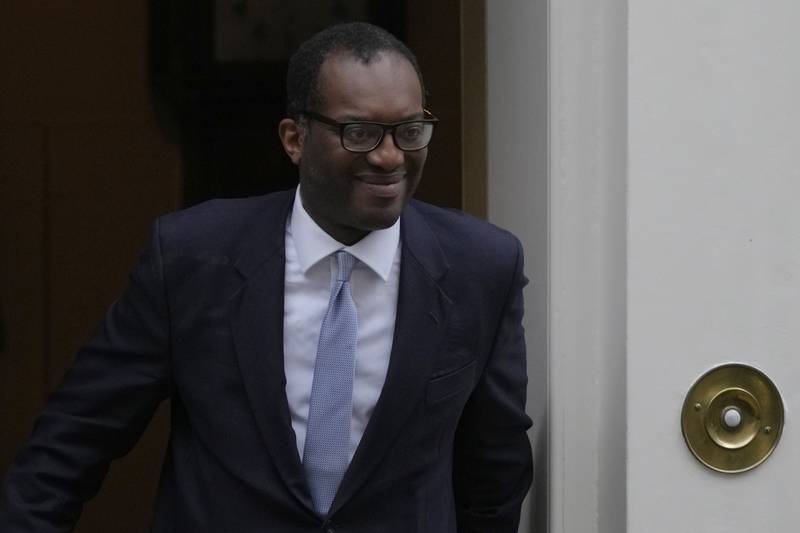
Political satirists will be joining the ranks of the unemployed this weekend as the Conservative Party leaps clear of the scope for parody and lands firmly in the realm of the absurd.  The sacking of Chancellor Kwasi Kwarteng, less than a month after his widely derided mini-budget, was only trumped by the appointment of failed leadership candidate Jeremy Hunt to fill his position at the Treasury.

While the Daily Telegraph today went with the headline ‘Kwarteng: I’m going nowhere’ the erstwhile Chancellor was already on a plane back to London this morning, cutting short discussions with the IMF in Washington aimed at reassuring them that everything in the British economy was under control!

No episode of Yes Minister could possibly match it and even The Thick of It would probably see the script rejected.  The Have I Got News for You panellists will be hard pressed to mock what is already the biggest mockery in British government for a century.

The main question in Westminster circles at present is ‘how long can Liz Truss hold onto her job?’  In a brief press conference this afternoon Truss studiously avoided actually answering any of the questions put to her by journalists, while back pedalling on her previous commitment not to increase the rate of corporation tax from 19% to 25% of company profits.  In response to questions as to whether she should stay on as Prime Minister Truss stated that she is “determined to see through what I promised.”

The rationale for the latest u-turn on the mini-budget, according to Truss, is not that any of the proposals were wrong, just that they went “faster and further” than markets expected and they were therefore unable to cope.  A clear signal that if Truss stays in No. 10 for any length of time the reduction in the 45p top rate of tax and the cut in the corporation tax rate will be back on the agenda.

Pressed at Prime Minister’s Questions this week as to whether her economic plans included cuts in public spending Truss stated “absolutely not”, though given the track record of the Tories in general and that of Truss and u-turns in particular, such an assurance must surely be taken with a pinch of salt.   This is reinforced by the assessment of the Institute for Fiscal Studies, that the government would have to cut spending or raise taxes by £62billion in order to stabilise or reduce the national debt as they have promised.

Jeremy Hunt, having been defeated in one leadership contest by Boris Johnson, stood briefly in this year’s contest.  Though he failed to make any impact, one of his key pledges was to slash the rate of corporation tax. So, if his stint as Chancellor has any longevity that policy looks like a certainty for resurrection.

Truss backers have been quick out of the blocks to lay the blame for the economic crisis anywhere but with the Prime Minister.  The Bank of England has been accused of being too slow to act while Business Secretary, Jacob Rees-Mogg, turned his fire on the Office for Budget Responsibility (OBR), suggesting that “its record of forecasting accurately hasn’t been enormously good” and that gloomy forecasts of low growth and rising debt should be ignored.

This is all very well for Rees-Mogg, with a personal fortune running into millions, but there are those for whom rising debt has a real life impact upon their ability to pay the rent, feed the kids, buy fuel or pay the soaring energy bills, only partially offset by government action, whatever Liz Truss may say.

The detachment of the Tories from reality is evident now on a daily basis as the opposition to the failures endemic to capitalism continues to grow.  Strike action and ballots for industrial action continue to proliferate, with even the historically moderate Royal College of Nursing joining the fray.

Kier Starmer and his Chancellor in waiting, Rachel Reeves, are sniping from the sidelines but are not offering solutions which will get to the heart of the issue, that the system itself is broken and needs to be re-established on planned socialist lines, if it is to serve the needs of the many, not the few.

Until the Labour leadership grasp this they will continue to offer little more than sticking plasters over a gaping wound.  Though they will be unlikely to say so in public, many Tories could live with a Starmer government of this ilk, while they take stock and reorganise.  A real shift in the balance of power will only come when pressure upon the Labour Party comes from mass extra parliamentary action and the demand for fundamental change becomes impossible to ignore.

The capitalist crisis deepens

8th October 2022

Calming the faithful? Liz Truss at Tory Party Conference.

The crisis of British capitalism, which became manifest with the banking crisis of 2008, continues to play out its latest act with the debacle of the Liz Truss premiership.  The British ruling class has been divided in its response to the crisis for the past fourteen years and continues to struggle to find the best fit to maintain its power and privilege.

The David Cameron/George Osborne years of enforced austerity continued the drive to reduce spending on public services, in order to enrich further the already wealthy, but foundered on the question of Brexit.  The more mainstream sections of the capitalist class recognised the benefits of continuing with the European Union’s public spending straitjacket and the free movement of cheap labour.  A more jingoistic section of the ruling class saw exit from the EU as the chance to play up old tropes about immigration, empire and national identity to pursue their own chauvinistic agenda.

Neither saw coming the ground shaking impact of the change in Labour Party direction under the leadership of Jeremy Corbyn, which tapped into popular disaffection with the outcomes of both Tory austerity programmes and EU ineffectiveness to provide anything for the British working class.

With the pro-Brexit Tories in the ascendant, seeing off the Corbyn challenge was essential if a progressive Labour government, unchained from the monetarist constraints of the EU was not to be let loose.  A combination of disinformation, character assassination of Corbyn and promotion of the blokey populism of Boris Johnson, contrasting with the robotic Theresa May, were the weapons of choice. 

Success for Johnson in 2019 appeared to buy time but the incompetence of Johnson personally, and his administration in general, led to a crisis of confidence in Johnson’s ability to keep the Tory ship afloat.  The leadership election marathon of 2022 ensued with Liz Truss emerging as the candidate of the political wing of the ruling class, though elected by a marginal demographic on a small percentage of the vote.   

The first weeks of the Truss premiership suggest that her backing falls well short of unanimity in Parliament, with the Tory rank and file and certainly with the British public.  The mini-budget debacle has been rapidly followed by the u-turn on the 45p top rate of tax proposal, which Truss openly blamed on Chancellor Kwasi Kwarteng in a BBC interview, failing even to show solidarity with her closest ally!

The go for growth agenda which Truss and Kwarteng, at least for the moment, appear to agree upon, has been met with a sinking pound, emergency action to shore up pensions by the Bank of England and an unprecedented wave of strike action in response to rampant inflation and rising interest rates.  Truss has even sunk to the level of inventing the ‘anti-growth coalition’ which for her includes anyone who disagrees with the economic strategy she and Kwarteng are following.

The ‘cost of living crisis’ may be the phrase making the news and media headlines but the reality is that the crisis is one of capitalism and part of its ongoing decline as a political, economic and social system.  Failing to tax the rich, the Truss government’s only recourse to fund the so-called growth programme will be to double down on public expenditure and continue to punish the poor by cutting back on public services.

The growth plan announced by Kwasi Kwarteng makes no mention of the farrago of ‘levelling up’ but instead dangles the carrot of Investment Zones.  These are basically a Tory trick to privatise areas previously under local government control, much in the way that the Development Corporations of the 1980’s, the response of the Tories at that time to ‘inner city crisis’, distorted local economies.    

Meanwhile recent research suggests that local councils are likely to be facing a financial black hole of £7.3bn by 2025/26.  This week it was revealed Kent County Council faces a budget gap of more than £50m by June, enough to wipe out 50% of its total reserves if not reduced.  An estimated 1 in 6 councils in England could run out of money as early as next year without further budget cuts or additional income.

Phillip Woolley, head of public services consulting at Grant Thornton UK LLP, said,

 “Our research shows, the additional Covid-19 funding – while critical to support immediate challenges – has not addressed underlying systemic issues or the precariousness of councils’ financial sustainability in the face of economic instability.  Local authorities are also now facing the risk of interest rate rises increasing debt financing costs and the real risk of reduced funding from central government, in response to the current economic turmoil facing the country.”

Wakefield Council has taken steps to close its County Hall building to save on energy costs and is considering its options for further building closures to keep costs down.  It is unlikely to be the only council contemplating such measures in an attempt to preserve essential services for the most vulnerable.

However the ruling class twist, turn or shuffle the personalities in 10, Downing St installed to do their bidding, there is no getting away from the reality that, for the majority, capitalism is a moribund system that not only fails to meet their needs but makes them pay the price for the crises arising from its contradictions.  If ever there was a time to build the call for a fundamental change in favour of a socialist alternative, that time is now.

Iran Erupts

30th September 2022

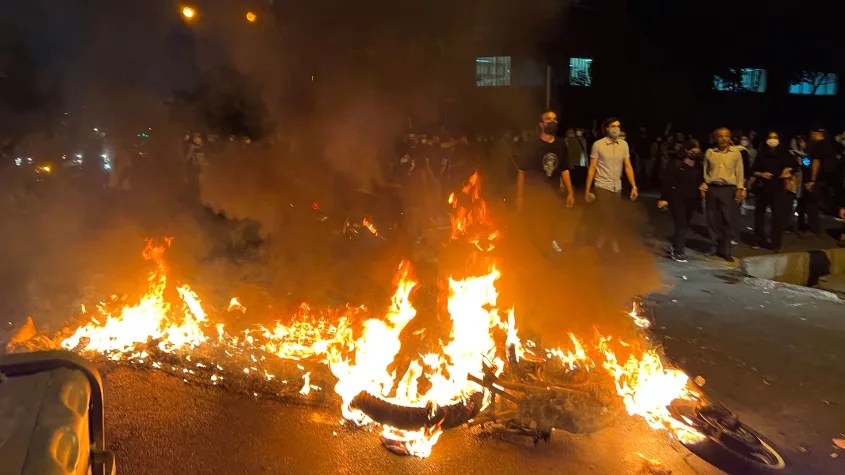
Iran in flames following the death in detention of Mahsa Amini

As protests grow across Iran following the murder in detention of 22 year old, Mahsa Amini, solidarity with the Iranian people is now more important than ever. 

The grip of the theocratic dictatorship which has been in place in Iran since the early 1980’s has been tested several times but none more so than in recent weeks, following the death in custody of Mahsa Amini, for allegedly not following oppressive hijab rules.

Protests are taking place across all regions in Iran.  Demonstrations of opposition to the regime have extended beyond the major cities and into the traditionally more conservative small towns and countryside areas.  The degree of fury outstrips that expressed following the rigged election of 2009 which handed the hardline Mahmoud Ahmadinejad the presidency and spawned the Green Movement.

Recent protests have also surpassed those seen in November 2019, when a unilateral hike in fuel prices triggered angry scenes, leading to over 600 deaths and more than 7,000 arrests as the brutal security forces of the Islamic regime responded with force. The response to the death of Amini by the women of Iran harks back to the protests in 2017 when videos of women burning the hijab as a symbol of oppression were posted across social media, leading to further recriminations from the regime.

These incidents form a pattern of discontent and disillusionment with the leadership of the Islamic Republic, which has been simmering for some time, but can struggle to find expression through any normal democratic or media channels.  Candidates for election to the Iranian Parliament are strictly vetted by the regime, as are presidential candidates.  Trade union activity remains underground and illegal in Iran.  The visual and print media are largely state controlled.  Even social media and internet access can be restricted through government intervention, as has been seen in recent weeks.

However, recent events have seen the omnipresence of the regime challenged as protesters find new ways around media restrictions and the means to co-ordinate protest actions.

The accumulation of pressure upon the regime is also a result of forty years of human rights abuses, which has seen the arrest and execution of opposition political leaders; the imprisonment of trade union activists; the arrest and harassment of women protesters and student activists; and the use of lethal force against those taking to the streets in opposition to the regime.

Much of the recent outcry against the government in Iran has focussed upon corruption, as the regime’s leaders and members of the Islamic Revolutionary Guards Corps (IRGC) continue to fatten their bank accounts while increasing numbers of Iranians face unemployment and poverty.  Ongoing sanctions imposed by the Western powers to restrict Iran’s ability to manufacture weapons grade uranium also exacerbate the economic crisis.  Iran’s leaders continue to claim that its nuclear programme is for purely civilian purposes.

The death of Mahsa Amini has tapped into a deep well of resentment felt by the women of Iran who are increasingly frustrated by the restrictions imposed upon their economic and social activity by the regime and the lack of protection from domestic abuse.

Iran’s mandatory hijab law, which has been in place since 1981 has been enforced through the so called ‘morality police’, a practice which has been challenged by many Iranian women.  In recent years protests have escalated with some women appearing in public without the required head scarf and loose robe.  Ms. Amini’s family, it must be said, dispute that their daughter was even breaking these rules.

Since 2017, when dozens of women publicly took off their headscarves in a wave of protests, the authorities adopted tougher measures.  With the election of hardline President Ebrahim Raisi in 2021 enforcement has increased even further and the attitude of the regime towards women in public has become more repressive.

Protests across Iran in the past weeks have seen 70 reported deaths and widespread arrests.  The death of Mahsa Amini, and the repressive attitude of the regime towards women, has been the trigger but the slogans being shouted on the streets of Iran are calling for regime change and an end to the theocratic dictatorship of the Islamic clergy.    

Such sentiments are ones which have driven the campaigning of the Committee for the Defence of the Iranian People’s Rights (CODIR) for nearly 40 years and it is now more vital than ever that the Labour and trade union movement in Britain shows solidarity with the people of Iran in their struggle against dictatorship.

It is also vital that the call for regime change in Iran is a call for the people of Iran to lead and determine that change.  The United States, Israel and Saudi Arabia have all, individually and collectively, expressed their desire to see the end of the Islamic Republic and the threat of external intervention has been a very real one for many years.

However, such an approach has resulted in catastrophe in Iraq, Libya, Syria and Afghanistan and will be of no benefit to the people of Iran or the wider Middle East.  Solidarity with the Iranian people should be just that, with the people of Iran having the opportunity to determine a future based upon peace, democracy and human rights.

For more information go to www.codir.net

Deluge of opposition to trickle down economics

24th September 2022

Chancellor Kwasi Kwarteng – budgeting for the rich

Casino economics has been a key feature of capitalism since the late twentieth century.  The idea that rewarding the rich would result in the ‘trickle down’ of wealth to the poor was a theory beloved of US President, Ronald Reagan, and British Prime Minister, Margaret Thatcher, in the 1980’s.  It is stating the obvious to point out that poverty in the US and Britain has not been alleviated as a consequence and that while the poor continue to grow in number, so too do the numbers and wealth of billionaires.   

The logical outcome of this economic model was the 2008 financial crash, which precipitated over a decade of austerity and the working class being forced to pay for the bankers gambling debts.  In spite of this, the trickle down theorists suggest that liberating constraints on business and the wealthy will generate economic growth and job creation, in which we will all be able to share.  The creation of jobs is a worthy objective, with which no one can argue, but those in the gig economy, on zero hours contracts or working at rates below the living wage may feel that not enough of that wealth has trickled in their direction.

The best guarantee of sustaining jobs with decent rates of pay is through trade union organisation at the workplace, yet the trickle down theorists do not seem to agree.  While casino economics and deregulation are seen to be good for the bankers and corporations in the City of London, for example, this inevitably goes hand in hand with tighter regulation and constraint upon trade union activity, in an attempt to subvert workers accessing more of that trickling down wealth.

Prime Minister, Liz Truss, and her new Chancellor, Kwasi Kwarteng, are card carrying casino economists of the worst type, determined to enrich the wealthy and keep the poor in their place.  The so-called mini-budget unveiled on Friday aims to do just that.

Even just calling it a mini-budget is a sleight of hand.  An actual budget has to be scrutinised by the Office for Budget Responsibility and some assessment, independent of the government, made of its impact.  The ‘fiscal event’, as the mini-budget has been described, does not require even this level of scrutiny.  If Truss and Kwarteng were hoping to gain anything by this the plan has backfired as budget analysis fills the print media and the airwaves.  

There are many headlines associated with the budget.  The 45% tax rate for those earning over £150,000 a year is to be abolished.  Income tax rates for all (who earn enough to pay them) will be cut from 20% to 19% from April 2023.  The cap on bankers’ bonuses will be scrapped.  Corporation tax will remain at 19% rather than increasing to 25% as previously planned.  The 1.25% increase in National Insurance, introduced to help fund social care, will be cancelled from 6th November.  More stringent regulation on when trade unions can call out members on strike will be introduced.

The net effect of these measures, according to the Resolution Foundation think tank, is that the lowest income households will save £22.12 per year, while the richest households will benefit by an extra £9,187 a year.   For anyone earning over £1m the effect of the combined measures will be to net them an extra £55,220 per year.  Perhaps they will use some of that wealth to help pay the energy bills of those gaining little more than twenty quid? Perhaps not.

The trickle down theorists assert that companies paying less in corporation tax will use that money to invest in growing their business.  Evidence suggest that it is likely to result in bigger dividends for shareholders, further increasing the wealth of those at the top.

Speaking about the creation of 40 investment zones, with tax breaks for businesses and ‘relaxed’ planning regulations, Kwasi Kwarteng asserted,

“If we really want to level up, we have to unleash the power of the private sector.”

Of course, Kwarteng and his cohorts have no desire at all to ‘level up’ and the unleashed ‘power of the private sector’ led to the 2008 financial crash.  Investment zones in whatever guise have no great track record of success in terms of sustained job creation and have often led to local infrastructure crises as they are outside of the control of local planning authorities.

Casino economists like Truss and Kwarteng fail to recognise that the real engine of economic growth is public sector investment.  Modernising schools, hospitals, making homes more energy efficient, expanding the digital infrastructure, building council houses, expanding the electric vehicle charging network, would all create jobs and boost growth.  Going further, the nationalisation of key sectors such as energy, mail and transport would give more control over capital investment and bring consumer benefits. 

Even these steps are possible within the constraints of a capitalist economic model and, with the right political leadership, could be the first steps on the road towards a fully fledged socialist economy.  They are the very least the Labour Party should be arguing for in response to the mini-budget and in the lead up to the next General Election.  Opposition to the mini-budget and the new government should not be confined to a trickle, it should be a deluge.

Class struggle still the key

17th September 2022

Not my King – anti Monarchy protesters in Edinburgh

As the state media frenzy surrounding the death of Queen Elizabeth II builds to its conclusion with her funeral on Monday, a salutary reminder of the realities of life for many of the new King’s subjects has been delivered in a report by the Living Wage Foundation.

In a poll of 2,000 workers earning less than the real living wage of £9.90 per hour, 78% said that this was the worst financial period they had ever faced.  More than a fifth (21%) said that they had no disposable income after paying out for essentials such as rent and food.  Over half had used a food bank in the past year and over 40% had skipped meals as they could not afford them.

According to the Resolution Foundation thinktank nearly 5 million British workers earn less than the real living wage.  With the cost of living crisis only set to get even more severe there is every likelihood that many will join them in sinking into poverty and desperation.  With inflation still at 9.9% according to latest figures there is little on the horizon to mitigate the threat to Britain’s poorest families.  The energy cap announced by Prime Minister Liz Truss, at £2,500 a year, is still higher than the current £1,900 and twice as high as bills were this time last year.

Meanwhile, newly appointed Chancellor of the Exchequer, Kwasi Kwarteng, has moved quickly to endear himself to the bankers and the City of London by suggesting that the cap on banker’s bonuses, put in place after the 2008 financial crash, may be lifted.  Kwarteng argues that the cap restricts the recruitment of the best talent into the City of London, failing to acknowledge that it was the risk taking gambling of such ‘talent’ that brought about the financial crash and heralded over a decade of austerity in the first place!

Still, the Tories are nothing if not consistent in defence of the privileges of the class they are bankrolled to support.  With a mini-budget earmarked for the 23rd September it will be interesting to see how Kwarteng proposes to address the pain and poverty 12 years of Tory government have brought to the British working class.  Little if anything is expected for the poor, while further tax cuts for the rich are already being trailed.

The pound is currently trading against the dollar at its lowest rate for 37 years.  Given uncertainties around energy costs and the war in Ukraine, investors are defaulting to the world’s main reserve currency to protect their assets.  The US Federal Reserve decision to push up interest rates also makes the dollar more attractive to the international money market gamblers, as higher rates mean a better return.  The fall in the pounds value may make British exports cheaper but also makes imports dearer, adding to the pressure on inflation.

The drop in consumer spending last month, both in shops and online, is largely a result of consumer anxiety about inflation and higher costs, including rising energy bills.

Nevertheless, the BBC in particular continues to feed the world a rich diet of revelry in the social progress made during the reign of Queen Elizabeth II.  Such progress as there has been in the past 70 years however is in spite of, not because of the Monarchy, which has never played any part in advancing life for the working class.

The establishment of the NHS, initially opposed by the Tories; the post war nationalisation of key industries; the establishment of comprehensive education; the building of affordable Council housing; the achievement of legislation on Equal Pay and Sex Discrimination; none of these things were achieved as a consequence of the Monarchy.  By the same token the Monarchy has played no role in trying to defend such gains, as they have been swept aside by successive Tory governments.   On the contrary, the Monarchy has been more concerned with ensuring its own privileges are protected, such as the exemption on payment of inheritance tax for example.  

The reality is that social gains are made as a result of struggle by working class political, trade union and community organisations applying extra-parliamentary pressure upon the establishment.  Once the manufactured suspension of everyday reality created by the period of so called National Mourning is over, that struggle will continue.  No amount of fake bonhomie on the part of the Royal Family, as the figureheads of the British ruling class, will change that.

What must change are the terms on which the struggle in Britain is conducted.  It is not about regional disparities as the apologists for levelling up suggest.  It is not about national disparities as the Scottish Nationalists and Plaid Cymru insist, other than in the north of Ireland, where the six counties should become part of the Republic of Ireland.  It remains always and everywhere about class distinctions, class disparities and class struggle.

The outpouring of emotion from some sections of the population over the death of Queen Elizabeth II does not change the fact that the Monarchy is an embedded part of the ruling class.  In the 21st century the Monarchy is, like capitalism itself, an anachronism which serves no purpose other than to perpetuate the privileges of the few over the rights of the many.  The struggle to change that does not stop with the death of a Monarch.

Monarchy, media and manipulation

10th September 2022

The Queen is Dead – crowds outside Buckingham Palace

If the Monarchy was an anachronism following its restoration in 1660, over three hundred and fifty years ago, it certainly is now, well into the first quarter of the twenty first century.  Yet for the British ruling class the institution remains central to its grip on power, both through its actual constitutional role and its carefully stage managed narrative, designed to play to an audience brought up with mass media, functioning as a soap opera for the nation.

The Monarch is not only the unelected Head of State but also the Head of the Church of England.  As Head of the Commonwealth, the Monarch is also Head of State in fourteen other nations, including Canada, Australia and New Zealand.  All of this without a single vote being cast as to who should take on the role. 

The term of office is for life and you get the job by being the first born of the previous title holder.  If such a system were to have been instituted in the former Soviet Union, or in present day China, the outcry across the BBC and British media would have been deafening, with demands for democracy and denunciations of dictatorship ringing across the airwaves.

Apologists for the Monarchy will say that Britain is different, a constitutional monarch does not wield real power, the role is symbolic, it is a representation of national unity.  Still, every Act of Parliament must receive Royal Assent.  The Leader of the majority party in the House of Commons has to be granted permission by the Monarch to form a government or dissolve a Parliament.  The Queen’s Speech (soon to be King’s) outlines the parliamentary legislative programme.  The Prime Minister of the day has a weekly audience with the Monarch. Even the opposition in the House of Commons is Her (His) Majesty’s Loyal Opposition.

These protocols are so embedded within the British state that they are either taken for granted or are invisible to most of the population.  While they may not be direct levers of power they are certainly channels of influence, latent should there be a constitutional or political crisis.  There can be no doubt that in any revolutionary situation in Britain the Monarchy would not remain ‘above the fray’ and would do all it could to protect its power, privileges and influence on behalf of the class which it represents.

The public narrative around the Monarchy does not dwell on these things.  The drama of the Royal Family is played out in births, marriages, tragic deaths, inappropriate relationships and moments of national celebration, which feed not only the tabloid press but the BBC and other media in their presentation of the nation’s longest running soap opera.

Like all drama there are moments of comedy and tragedy, there are heroes and villains, there are cliffhanging moments, there are scenes of joy and scenes of sorrow. However, like all drama this is a careful construct, designed to manipulate the message in favour of the main players and sideline those who do not fit the narrative. Not everything can be controlled of course, not least the audience response, but the ramping up of the role of the Queen in particular in recent years has provided a focal point to the action and ensured her star billing.

The analogy may seem a little stretched for some but the Queen playing opposite James Bond actor Daniel Craig, in the 2012 London Olympic ceremony, and alongside Paddington Bear in the recent Platinum Jubilee commemorations are almost designed to hide the fiction of the Royal Family as drama in plain sight.

Death is always a heightened moment of drama and, after seventy years of careful management of the interests of the aristocracy and ruling class, the demise of Queen Elizabeth II, even at the age of 96, was always going to be greeted with shock.  The media frenzy, the carefully curated images of family grief, the vox pops of grieving members of the public outside Buckingham Place and Balmoral, the declaration of ten days of National Mourning, are all part of the stage management of the transition by the ruling class to maintain stability, provide the illusion of continuity and characterise any resistance to this as somehow unworthy or unpatriotic.

National strike action by rail and postal workers has been postponed in response to the prevailing mood, Premier League football suspended and radio stations reduced to playing ‘relaxed’ programmes, so as not to cause any outrage or offence. The House of Commons was, of course, ‘united in grief’.  Planning for proclamations, church services, lying in state and the State Funeral began in earnest, all under the umbrella of Operation London Bridge.

However, none of the ruling class propaganda in favour of the Monarchy, which is already engulfing the nation, will change the fundamental realities of life in Britain today.  Only 48 hours before her death the Queen approved a new Prime Minister, Liz Truss.   Top of the in tray for Truss was the energy crisis and the need for homes and businesses to get some relief from escalating energy costs.  The new Prime minister promised action.  What she actually delivered was an energy price cap of £2,500, almost double that of bills for the past year and no windfall tax upon the energy supply companies which are making such vast profits.

Instead, Truss has promised to meet the gap between the energy cap and what companies are paying on the international market, from the Treasury.  In effect this means company profits will not be affected but the national debt will increase and with it the percentage of the country’s GDP that the government must spend on debt interest repayments.  In effect less money for public services, the NHS and other essentials.  Add to this the commitment of Truss to increase military spending from 2% to 3% of GDP and it is already clear where the new Prime Minister’s priorities lie.

When the pomp and ceremony of the State Funeral has passed and the sheen of the new King has faded, the realities of hardship and struggle for the working class will continue to be faced this winter and beyond.  The death of the Queen may have broken the spell of the Monarchy for many.  The ruling class have lost a principal player and the understudy has proved to be a harder sell with the public.  The Monarchy will do everything necessary to change the storyline however, if that ensures its survival.

On the subject of survival, the only real interest of Liz Truss over the next two years is to save her premiership.  By the time of the next election the Tories will have been in office for fourteen years.  Their record of fourteen years of austerity and hardship should be indefensible.  The real national interest is not the changing of the leadership of the aristocracy, it is the changing of the system which gives rise to them in the first place. 

One step towards that change must be mass extra parliamentary action to press for a progressive Labour government, which will move Britain in a new direction, free from austerity for workers and handouts for the rich.  At its core should be the vision of moving towards a socialist republic.