Blog

Diverting attention from the debt crisis

4th June 2023

The US – counting on the dollar to stay supreme

In a week in which the world’s biggest economy almost tanked it is telling that the British media was more concerned with the transgressions of TV presenter, Phillip Schofield.  Both print and TV media in Britain have given more airtime and print space to the Schofield saga than the fact that the world economy almost came to collapse and that the prospect of such a calamity may only have been delayed, rather than averted entirely.

The issue has centred around the US economy sailing very close to its debt ceiling, the amount Congress has authorised America’s government to borrow in order to meet its basic obligations.  This includes a range of commitments, from providing medical insurance to paying military salaries. The current ceiling for gross debt is $31.4trn (117% of gdp).

The US House of Representatives did eventually vote to agree a deal reached by President Joe Biden and Speaker Kevin McCarthy to raise the amount America can borrow. Failure would have meant the country would have defaulted on debt payment obligations for the first time in its history.  The alternative would have seen interest rates soaring, stock and bond markets crashing and the global financial system being plunged into turmoil.

Given the trillions of dollars Congress has authorised the US government to spend over the last decade United States debt has nearly tripled since 2009.  The US has been running a deficit, meaning it spends that much more money than it receives in taxes and other revenue, of over £1 trillion every year since 2001, resulting in additional borrowing to finance payments Congress has authorised.

The debate in US political circles has focussed upon President Biden and senior Republicans in the House of Representatives negotiating an increase in the debt ceiling in exchange for reductions in federal spending.   Republican proposals centred upon imposing work requirements for some recipients of federal benefits, putting lasting caps on federal spending, and loosening rules for fossil fuel energy projects.

Economists Goldman Sachs estimated that a breach of the US debt ceiling would cause a reduction in about 10% of US economic activity.  Centre left US think tank, Third Way, calculate that a default could lead to the loss of 3 million jobs, push up interest rates, thus increasing mortgage payments, with higher interest rates also diverting future spend away from much-needed investments in such areas as infrastructure, education, and health care.

US Treasury Secretary, Janet Yellen, summed up the situation succinctly stating,

 “Failure to meet the government’s obligations would cause irreparable harm to the U.S. economy, the livelihoods of all Americans and global financial stability.”

The US dollar is the most commonly held reserve currency, making up more than 60 percent of global foreign exchange reserves, and the most widely used currency for international trade and other transactions around the world.  Given the status of the US dollar as the world’s reserve currency, many countries hold their foreign currency reserves in dollars, meaning any reduction in the value of the dollar has an international impact, making debt repayments more expensive.  Heavily indebted low income countries would struggle to repay their debts and therefore tip into default and political crisis.

As a consequence of US financial hegemony this is potentially disastrous.  The recent move of the BRICS (Brazil, Russia, India, China, South Africa) nations, towards a process of de-dollarisation, by creating an investment bank less dependent on the dollar, is a move in the right direction and could potentially loosen the stranglehold of the US over international finance systems.

That the world’s most powerful nation and strongest economy can be in such a mess is, in any event, a cause for concern.  The mantra of low taxation, free market economics and the small state, beloved of right wing neo-liberal economists is taken to its limits in the United States.  Any effort to expand the role of the state in supporting healthcare, the environment or those on welfare are pushed back by Republicans in particular but not resisted with vigour by leading Democrats.

It is unlikely to be coincidence that the downward pressure on public spending is accompanied by a recent decision of the US Supreme Court to effectively outlaw strike action. The 8-1 vote, in the right-wing-dominated US Supreme Court, has curbed the right of the nation’s workers to strike by allowing companies to sue unions in state courts whenever they wish for alleged “damage” strikers cause. Full details can be found here https://peoplesworld.org/article/in-historic-step-backward-the-supreme-court-limits-the-right-to-strike/?eType=EmailBlastContent&eId=46dc7349-f34f-4076-aa74-c1cec7e0d5e2

In addition, any productive investment by the state is inevitably drained by the massive spend on weapons of mass destruction, to maintain the US military budget at the highest level in the world and sustain its role as the self styled ‘global policeman’.

The predominance of the dollar in international trade also means that it can be weaponised by the US in the form of sanctions.  Almost all trade done in US dollars, even trade among other countries, can be subject to US sanctions, because they are handled by so-called correspondent banks with accounts at the US Federal Reserve.

By cutting off the ability to transact in dollars, the United States can make it difficult for those it discriminates against to do business. In 2015, the French bank BNP Paribas was given a record penalty of nearly $9 billion for violating US sanctions by processing dollar payments from Cuba, Iran, and Sudan.

For Cuba in particular, suffering under a US economic blockade which has lasted for over 60 years, this is a particular issue, as circuitous routes to make payments and trade internationally have to be constantly devised and end up being more costly for the Cuban economy.

The mantra that when the US sneezes the world catches a cold is a direct result of the economic stranglehold the US continues to exert across the globe.  The current US fear of China’s economic growth, manifest in US sabre rattling over the future of Taiwan, is that the US may lose its prime economic position and thereby find its political influence diluted.

Resorting to threats, bullying and military intervention are the direct consequences of US fears.  Any alternative to the US capitalist model, as presented by China or Cuba, is inevitably demonised and any achievements put down to fluke or good fortune, rather than the alternatives offered by a socialist orientated system.   Demonstrating that there is an alternative to capitalism is not what the British media is paid to promote or explain.  Far safer to keep everyone worried about the private life of Phillip Schofield.

Turning the tide of war

27th May 2023

The devastating impact of NATO’s proxy war in Ukraine

The propaganda war of the Western media in relation to Ukraine is now in full swing behind the much talked about Ukrainian counter-offensive to expel Russian troops.  Reporting across the BBC in particular on the prospects for the counter offensive has been confusing in many respects.  While the general tenor is one of support for the ‘plucky’ Ukrainians against the ‘land grabbing’ Russians, there is also a certain amount of hedging about the prospects.

A Ukrainian government official, speaking on condition of anonymity to the BBC, said the leaders in Ukraine “understood that they needed to be successful” but that the offensive should not be seen as a “silver bullet”.  The BBC has also simultaneously reported that Russian forces are demoralised but also resolute, fortifying their defences along the 900 mile long frontline.  At the same time BBC correspondent in Kyiv, Hugo Bachega, reports that,

 “The expected attack could be decisive in the war, redrawing frontlines that, for months have remained unchanged.”

Secretary of the National Security and Defence Council of Ukraine, Oleksiy Danilov, is currently predicting that the assault to retake territory could begin “tomorrow, the day after tomorrow or in a week.”

Given the extent of Russian defences it seems unlikely that any land offensive by the Ukrainians could make major gains without significant support from the air.  In this respect the decision of the British government to supply Storm Shadow cruise missiles, with a range of over 155 miles and adapted to be compatible with Ukraine’s existing aircraft, may be designed to provide that cover.

The NATO powers and their associated military industrial complex of arms suppliers are heavily invested in the war in Ukraine.  Whatever the outcome of the counter offensive it is a potential win-win for military hawks in the West.  Any failure will be used as justification for pouring more weapons into sustaining the Ukrainian position.  Any success will be heralded as justification of the strategy so far, the effectiveness of NATO weaponry and the need for ongoing support for Ukraine.

There can be no clearer example of the  mantra that those who want war send weapons, those who seek peace send diplomats.

In a recent news conference with US Secretary of State, Anthony Blinken, the British Foreign Secretary, James Cleverly, was quite explicit about the position taken by the British government with regard to Ukraine, stating,

“We need to continue to support them, irrespective of whether this forthcoming offensive generates huge gains on the battlefield, because until this conflict is resolved and resolved properly, it is not over.”

Secretary of State Blinken, as well as meeting the British Foreign Secretary, also met with his counterpart from Spain this week to shore up commitments to military aid to Ukraine, sending a message that battlefield gains are the priority.

In spite of the resistance of the West, China continues to play its part in offering to mediate a negotiated solution to the conflict, a proposal rejected out of hand by the US on the grounds that Beijing does not publicly condemn Russia as the aggressor in the war.

However, there are even differences within US circles as the position indicated by Blinken is not echoed by Gen. Mark A. Milley, the chairman of the Joint Chiefs of Staff, who has argued for the need for Ukraine and Russia to consider negotiations, suggesting that a prolonged war would result in many more casualties.

The position of Gen. Milley is reinforced by 15 former diplomats and military figures who took out a full page advert in the New York Times on 16th May, stating,

“The immediate cause of this disastrous war in Ukraine is Russia’s invasion.  Yet the plans and actions to expand NATO to Russia’s borders served to provoke Russian fears.  And Russian leaders made this point for 30 years.  A failure of diplomacy led to war.  Now diplomacy is urgently needed to end the Russia-Ukraine war before it destroys Ukraine and endangers humanity.”

In Britain, momentum in opposition to the war continues to be mobilised at a grass roots level, with the Stop the War Coalition holding public meetings in Glasgow, Leeds and Liverpool this week to argue the case for peace talks.

However, the official Labour Movement positions need to be continually challenged.  The Kier Starmer led front bench of the Labour Party has fallen into line with the Tory position of sending more weapons to Ukraine, while maintaining support for NATO.  The TUC recently reversed its long standing objection to raising military budgets and passed a motion agreeing to higher military spending.   Opinion at a local level is still divided and heavily influenced by the blanket pro-Ukraine positions taken by the media.

The class interests driving the war in Ukraine are not those of the working class of Russia or Ukraine, they are not those of the working class in the US, Britain or elsewhere in Europe.  The US autocracy remains fixed on its desire to have a unipolar world in which it is the strongest military power and can police across the globe.  Britain, with its current Global Britain policy and delusions of grandeur through its nuclear status, continues to hang onto US foreign policy coattails.  The EU continues to heavily back NATO membership and EU neoliberal economic influence in countries right up to Russia’s borders.

The ruling class across the US, NATO and EU blocs are only beneficiaries of the conflict being protracted if it does not slip over the edge into nuclear conflagration.  As things stand, given their belligerence, that is a possibility.  The failure to address a diplomatic solution to the immediate conflict could turn out to be a failure for us all, unless war preparations in the West are turned down and steps towards peace negotiations turned up.

The shadow of Hiroshima

20th May 2023

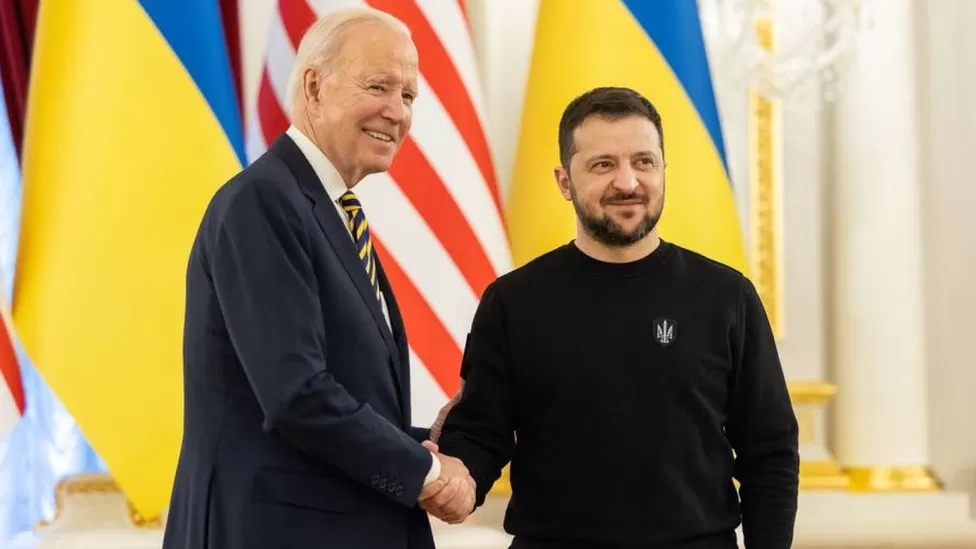
Biden and Zelensky – partners in crime

It is without any sense of shame or irony that the G7 leaders of the capitalist world are meeting this weekend in Hiroshima, Japan.  The city is the scene of one of the twentieth century’s most heinous war crimes, resulting in the death of an estimated 330,000 people as a result of the atomic bombing on 6th August 1945.  Add the death toll from the bombing of Nagasaki, three days later, and the combined death toll is well in excess of half a million people.

These are war crimes for which the United States has never even apologised, let alone been brought to any international body to answer for its actions.  The US justification for the bombings has always been that they were necessary to end the war in the Pacific.  There is evidence to suggest that the Japanese surrender was already in preparation and fighting would have concluded with Japan surrendering to the Red Army in the East.  This was a scenario the West could not tolerate.

The failure of Britain and the US to open an effective Second Front in Europe, while prioritising imperialist assets in North Africa, had seen the Soviet army push the Nazis from Soviet soil and all the way back to Berlin.  By the time of the much celebrated D-Day landings the German army was well on its way to becoming a beaten force in Europe.  So, Japan falling into Soviet hands was not in the interests of imperialism and had to be stopped.  The atomic bomb was the answer.

Given this context it is perhaps fitting that US President, Joe Biden, has taken the opportunity to further ramp up the war in Ukraine.  Biden has promised to support the training of Ukrainian pilots in the use of US F16 fighter jets, along with several other NATO countries.  The fighters involved also include Britain’s Eurofighter Typhoon and France’s Mirage 2000. The decision opens the door for the US to licence the sale of F16’s to Ukraine, thus promoting a dangerous escalation in the conflict with Russia.

While training will take some time, and jets are unlikely to be supplied overnight, the Ukrainians have indicated that F 16’s could be in operation within four months of the start of training.  Western observers suggest the timescale may be nearer six to nine months.  In any event such timescales would certainly see the possibility of a significant escalation in the conflict before the end of the year or into early 2024 at the latest.

Since the war began, the Biden administration and the U.S. Congress alone have directed more than $75 billion in assistance to Ukraine, which includes humanitarian, financial, and military support, according to the Kiel Institute for the World Economy, a German research institute.

Military aid alone from the US totals over $46 billion, far in excess of second placed Britain at $5.1 billion and the EU at $3.3 billion, although $2.5 billion each from Germany and Poland needs to be added to that total, alongside smaller contributions from Netherlands, Italy, France and Norway. 

There can be little doubt that the war in Ukraine is a proxy war initiated and fought by NATO against Russia, as part of the West’s 30 year long strategy of encirclement and containment of Russia.  Having initially courted capitalist Russia as a partner, during the brief G8 period, the US quickly saw the dangers for its hegemonic unipolar position in the world from a strong capitalist Russia.  The US has been working to weaken Russian influence ever since.

Ironically, over the same period, the US has seen its reliance on imports from China grow from $4 billion in the 1980’s to over $500 billion at present.  Loading guns and weaponry into Ukraine may yet result in a weakened Russia as the outcome but the trade lock between the US and China will be more difficult to shake, however belligerent the US continues to be against the People’s Republic.

The danger for the world is that the US fails to acknowledge that the dream of unipolar world dominance is not sustainable and continues its pattern of aggression and military intervention to try and maintain its position.  Recent decades have seen the people of Afghanistan, Iraq, Libya, Palestine and Syria paying the price for this strategy.  The people of Russia and Ukraine are currently paying that price as a result of US led NATO intervention.    

Peace protesters have greeted G7 leaders in Hiroshima, calling for an end to the proliferation of nuclear weapons and the eradication of the world’s estimated stockpile of 12,705 nuclear warheads.  It is unlikely that they will get as much news coverage as the visit of Ukrainian President, Volodymyr Zelensky, a willing partner in crime with the West, a faux man of the people in danger of colluding in leading his people, and many others, over the precipice.  

Upholding ruling class law

13th May 2023

Draconian police powers protect the ruling class

Liberals may take comfort in the delusion that Britain is not, or could not become, a police state but the evidence of the past week and recent legislation ought to make them think twice.

First up as evidence is the Police, Crime, Sentencing and Courts Act 2022.  Powers under the Act were liberally deployed by the police over the coronation weekend.  Three arrests under the powers were of volunteers working for “Night Stars”, an organisation funded by Westminster Council to help stop the sexual harassment of women.  The volunteers distribute rape alarms to women who might need them and are clearly identified by their pink tabards adorned with the logo of their Metropolitan Police partners.

Nevertheless, the arrests took place at 2am in the morning before the coronation and were ‘justified’ on the basis that ‘intelligence’ suggested that the rape alarms might be used to frighten the horses that would be part of the parade.  The volunteers were held for 14 hours before being released on bail.

The 2022 Act outlaws “serious disruption” and criminalises “intentionally or recklessly causing public nuisance”, the interpretation of which is so broad that any number of relatively peaceful protests could come under its definition.  Even handing out rape alarms it would seem.  With penalties of up to 12 months in prison the Act is clearly designed to deter anyone thinking about public protest.

Second up as evidence is the positively draconian Public Order Act 2023.  This is the old ‘sus’ laws, widely used against black working class youths in the past, dressed up and expanded.  Anyone can be stopped and searched if the police “reasonably believe” that protests may be about to take place or if they think that someone may be carrying a “prohibited object”.  Resisting a search can result in up to a year in prison, being found guilty of engaging in an ‘illegal’ protest can get you up to three years in jail.

A key clause of the Act is the introduction of “serious disruption prevention orders” which give the police powers to prevent certain individuals from attending protests, associating with named others and even going so far as imposing house arrest.  Orders can be applied based on a “balance of probabilities” and last for up to two years, renewable for a further two if deemed necessary.

In the build up to the coronation weekend activists from the anti-Monarchy group Republic were in discussions with the police for four months, making clear that their protests would be peaceful, the nature of the action and where they would take place.  Nevertheless, six activists, including Republic spokesman, Graham Smith, were arrested while unloading placards from a van at 7am on the morning of the coronation and were not released until 11pm the same night.

Whatever ‘intelligence’ the police were working on to make these arrests you would think could extend to recognising someone they had been negotiating with for four months in less than 16 hours!  Apparently not.

All of which points directly towards the arrest of the Republic activists as a planned operation by the police in an attempt to either sabotage any protest or, at the very least, send out a warning message to activists for the future.

The police are the frontline enforcement arm of capitalism.  Evidence over decades confirms this, the Miner’s Strike 1984/85 being the most sustained example followed by a phalanx of anti-trade union legislation aimed at constraining strike action.  Subsequent protests against poll tax imposition, the protests of animal rights activists, Just Stop Oil campaigners and others campaigning to save the environment, add to the evidence that the capitalist state will do its utmost to suppress dissent.

The most recent report into the Metropolitan Police by Louise Casey, published in March, found the force to be institutionally racist, misogynistic and homophobic.  This is the latest in a long list of evidence accumulated over many years, through a wide range of inquiries into police activity, that the police are a force for the upholding of ruling class laws, not defenders of local communities.

The actions of the police over the weekend of the coronation will no doubt be applauded by the right wing press as evidence that the new powers are necessary.  As capitalism struggles to retain any semblance of credibility, as company profits surge while the real value of wages plummet, there is no doubt that more enforcement of working class communities and those protesting against the injustices of the state will increase.

Active opposition to such draconian measures is an essential first step and any incoming Labour government should, first and foremost, be committed to their repeal.

Mind the gap

6th May 2023

Night moves – rehearsals in Central London for the coronation of King Charles III

Travellers on British trains and the London underground from Friday to Monday this weekend will find themselves subject to a message from King Charles and Queen Camilla, wishing them a wonderful coronation weekend, a safe and pleasant journey and concluding with a final plea from Charles to “remember, please mind the gap.”

“The coronation is a rare and exciting event and we very much look forward to welcoming passengers with this special message,” said Jacqueline Starr, chief executive of the Rail Delivery Group, which represents Britain’s rail industry.

The recording will be played in all 2,570 railway stations throughout the UK, the group said.

For much of the country this example of the wit and wisdom of the newly anointed royal couple will go down like a lead balloon.  Self awareness has never been a key characteristic of the British ruling class and its royal representatives, who are clearly oblivious to the fact that “the gap” will mean many different things to many people across the country.

The gap between the costs of the coronation knees up itself, an estimated £100 million, compared to the need to pay nurses, junior doctors, postal workers, rail workers, teachers and others a decent wage is one such difference.  There is also the growing gap between the rich and the poor.  In 2022, incomes for the poorest 14 million people fell by 7.5%, whilst incomes for the richest fifth saw a 7.8% increase.  For the same year households in the bottom 20% of the population had, on average, a disposable income of £13,218, whilst the top 20% had £83,687.

Compared to other developed countries Britain has a very unequal distribution of income, with the second highest level of income inequality in Europe, although it less unequal than the United States which is the world leader in this regard.

These are gaps which we all ought to be mindful of.

When it comes to overall wealth in Britain the gap is even wider than income. In 2020, the Office for National Statistics (ONS) calculated that the richest 10% of households hold 43% of all wealth. The poorest 50%, by contrast, own just 9%.

Looking more broadly at the Commonwealth, 14 nations of which King Charles will be Head of State. Of the 56 Commonwealth countries 12 are categorised among the world’s least developed countries (LDC), an official United Nations designation, covering 46 of the world’s poorest countries.

The economic gap between LDCs and the rest of the world has been increasing. GDP per capita for the LDC group represented 15 percent of the world average in 1971, but by 2019 this had declined to less than 10 percent.  In short, the rich nations are getting richer while the poor get poorer.

That 12 of the 46 nations categorised as LDC by the United Nations are part of the Commonwealth says much for the supposed magnanimity of the British ruling class amongst this ‘family of nations’.  A thinly veiled cover for exploitation and expropriation if ever there was one!

This is a gap we ought to be mindful of.

Latest figures for military spending show British arms spending as the fifth highest in the world, at $52.9 billion (2020 figures), this being the highest of any European country.   In April, the IMF published new forecasts for the world economy. The IMF expects inflation rates to slow and forecasts British GDP to fall by 0.3% in 2023, the lowest figure in the G7, with growth of 1.0% in 2024.   

The strain of the military budget, under investment in new technologies and the role of Britain as a tax haven for the rich are clearly burdens upon economic growth.  CND has calculated that replacing Trident, Britain’s nuclear weapons system, will end up costing at least £205 billion, and that is before taking into account that Ministry of Defence projects typically go well over budget.  This will not only add to the strain on the British economy but will take more resources away from the real needs for schools, hospitals and investment in renewable energy sources.  

A huge gap exists between the illusory need for weapons of mass destruction and the real need to invest in ways to save the planet from the certainty of global warming and its consequences.

Being a republic is not in itself a guarantee of equality however. Unelected monarchy and Parliamentary representation is the peculiar combination which capitalism has evolved in Britain to protect the rich and privileged.  However, class division does take Republican forms elsewhere. Britain is pipped by Italy in the inequality in income stakes in Europe for example.  France and Germany may have dispensed with Kings and Queens long ago but remain hugely unequal societies. 

The self styled home of the brave and land of the free, the United States, is the world leader in inequalities in both wealth and income.  At nearly $800 billion per annum the US also far outstrips allcomers in spend on weapons of mass destruction to defend the rights and privileges of its elite class.

Other gaps could be explored.  The gender pay gap.  The likelihood of arrest or harassment as a black youth in London and other major cities.  The gap between the recently announced profits of energy giants, Shell and BP, compared to the ability of working class people to pay their bills.  The list goes on.

In minding these gaps getting rid of the anachronism of an unelected monarch is merely a first step, though an important symbolic one.  The real struggle remains that of overturning the system in which inequality, exploitation and injustice are embedded, capitalism itself.  The people’s of the former Soviet Union and much of Eastern Europe have found that living in a state orientated towards socialist development was quite different to the cut throat world of capitalism they now inhabit.

The gap between socialism and capitalism is the biggest one we have to bridge.

Avanti Populo wishes everyone a safe journey, wherever you are going and whatever you may be doing this weekend but don’t just mind the gap, get as mad as hell about it and resolve to take action to close it sooner rather than later!

Liberation Statement – May Day 2023

International solidarity is not an act of charity: It is an act of unity between allies fighting on different terrains toward the same objective. The foremost of these objectives is to aid the development of humanity to the highest level possible” (Samora Machel)

As the world continues to struggle through a period of heightened tension and conflict, Liberation once again reasserts our key values of peace, democracy and internationalism on May Day 2023. May Day reminds us that it is only solidarity between the people’s of all countries which will overcome conflict. 

As ever, the common interests of working people across the world underline that there is more that unites the international working class than divides them.  The struggle for core rights to peace, health, homes and jobs is a common struggle of working people internationally. Without these basic securities many are condemned to lives of uncertainty, poverty and oppression.

The economic and military inequity which the United States is making every effort to maintain, by insisting upon its role as global policeman, is however being challenged.

The growing economic strength of China presents a challenge to the unipolar hegemony the United States has enjoyed for over 30 years and is keen to maintain.  The provocations of the US against China, through overtly supporting the arming of Taiwan and establishing the AUKUS military alliance with the UK and Australia, are clearly dangers to both regional stability in the Indo-Pacific area, as well as being a threat to world peace.

US dominance in the economic sphere is also challenged by the latest developments by the BRICS nations (Brazil, Russia, India, China and South Africa) to challenge the dominance of the dollar and, through the BRICS New Development Bank (NDB), provide 30% of loans to member states in the period to 2026 in local currencies.

The racist nature of the Illegal Migration Bill, currently going through Parliament in the UK will further undermine the ability of many to seek  asylum and push the blame for the migrant crisis upon the victims rather than the perpetrators.

Those fleeing violence and war are not those initiating conflicts, which have largely occurred as a result of Western policy in the Middle East and Africa, resulting in the huge displacement of those affected.  The current crisis in the Sudan has its roots in the colonial history of UK domination of the country and the struggle to establish democratic structures in the post colonial environment.

The European Union continues with its policy of attempting to reduce migrants and refugees from North Africa by paying millions of Euros to a range of dubious warlords and militias, contracted to stem the flow of potential migrants to Europe.

The fragile situation remains in Ukraine with the continuing supply of arms from the NATO Alliance being an impediment to peace negotiations, although efforts on the part of both China and Brazil to break the deadlock are to be welcomed.  In any event, the objective should be to find a peaceful solution in the interests of the people of both Russia and Ukraine, with diplomacy being prioritised over weapons sales. 

Campaigns worldwide for peace, democracy and human rights are central to the struggle for equality and against injustice. 

Wars of intervention continue to the detriment of the peoples of many countries in the world. Self-determination remains an issue in the struggle for justice for the Palestinian people and is likely to be made worse by the policy and actions of the new Israeli administration. 

Not only does Palestinian land continue to be occupied in contravention of United Nations resolutions by Israeli forces, the religious fundamentalists in the current government openly fail to recognise any Palestinian claim to territory. Daily life becomes more difficult for the working people of Palestine as the Israeli land, air and sea blockade imposed upon Gaza, continues to restrict access to basic goods and health care provision.

The reality of poverty, injustice and uncertainty in the daily lives of working people across the world is exacerbated by war, occupation and the ensuing migrant crises.  It is exacerbated by the climate crisis and increasing environmental degradation.   

On the occasion of May Day 2023 Liberation repeats its determination to back the call for a new international economic order; supports the cancellation of the debt burden imposed upon already impoverished nations; seeks the re-establishment of a movement towards non-alignment; and calls for the settlement of international disputes in line with UN resolutions.

These demands should be central to a progressive foreign policy for the UK, one based upon the principles of peace and co-operation, not weapons sales and wars of foreign intervention.

Peace, democracy and social justice are core to the ethos of May Day and central to the campaigning priorities of Liberation. These goals will only be achieved through solidarity action and unity amongst the workers of all nations. Neo-colonialism and imperialism have shown that they do not have the answers to the problems faced by the majority of the world’s citizens. 

It is time to make way for a truly new world order based upon the needs of the people not just the desire for profit for the few.

Find out more at https://liberationorg.co.uk/

Sudan – reactionary infighting prevents progress

29th April 2023

Passengers being bussed from war torn Khartoum – not all are so lucky

As the crisis develops in Sudan reporting from the BBC takes on its usual character of obfuscation rather than illumination.  The only concern of the BBC appears to be the fate of British nationals and the scramble to evacuate British passport holders from Khartoum as quickly as possible. 

The roots of the current situation in Sudan however inevitably have their origins in the neo-colonial grip of transnational corporations, which exercised control over Sudanese resources and were happy to prop up the corrupt government of Omer Al-Bashir from 1989 until his popular overthrow in 2019.  

The forces behind the revolution which overthrew Al-Bashir in April 2019 included the Professional Alliance, the Civil Society forces and the Sudanese Communist Party, part of an alliance of 80 organisations which signed a Minimum Programme for democratic change.

Any progress towards shifting the balance of power in Sudan was thwarted however with the civilian led government being ousted in a military coup in October 2021.  While the pro-democracy movement responded with a civil disobedience campaign the military responded with live gunfire resulting in hundreds of deaths.

The pro-democracy movement was demanding the transfer to state ownership those companies controlled by the army and security forces, which have a monopoly over the export of Arabic gum, cattle, gold and various agricultural products.  Demands for a new labour law, democratic liberties including the right to peaceful protest and the handing over of Al-Bashir and other war criminals to the International Criminal Court were not implemented.

These progressive measures were stymied by the reactionary elements of the civilian government, even before the October 2021 coup, but have had no chance of being progressed under the generals. Many of these elements were members of Al-Bashir’s security forces and some reactionary Islamic groups.  The military in Sudan has very much reflected the position of the former regime’s National Congress Party, the Islamic Brotherhood in all but name.  The chance for democratic or progressive change under the revolutionary forces’ slogan, freedom, peace and justice, have been severely setback by the present infighting.

The recent phase of conflict, which began on 8th April is effectively one between Sudan’s military and the country’s main paramilitary force. It is a proxy war led by the Rapid Support Force (RSF) and its leader General Mohamed Hamdan Daglo, or Hemeti as he is known, on the one hand, and the Security committee “of the National Islamic Front” in the Sudanese military headed by Al-Burhan on the other. Both sides are supported by their foreign allies.

The RSF was able to build its resources under the previous regime through an arrangement with the EU implemented in October 2014, known as the ‘Khartoum Process’.  The funding under the agreement was given to various African countries to halt the flow of African migrants reaching the European Union.  Sudan alone had received €215 million from this fund by 2017, much siphoned off by the RSF to fund its activities.

In effect the war, in which the main victims are the Sudanese people, is a power struggle between two reactionary military and political factions, who were previously united to prevent civilian rule through initiating the October 2021 coup.  However, the lure of control over Sudan’s significant resources, not least its gold deposits, has proven too difficult for the reactionary factions to resist.  The progressive Sudanese resistance committees have evidence, in the form of videos and documents, that shows both the Russian mercenary Wagner group and the Egyptians involved in smuggling gold.

The resistance committees are calling for the formation of an alliance against the war, and the restoration of civilian government, for the army to return to barracks and the militia to be dissolved.  Further than this the resistance is calling for the Sudanese revolution to continue, demanding the people’s control of their wealth, progressive economic development, and the building of a strong public sector that serves the people.

While the United Nations has previously been involved in some attempt at negotiations, key sections of the progressive forces have refused to negotiate with the military, who they regard as having no legitimate role, having seized power from the elected government in the October 2021 coup.

The progressive forces in Sudan have made calls for support and international solidarity to back the goals of the revolution and demand a return to civilian rule.  The Sudanese Communist Party, as part of the progressive alliance has issued a statement which includes the following,

“We condemn the military escalation between the two counter-revolutionary military forces. This is certainly an expected outcome of these factions’ leaders’ power struggle aimed at controlling the country’s resources at a time when their four years alliance in power has proven to have failed in running the country…”

The statement goes on to request support from politicians and trade unions in Britain in order to halt the current crisis, refuse to arm or train either of the forces involved and press the UN to initiate discussions towards a meaningful transition to civilian government.

The situation on the ground in Sudan is clearly complex and Western companies along with regional powers such as Saudi Arabia, Egypt and the United Arab Emirates will undoubtedly feel that their own positions are threatened if there is a successful popular revolution in the region.  The idea may spread! 

For that reason it is vital that the demands of the Sudanese people are made known, reported and supported.  Any attempts to thwart the progressive demands of the revolution will only reinforce the reactionary armed forces engaged in fighting at present, as well as the reactionary regimes supporting them.  For the sake of the people of Sudan and those of the wider region the current slaughter must stop.

Building BRICS of new development

22nd April 2023

President of Brazil, Lula de Silva, with New Development Bank President, Dilma Rousseff

The establishment of the BRICS New Development Bank (NDB) in 2015 was a major step forward in opening up the possibility for developing countries, and those of the Global South, to take a step towards controlling their own development programmes and reduce reliance on international finance institutions dominated by the US dollar.

The BRICS nations (Brazil, Russia, India, China and South Africa) not only represent a huge percentage of the world’s population but some of the world’s key areas of economic growth. The group has recently added Bangladesh, the United Arab Emirates and Egypt to its cohort, while Uruguay is in the process of joining, and many other countries have expressed interest.  For example, Argentina, Iran, and Algeria have formally applied to join the extended BRICS+ bloc.

In January this year South Africa’s Foreign Minister, Naledi Pandor, indicated the group’s intention to  “develop a fairer system of monetary exchange”, with a view to weakening the dominance of the US dollar.

“The systems currently in place tend to privilege very wealthy countries and tend to be really a challenge for countries, such as ourselves, which have to make payments in dollars, which costs much more in terms of our various currencies”, she said.

In a recent visit to NDB Headquarters in Shanghai, Brazilian President, Lula de Silva, said the NDB’s goal is “creating a world with less poverty, less inequality, and more sustainability”, adding that the bank should play a “leading role in achieving a better world, without poverty or hunger”.

Lula was in Shanghai to witness the swearing in of a former Brazilian President, Dilma Rousseff, as the new President of the NDB.  In an interview following her inauguration Ms. Rousseff stressed the role of the NDB in supporting countries with regards to climate change and sustainable development goals; promoting social inclusion at every opportunity; and financing the most critical and strategic infrastructure projects. 

Ms. Rousseff also stressed the need to tackle the higher inflation and restrictive monetary policies which are a feature of developed countries and are often passed on, in the form of high interest repayments, to those developing countries struggling to build their own infrastructure.

“It is necessary to find ways to avoid foreign exchange risk and other issues, such as being dependent on a single currency, such as the US dollar,” she stated.  Critically, Ms. Rousseff went on to state that,

“At the NDB, we have committed to it in our strategy.  For the period from 2022 to 2026, the NDB has to lend 30% in local currencies, so 30% of our loan book will be financed in the currencies of our member countries.  That will be extremely important to help our countries avoid exchange rate risks and shortages in finance that hinder long-term investments.”

To date NDB has invested in 96 projects, approving $32.8 billion worth of finance to support programmes which are climate-smart, disaster-resilient, technology-integrated and socially-inclusive.

While the BRICS countries, and those looking to gain membership of the NDB, are by no means a homogeneous group in terms of their political outlook the initiative remains an important one.  The stranglehold of imperialist designed institutions such as the International Monetary Fund (IMF) and World Bank, both of which are US dominated and controlled, has tied developing nations to Western economies in ways which have thwarted, rather than encouraged, their economic independence.

In reality, the tools of the imperialist banking sector are there precisely to generate dependence and keep former colonial nations within a neo-colonial orbit.  The deployment of Western corporations, infrastructure and technology only serves to reinforce those dependencies over the long term.  Inevitably there is usually a military pay off too, with arms contracts being tied into economic support and the stationing of military bases and US hardware often being part of the deal.

The NDB cannot break such entrenched relationships all in one go and is itself still dependent upon the existing international banking arrangements in order to function.  However, the fact that the concept of “de-dollarisation” is even on the agenda of developing nations, and that there is an emerging investment network which it does not control, will be of concern to the US.

No doubt much of the current US provocation towards China stems from the fear that the unipolarity it has enjoyed since the defeat of the Soviet Union is not only being questioned but is being actively challenged.  The extent of the NDB’s success may well be measured by the increasing belligerence of the US towards those countries which are part of its network.

Urgent action to free women journalists demanded  

12th April 2023


The Committee for the Defence of the Iranian People’s Rights (CODIR) has called for the immediate release of journalists, Niloofar Hamedi and Elahe Mohammadi.  The two women have been imprisoned by the regime in Iran since September 2022 on alleged charges of espionage. 

The only ‘crime’ committed by the two journalists however was to report on the death in custody of Mahsa Amini, who was killed by the so called ‘morality police’, for allegedly not adhering to Iran’s stringent hijab laws.

Hamedi wrote for the reformist newspaper Shargh and was the first journalist to report on the death of Amini, doing so from the hospital in Tehran where Amini had been on life support. Mohammadi had reported on the protests at Amini’s funeral in her hometown of Saqez in northwest Kurdistan province.

These imprisonments are part of an increasing pattern of persecution of journalists in Iran since the emergence of the Women, Life, Freedom movement which emerged after Amini’s murder.  More than seventy journalists have been imprisoned in Iran since the protests began last September, almost half of whom are women.

While the Constitution of the Islamic Republic of Iran formally recognises freedom of expression and freedom of the press, these provisions are more routinely honoured in their breech rather than their observance.  They are often overlooked or subjected to severe restrictions.

This recent upsurge in arrests may go beyond the regime’s usual harassment of journalists but the phenomenon is not limited to Iranian journalists covering the ongoing protests. The Islamic Republic has a long history of jailing journalists as well as subjecting them to extreme censorship and political pressure.

CODIR is calling for the release of the imprisoned women journalists, Niloofar Hamedi and Elahe Mohammadi, who have committed no crime.  They have done nothing more than report on the criminal activity of the Iranian state itself in highlighting the circumstances surrounding the death of Mahsa Amini.

Since the death of Ms Amini last September, Iranian people, with women and youth often at the forefront, have been taking to the streets across the country, despite the growing threats and brutal suppression carried out by the security forces, acting on the commands of the regime’s leaders.

CODIR Assistant General Secretary, Jamshid Ahmadi, has expressed condemnation of the incarceration of the two women and the lack of due judicial process in Iran.

“These imprisonments are a further example of the Iranian regime having no interest in justice and no commitment to press freedom,” he said.  “CODIR will continue to highlight the actions of the theocratic dictatorship in Iran in gagging those who have a legitimate right to freedom of expression.  The regime in Iran is clearly feeling under threat from the emergence of regular protests.  We reassert our ongoing commitment to support the popular struggles of the Iranian people towards the establishment of a modern, secular and democratic government.”   

CODIR has called for all forces supporting the struggle for human and democratic rights in Iran, to condemn the imprisonment of the women journalists, through issuing statements in solidarity with those campaigning for their release.  

CODIR requests that trade union affiliates write to the embassy of the Islamic Republic of Iran to make clear their opposition to these imprisonments and the restrictions placed upon freedom of expression in Iran. 

CODIR is also asking for individuals to write to their local MP, drawing their attention to the worsening situation inside Iran and requesting that they write to the embassy of the Islamic Republic of Iran on similar grounds, as well as using their platform in Parliament, to draw attention to the plight of the people of Iran.

Further info at http://www.codir.net

Opposing the China crisis

8th April 2023

Taiwan’s Tsai Ing-wen (left) meets with US House Speaker Kevin McCarthy

The trip to Central and North America of self styled Taiwanese ‘President’, Tsai Ing-wen, is the latest step in the propaganda war the West is playing against China.  Tsai is touring to shore up flagging support for recognition of the renegade island, withdrawn recently by Honduras, leaving Belize and Guatemala as the only regional states with formal ties with Taiwan.

While the United States does not formally recognise Taiwan, consistent with the position of the United Nations, every opportunity is taken to use Taiwan as leverage against the legitimate Chinese government.   The visit of then House Speaker, Nancy Pelosi, to Taiwan last year, was clearly a deliberate provocation to China, designed to ramp up tensions and push China towards action in relation to Taiwan. 

This week Tsai met the current US House Speaker, Kevin McCarthy, at the Ronald Reagan Presidential Library, where McCarthy stressed the urgency of arms deliveries to Taiwan and Tsai praised the “strong and unique partnership” with the US.  Unique is certainly the word, as the US position would be akin to China supplying arms to Scotland, should it prepare to declare itself free of the so called United Kingdom!

It comes as little surprise that Beijing has reacted angrily to the meeting between Taiwan’s leader and McCarthy.  After the Vice President, McCarthy is next in line to the President, so the meeting carries clear significance as a statement of US policy towards Taiwan and, by implication, China.

McCarthy, the most senior figure to meet a Taiwanese leader on American soil in decades, was joined by a bipartisan group of US politicians showing support for dialogue with Taiwan.

“We must continue the arms sales to Taiwan and make sure such sales reach Taiwan on a very timely basis,” McCarthy said at a news conference after the meeting, adding that he believed there was bipartisan agreement on this. “Second, we must strengthen our economic cooperation, particularly with trade and technology.”

In denouncing the meeting Beijing’s foreign ministry said in a statement that China will take “resolute and effective measures to safeguard national sovereignty and territorial integrity.”

While the formal US position is recognition of the People’s Republic of China as “the sole legitimate government of China”, with Taiwan as “part of China”, moves are clearly being made to overturn this position and the historical One China policy which has held since 1979.

Wrapped in talk of democracy and shared values however is what the US regards as its rightful economic interests in the Indo-Pacific area.  Taiwan is strategically placed on key trade routes and helps sustain US dominance over markets in Japan, the Philippines and South Korea.  The danger, as seen through US eyes, is that loss of control over Taiwan could allow the area to be controlled economically by China, as well as threatening the network of military bases which the US has in the region.

From the perspective of the US the economic rise of China poses a far greater threat than a maverick capitalist Russia, in spite of the recent intervention in Ukraine.   With Russia, the US and NATO were able to play a long game of encirclement, gradually enticing former allies of the Soviet Union into the NATO military alliance and boxing in Russia’s options and alliances.  The strategy is not without risk, not least as Russia still has significant military capability, and absorption into the NATO command structure is not universally accepted across Eastern Europe.

However, while major parts of the world do not accept the US narrative in relation to Ukraine, the West has been able to sustain an unparalleled propaganda assault over the past 18 months, to persuade significant sections of its population that the war in Ukraine is purely down to an act of Russian aggression.  

The current provocations against China are from the same playbook but the stakes are higher.  The Russian economy is relatively weak and Russia’s international reach limited.  The same cannot be said of China, clearly an economic power house which is increasingly challenging the US in key economic areas and in areas of international influence.

In addition, Taiwan itself is a world leader in the production of semi-conductors, vital to computers, mobile phones and cars.  In the US, Silicon Valley relies on Taiwan’s supply of semi-conductors, necessary to maintain US dominance over all high-tech fields.  China is yet to catch up in this area and the US clearly does not want to see that happen.

The AUKUS military pact, signed by the US, Britain and Australia in 2021, is another key element of the attempt to either contain China militarily or provoke it into action over Taiwan.

China is clear that it wants to reunite with Taiwan peacefully.  China does acknowledge a conflict scenario if Taiwan develops nuclear weapons or fully secedes. Either of these developments would pose an existential threat to China because they would mark the removal of all constraints on the US using Taiwan as its main forward base against the mainland.

The pace of economic growth driven by technological change, coupled with the clearly anti-imperialist stance of the Chinese government, means that the West cannot secure its goals by utilising the long game it was able to play against Russia.  The US is keen to sustain its position as the world’s only superpower, in both economic and military terms, and is struggling to do so.

As Frieda Park has noted recently in The Socialist Correspondent (Spring 2023),

“The US world order is the biggest threat to peace and the greatest constraint on progressive forces on a global scale as evidenced by the numerous illegal wars it has fought, and its military interventions and coups against leftist governments.”

Unless the forces of peace and progress are able to unite internationally the ongoing US provocations against China are only heading in one direction.  Opposing the escalation of military spending across NATO and demanding an end to the drive to war, particularly with China, are now urgent tasks.