The profit dash continues

6th June 2020

Out of touchBoris Johnson – increasingly out of touch
It is hard to believe, with the UK death rate from COVID-19 the second highest in the world, topping the 40,000 mark according to official figures, that Prime Minister, Boris Johnson, can declare himself “very proud” of the government’s record on reducing the spread of the virus.

No one but a dyed in the wool Tory MP, financial backer or voter can believe such nonsense when the government approach to the pandemic has been calamitous from the start.  The World Health Organisation declared a global pandemic on 11th March.  The very next day, 12th March, the UK government stopped the limited test and trace programme it had in place, then proceeded to wait until 23rd March before introducing any significant lock down measures.

This was in spite of having the advantage of seeing what was happening in China, South Korea and Italy, giving the government time to respond and put measures in place quickly.  Part of the abject failure of the Tories’ response to the crisis is purely ideological.  Local government officers in public health and environmental health teams have well established test and trace practices which could have been activated at a local level quickly and efficiently.

The government however chose to go with a centralised approach, looking to by pass local government, and hand out contracts to its private sector pals.  Millions have been spent on private sector contracts without any assessment of value or capability in order to be seen to be acting quickly.  The UK death rate is the grim reality of the outcome of that approach.

The current test and trace system, which the government is now heralding as being central to its strategy, is a case in point.  Private sector company Serco is one of several firms employed to recruit a network of 25,000 tracers as part of the government scheme.  The programme is already way behind time and is not expected to be at “world class level” until September or October.

It is critical that test results are turned around in 24 hours if contacts are to be traced in order to isolate the virus.  The government continues to equivocate on the percentage of tests returned in that timescale, though it claims 92% are back within 48 hours.  Even if that is the case, all the evidence suggests that it is simply not fast enough.

Serco Chief Executive, Rupert Soames, seems less concerned about the death rate than the prospect of future profits from NHS contracts.  In an e mail to staff this week Soames said,

“If it succeeds…it will go a long way in cementing the position of private sector companies in the public sector supply chain.  Some of the naysayers recognise this, which is why they will take every opportunity to undermine us.”

As an opportunity to undermine, Soames’ e mail is something of a gift!  The purpose of test and trace is to save lives, not to boost the bank balance of the Serco shareholders.

In an attempt to bring attention to the human loss in the pandemic 27 eminent health professionals, in a letter to The Guardian this weekend, question the validity of the government’s approach, stating,

“If, as seems probable, there is a second wave this winter, many more will die unless we find quick, practical solutions to some of the structural problems that have made implementing an effective response so difficult.  These include the fragmentation, in England, of the NHS, public health and social care; the failure of those in Westminster to engage with local government and devolved nations; the channels by which scientific evidence feeds into policy; and an inability to plan for necessary goods and services, and procure them.”

As an indictment of the government’s approach this could hardly be more comprehensive.  Yet Boris Johnson is “very proud” and Rupert Soames has his eye on the company balance sheet.

Quite why this is not proclaimed as a national scandal from every news bulletin and newspaper headline is a scandal in itself.  However, the Tory press cannot bring themselves to face the reality of the government’s incompetence, while the BBC continues to play a role which can only be described as supine when it comes to journalistic credibility.

On the day the official death toll passed the 40,000 people, on the official count, the BBC reflected nothing by way of outrage but instead leavened its reporting with an emphasis on the falling rate of infections in the community.

The government has lost further credibility with the health sector, should that be possible, by unilaterally announcing that from 15th June, hospital visitors and outpatients must wear face coverings and staff must use surgical masks.  A major operational challenge for NHS Trusts around the country about which they were not consulted.

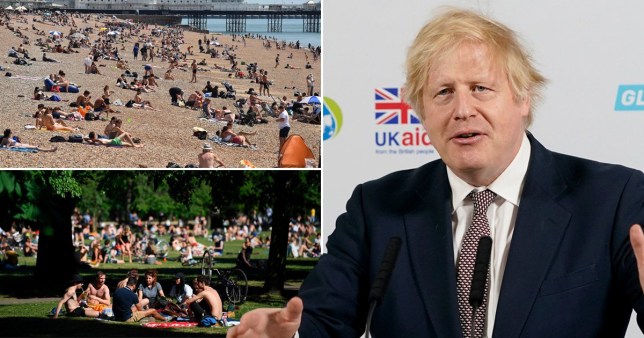
The dash to shore up company profits rather than save lives will take another step on 15th June with non-essential shops being allowed to open, as long as COVID secure measures are in place.  Following the easing of restrictions on outdoor activity, which saw many rush to the beaches in May, and the option to open schools from 1st June, there is a growing sense that the government is going too far, too soon.

The science around the pandemic is still too uncertain to proceed with anything but extreme caution.  The evidence already is that there are disproportionate impacts upon black and ethnic minority and disadvantaged communities.  Poorer housing conditions, fewer life opportunities and, as a consequence, a greater incidence of underlying health conditions, all play a part in the disproportionate impact of the virus.

It’s a fair bet not many Serco shareholders will fall into this bracket.   We can only hope that Boris Johnson’s ‘pride’ is of the variety which precedes a fall.


“I Can’t breathe…”


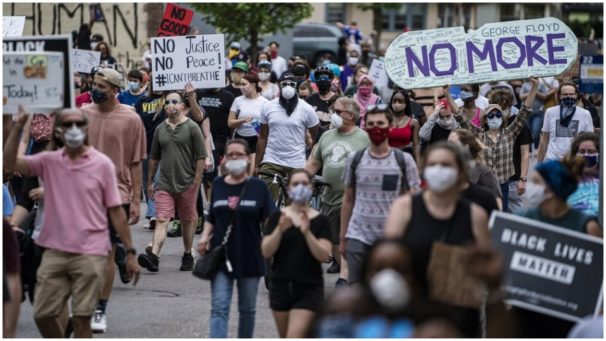
…these were the last words of George Floyd, killed in Minneapolis while not resisting arrest, the latest in a long line of African Americans murdered by the US police state.  The protests that have followed the murder of Floyd have exposed once again the deep divisions in the so-called “land of the free”, where apartheid may no longer be enshrined in law but is very much the reality of the day to day lives of the black population.

Minneapolis(2)

Protests mount against apartheid policing in the United States

Floyd was handcuffed on the ground for 11 minutes with a police officer pressing his knee into his neck, while three other officers stood by.  An ambulance was finally called when Floyd lost consciousness but he died later in hospital.  The public prosecutor has charged one officer, Derek Chauvin, with murder in the third degree.  That is killing without intent.  The other officers have so far not been charged.

There is a point after which, pressing your knee into the neck of a man who is protesting that he cannot breathe, especially when he is handcuffed on the ground, becomes intent.  The fact that video of the action went viral left the officers involved with nowhere to hide but behind the time honoured fortress of white privilege.  The killing has resulted in protests across the city, with a predictably robust police response.

Ilhan Omar, congressional representative for Minnesota’s 5th District, which includes Minneapolis, tweeted:

“Shooting rubber bullets and tear gas at unarmed protesters when there are children present should never be tolerated. Ever. What is happening tonight in our city is shameful. Police need to exercise restraint, and our community needs space to heal.”

The protests in Minneapolis are a reflection of the outrage relating to the death of George Floyd but are now spreading to cities throughout the United States.  The murder resonates throughout the black community.  Do black lives matter? Not very much as far as the United States is concerned.

Apart from the lived experience of the Black community and nationwide initiatives such as Black Lives Matter, studies have shown that across the country, Black people face intense bias in the criminal justice system. Minneapolis city data shows that Black residents are more likely than others to be stopped and searched by police as well as to be the targets of police use of force.

Floyd’s death is similar to that of another Black man who died as a result of police misconduct, Eric Garner.  Garner was killed when a New York City police officer, Daniel Pantaleo, put him in an illegal chokehold that resulted in his death. The officer was never brought up on charges.

Inevitably President Trump has weighed into the controversy with a helpful tweet, “when the looting starts, the shooting starts.”  It is not surprising that civil rights activists have seen such an intervention as provocation.  In an election year though Trump’s only agenda is to play to his base and he knows that the African-American vote is never going to swing his way.

Trump’s response is in stark contrast to his attitude to armed nationalist white militias groups who have been protesting against COVID-19 lockdown restrictions in recent weeks.  In effect Trump has conceded to the business lobby to open up large sections of the economy whether it is safe for workers to return to work or not.  Threats to withdraw unemployment benefit are being used to force workers back to the workplace, whatever the consequences for their safety.

Mainstream US media is inevitably focussing upon the damage and allegations of looting which have followed the protests since Floyd’s murder.  Whatever the truth of these reports, the reality remains that the world’s richest state and self styled defender of democracy, treats a huge section of its population as second class citizens based purely on the colour of their skin.

That is the real scandal, that is the real injustice which needs to be addressed.


Backing down and blustering

23rd May 2020

BB2

Empty benches – no backing for Boris?

For all of his fake ‘man of the people’ persona, when it comes to the crunch public schoolboy Prime Minister, Boris Johnson, has no clue as to the popular mood.  Insisting on the necessity of a healthcare surcharge for foreign NHS workers at the start of the week, set to increase from £400 to £634 in October, he had climbed down by the end of the week.  Downing Street was forced to issue a statement saying,

“The prime minister has asked the Home Office and the Department for Health and Social Care to remove NHS and care workers from the surcharge as soon as possible.”

Momentum had been building during the week, with Johnson initially defending the money brought into the health service by the surcharge, which has totalled £917m over the past four years.  With even leading Tories quoted as describing the charge as “mean spirited” and “immoral and monstrous”, damage limitation became the order of the day from the Johnson camp, claiming the Prime Minister had listened and “shown true leadership”.

The episode is symptomatic of the government’s handling of the COVID-19 crisis and the inability of Johnson himself to provide any credible lead.  The shine of Johnson’s election victory has faded rapidly and is best illustrated by the fact that Labour leader, Kier Starmer, is getting relatively sympathetic treatment from sections of the media.

The Daily Mail remains something of an exception in relation to Starmer, trying to whip up indignation over him owning a donkey sanctuary, but the story has done more to undermine the already shredded credibility of the Mail than it has Starmer.

Elsewhere, in the relatively tame House of Commons exchanges that now pass for Prime Minister’s Questions, Starmer has been described as incisive and forensic in his questioning of Johnson, who has blustered in his usual fashion but without the fan club chorus he usually enjoys.  This has led de facto fan club chairman, Jacob Rees-Mogg, to suggest that MPs should be back in the Commons, in order to mask the windbag’s blustering.  There is an irony that someone as socially distant as Rees-Mogg should be advocating the exact opposite.

While much is made of his legal career the truth is that Starmer’s questioning is no more incisive or forensic than that of Jeremy Corbyn, in fact in terms of political cutting edge it is decidedly less so.

What Starmer does have over Corbyn is establishment acceptability.  His honeymoon handling by much of the media is the first indication that the ruling circles regard capitalism as potentially being safe in Starmer’s hands.  This was never the view taken of Corbyn, who was always regarded as suspect at best and certainly likely to rock the boat, should he get anywhere near the keys to 10, Downing Street.

Johnson was always a stopgap candidate for the Conservatives, his election to the leadership based upon his populist rhetoric, media persona and the lack of a credible alternative.  In spite of his massive Parliamentary majority Johnson could yet be the fall guy for the inept handling of the pandemic.  A recession is already underway and an austerity programme is certain to follow, as the people will once more be asked to carry the cost of the crisis.

A jaded country, 15 years into austerity, could be persuaded to welcome Kier Starmer with open arms.  Inheriting an economy in a state of collapse a one term Labour administration could be permissible to UK capitalism while the Tories re grouped.

Crystal ball gazing is a dangerous practice in politics, there are so many imponderables.  Yet there is an alternative to the above scenario.  There is a world in which the inadequacies of capitalism to clothe, feed, employ and keep its people healthy are exposed.  A scenario in which the fact of care homes being run for profit rather than people’s needs is regarded as a scandal.  A scenario in which education is an equal right not a privilege according to your income.

It would be a scenario in which billions are no longer spent on weapons of mass destruction but the needs of the health service, transport infrastructure and green economy were prioritised.  Such a programme will not be advanced by a party of media darlings, it will need to be fought for inch by inch as the rich dig in to defend their privileges.

Labour can claim a small victory in seeing Boris Johnson make a u-turn this week.  It is a first step but they need to set their sights higher.  At some point they may also need to question whether Kier Starmer is the man to carry forward a programme for real change, rather than one which may just see Labour re-elected to office, on terms not of their choosing.


Mixing the message

12th May 2020

Stay Alert

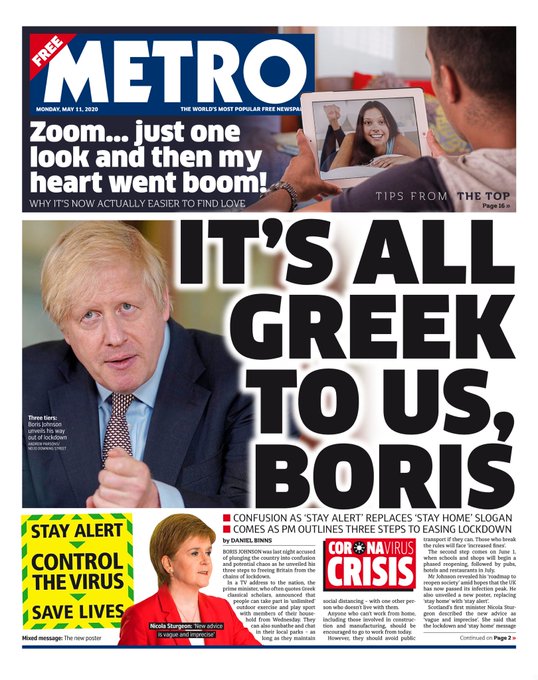
Press mocking of the Stay Alert message was widespread

Having steered the UK to the top of the European COVID-19 fatality league, the Tories have now chosen to drop the ‘Stay at Home’ message in order to exhort us all to ‘Stay Alert’.  This is only in England.  In Scotland, where First Minister, Nicola Sturgeon read about the change with her morning cornflakes, the message remains ‘Stay at Home’.  In Wales the Labour administration had said it was not changing the message even before Boris Johnson’s ‘address to the nation’ was broadcast.  The position is the same in Northern Ireland.

It is hard to credit that the Tories do not even have the capability of uniting a country as small as the so called United Kingdom around a single message.  It is even more remarkable that in his address Johnson claimed to have consulted with the devolved administrations before embarking on the new approach. Quite apart from the fact that he obviously forgot to mention it to Nicola Sturgeon, he clearly did not get agreement for the new approach.

Johnson is bowing to pressure from the business community to ‘get the economy moving’ while continuing to use the fig leaf of being ‘led by the science’ as cover.  The science is, as ever, conflicted on many points, not least because not enough is yet known about the behaviour of COVID-19 to make reliable predictions.  What is does appear to be clear on though is that releasing lockdown too soon will result in a more rapid spread of the virus and lead to more deaths.

It also appears, from the evidence of South Korea and Germany, that rigorous systems for testing and contact tracing need to be in place, if there is to be any chance of controlling the spread of the virus.  There is no evidence that this is the case in the UK, in spite of the dash to 100,000 tests a day in April, a level which the government fails to meet on a daily basis.

The message to workers to go back to work, but not use public transport, walking or a bike is recommended, is also in advance of clear guidance on how workplaces can be made safe and clear guidance on enforcement where employers are tempted to cut corners.

Allowing people to go outside and exercise more frequently is a welcome nod to physical and mental health issues. However, the freedom to drive to a place of exercise opens up the possibility of a rush to beaches and beauty spots in good weather and the possibility of infection being spread as a result.  The timescale outlined by Johnson allows for non-essential retail being open from 1st June, sport being allowed behind closed doors and a return of some primary education.  Some hospitality and leisure outlets may open from 4th July, with the caveat that this depends upon the virus not getting out of control.

The approach adopted in the UK outside of England does not align with the timescale outlined by Johnson, opening the prospect of an uneven easing of lockdown measures and, as a consequence an uneven approach to tackling the spread of the virus.

The Tories are following up Johnson’s statement with a flurry of ‘guidance’ in order to cover the gaps.  The hope is that the economy can become active, while at the same time bringing down the rate of infection and cutting the rate of deaths.  As with the government’s whole approach to the COVID-19 crisis, it is a gamble.  As ever it is a gamble with the lives of the elderly, the poor and the most vulnerable.

One of the government’s so called five tests is to avoid a spike in the infection rate which will overwhelm the NHS.  That means avoiding a spike in the winter months when the usual bouts of flu and norovirus infections, do their annual rounds.  A spike in August or September would avoid this particular eventuality.  It may be where the UK is heading.  With over 32,000 deaths so far, it is hard to see how the UK will not be on course for 50,000 before the crisis is over.

Making History – 75 years on

8th May 2020

BerlinSoviet troops liberate Berlin

The commemorations of the 75th anniversary of the conclusion of the Second World War are taking place in the face of the international COVID-19 pandemic, which requires co-operation between nations in order to achieve victory.

The defeat of Nazism required just such levels of co-operation but took many years, many betrayals and many political twists before it came about.

The First World War had concluded with the defeat of German imperialism and the collapse of the Ottoman Empire, with the spoils being divided largely between the British Empire, the French and the emerging United States.  However, an unintended consequence of a war to divide the spoils amongst imperialist powers was the 1917 revolution in Russia, from which emerged the establishment of the Soviet Union and the presence of a force on the international political stage committed to peace.

The Wars of Intervention by the armies of fourteen nations launched in 1918, aimed at defeating the Bolshevik revolution, failed and by the 1920’s the world had to recognise that a new world order had been established.

It was an order that Britain, France and the United States were not comfortable with, as it constrained their opportunities for expansion, and it was an order which they were determined to subvert at the earliest opportunity.

The need to rapidly industrialise and bring a peasant nation, so long oppressed by the Tsars, into the 20th century was the key objective of Soviet domestic policy.  Foreign policy was guided by the maxim of non-interference in the affairs of other states and recognition of the need for peaceful co-existence between states.

Such an approach to international affairs was unknown in the world, the previous periods in history having been dominated by the conquest and suppression of indigenous people, while stripping their lands of resources and enriching the conquering nation.  The British Empire was an example par excellence of this approach.  An Empire upon which the sun never set and the blood never dried.

The end of the First World War did not settle the inter-imperialist rivalries which had brought it about.  If anything, it served to exacerbate them.  The sun was beginning to set upon the British Empire with the growing demands for independence in its colonies and the growing power of the United States as a global force.

Japanese imperialism had designs in South East Asia, not least on China, and was beginning to challenge US influence in the region.  German imperialism, straight-jacketed by the Versailles Treaty, was beginning to find a route out through the rise of fascism and the populist demagogue, Adolf Hitler.  Italy had its own version in the form of Benito Mussolini.

While the British and US ruling establishments could not bring themselves to openly associate with the policies of the far right they certainly saw an opportunity.  The amount of effort which went into appeasing Hitler in particular, was for the express purpose of seeing the Nazi armies face Eastwards and attack the Soviet Union on its Western flank.

As a potential back up, much effort also went into persuading the Japanese to look to the Eastern flank of the Soviet Union and take its designs on China right through to the Soviet Far East.

In Spain in 1936 Britain and the United States looked the other way, adopting a policy of non-intervention, while the fascist troops of Germany and Italy took the side of Franco, in what is widely regarded as the Spanish Civil War but was truly a war of fascist aggression.  Some aid from the Soviet Union did get through to the Spanish Republic, much was stopped by land at the border with France and by sea.

A free hand in Spain and victory for the puppet Franco in 1939, secured Hitler’s rearguard in Southern Europe.  The selling out of Austria and Czechoslovakia by the Western powers, forced to surrender to Hitler without firing a shot, virtually gave Germany the green light to advance further.  Poland was in Hitler’s sights.

Throughout the 1930’s the Soviet Union had been pursuing a foreign policy of seeking to head off Nazi aggression and to form a European anti-fascist alliance with Britain and France.  The Soviet Union and France had signed a non-aggression pact in 1932; the Soviet Union was pressing for this to be one of mutual assistance in the event of an attack on either nation by an outside aggressor.

Moreover, the Soviet desire was for such a pact to include a range of countries threatened with Nazi aggression, including Poland, Belgium, Czechoslovakia, Lithuania and Finland.  Given the alliance of France and Britain as it stood, an attack on any of the nations by Nazi Germany would have brought all into conflict.

Such an alliance, through a combination of political manoeuvrings and a desire to appease Germany amongst some in French ruling circles, did not come about.  It was opposed by both Britain and the United States, of whom US historian, Foster Rhea Dulles, said that the US, “hoped that if war broke out in Europe, it might somehow be channelled into a crusade against Communism and accomplish the purposes which Allied intervention had failed to achieve in 1918.”

Hitler’s hatred of Communism was no less vehement than that of the United States or Britain and there can be no doubt of his desire to access the vast land and resources of the Soviet Union.   However, the policy of appeasement by the Western European powers was giving Hitler free rein to build his army, navy and air force as well as gain territory.

The Western powers being determined that Hitler attack the Soviet Union and the Soviet Union finding itself without any allies against such aggression, was left with only one option, a non-aggression treaty with Germany.   Moreover, Nazi generals feared war with the Soviet Union more than war with the West.  They recognised that an alliance of Western powers with the Soviet Union could thwart their plans, with the chief of the General Staff of Germany’s Land Forces, Halder, stating,

“It’s hard to swallow a pact between the British and the Russians…on the other hand, it’s the only thing that will stop Hitler now.”

Hitler himself declared that, without an alliance of the Western powers with the Soviet Union,

“I can smash Poland without any danger of a conflict with the West.”

The Soviet-German Non-Aggression Pact effectively gave the Soviet Union more time to build its forces for the inevitable attack, it was not a question of if the Nazis would invade, only a question of when.

Western diplomacy through its combination of appeasing Hitler and failing to build an alliance with the Soviet Union, in the hope that Hitler would turn his attention East, had failed abjectly.   Millions were to pay the price.

France capitulated to German forces in a matter of months and British forces were forced into a humiliating retreat from Dunkirk.  By June 1941 Hitler did invade the Soviet Union.  Estimates vary but at least 20 million Soviet citizens lost their lives in World War 2.

The defeat of the Nazi forces at Stalingrad, fought out over many months from July 1942 – February 1943, turned the tide in the Second World War.  What was by now an alliance of Britain, the United States and the Soviet Union, against the fascist forces of Germany, Italy and Japan, was gaining the upper hand.  There was still a long way to go and it was not until the 8th May 1945 that the Red Army reached Berlin and the liberation of Europe could truly begin.

Revisionist historians in the West inevitably play down the role of the Soviet Union in defeating Nazism.  It never fitted the anti-Soviet Cold War narrative and does not sit with the ongoing Western anti-Russian sentiment today.

Amid all of the nationalism, xenophobia and jingoism that surrounds such anniversaries in the UK today, it is as well to remember that there is an alternative narrative to the one played out on the BBC and in the national press.

It is one that recognises that it is only unity between people’s across the world that can result in the defeat of a common enemy.  It is one that recognises that only a policy aimed at peace between nations is a truly internationalist position.  It is one that recognises the superiority of socialism over capitalism as a solution to the needs of the people of the world. On the 75th anniversary of Victory in Europe these are very much lessons for today.


On the downward slope

2nd May 2020

Boris Bluster

Boris Johnson – back with the usual bluster

“Boris bounces back to get UK moving” proclaimed the austerity loving apologists at the Daily Mail earlier this week, neatly sidestepping the national scandal of the government’s miserable mishandling of the COVID-19 crisis.  With the third highest death rate in the world, a testing rate manipulated to reach the government’s 100,000 test a day target by the end of April and contact tracing still a shambles, the government has little of which to be proud.

Not that this would be in evidence from the daily Downing Street press briefings, the supine ‘analysis’ provided by a parade of commentators on the BBC, or the predominantly right wing newspaper press, with the notable exception of the avowedly left wing Morning Star and the occasional critique in the liberal leaning The Guardian.

In his first Downing St briefing on Thursday, since returning to work following his own bout of COVID-19, UK Prime Minister, Boris Johnson, suggested that the worst of the virus was over, proclaiming,

“I can confirm today for the first time that we are past the peak of this disease.  We are past the peak and we are on the downward slope.”

Seemingly oblivious to the death toll in the UK compared to elsewhere in the world, apart from the United States and Italy, Johnson went on to blithely state that,

“We’re learning lessons everyday but I do think that broadly speaking, we did the right thing at the right time.”

All of which begs the questions as to what a national catastrophe would look like if close to 30,000 deaths, on the official count, in just three months does not qualify.

In response to ongoing pressure from the business sector, keen to resume economic activity whatever the cost to the lives of its workforce, Johnson promised this week to deliver a “comprehensive plan” pledging to cover “how we can continue to suppress the disease and at the same time restart the economy.”

The business sector increasingly have their own ideas about restarting the economy, with British Airways considering 12,000 job losses and Ryanair looking at a 3,000 job cut.  That is just for starters.  No doubt many other businesses will take the chance to cut back jobs, pay and conditions using the virus crisis as cover.  It will be interesting to see how many of the same companies cut executive pay or shareholder dividends once the economy is back up and running.

Johnson also had the temerity to say that he did not like the term ‘austerity’ to describe the brutal cuts imposed upon public services, as part of the policy programme he has supported throughout ten years of Tory government.  If this is not Johnson’s attempt to pave the way for even more austerity, dressed up in nicer terminology no doubt, to pay for the present crisis it is hard to see what else it is.

While the fanbase may well have welcomed Johnson’s return his usual bluster failed, once again, to inspire confidence.  As The Guardian sketch writer, John Crace, summarised succinctly the day after Johnson’s appearance,

“Boris talked big about the economy bouncing back, avoiding the second peak and enforcing the wearing of face masks.  But deep down he knows he’s met his match.  Up till now, he’s never found a situation he couldn’t bluster his way out of.  Now he’s up against a power greater than himself.  In a contest between coronavirus and bullshit, coronavirus wins every time.”

Meanwhile, in the United States the bullshit detector went into overdrive this week.  Following his pronouncement that a blast of bleach might be the answer to cleanse a way out of COVID-19, the Donald Trump fake news machine has reached even dizzier heights.

Even though US intelligence agencies have reached the conclusion that it “concurs with the wide scientific consensus that the COVID-19 virus was not manmade or genetically modified”, Trump claims to have seen evidence to the contrary, suggesting that the virus originated in a laboratory in Wuhan, China.

Quite who is briefing the US President behind the back of his own intelligence services is an interesting question.  The Wuhan lab ‘theory’ has been circulating on right wing conspiracy theory websites in the United States for the past couple of months and is progressively making its way into mainstream news media headlines in the US and the UK, with little critique or comment.  A masterclass in fake news perpetuation and media manipulation.

Anti-Chinese rhetoric in a US election year should come as no surprise.  Even more so when China’s economic power is increasingly seen as a threat to US interests in South East Asia.  The US Navy has recently stepped up its presence in the South China Sea.  While the world is focussed on fighting COVID-19 it is not beyond the US, especially under the current administration, to be building towards conflict of the more traditional but equally devastating kind.  In which case, the whole world may be on the downward slope, to coin a phrase.


May Day 2020

 Statement on the occasion of May Day 2020

Cuba May DayMay Day in Cuba – this year workers will be asked to stay safe, stay at home

There can be no doubt that May Day 2020 will be unlike any other in living memory.  The entire world is locked in a struggle with the coronavirus, Covid-19, and social distancing will prevent the mass gatherings we would normally associate with this day of celebration and commemoration.

While May Day is so often a gathering to celebrate it will, this year, be much more focussed upon commemorating the many thousands of ordinary people across the world who have fallen victim to this deadly virus.

Men, women and children, across the globe have been lost to their friends, families and loved ones through no fault of their own.  In many instances the cause lies firmly elsewhere.

It lies with governments like that in Brazil, who failed to take the threat of the virus seriously enough.

It lies with politicians like those in the UK, who underinvested in their primary care and public health systems, cutting corners for profit and failing to address the growing health needs of working people.

It lies with dictatorial regimes, like that in Saudi Arabia, where the grasp on democracy and accountability to the people cannot even be described as slim. Where a ruling elite are dedicated to lining their own pockets from their oil wealth, rather than share the benefits with their people.

Covid-19 can attack both rich and poor, it does not discriminate in that respect. However, there can be no doubt that the poor are hit the hardest and due to inadequate diet, poverty living conditions and poor health care, die in greater numbers.

May Day 2020 must be the occasion to remember all those who have fallen victim to Covid-19 but it must also be the opportunity to redouble our efforts not to allow such disasters to continue to wreak havoc across the planet.

Campaigns worldwide for peace, democracy and human rights are central to the campaign against Covid-19 because they are central to the struggle for equality and against injustice.

While the body count in the United States from Covid-19 continues to mount, the US President can still find time to tighten sanctions against Cuba and attack the exemplary work carried out by Cuban health professionals across the world to combat the current pandemic.

In spite of the clear and evident need for international co-operation to defeat the virus the United States insists on maintaining sanctions against Venezuela and Iran too, thus weakening the capability of those states to recover.

Wars of intervention continue to rage, to the detriment of the people’s of many countries in the world.  Western presence in both Syria and Iraq continues to be an obstacle to a democratic solution, based upon the will of the people of those nations, and their ability to assert their right to self determination.

Self determination is also an issue in the struggle for justice for the Palestinian people.  Their land continues to be occupied, in contravention of United Nations resolutions, by Israeli forces.  Daily life continues to be uncertain due to the Israeli land, air and sea blockade imposed upon Gaza, which restricts access to basic goods and health care provision.

The continued and bloody intervention of the Saudi led coalition in Yemen, effectively being used as a testing ground for high tech Western arms, is a further reminder of the consequences of foreign intervention in internal affairs.

Refugee crises across the globe follow as a result of occupation and injustice.  The Rohingya Muslim communities, driven into Bangladesh by the authorities in Myanmar are one example, the growing refugee crisis on the southern borders of the European Union is another.

The poverty, injustice and uncertainty in the daily lives of working people across the world is exacerbated by war and occupation.  It is exacerbated by the climate crisis and increasing environmental degradation.  It is exacerbated by the Covid-19 pandemic.  There is no social distancing in a refugee camp.

This May Day will be one on which we must stay home in order to save lives, where we must socially distance in order to prevent surge upon our health care services, where we must curtail our visits to friends and families to prevent the spread of this disease.

As we do so, we must take time to consider those displaced and homeless across the globe who will have no home to stay in;   we must remember those who do not benefit from a well organised professional health service to come to their aid; we must spare a thought for those whose families have been dispersed, due to the uncertainty of war and foreign intervention.

They need our practical support and our solidarity more than ever.  We must take this opportunity to redouble our efforts to provide that support and turn 2020 from a year of international tragedy to one of international solidarity and international action to defeat injustice.

In addressing the current crisis and afterwards, in the rebuilding of a post CoVID-19 world, international cooperation and solidarity are essential. This has been emphasised by the Secretary General of the United Nations.  He is calling for a global ceasefire, a lifting of all economic sanctions and the sharing of knowledge and resources if there is to be any hope of lasting recovery.


Starmer Chameleon

26th April 2020

Keir-Starmer

Labour Leader, Kier Starmer – choices to be made

It is a well known characteristic of the leopard that it cannot change its spots.  The chameleon however is a creature of quite a different type, able to change it skin colour in order to blend in with its background.  Red, green or blue, the chameleon adapts in order not to stand out, becoming indistinguishable from any context it happens to find itself.

In his campaign to become Leader of the Labour Party, Kier Starmer was conscious of the popularity with the Labour membership of the policies developed under the leadership of Jeremy Corbyn.  Nationalisation of railways, the mail service and water have not been ruled out under Starmer for example.  Part of his ten point plan is to repeal the Tory Trade Union Act, which restricts the rights of workers.  He has been quoted as saying he will defend his party’s values including opposing “the moral injustice of poverty, inequality, homelessness”.

If Starmer is to be true to these promises then he will need a team around him which is capable of delivering and one which believes in this vision as the way forward for Labour.  So far, the signs are not good.  Starmer has been quick to remove Rebecca Long Bailey, Dianne Abbott and Jon Trickett from the National Executive Committee.  They are replaced by key Starmer supporters Jim McMahon, Jo Stevens and Jonathan Reynolds, who do not inspire confidence in sustaining progressive policies.

Starmer has found space for Long Bailey in the Shadow Cabinet, as Shadow Education Secretary, but she is very much in a minority of even remotely left wing voices in Labour’s top team.

Starmer is faced with two immediate issues he needs to address in order to determine Labour’s way forward under his leadership.

Firstly, there is the question of the leaked report into Labour officials effectively sabotaging Jeremy Corbyn’s leadership and in particular the 2017 election campaign.  There can be little doubt that those engaged in such activity should be excluded from Labour’s ranks and that their actions should be universally condemned.  Starmer has said that the investigation he has initiated with Deputy Leader, Angela Rayner, will report by July.  Action arising from that report will be awaited with interest.

Secondly, there is the stance of Labour on the issue of COVID-19 and how to handle the current pandemic.  In general, Starmer has taken the ‘national unity’ approach, offering ‘constructive criticism’ of the government while at the same time broadly supporting its efforts to get the pandemic under control.

The consensus of the political and media establishment is that it would be wrong to ‘play politics’ at such a crucial time.  Yet, as ever, politics it is.  Every decision taken by the government is a political one, however much it claims to be led by the science.  The Chief Medical Officer can express his opinion but it is the government which must decide what to do.

Not to ‘play politics’ is merely to cover up the scandal of the government’s mishandling of the pandemic and fail to expose the fact that thousands of deaths could have been avoided with quicker, more decisive action.

A confidential Cabinet Office briefing from 2019, leaked to The Guardian recently, is clear on the need to stockpile PPE, establish protocols for contact tracing and draw up plans to manage a surge in excess deaths.  This report appears to have been sidestepped.  In addition, the government’s initial herd immunity strategy, flying in the face of World Health Organisation (WHO) advice, proved disastrous and was quickly reversed when it was clear that deaths were escalating.

While lockdown measures appear to be flattening the curve of the pandemic the PPE situation for frontline NHS staff and carers remains a scandal, while plans to expand testing and reintroduce contact tracing look cumbersome at best.

In the face of the mounting body count leading Tories appear more concerned about finding ways of lifting the lockdown and allowing businesses to function.  In the longer term this will be necessary but the country has the wealth to support business through this, if the government is prepared to take the necessary measures to squeeze the taxes of the rich, repatriate unearned income from offshore tax havens and commit to public investment post crisis to keep the economy moving.

The first priority must be to save lives.  Labour should be making this clear while making it equally clear that investment in the NHS, public health, social care and local government infrastructure will be vital to preparations for any future pandemic.  It will also mean better lives for working class families in the meantime.

If that is playing politics, Kier Starmer needs to get into the game, pick his side and make it clear which colour shirt he is wearing.  Unlike the chameleon, this is no time to be changing colour midway through the match.


Iran – regime negligent in the face of COVID-19

19th April 2020

Tehran shoppersShoppers in Iran last week – smart distancing?

The Committee for the Defence of the Iranian People’s Rights (CODIR) has accused the Iranian regime of gross irresponsibility and negligence in its approach to the COVID-19 pandemic in Iran.  While there were widespread indications that the virus had reached Iran in January, the regime refused to acknowledge its presence or take any measures to prevent its spread.

CODIR cites as evidence of the Iranian regime’s negligence the fact that the regime wanted mass participation in the celebrations marking the 41st anniversary of the 1979 Revolution on 11th February, as well as encouraging a high turnout for the parliamentary elections, that took place on the 20th February.

The regime’s policy towards the COVID-19 pandemic has proven costly.  The regime only announced the first two coronavirus deaths on the afternoon of polling day when the election was already well underway. By then the virus had taken hold throughout the country.

As of 17th April, according to the regime’s official figures, there were 80,868 cases of the virus resulting in 5,031 deaths.  However, the World Health Organisation (WHO) has expressed doubts about these figures, given the size of the population in Iran (85 million) and the lateness with which any controls were introduced.

The recent announcement by the regime that Iranians should return to work will only exacerbate this situation and is likely to result in a more rapid spread of the pandemic.  In response to criticism of the policy, President Rouhani has stated that he would rather see 2 million die than 30 million hungry out on the streets.

Rouhani has urged people to use private cars after there were crowded buses on the first day of the relaxed rules last weekend, while the metro has called for “smart distancing”, although what this means in practice is not clear.

Iran’s medical system organisation expressed concern, saying smart distancing “was being introduced without considering the scientific and executive justifications for the project, or the threat that the past efforts of all people, officials and medical staff will be wasted”.

Surveys cited by the government showed that a third of people are experiencing financial problems.  Ali Rabiei, Rouhani’s spokesman, has said that the Covid-19 crisis has affected 3.3 million official employees through dismissal, suspension or reduction of wages, with a further 4 million self-employed also feeling its impact.

While the country’s under resourced and over stretched health sector struggles to deal with the pandemic, the sanctions imposed upon the regime by the United States have not only stayed in place but have been expanded.

The US is refusing to spare Iranian people from the negative impact of the sanctions, which affect the availability and provision of food and medicine while destroying the economic fabric of the country.  The United Nations and leading European powers including Britain, France and Germany have officially called on the US to remove the sanctions in order for a humanitarian relief effort to take place to help the beleaguered country’s people.

The US however continues to block a $5bn emergency loan application to the IMF by Iran to help tackle the COVID-19 crisis.

Against this background the fate of political prisoners is also cause for particular concern.  Prisoners are kept in overcrowded and unsanitary conditions and are subject to routine mistreatment.  Since early-February there have been continual calls for the release of political prisoners or for them to at least be granted temporary leave.

Just before the Iranian New Year on 20th March, the regime grudgingly assented to the release of thousands of prisoners.  However, those political prisoners with a sentence of longer than 5 years were excluded from the release.

The regime is refusing to support the call for the provision of a safe environment for emergency work to be carried out and is not providing guarantees for workplaces that decide to stop production owing to the pandemic.  This means that workers are coerced into going to their workplaces, despite the dangers, rather than being left jobless, destitute and hungry.

The combination of the ineptitude of the Iranian regime and the vengeful action of the US, in intensifying sanctions, is putting the lives of many ordinary Iranians at risk.  Both must be opposed; both must be stopped.


Spies in the camp

15th April 2020

StarmerCorbyn

Kier Starmer – will he call out those who undermined Corbyn?

There has never been any doubt that political factions within the Labour Party consistently worked to undermine the leadership of Jeremy Corbyn.  The abortive Owen Smith leadership bid of 2016 for example, with Lisa Nandy as campaign co- chair.  The Chuka Umunna led split to create the short lived political embarrassment of Change UK.  The regular pronouncements of former Deputy Leader, Tom Watson, culminating in the creation of internal faction Future Britain, in express opposition to the official policies of the Labour Party under Jeremy Corbyn.

Current leader, Kier Starmer, was to the forefront in calling for a second referendum on Brexit, in stark contrast to the agreed conference policy of honouring the referendum outcome, a position which had blown a hole in Theresa May’s majority in 2017 and brought Corbyn within a whisker of Number 10.

The Labour right though, wanting neither Corbyn as Prime Minister nor departure from the EU, deliberately failed to unite around and build upon the 2017 manifesto but consistently worked to undermine it.  A nest of spies in the camp.  The Tories, the BBC and the right wing media had no problem with following this line.

A leaked internal report, circulated at the weekend, shows just how deep the antipathy to Corbyn went, especially amongst those employed by the Labour Party to support Corbyn’s work as Leader of the Opposition.   The 860 page report, seen by Sky News initially but subsequently circulated more widely, finds “abundant evidence of a hyper-factional atmosphere prevailing in Party HQ”, going on to suggest that this “affected the expeditious and resolute handling of disciplinary complaints.”

This is significant as the major area of complaint focussed upon are those of antisemitism within the Labour Party.  Corbyn was consistently vilified by the press and his own Parliamentary party for failing to act swiftly enough in dealing with alleged antisemitism.    The leaked report indicates that, far from Corbyn being slow to act, the Party machinery deliberately sabotaged attempts to deal with the issue in order for it to be an ongoing source of embarrassment for Corbyn.

In the 10,000 emails and thousands of WhatsApp messages cited in the report it is claimed that senior former staff,

“…openly worked against the aims and objectives of the leadership of the Party, and in the 2017 general election some key staff even appeared to work against the Party’s core objective of winning elections.”

This is ironic as current Labour Leader, Kier Starmer, is in post precisely because of his perceived ‘electability’.  The fact is that many within Labour’s ranks were simply not up to the challenge of the direction which the Party’s policies under Corbyn, as endorsed by the membership, had taken.  They longed to get back to a cosy middle ground, free of any real challenge to the system or any real conflict.

The biggest fright for the right wing faction within Labour, along with the political and media establishment, was that Labour’s policies under Corbyn were actually resonating with a public sick of Tory austerity and the impact upon their standard of living.  The ramping up of the antisemitism smear campaign; the  blind alley of the so called People’s Vote call for a second referendum; and the personal vilification of Corbyn over the 2017 – 2019 period, were designed to bring about the election result which occurred last December, paving the way for Labour to be back in ‘safe hands’.

The Labour Movement has always had to contend with those who do not see radical change as an option for fear that it will cause conflict and disruption.  Yet radical change cannot happen without conflict or disruption.  Those who hold the levers of power run the system precisely to benefit their own class interests and are not going to give up control lightly.  They will mock, vilify and sabotage anything which they see as a challenge.

Labour’s programme under Jeremy Corbyn was hardly revolutionary but it was radical enough and potentially popular enough for the political establishment to be worried.  There is some irony in the fact that under the current COVID-19 crisis conditions, the increased state control and public spending, which Corbyn was so vilified for supporting, have become a necessity.

The real test though will come post lockdown when decisions have to be made as to who foots the bill.  Following the 2008 banking crisis the very NHS, local government and care sectors workers, whom even Tory ministers applaud on a Thursday night, bailed out the bankers by paying through enforced austerity measures.

Will the banks, corporations and City of London pay this time round for all of the effort the underfunded, underpaid and under resourced public sector has put into saving lives and stopping the spread of the virus?  Will Kier Starmer and Angela Rayner be leading the line in demanding that they do so?   We shall see.