Solidarity with People of Myanmar

13th March 2021

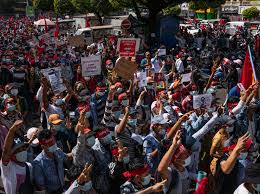
Protests continue in Myanmar against the military coup

At its AGM today (13th March 2021) the British based international solidarity organisation, Liberation, adopted the following statement in support of the people of Myanmar who have taken to the streets in protest since the military coup on 1st February 2021.

The mass upsurge in Myanmar against the military takeover has engaged peoplefrom all walks of life, who have been out on the streets in recent weeks protestingagainst the brutal suppression of democracy.

The Tatmadaw (Myanmar armed forces) staged the coup on 1st February, the day the new parliament was to open, after the general election in November 2020.

The election had resulted in a landslide victory for the Aung San Suu Kyi-led National League for Democracy (NLD). However, the army declared the results tobe illegal and deposed President Win Myint and State Counsellor Suu Kyi. They andother NLD leaders have been arrested and detained.

The armed forces had ruled Myanmar for decades since the military coup of 1962. The movement for democracy achieved a breakthrough in 1981 but it was brutally crushed by the army. Suu Kyi was put under house arrest for sixteen long years.

After much pressure, the army conceded some powers, and a hybrid democratic system was put in place based on the 2008 Constitution adopted by the army. Under this system, the army still held key powers; 25 per cent of the seats in the two houses of parliament were reserved for military nominees.

For the first time, in 2015, the NLD contested the elections, winning over 80 per cent of the seats in the two houses. Suu Kyi could not assume the post of head of government, the constitution barring anyone with a foreign spouse from holding that office, so she was made a State Counsellor and was the de facto prime minister.

In the 8th November 2020 general election, the NLD improved its position by winning 258 out of the 310 seats in the House of Representatives and 138 of the 168 seats in the House of Nationalities. The military-backed Union Solidarity and Development Party (USDP) only gained 26 seats and 5.9 per cent of the vote in the lower house.

Frustrated by this result, the armed forces declared an emergency under a constitutional provision and said it would last for one year after which fresh elections would be held.

The vested interests exercising political and economic power through the armed forces’ elite were getting threatened by the growing electoral legitimacy of the NLD and its leader. The higher echelons of the armed forces have built up a powerful network of patronage and business interests in the country. Some of the lucrative sectors like precious gems, timber and mineral resources are controlled and plundered by enterprises run by generals and former members of the officer corps.

The armed forces had thought that the USDP would gain enough strength to checkmate the NLD and Aung Suu Kyi, not expecting that, in both the 2015 and 2020 elections, the NLD scored over 80 per cent of the seats in the non-military sector.

That the armed forces are completely isolated from the people has become evident in the recent protests. Significantly, the bulk of civil servants, health workers, power sector employees and railway workers have joined the mass protests and gone on strike.

Faced with the growing protests, the police and the army are now resorting to repressive tactics including firing on peaceful protestors. Hundreds have already been arrested and put in jail.

The return of military rule clearly further threatens the position of the Rohingya population in Myanmar, stripped of their citizenship and subject to human rights abuses since the push in the late 1970’s to expel them from Myanmar.

In giving our full backing to the progressive campaign for the return of democracy in Myanmar Liberation will:-

• encourage progressive MPs to find ways to promote the return to democracyin Myanmar;

• call for an end to military rule and the restoration of democracy;

• demand the release of all detainees; and

• call for the safeguarding of the lives, human and democratic rights, and livelihoods of the Rohingya population as well as the state recognised ethnic minority groups like the Chin and Kachins in Myanmar.

In an impressive show of solidarity the people of Myanmar are bravely facing the might of the military. For decades, the people of Myanmar were under the brutal heel of a military dictatorship. They have now resolved not to allow this to happen again. They deserve our ongoing support and solidarity.

Further information on the work and activities of Liberation can be found here

https://liberationorg.co.uk/

Tories test the limits

6th March 2021

NHS staff – lives on the line during the pandemic

The Tory promise to ‘level up’ the country was never more than hollow rhetoric designed to shore up votes in constituencies Labour surrendered at the last General Election.  The Tories are only ever interested in levelling up the bank balances of their friends and backers, in order to keep their grip on the reins of power and keep the balance in the political establishment.

The levelling up confidence trick is underpinned by a £4.8bn Levelling Up Fund, allegedly designed to assist regions struggling to adjust to post industrial underinvestment and austerity, ironically key planks of Tories regional policy for decades.  The fund is designed in three tiers, prioritising those areas which require the greatest assistance.  Local authorities across England will be invited to apply to the fund, which will be competitive, in order of priority.

The outcomes for unsuccessful bids, in areas deemed to be in need of assistance, is the kind of conundrum only the Tories could dream up.  Still, consistency has never been a Tory strong point as any analysis of the 93 areas in the top tier eligible to bid to be levelled up illustrates.

Of the areas designated tier 1 there are 31 which are not in the top third most deprived places by indices of deprivation.  Of this 31 there are 26 which have Tory MPs across the whole area while the others have at least one Tory MP.

Four places in tier 1 are in the bottom third of English regions by deprivation, that is not deprived at all, including Richmondshire in North Yorkshire, which is not only in the top fifth of most prosperous places in England but is represented by Rishi Sunak MP, currently Chancellor of the Exchequer.  Perhaps the people of Richmondshire are feeling deprived relative to Knightsbridge and need to be levelled up within their privileged social sphere?

It gets better.  The Tories also have a scam going called the towns fund, for which Sunak announced an extra £1bn in the budget.  This week saw 45 towns added to the list, of which 39 have a Tory MP.  Any sign of a pattern emerging here?

Boris Johnson has responded in his usual comprehensive manner stating,

“I’ve asked about this and I’m told that the criteria was entirely objective – it takes in data on poverty, employment and so on.”

Sunak has followed up with the assertion that assessments were “based on an index of economic need, which is transparently published.”  What is transparent is the Tories desperate need to find ways to distract the public from their catastrophic handling of the pandemic by pretending that they care about the areas of highest deprivation and vulnerable communities.  It really will not wash.

Not content with handing out contracts worth billions to friends and neighbours to deliver dodgy PPE or run failing test and trace systems as part of the pandemic, the Tories now claim that they cannot afford more than a 1% pay rise for nurses and medical staff.  This is on top of the pay freeze for other pubic sector workers, many of whom have also worked through the pandemic to ensure the delivery of essential services and care to communities.

Quite righty though, it is the cavalier treatment of NHS staff that is drawing public ire and showing the Tories in their true colours.  Warm words at the height of the crisis and polite applause outside 10, Downing St are looking exactly like the shallow gestures they always were. 

It is ironic that the NHS Pay Review Body claims that

“Covid-19 has placed a huge strain on both public and NHS finances.  The economic outlook for 2021/22 remains uncertain and pay awards must be both fair and affordable.”

If only the same were true of the government’s contract procurement process!

The treatment of NHS staff only adds to the national scandal that is the government’s handling of the pandemic.  Is it any wonder that nurses are now talking of strike action?  NHS staff have been taken to the limit, literally putting their lives on the line, over the past year. They deserve better and it is the Tories who must now be taken to the limit and, without ceremony, dropped over the edge.

Solid Foundations

4th March 2021

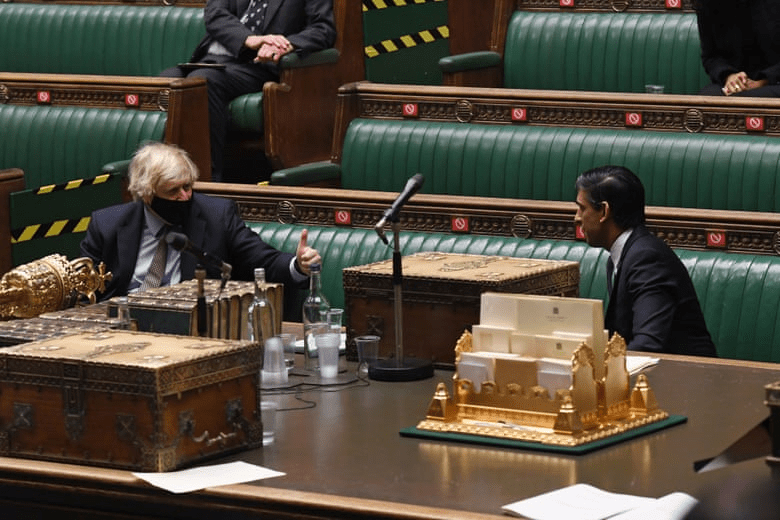
Partners in crime – Boris Johnson and Rishi Sunak after yesterday’s budget speech

The Budget delivered by Chancellor Rishi Sunak yesterday was never going to fundamentally change the UK economy in such a way that it would ‘level up’ in favour of working people.  As expected, Sunak has merely applied a sticking plaster over a gaping wound, by favouring short term measures to alleviate some of the worst excesses of the pandemic, over long term structural change.  

Some of these measures, the extension of the furlough scheme, additional help for the self-employed, extending the £20 per week Universal Credit top up, will be welcomed by those struggling to make ends meet, who live in fear from one government announcement to the next that the safety net may be withdrawn.

Sunak was keen to portray these measures as an indication of government magnanimity, that in the face of the uncontrollable force of the pandemic the government has taken steps to protect those most at risk and most vulnerable.  Sunak was keen to make it sound as if the government cares.  The increase in Corporation Tax, from 19% to 25% in two years time even gave Sunak cover to suggest that the burden would be shared and even the biggest corporations would be made to pay their share.

This political conjuring is only to be expected from the Tories.  Big corporations in Britian have been getting away with some of the lowest levels of corporation tax in Europe for years, abjectly failing to pay their share while the NHS and local authority run services have had to struggle under the burden of austerity, to pay off the bankers gambling debts from the 2008 crash.

It is easy to see the pandemic as an uncontrollable force.  The fact of it happening may not have been immediately predictable but the response to it has been very much in the hands of governments around the world.  Britain still leads the European league table for death rates, at over 120,000, a national scandal barely acknowledged by the right wing press and BBC. 

The hardest lockdowns have produced the most effective results, in China, Vietnam and New Zealand, where it has been recognised that public health cannot simply be sacrificed on the altar of private profit.  Ironically, having put public health first, these are the places where economic recovery is returning most strongly.  Conversely the United States, Britain and Brazil not only see escalating deaths but flagging economic recovery.

Sunak may be able to bathe in the congratulations of the Tory backbenches for a while.  He may even win the praise of a few hard pressed families desperate to hang on to what little they have in the short term.    The City of London and corporations may whinge a bit about corporation tax but they know they can both afford and absorb a modest increase.  There is no wealth tax or windfall tax on companies which have profited from the pandemic.  There is no indication that the billionaires who have increased their wealth by over £25bn during the pandemic are going to feel any pain.

Frontline staff in the NHS, social care and local government did not warrant a mention in the budget.  Yet this is where the real work of recovery is happening.  The vaccination programme being driven, not by entitled members of the House of Lords, but frontline staff and volunteers working to help out in their local communities.

Even Labour leader, Kier Starmer, not famed for his radicalism, accused Sunak of “papering over the cracks rather than rebuilding the foundation” going on to call for a budget “to fix our economy, to reward our key workers, to protect the NHS and to build a more secure and prosperous economy for the future.”

That would certainly be a start.  Those who have lost their livelihoods as businesses fold, find themselves in increasing debt as bills come in, or have lost their jobs as unemployment escalates, may increasingly find that they need even more.  Rebuilding the foundation is all very well but if the foundations are built upon capitalist economics they will be poorly embedded and prone to crumble in the next economic storm.

Solid foundations will need to be built from socialist bricks. That will not only require radical new architects with a vision for the future but a whole new firm of builders.

Trident – Deterrence or dependence?

27th February 2021

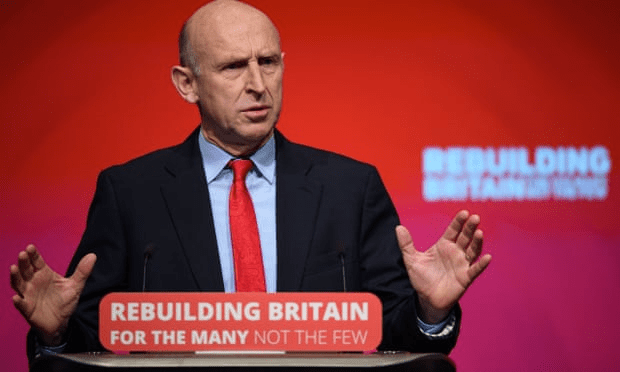
Healey – unshakable committment?

The transition of the Labour Party back towards being a fully fledged party of the UK political establishment took another step this week when Shadow Defence Secretary, John Healey MP, committed Labour to re-commissioning the Trident nuclear weapons system.

It may be argued, with some justification, that Labour has never strayed from the political mainstream and Healey’s speech, on one level, was merely reaffirming existing party policy.  Politics however rarely functions on just one level and the subtext underlying Healey’s words were clear.  This is Labour departing from the political direction in which the party was pointing under Jeremy Corbyn.  This is Labour making clear its patriotic credentials.  This is Labour wrapping itself in the union flag.

Corbyn’s opposition to Trident was well known.  As a lifelong member of the Campaign for Nuclear Disarmament, a profound sceptic in relation to Britain’s membership of NATO and a consistent opponent of military wars of intervention, Corbyn did not cut the kind of patriotic figure in whose hands the establishment could feel entirely comfortable. 

History will no doubt judge that, in the grand scheme of things, the four years of Corbyn leadership was a relatively modest challenge to the political orthodoxy.  The fact that they had to go to such lengths to snuff it out says as much about their sense of insecurity as it does about the scale of the threat.

Nevertheless, Healey’s words at the Royal United Service Institute, were aimed to reassure the military industrial complex that their profits remained safe.  Labour’s commitment to retaining nuclear weapons was described as “non-negotiable”, a degree of emphasis only matched by Healey’s assertion that “Labour’s commitment to NATO is unshakable.”  In case the message was not absolutely clear Healey went on to position Labour as “the party of sovereign defence capability.”

The pill was sugar coated in the usual way.  Labour would be committed to international law and upholding human rights.  Why would it not? Labour would be committed to direct investment into British industry as a priority.  Again, why would it not?  The real question is whether either of these commitments are sufficient justification to spend billions on weapons of mass destruction.

Added irony comes from Healey’s speech being set against the debate about what Chancellor, Rishi Sunak, should include in his budget this week and how far tax rises will be necessary to help pay for the consequence of the pandemic.  Labour leader, Keir Starmer, has already said that this is not a time to tax business and families. 

However, Starmer has made no commitment to supporting the recent Wealth Tax Commission report, which demonstrated clearly that a windfall tax upon the wealthiest, levied over a five year period, would go a long way towards covering the costs associated with the pandemic.  Add to that the saving from not buying into Trident and Starmer’s fears for business and families could be easily allayed.  Such thoughts are, unfortunately, too far from the political mainstream for the Labour leader.

A further dimension to the timing of Healey’s speech was the fact that, after a mere 35 days in office, US President Joe Biden ordered his first illegal air strike against targets in Syria, a war in which the US has no legal right to intervene.  The role of the US and its NATO allies in Syria has been to exacerbate tensions in the Middle East, in an attempt to shore up US strategic interests in the region.  As the Stop the War Coalition has pointed out,

“The US still has 2,500 troops in a country which they have devastated since they invaded in 2003.  Biden is following in the footsteps of his predecessors despite all evidence that military interventions do nothing but create destruction and misery and the conditions for future wars.”

This is the alliance to which Healey and Starmer are saying Labour’s commitment is “unshakable”.  This is the alliance which has actual control over the Trident nuclear weapons system, not the UK as an independent nation. 

Buying in to Trident is not about deterrence, it is about dependence.  That dependence is military, political and technological.  It provides no protection in classic military terms and is a threat to jobs due to the constraint upon investment it represents, diverting billions into weapons of mass destruction rather than socially useful production.

Labour’s position on spending billions on Trident is shameful and should be opposed at every level of the Labour movement, linked to a plan for job creating investment in new technology and green solutions to the climate challenge.  That would be the start of a radical programme for change and one to which millions would sign up.

Labour needs a real contender

20th February 2021

Labour leader Kier Starmer – will he ever be a contender?

Latest opinion polls currently show a Conservative lead over Labour of between 2% and 6% with most leaning towards the upper end of that spectrum.  This comes almost a year after the first COVID-19 pandemic lockdown; the infection spreading Eat Out to Help Out farrago in the summer; the slightly less than ‘world beating’ test and trace programme; the debacle over school examinations; the equally diabolical return to campus of university students; a second lockdown; the dithering over who could see whom , where and when at Christmas; a wave of infection sweeping the country since the New Year; a third lockdown; the death toll heading towards 120,000, the highest in Europe; and the poorest prospects for recovery of any G7 economy.  

This catalogue of calamity does not even include the amateur approach to the Brexit negotiations, being shamed into feeding poor children during school holidays or the lack of insight that allowed Dominic Cummings, with his poor eyesight, take a trip to Barnard Castle.

Even with the collusion of the right wing press and the BBC, determined to emphasise the positives of the successful vaccine roll out, the government record of handling the pandemic is nothing short of a national scandal, which should be hitting the headlines as such. At the very least it would be expected that some of the Opposition punches would land and that the government, if not on the canvas, would at least be on the ropes.

The problem is that in the red corner, the Kier Starmer led Labour opposition have not only failed to land any punches, they have not even laced up their gloves!  In fact Labour have spent more time reassuring the government that they are not really in the red corner at all but are merely a paler shade of blue, quite happy to cosy up in the blue corner and try to persuade the audience that there is nothing to see here, there is no fight.

Labour have come to such a pass by flying the flag of ‘national unity’, not wanting to create strife and division at a time of national crisis, not wanting to ‘play politics’ with the pandemic.  This is the politics of ‘playing fair’, obeying the rules, being decent chaps.  The Tories meanwhile are making hay whether the sun shines or not, crisis or no crisis, with contracts awarded to cronies left, right and centre without so much as a tip of the hat to fair procurement practices, experience in the field of PPE manufacture, pandemic management or public health awareness.

However much the business sector whinge about the economy being closed down there are plenty of the Tories’ mates who have made a tidy sum from the pandemic and appear to have no compunction in profiting from the deaths of thousands.

Kier Starmer made a ‘big speech’ this week setting out Labour’s position.  We know it was a big speech because the public relations trailers told us so, but it would have been difficult to recognise as such otherwise.  

So, what is the inspiring vision set out by Starmer?  Well firstly Labour would “forge a new contract with the British people, introducing British Recovery Bonds to give households a stake in our country’s future and a role in creating the infrastructure of tomorrow.”

Really? If this was tripping off the tongues of those in Labour’s focus groups they were talking to the wrong people! However, there is more…

“Together, we would invest in a new generation of British entrepreneurs by providing start-up loans for 100,000 businesses, making sure support and opportunity is spread across the country.”

Top of the list when you cannot pay the rent, feed the kids or find a decent job!  Way to go Kier!

Finally, a modicum of reality poked through as Kier promised that in,

“Reversing Tory cuts to Universal Credit, properly funding local councils, giving our key workers the pay rise they deserve – there is a real alternative to Boris Johnson’s approach.”

On a more philosophical note Kier also acknowledged that,

“Coronavirus has pulled back the curtain on the deep inequalities and injustices in Britain, as a result of a failed ideology that weakened Britain’s foundations and left us exposed to the pandemic.”

That failed ideology is capitalism, if only Starmer would spell it out, the deep inequalities and injustices are as result of its endemic exploitative character.  No amount of recovery bonds will change that.

No Labour leader yet has made a call for revolution and no one is expecting that from Starmer.  However, investment in Council housing; tackling Rachman landlords; investing in comprehensive education; taking away the ‘charitable’ status of the private education sector; committing to abolish Trident nuclear weapons; investment in job creating green technology, all of these things and more are possible under capitalism and would be a popular campaigning platform.

More will be necessary to achieve the real shift in the balance of power needed to move towards a socialist economy.  However, indicating some intent to move in that direction would be a start.  Starmer needs to limber up and get himself into the ring or make way for a real contender.

Vaccination progress but no quick fix

14th February 2021

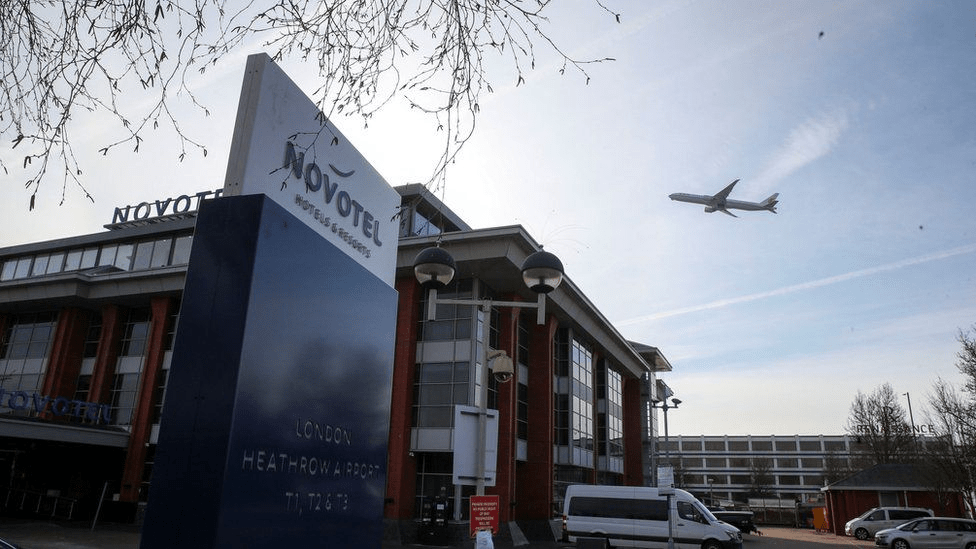
Concern for workers at Heathrow as the quarantine programme begins

As the vaccination programme across Britain continues its, so far, successful community roll out, pressure is inevitably mounting from the business sector to open up the economy still further.  The hardline Tory MPs, who make up the so called Covid Recovery Group, are calling for the complete opening up of the economy by the end of April.  That such a move would inevitably expose more workers to the dangers of infection does not seem to be high on the list of their concerns or those of employers, keen to return to profit in order to assuage hungry shareholders.

Those in work, unable to work from home, are already in the frontline.  So far there have been no prohibition notices served upon employers by the Health and Safety Executive (HSE) regarding workplaces not being Covid Secure, even though there have been 3,500 outbreaks since the start of the pandemic.

These dangers mean that many workers, struggle to subsist on reduced furlough income or worse still Universal Credit, while others are forced into calculating the risk of attending a COVID insecure workplace compared to the certainty of ongoing poverty.  The struggle for many to self isolate is a real one. 

There are growing concerns that vaccination take up amongst care home staff is too low, if protection of the most clinically vulnerable is to be effective.  A recent survey by the Royal College of Nursing (RCN) also estimated that 15% of nurses remain unvaccinated.  Both sets of workers are amongst the most vulnerable due to their frontline work but also due to their low pay and the pressure to stay at work.

In the wider community the situation is further fuelled by a barrage of misinformation perpetrated by vaccination deniers, including Members of Parliament, muddying the waters.  Conspiracy theories range from the vaccine being a means of microchipping the population by the government, to the fallacy that the vaccines contain animal products which may contravene the lifestyle choices or religious beliefs of many.

In spite of this ongoing battle with ignorance the army of NHS staff, local government workers and volunteers continue the task of pushing ahead with the vaccination programme.  All over 70 year olds and those in the higher vulnerable groups will have been offered a vaccine by next week, most will have gladly taken up the offer.  More than 90% of over 75 year olds in the UK have had their first dose.

It is notable that the success of the roll out so far has been due to mobilisation at a local level.  No centralised awarding of contracts to national companies with no public health experience, no high profile government crony appointments to oversee the system.  Just local NHS, local government and voluntary sector organisations on the ground co-operating to deliver the best for their communities.

As long as vaccine supplies can be ensured, an area in which national government unfortunately has to play a role, the local vaccination programme will continue to be delivered.  National government action however continues to be necessary in implementing measures to suppress the spread of new variants, to ensure that all of the effort going on at a local level is not in vain.

To that end the pressure upon the government to close borders has resulted in an initial ‘red list’ of 33 countries being identified.  Travellers into England from these locations, from 15th February, will have to undertake hotel quarantine for 10 days with testing on day 2 and day 8 of their stay.  In Scotland all inbound travellers will be required to undertake the 10 day quarantine period. All inbound travellers will continue to be required to provide proof of a negative coronavirus test to enter the country.

A new department has been set up within the Department of Health and Social Care (DHSC) that will be leading the transfer of passengers from the 33 red-list nations from airports to hotels to begin their 10-day quarantine.  However, neither the police nor Border Force were told who is running the new department, which is understood to be called Managed Quarantine Services.

There are other potential flaws in the plan.  The proposed £1,750 hotel cost may be prohibitive for some.  There are no plans for the regular testing of hotel and security staff.  England’s Department of Health said plans for a “bespoke service” for staff testing were being developed but it could not confirm whether it would be ready for the start of the policy on 15th February.  Over half of the countries with identified cases of the South African variant of COVID 19, against which existing vaccines are least effective, are not on the list.

A spokesman at Heathrow Airport, one of five in England where people requiring hotel quarantine can enter the UK, expressed frustration with the government stating,

 “We have been working hard with the government to try to ensure the successful implementation of the policy from Monday, but some significant gaps remain.  Ministers must ensure there is adequate resource and appropriate protocols in place for each step of the full end-to-end process from aircraft to hotel to avoid compromising the safety of passengers and those working at the airport.”

Nadine Houghton, GMB National Officer representing workers at Heathrow said,

“If you’ve got people getting off planes from the red list countries, then being crammed into areas with passengers who aren’t going into quarantine – and staff as well- you’ve failed at the first hurdle.”

Calls for a blanket quarantine of 14 days for all arrivals in the UK are growing, with experts pointing to the stricter measures taken in China, Australia and New Zealand as having had a significant impact in suppressing outbreaks.

With the government promising a ‘road map’ announcement on 22nd February it is vital that the success of the local vaccination roll out programme is not undermined by those looking to relax measures too quickly.  If the elderly, the vulnerable and those in challenging low paid work are to stand any chance of staying safe, the government must not be swayed by those seeking to make a quick profit.

US Foreign Policy – back to business as usual?

6th February 2021

US Foreign Policy – back to business as usual?

Biden’s first foreign policy speech – US business as usual?

“America is back, diplomacy is back”; the words of Joe Biden in his first foreign policy address this week as US President.  Biden was clearly using the phrase to draw a line under the past four years and distance himself from the Make America Great Again rhetoric of Donald Trump.  Biden’s words are unlikely to be worn across baseball caps by his supporters but in its own, less belligerent way, Biden’s phrase is still a variation on the theme of making America great again.  Making America great has, in one way or another, been the theme of US foreign policy for over a century.

As Biden made clear,

“There’s no longer a bright line between foreign and domestic policy. Every action we take in our conduct abroad, we must take with American working families in mind.”

Which is not to say that Biden will not do things differently to Trump.  In some areas he will. The temporary ban on weapons sales to the Saudi Arabia led coalition which has been bombing schools, hospitals and communities in Yemen since 2015 looks like being firmed up.  Biden did not cut the Saudis loose entirely though, promising to continue to help Saudi Arabia “defend its sovereignty and territorial integrity.”

Biden has made no secret of his desire to take a more strident tone with Russian President Vladimir Putin, though actual policy substance may not differ greatly.  Biden was clear that Defence Secretary Lloyd Austin will conduct a review of the US global force posture to ensure that the US “military footprint is appropriately aligned with our foreign policy and national security priorities”, a warning signal to Russia and the growing military and economic power of China.

In the Middle East Secretary of State, Anthony Blinken, has restated Biden’s commitment to reconsider US withdrawal from the Joint Comprehensive Plan of Action (JCPOA), known as the Iran nuclear deal, agreed with Iran in 2015 before US violation in 2018 led to withdrawal. 

US return to compliance with the JCPOA is by no means unconditional, with Biden wanting to make Iranian compliance in a number of “deeply problematic” foreign policy areas outside of the deal a requirement before the easing of US sanctions, tightened by Trump in 2018 after US withdrawal.

While Iran has welcomed the fact that Biden presents the opportunity to step back from the abyss the two countries were staring into following Trump’s action, they still want a return to the 2015 deal as agreed, without additional conditions.  The Islamic Republic is not short of hardliners of its own, willing to continue a face off with the ‘Great Satan’, though more pragmatic voices recognise that the economy is on its knees and an increasingly rebellious population could threaten the foundations of the theocracy itself. An easing of sanctions is seen as an opportunity to at least buy time.

Biden and his Vice-President, Kamala Harris, have made no secret of their pro-Israeli position when it comes to the politics of the Middle East.  While the love-in Benjamin Netanyahu enjoyed with the Trump administration is unlikely to be sustained, Israel’s role as the eyes, ears and, where necessary, military proxy of the US in the Middle East is unlikely to be threatened. 

Negotiation and diplomacy may be back on the agenda in the Middle East.  However, with regard to the question of Palestine, Israeli withdrawal from the illegally occupied territories and insistence on compliance with international law, flouted by Israel for over half a century, may be a challenge too far for Biden.

The United States has form of its own in this area, which continues to undermine any claim it may have to a moral high ground on the issue of compliance with international law.  As well as the illegal detentions which continue at the Guantanamo Bay prison camp, the United States persists in its 60 year long illegal economic blockade of Cuba.  The degree of détente introduced under Barack Obama, a first step towards the normalising of relations between the two countries, was quashed by Donald Trump.

In a final vindictive act, Trump added Cuba to the US list of ‘state sponsors of terrorism’ in the weeks before leaving office.   Given the number of terrorist acts sanctioned by the United States against the people of Cuba over the years, to suggest that this was ironic would be mild understatement.  Since 1959 over 3,000 Cubans have lost their lives to terrorist acts, most of which emanated from the United States.  It is vital that Biden takes Cuba off the list, ends the blockade and begins the normalising of relations with Cuba, if any claim of a new page in US foreign policy being turned is to be taken seriously.

Famously regarded by the US as its ‘backyard’ the relationship of the superpower to its neighbours to the south in Latin America has historically been characterised by subterfuge and illegal intervention. From the coup d’etat in Chile, undermining the Sandinistas in Nicaragua, gun running in El Salvador, invading Grenada, the list goes on. 

More recent examples include covert support for the coup in Bolivia and ongoing attempts to undermine the government of Venezuela.  Such interventions must stop and Latin America must be free from US interference.  Whether the corporations who have so much investment in maintaining low pay, poor working conditions and under privilege in Latin America will give Biden any latitude remains to be seen.  History points in the opposite direction however.

The rhetorical flourish and embellishment of the daily tweets from Donald Trump may be gone.  The sense of unpredictability about the position of the US in the international arena will go.  The tone of the Biden administration will no doubt aim to be one of calm and stability.  While that may be a relief in many respects, given the rollercoaster ride of the past four years, the message that US foreign policy is back to business as usual will, for many, not be as reassuring as Biden may like to think.    

Payback time for Tories

26th January 2021

Boris Johnson – facing the grim reality?

More than 100,000 people in the UK have died as a result of COVID-19, according to the latest official figures.  The Prime Minister, Boris Johnson, claims that the government have done everything in their power to save lives.  That is not true.  At every stage of the pandemic the government have made decisions driven by economic imperatives rather than public health concerns.  

The government dithered initially about locking down the economy; failed to set up an effective test, trace and isolate system; gave out optimistic signals that Easter, Summer then Christmas would be the point at which the death toll would slow down and the government would ‘control the virus’.

Mask wearing took months to become the norm, schools re-opened in September and, along with the impact of the summer Eat Out to Help Out scheme, saw the beginning of the second spike in infection rates.  The furlough system has been a lifeline for some but many more still cannot access support other than through Universal Credit.  Even there the additional £20 which the government provided to help the most vulnerable is in danger of being withdrawn at the end of March.

Thousands of jobs are being lost with 25,000 in the retail sector alone this week.   On the day the death toll crossed the 100,000 line the highest unemployment figures in the UK for five years were announced, with 418,000 people losing their jobs in the last year alone.  That is not a coincidence, that is negligence on the part of a government that can neither protect the population through its public health measures, nor sustain the economy it claims it is doing its best to protect.

The inept test and trace system fails fundamentally because people in a zero hours and low pay economy cannot stay at home and self isolate, for the simple reason that they cannot afford to do so.  Unless the government addresses this fundamental issue infection rates amongst the poorest communities will continue to rise.

The highest death toll in Europe, the fifth highest death toll in the world.  What has happened in the UK over the past year is a national scandal.  The government’s response has not only failed to tackle the issues at the core of the rising rate of infections but at every turn has compounded them, resulting in thousands of unnecessary deaths.

It is ironic that Johnson’s Brexit campaign rhetoric placed so much emphasis upon the UK taking back control of its borders.  Any measures to actually do this, which may have helped stem the flow of infection through minimising cross border traffic and quarantining visitors, have only been under consideration in the past week.

The light at the end of this very long tunnel is the vaccination programme.  The government will try to milk whatever credit it can from the fact that the roll out is, at present, reaching thousands every day.  That this is good news cannot be denied, although Big Pharma will no doubt see a profit, but it should not get the Tories off the hook.

The virus has been catastrophic for working class people and their families.  It has hit working class communities the hardest.  Its long term effects in both health and economic terms will stay with the working class for longer and recovery will be slower.  Recovery for employers will mean maintaining low pay and trying to maximise profits, given the additional pool of labour created by the crisis, the additional numbers desperate for work.

This is the very nature of capitalism, exposing the Tories’ protection of their class, their interests, at the expense of those who are the real wealth creators.  The wealthiest have not lost out in the pandemic nor have they been made to pay their share.  The working class have suffered over ten years of austerity, paying off the gambling debts of bankers following the 2008 crisis.  It is time for payback, in every sense.

Israeli apartheid exposed

23rd January 2021

Mural in Gaza highlighting the impact of COVID-19

The Israeli democratic rights group, B’Tselem, which tracks human rights violations, published a report this month claiming that the Israeli state is effectively running a system of apartheid in relation to its treatment of the Palestinian population in the occupied Gaza Strip and West Bank.

“Israel is not a democracy that has a temporary occupation attached to it,” said the body’s executive director, Hagai El-Ad. “It is one regime between the Jordan River to the Mediterranean Sea, and we must look at the full picture and see it for what it is: apartheid.”

The response of the Israeli establishment has been predictably dismissive with Ohad Zemet, the spokesperson for Israel’s UK embassy, dismissing the report as “a propaganda tool”, stating that,

“Israel rejects the false claims in the so-called report as it is not based on reality but on a distorted ideological view.”

B’Tselem’s report illustrates that Israel has created a system over all of the state of Israel and the illegally occupied territories, in which Jewish citizens have full rights.  Palestinians on the other hand are divided into four tiers with various levels of rights depending on where they live, but always below Jewish people.

At the lowest end are the roughly 2 million Palestinians in the Gaza Strip, ruled by the militant group, Hamas, subject to an Israeli blockade, which effectively gives the Israeli state complete control over people, goods and services which can enter or leave the territory.

Only slightly better off are the roughly 2.7 million Palestinian “subjects” in the West Bank, who are described by B’Tselem as living in “dozens of disconnected enclaves, under rigid military rule and without political rights”.

The roughly 350,000 Palestinians who live in East Jerusalem fare marginally better.  Although Israel has offered citizenship to these residents, many have refused on principle and the rejection rate is high for those that try.

Palestinian citizens of Israel, also called Arab-Israelis, have full citizenship and make up about a fifth of the population of Israel. However, as B’Tselem point out, they are also subject to land ownership discrimination, immigration laws that favour Jews and laws that give Jewish people extra political rights.

While Israeli Prime Minister, Benjamin Netanyahu, has put on hold plans to annexe part of the West Bank, B’Tselem argue that there is already a “de facto” annexation, with more than 400,000 Jewish settlers living there and enjoying the same rights, and many of the same services, as other Israelis.

The report comes at a time when the Israelis are gaining huge international media profile for their COVID-19 rapid vaccination programme, with 25% of the 9 million population already having had a first shot and 850,000 a second jab, including 80% of the population over 60 years old.

However, while the Jewish population enjoy the benefits of vaccine protection the Palestinian population are excluded from the programme.  In the West Bank the vaccine is distributed to Jewish ‘settlers’ but not to the Palestinian population.  In Gaza the impact of the Israeli blockade makes a desperate situation even worse, with even routine medical supplies being difficult to access.

The route to the vaccine for Palestinians is through the World Health Organisation (WHO) programme, Covax, designed to support poorer nations gain access to vaccines.  Even this route, should supplies get through, would only see vaccines reaching the Palestinian population by mid-February at the earliest.  Gerald Rockenschaub, the head of office at WHO Jerusalem, said it could be “early to mid-2021” before vaccines on the Covax scheme were available for distribution to the Palestinian territories.

While Israelis claim that they are not responsible for the Palestinians in the occupied territories, the ongoing occupation places humanitarian and legal obligations upon the Israeli state.   Moreover, while the Israeli rapid vaccination programme aims for a quick return to some form of normality, Palestinians could remain trapped by the virus. That may have a negative impact on Israel’s goal of herd immunity, as thousands of West Bank Palestinians work in Israel and the settlements, which could keep infection rates up.

Israel’s obligations under international humanitarian law include a duty to maintain “public health and hygiene in the occupied territory, with particular reference to the adoption and application of the prophylactic and preventive measures necessary to combat the spread of contagious diseases and epidemics” (Article 56 of the Fourth Geneva Convention).

The Palestine Solidarity Campaign (PSC) has placed particular emphasis upon the plight of those in the blockaded Gaza Strip stating,

“Israel’s blockade on Gaza will have catastrophic effects on the spread and fatality of coronavirus within the besieged strip. We must urge the UK to use its diplomatic power to put end to this, so that Palestinians can gain access to the healthcare they need during this crisis.”

The Israelis continue to claim that they are not presiding over an apartheid regime.  On this evidence it is difficult to see how else to characterise it.

While the likelihood of the British government taking up the Palestinian cause is slim, the same can also be said of the Labour opposition.  Labour leader, Kier Starmer, has just appointed former Israeli spy, Assaf Kaplan, to a key post in his office to manage social media output and surveillance.

Kaplan spent five years in Israeli military intelligence cyberwarfare outfit, Unit 8200, specialising in spying, hacking and encryption.  This included spying on Palestinian civilians living under Israeli occupation.

The appointment hardly inspires confidence that the Leader of the Opposition’s Office will be providing objective information on the situation in the occupied territories and the Middle East generally.

PSC has asked Keir Starmer to make a public statement making clear his abhorrence of the activities of Unit 8200, in accordance with Labour’s stated commitment to an ethical foreign policy rooted in respect for international law and human rights. PSC have also demanded that he should outline the steps he has taken to ensure that these values are held by all of those working in his office.

More information on the Palestine Solidarity Campaign can be found here https://www.palestinecampaign.org/

Inauguration Day – one more test

17th January 2021

Trump supporters – no let up in conflict likely

The self styled “land of the free and home of the brave” will this week inaugurate its 46th President, Joe Biden, inside a capital that has effectively become a military fortress, with the deployment of an estimated 20,000 troops across the city.  Washington DC has been transformed, since the Donald Trump inspired neo-fascist storming of the Capitol building last week, in the failed attempt to subvert the confirmation of the election outcome.

The militarisation of Washington for the Inauguration Day ceremony on 20th January is a reflection of the ongoing threat of neo-fascist violence to which the Trump presidency has given licence.  That threat is, according to the FBI, a real and present danger in the capitals of every state across the so-called United States, with gun toting white supremacists threatening a show of strength across the country in opposition to Biden’s presidency.

The tension across the United States is reflected in the fear expressed by those opposed to Trump, as reported this week by the People’s World,

“One thing Trump has clearly been successful with is instilling fear in anyone thinking of coming out against him. People with anti-Trump t-shirts and bumper stickers and those with Biden-Harris signs in windows or on cars are removing them, also out of fear for themselves or their property. A young couple with a reputation in the Hyde Park section of Chicago for driving a car with no less than 30 bumper stickers promoting liberal causes said they spent time Thursday soaking and removing them.”

Through the variety of social media platforms used by right wing groups, neo-fascists across the US are calling on people to join a so called Million Martyr March on Inauguration Day.   The same right-wing groups have been known to use a wide variety of tactics to achieve their ends, including posing as left or progressive activists to smear the reputation of those groups, as well as mounting attacks on police departments that they think are not right-wing enough for them.

The reality of institutional inequality and racial injustice in the United States has been brought to the fore in recent months with the resurgence of the Black Lives Matter movement and the anti-Trump coalition which has delivered Biden the presidency. 

However, while the challenge for Biden has been exposed by the four years of Trump’s presidency the underlying rot in the United States had taken firm hold long before.  In 2016, after eight years of Barack Obama’s presidency, the Pew Research Center thinktank estimated that the median wealth of white households in the US was $117,000, ten times that of black households at $17,100.  This was larger than in 2007, the year before Obama was elected.

Pew also estimates that income inequality in the US increased by 20% between 1980 and 2016.  The Economic Policy Institute estimates that Chief Executive Officers have seen salary rises of 940% since 1978, while the typical workers wage rose a mere 12% over the same period.

Racial division is used by the right wing in the United States to mobilise disaffected poor whites but it is clear that the real divide in the US is along class lines.  Racial prejudice is used, as ever to divide and rule as the US establishment fears, more than anything else, a united working class response to oppression and injustice.

The constitutional consensus which has sustained US capitalism in its one system, two parties approach has been breached in the past four years.  The final days of the Trump administration have been designed to ensure that the breach in the system cannot be closed and that the ‘healing’ of Joe Biden’s rhetoric cannot occur.   

Inauguration Day this week will be one further test but it will by no means be the final battle.  Republicans are already looking ahead to 2024 and planning a way to regain the White House.  Trump himself, or a family member, may be deemed a step too far for some Republicans but acolytes, such as outgoing Secretary of State, Mike Pompeo, are not just waiting in the wings but are actively planning a path to the Republican nomination.

As a recent People’s World article concludes,

“Unless the mass movements and broad coalitions that ousted Trump and elected Biden remain united and continue their fight for social and economic justice, what happens in this country over the next few years will likely be much worse than what happened in the Capitol last week or what will happen next week in our country.”

The scenes from the United States last week shook the world but they are unlikely to be the last we see the as the struggle escalates.  Working class unity, in the face of the onslaught, will be more vital now than ever.