Iran – executions of protesters underway

17th December 2022

 Protests continue across Iran in spite of the regime’s crackdown

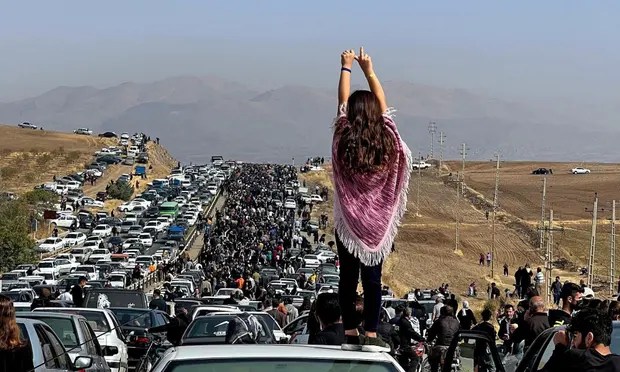
Since the murder of 22 year old, Mahsa Amini, by the Iranian morality police in September, nearly 400 protesters are known to have been killed, including 57 children, while over 16,000 people are known to have been arrested.  At last count, 990 separate protests had taken place across 146 cities and 140 university and college campuses around Iran.

Protests have continued in earnest in defiance of a warning by the head of the Islamic Revolution Guard Corps (IRGC) that they must stop. A vote by 227 of Iran’s 290 legislators in November, decreed that the death penalty be applied to those protesters brought before the courts on charges of serious crimes against the state. 

The charges against the protesters have included vaguely defined national security charges such as enmity against God, corruption on earth, and armed rebellion.  All of these vaguely worded crimes are capital offences. The trial proceedings are rushed and defendants are prevented from having a lawyer of their choice, falling well below accepted international standards.

The first two death sentences have already been carried out by the regime.  In Mashhad the regime has publicly executed 23-year-old Majid Reza Rahnavard, found guilty of enmity against God, for the alleged killing of two security officers, and injuring four others.

The regime is also reported to have executed 23-year-old Mohsen Shekari, who was sentenced to death for enmity against God for allegedly “using a weapon to spread terror and violate the public’s freedoms and security” and for injuring a police officer.

Courts in and around the Iranian capital, Tehran, alone have jailed 400 people on charges related to recent protests, for terms of up to 10 years.  Ali Alghasi-Mehr, the judiciary chief for Tehran province, said,

“One hundred and sixty people were sentenced to between five and 10 years in prison, 80 people to two to five years and 160 people to up to two years.”

These arrests and executions follow a consistent pattern of behaviour by the Iranian regime over the past forty years and follow on directly from the anti-working class character of successive regime’s in Iran going back to the days of the Shahs.

The early years of the Islamic Republic set the tone for the ongoing record of the Iranian regime in relation to human and democratic rights in general, and the rights of political and trade union activists in particular.   In draconian purges against those who opposed the establishment of a theocratic state, they arrested, tortured and exiled key sections of the Left, effectively driving underground any opposition to the consolidation of the rule of the theocracy.

It remains an appalling record, with many activists still exiled and trade union activity either restricted by the state or forced to operate clandestinely.

In December 2020, a group of UN human rights experts wrote to the Iranian government warning that past and ongoing violations related to the prison massacres of 1988 may amount to crimes against humanity and that they would call for an international investigation if these violations persisted.

Between late July and early September 1988, thousands of imprisoned political dissidents across Iran were forcibly disappeared and then extrajudicially executed under a shroud of secrecy.  For more than 30 years, the Iranian authorities have systematically concealed the circumstances surrounding their deaths and the whereabouts of their remains. 

During this brutal atrocity, the core structures and leaderships of the main Left opposition parties, including the Tudeh Party of Iran, were effectively annihilated, and any remnants of those organisations were driven either underground or into exile.

Following the violent suppression of the Green Movement after the rigged presidential elections in June 2009, it became clear, even to those who remained under any doubt, that the Iranian regime was beyond reform.  The two-term Rouhani presidency, elected on a supposedly reformist ticket, attempted to paper over the cracks. 

However, the sham of Iranian democracy which sees all candidates in parliamentary and presidential elections vetted for approval by the Islamic Guardian Council, and power ultimately in the hands of Supreme Leader Ali Khamenei, prevailed over any leaning towards change in the country.

Even according to the regime’s own statistics, almost 40% of the population live below the poverty line in Iran.  This is the result of three decades of neo-liberal economic policies imposed by the regime, encouraged by the IMF and World Bank.  The class interests of the regime are inextricably aligned with the interests of the country’s corrupt and parasitic big bourgeoisie which controls the entire economic and political direction of Iran.

There remains confusion in some left-wing and progressive circles in characterising the regime in Iran as an anti-imperialist force, owing to its record of posturing against the United States.  However, despite the Iranian regime’s anti-imperialist rhetoric, the Islamic Republic has remained a faithful aid to imperialist designs and interests throughout its existence.

This ranges from its support for the Contras in Nicaragua, and secret relationship with the US and Apartheid South Africa, during the 1980s; through to its active participation in the US’ destabilisation and overthrow of the People’s Democratic Republic of Afghanistan; the civil war in Tajikistan; the subsequent invasions and occupations of both Afghanistan and Iraq; and its continued support for some of the most reactionary forces in the region, including the Taliban. 

These are not the actions of a regime with which the Left and progressive forces can do business or count on as an anti-imperialist ally.  The only true interest of the theocracy ruling Iran is in its own survival, whatever the cost to its own people and whatever expedient international relationships it may forge to perpetuate its own hold on power.

Supporting the demands of the people of Iran for peace, democracy and social justice is the only legitimate position for the Left to adopt in relation to Iran today.

For more information visit www.codir.net

Government dedicated to strike breaking

11th December 2022

Postal workers – on strike due to intransigent management

There are 50,000 vacancies for nurses across Britain.  The Royal College of Nursing (RCN) is about to embark on the first days of industrial action in its history, planned for the 15th and 20th December.  The RCN are asking for inflation plus 5% in their pay claim, to address the cost of living crisis and to get to a decent wage level for nurses to stop the outflow from the profession.  As it stands Health Secretary, Steve Barclay, is refusing to meet nurses leaders to discuss pay.

Quite apart from the long hours, variable shifts and often emotionally draining nature of nursing as a profession, the fact is that nurses in many parts of the country are having to resort to using food banks to make ends meet.  Having been applauded on doorsteps, including 10, Downing Street, as heroes throughout the COVID 19 pandemic, nurses are now engaged in struggle alongside many others to make a decent living.

Intransigence on the part of management, in the face of the legitimate demands of rail workers, is resulting in further transport disruption over Xmas and the New Year.  As usual the supine BBC ran the headline that rail workers union RMT had refused an 8% pay offer from management.  Quite apart from the offer being well below inflation at 11%+ anyway, and being tied to unacceptable changes in working practices, the offer was over two years.  Not quite the headline the media want the public to believe.

Postal workers face similar issues with management insisting that any deal on pay has to be tied to changes to work practices, with the unions justifiably pointing out that working practices have been changed  and it is only failings on the part of management that are resulting in them being forced to take action.  

Royal Mail management have taken to social and traditional media channels to accuse the Communications Workers Union (CWU) of bullying tactics on picket lines, in the hope of breaking union and public support for the postal workers action.  The strike action arises from the management of Royal Mail unilaterally reneging on an agreement reached with trade unions last year to deliver what the CWU described as “an historic pension solution, a mutual interest driven relationship and a joint vision for a successful postal service with social aims.”

Over 70,000 university staff at 150 universities took strike action  for three days in November over attacks on pay, working conditions and pensions. The National Union of Students (NUS) has backed the strikes, which will be the biggest ever to hit UK universities and could impact 2.5 million students.  The University and College Union (UCU) has said that further disruption can be avoided if employers  make improved offers. If not, strike action will escalate in the New Year alongside a marking and assessment boycott.

In relation to pay and working conditions, the union’s demands include a meaningful pay rise to deal with the cost of living crisis and action to end the use of insecure contracts. Employers imposed a pay rise worth just 3% this year following over a decade of below inflation pay awards. A third of academic staff are on some form of temporary contract.

In relation to pensions, UCU is demanding employers revoke recent cuts and restore benefits. The package of cuts made earlier this year will see the average member lose 35% from their guaranteed future retirement income. For those at the beginning of their careers the losses are in the hundreds of thousands of pounds.  This is at a time when the university sector generated record income of over £40 billion last year.

Further action is likely in the New Year with junior doctors having been given the go ahead to ballot for strike action in January, after the government failed to meet the British Medical Associations (BMA) demand for pay restoration to 2008/9 levels.   Junior doctors have experienced real-term pay cuts of more than a quarter of their salaries since 2008/9. The Government this year gave junior doctors a 2% pay uplift, excluding them from the higher 4.5% pay uplift for other NHS workers which the BMA says is ‘still derisory’ given the ongoing cost of living crisis and following the COVID pandemic.

Two-thirds of trainee doctors responding to a recent General Medical Council survey said they ‘always’ or ‘often’ felt worn out at the end of a working day.  The BMA said it is ‘deeply concerned’ that continuing pay erosion will drive doctors out of the profession at a time of record backlogs and when the NHS ‘can least stand to lose them’.  The union believes the lack of a fair pay deal will lead to ‘a vicious cycle of crippling staffing shortages and worse patient care’.

Rather than looking to address the legitimate demands of workers across a wide range of sectors, Downing Street has set up a dedicated unit to coordinate its response over the waves of action, fearing a repeat of the “winter of discontent” of 1978-79, as the crisis grows. The Cabinet Office minister Oliver Dowden has been delegated by Rishi Sunak to plan for how the government responds to growing industrial unrest.

Already the army have been put on alert to act as scabs in order to try and break disputes.  The government has said that military personnel, civil servants and volunteers are being trained to scab in a range of services, including Border Force at airports and ports.

A statement from Number 10 claims that the decision on whether troops would be deployed has yet to be taken, but that personnel “are part of the range of options available should strike action in these areas go ahead as planned”.

The government have a dilemma in that the usual tropes about greedy strikers and manipulative union leaders will not wash with a public who are directly engaged in industrial action, suffering from the cost of living crisis and are themselves, in many cases, resorting to foodbanks for survival.  As the strike movement gathers momentum there is scope for the TUC to add to the government’s isolation by greater co-ordination of strike action.  Positive support from the Labour leadership would also do no harm.    

Clearly, the government sees the unrest as an arena for confrontation rather than negotiation.  It does not see the wave of demands for fair pay as evidence of its own failings or as an endemic flaw in capitalism as a system.  The government’s “dedicated unit” will be dedicated, as ever, to defending the interests of the class it represents and in making sure that its power and privileges are protected.

Poverty gets worse as the rich list swells

3rd December 2022

Food banks – on the increase across Britain

As the Winter begins to bite, energy bills continue to soar and the cost of living crisis takes a grip on many working class families, the realities of Tory generated rampant inflation are being exposed. As part of a recent report consumer magazine, Which?, and researchers from  the Consumer Research Data Centre at the University of Leeds, have created a Priority Places for Food Index.

The index shows where people need extra support to find healthy and affordable food.  It found factors such as low income, a lack of online shopping deliveries and circumstances such as not having access to a car, can make it hard for people to put food on the table.

The index shows almost half (45%) of local areas in the North East of England are in ‘dire’ need of extra support due to poor access to online shopping deliveries, being further away from supermarkets and the need for support such as food banks and free school meals.

Yorkshire and the Humber, the West Midlands and the North West of England all have about a third of local areas in the region in need of extra help. Birmingham Hodge Hill is considered the worst, as 100% of its local areas are in need of extra support.

The research behind the index shows that many people are changing their behaviour by trading down, buying cheaper products or shopping around. Some are having to take more drastic action, such as missing meals, with the impact being especially high on those who are struggling financially, for whom it is becoming much more difficult to eat healthily.

The report outlines a ten-point plan aimed at supermarkets, encouraging them to do more to help those struggling on low incomes to make healthier choices.  The plan includes asking supermarkets to make pricing more transparent so that shoppers can more easily compare best value;  offer straightforward price reductions rather than multi-buy offers, which require higher initial outlay; and making more promotions available on healthier foods.

Such suggestions help to raise the issue but whether they can impact upon supermarket strategies is another matter.  While retailers have an interest in retaining their customer base they are also driven by the need to generate a profit.  The latter is certainly the bottom line as far as shareholders are concerned and just how magnanimous local managers can be, faced with the pressure to turn a profit, is likely to be limited.

There is no doubt however that food poverty is on the increase.  In May 2022, the Independent Food Aid Network (IFAN) surveyed 101 of its organisations representing 194 independent food banks across 94 local authorities in England, Scotland and Wales. At that stage 93% of organisations reported an increase or significant increase in the need for their services since the start of 2022.  It is likely that demand will only increase as the start of 2023 looms.

It is estimated that there are over 2,500 food banks across Britain.  In 2019-20, pre-pandemic, it is estimated that 700,000 or 2.5% of British households used a food bank.  In February 2022, the Food Standards Agency published data on food bank usage in England, Wales and Northern Ireland gathered by IPSOS Mori between April 2020 and October 2021 showing that 8% of respondents had used a food bank or a food charity in April. This rose to 11% by October 2021.  Once again, this data is only likely to be heading in one direction.

At the other end of the spectrum Britain’s super rich have grown their combined fortunes by 8 per cent to a record £710 billion in just 12 months, according to this year’s Sunday Times Rich List.  A record 177 UK billionaires are identified in the 34th edition of the annual rankings, six more than in 2021. This year’s top 250 now have more wealth than the entire 1,000 entries of the 2017 Rich List.

Millions of households may be facing the sharpest rise in the cost of living for 40 years, but it is clear that a golden era for the super rich is continuing unchecked.  Is it any wonder that rail workers, postal workers, teachers, nurses and many others on low wages are taking, or threatening to take, strike action just to make ends meet, just to pay for the rising cost of energy, just to put food on the table?

This is the reality of capitalism in the twenty first century, in many ways no different to the twentieth century, but even worse.  More poverty, more struggle for the working class but more billionaires and a boom time for the super rich.  A system which cannot address the basic needs of its people has clearly outworn its usefulness, overstayed its welcome and needs to exit the historical stage.

Planning for people, not for profit, in the context of a socialist economy is the only way forward.  The present strike wave must be encouraged and supported but must be linked to the wider struggle for a change in the system, otherwise the rich will only continue to get richer, while the rest continue to suffer.

Fit and Proper protest

27th November 2022

Iranian players – forced to sing the national anthem

As the most controversial World Cup ever draws to the end of its first week any doubt that politics and sport do not mix has been firmly put to bed.   Arguably that bridge was crossed when the non footballing Qatari dictatorship was awarded the World Cup in 2010.  Not that Qatar 2022 is the first controversial staging of an international sporting event.  The 1936 Olympics in Nazi Germany is the most obvious reference point, setting the template for using international events as propaganda in Leni Riefenstahl’s film Triumph of the Will.

The Qataris have been building up to 2022 for 12 years, quite literally in the case of the range of stadiums built, controversially with cheap migrant labour, resulting in an estimated 6,500 deaths during the period.  During that time they have also bought into the European Champions League, through the purchase of Paris St. Germain with a minority stake in Portuguese club Braga on the horizon.  

The illusion that FIFA makes the rules in the international football arena has also been dissolved in Qatar.   Solidarity with the LGBTQ community, through the wearing of rainbow armbands, hats or wristbands, either on or off the pitch, have been quashed by the Qataris either directly or through FIFA.  In spite of the 12 years of planning the Qataris imposed an alcohol ban inside stadiums just two days before the first match.  FIFA were powerless to resist, in spite of the multi-million dollar sponsorship deal with Budweiser, which may yet lead to court action.

The focus on the abuse of human rights in relation to the LGCTQ community and migrant workers has overshadowed the draconian approach that the Qataris have to half of its citizens, women.  Medieval rules restrict women’s movement, right to work, right to education and, as for the right to vote, in common with the rest of the Qatari population, they cannot even go there.

There is an argument that it is a step forward to hold a World Cup in a Middle East and Muslim nation.  If nothing else it has shone a light on human rights abuses and given otherwise marginalised communities more prominence.  This may be an unintended outcome of the current situation but was certainly not planned. 

With regard to Muslim nations hosting a World Cup both Egypt and Turkey are Muslim countries, though controversial too for a range of reasons, which have a far richer football pedigree than Qatar.  However, neither possess the financial muscle of the Qataris and this World Cup is nothing if not a bought and paid for attempt at sportswashing by the unelected dynasty in Qatar.

Not to be outdone, the Qataris neighbours in Saudi Arabia are keen to make the most of their presence at Qatar 2022.  Quite apart from any on pitch exploits the Saudis have carefully placed adverts advising viewers to experience the adventure that is Saudi Arabia, during commercial breaks in World Cup coverage on ITV.  This follows on from the use of the ‘Fly Saud’ advertising around pitch side barriers at recent acquisition Newcastle United’s ground, St James’ Park.  

In spite of the Qatari and FIFA efforts at manipulation on the pitch protests have been seen.  Significantly, the Iran team refused to sing the national anthem before their game with England, in solidarity with 22 year old Mahsa Amini, murdered by the morality police in Tehran.  They were subsequently forced to do so ahead of their game against Wales, following threats from the Iranian regime.  The German team have covered their mouths in protest at being silenced by FIFA and the England team continue to take the knee, in protest at all forms of racism and discrimination.

As the tournament progresses it is inevitable that the football debates and issues will temporarily supersede the political issues.  However, it is clear that whoever wins at Qatar 2022, no-one will really be covered in glory.  From FIFA’s original award, to the Qataris attempts to clean up their international reputation the damage to football, as a potential unifying force, may have suffered a terminal blow.   

With the Glazer family recently signalling that they will listen to offers for Manchester United, perhaps the world’s most recognisable football brand, it will be interesting to see how quickly the oil rich dictatorships move to add yet another title to their sports washed portfolio.  It is likely that the FA’s fit and proper owner test will no doubt be swept aside as easily as FIFAs take on a fit and proper location to stage a football World Cup.

Budget confidence tricks

17th November 2022

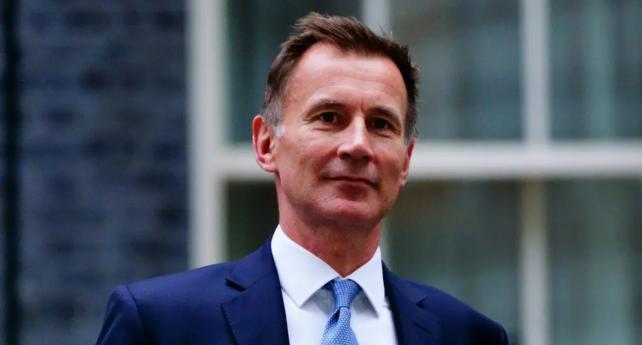
Chancellor Jeremy Hunt – no more than a confidence trickster

The lowest living standards for over half a century; the lowest growth rate of the major capitalist economies; wage restraint and draconian trade union legislation to shackle demands for higher pay; military spending amongst the highest of NATO members, with the exception of the United States, and set to increase by 50%; an eye watering multi billion pound bill in prospect for the renewal of Trident nuclear submarines; millions poured into arming the nationalist right wing government of Ukraine; twelve years of austerity and public spending squeezed under Tory governments.

This was the backdrop, though not mentioned, in the Autumn Budget Statement of British Chancellor, Jeremy Hunt, this week.  However, all play their part in informing the carefully constructed political choices which Hunt tried to portray as inevitable when he delivered his statement to the House of Commons.

The Tory narrative preceding the budget has been built around fixing the outcomes resulting from the disastrous budget of former Chancellor, Kwasi Kwarteng; the need to restore market confidence; and the necessity of filling an alleged £50 billion economic black hole, through a combination of public spending restraint and tax rises.  The BBC and the media in general have bought into this version of events and helped prepare the public for a ‘tough but necessary’ approach to the Autumn Statement.

The announcements made by Hunt, retaining the triple lock on pensions; raising benefits in line with inflation; and retaining some support for energy bills, even though the ‘average’ bill will rise to £3,000 per year; were all designed to create the illusion of a fair and balanced budget.  This was offset by the highest tax rate band being dropped to include those earning £125,000 per year and the windfall tax on energy companies being increased from 25% to 35%, even though much of that can be claimed back if they invest in new gas or oil exploration.

Hunt did not close tax loopholes for those with non-dom status; levy a wealth tax on the wealthiest 1%; or reinstate the cap on banker’s bonuses, lifted by his predecessor.  More tax will not be paid by the very wealthiest, while a freeze on tax thresholds till 2028 will draw more of those on low pay into the tax net.

The fiscal ‘black hole’ is nothing more than the usual Tory confidence trick dressed up as economic necessity.  The so called black hole is effectively the gap between what the Office for Budget Responsibility (OBR) predict the national debt will be, compared to where Hunt would like it to be.  This is not an economic necessity, it is a political choice.  Borrowing to fund tax cuts for the rich, as proposed by Kwarteng, is one thing but borrowing to invest in renewing schools, hospitals, transport infrastructure, renewable energy and the digital future is not action that would spook markets, even in capitalist terms.

In theory these are political choices Hunt could have made.  The reality however is that Hunt is no more a friend of the working class than Kwasi Kwarteng.  Hunt has played a key role in Tory governments over the past 12 years and has sat in Cabinets which have presided over the demise of the British economy throughout that period.

Like the Cameron / Osborne years of austerity the Sunak / Hunt model is no different.  It is being packaged as an antidote to the recklessness of the Truss / Kwarteng overnight stay but it is the same old Tory wine in not very new bottles.

The winter will be a tough one for working class families.  Average energy bills at £2,500 were always going to be a challenge, as many of the poorest spend more than the average on energy.  That average escalating to £3,000 will not help.  Inflation now running at over 11% will continue to bite.  Mortgage rates continue to climb for those buying their homes and rents look set to rise for those unable to save for a mortgage deposit.

Local councils will be allowed to raise Council Tax by up to 5%, which they may have to do to maintain essential local services but, once again, it is the communities who need those services the most who are going to have to pay more for them.

Yet again a Tory budget is a budget of the rich, by the rich, for the rich.  However Hunt tries to dress it up, blame the Russians or blame the pandemic, that is the reality.  Mass opposition, support for those on strike for higher pay, support for local communities struggling against service cuts, will all be key to building resistance as the General Election looms.  That resistance is growing and must get stronger in order to expose yet another Tory confidence trick.

COP out 27

12th November 2022

Hollow words – are US climate change promises to be believed?

“Pushing through the market square, so many mothers sighing.

News had just come over, we had five years left to cry in.

News guy wept and told us, Earth was really dying.

Cried so much his face was wet, then I knew he was not lying.”

The opening lines of Five Years by David Bowie from The Rise and Fall of Ziggy Stardust and the Spiders from Mars (1972).  Nothing coming out of the COP27 conference in Egypt this week suggests that Bowie’s dystopian vision has been consigned to the realms of twentieth century musical theatre, as opposed to being a prescient narrative for our twenty first century future.

The recently published, Global Carbon Budget, an annual assessment of how much the world can afford to emit to stay within its warming targets, found that greenhouse gas pollution will hit a record high this year.  Much of the growth comes from a 1% increase in carbon dioxide from burning fossil fuels. Emissions in both the United States and India have increased compared to last year, while China and the European Union will probably report small declines.

The report indicates that nations are likely to burn through their remaining carbon budget in less than a decade, if they do not significantly reduce greenhouse gas pollution.  This will result in the world passing the critical warming threshold of 1.5C above pre-industrial levels in a mere nine years, resulting in catastrophic climate impacts.

Far from backing the call for greater investment in renewable and alternative energy sources, leaders at COP27 have been advocating natural gas as a transition fuel, from fossil based energy to renewables.  At least four new gas projects have been announced recently, with African nations looking to export to Europe to plug the gap in supply, as a result of the reduction in supply from Russia.

A study by the research group Climate Action Tracker shows that currently planned projects would more than double the world’s current liquefied natural gas capacity, generating roughly 47 billion tons of carbon dioxide equivalent between now and 2050.  While burning gas for energy emits about half as much carbon dioxide equivalent as burning coal, that is still a significant amount of carbon dioxide generation.

Climate scientists have stressed that planned expansion goes beyond what is needed to replace interrupted Russian fuel supplies. The proposals also fly in the face of findings by the Intergovernmental Panel on Climate Change and the International Energy Agency that there can be no new gas, oil and coal development if humanity wants to prevent dangerous warming beyond 1.5 degrees Celsius.

While an initial group of more than 20 countries had pledged to stop public investments in overseas fossil fuel projects by the end of this year, some are backsliding as the hunt for alternatives to Russian gas continues.  The credibility of the COP27 process is further undermined by the significant presence of representatives from fossil fuel companies.  An estimated 200 people connected to oil, gas and coal are included in country delegations, with another 236 with trade groups and other nongovernmental organisations.

Lorraine Chiponda, an environmental justice activist from Zimbabwe who co-facilitates a coalition of advocacy groups, called Don’t Gas Africa, summed up the fears of many climate change activists stating,

 “This is supposed to be a space to discuss climate solutions, but instead it’s being used to drive fossil fuels.”

COP27 has also seen increasing pressure from developing nations for a loss and damage fund, through which large emitters would pay for irreversible climate harms like Pakistan’s recent floods.  The demand however is struggling to make headway, meeting resistance from the United States and other industrialised countries.  In addition, wealthy nations have not fulfilled their promise to provide $100 billion to help vulnerable areas reduce emissions and adapt to warming that is already underway.

It inspires little confidence that COP28 will be hosted by the United Arab Emirates, whose President has pledged to continue providing oil and gas “for as long as the world is in need.”  Or at least for as long as the fossil fuel rich sheikhs can continue to make a profit!

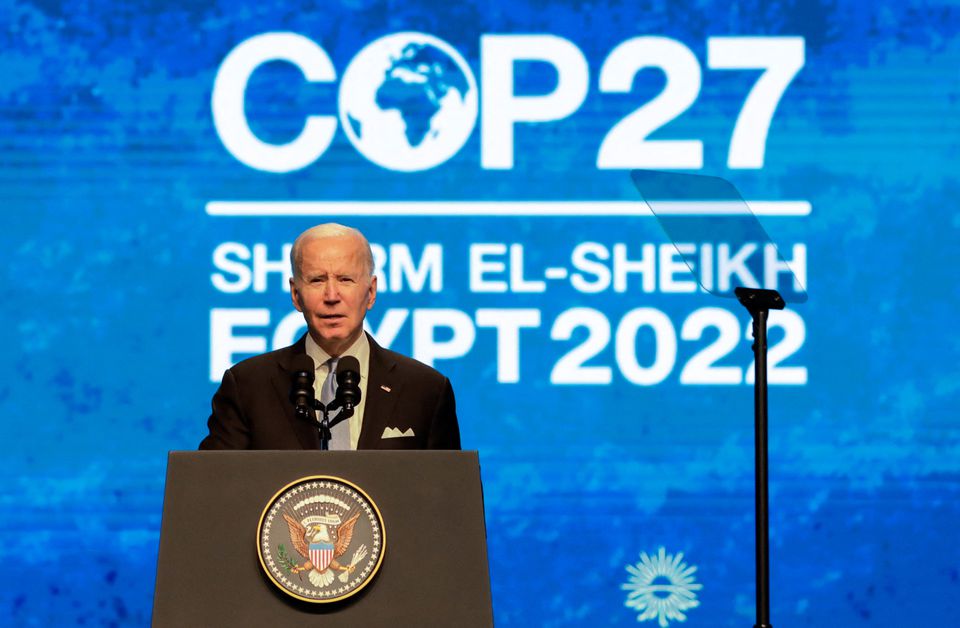
US President Joe Biden addressed the conference on Friday.  With the nuclear codes in one pocket and a first use of nuclear weapons policy in the other, Biden still had the audacity to suggest that the US was showing leadership on the question of climate change, stating,

“Countries that are in a position to help should be supporting developing countries so they can make decisive climate decisions, facilitating their energy transitions, building a path to prosperity compatible with our climate imperative.”

All of which is very well but ironic coming from the world’s most highly armed nuclear state and the world’s biggest exporter of weapons to anti-democratic forces and regimes worldwide.  As far as saving the planet goes Biden’s words ring hollow.

The climate change process will only succeed with international co-operation but while resources are in the hands of profit hungry energy corporations the desire to make more money and avoid regulation will win out.  Under capitalism the existential threat to profit still overrides the existential threat to the planet. 

Only a revolutionary shift in thinking and economic systems can bring about the necessary changes. Until the world’s energy resources can be planned and investment in renewables agreed on a co-operative, socialist basis the dangers continually raised at COP gatherings will persist and the time for effective climate action will continue to get shorter.   

Unity, solidarity, internationalism

5th November 2022

A victory for Lula in Brazil – resistance is possible

Capitalism has always sold itself to the public as being a system based upon democracy.  In spite of the vast differences in wealth between the rich and the poor; the huge gulf in life opportunities; the systemic prejudices which working class people, ethnic minorities, women and others have to deal with; in spite of these things, capitalism is heralded by its apologists as the apogee of democracy.

The basis of this claim is that there are regular elections.  Voters have the chance to change the party or President in office and return an alternative. The models across capitalist states vary.  The British state has an unelected Head, in the form of King Charles III, who occupies that position across 14 Commonwealth countries.

The United States and France have Presidential systems with degrees of power federated to States or Departments.  Germany has a President as Head of State but the real power lies with the Chancellor, usually the leader of the biggest party in the Parliament following an election and, in most cases, coalition negotiations.  The system in Italy is similar.

Whichever version of ‘democracy’ capitalist states adopt, the underlying principle is that the system itself must not change or be challenged.  The fact that there are elections gives the illusion of choice and possible change, so long as the edifice of capital itself is not challenged.

Any challenge from the Left is routinely dealt with by a mobilisation of state media to vilify or even criminalise leaders.  The experience of Lula da Silva in Brazil, jailed for trumped up corruption charges, is one example.  The anti-Semitism smear campaign launched against former Labour leader, Jeremy Corbyn, is another.

The prospect of the threat of disinvestment, a run on the banks and general economic chaos, is usually part of the armoury of the political establishment, seeking to head off any threat to their wealth and privilege.

The return to the Presidency of Lula da Silva in Brazil is a major step forward for the Left, consistent with much of Latin America, but outgoing President Jair Bolsonaro was slow to concede defeat and his supporters have continued to protest against the result.   The forces behind Bolsonaro will no doubt be threatened by Lula’s pledge to end deforestation in the Amazon as well as shifting the emphasis of state policy towards helping the poor.

The forces of the Left, the poor and the dispossessed in Brazil will need to be highly organised to resist the inevitable challenges there will be to Lula’s return to the Presidency.  The fact that Lula clearly won the election for the Presidency will not prevent the right wing from questioning his authority or seeking to overturn the result.

Other recent and up and coming elections challenge the claim of capitalism to be democratic in different ways.  The neo-fascist Brothers of Italy polled the highest number of votes in recent Italian elections and, in coalition with the Forza Italia party of discredited playboy, Silvio Berlusconi, and the right wing League, now boast Italy’s Prime Minister in the form of Giorgia Meloni. 

Meloni is an open admirer of former fascist dictator, Benito Mussolini, and her presence will strengthen a growing right wing bloc within the European Union.  Meloni’s right wing agenda will do nothing to help Italy’s working class as well as actively pursuing an agenda which puts in question LGBT rights, abortion rights and immigration policies.   Meloni was a protégé of Republican strategist and Donald Trump ally, Steve Bannon, who headlined her party conferences in Italy before the Covid-19 pandemic.  Meloni may have won an election but can her rise to the top in Italian politics really be seen as a victory for democracy?

Similar questions arise from the return to the Premiership of Benjamin Netanyahu in Israel where recent elections have put a right wing bloc in power.  The grouping includes Religious Zionism, the third biggest party in the Knesset.  Its leaders, Itamar Ben-Gvir and Bezalel Smotrich, are known for their anti-Arab rhetoric. The former has called for the deportation of citizens deemed “disloyal”, while the latter has called for Arab political parties to be outlawed.  

Netanyahu himself has never taken a progressive line on the question of Palestine but the inclusion of Religious Zionism in the new government will not only alarm many left-wing and centrist Israelis, but also Israeli Arabs, who make up a fifth of the population.   That it will add to already tense relationships with the Palestinian Authority, due to Israel’s illegal occupation and settlement programme, is an understatement.  Once again, an election victory, but a step forward for democracy?

The up and coming mid-term elections in in the United States will take place in the shadow of the attempted coup by Donald Trump supporters in January 2020.  The Make America Great Again movement is still alive and is given ‘intellectual’ cover through the right wing America First Policy Institute (AFPI) think tank.  In their own words AFPI priorities include “finish the wall, deliver peace through strength, make America energy independent, make it easy to vote and hard to cheat, fighting government corruption by draining the swamp.”   The AFPI claim to have put ‘boots on the ground’ in 32 US states in advance of the mid-term elections in order to pursue its right wing agenda.

The right wing surge in the US is also characterised by the movement to ‘take America back for God’, a coalition of Christian nationalists, explicitly endorsed by Trump and, unsurprisingly, pursuing a similar right wing agenda.   Victory for the Republicans in the mid-term, or worse still 2024 presidential elections, will see the US move even further to the right.  The threat to workers and minorities rights will be significant, the threat to world peace will increase dramatically.  Elections will ostensibly be the route to power but will this improve democracy?

These are not places which capitalism has not already visited, with tragic consequences.  The rise of the Axis powers of Germany, Italy and Japan culminated in World War 2 when these creatures of the most reactionary elements of international capital slipped the leash.  Capitalism is not adverse to toying with, or openly endorsing fascism, if it will serve its short term purpose.

That may involve using the path of elections to give a veneer of democracy.  It may result in the more open use of force to assert its power against the challenge of the people.  The Palestinians know this.  Black and ethnic minority communities and migrants to the US know this.  The migrants fleeing NATO sponsored wars to what they assume will be a safe haven in Europe know this.

Working class unity, solidarity and true internationalism of the people, not the phoney internationalism of the EU leaders and others, is the route to overcoming such outcomes.  Building that unity, solidarity and internationalism is one of the most pressing tasks of the Left if a shift to the Right is to be resisted and ultimately defeated.

Stormy waters

29th October 2022

Sunak – the Tories’ latest hope to save the sinking ship

A week may well be a long time in politics but two weeks is not long enough in which to fix a broken economic system.  The decision of Chancellor, Jeremy Hunt, with the backing of Prime Minister, Rishi Sunak, to delay the Autumn Budget statement from 31st October until 17th November smacks of desperation.

They claim that the economic indicators will look more favourable then.  That markets will have settled following the ‘good news’ of Sunak’s ascension to the Premiership.  That the Office for Budget Responsibility (OBR) will be able to make a more informed assessment of the economic future.

All of which is simply so must smoke and mirrors, characteristic of capitalist economics.  The British economy has been unravelling due to a lack of strategic investment since the late 1970’s, a trend which has accelerated since the financial crash of 2008, since when the levels of productivity in the British economy have declined year on year.

While the gambling dens of the City of London have sucked the British economy into a false sense of reliance upon financial services and trading, the manufacturing base has either been closed down or sold off to overseas buyers, keen to take advantage of the capital friendly regime successive British governments have encouraged.

The current crisis is blamed, by the Tories, upon the war in Ukraine and the mistakes made by overnight Premier, Liz Truss, in her mini-budget of 23rd September.  Labour routinely add Brexit to this list, not to criticise the Tories mishandling of the exit from the EU, but to suggest that leaving the monetarist straitjacket of the EU was, in itself a mistake.

All of which feeds the illusion that with some adjustments or a different set of policies, or even by re-joining the EU, that the system can in some way shape or form be ’fixed’.  The ruling class, as part of their response to the crisis, need to feed this illusion or the reality that the crisis is in fact a systemic one may gain sufficient prominence to pose a threat.  This was a strain of public realisation which Labour touched upon under the leadership of Jeremy Corbyn, hence the need for it to be ruthlessly crushed.

It is a strain which is resurfacing in the wave of strikes and strike ballots amongst workers demanding, not only wage rises to keep pace with inflation, but the maintenance of safe working conditions for themselves and the public. 

These demands contrast sharply with the announcement of profits by energy giants such as Shell, reporting a record $30 billion profit in the year so far, and Exxon Mobil posting a quarterly profit of nearly $20bn.  Shell has paid no windfall tax on the profit by exploiting a loophole which exempts companies that invest their surplus in increasing oil and gas extraction.

Clearly such investment will be with a view to increasing profits further.  It will not contribute to the net carbon zero commitments of the government, a target of 100% clean energy by 2035, or do anything to support the necessary investment in renewable energy sources.   The fact that multi billion dollar profiteering companies can get away with dodging tax, while contributing to the destruction of the planet, at a time when those responsible for rail, NHS, mail and other services struggle to get a decent pay rise, is not lost on the general public.

This level of hypocrisy is characteristic of the Tories in particular but is symptomatic of a system which has the defence of the banks, corporations and aristocracy as its raison d’etre.  There is no doubt that the Tories have sailed the economy into stormy waters but however Hunt and Sunak choose to reshuffle the deck chairs in two weeks time, there is no avoiding the fact that, with them at the helm, the ship is sinking.

Resistance must continue to build to expose Tory lies, Tory hypocrisy and Tory economic mismanagement.  Arresting the economic decline which has been the hallmark of the Tories over the past 12 years by investing for the public good, both in people and infrastructure, will only be the first step.  A revolutionary reshaping of political, economic and environmental priorities is required to begin to turn around the damage done by capitalism.

It is not only desirable, it is possible, with collective action, a socialist programme, with mass popular backing, and the will to succeed.  That message must be the one that is repeated to force Labour off the fence.  It is vital that we continue to apply pressure for a manifesto which is not primarily aimed at assuaging the markets but is aimed at challenging the immediate inequalities in the system, which a view to overhauling it entirely.  A manifesto for the many, not the few.

Anything to please the markets?

22nd October 2022

Kier Starmer – pleasing the markets not enough

The chaos in British ruling circles took another turn towards pantomime this week, with Liz Truss emerging from under her desk to resign as Prime Minister and the will he, won’t he speculation about the possible return of Boris Johnson.  The fact that Johnson’s last stint ended ignominiously and that he is still under investigation for misleading Parliament, barely seems to be touching the radar.   Add to that his mishandling of the pandemic, presiding over the highest death rate from COVID 19 in Europe, and any rational person would not rate his chances highly.

However, Tory MPs and the membership at large, if 160,000 members can be described as large, do not do rational.  Otherwise, why elect Johnson in the first place?  Why go on to elect Liz Truss as his replacement?  Why even contemplate Johnson’s return?

The main driving force for Tory MPs is to retain their seats in Parliament.  They will not vote according to anything resembling conscience or principle, anathema to Tory MPs anyway, but purely out of self interest.  With a General Election little more than two years away the Parliamentary Conservative Party will be looking to the candidate who can best please the markets, the real power behind the British economy, and who can best translate the current mess into a recovery narrative which can be sold to the British public, in the face of the ongoing economic crisis.

Johnson has won elections before, many will think he can win them again.

Other hats are likely to be in the ring, with Penny Mordaunt and Rishi Sunak being the main potential contenders, alongside a possible return for Johnson.  Whatever the uncertainties currently swirling around the party of the ruling class there are some certainties which the majority of the country can be sure will take centre stage.

The crisis in social care continues to deepen, with a shortage of 300,000 staff nationally and hospital beds taken up with many who are medically fit but cannot leave, due to the lack of availability of care packages.  The squeeze on public spending is set to continue which will mean little respite for the NHS in real terms and none for local government, traditionally at the sharp end of Tory spending cuts. 

Between 2010 and 2020 councils did most of the heavy lifting in terms of public sector cuts with a £15 billion real terms reduction in their budgets.  The Local Government Association (LGA) estimate that,

“Spiralling inflation, increases to the National Living Wage and higher energy costs have added at least £2.4 billion in extra costs onto the budgets councils set in March this year. Since then, inflation has risen further.”

The LGA go on to point out that, if nothing changes, “councils are facing a funding gap of £3.4 billion in 2023/24 and £4.5 billion in 2024/25.”

Massive figures for sure but how do they translate in terms of real services to communities?  The day to day work of emptying bins; filling pot holes in roads; providing arts, library and sports facilities; addressing social care for adults and children; and tackling homelessness, all become threatened once more.

Chancellor Jeremy Hunt, the last roll of the dice by Liz Truss, has already indicated that public spending cuts are coming.  Whether or not Hunt survives in the Treasury makes no difference.  The Tories are not going to tax the rich, nationalise the energy sector, railways or mail services to make them more efficient, or impose any constraints on the gambling activities of the City of London.  They are not even going to cut the basic rate of income tax by 1p!

While inflation ramps up to 10.1% and energy bills soar for the winter, there can be little doubt that for many people who leads the Tory Party and, for that matter, who is Prime Minister is nothing more than a sideshow.  The party of the rich, for the rich, run by the rich, will continue to do what it must to keep the rich in their positions of privilege, while the majority struggle to make ends meet.

Calls for a General Election are growing but it is hard to see why the Tories would concede this, unless they are set on political suicide, based upon current poll ratings.  That can only mean that mass extra parliamentary action is more important than ever, to support the growing wave of strike action against meagre pay offers, to resist the looming cuts in public services, and to pressurise the Labour Party into taking a more radical stand in defence of the working class.

As things stand the manifesto of Labour going into a General Election could be summed up in one line, ‘Anything to please the markets’.  When it comes to the crunch that will not be good enough.  What is needed for the benefit of the working class is not pleasing the markets but radical action to transform the economy towards investment in health, homes, schools and jobs. 

It will mean ditching the wasteful spending on Trident submarines and redirecting that money into socially useful investment, creating more jobs than nuclear submarines or warheads ever could.   Doctors, dentists and decent homes over weapons of mass destruction; a better starting point than ‘anything to please the markets.’

Theatre of the absurd

14th October 2022

Another one bites the dust – sacked Chancellor, Kwasi Kwarteng heads for the backbenches

Political satirists will be joining the ranks of the unemployed this weekend as the Conservative Party leaps clear of the scope for parody and lands firmly in the realm of the absurd.  The sacking of Chancellor Kwasi Kwarteng, less than a month after his widely derided mini-budget, was only trumped by the appointment of failed leadership candidate Jeremy Hunt to fill his position at the Treasury.

While the Daily Telegraph today went with the headline ‘Kwarteng: I’m going nowhere’ the erstwhile Chancellor was already on a plane back to London this morning, cutting short discussions with the IMF in Washington aimed at reassuring them that everything in the British economy was under control!

No episode of Yes Minister could possibly match it and even The Thick of It would probably see the script rejected.  The Have I Got News for You panellists will be hard pressed to mock what is already the biggest mockery in British government for a century.

The main question in Westminster circles at present is ‘how long can Liz Truss hold onto her job?’  In a brief press conference this afternoon Truss studiously avoided actually answering any of the questions put to her by journalists, while back pedalling on her previous commitment not to increase the rate of corporation tax from 19% to 25% of company profits.  In response to questions as to whether she should stay on as Prime Minister Truss stated that she is “determined to see through what I promised.”

The rationale for the latest u-turn on the mini-budget, according to Truss, is not that any of the proposals were wrong, just that they went “faster and further” than markets expected and they were therefore unable to cope.  A clear signal that if Truss stays in No. 10 for any length of time the reduction in the 45p top rate of tax and the cut in the corporation tax rate will be back on the agenda.

Pressed at Prime Minister’s Questions this week as to whether her economic plans included cuts in public spending Truss stated “absolutely not”, though given the track record of the Tories in general and that of Truss and u-turns in particular, such an assurance must surely be taken with a pinch of salt.   This is reinforced by the assessment of the Institute for Fiscal Studies, that the government would have to cut spending or raise taxes by £62billion in order to stabilise or reduce the national debt as they have promised.

Jeremy Hunt, having been defeated in one leadership contest by Boris Johnson, stood briefly in this year’s contest.  Though he failed to make any impact, one of his key pledges was to slash the rate of corporation tax. So, if his stint as Chancellor has any longevity that policy looks like a certainty for resurrection.

Truss backers have been quick out of the blocks to lay the blame for the economic crisis anywhere but with the Prime Minister.  The Bank of England has been accused of being too slow to act while Business Secretary, Jacob Rees-Mogg, turned his fire on the Office for Budget Responsibility (OBR), suggesting that “its record of forecasting accurately hasn’t been enormously good” and that gloomy forecasts of low growth and rising debt should be ignored.

This is all very well for Rees-Mogg, with a personal fortune running into millions, but there are those for whom rising debt has a real life impact upon their ability to pay the rent, feed the kids, buy fuel or pay the soaring energy bills, only partially offset by government action, whatever Liz Truss may say.

The detachment of the Tories from reality is evident now on a daily basis as the opposition to the failures endemic to capitalism continues to grow.  Strike action and ballots for industrial action continue to proliferate, with even the historically moderate Royal College of Nursing joining the fray.

Kier Starmer and his Chancellor in waiting, Rachel Reeves, are sniping from the sidelines but are not offering solutions which will get to the heart of the issue, that the system itself is broken and needs to be re-established on planned socialist lines, if it is to serve the needs of the many, not the few.

Until the Labour leadership grasp this they will continue to offer little more than sticking plasters over a gaping wound.  Though they will be unlikely to say so in public, many Tories could live with a Starmer government of this ilk, while they take stock and reorganise.  A real shift in the balance of power will only come when pressure upon the Labour Party comes from mass extra parliamentary action and the demand for fundamental change becomes impossible to ignore.