

Popular policy to put people first
5th January 2025

Cuban medical workers – under pressure but an example to the world
The year begins with much media speculation about the collapse in popularity of the Labour government and its leader, Keir Starmer. The economy is not showing signs of recovery. The winter fuel allowance issue is returning to haunt Starmer and Chancellor Rachel Reeves, as the cold weather kicks in. The much trumpeted review of the NHS does not report until the Spring and the reform of social care will take until 2028. Business leaders continue to use the increase in employers national insurance as an excuse not to recruit, or to resist wage increases, in spite of hefty profits going to shareholders.
Public services are struggling with the need for investment to function efficiently or, in the case of the energy sector, with the obscene profits made by companies failing to deliver an effective service to communities. The water industry is the biggest offender but others in the sector are equally guilty of milking profits from hard pressed working class families while not addressing the need for investment in modernisation.
The crisis in the NHS is a major case in point. Recent reports suggest that every acute hospital trust in England is failing to hit the target to treat 92% of patients within 18 weeks. There are 7.5 million people on the waiting list for treatment. The government did promise a £22.6 billion increase for the NHS in the last budget plus an additional £3.1 billion for capital investment. This is welcome and, with the hard work and dedication of staff in the NHS, may result in some short term improvement.
However, even these figures are a sticking plaster over a gaping wound. Britain currently spends £64.6 billion per annum on weapons of mass destruction and the military. Labour is committed to increasing that figure to £87.1 billion to meet its commitment to spending 2.5% of GDP on the military. The equipment plan alone for the Ministry of Defence over the period 2021-31equates to £238 billion plus, according to official forecasts, £117.8 billion on nuclear weapons. CND estimate that the latter figure will in fact be nearer £205 billion. (see The Fight for Peace and Disarmament by Gary Lefley – Socialist Correspondent Issue 53 Winter 2024)
The obscene spend on the military is argued for by the ruling class, with Labour support, as being necessary for defence but in fact just makes Britain a potential target. Given the craven support of the British ruling class for US wars of intervention across the world, including the Ukraine and Israeli genocide in the Middle East, and the backing given to US sabre rattling over China, this danger is likely to increase.
Meanwhile, ambulances are queued outside of hospitals waiting to register patients, who cannot be admitted because beds are occupied by people without any social care arrangements, and emergency calls suffer as a consequence. It is a vicious circle and one which will undoubtedly impact disproportionately upon working class communities.
If Starmer and the Labour government want to increase their popularity, shifting the balance of resources from weapons of mass destruction to investment in health, social care and education would be a progressive step. Shifting the emphasis in both foreign and domestic policy onto improving the lives of working class communities, rather than put them under threat would be a huge leap forward.
At present the health service, in spite of the emphasis upon community health, aimed at preventing hospital admissions and promoting healthier lifestyles, cannot cope with the needs it has to address at the acute end of the healthcare spectrum. Any additional resources inevitably go into trying to prop up the needs of the most vulnerable and little is left for prevention work.
In a socialist system this would be different. This is not theory, there is a practical example in the form of Cuba. In spite of the 60 year long illegal economic blockade, imposed by the United States, the Cuban healthcare system is an example to the world in terms of its approach. Community based care and access to local medical centres are key but struggle because of the lack of resources due to the US blockade. The Cuba Vive Medical Aid Appeal is currently crying out for sutures, syringes, catheters, antibiotics, butterfly needles and paracetamol. These are just a few of the items on the list of needs for Cuban hospitals and polyclinics. https://www.cubavive.org.uk/donate/
The resources available in Britain however means that there is no excuse not to invest and properly resource the NHS, as well as the social care system. It is an act of state negligence not to do so. Labour would do well to look less towards supporting the imperial ambitions of the United States and more towards the needs of working class communities in Britain. That would be popular in every sense.
The noxious smell of musk
12th January 2025
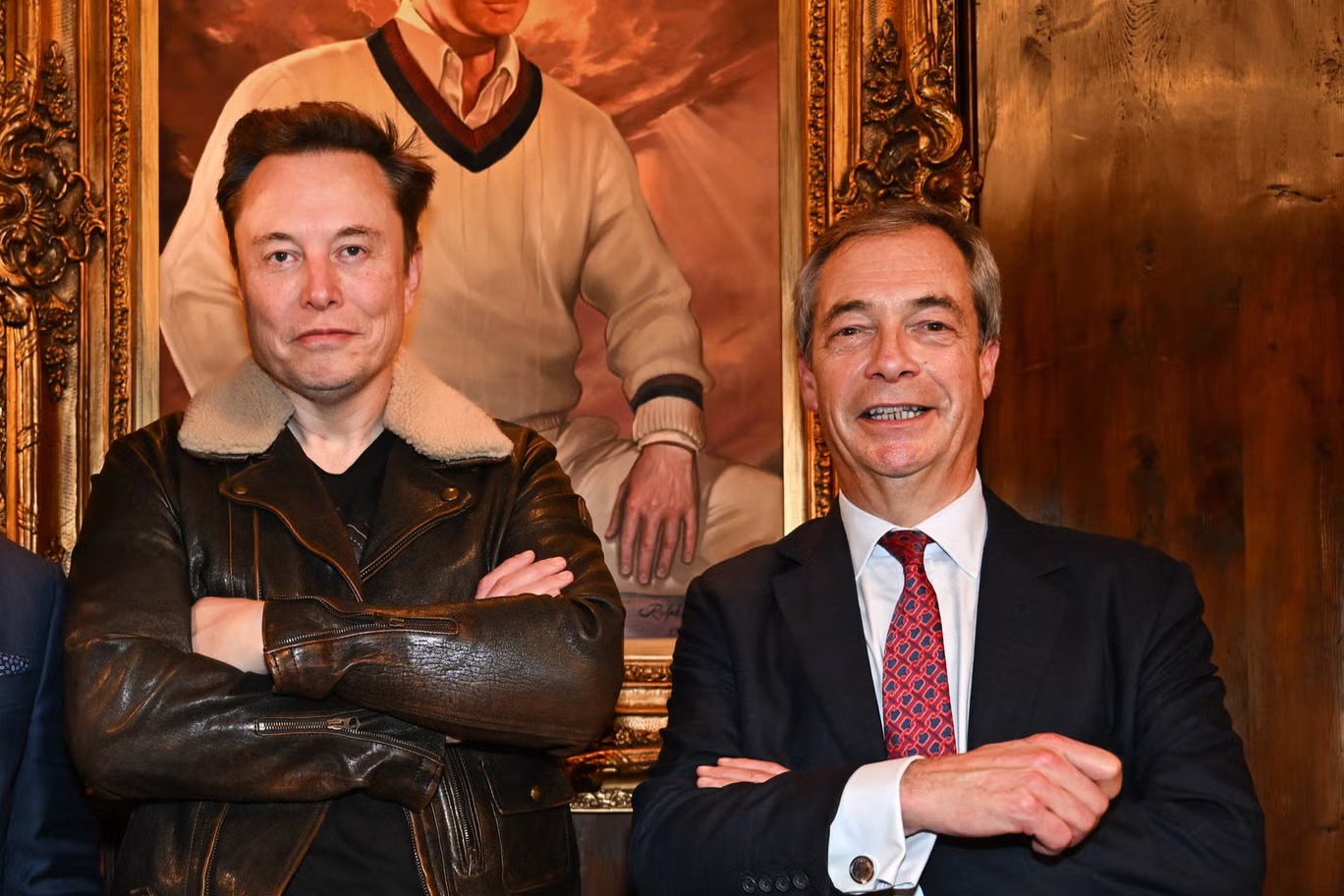
Musk and Farage – potential partners in crime
The whiff of musk which followed Donald Trump around the campaign trail in his bid to return to the White House in the United States has become an acrid and pervasive smell. Worse still, the odour has been caught on the Atlantic winds and made its way across the ocean to become a stench in danger of immobilising further the political life of Britain.
The world’s richest man, Elon Musk, has an estimated worth of US$421 billion. Not content with a role gifted by Donald Trump to run a Department of Government Efficiency, effectively Trump outsourcing cuts in public services, Musk has recently been intervening in British politics on the subject of grooming gangs, which has stirred considerable controversy, and his on again off again threat to fund Nigel Farage’s Reform Party to the tune of $100 million.
Since acquiring the media platform formerly known as Twitter, now X, in October 2022, Musk has diluted verification measures on the site and, according to a wide range of campaign groups, has overseen a growth in racist hate speech, homophobic slurs and antisemitic comments on the platform. In November 2023, the Centre for Countering Digital Hate released a new report claiming 98% of misinformation, antisemitism, Islamophobia, and other hate speech, in relation to the Israeli genocide in Palestine, remained on X after 7 days of reporting, generating over 24 million views.
To say that Musk has significant power and influence would be an understatement. That this influence is being used in an attempt to distort the political landscape in Britain, consistent with the distortions already evident in the US, would be hard to deny.
The recent controversy around grooming gangs, repeated in a wave of social media posts, including some amplified by Musk, allege that a 2008 Home Office document advised police not to intervene in child grooming cases because victims had “made an informed choice about their sexual behaviour”.
The unfounded claim about a Home Office circular to police stems from an interview Nazir Afzal, former Crown Prosecution Service chief prosecutor for North West England, gave to the BBC on 19 October 2018. He now admits that he had not seen any such circular himself, despite apparently stating its existence as fact.
In a statement to the BBC, the Home Office said it had never instructed police not to go after grooming gangs:
“There has never been any truth in the existence of a Home Office circular telling police forces that grooming gangs should not be prosecuted, or that their victims were making a choice, and it is now clear that the specific circular which was being referred to does absolutely no such thing.”
However, none of this has gained traction on X, though Musk’s suggestions that Keir Starmer failed to prosecute gangs and that Home Office minister Jess Phillips “deserves to be in prison”, as well as being described by Musk as a “rape genocide apologist”, have gained widespread coverage.
The Child Sexual Abuse Inquiry, which published its findings in 2022, makes clear that “abuse must be pursued and challenged everywhere with no fear or favour”. Professor Alexis Jay, who led that inquiry, has said that she felt “frustrated” that none of its 20 recommendations to tackle abuse had been implemented more than two years later.
However, none of this makes it an issue for Elon Musk, and his intervention has only accelerated disinformation around this issue. The far right have pounced upon the issue of child sexual exploitation (CSE) to suggest that grooming is predominantly an issue of race or religion, citing the fact of men of Pakistani heritage being involved in cases in Rochdale, Rotherham and Telford. However, Home Office research published in 2020 draws no such conclusion, in fact stating that “Research has found that group-based CSE offenders are most commonly White.” (Group-based Child Sexual Exploitation Characteristics of Offending – December 2020)
Clearly the Tories, who have also jumped on this bandwagon, failed to do anything about the Jay Inquiry when in office. In fact Tory leader Kemi Badenoch opted this week to try and stop Labour’s Bill aimed at protecting children. Labour have the opportunity to consider and implement the Jay recommendations. This must be a priority as a minimum in relation to this issue.
To add to the looming disinformation wars Meta boss, Mark Zuckerberg, announced this week that the third party fact checking network set up in 2016, in relation to Facebook and Instagram is to be dismantled, accusing them of being “politically biased”. How effective the network has been is open to debate but the fact that Zuckerberg sees fit to jettison it, just as Donald Trump calls in the removers for his return to the White House and Elon Musk decides on the arrangement of furniture, is further cause for concern.
Zuckerberg has stated that he will,
“work with President Trump to push back on governments around the world that are going after American companies and pushing to censor more.”
Lies, deceit and disinformation are an endemic part of the capitalist system and core to its functioning to discredit the Left and any opposition. The smear campaigns run against Jeremy Corbyn as Labour leader may yet come back to haunt Starmer as the world wide bastions of right wing authoritarianism mobilise around Trump’s return to the White House.
Labour may have been seen as a safer pair of hands than the Tories in the short term as far as British capital was concerned but US imperialism may not see things the same way. Toying with funding for Farage sends just such a signal.
We have already heard threats against, Greenland, Panama and the desire for Canada to become the 51st US state coming from the President Elect. Some of this may be bluster but may equally be laying the ground for the looming conflict with China, which the US is keen to engineer. If that does happen there could be many innocent victims but there is a guarantee that for Trump and his international media cronies, truth will certainly be one of them.
Warning Signs – first week of Trump 2.0 spells danger
22nd January 2025

Mass opposition to Trump underway in the USA
At the victory rally held in advance of his official inauguration, US President Donald Trump vowed to get rid of the “radical Left woke” which he saw as dominating American life and culture. For Trump the term encompasses a whole range of progressive policies and positions that working class organisations have fought for and won over many years but Trump and his cronies see as an impediment to the realisation of their particular version of the American Dream, to make the rich even richer.
In less than a week Trump has signed orders to withdraw from the Paris climate agreement; withdrawn the US from the World Health Organisation (WHO); declared a national emergency on the US/Mexico border, in order to not only halt migration into the US, but initiate the biggest mass deportations in US history; declared that children of migrants, born in the US, will no longer be deemed to have automatic rights to US citizenship, contrary to the 14th amendment of the US constitution; and granted pardons to nearly 1600 of his followers who stormed the Capitol building in January 2021, in spite of them having been convicted following due process in US courts.
Trump has also issued an executive order calling for an end to what he describes as “dangerous, demeaning and immoral”, diversity, equity and inclusion schemes, putting all staff overseeing such programmes on paid leave with immediate effect. Consistent with this approach Trump has declared that in relation to gender in the US there, ”will be two sexes, male and female”, clearly a swipe at the transgender and LGBT communities.
In the US the People’s World noted that Trump has also “ended the Biden administrations Justice40 initiative, which set a policy that 40% of the benefits of federal investment must go to disadvantaged communities and repealed an executive order setting up a national goal for electric cars to make up half of new cars and truck sales by 2030.”
Flying in the face of all of the evidence that the planet faces a climate emergency, Trump’s response has been, ‘drill baby, drill’, and a promise of more permissions for oil and gas exploration to be granted. Tariffs on imported goods from Canada and Mexico it has been suggested could be at 25% while a trade war with China, imposing tariffs on Chinese goods is in Trump’s sights, with a 10% tariff likely to be imposed as early as next week. The mobilisation of the US military in the South China Sea and the possibility of Taiwan being a provocation for military action against China cannot be ruled out.
While Trump has already made belligerent noises in relation to Greenland and Panama, allegedly in the interests of economic and military security, some form of action against Iran is also a likely scenario, either directly or through proxy Israel, and there is almost certain to be an even greater intensification of the illegal blockade against Cuba. Newly sworn in Secretary of State, Marco Rubio, is known for his vicious anti-Cuban views.
While there is a degree of naivety amongst some on the Left that Trump can only serve one term and sense will prevail in 2028, there is no indication that the Democrats have either a strategy for winning back working class votes or a credible candidate to front a campaign. There is also the possibility that the constitutional constraint on Presidents only serving two terms could be overturned and a Trump Presidency extended into the 2030’s.
In any event, based upon the first week in office it is clear that there is no room for complacency. Progressive trade union, women’s and civil rights groups, along with the Communist Party USA, are organising resistance at local, state and national levels to challenge Trump every step of the way, opposing both domestic policy and the imperialist designs of the US across the world.
Supporting these efforts will become increasingly important as Trump’s term progresses. That will include putting pressure upon the British government not to kowtow to the agenda of racism, imperialism and the threat of war which Trump’s second term will undoubtedly herald. Trade unions, the Labour Party and progressive campaigns such as Stop the War and CND must ensure that mass extra Parliamentary action is used effectively to press for an independent British foreign policy, free of US diktat, leaving NATO and reducing military spending.
Kickstart or stalling?
4th February 2025

Reeves on economic growth – kickstart or cold start?
British Prime Minister, Keir Starmer, and Chancellor, Rachel Reeves, are in danger of having to eat humble pie when it comes to their ability to deliver on the promise of economic growth. The mission of the present government has been made clear, economic growth, but simply repeating the mantra does not deliver the desired outcome.
The keynote speech on the subject by Reeves last week has only succeeded in re-opening the 20 year long debate about a third runway at Heathrow Airport; whether or not this will actually deliver growth anyway; how it will help Britain meet its net zero carbon targets; and why so much emphasis on investment in the South East when the rest of the country is crying out for economic support. The aspiration to turn the corridor between Oxford and Cambridge into Britain’s Silicon Valley just reinforced this point.
Reeves claims that 60% of the benefits of a third runway at Heathrow will be felt in areas other than London and the South East, though without giving details as to precisely how. The geographic distribution of investment may in any case be an academic point as the accumulation of wealth in the hands of a small minority, rather than ownership and production being in the hands of the people, will ensure the maintenance of Britain’s class system. The working class are not going to be the ultimate beneficiaries, whether in John O’Groats, Land’s End or anywhere in between.
Socialism, or any aspiration towards it, is not on the agenda of this government, in common with all previous Labour governments, so tweaks to how capitalism functions is the best that they hope to deliver. Even in those terms however, Reeves does not seem to have won any allies.
What used to be regarded as the environmental lobby but is actually articulating the interests of many in saving the planet, has been up in arms about the third runway proposal, as well as the possibility of the government consenting to the Rosebank development, Britain’s biggest untapped oilfield.
The project is being led by Norwegian company, Equinor, and having had a consent application rejected in Scotland recently they are expected to return with a further proposal later in the year, claiming that “Rosebank is critical for the UK’s economic growth”, a euphemism for Rosebank being critical for Equinor’s profits and its shareholder’s dividends.
There are potential routes to economic growth, even in the short term, within the straitjacket of capitalist economics. Investment in renewable energy technology would be an option that would both promote growth and contribute to net zero carbon targets. Diverting spending away from the cost of weapons of mass destruction and nuclear submarines would free up resources, which could begin to address the crumbling schools and hospital infrastructure. Investment in renewing the health and education systems would in itself help promote economic growth.
A renewal of the national rail network, charging point infrastructure to encourage the take up of electric vehicles, more resources for the creative industries, proper financing of local government, all of these things would contribute to economic growth, as well as providing the platform for arguing that public, and ultimately the people’s, ownership and control is the key to lasting economic change.
Sadly Starmer, Reeves and the Labour Cabinet have no such vision and remain trapped within the confines thinking that reform within capitalism is a sufficient goal. Clearly it is no such thing, as working class families continue to grapple with rising water and energy costs, rising food costs, rising housing costs and deteriorating local services. That was never going to be reversed in six months but a roadmap towards it could have been outlined and a vision fought for.
As it stands the demagogues of the far right are making up ground in Britain and across Europe; Zelensky in Ukraine, Meloni in Italy, Le Pen in France, Alternative fur Deutschland in Germany, to name a few.
It is not impossible to see Reform UK taking seats off both Labour and the Tories at the next General Election and shifting the political landscape in Britain even further to the right. A YouGov poll published in The Times today (4th February) puts Reform on 25%, Labour on 24% and the Tories further behind on 21%. While Britain is still a long way from a General Election if this trend continues Labour’s dream of a second term could easily be wiped out.
A response to such polling figures should be to mount a robust challenge to the politics of Reform and the Tories. However, too many in the Labour Movement are afraid of being accused of being “woke”, a term that has become a pejorative in the hands of the right wing media to demonise anyone with progressive ideas or left wing politics. The fact is that anyone not woke is, by definition, asleep and that will usually come with being bigoted, xenophobic, homophobic and in denial of the climate emergency.
Capitalism as a system, designed to serve the interests of the rich and powerful, cannot be modified in the interests of the working class, it must be overthrown. The more the Left pussyfoots around this reality the more emboldened the right wing will be to push their simple answers to complex solutions. This is the message the Labour and peace movements in Britain need to grasp and campaign upon, before the world is reshaped entirely in the image of Donald Trump or Elon Musk. These are the people who must be stopped. Theirs are the ideas that must be quashed.
Towers of Ivory and Steel
13th February 2025
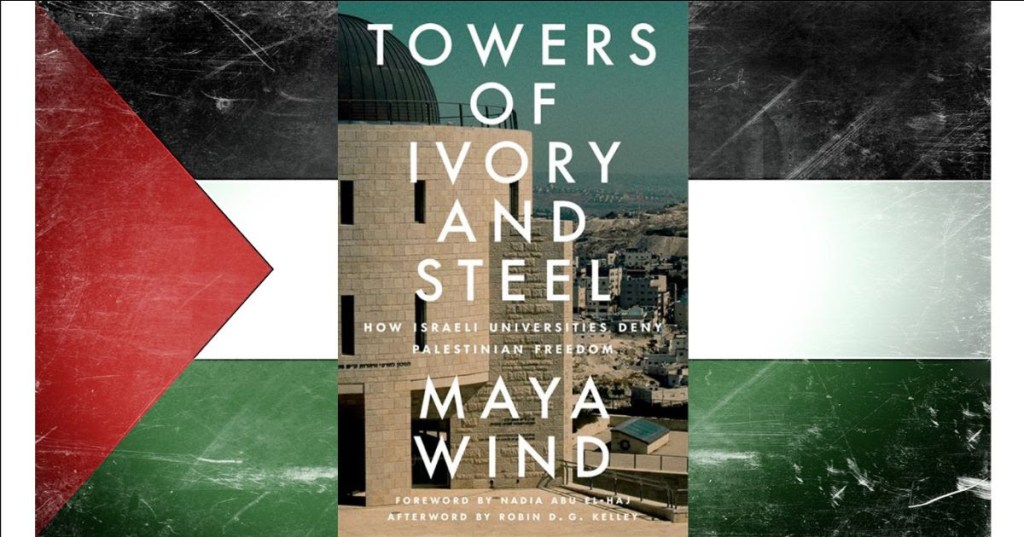
Review by Steve Bishop
Maya Wind’s detailed and incisive study, Towers of Ivory and Steel, charts the role of Israeli universities in systematically denying Palestinian freedom. It should be a wake up call for any British university engaged in collaboration with Israeli counterparts, urging them to address distortions of academic practice and acknowledge the internationally recognised rights of Palestinians to equality of access to education.
British universities will not see themselves as colluding in the settler colonialism of the apartheid Israeli state. They will rationalise any joint work as being on a purely academic basis, not part of a systemic exclusion of Palestinians from access to intellectual expression and freedom.
Maya Wind’s analysis debunks such liberalism and demonstrates how the Israeli university system is an embedded part of the apartheid state of Israel, actively supporting the settler colonial narrative of Zionist supremacy, and denying any Palestinian historical agency in land they have farmed, worked and lived on for generations.
Since October 2023 the world has once again seen the sheer scale of Israeli brutality towards the Palestinian population through the genocide in Gaza, backed by support from the United States, Britain and the European Union, culminating in the proposal of US President Donald Trump to ethnically cleanse Gaza of Palestinians.
This is the undeniably savage side of the Israeli Defence Force (IDF), the consequences of its actions filling news broadcasts around the world. However, as Wind demonstrates, behind the smokescreen of liberalism in Israel’s universities there lies an ongoing and pervasive denial of access for Palestinians, a denial of study of their history, suppression of any student activism and an active collusion with the Israeli military and state by the university authorities.
In disciplines which under any circumstances should require objectivity and academic rigour, Wind shows how Palestinian dimensions are excluded. Archaeological excavations led by Israeli academics at a site in Susiya, for example, revealed evidence of a synagogue and a mosque, illustrating both Jewish and Muslim heritage, yet as Wind notes,
“Ruins of a mosque were also found on the very same site as the synagogue, yet these were swiftly erased from the historical record; there is no mention of them in the official documentation or at the site itself.” (p.26)
Wind demonstrates how legal studies are skewed to justify the actions of the IDF and the Israeli government in the international arena, “constructing interpretations that justify Israeli state and military policies” (p.40) while routinely processing arrested Palestinians under the Israeli military court system, rather than a civilian legal process.
In the field of Middle East Studies, Israeli universities actively collaborate with the state and the military, to reinforce a particular version of history. The forced exclusion of over 700,000 Palestinians from their land, in the Nakba in 1948, is not covered for example. As Wind indicates,
“What began as repression of academic research on the Nakba and Israel’s founding has since expanded into public scrutiny of syllibi addressing Israel’s military occupation and apartheid and, most recently, into a broader purge of any critical discourse on the military and the racial violence of the Israeli state.” (p128)
Any attempt by Palestinian students to commemorate the events of 1948 are violently shut down. Such actions are facilitated by having uniformed soldiers on campus, as part of their training in military and intelligence work. This presence is inevitably intimidating for the few Palestinian students tolerated at Israeli universities and reinforces the close links between university hierarchies and the military.
Wind provides detailed evidence of how Palestinian students are subject to arrest, incarceration, and torture for engaging in what would be regarded in most parts of the world as routine student activism. For the Israeli state any degree of activism or expression of support for Palestinian statehood is treated with suspicion.
Launched in 2004 the Palestinian Campaign for the Academic and Cultural Boycott of Israel (PACBI) has worked to raise awareness of the role of Israeli universities in the repression of Palestinians and to call on “international scholars to initiate a boycott of Israeli academic institutions”.
Closely allied is the Boycott, Disinvestment and Sanctions (BDS) Campaign launched in 2005 to exert pressure on Israel to meet its obligations under international law to, “first, end the colonization of Arab lands and dismantle the military occupation and the wall; second, recognise the right to full equality of Palestinian citizens of Israel; and third, respect and promote the right of Palestinian refugees to return.” (p.5)
Maya Wind is clear that support for the PACBI and BDS campaigns is a necessary step on the road to justice for the Palestinian people. The research and analysis provided in Towers of Ivory and Steel is an important contribution to moving forward on that journey.
Redrawing the Map
18th February 2025
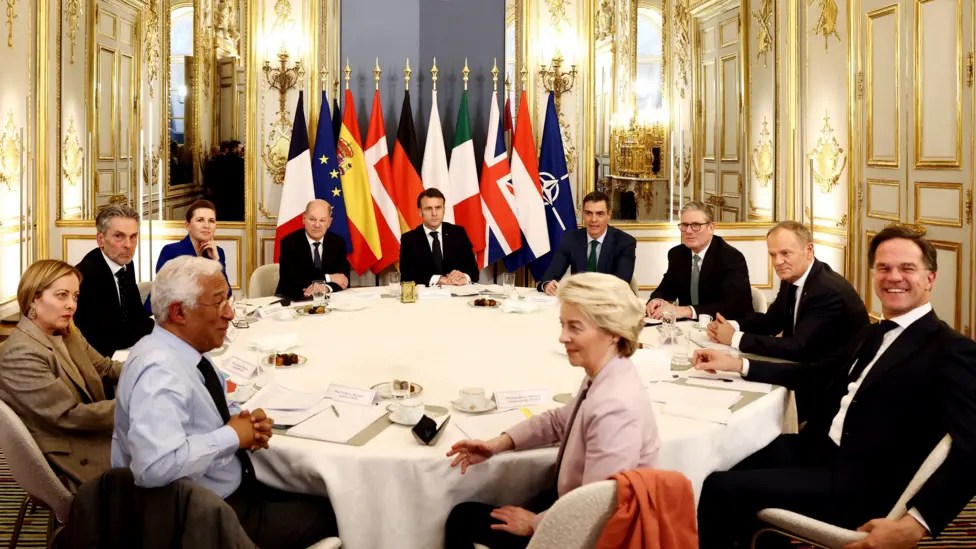
European leaders ponder what to do as the US pushes for a deal with Russia
European leaders have been in Paris this week wondering what to do about the apparent maverick actions of the United States, in relation to the NATO proxy war in Ukraine. What at first seemed like a straightforward NATO vs Russia scenario, in defence of right wing nationalist Ukraine, has been complicated by the return to office of Donald Trump. Not that Trump’s attitude to Ukraine should come as a surprise, he has been trailing it on his campaign journey for over a year, but Europe, including Britain, has been taking an ostrich like approach to the possibility of Trump’s return and they are now having to face the consequences.
The US has signalled bi-lateral discussions with Russia, underway in Saudi Arabia, in order to achieve a settlement, no doubt to be followed by conversations with Ukraine to persuade them to accept any deal. There will inevitably be a quid pro quo in terms of US arms being sold to Ukraine, in exchange for access to resources such as mineral wealth. Russia will incorporate the Crimea and Donetsk regions, in line with the stated wishes of those populations.
The European Union plus Britain may tub thump about the prospect of Russia extending its reach and invading the Baltic states and Moldova etc but this is largely a bogie of NATO’s own creation for internal consumption, to justify the persistent increase in arms spending. The likelihood of Russia precipitating a response from NATO by overstepping its existing boundaries must be rated as very small in reality. Europe’s Cold War anti Russia scaremongering is likely to wear thin as US priorities change.
So what is the endgame of US imperialism? Russia, as it has been historically, is the weak link in the imperialist chain. While rich in resources and still a significant nuclear power it does not pose a direct threat to the dollar based economic order. However, in alliance with China, an actual economic threat to the US, and the wider BRICS network of nations, the role of Russia is more significant.
It is certainly in the interests of the US to drive a wedge between the current alliance of Russia and China. Trump has also made it clear that the aim of the BRICS nations to move away from the dollar as the default international currency is not something he will tolerate. Bearing in mind that Trump speaks, not purely as an individual but as the mouthpiece of US imperialism, his words take on greater significance.
The potential market which Russia represents for US firms, and the resources which it controls, are vastly greater than anything Ukraine can offer and certainly more than the European Union can lay claim to.
European leaders in Paris have continued to bleat about the abandonment of Ukraine, British Prime Minister, Kier Starmer, referring to a “generational” security challenge posed by Russia and reiterating his commitment to deploying British troops if necessary. The continued warmongering on the part of Starmer and other European leaders, with talk of a 5% of GDP spend on the military, is a recipe for a massive crackdown on public services which will hit working class families hard. The economics of war may work for the military industrial complex, it will not work for the working class citizens of Europe.
Against this backdrop it may just be that the US has its eye on the bigger goal of competing with the rising economic might of China and positioning itself to reassert its grip on the international economy.
Ironically, it may be that Zelensky’s wild call for a European army, at the Munich Security Conference last week, may be the first recognition of this possibility. While the media, as ever, portray things in terms of personalities it is not a Trump/Putin love in that we should be wary of but a strategic US/Russia alliance which would truly redraw the map and reshape the international order, creating a powerful economic and military bloc containing most of the planet’s nuclear arsenal.
What the EU/Britain could do in the face of this would be very tame and even China’s economic strength would pale by comparison. They could huff and they could puff but it would be quite a house to try and blow down.
Recognising the Stranger
On Palestine and Narrative
by Isabella Hammad
Book Review

A sense of timing and an eye for synchronicity are common concepts deployed by authors in the construction of a narrative. On 28 September 2023 the British-Palestinian novelist, Isabella Hammad, gave the Edward W Said Memorial Lecture at Columbia University, now published as Recognising the Stranger: On Palestine and Narrative.
Hammad could not have foreseen that only a week later, on 7 October 2023, the Qassam Brigades of Hamas would, in response to the ongoing Israeli occupation and blockade of Gaza, launch a military attack upon Israeli military bases and kibbutzim. The attack resulted in over 1,000 deaths and the taking of over 200 hostages, to be held until the 5,000 Palestinian political prisoners held in Israeli jails were released.
Hammad’s lecture would have been relevant and a percipient insight into the situation of the Palestinian people had the events of 7 October and their aftermath, not have happened. However, given the Israeli response to the Hamas attack, Hammad’s lecture and subsequent Afterword: On Gaza, written in January 2024, take on added relevance.
In her original lecture Hammad is concerned with considering turning points, ostensibly in literature but also in the personal and political spheres. Those points in a fictional narrative when characters have moments of recognition, when an aspect of the plot, which may have been clear to the reader, is revealed to the characters and what has been, up until then, a mystery falls into place.
Hammad suggests that in the personal and political spheres the concept of a turning point is “a human construction, something we identify in retrospect” (p.2) but that the moment in which we now live “feels like one of chronic ‘crisis’” (p.2).
Hammad explores the role and function of the novel in the contemporary world, competing against the wide range of other ‘entertainments’ on offer, yet still powerful and relevant enough to find a mass audience and speak to the need for narrative, storytelling and a search for meaning.
Hammad links the concept of turning points in literature to those in real life through the example of writers visiting the Palestine Festival of Literature and experiencing for themselves the reality of life for the Palestinian people under Israeli occupation.
“They visited Hebron, and saw the soldiers patrolling, guarding settlers; they visited the destroyed town of al-Lydd; they navigated checkpoints; they travelled through Jerusalem and crossed in and out of the West Bank; they listened to statistics of killings and imprisonments and night time raids and asked careful questions.” (p.21)
Hammad goes on to analyse the wider international debate regarding the position of the Palestinian people, the incremental retreat from insistence upon a two state solution, with Palestinians having a right to their own state, while the international community in the Global North, largely accept and reinforce the state propaganda and Zionist supremacist ideology of the Israeli regime.
Hammad does recognise that there is a shift in awareness amongst many ordinary people across the world, including amongst Israelis, a recognition that Palestinians have human rights. She cites what co-founder of the Boycott, Disinvestment and Sanctions (BDS) movement, Omar Barghouti, calls an aha moment,
“…talking specifically about the moment when an Israeli realises, in a turning point of action, that a Palestinian is a human being, just like him or her.” (p.25)
While Hammad’s lecture inevitably focuses upon the work of Edward Said, as a prominent Palestinian intellectual, his literary criticism and her own practice as a writer, she does not shy away from exploring the reality of the stateless position in which Palestinians are forced to exist and the implications of this for their culture.
In her Afterword: On Gaza Hammad is clear that the action of 7 October in itself represents a turning point, comparing it to “an incredibly violent jailbreak” and asserting that,
“It also signified a paradigm shift: it showed that a system in which one population is afforded rights that the other population is denied will be safe for neither.” (p.61)
Hammad robustly condemns the Israeli response to 7 October stating starkly that,
“Ten thousand dead children is not self defence.” (p.62)
A figure which has escalated significantly in the year since her afterword was written. Hammad condemns the extent to which the Western powers, the United States in particular, have supplied Israel with weapons to continue the bombardment of Gaza and the role of the US in vetoing ceasefire arrangements. This position may have changed for the moment but there is no guarantee that Israel will maintain it.
As Hammad states, as she moves towards a conclusion,
“The possibilities faced by the Israeli state for at least twenty years have been: maintain apartheid and forfeit the claim to being a democracy; return to the pre-1967 state borders and allow for the creation of a Palestinian state; break down the system of apartheid and enfranchise the Palestinians in a one-state reality; or conduct large scale ethnic cleansing. They are choosing the last option.” (p.75)
Just over a year since that Afterword was written, it is clear that this is precisely the path that the Israeli regime has taken and that solidarity with the Palestinian people is more vital now than ever.
Isabella Hammad is the award winning author of ‘The Parisian’ and ‘Enter Ghost’. In 2023, she was included as one of Granta’s Best of Young British Novelists.
Culture funding – mere crumbs from the Cabinet table
26th February 2025

Culture Secretary, Lisa Nandy, gathering the crumbs from the table
Culture Secretary, Lisa Nandy, was last week showered in plaudits for announcing investment of £270 million into the cultural sector. The occasion was the 60th anniversary of Jennie Lee’s landmark White Paper, A Policy for the Arts: The First Steps, published in 1965, which set the framework for the establishment of Arts Council England, regional arts boards and investment in arts and education.
Lee’s paper was undoubtedly significant. What is equally significant is that no Labour government since has produced a further White Paper on culture, or given it such prominence. The only government White Paper on Culture to emerge in the last 60 years in fact came from the Tories, in 2016, when Ed Vaizey was briefly Culture Secretary.
Vaizey’s paper, given its Tory provenance, was not a bad stab at summarising the cultural landscape at the time but did not come with the necessary cash to follow through with any significant change. Also, coming up against the buffers of the Brexit debate, the debacle of the Boris Johnson government and the pandemic, it had little chance of making any headway.
Nandy’s announcement was accompanied by a press release quoting a wide range of luminaries from the cultural sector falling over themselves to welcome the new money. You can find it here https://www.gov.uk/government/news/major-investment-to-boost-growth-and-cement-britains-place-as-cultural-powerhouse
The general view across the cultural world is to be thankful for any investment that comes along. However, it would have been good to see a more critical view, deploring the paltry sum as merely crumbs from the Cabinet table, which will barely scratch the surface of what the cultural sector needs to survive, let alone thrive. Much of the announced investment will go to further rounds of existing capital programmes, for which the cultural sector has to compete and secure local authority match funding. Given the devastating impact of Tory austerity on local government finance over the past 14 years that will be a challenge.
In any event, such funding largely goes to retain existing infrastructure and does nothing to support the revenue streams needed to sustain actual creative work in such spaces. Funding channelled through Arts Council England and National Lottery are, in any case, only part of the cultural funding landscape. Much community investment in activity in the cultural sector has been through local authorities. However, the requirement to maintain a library service is the only cultural responsibility local councils have which has a statutory basis. That means cultural budgets have been hammered as Councils are forced into prioritising areas of adult and children’s social care, where they have clear statutory obligations.
It is no surprise that access to culture for working class communities is being choked off or that the majority of those currently working in the cultural sector have had the privilege of a private education. A recent Guardian survey shows that “…17.5% of artistic directors and more than a quarter (26%) of Chief Executives went to Oxford or Cambridge, compared with less than 1% of the general public.” This narrowing of the life experience of those working in the sector inevitably narrows the range of cultural output. The same survey also found that, since 2010, enrolment in arts GCSEs has fallen by 40% and the number of arts teachers declined by 23%, areas where working class children may have been able to access the arts.
The latest challenge to the sector comes from the potential change to Britain’s copyright laws in order for AI companies to harvest creative work without permission, acknowledgement or payment. The proposal has been out to consultation and has met with a robust response from the Creative Rights in AI Coalition, but for a government which claims to be serious about stating that,
“Arts and culture are a vital part of our first-class creative industries and are a key part of what makes Britain so great.”
this proposal should not even be on the table.
Labouring under the delusion that investment will unlock private sector money for regional cultural activity Nandy claimed,
“Small amounts of government money can unlock much larger sums. Over the last decade and a half, we’ve seen philanthropy step in to fill the gap that’s been lost from some government funding. But the problem is so much of that has been targeted towards a handful of major institutions, mostly in London.”
This is clearly wishful thinking of the highest order. If the Culture Secretary is serious about getting investment into the sector in a way that will make significant change she will need to go into arms manufacturing.
In another part of the government forest it is possible to find the UK support for Ukraine: factsheet, which identifies £12.8 billion which has been committed to Ukraine, £7.8 billion of which is for military support. It can be found in full here https://www.gov.uk/government/publications/uk-support-to-ukraine-factsheet/uk-support-to-ukraine-factsheet
To suggest that this dwarfs Lisa Nandy’s £270 million is not only an understatement, it is a scandal. That the Labour leadership have been actively supporting the right wing nationalists in Kyiv is bad enough but that billions are being poured into that support, at the expense of the vital needs of working class communities, is scandalous.
The list of possible ways to spend £12.8 billion is long, from hospitals to schools to green infrastructure to housing. However, there is no reason why culture should not be on that list too. Even within the constraints of a capitalist economy there are political choices to be made. The government’s prioritising of weapons of destruction over creativity is another stark example of where those choices can go badly wrong.
Keir Starmer’s announcement that military spending will rise to 2.5% of GDP by 2027, by robbing the foreign aid budget, adds to the pressure upon other budgets aimed at addressing social issues. The pursuit of war rather than peace presents a danger to all.
Wealth tax reform not welfare cuts
13th March 2025

Work and Pensions Secretary, Liz Kendall, ignoring UN warnings on poverty in Britain
In April 2024 the United Nations Committee on the Rights of Disabled People (UNCDRP) published a report into its findings regarding provision for disabled people in Britain, including the impact of welfare reform. The UN found that Britain has ‘failed to take all appropriate measures to address grave and systematic violations of the human rights of persons with disabilities and has failed to eliminate the root causes of inequality and discrimination.’
As signatories to the UN Convention on the Rights of Disabled People the British government agrees to periodic reviews of its provision for people with disabilities, the latest being initiated in 2023 and its report concluding in 2024 finding that ‘grave and systematic violations’ of disabled persons rights had taken place since 2010 and that welfare reform had “disproportionally and adversely” affected the rights of people with disabilities.
The report concludes that there has been no significant progress with independent living rights and active regression in relation to work and social security rights, recommending urgent measures be taken in relation to improvements in these areas.
Given that much of the period of the review was covering the 14 years of Tory government such harsh attacks upon the rights of people with disabilities comes as no surprise. The ‘skivers not strivers’ narrative is one that the Tories and their right wing media allies in the Mail, Express and Telegraph have been pursuing for some time, in order to deflect attention away from the obscene profits made by the super rich and the increased wealth of billionaires in Britain, which rose by £35 million a day last year.
This month the UN Committee on Economic, Social and Cultural Rights (CESCR) issued a series of recommendations to tackle poverty in the Britain. The report urged Keir Starmer to reverse the five-week wait for universal credit in a warning that the British government is infringing human rights with the ongoing poverty crisis.
The report highlighted fears over the Department for Work and Pensions’ (DWP) welfare reforms that have resulted in severe economic hardship, increased reliance on food banks, homelessness, negative impacts on mental health and the stigmatisation of benefit claimants. It further urged government to up spending on benefits, remove the benefit cap and scrap the two-child limit, which prevents parents from claiming child tax credit or universal credit for more than two children.
Labour’s Work and Pensions Secretary, Liz Kendall, does not seem too perturbed by the UN’s findings. With a Spring statement from Chancellor Rachel Reeves due on 26th March welfare reform, a euphemism for cuts to benefits, is clearly high on the agenda of both Kendall and Reeves.
Kendall’s stated position is that,
“I think the only way that you get the welfare bill on a more sustainable footing is to get people into work. And you know, we will be bringing forward big reforms that actually support people into work, that get them on a pathway to success.”
All of which may sound fine in a press conference but in the real world of de-industrialised, zero hour contract, low wage economy Britain it has a hollow ring.
Labour’s claim is that welfare reform is necessary to fill the fiscal black hole Reeves has discovered due to the economy not growing fast enough. Kendall has refused to deny that the Treasury is looking for £5 billion of cuts to her budget.
As ever, government economic decisions are about political choices, whatever issues may arise in relation to the world economy. The current Labour government has ditched the notion of ‘jobs not bombs’ and gone for bombs, £12.8 billion to Ukraine alone, before the cost of supporting Israeli genocide in Gaza is factored in, or weapons sales to dictatorships such as Saudi Arabia.
There is clearly a case for reform of the welfare system in Britain, as the UN has pointed out, but that is not the same as making a case for swingeing cuts which will plunge people into further poverty. There is certainly a case for reform of how the wealthy are taxed in Britain. As Nadia Whittome MP for Nottingham East has pointed out,
“If we implemented something very moderate, like a 2% tax, a threshold of assets over £10m a year, that would only impact an estimated 20,000 people in the UK but would raise £24bn.”
These are the real choices a Labour government faces, yet again. War or peace, rich or poor, capitalism or socialism? Currently Keir Starmer and the Labour leadership are getting it wrong on all three counts. There is clearly some pressure from progressive Labour MPs within Parliament but only mass extra parliamentary action will apply sufficient pressure to move the Labour leadership. Putting wealth tax reform ahead of welfare cuts would be a step in the right direction.
Coalition of the Wilting
20th March 2025
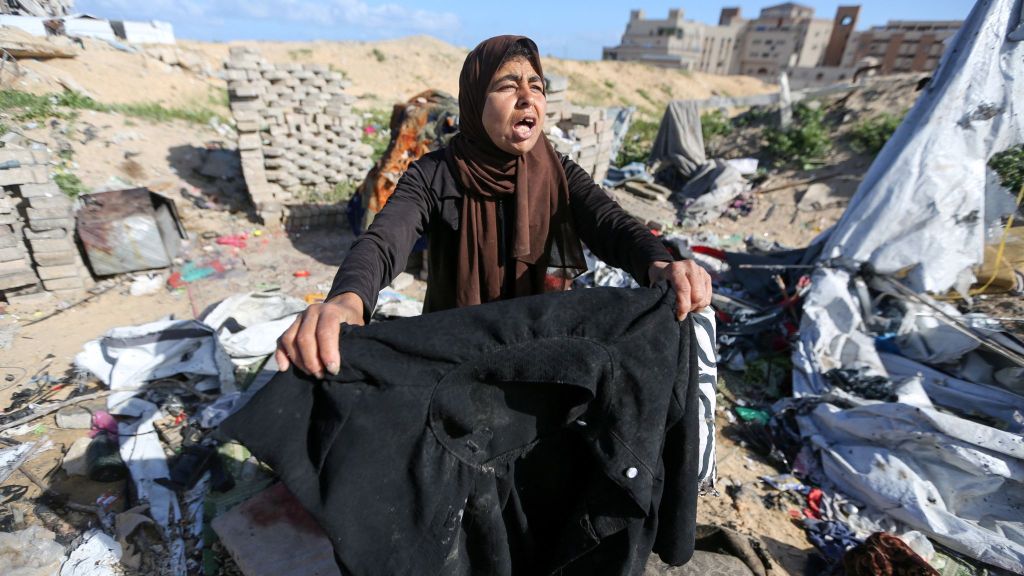
Israeli action in Gaza continues to hit civilian targets
While the Israeli Defence Force (IDF) resumes its genocidal bombing campaign against the people of Gaza, the leaders of European nations gather to work out how they can protect the right wing nationalist government of Volodymyr Zelensky from the Russian ‘threat’ in Ukraine.
Israel has treated international law with impunity for decades while the West has not just turned a blind eye to the treatment of Palestinians but has armed Israel to the teeth in the process. The United States has by far been the biggest arms supplier to Israel but Britain has provided more than its fair share of weapons used to keep the Palestinian population under the jackboot of the IDF.
As the Campaign Against the Arms Trade (CAAT) indicate,
“By the end of 2023, the USA had delivered 39 F-35 Joint Strike Fighters to Israel. Israel has a further 36 on order. Israel has been using the F-35s extensively to bomb Gaza, operating them at a far higher rate than normal. This has depended on a constant supply of spare parts from the US and other countries producing components, including the UK.”
Working out direct British involvement can be complex as CAAT point out that licences for components go via the US for use in weapons manufactured by them. While the government has instituted a partial suspension of export licences “it left in place licences for equipment such as components for trainer aircraft and naval vessels, as well as for components going to Israel’s arms industry to be included in equipment for onward export.” (https://caat.org.uk/data/countries/israel/)
By comparison to the actions of the IDF, the Russian action in Ukraine has not involved the subjection of an entire population, is not aimed at eradicating a nation, or displacing its population from their land. On the contrary, the action of Ukrainian forces against the largely Russian speaking population of the Donbas region, which resulted in 14,000 civilian deaths between 2014 and 2022, precipitated the Russian action but has gone largely unreported by the Western media.
This version of events, does not fit the NATO narrative of an expansionist Russia looking to swallow up the neighbouring states, in advance of an onward march towards Western Europe. NATO bosses would have us believe that the only possible defence against such an eventuality is to spend more on weapons to guard against the so called Russian threat. The British government is committed to increasing spend on the military to 2.5% of GDP with a rise to 3% being mooted. Calls have come from the US for NATO nations to be committing to 5% of GDP spend on the military.
It is hard to see this as anything other than a drive to war and certainly a drive towards greater profits for arms manufacturers who must be rubbing their hands with glee.
The right wing Polish government are asking for nuclear weapons to be stationed in Poland, minutes away from a strike on Moscow, to ‘defend’ against Russian invasion. This in spite of the fact that as a member of NATO any attack on Poland would, under article five of the NATO Treaty, bring the whole of NATO to its defence. Nuclear weapons in Poland will not add to that capability.
In spite of the Western commitment not to move NATO one inch eastwards the incorporation of Eastern Europe nations into NATO has effectively completed the encirclement of Russia over the past thirty years, with Ukraine being virtually the last piece in that jigsaw.
The ‘Russian threat’ bogie is a repackaging of the old Soviet threat myth from the days of the Cold War, when the NATO bloc had to have an ‘enemy’ to defend against, in order to justify its proliferation of nuclear and conventional weapons.
If history is played out first time as tragedy and second as farce then the so called Coalition of the Willing, convened by British Prime Minister, Kier Starmer, should be in the running for a comedy award. Having been cut loose by the US, in relation to the strategy of defending Ukraine at any price, European leaders are scrambling around like latter day Keystone Cops wondering which way to turn.
However, it will be no joke should they make good on their threat to increase spending on weapons, which will only impoverish the European working class further and rob them of much needed social provision in the form of homes, schools, medical provision and transport infrastructure. It will be less than amusing for working class families if their sons and daughters are sent to the frontline in ‘defence’ of Ukraine and find themselves embroiled in an unwinnable conflict.
The grandstanding of Starmer and Macron, the main drivers of the wilting European coalition, needs to be exposed and the priorities for a just settlement in Palestine and an end to war in Ukraine emphasised, as the key foreign policy objectives.
The drive to sustain the war in Ukraine, while ignoring Israeli genocide in Gaza, is a double threat to world peace. Mass action on both fronts must continue while being linked to the struggle for jobs, health and homes, all of which will be threatened by the drive to war.
Spring statement: for the few, not the many
27th March 2025
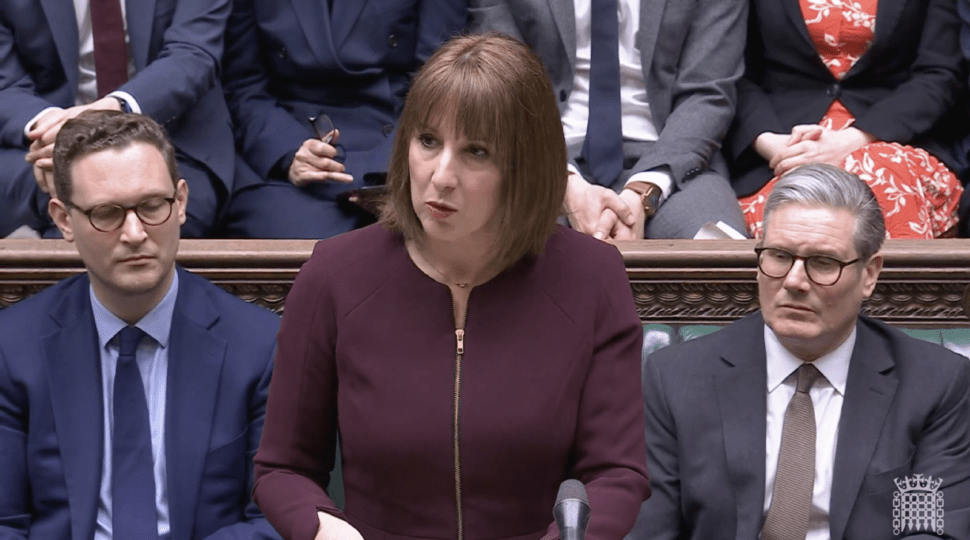
Chancellor Rachel Reeves – not winning friends amongst the working class
In a classic guns not butter statement yesterday Britain’s Chancellor, Rachel Reeves, hammered the poor in order to enrich the arms industry. To add to the £2.9 billion already earmarked for the military budget next year Reeves found a further £2.2 billion, a grand total of £5.1 billion extra next year alone, with the promise of more to come.
In order to build this additional military capacity, to defend against a mythical Russian threat, Reeves not only hammered the poor in Britain with welfare cuts but cut the overseas aid budget further, just to ensure that the pain was spread at an international level.
Reeves claims to have cut welfare in Britain by £4.8 billion but the Resolution Foundation think tank calculates that about 800,000 claimants will have reduced personal independence payments, saving the government £8.1bn by 2029-30. It is estimated that this will affect 3 million families.
While Reeves pins her hopes on economic growth and getting people into jobs to offset the slashing of welfare, the Office for Budget Responsibility (OBR) halved Britain’s economic growth forecast for next year from 2% to 1%, which hardly suggests a boom in employment of any kind, let alone one which could compensate for the ripping away of the welfare safety net for many.
A recent economic analysis by the Joseph Rowntree Foundation, projects that living standards for families in Britian will be worse in 2030 than in 2025, with those on the lowest incomes declining twice as fast as middle and high earners. The report indicates that the poorest third are being disproportionately affected by rising housing costs, falling real earnings and frozen tax thresholds. Increased military spending, along with the other measures in the Spring statement, will further exacerbate this trend.
Even the Treasury’s own impact assessment estimates that 250,000 more people, including 50,000 children, will be left in relative poverty after housing costs by the end of the decade as a result of the government’s squeeze on welfare.
Just to add to the wider uncertainty about the economy US president, Donald Trump, this week announced a 25% levy on car imports to the US, with the possibility of further measures to come. The danger of being sucked into a trade war, due to the actions of Trump, will further undermine the notion that Britain has a ‘special relationship’ that will allow it to be excluded from Trump’s wider tariff war.
However, speaking on Sky News, Reeves was firmly wedded to her deluded projections saying,
“I am absolutely certain that our reforms, instead of pushing people into poverty, are going to get people into work. And we know that if you move from welfare into work, you are much less likely to be in poverty.”
Given the nature of capitalism, as an exploitative system dominated by private sector companies whose main objective is to increase profit, not wages, Reeves vision is at best utopian, at worst simply an attempt to mislead and dissemble her way out of the fact that the cuts proposed are not out of necessity but are from political choice.
Of course, Reeves is not a one woman band. She has the full backing of Labour leader Kier Starmer, the Cabinet and a majority of Labour MPs, so responsibility runs deep within the Parliamentary Labour Party, even though approval for the actions of Labour’s leadership is not shared by many trade union affiliates or local party activists.
Unite leader, Sharon Graham, condemned Reeves for rigidly sticking to her self imposed financial rules with the evidence of ruin in working class communities all around, stating,
“Rachel Reeves is right; the world has changed but why is it always everyday people that have to pay the price. They paid the price after the 2008 crash, the Covid pandemic and are now expected to pay the price again. It is simply wrong.”
Unfortunately Graham is unable to make the link between attacks on working class communities and the increase in military spending, going on to congratulate the government for pledging to “invest in our defence in an uncertain global world”.
GMB General Secretary, Gary Smith, was more succinct stating,
“Tackling huge economic problems is a historic challenge. That’s why we need proper investment in key industries – and must nationalise them if necessary.”
On behalf of the TUC General Secretary, Paul Novak, took issue with the Office for Budget Responsibility (OBR), stating,
“It is time to review both the role of the OBR and how it models the long-term impacts of public investment. Short-term changes in forecasts should not be driving long-term government decision-making.”
Posting on X former Labour leader and Independent MP, Jeremy Corbyn, was absolutely clear,
“This Labour government could have taxed the wealthiest in our society. It is disgraceful that they are choosing to go after the poor and disabled instead.”
Unity around the concepts of jobs not bombs, welfare not warfare and organising society in the interests of the many, not the few, are key to moving towards lasting socialist change. There is clearly still work to be done across the Labour movement and within working class communities to build support which recognises that these issues are linked and the common denominator is capitalism.
Ongoing mass extra Parliamentary action will play a key role in building that support and that political understanding, vital in the progress towards a socialist future.
US/Iran talks finely balanced
12th April 2025
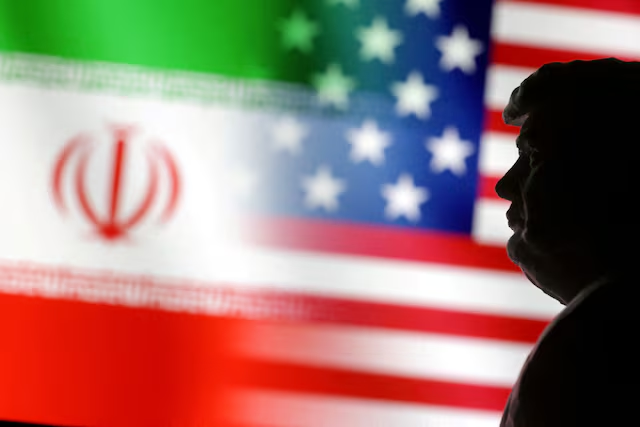
US President, Donald Trump, will cast a long shadow over US/Iran talks
While US President, Donald Trump, continues to play ping pong with the world economy representatives from the US and Iran will meet in Oman this weekend to explore the prospect of a deal between the two countries, which could raise the possibility of de-escalating tension in the region.
The Committee for the Defence of Iranian People’s Rights (CODIR) has welcomed the proposed talks between the United States and Iran as a possible first step towards relieving the pressure upon the Iranian people, caused by ongoing sanctions against the country.
While the solidarity organisation continues to highlight the human rights abuses of the theocratic dictatorship in Iran, CODIR also recognises that the sanctions regime, which is crippling the economy, is a massive pressure upon the Iranian people.
“We are under no illusions that the engagement of the Iranian regime in talks with the US is about little more than self preservation”, said CODIR General Secretary, Gawain Little, “but any opportunity for dialogue which will reduce tension in the region and avert the possibility of military intervention in Iran must be welcomed, however cautiously.”
The latest report from Amnesty International concerning executions worldwide, Death Sentences and Executions 2024 identifies over 1,500 executions worldwide in 2024, the highest figure since 2015, with Iran, Iraq and Saudi Arabia being the main offenders.
In Iran alone executions increased by 119 from the previous year, a total of 972, accounting for 64% of all known executions.
The Secretary General of Amnesty International, Agnès Callamard, was trenchant in her opposition to the death penalty, stating,
“The death penalty is an abhorrent practice with no place in today’s world. While secrecy continued to shroud scrutiny in some countries that we believe are responsible for thousands of executions, it’s evident that states that retain the death penalty are an isolated minority. With just 15 countries carrying out executions in 2024, the lowest number on record for the second consecutive year, this signals a move away from this cruel, inhuman and degrading punishment.”
However, the Islamic Republic of Iran appears to be going against this trend, not only with increasing executions, but also continued extra judicial torture and imprisonment without access to legal counsel.
This has particularly been the case in the last two years with the rise of the “Women, Life, Freedom” movement, which has seen mass protests throughout Iran, as well as the wave of industrial action across the country, in response to the impact of state corruption and the repressive sanctions regime imposed by the West.
The Amnesty report goes on to indicate that over half of the executions in Iran are for offences that should not result in the death penalty under international law, such as drug related offences. Also, there is clear evidence that the use of forced confessions has been widespread and that trials carried out by the Revolutionary Courts are grossly unfair and likely to have been based upon torture tainted confessions.
The talks in Oman will not focus upon Iran’s human rights record but will primarily be concerned with reaching agreement around Iran’s uranium enrichment programme for nuclear power generation. However, the reality is that arrest torture and execution remain key tools used by the regime to silence opposition and are an indication of its narrow public support.
The current tension in the region, due to the Israeli genocide in Gaza and the weakening of Iran’s so called Axis of Resistance of Hamas, Hezbollah and Houthi organisations, has increased the likelihood of a further military strike against Iran, either directly by the US or by Israel.
With regard to talks with the US, Iran’s Foreign Minister, Abbas Araghchi, was sounding bullish a couple of weeks ago, saying,
“Our policy is still not to engage in direct negotiations while under maximum pressure and military threats, however, as it was the case in the past, indirect negotiations can continue.”
However, the discussions in Oman will clearly be more direct than Araghchi suggests.
While Iran may grandstand to impress its regional allies, it remains in a relatively weak position. While a strategic partnership treaty was signed with Russia in January, it does not obligate either side to support the other if under military attack, only an agreement not to help any country that attacked the other.
The so called Axis of Resistance has been significantly weakened by the actions of the Israeli Defence Force (IDF). The demise of the Assad regime in Syria has robbed Iran of a key regional ally. Close relations with China, based upon a twenty five year agreement signed in March 2021, does not imply any military support and has yet to yield any significant boost to the Iranian economy.
While links with Russia and China can by no means be dismissed, and a direct attack upon Iran could change the dynamics of those alliances, the Iranian regime cannot expect military support as a matter of course.
Added to the relative isolation of Iran on the international stage is the growing internal pressure, arising from the economic crisis resulting from sanctions, endemic corruption and economic mismanagement. Increased production was once again a theme of the address by Khamenei to mark the Iranian new year in March but this has been rhetoric from the dictatorship for many years, without any significant investment or strategy for increased industrial production materialising.
While the Iranian regime seeks to avert any military conflict to save itself, the US will also recognise that being embroiled in an overseas war in Iran will bring no advantage while a deal, which opens up access to the potentially lucrative Iranian market, would be of far greater benefit to US capital.
As the US relationship with Saudi Arabia shows, the US is by no means adverse to doing deals with theocratic dictatorships if the calculation is that it will bring a strategic advantage for US imperial ambitions.
Further info at http://www.codir.net
Trump turns up heat on ‘allies’
17th April 2025

US President Donald Trump pointing in which direction the US economy is heading
In the midst of the apparently chaotic approach to the international economy taken by United States President Donald Trump, there is an underlying objective which was made clear by the Wall Street Journal this week. The newspaper cited internal sources in the Trump administration confirming that the plan is for the US to use “ongoing tariff negotiations to pressure US trading partners to limit their dealings with China.”
The Wall Street Journal states that,
“U.S. officials plan to use negotiations with more than 70 nations to ask them to disallow China to ship goods through their countries, prevent Chinese firms from locating in their territories to avoid U.S. tariffs, and not absorb China’s cheap industrial goods into their economies.”
The so called Liberation Day ‘reciprocal’ tariffs, announced on 2nd April, saw the US propose a wide range of tariffs upon trading partners based upon the trade deficit they had with the US, a methodology which famously included the Heard and McDonald Islands, only inhabited by penguins.
The British government, far from being outspoken in opposition to the tariffs, expressed relief at only being in the 10% tariff band, a category which is now occupied by everyone but China, faced with an outrageous 145% tariff on goods exported to the US. The 90 day hiatus on implementation of the tariff bands subsequently announced by Trump is supposedly to give countries the opportunity to negotiate.
What this means in reality is that those countries who rely significantly on trade with the US are expected to bend the knee to US imperialism or be hit with more punitive action once the 90 days is up. In particular, the negotiations will be a means by which the US tries to compel nations to limit their dealings with China.
The US is used to getting its own way, either through economic manipulation of international bodies such as the International Monetary Fund (IMF) and World Bank, or through the use of military force.
The clearest example of economic pressure is the illegal blockade of Cuba, which has stood up to US imperialism for over 60 years and continues to survive in spite of the attempts of the US to strangle its economic development.
More recently the US has adopted similar tactics in relation to Venezuela in an effort to enforce regime change. Threats to annexe the Panama Canal and take over Greenland are current indicators of US intentions, while the people of Libya, Iraq, Afghanistan and Syria can attest to the fallout of direct US military intervention in the Middle East. The people of Gaza and the West Bank are the ongoing victims of the genocide perpetrated by the US’s proxy in the Middle East, Israel.
The unipolarity which US imperialism enforced following the defeat of the Soviet Union in the early 1990’s is now threatened by the rapid economic development of the Chinese economy.
The latest World Economic Outlook data, published by the IMF in January 2025, indicates growth of 2.7% for the US in 2024, the EU at 0.8%, Britain at 0.9% and China at 4.8%. While this only provides a snapshot it is indicative of the trend globally, that capitalism as a model is failing and that economies structured with more centralised state control are on the ascendant.
In recognising this the US trade war, launched by Trump, is a clear attempt by the US to bully so called ‘allies’ back into the US camp. The pressure upon members of the NATO Alliance to increase their military spending to 5% of GDP is also part of this strategy. Not only will public services across much of Europe be impoverished but the main beneficiaries will be the US arms dealers who have access to the most up to date weapons technology.
China’s response to US tariffs has been to impose tariffs of its own, at 125%, on US goods imported into China. Chinese President, Xi Jinping, has undertaken a tour of Southeast Asia this week, as part of an anti-tariff campaign and offering a more stable alternative trading partner to US uncertainty.
As part of the BRICS (Brazil, Russia, India, China, South Africa) Alliance, China is already engaged in a process of exploring alternatives to the US dollar as the default international currency measure. The Global South generally is suspicious of US actions and intentions in relation to both economic issues and military threats.
While tariffs will undoubtedly hit the Chinese economy the capacity of China to withstand the impact is arguably greater, as it can more easily replace what it imports from the US from other sources. US exports to China are heavily agriculture focused such as soya beans, cotton, beef and poultry. Conversely the US relies on China for imports of electronics, machinery and processed minerals, far more difficult to source from elsewhere.
Also, as a result of tariffs imposed upon China in Trump’s first term, China has consciously reduced its share of imports from the US, down from 21% in 2016 to 13.4% in 2024, all of which underlines why the US is also putting pressure upon so-called allies to reduce trade with China.
China controls more than two thirds of global rare earth production and more than 90% of processing capacity. The US relies on China for many rare earth metals, essential for electric vehicle batteries for example, which means Trump’s trade war could well backfire even more spectacularly than it already has.
The real danger for the world is that if the economic arm twisting tactics of US imperialism do not work the usual recourse is to military force. Anti-Chinese propaganda is now widespread across Western media and the possibility of action over Taiwan could well be the occasion for a military flashpoint. The peace, trade union and labour movement need to be alert to this possibility and be ready to expose the machinations of US imperialism rather than be fooled by the illusion of a US/Britain ‘special relationship’, which will certainly not be special for the working class if world war is the outcome.
Real change needed
5th May 2025

Nigel Farage – delighted to see Reform UK take over Durham County Council
After UKIP and the Brexit Party, the latest incarnation led by right wing nationalist, Nigel Farage, is Reform UK. As with the previous manifestations of the Farage ego, Reform UK is a party of the rich, for the rich, run by the rich, masquerading as the voice of the people. The Farage brand, the ordinary bloke down the pub with common sense opinions, is as phoney as any marketing ploy adopted by the leaders of other parties to try and burnish their fading fortunes.
Like US President Donald Trump, Farage presents himself as an outsider, the scourge of the establishment, the man with a mission to ‘drain the swamp’, stop the waste of taxpayers money, root out corruption, a real man of the people. All part of the branding.
Farage, like Trump, is not against the establishment he is just another, more vicious manifestation of it. The attacks upon concepts of equality, diversity and inclusion; the trashing of targets for net zero carbon emissions; the anti trade unions stance; the attacks upon local government; and the massive emphasis upon reducing migration to Britain are all simply extensions of policies which have been lurking on the right wing of the Tory Party for years and sound like easy solutions to the deepening crisis of capitalism in Britain today.
In taking over control of Durham County Council in the North East of England Farage was quick to pronounce that any staff working on equality schemes or the green agenda should be looking for new career paths. The idea that money spent in such areas of local government activity could be diverted to address the problem of potholes in roads was flagged by Durham CC Reform Cllr Darren Grimes, a man who has recently posted,
“Not a chance I’ll support migrants getting keys to homes while locals get kicked to the kerb.”
This posing of one issue against another, equality work versus potholes, migrants versus homelessness, is classic right wing demagoguery, which is a cover for not wanting to reveal the fact that the entire capitalist system is failing working people and needs to be overthrown in its entirety.
The rise of Farage and his ilk is only possible because the party with the deepest roots in the working class and trade union movement, the Labour Party, has abandoned any notion of tackling head on the real issues faced by working class people in Britain. The shrinking of opportunities through advancement in education; the decimation of local government services on which the most vulnerable rely; the creeping privatisation of the NHS; the waste of money on weapons of mass destruction; the need to invest in green infrastructure in order to create jobs and prosperity.
The Labour Party leadership is afraid of its own shadow, is afraid to stand up and say that we do not have a migration crisis in Britain, that the numbers of migrants is small and can easily be accommodated. The Labour leadership is afraid to say that weapons of mass destruction do not create jobs, they simply divert resources away from more socially useful production while making Britain a target. The Labour leadership is more concerned with clinging to its illusion of power than making the case for real change for the working class of Britain. It’s not that they won’t go down without a fight, it’s that they won’t put up a fight in the first place.
All of which leaves a void to be filled by the ‘bloke down the pub’ politics of the likes of Farage, with no-one piping up to point out that the bloke down the pub is usually half tanked and talking bollocks.
Reform UK gaining 677 councillors and control of eight local authorities, as well as overturning a 14,000 strong Labour majority in the Runcorn and Helsby by-election has to be awake up call. Whether the Labour leadership has the political acumen or nous to realise this is another matter. They clearly have no understanding of the depth of the crisis US imperialism faces globally, with the growing efficiency of the Chinese economic model, even less understanding of that for the British economy and seemingly no clue as to how to begin the process of carving out a place for an independent socialist Britain which could truly address people’s needs.
Pundits across the press and media have been proclaiming the end of the two party system in Britain over the past few days, following the 1st May election results. What they fail to realise is that, whether there are two parties or five, what is broken is the entire system which, whatever combination of parties make up the House of Commons, remains geared to serve the interests of the banks, corporations, the City of London and the military industrial complex.
Begin to challenge that and real change may then be possible.
Book Review
Syria – Civil War to Holy War
https://liberationorg.co.uk/book-review/syria-civil-war-to-holy-war-review/
Strategic Defence or weapons wish list?
2nd June 2025

British troops – in even greater danger following defence review
Within days of taking office last July one of the first acts of Keir Starmer’s government was to commission a Strategic Defence Review (SDR). Today that review, headed up by former NATO General Secretary, Lord Robertson, has been published. On one level it holds no surprises, though the suggestion that Britain needs to move to “war fighting readiness” may come as a shock to many. The review is predicated on the assumption that Britain faces “a new era of threat” as justification for its belligerent tone.
As a nuclear power, a big spender on the military, a permanent member of the UN Security Council and with pretentions of still playing an imperial role in the world, the British ruling class has for decades been eager to bolster its ailing power and influence over global affairs.
The Empire upon which the sun never set, and the blood never dried, may be no more but Britain still exercises a powerful neo-colonial reach through the Commonwealth, as well as being one of NATO’s two European nuclear powers, alongside France.
No Labour government has ever challenged this so called defence framework, designed by the ruling class, for the ruling class and benefiting the ruling class and their cronies in the military industrial complex. There has broadly been bi-partisan agreement between the leadership of Labour and the Tories that the military is untouchable and, however inefficient its use of resources, its budget is maintained.
With Labour elected on a commitment to increase the military budget to 2.5% of GDP, increasing to 3% it is no surprise that likely spend by 2034 is predicted to be 3.5% of GDP. Six new munitions factories are proposed to facilitate making weapons to meet this upsurge in spend, billions will be wasted on renewing the pointless and US controlled Trident nuclear submarine fleet and, as part of the AUKUS agreement with the US and Australia, Britain will maintain an aircraft carrier presence in the South China Sea, to help defend against the ‘threat’ posed by China.
The SDR also commits Britain to building 12 nuclear-powered attack submarines as part of the AUKUS alliance, the first of which will launch in the late 2030s, replacing seven Astute-class submarines, tasked to operate around the world.
According to a report in The Guardian (2/6/25),
“Ministers are also considering whether to restore an air-launched nuclear deterrent by buying F-35A aircraft which have been certified to carry the US B61-12 gravity bomb, which has a maximum explosive yield of 50 kilotons, more than three times the size of the 15kT bomb that was dropped on Hiroshima in 1945.”
China, along with Russia, Iran and North Korea are cited as the main reason behind this arms spending spree, with China deemed to be a “sophisticated and persistent challenge” to Western ‘interests’.
As ever, a bogie is needed to justify spending more on weapons rather than schools, hospitals, housing, roads and green infrastructure, all of which would be of direct benefit to working class families. The Cold War template of accelerating arms spending to counter the mythical Soviet threat is tried and tested, so is being dusted down once again and given a further airing with the assistance of a supine press and BBC.
One sided and clearly partisan reporting of the Russian intervention in Ukraine has heightened public alarm, while the Chinese ‘threat’ to Taiwan, internationally recognised as part of China, is being prepared as justification for intervention in South East Asia.
At a recent summit in Singapore US Defence Secretary, Pete Hegseth, stated that “any attempt by Communist China to conquer Taiwan by force would result in devastating consequences for the Indo-Pacific and the world.” Hegseth further called for other countries in the region to boost their military spending, though this has met with a mixed response, given widespread scepticism in the region regarding the Trump administration’s assessment of the degree of threat China poses.
Only fourteen nations internationally recognise Taiwan and the US is not one of them, so the interest which the US has in Taiwan is merely as a possible stick with which to beat China and to ramp up tensions in the region.
That the British government should be complicit in the misinformation drive to demonise China, Russia and others is ultimately a betrayal of Labour’s working class roots and a drain on even the remote possibility that a capitalist economy could continue to provide anything of significance for the working class.
Warmongering while wrapped in the Union Jack may have a patriotic ring but it will sound increasingly hollow when the consequence of more weapons is the shrinking of the health, education and housing infrastructure even further than they have been reduced over the past 30 years.
Labour’s so called Strategic Defence Review is little more than a wish list for weapons, none of which will defend working class communities but, deployed in other parts of the world, will make working class men and women targets. Continued support for movements such as CND and Stop the War will be essential to try and stem the tide of Labour’s warmongering stance.
The case for a non-nuclear, non-NATO, non-aligned foreign policy could not be clearer. Increasing the stockpiles of weapons of mass destruction will only benefit the arms manufacturers and do nothing but make working class communities potential targets.
US and Israel complicit in war crimes
5th June 2025

Out on a limb – the US once again vetoes a ceasefire in Gaza at the United Nations
The so-called Gaza Humanitarian Foundation (GHF) is nothing more than a trojan horse created by the United States and Israel to facilitate the ethnic cleansing of Palestinians from Gaza. The BBC and international media continue to report on its activities as if it had some credibility when in reality it has none.
Established two weeks ago, the GHF was set up to bypass the work of the United Nations and other international aid agencies, who have tried and tested methods of delivering international aid through well established local networks.
The Israelis claim that aid through these routes is being hi-jacked by Hamas and is not reaching the people who need it. They have produced no evidence whatsoever to back up such claims. The GHF, which is not run by experienced aid workers, but is staffed by private US security agencies, lacks local knowledge, local networks and has only four centres from which aid can be accessed.
The UN and international aid agencies have 400 sites across Gaza from which aid could be accessed should the Israeli military allow. The GHF have a limited number of sites in the south of Gaza, where the Israelis are attempting to drive the Palestinian population, and they are only accessible by civilians going through known combat zones. Nearly one hundred civilians have been killed by Israeli troops and hundreds more wounded in the past two weeks, attempting to access aid at GHF hubs.
The hubs are located in Israeli military zones, where journalists have no access.
To reach the sites in Rafah, Palestinians must walk for miles along a designated route where GHF says the Israeli military keeps security. In statements to the public, GHF has warned people to stay on the road, saying leaving it “represents a great danger.”
Distribution usually starts at 5 a.m. each day but thousands of Palestinians start walking hours earlier, desperate not to miss out on food. That means large crowds passing by Israeli troops in the dark.
Israel admitted on Tuesday for the first time that its forces shot at Palestinians. In a statement, the Israel Defence Forces (IDF) said troops fired shots near a food distribution complex after noticing “a number of suspects moving towards them”.
This was the third time civilians had been killed by the IDF in three days.
Mirjana Spoljaric, the president of the International Committee of the Red Cross (ICRC), told the BBC on Wednesday that conditions in Gaza had become “worse than hell on earth” and that states are not doing enough to end the war, end the suffering of Palestinians and secure the release of Israeli hostages.
The recent killings has resulted in at least one of the GHF hubs being closed temporarily.
That Israel is pursuing a policy of starvation, ethnic cleansing and genocide in Gaza, in addition to approving more illegal West Bank settlements, is clear to the world. The British government’s continued complicity in the war crimes carried out by the Israeli regime was challenged in the House of Commons this week, in a Bill presented by Independent MP, Jeremy Corbyn, calling for a public inquiry into Britain’s “military, economic, or political co-operation with Israel since October 2023.” The Bill was endorsed but has little chance of being translated into action without government backing.
This week the United States, for the fifth time, vetoed a United Nations Security Council resolution calling for an “immediate, unconditional and permanent ceasefire” in Gaza. All other 14 countries on the security council voted in favour, including Russia, China, France and Britain. The resolution also called for the “immediate and unconditional lifting of all restrictions on the entry of humanitarian aid into Gaza and its safe and unhindered distribution at scale, including by the UN and humanitarian partners”.
US secretary of state Marco Rubio said in a statement after the vote,
“The United States will continue to stand with Israel at the UN.”
Israel’s Minister of Foreign Affairs, Gideon Saar, thanked the US “for standing shoulder to shoulder with Israel and vetoing this one-sided resolution in the UN Security Council.”
Both countries are clearly guilty of direct engagement and active support for war crimes and international pressure must continue to be brought to bear, in order to bring them to justice for their actions.
Iran – no to foreign intervention
22nd June 2025
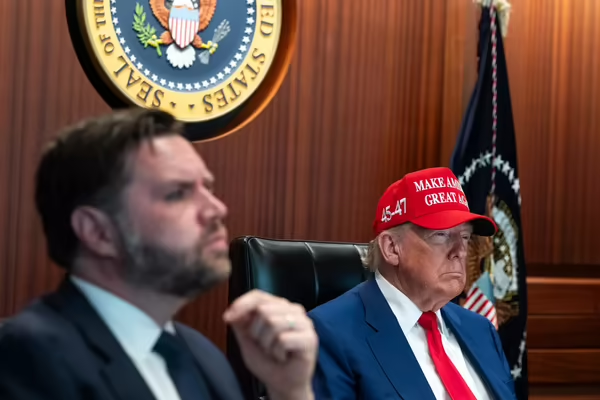
War room: US imperialists Vance and Trump endanger world peace
The bombing of Iranian nuclear sites by the United States overnight (21 June) is a flagrant breach of international law and a further indication of the designs of US imperialism to re-shape the map of the Middle East.
Following the unprovoked attack upon Iran by Israel last week, US President, Donald Trump, called for Iran’s “unconditional surrender”, while preparing to give the green light for overt military intervention by the United States. That order has now been enacted and Trump, in spite of his America first and no foreign intervention rhetoric, has acted like every US President before him. Though without Congressional approval for such action impeachment may be an issue Trump has to face, his action having made the danger of a world war significantly higher than at any time in the past.
The US had already been covertly assisting the Israeli assault by providing back up for its Iron Dome missile defence system, designed to intercept any Iranian missiles fired towards Israel in response.
That the United States has added to the unprovoked Israeli military intervention in Iran, is an international scandal. Israel has a decades long record of flouting international conventions and dismissing United Nations resolutions but, to be backed so overtly in doing so, by its major ally and arms supplier, takes the threat to world peace which US and Israeli actions represent, to a new level.
In addition, it is widely known that Israel has a nuclear capability though, in line with its official policy of “nuclear ambiguity”, it refuses to confirm or deny the existence of a nuclear arsenal. The possibility of the use of nuclear weapons by Israel, given the religious fundamentalist nature of its leadership, cannot be ruled out.
Just as there can be no justification for the Israeli genocide in Gaza, the attacks upon Iran have no legal or moral basis. They do however, have a clear political objective and that is one which has been asserted more prominently in the past few days; regime change.
In line with the wishes of the Iranian people as expressed in their opposition to the dictatorship of the former Shah in 1979 and, as increasingly expressed in their opposition to the theocratic dictatorship today, change in Iran is vital to secure peace, democracy and social justice for the people of Iran.
However, the regime change which Trump in the White House or Netanyahu in Tel Aviv are seeking is not for a progressive and democratic Iran. On the contrary, support for Monarchist opposition in the form of Reza Pahlavi, son of the former Shah based in the United States, is given greater prominence by Western politicians and media.
Netanyahu’s call for Iranians to rise up against the present regime in Iran have been echoed by Pahlavi, who met Netanyahu on a visit to Israel in 2023. The likelihood of Pahlavi being able to mobilise mass popular support inside Iran is slim however, given his distance from the country and the perception of many Iranians that he is collaborating with the aggressor Israel.
Any return to Iran for Pahlavi would need the significant backing of US or Israeli military forces to suppress the opposition which such a reactionary move would provoke. The danger of Iran becoming a state dismembered by Western imperialism, such as has been the case with Iraq, Libya, Afghanistan and Syria would be all too real in such a scenario.
An alternative for the West could be backing the Mujahedin-e Khalq (MEK), an exiled group that enjoys support in the US from hawks such as veteran Republican John Bolton. During the 1980s, the MEK backed Iraq in its war with Iran, and the Islamic regime often accuses it of collaborating with Israel. Like Pahlavi, the MEK does not enjoy popular support inside Iran and would require significant external backing in order to maintain any grip on power.
The US and Israeli cover story for their actions against Iran, to halt the nuclear programme, simply do not hold water. Recent years have seen increasingly popular opposition movements inside Iran. Millions protested disputed elections in 2009 in what became known as the Green Movement. In 2022, the Women, Life, Freedom Movement mobilised millions across Iranian cities, calling for an end to supreme leader Ayatollah Ali Khamenei’s rule following the death of 22-year-old Mahsa Amini in police custody after she was arrested for allegedly not properly wearing her hijab.
Workers in the transport, oil, public services and teaching sectors have taken action to improve wages and conditions in spite of trade unions being effectively outlawed in Iran. These are the potential movers of regime change that Trump and Netanyahu do not want to see. Those who are opposed to the theocratic dictatorship but equally do not want to see Iran’s future shaped by the outside interests of Israel or US imperialism.
Change in Iran has been coming for a long time but it must be change for the people, by the people, not change shaped by foreign intervention and an imperialist agenda, imposed upon the people of Iran.
Stop Arming Israel
12th July 2025

The persistence of the genocide carried out on behalf of the Israeli government by the Israeli Defence Force (IDF) continues at a staggering level. The IDF show no remorse for the killing of innocent civilians, 15 of whom died queueing to access food this week. The IDF claim to have been targeting a Hamas ‘terrorist’ so the loss of civilian life was simply collateral damage.
This weekend has seen a further 50 deaths including 10 at a water collection point which saw 6 children killed. This follows the killing of 110 people on Saturday including 34 at a food collection point in Rafah. Since 7th October 2023 the IDF has killed at least 57,882 people and wounded 138,095, according to Gaza’s Health Ministry.
According to the United Nations an estimated 800 Palestinians, many children, have died while seeking food at the so called Gaza Humanitarian Foundation (GHF) distribution points. The GHF is run by the United States, using American mercenaries, and backed by Israel. GHF has four distribution points, compared to the 400 previously operated by the UN, which Israel will no longer permit to operate.
Random killing was also the approach applied by the IDF in the recent Israeli bombing of Iran, which resulted in the assassination of a number of leading figures in the Iranian armed forces as well as key nuclear scientists. Western media reports played down the fact that in many instances it was not only the military and scientific targets who were murdered but many of their families, innocent of any ‘crime’ as deemed by the Israelis.
Such atrocities are often mis-reported, under reported or not reported at all by the media, keen to play down the extent of Israel’s flouting of international law but also uncomfortable covering any British government complicity in the genocide.
Palestinian deaths certainly don’t warrant the attention any criticism of the IDF does for the British media. Punk rap act Bob Vylan became the all round media villain recently when his Glastonbury set included him chanting “Death to the IDF”. The Mail on Sunday saw fit the following day to go with the banner headline “NOW ARREST PUNK BAND WHO LED ‘DEATH TO ISRAELIS’ CHANTS AT GLASTONBURY”.
The bandwagon rolled on into Monday with the Sun, Daily Mail, Daily Telegraph and the Daily Express weighing in and Kier Starmer proclaiming the comments “appalling hate speech”, stronger language than he uses when mentioning IDF atrocities.
Quite apart from the inaccuracy of the original Mail on Sunday headline, the claim made by the paper, that this was “antisemitic chanting”, was simply not true. The IDF, being the military wing of the Israeli state, does not represent all Israelis, any more than the government of Benjamin Netanyahu, which continues to face internal criticism for its policy and actions in relation to Gaza and the West Bank. Criticism of the IDF or the Israeli government is not antisemitic, it is a perfectly legitimate political stand to take in the face of their ongoing actions against the Palestinian population.
That Kier Starmer, as Prime Minister and Leader of the Labour Party, should join in such baying for blood along with the right wing media is a disgrace. Starmer and the government’s complicity in crimes against the Palestinian people is underlined by the Campaign Against the Arms Trade (CAAT) which, in relation to British arms sales to Israel,
“…estimates that between October 2023 and May 2024, over 100 new licences were issued, with a total estimated value of at least £100 million in military equipment since October 7th, 2023. These sales include components for F-35 combat aircraft, which CAAT estimates account for approximately 15% of the value of each F-35 and are used in ongoing conflicts, including those in Gaza.”
The government defends its position by claiming that “no evidence has been seen that Israel is deliberately targeting civilian women or children”. It further claims that “there is also evidence of Israel making efforts to limit incidental harm to civilians”.
The actual evidence, coming back from the UN, Médecins Sans Frontieres and Palestinian people themselves suggests that the British government is either being extremely naïve, or is simply lying.
The latest Israeli proposal, to create a concentration camp for Palestinians on the ruins of Rafah in the south of Gaza, would be a further crime against humanity.
The latest National March for Palestine, organised by Palestine Solidarity Campaign and its allies takes place on 19 July in London. The pressure on the British government to stop arming Israel and stop the starvation in Gaza must continue.
Like Many Other Things
Published by the recently established Newcastle based, Valparaiso Arts, a slim volume of new and selected poems, Like Many Other Things by Brian Topping is now available.
This is Valparaiso Arts first publication.
At only £7 inc p&p all proceeds will go to the Palestine Solidarity Campaign.
To get your copy simply follow the link below.
https://www.paypal.com/ncp/payment/F4SH749UP8QYE
More medical aid en route to Cuba
24th July 2025
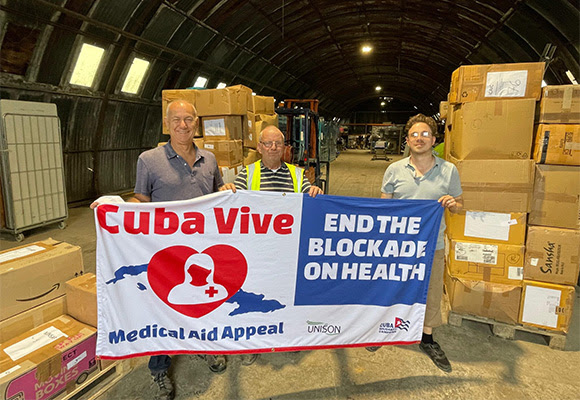
With your help, the Cuba Vive appeal hopes to raise over £200,000 by the end of the year
Eighteen months after its launch, the Cuba Vive Medical Appeal for Cuba has raised more than £190,000 and will hopefully surpass £200,000 by the end of the year. Thanks to the generosity of CSC members, affiliates and friends, hundreds of thousands of items of essential medical supplies, from syringes to surgical gloves, are being used by Cuban health workers to improve and save the lives of patients.
Second container on its way with more scheduled for 2025
Another 40ft container of life-saving medical aid departed from the Yorkshire port of Immingham in July and is due to arrive in Cuba in late August.
The container is packed full of much-needed resources such as catheters, tracheostomy equipment, syringes, needles, surgical scrub, colostomy bags, wheelchairs, Zimmer frames, crutches, and specialist operating theatre supplies including eight operating beds.
This is the second container of aid (of three consignments sent so far) that will be delivered working in partnership with UK charity Jacob’s Well Appeal, who organise the logistics, including sorting, storage, packing and shipping. A further container will leave later this summer, and more by the end of the year.
First aid kits for every residential education centre
The container includes over 200 first aid packs for every educational residential establishment in Cuba. They form part of medical aid funded by the National Education Union (NEU) for each of the country’s 147 residential schools for children in rural areas and 54 children’s homes.
The NEU is responding to a special request from the Cuban education union SNTECD since the shortages in the Cuban health service also impact the education sector. These are especially acute in educational care and residential settings, where everything from basic first aid kits to PPE and paediatric medical supplies are scarce.
Cuba Vive aid supports Cuban cancer hospital
In May, CSC director Rob Miller visited Havana’s Institute of Oncology and Radiobiology, one of the hospitals that has benefited from the Cuba Vive appeal, and spoke to staff and patients about how the medical aid was helping their work and treatment.
Find out more at https://www.cubavive.org.uk/
Don’t Leave Nagasaki
9th August 2025

In a debate in the House of Commons in 2016, on the renewal of Britain’s Trident nuclear submarine capability, then Prime Minister, Theresa May, was asked point blank if she would be prepared to use these weapons of mass destruction. Her equally blunt response was that yes, she would, on the basis that there is no point in having a deterrent unless you are prepared to use it. There is an inexorable logic to May’s position, if you believe that possessing nuclear weapons has a deterrent effect.
There is no evidence that nuclear weapons do deter, any more than there is any absolute evidence that they do not. So the real motivation behind whatever position is taken on the issue has to be a mix of the political, the moral and the humanitarian.
The war crimes committed by the United States of America, in dropping nuclear bombs upon the Japanese cities of Hiroshima and Nagasaki in August 1945, have never been acknowledged as war crimes. History, written by the victors as ever, records the use of nuclear weapons as having brought an end to the war in the Far East more quickly. That at least is the generally accepted wisdom. The fact that the war in the Far East was all but over, and the Japanese were seeking mediation through the Soviet Union to end the war, an outcome that the United States could not countenance, finds little airspace.
This poem was written in 2015 on the occasion of the seventieth anniversary of the bombings. Then, as now with the eightieth anniversary, Hiroshima gained much news coverage, due to being the first, while Nagasaki received less attention, hence the subject of the poem.
Not long after writing this poem I read the first hand account, Hiroshima by John Hersey, first published in the New Yorker in August 1946 and now published as a Penguin paperback. It is probably the most harrowing 100 pages of journalism you are ever likely to read.
The debate about Trident is not the major political fault line in 2025 that it was in 2016. The Tories, and no doubt Reform, are emphatic in their defence of Britain retaining nuclear weapons. In the debate in 2016 then Labour leader, Jeremy Corbyn, was categorical in his opposition to the recommissioning of Trident and vowed never, under any circumstances, to resort to the use of nuclear weapons.
Current Labour leader, Kier Starmer, has made no such commitment. On the contrary, Starmer actively commits to and embraces Britain’s role as part of the NATO war machine.
The possession of nuclear weapons and membership of NATO are subjects on which we all must all take a stand, a stand in opposition to either.
Don’t Leave Nagasaki
Little Boy pushed his way to the front,
Had to be first in the queue.
Fat Man groaned as the boy shoved past,
‘Hey son, I was there too.’
In the cold war light the atomic flash
Turned people to shadows on the floor,
Shedding thousands of tears in the eighty years,
Since opening the nuclear door.
Don’t leave Nagasaki burning
With the shame of this regret
Don’t leave Nagasaki wondering
Why no justice yet?
At The Hague they try war criminals
So the world can understand,
But there is no space to try the case
Of the melting of Japan.
The United States stands for freedom,
The United States stands for law.
Is there anyone outside of the United States
Who believes that, anymore?
Don’t leave Nagasaki burning
With the burden of this war crime.
Don’t leave Nagasaki thinking
That there could even be a next time.
Steve Bishop
Note
Little Boy was the name given to the atomic bomb the United States dropped on the Japanese city of Hiroshima on 6th August 1945. Fat Man was the name given to the bomb dropped on Nagasaki three days later, on 9th August 1945. Over 200,000 people died as a result of the bombings. Tens of thousands more have died subsequently from burns and radiation.
Fascism is coming
2nd September 2025
Fascism is Coming
by Brian Topping
Fascism is coming
Hoisting red white and blue
The red is right-wing Labour
Facilitating with false promises
The blue is where nothing is true
Tories muse on how far they can go
The white is working class
Blaming black for its troubles
But what is coming
Waits wearing a smile like a hyaena
Watching its prey
Limping towards destruction
More poems by Brian Topping are available from Valparaiso Arts.
At only £7 inc p&p all proceeds will go to the Palestine Solidarity Campaign.
To get your copy of his collection, Like Many Other Things, simply follow the link below.
https://www.paypal.com/ncp/payment/F4SH749UP8QYE
Nobel Provocation
11th October 2025
It is hard to think of a worse candidate for the Nobel Peace Prize than US President, Donald Trump. Not just because of the brazen campaign run by him and his supporters to try and secure the award. The ongoing role of the US in selling arms and fuelling conflicts around the world is an even more significant factor.
Benjamin Netanyahu, given his role in the genocide perpetrated in Gaza, would be as bad a candidate. The actual recipient of the Nobel Peace Prize 2025, Maria Corina Machado, was a shock to progressive movements arond the world, as she also has no claim to the award. The opinion piece below by Michelle Ellner, for Venezuela Analysis, explains why.
Machado certainly wasted no time in trying to take advantage of the profile associated with the award. Her first call was to Donald Trump, to thank him for his support in stationing US warships off the coast of Venezuela. Trump’s pretext for such action has been to allegedly stop drug traffiking but the US has been looking to take advantage of Venezuela’s oil reserves for some time and is clearly stepping up the pressure now that Trump has returned to the Presidency.
Details of the aggressive nature of US actions and the fear for direct military intervention have been raised in Britain by the Venezuela Solidarity Campaign. Find out more here
When Maria Corina Machado Wins the Nobel Peace Prize, ‘Peace’ Has Lost Its Meaning
by Michelle Ellner

Maria Corina Machado is known for her incendiary speeches
When I saw the headline Maria Corina Machado wins the Peace Prize, I almost laughed at the absurdity. But I didn’t, because there’s nothing funny about rewarding someone whose politics have brought so much suffering. Anyone who knows what she stands for knows there’s nothing remotely peaceful about her politics.
If this is what counts as “peace” in 2025, then the prize itself has lost every ounce of credibility. I’m Venezuelan-American, and I know exactly what Machado represents.
She’s the smiling face of Washington’s regime-change machine, the polished spokesperson for sanctions, privatization, and foreign intervention dressed up as democracy.
Machado’s politics are steeped in violence. She has called for foreign intervention, even appealing directly to Benjamin Netanyahu, the architect of Gaza’s annihilation, to help “liberate” Venezuela with bombs under the banner of “freedom,” She has demanded sanctions, that silent form of warfare whose effects – as studies in The Lancet and other journals have shown – have killed more people than war, cutting off medicine, food, and energy to entire populations.
Machado has spent her entire political life promoting division, eroding Venezuela’s sovereignty and denying its people the right to live with dignity.
This is who Maria Corina Machado really is:
- She helped lead the 2002 coup that briefly overthrew a democratically elected president, and signed the Carmona Decree that erased the Constitution and dissolved every public institution overnight.
- She worked hand in hand with Washington to justify regime change, using her platform to demand foreign military intervention to “liberate” Venezuela through force.
- She cheered on Donald Trump’s threats of invasion and his naval deployments in the Caribbean, a show of force that risks igniting regional war under the pretext of “combating narcotrafficking.” While Trump sent warships and froze assets, Machado stood ready to serve as his local proxy, promising to deliver Venezuela’s sovereignty on a silver platter.
- She pushed for the U.S. sanctions that strangled the economy, knowing exactly who would pay the price: the poor, the sick, the working class.
- She helped construct the so-called “interim government” a Washington backed puppet show run by a self-appointed “president” who looted Venezuela’s resources abroad while children at home went hungry.
- She vows to reopen Venezuela’s embassy in Jerusalem, aligning herself openly with the same apartheid state that bombs hospitals and calls it self-defense.
- Now she wants to hand over the country’s oil, water, and infrastructure to private corporations. This is the same recipe that made Latin America the laboratory of neoliberal misery in the 1990s.
Machado was also one of the political architects of La Salida, the 2014 opposition campaign that called for escalated protests, including guarimba tactics. Those weren’t “peaceful protests” as the foreign press claimed; they were organized barricades meant to paralyze the country and force the government’s fall. Streets were blocked with burning trash and barbed wire, buses carrying workers were torched, and people suspected of being Chavista were beaten or killed. Even ambulances and doctors were attacked. Some Cuban medical brigades were nearly burned alive. Public buildings, food trucks, and schools were destroyed. Entire neighborhoods were held hostage by fear while opposition leaders like Machado cheered from the sidelines and called it “resistance.”
She praises Trump’s “decisive action” against what she calls a “criminal enterprise,” aligning herself with the same man who cages migrant children and tears families apart under ICE’s watch, while Venezuelan mothers search for their children disappeared by U.S. migration policies.
Machado isn’t a symbol of peace or progress. She is part of a global alliance between fascism, Zionism, and neoliberalism, an axis that justifies domination in the language of democracy and peace. In Venezuela, that alliance has meant coups, sanctions, and privatization. In Gaza, it means genocide and the erasure of a people. The ideology is the same: a belief that some lives are disposable, that sovereignty is negotiable, and that violence can be sold as order.
If Henry Kissinger could win a Peace Prize, why not María Corina Machado? Maybe next year they’ll give one to the Gaza Humanitarian Foundation for “compassion under occupation.”
Every time this award is handed to an architect of violence disguised as diplomacy, it spits in the face of those who actually fight for peace: the Palestinian medics digging bodies from rubble, the journalists risking their lives in Gaza to document the truth and the humanitarian workers of the Flotilla sailing to break the siege and deliver aid to starving children in Gaza, with nothing but courage and conviction.
But real peace is not negotiated in boardrooms or awarded on stages. Real peace is built by women organizing food networks during blockades, by Indigenous communities defending rivers from extraction, by workers who refuse to be starved into obedience, by Venezuelan mothers mobilizing to demand the return of children seized under U.S. ICE and migration policies and by nations that choose sovereignty over servitude. That’s the peace Venezuela, Cuba, Palestine, and every nation of the Global South deserves.
Tell the Nobel Committee: The Peace Prize belongs to Gaza’s journalists, not María Corina Machado!
8th December 2025
Iran – peace will give the people a chance
The emergence of the Islamic Republic of Iran, following the revolution which overthrew the Shah in 1979, and its persistence as a focus for the development of political Islam has increasingly been seen as a threat by Israel. The United States has been equally concerned with the turn of events following 1979 and was instrumental in encouraging the attack upon Iran by Iraq in 1980, which led to the Iran-Iraq war raging from 1980-1988.
The war did not dislodge the Iranian dictatorship but encouraged the intensification of the arrest, torture and execution of dissident voices inside Iran and a consolidation of its control of the state by the medieval theocracy. The fragile alliance with Iraq, having served its purpose soon saw the US perform a volte face, eventually resulting in the downfall of former ally Saddam Hussein and the fragmentation of Iraq as a functioning state following the invasion of 2003.
It is against this background that the legitimate fears of the Iranian people of further military action must be viewed. Since the attack upon Iran in June the regime in the Islamic Republic is reported to have significantly increased missile production with a view to generating enough capability to overwhelm Israeli missile defences. Inside Iranian ruling circles the threat of renewed conflict is widely considered high, with some officials and experts suggesting that another war is “only a matter of time”.
Such thinking is fuelled, not only by the desire of the regime to increase its defence capability, but also by reports from reliable Israeli sources that Israel aims to topple the existing regime in Tehran by the end of the term of US President Donald Trump in 2029. Israeli security sources indicate that Israel is preparing to respond “much more aggressively” and for hostilities to last longer than the June conflict.
The religious zealots in the Israeli government view Iran as an existential threat and, in spite of the degrading of the network of Iran’s proxies in the Middle East notably Hamas and Hezbollah, the ultimate goal remains the elimination of the regime in Iran itself. Iran’s continued enrichment of uranium and increase in missile production are seen as sufficient justification for such an approach.
The current situation is exacerbated by the diplomatic impasse which has existed since the June attacks with efforts to resume nuclear talks between the US and Iran floundering, removing a key channel for de-escalation.
The threat of war, likely to be launched by Israel with the backing of the United States, is clearly the most urgent and pressing issue facing the Iranian people. Wider escalation across the Middle East, which could follow, would be disastrous not only for the people of Iran but would bring closer the prospect of worldwide conflict, given the geo-political significance of Iran for both Russia and China.
In parallel, the debate over access to nuclear facilities attacked in the June assault by the United States continues, with the International Atomic Energy Agency (IAEA) recently passing a resolution requesting access to sites in Fordo and Natanz, which were hit in the strikes. Iran’s resistance to further inspections of these sites, though it has allowed access to others, is fuelled by the reluctance of the IAEA to condemn the June attacks.
In response to the IAEA resolution Iranian ambassador to the IAEA, Reza Najafi, told reporters that, “I’m afraid the resolution will have its own consequences”. Asked what those were, he said, “We will announce the consequences later.”
Recent pronouncements from the United States suggest that President Donald Trump may be willing to break the current diplomatic impasse, claiming that Tehran is seeking a diplomatic resolution with Washington, which has sought the dismantlement of its nuclear programme.
“I am totally open to it, and we’re talking to them,” Trump said.
“And we start a process. But it would be a nice thing to have a deal with Iran. And we could have done it before the war, but that didn’t work out. And something will happen there, I think.”
The actions of the US in giving Israel the green light to attack Iran when negotiations were ongoing, and the subsequent US role in attacking nuclear sites, make it difficult to take Trump’s words at face value. There is no doubt that a section of the corrupt leadership in Tehran realises that its survival depends upon some rapprochement with the West, while more hardline factions are reluctant to engage in anything they would regard as compromise.
Perhaps the only certainty in the current situation is that the main losers are the Iranian people who, as well as the threat of external intervention, are also having to struggle with the impact of international sanctions, endemic corruption within the state and widespread economic mismanagement.
The response of Iranian workers to the collapsing political and economic environment they face has been to increase their demand for recognition, fair pay and employment rights. Strike action in the oil industry, the transport sector, the public sector and amongst pensioners has demonstrated the extent of internal resistance to the policies of the regime.
The regime continues to respond with the arrest, imprisonment and torture of trade union, cultural and academic activists, underlining its inability to fulfil the needs of its people and resort only to force to maintain its position.
The future of Iran ultimately must lie with its people and their resistance to the theocratic dictatorship, opposition to the pressures of external intervention and the demands for a non-aligned democratic Iran. Opposing war against Iran is the first step in this process and one which should be a priority for international solidarity work in the coming year. Only peace will give the people of Iran the chance they deserve.
The full text of this article appears in Liberation Journal, Winter 2025
 Avanti Populo