

13th December 2024
Silence the drums of war

Mark Rutte, Secretary General of NATO, beating the drums of war
Mark Rutte, recently appointed Secretary General of NATO, is saying today that the military alliance should shift to a “wartime mindset”, as Russia “is trying to crush our freedom and way of life” and could be in a position by 2029 to invade NATO countries. In order to combat this so called ‘threat’ spending on weapons of destruction should be increased to at least 3% of GDP, the current target for NATO members being 2%, which many struggle to achieve.
Britain currently spends 2.3% of GDP on the military and is committed to increase that to 2.5% ‘when economic conditions allow’. Military spending is not, however, primarily about economic conditions, it is about the political vision, assessment and understanding of where threats come from and how they are countered. The outcomes of such political assessments certainly have economic consequences. The more that is spent on tanks, guns and nuclear submarines, the less there is for roads, schools, hospitals and local government services.
Successive governments, Tory and Labour, have tried to mask their excessive spending on weapons by arguing that the first duty of government is to keep its citizens safe, to defend the nation. This argument is as bogus as that of the National Rifle Association (NRA) in the United States who insist that the constitutional right to bear arms is about keeping citizens safe. The death toll in US schools over recent years should be enough to counter that argument but gun control is shied away from by Republicans and Democrats afraid to lose the gun lobby vote.
Manufacturers of military weapons hate a vacuum, they want to see their goods tested in real battlefield scenarios. The people of Iraq, Afghanistan, Yemen, Libya, Gaza, Lebanon and Syria can testify to the impact of this approach over the recent years. The supply of weapons to Ukraine, fuelling a conflict which could be settled by peaceful means, continues this strategy.
The reality is that the more arms there are in circulation the more likely someone is to use them. That is true at the individual level and is equally true at an international level, either by design or by accident. The Cold War doctrine of Mutually Assured Destruction (MAD) may have held a precarious post war balance between the Soviet Union and United States but the real drive from a US perspective was to keep the pressure upon the Soviet economy, diverting resources from socially useful production, till it reached breaking point.
That goal having been achieved, with the active support of counter revolutionary elements inside the Soviet Union, the United States was left with a highly armed gangster capitalist economy in the form of post Soviet Russia which, given the nature of capitalism, soon developed ambitions of its own and did not just fit neatly into the concept of unipolar world dominance the US desired.
The European Union proved a useful tool with which to absorb Eastern European nations into the orbit of the West, as both new markets and sources of cheap labour. For most, NATO membership followed quickly on, tying them economically and militarily to the Western ‘alliance’ in every way.
That Russia should perceive this encirclement as a threat is no surprise and the belligerent tone of much of the rhetoric from Western leaders has only reinforced such perceptions. The anti-Soviet rhetoric of the post war years quickly translated into anti Russian rhetoric, when it became clear that the post Cold War scenario was not one of Russian resources being absorbed into the coffers of Western corporations but one of inter-imperialist rivalry. The current conflict in Ukraine is a direct result of over 30 years of Western belligerence and provocation, in an effort to bring Russia to its knees and ensure Western access to its vast market and resources.
The warmongering comments of Mark Rutte are a continuation of this process. His appeal to NATO members to provide the arms industry with “the big orders and long term contracts they need to rapidly produce more and better capabilities” is a clear signal that as far as NATO is concerned any form of détente is off the agenda.
Rutte’s comments should be a clarion call to the peace movement to redouble efforts to demand that Western governments do the exact opposite of what Rutte is urging. In Britain Labour should be pursuing policies based upon the peaceful co-existence of states, with mutual co-operation between them to address the climate emergency and ensure the long term safety of the planet.
Building more weapons, being part of the ‘nuclear club’, is not going to achieve anything other than Britian being a target, if NATO’s provocations do lead to a wider conflagration in Europe. There is evidence enough in the Middle East alone in recent years, that a policy of trying to resolve issues through military means only leads to the destruction of states and societies, along with the exacerbation of the international refugee crisis.
Mass extra Parliamentary action, along with the mobilisation of progressive MPs and opinion in the Labour and peace movements, must be mobilised if those beating the drums of war are to be silenced and the voice of the people, desperate for peace, is to prevail.
5th December 2024
Developments in Syria
A statement from Liberation
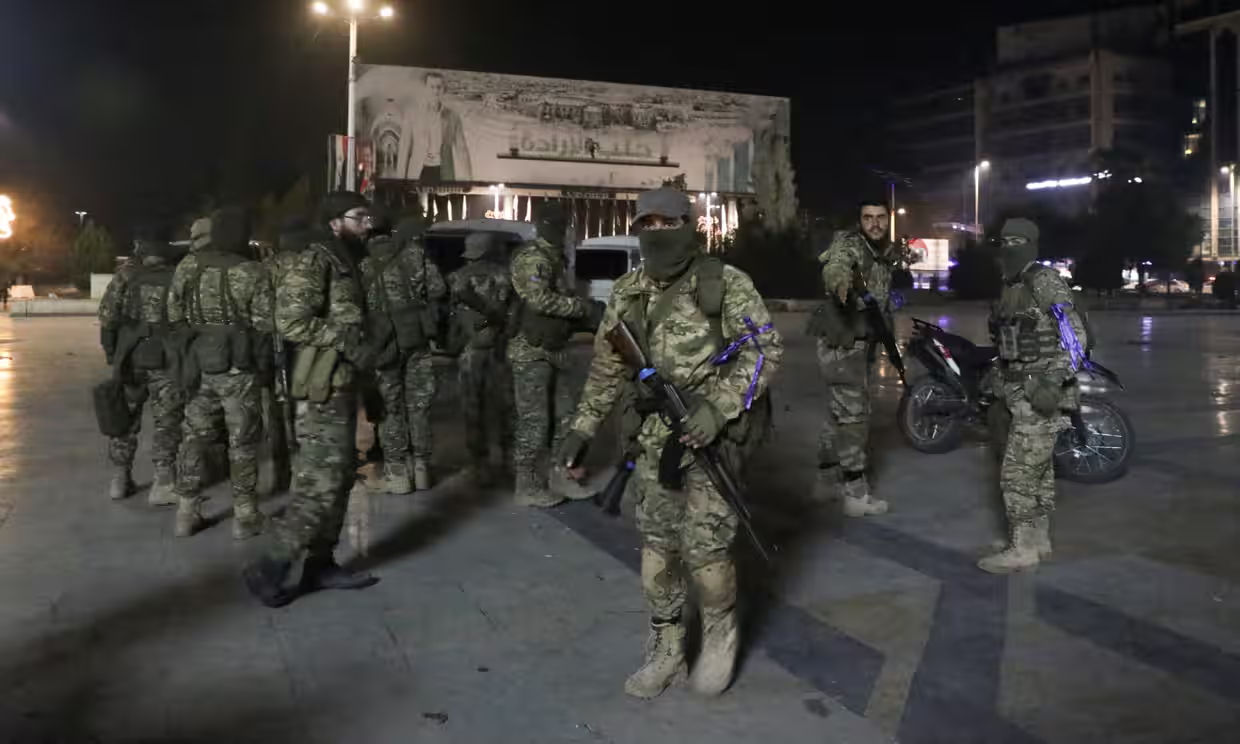
Islamist forces in Aleppo
The capture of Aleppo by Islamist paramilitary forces has taken many across the Middle East and around the world by surprise and signifies once more the destabilisation of Syria as well as the rapidly deteriorating situation in the wider region, opening the door to further external intervention and a catastrophic war.
Liberation has received information from progressive forces inside Syria, critical of the Assad regime, but also opposed to outside intervention and the fragmentation of the country.
The progressive opposition in Syria have articulated a number of key points regarding the present situation with a call for negotiation on the basis of UN Security Council resolutions being central to their position.
Firstly, they have made clear that the currently in place “de-escalation” zones, despite their importance in stemming further bloodshed from the Syrian civil war, are not a sustainable solution over the longer term. Their function was to stop the bloodshed in order to move towards dialogue and negotiations to reach a real political solution that would reunite the Syrian people and the entire sovereign territory of Syria through the implementation of UN Security Council Resolution 2254. A real politically driven transition towards a new political, economic, and social system ultimately determined by the Syrian people is the desired outcome.
Secondly, the progressive opposition recognise that, over the past 13 years, Syria has endured cycles of extreme violence and destruction throughout the country, which the implementation of de-escalation agreements and zones brought to a halt. This led to a state of near-complete ceasefire by mid-2019, essentially a freezing of the conflict. After that, the economic phase of attrition began, both from at home as well as abroad. Thus, international sanctions served to deepen and exacerbate the brutal neoliberal economic policies overseen by the Syrian government. This led to a worsening of the Syrian tragedy and laid the foundations for the fall of Aleppo and the events currently being witnessed in the country.
The progressive opposition in Syria states: “The renewal of the cycle of violence and battles means that a political solution is more necessary today than ever before, and more possible than ever before. None of the sides concerned with sitting at the negotiating table can claim the ability to achieve a crushing victory that will destroy the other side, and this has been tried for many years at the expense of the blood and suffering of the Syrian people.”
Liberation is also very concerned regarding the implications of the events of the past week in Syria for the further destabilisation of the wider Middle East, including the prospects for what would be a catastrophic regional war – with global implications – were it to break out. We believe the developments in Syria have not taken place in a void removed from the events since last October, not least the apparent drastic weakening, if not dismantling, of the so-called “axis of resistance” forces’ capabilities – and, by extension, those of the Islamic Republic regime in Iran in the region – over more recent months. The cynical exploitation of, if not outright malign interference in, these developments by governments such as Israel and Türkiye, serve only to make a desperate and deteriorating security situation in the region as well as wider fallout much worse. Indeed, we note the comment made earlier today by Iraqi prime minister, Mohammed Shia’ Al Sudani in which he stated that his country will not remain just a “spectator” to the events unfolding in neighbouring Syria.
Liberation supports the calls for a comprehensive and binding political solution to the crisis in Syria, and one free of any kind of military intervention from outside forces or other infringement upon the country’s sovereignty. Thus, we add our voice to the growing call for the urgent implementation of UN Security Council resolution 2254 and a resolution to the crisis in Syria firmly grounded and based upon the will of the Syrian people, not the forces of outside intervention.
21st November 2024
War Shadows Darken

British PM, Kier Starmer, grandstands at the G20 Summit in Brazil
NATO’s undeclared war on Russia, fought through its proxy in Ukraine, took further steps towards escalation this week. In the final desperate weeks of his presidency Joe Biden has upped the ante in the conflict in Ukraine by giving the go ahead for US missiles, with a range of up to 300 km, to be fired into Russian territory. Biden has also sanctioned the use of anti-personnel mines, widely discredited and subject to international agreements to prohibit their use, through the Anti-Personnel Mine Ban Convention, though neither the US or Russia are signatories.
Reports also suggest that British supplied Storm Shadow missiles have been used in recent days to hit targets inside Russia, increasing the danger of Britain becoming a target for retaliatory action. The West continues to ignore peace proposals put forward by China and persists in pouring more fuel onto the fire of the conflict, through the continued supply of arms and aid to Ukraine.
Britain alone has committed £12.8 billion to Ukraine since 2022 of which £5bn is financial support and £7.8bn is for military purposes. Britain is the third largest donor of military equipment after the US and Germany.
Speaking at the recent G20 Summit in Brazil Prime Minister, Keir Starmer, said that there had already been “1,000 days of sacrifice” but that Britain would continue to ensure Ukraine has what it needs to fight the war “for as long as it needs”.
Without any apparent hint of irony Starmer went on to say,
“In this moment when global challenges are affecting us at home, I take the view that British leadership matters.”
The character of that “leadership” would appear to be little more that to kowtow to the diktats of US foreign policy, by supporting the war against Russia, rather than addressing the real needs of working class communities in Britain. The billions that are going to pay for weapons of destruction in Ukraine could more usefully be spent on winter fuel payments for the elderly, investing in support for the health and care services, or supporting the crumbling schools infrastructure across the country.
As priorities go the idea of “British leadership” on the global scale is merely empty rhetoric as the Western military alliance, NATO, dances to the tune dictated by who pays the piper. By far and away NATO’s biggest paymaster is the US and there is no way that the British tail will be allowed to wag that dog!
What Starmer really needs to address are the challenges “affecting us at home”, with the emphasis on the “us” being working class families and communities, who inevitably shoulder the burden of imperialist wars and the waste of public money on weapons of mass destruction, rather than socially useful programmes which will support well paid jobs and help communities thrive. That however would require a true socialist perspective with planning for people at the forefront and the needs of the many put before the greed of the profit hungry few.
Instead the lobby for more money to be spent on the military is already underway with British chief of defence staff, Sir Tony Radakin, stating when interviewed by the BBC’s Laura Kuenssberg that the government should provide more money for defence.
Interviewed on the same programme Treasury minister, Darren Jones, said the government wanted to increase defence spending from 2.3% to 2.5% of the national income but that the government would not commit to a deadline until it had completed its strategic defence review.
The review, led by former Labour minister and NATO head George Robertson, is examining the current state of the armed forces, the supposed threats that Britain faces and the capabilities needed to address them. It is due to be completed in the spring of 2025. It is unlikely that Robertson’s review will conclude that threats could be minimised by not spending billions on fuelling conflicts, or by not renewing the Trident nuclear submarine programme, which will waste billions in public funds.
In a classic piece of government euphemism Jones in his interview went on to warn that increasing defence spending would mean “trade offs” with other areas of public spending. It hardly needs spelling out that trade offs will mean cuts in those other areas of public spending which will impact upon the services that people really need, such as health and social care, housing, education and transport. Having a few overpriced and essentially useless nuclear submarines at sea will not help any of that.
Starmer may feel his ego is boosted by puffing out his chest and grandstanding about supporting Ukraine at the G20 Summit. He may think that is “leadership” but the reality is that such a position is one of supine surrender to the drive of US imperialism, to escalate the conflict with Russia and ultimately to turn its sights towards China.
Working class communities in Britain will pay a heavy price if Starmer continues down that road. The work of Stop the War, CND and those sections of the Labour Movement committed to peace and social justice is more vital than ever in mobilising opposition to the growing threat of increased military activity in Ukraine, the Middle East and the Far East. The pro-war lobby must be stopped and it must be stopped now before the current conflicts truly do become worldwide.
7th November 2024
US election – resistance is vital
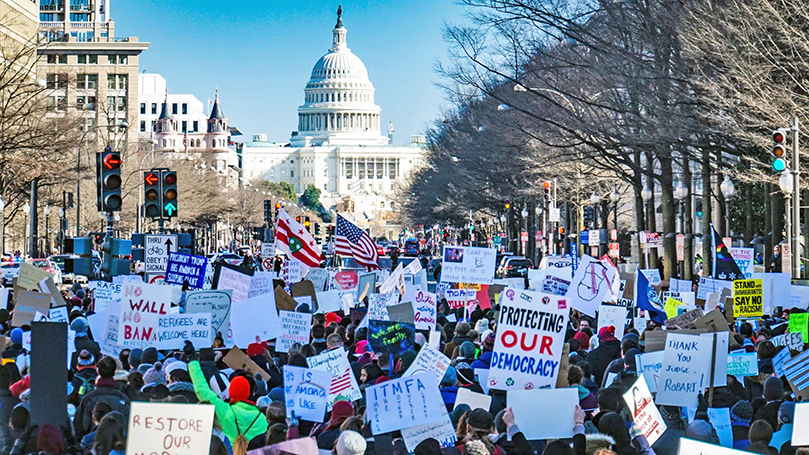
Demonstrations will continue to oppose the reactionary policies of President Trump
The election of a new President in the United States is always a moment of international significance, given the role the US plays in world politics. The Presidential election of 2024 has been described as the most consequential in a generation and there is no doubt that the re-election of Donald Trump will have profound repercussions both in the US and internationally.
Trump’s first term appointments of reactionary judges to the Supreme Court has already led to the reversal of Roe v Wade and the attack on reproductive rights in the US. While each State can at the moment determine its own position there is no guarantee that Trump will not introduce nationwide anti-abortion legislation, under pressure from the hardline Christian evangelist lobby.
The belligerent stand taken by Trump in relation to the Black Lives Matter Movement also does not augur well for progress in the discrimination and treatment of the Black and Latino communities in the US. While the media are making much out of the increase in Trump’s vote share amongst these communities, over the more socially liberal Kamala Harris, work is still needed to analyse the pattern of voting and the impact of many who stayed at home.
As a long standing advocate of gun laws being as relaxed as possible, US citizens cannot look forward to any action to restrain the gun lobby in the US, led by the fanatical National Rifle Association (NRA). The consequence of lack of control over gun law in the US saw nearly 43,000 people die from gun related violence in 2023 and any hope for that number to drop significantly under Trump is slim.
Trump has the backing of a shady grouping around the Make America Great Again (MAGA) campaign, called Project 2025: The Presidential Transition Project.
The blurb on their website states it’s mission:
“ It is not enough for conservatives to win elections. If we are going to rescue the country from the grip of the radical Left, we need both a governing agenda and the right people in place, ready to carry this agenda out on Day One of the next conservative Administration.
This is the goal of the 2025 Presidential Transition Project. The project will build on four pillars that will, collectively, pave the way for an effective conservative Administration.”
Trump has also called for thousands of federal employees to be fired and to be replaced by workers who are appropriately vetted on the basis of their ideological belief in the limited role of federal government and personal loyalty to him, stating,
“I will require every federal employee to pass a new civil service test, demonstrating an understanding of our constitutional limited government.”
Tax cuts for the rich and cuts in public services for the rest are likely to be the reality of Trump’s policies.
On the world stage the US military industrial complex will be looking forward to continued profits as Trump will undoubtedly continue promoting the sales of US weapons and technology worldwide.
In relation to the ongoing Israeli action in the Middle East, in Gaza, the West Bank, Lebanon and Iran, Trump has made clear his unswerving support for Benjamin Netanyahu and the ongoing incursions by the Israel Defence Force (IDF), resulting in thousands of deaths over the past year. Trump’s election victory was greeted enthusiastically by Netanyahu and his supporters in Tel Aviv.
In his first term as President, Trump tore up the Joint Comprehensive Plan of Action (JCPOA) in relation to Iran, which constrained Iran’s nuclear programme in exchange for a relaxation of sanctions. Given Trump’s belligerent tone towards Iran, allied with his support for Israel, there is a clear danger of escalation of the conflict in the Middle East.
In relation to Ukraine Trump has been more ambivalent but the strategic objectives of the US and NATO, in encircling Russia in order to contain its influence, remain real. However any settlement regarding Ukraine is arrived at in the short term, this wider objective will remain.
In the Indo-Pacific the military built up to counter the so called ‘threat’ of China continues, with ongoing economic and military support for Taiwan being key, along with the threat to peace in the region posed by the AUKUS alliance of the US, UK and Australia.
Any moves towards rapprochement with Cuba, mild as they were under the Obama administration, were ditched during Trump’s first term. Cuba was added to the US state sponsors of terrorism list. To the shame of the Biden administration this position was not reversed and the ongoing illegal blockade against Cuba, imposed by the US, will continue under a new Trump Presidency.
The ongoing CIA campaign to undermine progress in Venezuela, a long running effort to install a US friendly regime in that country, is unlikely to change under Trump, while a clampdown upon migration from Latin America in general will reinforce the jingoism which has been a hallmark of Trump’s policies. Trump has vowed to oversee the largest mass deportation in US history for example and has repeatedly stated that immigrants are “poisoning the blood” of the country.
The Trump administration may not be characterised as fascist yet but Trump does have form. According to John Kelly, former White House Chief of Staff, during a 2018 trip to Paris to commemorate the end of World War I, Trump told him that Hitler “did a lot of good things.”
Much of the United States will be waking up to the hangover of a second Trump administration. The broad anti-MAGA coalition will continue to mobilise against the reactionary legislation Trump is bound to introduce. The Communist Party USA is calling for a renewed resistance movement to build the anti-fascist front that has been developing over recent years. Resistance is not only possible but vital, for the people of the US and the world.
23rd October 2024
Creative Health – Wake up the nation

Health Secretary, Wes Streeting – big plans for the NHS but will they be big enough?
With only one week to go until the first budget from Labour Chancellor, Rachel Reeves, there has been much speculation about what it will include, in relation to both spending cuts and investment to allegedly boost the economy, usually a euphemism for increasing coprorate profits. As part of the pre-budget media management Health Secretary, Wes Streeting, has shared a vision for the NHS, or at least initiated a “national conversation”, with a 10 year plan for the NHS to be published next year.
As well as digitisation of patient records, controversial with many, the government is proposing neighbourhood health centres where patients will be able to see family doctors, district nurses, care workers, physiotherapists, health visitors and mental health specialists, all locally and under the same roof.
There will also be shift in focus, from sickness to prevention, with the aim of shortening the amount of time people spend chronically unwell and preventing ill-health. There are also plans to provide smart watches for people with diabetes or high blood pressure, so they can monitor their own health at home.
Some of these measures may have benefits but while smart watches to monitor conditions could address the symptoms it will not get to the root causes of economic disadvantage and poverty, which result in poor diet and cheap food choices, which many working class families are forced into.
At the same time, in a contradictory move, the government has approved the trial of an anti-obesity drug aimed at getting “those who are most likely to return to the labour market” back into work. The trial, based in Manchester, will involve 3,000 people in a five year study of the “non-clinical outcomes” of treatment to see if it encourages a return to the workplace.
The trial effectively treats people according to “their economic value, rather than primarily based on their needs and their health needs”, according to obesity researcher at Cambridge University, Dr Dolly van Tulleken. The emphasis of this approach is once again to blame the individual, rather than to highlight failures in the system which, due to lack of financial resources, limits options for many working class families and exacerbates health inequalities.
Quite apart from the ethics of such an approach it is nothing more than a sop to Big Pharma, always keen to explore drug based solutions, when a huge evidence base for the benefits of alternative approaches to preventative health care already exists.
The National Centre for Creative Health (NCCH) was established following the All Party Parliamentary Group on Arts and Health report, Creative Health, published in 2017. A subsequent commission, established by the NCCH and chaired by Baroness Lola Young, published its Creative Health Review in 2023 to update the findings of the original APPG report, in the light of the Covid-19 pandemic.
While a commission made up of the great and the good from the worlds of health and culture was never going to come up with a set of revolutionary demands, it has nevertheless highlighted flaws in the existing health and social care arrangements, which could be addressed to benefit working class communities if resources are made available.
The review set out a number of recommendations to government, primarily,
- the development of a cross-departmental Creative Health Strategy, driven by the Prime Minister, co-ordinated by the Cabinet Office and supported through ministerial commitment to ensure the integration of creative health across all relevant policies. Such an approach will facilitate the establishment of sustainable cross-sectoral partnerships across regions and systems, modelled by national policy.
- The long-term value of investing in creative health must be recognised and appropriate resources should be allocated by HM Treasury to support the Creative Health Strategy.
- Lived experience experts should be integral to the development of the Creative Health Strategy.
While these demands in themselves are relatively limited they are still a challenge to the conservative approach to health and social care taken by both the Tories and Labour in government.
Creative Health is defined as creative approaches and activities which have benefits for health and wellbeing. Activities include visual and performing arts, crafts, film, literature, cooking and creative activities in nature, such as gardening; approaches may involve creative and innovative ways to approach health and care services, co-production, education and workforce development.
Creative Health can be applied in homes, communities, cultural institutions, heritage sites and healthcare settings. Creative Health can contribute to the prevention of ill-health, promotion of healthy behaviours, management of long-term conditions, and treatment and recovery across the life course.
The Creative Health agenda is not just about tinkering with the NHS system and social care at the edges, it is about a wholesale reform of the approach to healthcare, which emphasises active community engagement in a range of creative activities. In study after study, both nationally and internationally, these have been proven to have positive impacts. The key to success however is that activity must be effectively funded at a community level and this has been systematically reduced by successive governments.
The squeezing out of arts activities in state schools, as part of the national education curriculum, will have a long term impact upon the ability of those other than the wealthiest to access creative resources. Grassroots arts activity is under threat across the country as venues and community facilities close due to the rising costs of stock and utilities. Local government arts budgets have been cut to the bone with arts, museum and library facilities continually under threat. Yet these very services are integral to the physical and mental health and wellbeing of local communities and should be at the core of any proposals which have prevention at their heart.
The Tories cut funding to the Arts Council England by 30% when elected in 2010 as part of the austerity agenda, claiming that support could be found by unlocking the potential in philanthropy. That ship has yet to come in to dock. The Office for National Statistics in a report in 2022 showed that while more than 16% of creative workers born between 1953 and 1962 were from working class backgrounds, that figure had fallen to 8% four decades later.
The number of students taking arts GCSEs has fallen by 40% since 2010 and the number of drama teachers in English secondary schools is down by 22% since 2011.
Such figures demonstrate the lack of value placed upon the creative sector, in spite of it being a huge income generator for the economy, over £108 billion in 2021, but also the failure to recognise the essential role creativity can play in reducing the burden upon the NHS as part of an integrated Creative Health approach.
The “national conversation” Wes Streeting has initiated needs to highlight these facts and the next 10 Year Plan for the NHS needs to have Creative Health and the real needs of working class communities at its heart. In addition, investment in the cultural sector, both through Arts Council England and the local government sector needs to be restored as a priority and the basis of arts education in the national curriculum reviewed.
Creative Health is unlikely to get much airtime in Rachel Reeves’ budget next week but if it is not taken seriously, as part of a wider package of investment in and reform of health and social care, the long term health of the nation, and the government, will be in doubt.
https://ncch.org.uk/creative-health-review
12th October 2024
Peace the Middle East priority

A Palestinian girl carries a child through the rubble of houses destroyed by Israeli bombardment in Gaza City
The extent to which Israel is prepared to go it alone in a threatened strike against Iran was made clear this week in reported discussions between the Israelis and the United States. US President, Joe Biden, and Israeli Prime Minister, Benjamin Netanyahu, discussed issues relating to Israel’s expected provocation against Iran in their first call in over a month last week. The White House has said that Biden emphasised the need for “a diplomatic arrangement” to allow Israeli and Lebanese civilians displaced by fighting to return to their homes; urged Israel to minimise civilian casualties in airstrikes against Beirut; and discussed “the urgent need to renew diplomacy” on achieving a cease-fire in Gaza.
Clearly Biden’s words have had little impact with the Israeli Defence Force (IDF) carrying out its heaviest bombing raids so far on Thursday night, just over 24 hours after the Biden/Netanyahu conversation. The strikes included attacks upon United Nations peacekeeping positions, reinforcing the rogue status of Israel in the Middle East.
It is apparent that the US is frustrated by being repeatedly caught off guard by Israel’s military actions in Gaza and Lebanon, but appears incapable of summoning the political will to head off further escalation. There was some hope that the US would learn more about what Israel was contemplating when Israeli Defence Minister, Yoav Gallant, and US Defence Secretary, Lloyd Austin, were scheduled to meet at the Pentagon last week. However, Netanyahu blocked Gallant from going to the US as Israel continued planning its Iran operation. As it stands the US claims not to know either the timing of the strike or what Israel might target.
It is known that Army Gen. Erik Kurilla, who heads US Central Command, with responsibility for US military operations in the Middle East, has met with Gallant and top Israeli military commanders, to warn against striking Iran’s nuclear sites or oil facilities.
Gallant is widely seen in the West as the Israeli leader most responsive to the US concerns about Israel’s prosecution of the war in Gaza, especially regarding increasing humanitarian aid and creating a plan for postwar governance. However, it is evident that Netanyahu’s desire to cling to office, and take advantage of the hiatus which the pre-election period in the US represents, outweighs any wider strategic concerns for him and the religious fundamentalist backers in his government.
US failure to act decisively is frustrating the international community as it is clearly the major supplier of arms to the IDF. Israel, can only continue to prosecute the wars it has initiated on multiple fronts, because of its dependence on the US military. Over the past year, it has not only relied on supplies of American munitions, but benefited from US help in shooting down missiles and drones, as well as the rapid deployment of American naval and air forces to deter more substantial Iranian attacks.
In turn the US has had to modify its strategic priorities, which were focussed on ramping up conflicts with China and Russia, to adapt. Struggling to head off an all-out Middle East war, the Pentagon has deployed two aircraft carrier battle groups to the region for much of the year.
Against this background the threat of further escalation once the IDF attack Iran is significant, for the region, for world peace and for the people of Iran themselves.
Inside Iran the theocratic leadership of the Islamic Republic is walking a political tightrope having seen its adventurist foreign policy in the region at least temporarily crushed, following the overkill of the Israeli response to the Hamas attack of the 7th October last year. Leaders of Hamas and Hezbollah have been assassinated, key targets have been hit, disrupting operations, and the Israelis have even reached into Tehran itself to undermine the Islamic dictatorship’s reliability on its own security apparatus.
Evidence in both Gaza and Lebanon would suggest that the Israelis are not inclined towards acting with restraint, as the death toll on both fronts mounts, along with the increasing unrest in the occupied West Bank. Iran’s response to the strikes against Hezbollah in Lebanon have so far not inflicted significant damage upon the IDF but have been sufficient to give the Israelis justification, in their eyes, to strike back.
It is clear from the evidence of the past year, the years of illegal Israeli occupation of Gaza and the West Bank and the repeated incursions into Lebanon by the IDF over the years, that there is not a military solution to the issues in the Middle East. The only solution can be a diplomatic one, starting with the right of the Palestinian people to self determination and a state of their own.
The failure of the international community, primarily the United States and Britain, to enforce United Nations resolutions, which would compel Israel to negotiate, and to continue to supply weapons to sustain the IDF, are the key drivers of the current situation. Until peace is at the top of the strategic objectives of all players the people of Gaza, Lebanon and Iran, will continue to suffer.
4th October 2024
Blatant Biased Content (BBC)
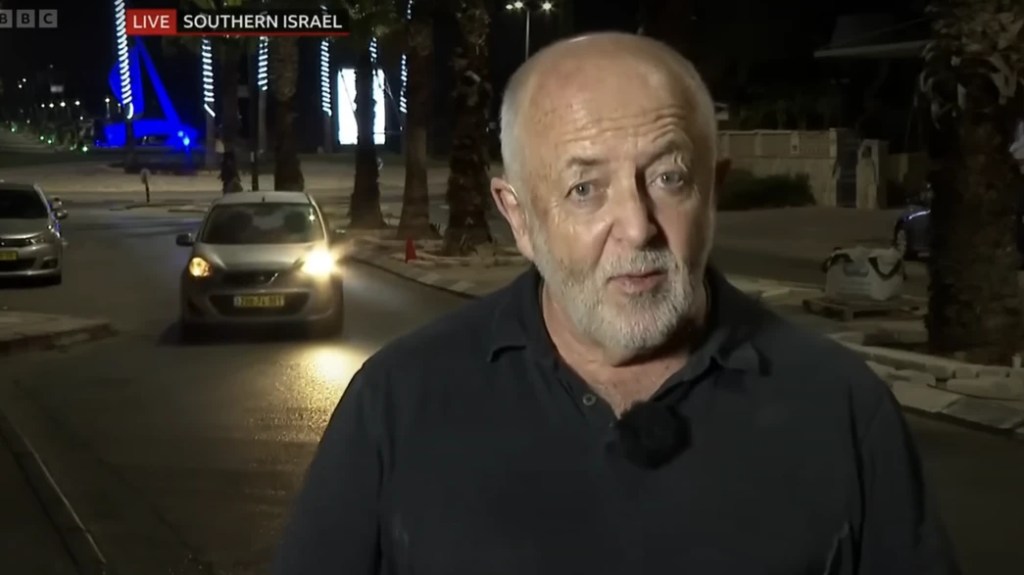
BBC International Editor, Jeremy Bowen
Reporting by the BBC on current conflicts demonstrates the bias of the corporation and the extent to which, in spite of its regular emphasis upon impartiality, the BBC is anything but when it comes to its international coverage.
The Russian incursion into Ukraine in February 2022 was undertaken in order to protect communities who had expressed a wish to become part of Russia, but had suffered at the hands of Ukrainian forces since 2014, resulting in 14,000 deaths. The Minsk Accords, signed in 2015 to halt the fighting, were later admitted by Western governments to be a mere ploy to give Ukraine time to re-arm.
The Russian intervention is nevertheless unfailingly referred to by the BBC as a full scale invasion and the wider context, including the CIA backed coup in Ukraine in 2014, conveniently overlooked.
Even after the intervention by Russia, a peace agreement mediated by Turkey in March 2022 was on the brink of being signed by Ukraine, until the United States persuaded then British Prime Minister, Boris Johnson, to deliver the message to President Zelensky that the “collective West” would not support the agreement.
In an item given widespread coverage by the BBC in the last couple of days, Khalil al-Hayya, the deputy leader of Hamas, was interviewed by BBC international editor Jeremy Bowen. On each occasion al-Hayya was introduced as someone whose views may be abhorrent to many. Bowen was asked to justify why the interview had taken place and why al-Hayya should be given air time.
Bowen dutifully trotted out the BBC line on impartiality and the need to hear all sides in a crisis situation. All very well, but the briefings by Israeli Defence Force (IDF) representatives, committing genocide in Gaza, killing medical teams in the West Bank and currently invading neighbouring Lebanon are not given the same caveat, even though many will find both their views and their actions abhorrent.
It is also noteworthy that the invasion of Lebanon by the IDF is described by the BBC as an ‘incursion’, a characterisation they may struggle to hold onto as the death toll inevitably mounts.
The BBC attempts to protect the illusion of impartiality in other ways too. John Simpson is regularly given his own half hour, titled Unspun World, in which Simpson interviews various BBC correspondents who invariably give a particular spin on events in the part of the world that are covering. The title is not meant to be ironic.
Then there is the BBC Verified branding. Presumably it is the BBC themselves who are undertaking the verification, which is a bit like the police investigating themselves or students marking their own homework. Are they really trying to kid us that a new logo is a guarantee of impartiality and objectivity?
How the Tories can continue to bleat on about the BBC being run by ‘Lefties’ and not toeing the line on issues is laughable. Apart from the odd moment of mild criticism the BBC knows quite clearly on which side its bread is buttered. Sadly it is not the side of investigative journalism, truth and objectivity.
29th September 2024
Turning Points
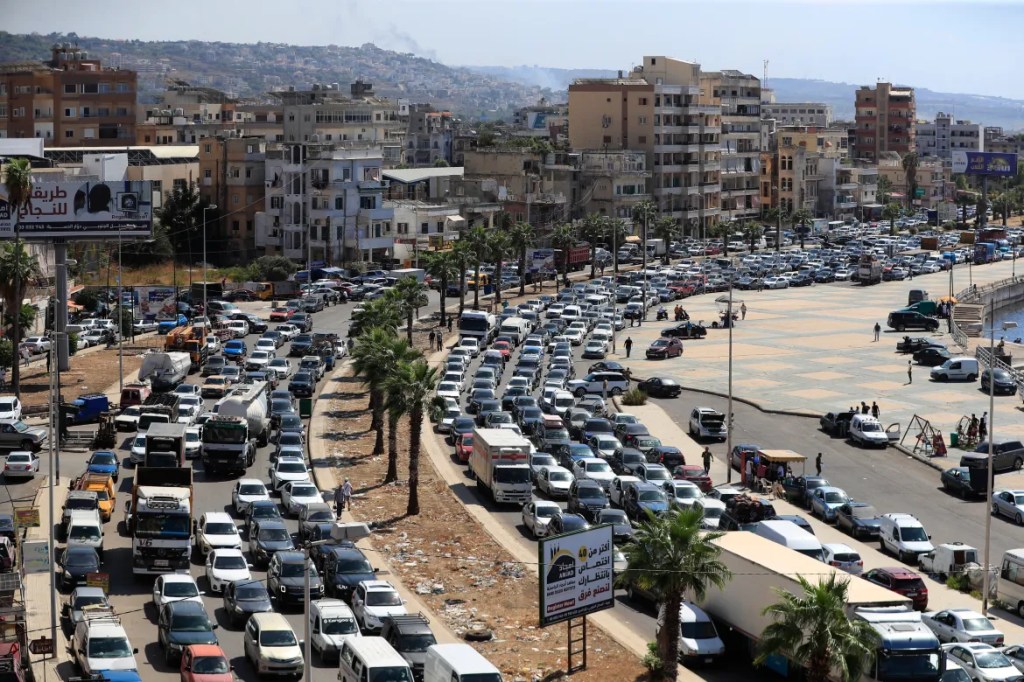
Thousands flee Lebanon to escape Israeli air strikes
The assassination of Hezbollah leader, Hassan Nasrallah, has been described by Israeli Prime Minister, Benjamin Netanyahu, as a ’turning point’, describing Nasrallah as “the axis of the axis, the central engine of Iran’s axis of evil”.
The killing and the ongoing bombing of civilian areas of Beirut may well prove to be a turning point but not necessarily in the way that Netanyahu means. Iran’s leader, Ayatollah Ali Khamenei has called for five days of mourning following Nasrallah’s death and vowed that his ”blood will not go unavenged.”
Lebanon’s Health Ministry has estimated that 800 are dead so far as a result of the actions of the Israeli Defence Force (IDF), while 50,000 people are estimated to have fled to Syria and an estimate 1 million are displaced, many having to sleep on the streets.
The bombings follow on from the indiscriminate attacks, not denied by the Israelis, upon Lebanese citizens by planting explosives in electronic communication devices, which killed 37 and injured thousands. This action has been widely condemned as a war crime precisely due to its indiscriminate nature.
While the IDF claim that the current bombing campaign consists of precision strikes, the reduction to rubble of buildings in clearly civilian areas gives the lie to this claim, costing the lives of non-combatant women and children in the process.
The latest strikes have even seen surprise expressed by the United States, Israel’s staunchest ally, with President Joe Biden claiming that the US had no prior knowledge of the attacks. Efforts by US Secretary of State, Antony Blinken, to engage Israel in the search for a diplomatic solution have so far abjectly failed.
It is becoming increasingly clear that the Israeli government, under the leadership of Benjamin Netanyahu, is out of control and driven by its own religious fundamentalist agenda. Devastating strikes on Beirut followed on almost immediately from Netanyahu’s widely boycotted speech at the UN General Assembly in New York and flew in the face of widespread calls for a negotiated settlement and ceasefire to be discussed.
Israel’s contempt for the will of the international community, as articulated by the UN, has been evident for decades in its illegal treatment of the Palestinian people and their just demand for national self determination and a fully sovereign state of their own. It is evident in its recent action in Gaza and the West Bank and is becoming more flagrant in its attacks upon the Lebanese capital.
Such actions increase the threat of widening the conflagration in the region, with escalation beyond the Middle East into a global war within the realms of possibility.
With the presidential election in the United States looming Netanyahu is clearly taking advantage of the hiatus this represents to press home his fundamentalist agenda, to the detriment of the people of the region and in spite of the opposition from many of his own citizens. Parliamentary elections in Israel are not scheduled until October 2026 and Netanyahu is gambling that he can hold together his right wing fundamentalist coalition at least that long, to present himself as a victor in the fight against both Hamas and Hezbollah.
The fate of the Palestinian people and the people of the Middle East generally should not rest upon the political survival and opportunism of one man.
Pressure upon Israel to come to the negotiating table must be increased through concrete actions. The British government must immediately cease all arms sales to Israel. Trade union and cultural organisations should support the Boycott, Disinvestment and Sanctions (BDS) campaign to isolate Israel internationally, until it is prepared to negotiate meaningfully on a way forward.
The US, as Israel’s major ally, must take a stronger line in bringing the IDF to heel and opening the way for negotiations. The turning point in the current conflict has to be to turn back. The coming days could well be crucial in determining the future of the Middle East and whether or not the world is plunged into a wider conflict.
21st September 2024
End the genocide in Gaza, Stop arming Israel!
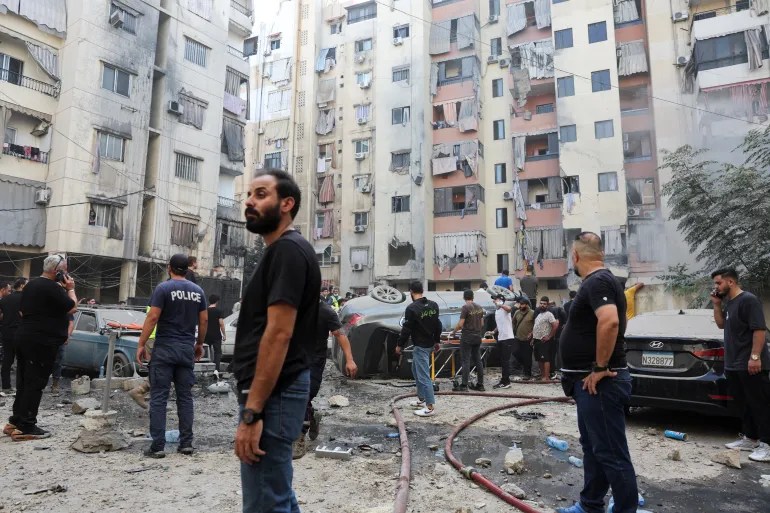
Residential Beirut, bombed by Israeli forces on Friday
The prospects of all out war in the Middle East accelerated this week as Israel swept aside calls for a ceasefire and stepped up its military action in Lebanon. The detonation of explosives in pagers and walkie talkies used by Hezbollah is estimated to have resulted in 37 deaths and over 3,000 casualties. Israel has not commented on the action but the operation clearly has the fingerprints of the Israeli secret service, Mossad, all over it.
The attack, in which several children were the victims, follows a week in which Israel announced a new phase in the war, moving the centre of gravity from Gaza to the northern border with Lebanon. Having reduced much of Gaza to rubble, the Israelis have created a humanitarian crisis due to restricted food supplies and medical aid. Medicins Sans Frontiers (MSF) have stated that,
“Infectious diseases including diarrhoea, acute respiratory infections, skin infections, and hepatitis are on the rise due to overcrowding and poor hygienic conditions in camps where displaced people are sheltering, and shortages of medicines and medical supplies.”
MSF and United Nations teams on the ground are tackling acute food shortages with latest figures suggesting that starvation is inevitable under the Israeli government’s policy of deliberate deprivation. According to the Integrated Food Security Classification (IPC), almost half a million people (22% of the population of Gaza) are facing catastrophic levels of acute food insecurity.
Israeli fighters bombing a residential suburb of Beirut yesterday killed at least 12 people, including 5 children, with a further 66 wounded according to the Lebanese Health Ministry. The strike hit the Dahiya district during rush hour as people were leaving work and children were heading home from school.
Local networks broadcast footage that showed a high-rise building flattened just kilometres from downtown Beirut. First responders combed through the rubble of at least two collapsed apartment buildings to search for missing people. Israel claims that it has killed top Hezbollah commanders in the strikes.
A further wave of strikes across southern Lebanon have seen some of the most intense bombing of recent months with the Israeli Defence Force (IDF) claiming that it was aiming “to degrade Hezbollah’s terrorist capabilities and infrastructure.” The prospect of a ground based incursion into Lebanon has not been ruled out.
For nearly a year, Hezbollah has engaged in near-daily exchanges of fire with Israeli forces along the Lebanon-Israel border in support of Hamas. Hezbollah has fired rockets regularly into Israel but with little impact, either falling in barren areas or being intercepted by the Israeli Iron Dome system. Tens of thousands of people on both sides of the border have been forced to flee their homes due to the fighting.
The current escalation of action by Israel brings closer the likelihood of a more concerted response from Hezbollah and the prospect of Iranian intervention, in support of their partners in the so-called axis of resistance. While Lebanese Prime Minister Najib Mikati blamed Israel for the explosions, saying that they represented a “serious violation of Lebanese sovereignty and a crime by all standards”, Iranian Foreign Minister Abbas Araghchi said he told his Lebanese counterpart that he “strongly condemned Israeli terrorism”.
While Britain has implemented a limited arms embargo against Israel, by suspending some weapons licences, the IDF are still largely bankrolled by the United States, who have confined their response to recent events to Secretary of State, Antony Blinken, “calling for restraint and urging de-escalation.” The UN has said it is “very concerned” following the strike on Beirut.
Palestine Solidarity Campaign (PSC) will be lobbying Labour Party Conference in Liverpool this weekend “to demand the government ceases its complicity in Israel’s genocide and apartheid against Palestinians, and ends all arms trade with Israel.”
The collusion of the imperialist powers in the oppression of the Palestinian people, through the arming of Israel and the failure to enforce UN resolutions, has emboldened successive Israeli governments to undermine Palestinian rights and the prospect of an independent Palestinian state. While many Israelis remain committed to live in peace with Palestinian and other Arab neighbours, the religious fundamentalists in Israel have increasing gained ground, to the extent that they are effectively dictating current government strategy.
The state of Israel has the right to exist, within internationally agreed borders, but so too does the state of Palestine, on the same basis. The British government acknowledging this and stating it explicitly would be a step in the right direction. Kier Starmer claims to be leading a government which will ‘listen’. In which case the message from the streets of cities across Britain is quite clear – End the genocide in Gaza, Stop arming Israel!
13th September 2024
Welfare not Warfare!

UNITE General Secretary, Sharon Graham, calling for a tax on the wealthy
The Labour Party leadership, backed by a majority of MPs in the House of Commons, this week agreed to the axing of winter fuel payments to all but the poorest pensioners, in order to save an estimated £1.2 billion as part of a £22 billion package of financial measures, which will effectively mean a continuation of austerity for many working class families.
The day after the Commons vote, Foreign Secretary, David Lammy, in Ukraine with United States Secretary of State, Anthony Blinken, announced a further £600 million package of support to Ukraine, to sustain the current NATO proxy war, increasingly in danger of becoming an all out NATO confrontation with Russia. While pensioners in Britain will struggle to keep the home fires burning, British money will be paying for weapons to keep the flames of war alight in Ukraine.
Labour leader, Kier Starmer, and Chancellor, Rachel Reeves, constantly talk about “tough choices” they will have to make on the economy. Starmer almost wears as a badge of honour his assertion that Labour will have to carry out measures which are unpopular. However, it is hard to credit that even the current leadership cannot see that the winter fuel payments measure is a clear political own goal, which will come back to haunt them for many years.
Such a measure was not a manifesto pledge and while Reeves promises to keep the pension ‘triple lock’ in place and provide, as yet unspecified, other means to support pensioners, the current furore could so easily have been avoided.
The UNITE trade union have been campaigning for a wealth tax, as have a number of independent MPs in the House of Commons, including Jeremy Corbyn. UNITE estimate that a 1% levy on those with wealth estimated at over £4m could raise up to £25 billion which, if accurate, is more than enough to fill the £22bn budget gap Reeves is concerned with and maintain winter fuel payments.
While the world of economics does not always work out as simply as this, it is still an indication that Labour have choices. If Starmer is so unconcerned about being unpopular why not choose to be unpopular with the super rich, rather than the pensioners at the other end of the spectrum?
The fact is that Starmer and Reeves are running scared of the City of London and the banks and corporations which have the real clout in the economy. Reeves’ caution even extends to claiming that without austerity measures there could be a run on the pound, which would weaken the economy, a claim not backed up by any evidence.
While austerity is the name of the game at one end of the Cabinet table the prospect of more cash for weapons is the reality at the other end. Quite apart from the ongoing and apparently open ended commitment to fuel the war in Ukraine, the government is committed to increasing military spending to 2.5% of gross domestic product (GDP). As one of NATO’s biggest spenders at the moment this commitment will only add to the pressure upon vital day to day services which local communities need. If an old slogan needed to be dusted down and resurrected the classic Welfare not Warfare may well be ready for a comeback.
In addition to which, apart from the obvious material and human cost of war and weapons of mass destruction production, the arms industry is a massive carbon emitter, thus contributing to the acceleration of the climate emergency. It would seem that for weapons manufacturers and their backers, that if the planet cannot be destroyed by one means, it will be destroyed by another.
It has taken very little time for the gloss of the Tories being ousted in July to be taken off the prospect of a shiny new Labour government. The proverbial Ming vase which Labour leaders carried across the General Election weeks still seems to be passing between them with no-one wanting to be the one to drop it. Caution, far beyond what even conservative capitalist economists would expect, is being exercised by Labour in order to show the ruling class and its media that they are ‘worthy’ of office.
However, these are vacillating and unstable allies at best and, at worst, an active fifth column. Once the smoke clears on the Tory leadership campaign, and if anyone deemed to be a credible candidate emerges, the right wing press and media will rally to their side and Labour will find themselves in the usual dogfight with the press.
If that is the case then why not take the fight to them and give them something they can really worry about, like abolishing the ‘right to buy’; resurrecting the NHS; massive public investment in green technology; cutting the military budget, including stopping arms sales to Israel; withdrawing from NATO; cancelling the renewal of Trident nuclear submarines? Not in the manifesto? The precedent for that has already been set!
7th September 2024
Sudan – war and disaster
The war in Sudan has now been raging since 15 April 2023. This devastating conflict, the military coup of October 2021, as well as other acts of brutal repression, have been cruelly inflicted upon the people of Sudan in an attempt to defeat the popular Sudanese Revolution and its objectives. Little if anything meaningful has been done to rein in the belligerents of this war or redress the gross injustices perpetrated against a people for daring to dream of democratic change and progression. The result is the worst and most pressing humanitarian crisis unfolding in the world today…
by Fathi El-Fadl

Sudanese civilians displaced from the fighting in their country seek sanctuary in a refugee camp across the border in neighbouring Chad.
The catastrophic war in Sudan continues on unabated. It intensifies with ever-worsening cruelty, resulting in thousands of innocent victims and the unprecedented movement of people desperately fleeing to save their lives. Over eleven million people have been displaced, seeking refuge in areas away from the military conflict raging in the country. Over two million of them have crossed the borders into neighbouring countries, mainly Egypt and Chad.
This gigantic exodus of the people is taking place with no sight of an end to the military disaster on the horizon. Peace talks at a resort near Geneva in Switzerland concluded with an agreement on famine relief, but an actual ceasefire was not even discussed due to the refusal of the Sudanese Armed Forces (SAF) generals to attend.
The US-led initiatives to reach a ceasefire, open safe corridors for humanitarian assistance to reach those most in need, and to protect civilians, failed to reach its objectives. With a ceasefire off the agenda, mediators concentrated on humanitarian issues to deliver food and medicine to the millions of starving Sudanese languishing in camps, schools, and makeshift shelters. Despite the agreement to open entry points at the Sudanese borders, there is still no clear agreement in place apportioning responsibility for the taking receipt of aid and its proper distribution thereafter.
Failure of the talks to reach a ceasefire means the continuation of the misery and suffering of the Sudanese people. The people are enduring what is now regarded to be the worst humanitarian crisis in the world. According to experts and international organisations, the war has led to the fragmentation of the country. A number of provinces remain under the control of the SAF, while others are controlled by the Rapid Support Forces (RSF) militia.
Hunger and the spread of diseases like cholera represent an additional cruel infliction upon the Sudanese population. According to the United Nations’ Food and Agriculture Organisation (UNFAO), around 25 million Sudanese are in need of urgent humanitarian assistance to prevent them dying of hunger. Furthermore, 80% of functioning clinics and hospitals have been destroyed in the fighting.
In a statement issued by the Sudan Doctors Union, it has accused international humanitarian organisations and their donors of failing to provide basic aid to alleviate the dangers Sudanese children are facing. At the same, it accused both the SAF and the RSF of wilfully obstructing the entry, delivery, and distribution of vital food aid and medicines.
A report by Tuna Turkmen, the Emergency Coordinator for Médecins Sans Frontières (MSF) in Darfur, states that there are children dying every day across all Sudanese provinces. In addition, Claire San Filippo, the MSF Emergency Coordinator for Sudan, has declared that her organisation has been prevented from bringing more medical staff and supplies to provide much needed medical care in the country – a need made even more acute considering the outbreak and spread of malaria as well as other diseases transmitted through contaminated drinking water. These restrictions have led to the spread of cholera in five provinces.
While regional and international powers pay lip service to the notion of a ceasefire at minor and limited gatherings, such as the one which just ended in Switzerland, they continue to malignly meddle in the sovereign affairs of Sudan, siding with either of the war’s belligerents, allowing them to further escalate, to the detriment and suffering of the Sudanese people.
Calling for a ceasefire without any clear vision to effect it and restore the peaceful democratic transition to civilian rule in Sudan, is not an option and represents a failure. This is further underlined when US-led talks exclude and ignore input from the bona fide popular forces that struggled against and brought down the Muslim Brotherhood military regime of Omar al-Bashir in the December Revolution [the Sudanese Revolution 2018-2019]. The forced absence of the Resistance Committees, the Forces for Radical Change (FRC) alliance, and the newly formed trade union front from the talks pertaining to Sudan’s future will only result in repeating the old mistakes that led to the present catastrophe.
The Sudanese radical forces, including the Sudanese Communist Party (SCP) and the Resistance Committees, have both consistently emphasised that the main conflict in our country is both national and international.
In response and opposition to the war, the revolutionary forces, especially the SCP, have adopted the slogan “Stop the war and reclaim the revolution through the broadest grassroots mass front!”, aiming to stop the war, defeat its political and social objectives, hold those responsible accountable, and bring them to trial, thus opening the road towards achieving the main goals of the revolution – Freedom, Peace, and Justice – which the masses have embraced as their path to radical change.
This declaration by the radical forces in Sudan of their political stance is coupled with a practical struggle towards the realisation of their objectives. Our fight is to stop the war, secure the right to live in safety, as well as compel responsible state organs to provide essential services and livelihoods to the people of Sudan.
In condemning both warring sides, we refuse to legitimise the war, while rejecting any compromise that would see the externally supervised restoration of the partnership between the remnants of the deposed Muslim Brotherhood regime and the Taqadom civilian alliance to form a government that would essentially serve foreign interests.
The Sudanese revolutionary forces are committed to mobilising a peaceful mass struggle that would bring about the defeat of reactionary groups and unmask their long-running conspiracies against Sudan and its people as well as reclaim the December Revolution. We will not tire!
Fathi El-Fadl is a member of the Forces for Radical Change (FRC) alliance in Sudan, opponents of the current civil war, and a vice-president of the International Centre for Trade Union Rights (ICTUR). He was previously, in the 1970s and ’80s, a student leader in Sudan and leading member of the International Union of Students. He is based in Khartoum and thus a witness to the ongoing conflict.
The full text of this article can be found here https://liberationorg.co.uk/comment-analysis/500-days-of-war-and-disaster/
24th August 2024
Iranian elections signal no change

Striking healthcare workers demand better pay and conditions in Iran
The election of Masoud Pezeshkian to the Iranian Presidency in July has encouraged false hopes amongst some in the West that Iran is on a path for reform and that the president will be able to influence the policy positions of the regime. Nothing could be further from the truth.
Masoud Pezeshkian has never expressed any views in opposition to Iran’s so called Supreme Leader, Ali Khamenei, and would not have been on the presidential ballot had he done so. The new president has so far done little more than make vague statements and quote from religious sermons. In August he jokingly said in a speech at the inauguration ceremony of the new head of the Planning Organisation: “We have no motivation at all. They don’t even give us a chance to do this job.”
The list of Cabinet members proposed by Pezeshkian in August and presented to the parliament for approval reflects the reality of his position. The retention of the Minister of Intelligence from former president Raisi’s repressive government, indicates that the new administration will simply continue the general policies of the regime.
While the Cabinet list presented to Parliament contained 14 new ministers indications are that the new ministers have been carefully vetted and selected by the fundamentalist camp and that former ministers been approved by the regime.
Even with this level of scrutiny there is likely to be more screening when the list comes to verifying qualifications in committees or on the floor of the House. Certainly, it is expected that in the next stages, some prominent ministers in the Cabinet will be targeted for attack and, after the necessary revelations and accusations, they will be disqualified. The final Cabinet will inevitably be weaker and less efficient at each stage and in the end more submissive.
Less than two weeks into his presidency Pezeshkian was faced with the resignation of former Iranian chief diplomat Mohammad Javad Zarif, who had been appointed as his deputy and minister in charge of strategic affairs. Conflicting reports suggest that on the one hand Zarif was unimpressed with the Cabinet selection and the constraints placed upon the new administration, while others suggest that behind the scenes, there has been a hardliner attempt to push Zarif out of office through a law barring officials with ties to the West.
The process not only reflects the iron grip which the clergy impose upon any so called democratic processes in Iran but also the weakness of Pezeshkian’s position. In the election first round, only 39% of those eligible cast their vote, a historic low for the Islamic Republic’s presidential elections. In the second round, when only Pezeshkian and hardliner Saeed Jalili were left in the race, about 49.8% participated, still one of the lowest turnouts in Iran’s presidential elections.
Given that the proportion of those voting directly for Pezeshkian will be even less than these figures, it is clear that the new President has no popular support, at best being seen as the lesser of several evils, and that the widespread boycott of the elections shows that the support base for the regime overall continues to dwindle.
The election campaign of Pezeshkian did contain some appeal to reform, including pushing for the end of internet restrictions and promoting some social freedoms, including on women and minorities rights. Whether the hardline clergy allow such changes remains to be seen.
Already the new presidency has been faced with striking healthcare workers who have been grappling with increasing economic pressures for the past two decades.
In some hospitals, that have been the site of protests over recent weeks, nurses have gone on strike. This is a dangerous development for public health but shows that nurses are deeply dissatisfied with their employment conditions. The indifference of officials and senior hospital management has caused nurses to suspend their professional and ethical duties and take to the streets to voice their grievances.
In relation to human rights issues recent news indicated that the Nobel Peace Prize laureate and Iranian human rights activist, Narges Mohammadi, was violently beaten by prison guards after leading a protest against the death penalty. Her requests for hospital care and a meeting with her lawyer were denied.
The lawyer, Mostafa Nili, told Iranian news media about the violence against Ms. Mohammadi, stating,
“My client says that she was beaten and has bruises on her body. Despite the prison doctor’s orders, and considering my client’s heart condition,” he said, “she has not been sent to the hospital.”
On foreign policy, Pezeshkian’s campaign focused on the need to engage with the West, including on the nuclear issue, to get sanctions relief and improve the economic conditions of the country, as well as to move away from the brink of regional war.
However, he also praised former president Raisi’s rapprochement with Arab countries, signalling that, on issues other than ties with the West, he is likely broadly to continue the policy of the previous administration. The question of retaliation against Israel for the assassination of Hamas and Hezbollah leaders also remains on the agenda with the potential to further increase the tensions in the region. Pezeshkian will be in no position to reverse the calls for retribution made by Khamenei and the clergy.
It is clear that the election of Masoud Pezeshkian is no indication that the Iranian leopard has changed its spots. The theocratic dictatorship remains in place and, while challenges are still there from mass popular movements such as Women, Life, Freedom and the industrial action gripping the country, the presidency is little more than a sideshow. Real change in Iran will only happen when it comes from the people and is driven by the people. A change in stooge presidents will not alter that.
10th August 2024
Racism – a real problem in Britain today
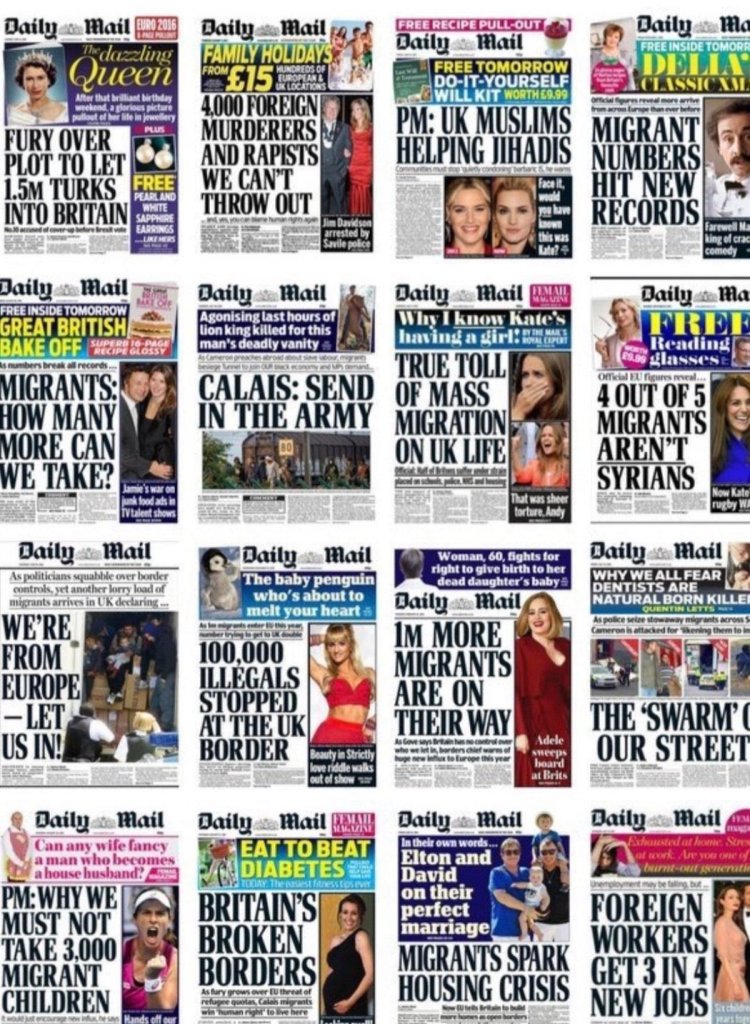
Daily Mail headlines fuel the anti asylum seeker narrative
Demonstrations across Britain this week, deemed anti-immigration protests by the media but actually pro-racism mob violence, have been met with stalwart resistance from local communities determined to resist fascist attacks. This has ranged from a 3,000 strong turnout in Newcastle upon Tyne’s West End to defend a centre for asylum seekers, to the City Centre clean up in Sunderland following a night of vandalism and looting. Similar actions have been reported from across the country.
Such shows of working class community solidarity are vital to quashing the misinformation spread by the far Right that Britain has an ‘immigration problem’. Such language and provocations are the natural territory of the far Right but the collusion of much of the mainstream media, including the BBC, in regarding immigration as a problem to be solved gives the claims of extremists more credibility in the eyes of the most gullible.
Coventry South MP, Zarah Sultana, recently posted on X a montage of Daily Mail headlines which fuelled the anti-asylum seeker narrative. Sultana also suffered hostile questioning on ITV’s Good Morning Britain this week, from presenters Ed Balls and Kate Garraway, for suggesting that the violence over the past week should be called out as Islamophobic.
Balls in particular was quick to defend Home Secretary, Yvette Cooper (his wife), and Labour leader Kier Starmer for acknowledging that the violence was fuelled by racism but refused to accept that they should call it out as Islamophobic. To her credit Sultana stood her ground and has come out of the encounter with more credit than either Balls or Garraway.
While the Labour government has been quick to point the finger at social media and mobilise the state apparatus of the police and the courts there has not been any recognition, from the Front Bench at least, that these measures are only dealing with the symptoms and not the cause. There is no argument about jailing fascist thugs or addressing any of the shortcomings of the Online Safety Bill. However, at root the issues of poverty, disaffection, and a sense of disconnection from a hugely unequal society are the causes which need to be tackled.
Those at the sharp end of the impact of capitalism and its endemic crises are the most likely to fall prey to the easy solutions presented by the demagogues of the far Right and the so-called populist rhetoric of the likes of Reform MP, Nigel Farage. It is no coincidence that the worst violence has been seen in areas of the greatest poverty, or that the previous Tory government placed asylum seekers in hotels in these areas.
Preventing a repeat of the scenes which have taken place over the past week will require robust action to tackle poverty, low wages and exploitation. It will require massive attention to the housing issues faced by many working class communities. It will require greater investment in the local government services which many working class communities rely upon. It will require a stronger approach to tackling wealth inequality and how resources are distributed across society.
It will require Labour politicians to be seen on the frontline with threatened communities showing their active support. It will also require Labour to reject the narrative that immigration is a problem to be solved and turn that round to make it clear that a major problem to be solved in Britain today is racism.
Divide and rule has always been a key tool of ruling class strategy and the recent activity across Britain has shown how some sections of working class communities can be persuaded by the far Right, while others will stand firm in the face of fascist violence.
Any strategy which is to ultimately succeed however has to be based upon a recognition of the class interests of those communities most threatened and that solidarity between black and white working class communities is the only way forward. In short it will require a strategy which not only deals with the symptoms but begins to tackle the causes of racist violence in Britan today.
1st August 2024
Israeli assassins escalate conflict
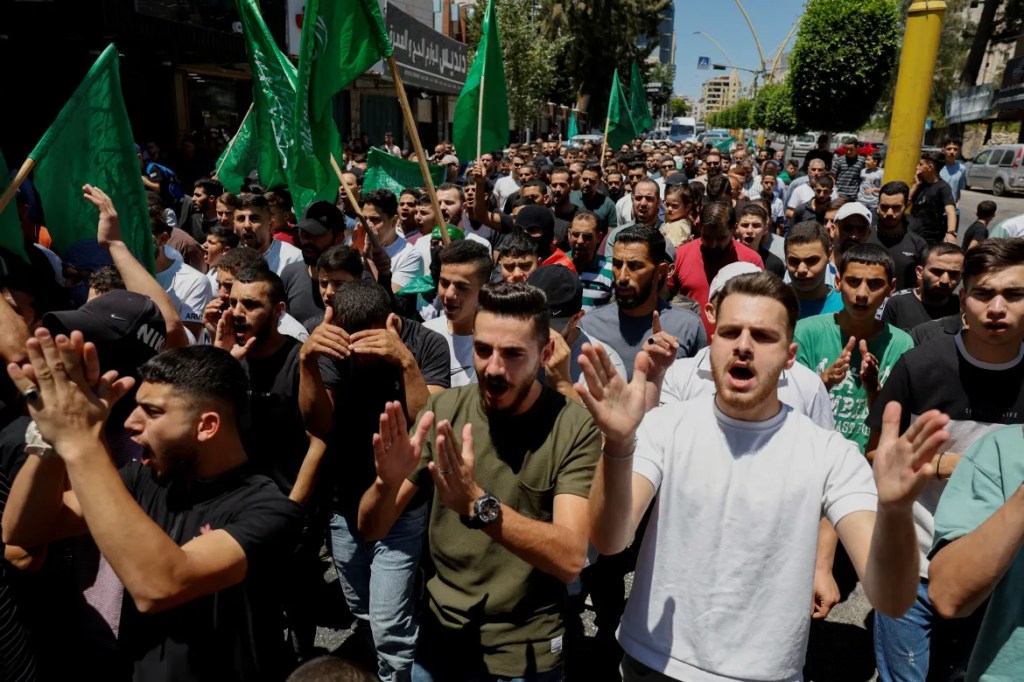
Palestinians in Hebron in the occupied West Bank protest against the assassination of Hamas political leader Ismail Haniyeh.
The assassination of Hamas leader Ismail Haniyeh, in Tehran two days ago, is a major escalation in the growing conflict in the Middle East. While Israel has not claimed responsibility for the killing there can be little doubt that the nature and precision of the operation has the fingerprints of Mossad all over it. That the killing took place just after the inauguration of a new Iranian president, Massoud Pezeshkian, and in the heart of Tehran itself will have been designed to cause maximum embarrassment to the Iranian regime.
The assassination also appears to be designed to torpedo the peace talks in relation to Gaza, as Haniyeh was the leading Hamas negotiator. As the Qatari Prime Minister, a key player in the peace mediation process pointed out, “Political assassinations and continued targeting of civilians in Gaza while talks continue leads us to ask, how can mediation succeed when one party assassinates the negotiator on the other side? Peace needs serious partners.”
Israel is the most well armed and efficient military state in the Middle East, massively supported by the United States and to a lesser extent by Britain. It has a clandestine nuclear weapons capability, rarely mentioned in the media but real all the same. It has a government propped up by right wing religious fundamentalists, every bit as zealous in their mistaken belief in their own supremacy as the theocrats who have been murdering their way across Iran for over forty years. That the response of the international community to assassination in a foreign capital has been little more than mild rebuke is nothing short of a scandal.
The killing of Haniyeh comes shortly after Israel claimed to have killed a senior military commander of Hezbollah in Beirut. There can be no doubt that this has exacerbated the crisis in the region, bringing it to the brink of an extremely dangerous and widespread military conflict.
The response from the theocratic dictatorship in Iran was predictable. Supreme Leader, Ayatollah Ali Khamenei, stated that Israel “by assassinating Ismail Haniyeh, has paved the way for a severe punishment” adding that “we consider it our duty to avenge his blood, shed in the territory of the Islamic Republic of Iran.”
The world awaits the consequences of the adventurist action of the Israelis. There can be little doubt however that Iran will galvanise it’s so called Axis of Resistance, through Hamas, Hezbollah and Houthis to strike back in some way shape or form. This is unlikely to be a mere symbolic action, as with the pre-warned missile strikes on Israel in April, responding to another Israeli act of international terror, when sixteen people were killed in the Iranian embassy in Damascus in Syria.
While hitting an embassy is technically still a strike on domestic territory it does not carry the symbolism of a strike in the heart of Tehran.
The US government has taken its usual line in defence of Israel expressing “ignorance” about the assassination and “not being involved” in it, yet at the same time warning that it would defend Israel if it were attacked. Suspicions have been raised that the attack, coming so close to the recent visit of Israeli Prime Minister Netanyahu to the United States, will have been given the green light by the US. Any evidence to suggest that would certainly put the US back in the dock in the eyes of the international community as being complicit in acts of terror and actively escalating conflict in the region.
The corruption at the heart of the Iranian regime was further exposed recently in the report of the United Nations Special Rapporteur on atrocity crimes committed in Iran in the 1980’s, following the hijacking of the national democratic revolution by the Islamic theocracy.
In his analysis of the first decade of the Islamic Republic, following the 1979 revolution Special Rapporteur, Javaid Rehman, details the summary, arbitrary and extra-judicial executions of thousands of political opponents of the regime, amounting to the crimes against humanity of murder and extermination. Significantly for the current regime and its apologists Rehman concludes that,
“…those with criminal responsibility for these grave and most serious violations of human rights and crimes under international law remain in power and control; the international community has been unable or unwilling to hold these individuals accountable.”
The assassination of Ismail Haniyeh in Tehran has raised serious questions about the state of Iran’s security apparatus, this not being the first time that Israeli security forces have been able to easily carry out terrorist operations on Iranian soil. This assassination highlights the extensive infiltration of imperialist intelligence agencies into Iran’s security apparatus.
The corruption at the heart of the Iranian regime is only matched by the religious fundamentalist cabal currently running the Israeli government. Opposition in both countries is either actively suppressed or given little media exposure, though under both regimes there is significant internal opposition to their respective government’s actions.
For there to be any prospect of heading off the imperialist drive to war in the Middle East the peace movements in both Iran and Israel, as well as in the imperialist centres of the US, Britain and the EU need to grow stronger and voice their opposition to the growing conflict. The Labour government in Britain needs to be pressured to adopt an independent foreign policy, not dependent upon the diktats of the US, or the pressures of its military proxy NATO.
Labour needs to take a stand which puts peace before conflict escalation and the interests of the people of the Middle East before those of imperialism. That will only be possible through mass extra parliamentary action and through the peace and labour movements making those demands. Labour should not be allowed to settle for carrying on the foreign policy positions of the Tories, as has happened in the past. Given current developments the need for an independent peace oriented stand is greater than ever.
20th July 2024
Mission Impossible?
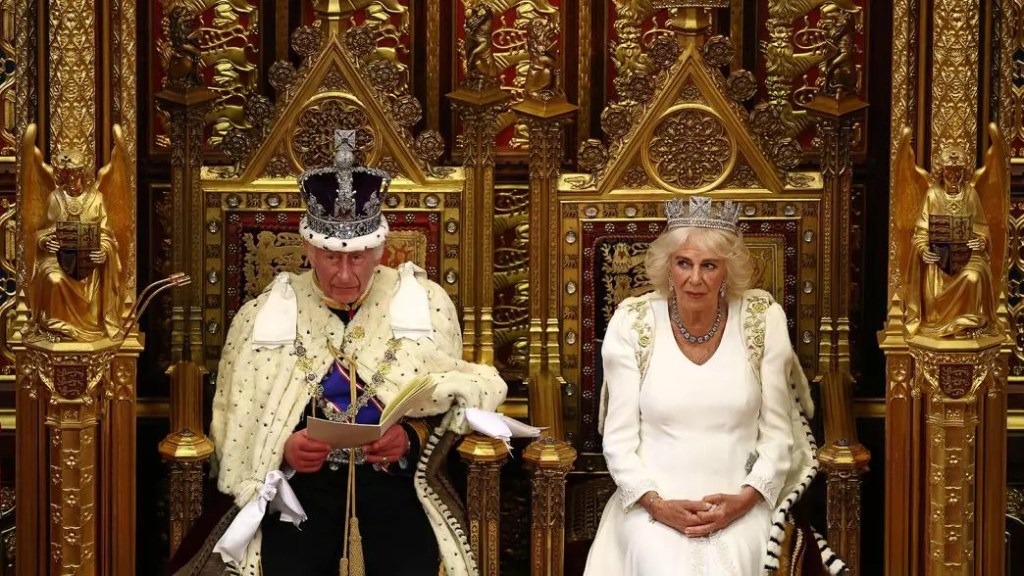
King Charles III reads the programme for the coming Parliament at the State Opening
The first King’s Speech under Kier Starmer’s Labour Party set out plans for what Starmer has described as a ‘mission driven’ approach to government which will focus upon the five key missions identified by Labour in its election campaign.
On the first of these, economic stability and growth, Labour is proposing a raft of bills from an Employment Rights Bill to ban zero-hour contracts, end fire and rehire, as well as strengthening sick pay and protections for new mothers, to a Railways Bill to reform rail including establishing GBR and allow rail contracts to be taken into public ownership at the end of contracts or if providers fail to deliver.
On the question of energy Labour is proposing to establish Great British Energy, a public body that will own and operate clean power projects across the Britain. In addition, a bill to regulate water companies to clean up rivers lakes and seas will be introduced.
Secure borders are another mission for Labour, with a bill to strengthen border security, crack down on organised immigration crime, and reform the asylum system in the pipeline. A Crime and Policing Bill is proposed to crack down on anti-social behaviour, tackle knife and retail crime, and provide a stronger response to violence against women and girls. There is no proposal to repeal the draconian powers afforded the police by the Tories under the Policing Act 2022 and the Public Order Act 2023.
The jailing this week of five Just Stop Oil protesters, getting a collective sentence of 21 years between them, is an outrage which Labour needs to address.
Health, although supposedly a major priority for Labour gets a light touch with only two bills proposed, to ban smoking for those born after 2008 and to improve mental health services. Rumours that Kier Starmer will bring in former Health Secretary, Alan Milburn, to ‘drive change in the NHS’, have yet to be confirmed but have to be a concern given Milburn’s record in the Blair governments.
Finally, in Labour’s mission list is breaking down barriers to opportunity, with bills proposed to improve children’s wellbeing, including a requirement for free breakfast clubs in every primary school and a bill to reform the rental market, including abolishing ‘no-fault’ evictions.
Other proposals include an Armed Forces Commissioner Bill,to strengthen support for members of the armed forces and their families, and a House of Lords (Hereditary Peers) Bill to remove the right of hereditary peers to sit in the House of Lords.
As ever Labour in government will tweak social provision and attempt to regulate capitalism more efficiently, clearing up the mess that the Tories have made of the system. This will be welcome news for British banks, businesses and corporations but is unlikely to do very much to change the lives of those most in need in Britain today.
While building more affordable homes is on the government agenda the affordability of public housing is undermined by the right to buy, which there are no plans to repeal. There is no indication so far that local government, often at the sharp end of dealing with communities in crisis will get any further support, other than through the extension of devolution deals, which are predominantly economic development programmes and rarely reach into local communities effectively.
Reform of Health and Social Care should be an absolute priority for any incoming government but does not appear to have yet hit the radar of Cabinet, in spite of having had many years in Opposition to formulate plans.
On the question of foreign policy the Labour Cabinet has moved quickly to consolidate the errors of the Tories by putting the question of continued arms sales to Ukraine at the top of the agenda. Right wing nationalist President Zelensky attended a Labour Cabinet on Friday and by all accounts was greeted with stormy applause. The commitment to tie Britain into the ongoing NATO proxy war with Russia is a tragedy in the making. Zelensky is doing the rounds seeking permission to use European made weapons to be fired into Russian territory. This level of escalation must be opposed and the reality of the implications of continually fuelling the war in Ukraine exposed.
Labour’s manifesto emphasised the need for a ceasefire in Gaza. On the question of Palestinian statehood, however, the party retreated from its 2019 pledge to offer immediate, unilateral recognition. Instead, Starmer has argued that statehood recognition should be part of a British contribution to a renewed peace process, in view of achieving a two-state solution.
It is likely that Starmer will seek to ensure that Britain stays in step with the US under President Biden. While this might mean targeted sanctions against Israeli extremists, up to and including those in government, it may be balanced by actions against Israel’s regional enemies, including designating Iran’s Islamic Revolutionary Guard Corps as a terrorist organisation.
However, with US policy in flux, with the prospect of the return of Donald Trump to the Presidency, there are still uncertainties ahead in being tied to the coattails of the US.
Electing a Labour government is a step forward from the Tories continuing to be in office but getting a Labour government to do the right thing, and act in its class interests, will continue to be a challenge. Hopefully it will not prove to be mission impossible. Concerted mass action from the Left and the wider Labour Movement will need to remain on the agenda.
5th July 2024
Superficial change
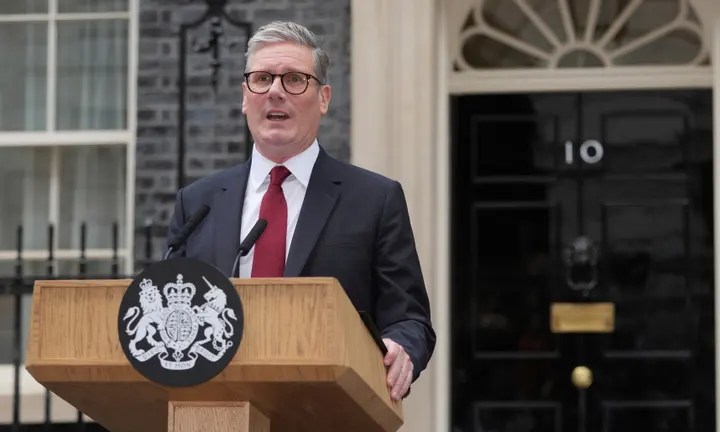
The keys to the door – Kier Starmer about to enter 10, Downing St
Having smuggled the metaphorical Ming vase across the threshold of 10, Downing St, Kier Starmer and his team need to decide whether its fragility is worth preserving or whether they just smash it and take advantage of their massive 170 seat majority to effect real change. Given the character of Starmer and his team the prospect is that the vase will sit quietly on the mantelpiece ready to be dusted off in 2029.
The scale of the Labour majority may give the illusion that the politics of Starmer and the Labour leadership have swept the country and that they expect to be hoist aloft on the shoulders of the people. The reality is not so clear cut.
Interviewed on Radio Four today architect of New Labour, right wing Labour henchman Peter (now Lord) Mandelson, described the Labour victory as ‘efficient’. Mandelson pointed out that Labour did not just stack up votes in safe constituencies but managed to gain seats in more marginal areas too. However, much of this was as a result of Reform splitting the Tory vote in some areas with the Lib Dems taking votes from the Tories in others. The collapse of the fractured and fractious SNP in Scotland was also a contributory factor.
The national turnout was low at 60% with Labour only gaining 35% of the votes across the country, slightly up on the 33% achieved under Jeremy Corbyn’s leadership in 2019 but well down on the 40% share Corbyn achieved in the 2017 General Election. Jeremy Corbyn retaining his seat as an Independent in Islington North was a small victory for the Left and the election of four other Independents on the back of Labour’s weak position on Israeli genocide in Gaza signalled to Starmer that there will be more progressive voices of dissent in the House of Commons.
The single word which characterised Labour’s campaign and was the title of its manifesto was Change. Starmer spent much of the campaign not just emphasising the word change in the context of change for the country but change in the context of the Labour Party itself. The purge of many on the Left, over recent years, is certainly testament to Starmer’s efforts at internal change. This was characterised by the imposition of Starmer friendly candidates in many constituencies, ensuring a House of Commons that will be largely compliant and reliant on the largesse of the leader.
The reality of the next five years is going to be one in which the adjective ‘superficial’ could precede the change mantra which is Starmer’s watchword. The pledge of Starmer to ‘unite the country’, in his first speech outside Downing Street, presupposes that the country can be united, Irish Republicans and Scottish Nationalists will disagree, or that the interests of conflicting classes can be harmonised. There is no evidence that Labour will do anything to stop the rich getting richer or that they will fundamentally challenge the causes of poverty which are endemic to capitalism as a system.
For the working class however, there is no doubt that getting the Tories out of government is a step forward. A Labour government at least gives the possibility of more progressive policies with the prospect of influence from the Left, from the trade union movement and from mass extra parliamentary action, potentially shifting Labour in a more positive direction.
Once the flurry of excitement about the Tory meltdown subsides the job of ensuring Labour is more focused on the issues in towns and backstreets, rather than the City of London, must be a priority. The rise of so-called populism, in the form of the Reform vote, offering the illusion of easy answers to complex problems, will need to be tackled in working class communities.
The importance of the need for real change, socialist change, as the only answer to really address the needs of working class communities will need to be articulated. There is certainly no sense that the Labour leadership under Starmer will do this but until it is part of Labour campaigning, simply repeating the mantra ‘change’ will not be enough to make it happen.
30th June 2024
Iranian election sham will not fool the people
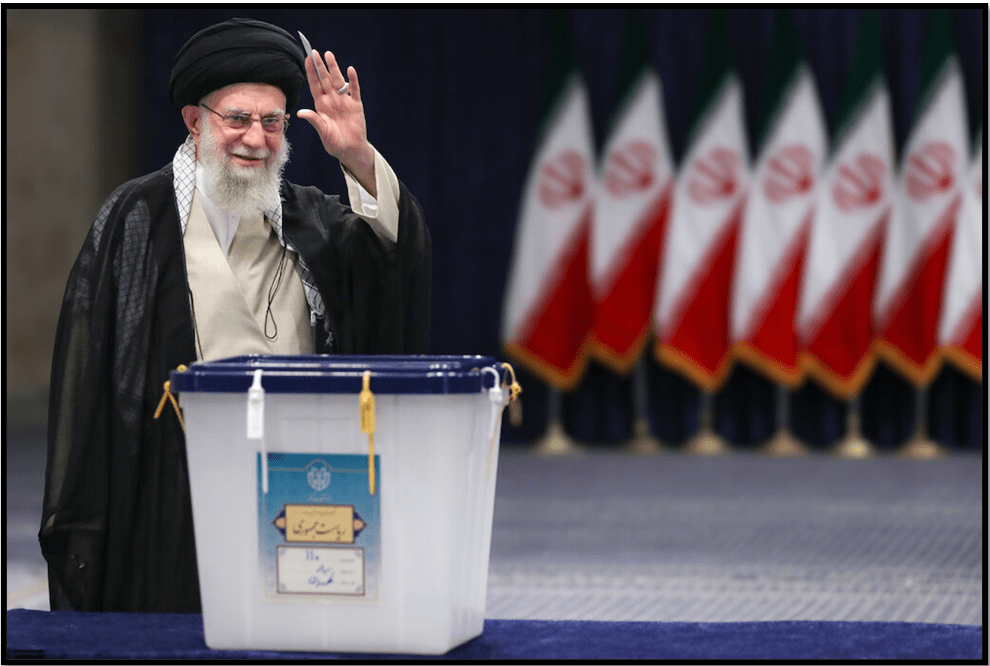
‘Supreme Leader’ Khamenei votes in Iran’s election sham
The Presidential election in Iran, following the death in a helicopter crash of President Raisi in May, has borne all the hallmarks of manipulation by the theocratic dictatorship under the Islamic Republic’s Supreme Leader, Ayotollah Ali Khamenei.
The death of Raisi, along with the ongoing wave of protests against inflation, poverty and corruption across Iran, have wrongfooted the regime. While the hardline Raisi maintained his position through the force of the Islamic Revolutionary Guard Corps (IRGC) and his close relationship with Khamenei, popular support was always at a low ebb.
The response of the regime, in an election where all candidates are closely vetted by the Guardian Council, was to come up with a ‘safe’ candidate to add to the ballot paper, in order to appease so called moderates within the regime, and to head off any further protests from excluded opposition parties, trade unions, women and youth groups.
To that end the inclusion of 69 year old former Health Minister, Masoud Pezeshkian, in the list of candidates approved by the regime was a calculated and deliberate tactic, in order to create a superficial and cosmetic change, without affecting the power structure based on the theory of “political Islam”.
The reformist faction within the regime urged public participation in the election and encouraged people to vote for Pezeshkian. Their rationale is that the prospect of “building trust with the regime” is one which has more chance if a less hardline candidate occupies the presidency. However, such tactics have proven to have failed in the past, with so called reformist candidates such as Muhammad Khatami (1997-2005) and Hassan Rouhani (2013-2021) failing to make any significant difference to the theocratic power structure which underpins the Islamic Republic.
Decades of experience with reformist movements, including the Green Movement for political and cultural openness and the teachers, workers, and retirees movements for better wages, livelihoods, and working and living conditions, have shown that hoping for the possibility of reform within the ruling structure is unrealistic. The emergence of the Women, Life, Freedom movement, in response to the murder in detention of Mahsa Amini in September 2022, has been the latest expression of this desire for structural, rather than cosmetic, change in Iran.
In spite of the efforts of the regime’s public relations machine in the lead up to the poll last Friday, desperate to increase participation in the election given the less than 50% turnout in recent votes, only 40% of voters turned out. The depth of opposition supporting the boycott of candidates was widespread, further undermining the regime’s claims that the elections demonstrate democratic legitimacy.
A run off vote with the two highest polling candidates, Pezeshkian and Saeed Jalili will be held on 5th July. However, with ultimate control over foreign and military policy remaining in the hands of the Supreme Leader the role of President in Iran can often be little more than ceremonial.
There is certainly no chance of either candidate challenging the corruption which is an endemic part of Iran’s economy, addressing the increasingly adventurist foreign policy in the Middle East, reflected in support for Hamas and Hezbollah, or addressing the lack of political and social rights of the Iranian people.
The scale of discontent within the country is underlined by the reports from the Union of Metalworkers and Mechanics of Iran (UMMI) that outsourced project workers in the country’s refineries, oil and gas installations and power plants have walked out in protest at their wages and conditions of service. The workers are demanding a change in shift patterns including a ‘14 days on, 14 days off’ rotation for oil and gas workers and to “de-casualise” workers’ contracts.
An estimated 3,000 workers joined the strike on the first day and the ongoing action may well inform attitudes towards the Presidential election. More recent reports suggest that the number of companies and workplaces affected by the action now stands at 80, involving at least 18,000 striking workers.
The scale of the suppression of political, democratic and human rights in Iran continues to be widespread an is an endemic feature of the regime. Activists across the spectrum of the protest movements in Iran do not see either of the presidential election candidates having a plan to respond to their real democratic and just demands. Even if this were the case, the theocratic structure would not allow for the opportunity to realise the implementation of democratic reforms.
Activists across the progressive opposition in Iran, who continue to advance democratic demands, continue to call for a country wide boycott of the election, in order to show that neither candidate represents the will or the aspirations of the Iranian people.
Progressive activists in Iran will continue to call for the development and deepening of the protest movements, seeking greater co-operation which can lead to the integration and convergence of different sectors.
Such a development will allow the true voice of the Iranian people to come through, not simply an echo manipulated through a sham election process.
15th June 2024
Ukraine – adding fuel to the fire

It’s a deal – Zelensky and Biden, partners in crime
The recently signed 10 year security pact, agreed between the United States and Ukraine marks a further ramping up of NATO’s proxy war against Russia. The deal, signed on the sidelines of the G7 summit in Italy last week, aims to commit future US administrations to support Ukraine, even if former President Donald Trump wins November’s election. The G7 nations also agreed to a $50 billion loan for Ukraine backed by profits from frozen Russian assets. US President, Joe Biden, asserted that the G7’s message to Russian President, Vladimir Putin, is “You cannot wait us out. You cannot divide us.”
The deal is widely seen as a step towards NATO membership for Ukraine and a further move towards the encirclement of Russia by NATO nations. Ukrainian President, Volodymyr Zelensky, has been pushing for full NATO member ship for some time. NATO regards any attack launched on one of its 32 members as an attack on all, under its Article Five clause, so membership is seen as a trump card by Ukraine in pressurising Russia.
Even without NATO membership the deal contains some clauses which point to potential US intervention in the current conflict. For example, in the event of an armed attack or threat of such against Ukraine, top US and Ukrainian officials will meet within 24 hours to consult on a response and determine what additional defence needs are required for Ukraine. Under the agreement, the United States restates its support for Ukraine’s defence of its sovereignty and territorial integrity. The agreement also outlines plans to develop Ukraine’s own defence industry and expand its military.
The text of the deal allows the two countries to share intelligence, hold training and military education programmes and combined military exercises, which will clearly be a provocation to Russia. The deal also asserts that Ukraine needs a “significant” military force and sustained investments in its defence industrial base, consistent with NATO standards. All of which is tantamount to a blank cheque for the US military industrial complex to make massive profits from the arrangement.
The deal also comes against the backdrop of Biden having recently shifted US policy against allowing Ukraine to use American weapons for attacks inside Russia, in effect permitting Kyiv to fire long-range US missiles against Russian targets near the Ukrainian city of Kharkiv.
In the press conference convened to announce the deal Biden said arrangements were being made to provide Ukraine with five Patriot missile defence systems, saying: “Everything we have is going to Ukraine until its needs are met.” Biden also added that his administration is “intensifying” its pressure on Moscow, including by warning banks earlier this week that they risk US sanctions should they do business with Russia.
The agreement between the US and Ukraine is the 16th such bilateral agreement Ukraine has now reached. As an executive order, it could be undone by a Trump administration, should Joe Biden fail to win the US election in November. However, the intention of the current US administration is that the accumulation of agreements collectively adds up to a form of security assurance that, although short of full NATO membership, will strengthen the hand of the military alliance in its provocations against Russia.
A unilateral so called, Global Peace Summit, takes place in Switzerland this weekend (15/16 June), initiated by Ukraine, to which Russia is not invited. The summit is little more than a vanity project initiated by President Zelensky in an attempt to galvanise international support around his right wing nationalist agenda. US President, Joe Biden, will not attend, sending Vice President Kamala Harris. China will not attend, as the Chinese Foreign Ministry has said it believes a peace conference should involve both Russia and Ukraine. Under half of the 193 United Nations member countries are planning to attend.
Russia remains keen to build upon a draft peace agreement negotiated in the early days of the war that included provisions for Ukraine’s neutral status and put limits on its armed forces. Ukraine continues to focus upon a 10 point plan drafted by Zelensky in 2022, which focuses upon the withdrawal of Russian troops and denial of the legitimacy of Crimea being part of Russia.
Mark Cancian, senior adviser for the International Security Programme at the Centre for Strategic and International Studies, said he expects many attendees to remain neutral on the war.
“Zelensky will want to turn the conference into an anti-Russian coalition,” he said. “However, some of the attendees may want to explore end states that are short of what Ukraine wants — for example, some sort of in-place cease-fire.”
While the summit is unlikely to achieve anything significant, without the participation of Russia or China, the signing of the 10 year deal between the US and Ukraine will ensure that the NATO strategy of encircling and provoking Russia remains in place and that the suffering of both the Russian and the Ukrainian people continues.
Peace proposals put forward by both Russia and China have been rejected out of hand by the West, which continues to increase the militarisation of Ukraine and pour weapons into the conflict, adding fuel to an already raging regional fire and increasing the threat of global war.
9th June 2024
Ambition for real change?

On the buses – but will Labour commitments short change?
While the political boomerang that is Nigel Farage, newly re-installed as leader of the Reform Party, wants the looming General Election to be about immigration, that will not be the major issue concerning working class people in Britain. Farage has for many years now pedalled his own xenophobic agenda and, while he has succeeded in fooling some of the people, some of the time, he will not fool all of the people all of the time.
Net migration into the UK is running at around 650,000, hardly a massive issue for a nation with a 65 million population and a responsibility to those it has forced to become migrants due to its complicity in bombing Afghanistan, Syria, Libya and Iraq in recent years. The least the British government can do is to give those displaced due to imperialist wars a place of shelter.
The real issue underlying everything facing the British electorate is, as ever, the economy. Capitalism is not a system designed to help, support or alleviate the suffering of the working class. It is a system based upon the exploitation of that class by a property and land owning autocracy, fronted by the Church of England and the Monarchy. Its representation in Parliament is ostensibly through the Conservative Party, although the occasional safe Labour administration is allowed to slip through the net, while the Tories untangle themselves from a political mess of their own making, or have simply been in government so long that people desire a change. The current point finds the Tories under pressure for both reasons, hence the likelihood of a Labour government on 5th July.
In which case, what will Labour do about the economy? The Labour leadership is absolutely committed to capitalism, so that will not change. The Labour leadership is committed to renewing Britain’s weapons of mass destruction, in the form of the Trident nuclear submarine programme, so less scope for spending on desperately needed schools and hospitals.
Labour’s manifesto will commit to the creation of GB Energy, a publicly owned green power company. It will commit to 40,000 more NHS appointments per week and the recruitment of 6,500 new teachers to shore up the flagging education workforce. It will even contain a commitment to recognising a Palestinian state, as part of the peace process.
Yet as positive as these pledges sound, there is still no real commitment to invest in order to grow the economy or address the issues of job insecurity faced by working class families. Sharon Graham, general secretary of UNITE, one of Labour’s biggest trade union backers, has said that she cannot endorse the document as the union has reservations about Labour’s position on hire and fire practices and zero hours contracts.
Shadow Chancellor, Rachel Reeves, has been the standard bearer of economic caution, promising not to spend more than the economy can allegedly afford and not to boost public spending. The reality is however that to address the needs of working class people, in order to improve their lives, public spending is essential.
A recent report by the Resolution Foundation think tank suggests that the next government will have to make £19 billion of annual cuts to unprotected departments by 2028-29 if budgets are to be sustained without new tax rises. Both the Tories and Labour are committed to military spending increasing to 2.5% of GDP, an area both will protect, while local government, the deliverer of key services to help working class families survive is afforded no such protection.
There are ways to raise additional funds, quite apart from not buying weapons of mass destruction in the first place. A wealth tax of 1% to 2% on those with assets of more than £10 million, just 0.04% of the population, would raise £22 billion annually. That would pay for 75% of the entire social care bill for a year. In 2020 the Wealth Commission recommended a one off wealth tax for five years, which could raise a tidy £260 billion. Recent YouGov polling suggests that 78% of people support an annual wealth tax on the super rich. Clearly not a vote loser!
No one is expecting a Labour government led by Kier Starmer, Angela Rayner and Rachel Reeves to make a call to build the barricades and tear down the capitalist system. However, it is disingenuous of all three to suggest that there is not money there to support working class people and to make their lives more bearable.
Electing a Labour government on 4th July remains a necessity but, with a majority which could be nothing short of monumental, that government ought to be firmer in its commitment to challenging the clear inequities in the system and putting in place policies to challenge them. Such a small step would make a minor dent in the edifice of capitalism but could make a huge difference to the lives of many working class families. Pressure must remain upon the Labour leadership to be more radical and to see getting the keys to 10, Downing St as the beginning of an ambition for real change, not the conclusion.
31st May 2024
US/Saudi pact a prospect?

All eyes on Rafah – Palestinians survey the damage done by an Israeli strike
As the Israeli Defence Force (IDF) assault on the civilian population of Rafah continues, under the thinly veiled excuse of rooting out Hamas fighters, behind the scenes discussions are ongoing to reshape the map of the Middle East.
The prospect of an historic pact between the United States and Saudi Arabia is gathering momentum with the carrot of access to the latest US military technology being dangled before the Arab dictatorship.
The deal could be part of a package to extend US influence in the Middle East by including a pathway to diplomatic ties with Israel. The quid pro quo would be that the Israelis halt the genocide in Gaza.
Negotiations between Washington and Riyadh have accelerated recently, with some reports that a deal could be reached within weeks.
An agreement would undoubtedly aim to reshape the Middle East in favour of the United States, reinforcing the ongoing support for its long term regional proxy, Israel, while bolstering influence in the Arab world by increasing weapons sales to the Saudi dictatorship. The US is keen to strengthen its position in the region, which it sees as being threatened by Iran and China.
The rumoured pact is thought to offer Saudi Arabia access to advanced US weapons that were previously off-limits. The dictatorship would then agree to limit Chinese technology from the nation’s most sensitive networks in exchange for major US investments in artificial intelligence and quantum-computing, as well as getting American assistance to build its civilian nuclear programme.
The conclusion of a US and Saudi Arabia agreement would, it is suggested, be followed by forcing Israeli Prime Minister Benjamin Netanyahu to make a choice. Netanyahu would be offered the opportunity to join the deal, which would entail formal diplomatic ties with Saudi Arabia for the first time. Israel would also be offered more investment and regional integration. The challenge for Netanyahu would be to end the slaughter in Gaza and agree to a pathway for Palestinian statehood.
In such a scenario Netanyahu would clearly face the ire of the right wing religious fundamentalists who currently prop up his government and are determined not to see an independent Palestine. However, a pact with the US and Saudi Arabia could also be seen by Netanyahu as a counter to Iran’s growing influence in the region and a potential restraint on attacks by Iran backed militias such as Hezbollah.
With a US election only months away President Joe Biden is desperate for a foreign policy breakthrough and the issue of Gaza has proven divisive amongst Democrats domestically. Student protests on university campuses across the US have exposed a fault line between those calling for a harder line to be taken with the Israelis over the action in Gaza and those more inclined to back the apartheid regime at all costs.
The thousands killed by the Israelis in Gaza are widely seen as a disproportionate response to the attacks by Hamas on 7th October 2023 and the recent vote by the United Nations General Assembly, to increase the status of the Palestinian state, although dismissed by Israel, has added to the international pressure for a lasting ceasefire. Subsequent recognition of Palestine by Ireland, Spain and Norway has increased the pressure upon the apartheid Israeli regime.
“We have done intense work together over the last months,” U.S. Secretary of State Antony Blinken claimed recently, while in Saudi Arabia. “The work that Saudi Arabia and the United States have been doing together in terms of our own agreements, I think, is potentially very close to completion.” Saudi Foreign Minister Faisal bin Farhan has also said that an agreement was “very, very close.”
However, while Blinken and Biden may be making positive noises about a deal there is scepticism, not only from the right wing in Israel, but also in the US. Republicans are unlikely to countenance a deal which does not give Israel sufficient guarantees, in particular Saudi recognition of Israel, even of it does mean an increase in arms sales to the Saudi dictatorship.
For their part the Saudis are keen to get as strong a deal with the US as possible, the aim being a formal defence pact which would bring the US military into play should the dictatorship be attacked.
While Saudi Arabia and Iran have been moving to normalise relations recently, with the signing of a deal in March 2023, the two Islamic dictatorships remain wary of one gaining more influence than the other in the region. For the Saudis, a defence deal with the United States needs to be sufficiently robust to send a message to Tehran without alienating the Iranians. For Riyadh to decide to openly bolster its security cooperation with Washington the reward would have to be worth the risk. In effect, Saudi Arabia seeks a defence pact with the United States that is credible enough in the eyes of both friends and foes.
The escalating violence in Gaza and Israeli intransigence on the question of a two state solution for Palestine is likely to undermine previous US diplomatic initiatives such as the Abraham Accords, signed in 2020, which established diplomatic relations between Israel and the United Arab Emirates, Bahrain and Morocco.
While hailed by the US as a means to encourage Israel to take positive steps toward ending its occupation and annexation of Palestinian territory, the real premise of the Accords was to prove that the Palestinian issue was no longer an obstacle for Israel’s relationships in the region, as Arab states dropped their demand for a Palestinian state as a condition to normalising ties with Israel.
Far from curbing Israeli abuses the Accords have emboldened successive Israeli governments to further ignore Palestinian rights. In the first year after the Accords, settler violence dramatically increased in the West Bank. Following the election of Israel’s most right-wing government in history in 2022, cabinet ministers openly called for the annexation of the West Bank and announced massive settlement expansions.
The United States does not have a great diplomatic track record in the Middle East, putting its own imperialist interests ahead of those of the people of the region. There is little indication that current initiatives will see different results.
26th May 2024
Resisting the call up

Rishi Sunak in Belfast this week – life jacket essential!
The decision by British Prime Minister, Rishi Sunak, to call a General Election for 4th July has been greeted with bemusement, not least within his own Party. The merest hint of economic good news, that prices continue to rise but by 2.3% rather than the double figures of a year ago, seemed to be enough to fire the starting gun for the campaign trail.
However, given the predictions of the International Monetary Fund (IMF) and the Organisation for Economic Co-operation and Development (OECD), neither of which hold out much hope for growth in the British economy over the next year, July may be Sunak’s best, if still slim, hope.
The OECD see growth at 0.4% this year with the IMF suggesting 0.7%. The IMF went on to suggest that the government’s sums for the next five years would see a £30 billion gap between what it proposed to spend and the amount it expected to raise in revenue. True to form the IMF suggested that the government would need to increase borrowing, raise taxes or cut public spending to meet these targets. With Chancellor Jeremy Hunt ruling out more borrowing, proposing to cut taxes, that just leaves another assault on public services in prospect if the Tories did pull off the minor miracle of re-election.
While Sunak pores over economic spreadsheets and concerns himself with the opinion of the Financial Times readership, the outlook in the real world is quite different. Quite apart from the catastrophe of 14 years of Tory government, with the damage inflicted upon public services and working class communities, there is the fact that since the calamity of the Liz Truss mini-budget alone shop prices are 20% higher than they were in 2021. For families eking out a living on the margins, forced to make the dreaded choice of whether to heat or eat, these figures have a massive impact. Inflation reducing to 2.3% will make little difference.
The first few days of campaigning have reinforced the sense that Sunak is out of touch with the real world. His initial announcement outside 10, Downing St in a torrent of rain, was to a serenade of Things Can Only Get Better, quite audible in the background. As the rain poured and the music blared, Sunak did not look like a man with any grip on his destiny.
The week has continued with a visit to the Titanic museum in Belfast, prompting a journalistic wit to ask if Sunak was the captain of a sinking ship. One senior Tory has been quoted as saying,
“It’s quite staggering that we’ve managed to call a snap election that took ourselves by surprise.”
Not exactly a vote of confidence. Former leadership candidates, Andrea Leadsom and Michael Gove have announced that they will not be standing for re-election. Gove is misleadingly described as a ‘big beast’ in the Tory ranks, though the only jungle creature he shares traits with is of the distinctly reptilian variety.
The latest Tory attempt at a vote winning campaign wheeze has been the announcement to bring back National Service, compelling all 18 year olds to serve a year in the armed forces or be engaged in some form of community service. Clearly Tory focus groups have not included anyone in the youth demographic, for whom this suggestion will have all of the buoyancy of a lead balloon. No doubt young people will already be mobilising to resist the call up. Another five weeks of this and Labour’s strategy of saying as little as possible will begin to look astute!
The Guardian columnist, Marina Hyde, has characterised the approach of Kier Starmer as being like “watching a very buttoned up man try not to have an accident.” It is certainly true that the Labour leadership could be more adventurous and that the commitment to supporting working class communities and trade union rights could be more robust. The six point plan announced by Kier Starmer is very much a dilution of the platform upon which he was elected leader and has been countered by the Left in the form of the Socialist Correspondent, which has suggested the following 6 steps towards peace and socialism:-
- Peace and Non-Alignment
- Sustainability
- Health and Education
- Public Ownership
- Public Housing
- Democratic and Workers’ Rights
The full article articulating the case for the above points can be found here https://www.facebook.com/story.php?id=100064546488320&story_fbid=846049760889899&__n=K
A vote for Labour will be essential in order to get the Tories out. A Labour government led by Kier Starmer however, will need to be kept under constant pressure not to succumb to the demands of the City of London and big business, not to make working class communities pay for the failings of the capitalist system and to begin the process of real, not just superficial, change in the interests of the working class.
The next five weeks will be crucial in ensuring the election of a Labour government; the following five years will be even more crucial, in ensuring that a government serving the interests of the working class emerges.
19th May 2024
Shadow and substance – Labour’s six point plan

Starmer drama but where is the plot?
Much of the presentation of political debate in Britain, by political parties and the news media, is couched as theatre. Clashes at Prime Minister’s Questions in the House of Commons are regularly reported in dramatic terms. Head to head television debates at election times pit candidates against one another with billings worthy of heavyweight boxing title fights. Personalities, rather than policies become the stuff of tabloid headlines as the popularity of TV soap opera is translated into political drama.
Presentation has become as important as content for those seeking the keys to 10, Downing St. With a General Election just months away the respective teams of Kier Starmer and Rishi Sunak are developing their communications plans and public relations strategies with a vengeance, in the hope of getting their man more media time, more positive coverage and more votes when it comes to the crunch of an actual election.
This week’s set piece from Kier Starmer was the presentation of Labour’s six point plan, an event which could not have been more theatrical. With a team of Shadow Cabinet colleagues behind him and an audience in front Starmer, in rolled up shirt sleeves, no jacket or tie, was presenting as a man who just wanted to get on with the job and get things done. TV cameras and news media were there of course to capture the key moments and translate them into the headlines such dramatic presentation was deemed to warrant.
The six points were emblazoned above Starmer,
- Crackdown on anti-social behaviour
- Launch a new Border Security Command
- Deliver economic stability
- Set up Great British Energy
- Cut NHS waiting times
- Recruit 6,500 new teachers
All very rehearsed and choreographed, no doubt tested through focus groups and with a certain type of Labour activist, but does this list represent the concerns of working class communities, where parents may be working two jobs to pay the bills, where the cost of childcare may mean the difference between taking a job or not, where Carer’s Allowance is being clawed back if earnings creep a penny over the princely sum of £151 per week?
Apparently, Kier Starmer does not mind being compared to former Labour Prime Minister, Tony Blair, because Blair was a three times General Election winner, and who would not want that comparison? Which gives away Starmer’s philosophy entirely. Winning elections only matters if changes are made as a result of election victories, the winning in itself is unimportant otherwise.
Blair’s three election victories did not result in reversing the anti trade union laws of the Thatcher years. They did not abolish the right to buy which has seen the run down of Council housing stock and the decline of affordable homes. They did not reverse the privatisation of water and energy companies and prevent private shareholders from reaping vast dividend payouts while bills soared. They did not reverse the break up of the comprehensive education system, abolish university fees or impose greater regulation upon the City of London, to prevent the gambling, greed and speculation which led to the 2008 financial crash.
The Blair/Brown years of Labour government did not see a reversal of the damage done by the Thatcher/Major Tory governments but a consolidation of the errors, an acceptance of neoliberal economics and the cult of the individual as being of key importance, rather than the collective wellbeing of the community.
There is nothing in the six points outlined by Starmer that Rishi Sunak would not sign up to or disagree with. There is nothing which suggests a challenge to the status quo or any shift in the balance of power from the entitled few to the downtrodden many. Starmer describes the plan as Labour’s first steps on a mission towards change but after 15 years of Tory imposed austerity working class communities are crying out for giant strides not baby steps.
Is it possible to be a mere shadow of something which does not have substance? If so, Starmer fits the bill as being a mere shadow of Tony Blair who, in spite of his election victories, did nothing to improve the lives of working class communities. Starmer is set on the same course, in danger of taking working class votes for granted, an election victory for granted and hoping that a programme which does nothing to scare the King’s horses will be enough to get him there.
It is said that history may at first play out as tragedy but repeats itself as farce. The Blair/Brown Labour governments tragically let down the working class, keeping capitalism safe for the ruling class and the return of the Tories in 2010. While voting Labour at the General Election will be necessary, after so many years of Tory austerity, we must resist the danger of a Keir Starmer government keeping the seats at the Cabinet table warm for the return of the Tories in five years time.
Mass extra Parliamentary action to compel a Labour government to act in the interests of the working class and to develop a manifesto for real change is vital in the run up to the General Election and beyond. Without it we will have a Tory-lite, Blair-lite episode from Labour and it may matter little who wins an election in five years time.
12th May 2024
Right to a home, not the right to buy
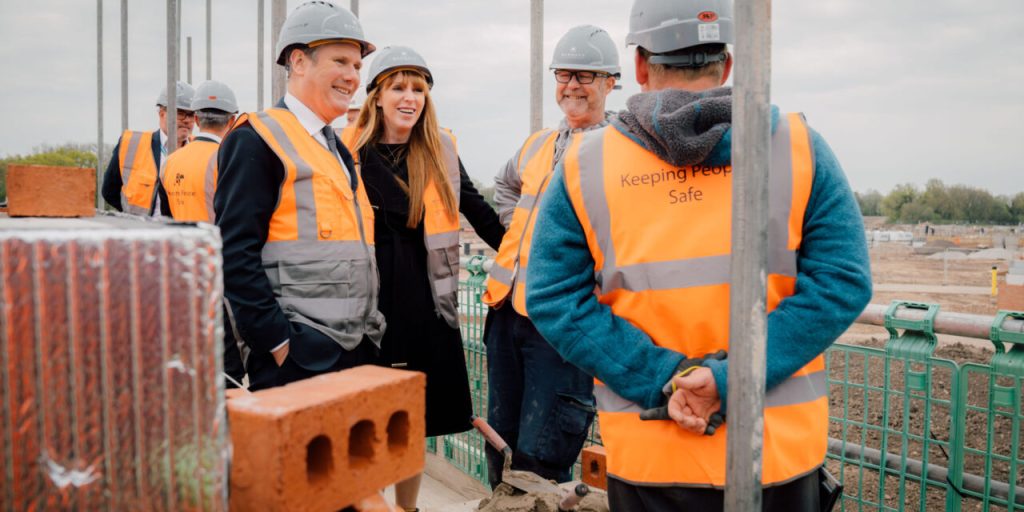
Labour leaders Kier Starmer and Angela Rayner – is housing policy radical enough?
The insidious ‘right to buy’ policy was one of the mainstays of the Thatcher government in the 1980’s. The policy was not sold as the privatisation of Council housing as a means to enrich private landlords or to inflate house prices, generating lifelong debt for many. That would have been too honest, too direct for the Tories.
Instead, the policy was sold as a chance to get on the housing ladder, an opportunity for home ownership, the golden ambition promoted as part of the philosophy of the individual above all, as the Tories marched onward in their determination to dismantle any semblance of post war social provision in housing, education and health.
The impact of the policy has been to increase uncertainty for working class families as Council stock diminishes, private rents increase and mortgages soar. As a consequence homelessness and poverty have spiralled.
Figures published by the Department for Levelling Up, Housing and Communities (DLUHC) at the end of last month showed a sharp rise in the number of children living in temporary accommodation.
There were 145,800 children in temporary accommodation as of the end of December last year, up by a fifth on 20 years ago when records for this measure began, and up 15% on the same period in 2022.
Michael Gove, the DLUHC Secretary of State has admitted that “for years now we have not been building enough homes” and that the Government has missed the supply target of at least 300,000 new homes per year. However, building homes only addresses part of the problem, making those homes affordable and secure for working class families is the real challenge.
Recent Freedom of Information requests, sent by the New Economics Foundation (NEF), found that 41% of all council homes sold under the right to buy scheme are now being let on the private market.
The research also found that the number of homes bought under right to buy and now in the private sector has risen by 3.2 percentage points since 2014/15. This means that around 109,000 more former council homes are now being let privately.
The New Economics Foundation (NEF) has called for a ‘suite of powers’ over housing policy to be devolved from Westminster to local authorities, which would give councillors the “ability to make decisions regarding the future of their council housing stock and give them greater control over the tenure balance of homes in their area”.
Insecurity in the private sector is supposedly being addressed with reforms to the private rented sector. Gove has insisted that the long-promised plan to end tenants being forced from their homes under section 21 notices will take “a matter of months”, but could not give an exact timetable.
With housing security being such a key issue for working class families and with a General Election looming it would be timely for the Labour Party to have a radical approach to housing and look to repeal the right to buy legislation in order to give Council’s more control over housing stock.
Labour does have a plan for housing, which focuses on building on brownfield sites and on poor quality and ugly areas of the Green Belt, which it has redesignated the Grey Belt. Affordable homes are mentioned, in the context of new developments having to target at least 50% affordable housing when land is released. Which sounds fine but a target is not an obligation and housing can quite quickly become unaffordable, when it is on the private market, or it can get sucked into the private rented sector.
As with many policy commitments the Labour leadership position on housing is kept vague in an attempt to avoid any direct criticism. Meanwhile, Homeless Link, the national membership charity for frontline homelessness organisations, criticised the UK government for not uplifting funding to match rising inflation. The group found there were 39% fewer accommodation providers and 26% fewer bed spaces for people experiencing homelessness in England in 2021 compared to 2010 with funding cited as one of the main reasons for the decline.
Abolishing the right to buy would be a massive step towards a policy which could make housing truly affordable for working class families. Labour need to prioritise giving working class families the right to a home, over the Tory philosophy of the right to buy.
6th May 2024
Cultural terrorism crackdown in Iran

Death sentence – Iranian rapper Toomaj Salehi
Engulfed in political, social, and economic crises, as well as rampant corruption, the Iranian dictatorship has accelerated its crackdown on the women and youth of Iran. The regime is attempting to demonstrate to its remaining loyal supporters its unwavering commitment to its outdated and medieval beliefs. In addition, the regime is seeking to divert public attention away from its economic failures, endemic corruption, growing social ills, and the environmental destruction caused by its wasteful missile programmes, all of which have blatantly squandered hundreds of millions of dollars of public funds.
Confirmed reports from Iran tell of a calculated attempt by the regime to drive women and youth away from protests in the streets, main throughfares, and city centres.
The recent crackdown by the security forces on women is taking place against the backdrop of a failing economy and widespread public discontent. The Iranian dictatorial regime, which has failed to overcome the deep economic crisis it has created, is presiding over a relentless rise in the cost of living. The majority of the population is being crushed under the weight of meagre wages, at the same time as the price of basic goods, food items and rents is skyrocketing.
Protests by workers, teachers, pensioners, nurses, students, young people, and women across Iran reflect the dire economic situation and deep-seated opposition towards the continuing rule of the theocratic regime.
Jailed Iranian Nobel Peace Prize Winner, Narges Mohammadi urged Iranians to protest against “full-scale war against women” after authorities intensified their crackdown obliging women to obey the country’s Islamic dress code.
The recent crackdown on women in Iran is a direct consequence of the decree by Ali Khamene’i, the regime’s Supreme Religious Leader. Khamene’i’s aim is to return the country to how it was before the murder in custody of Mahsa Amini in September 2022 and the massive “Woman! Life! Freedom!” protests which followed. Since then, the majority of women in Iran have chosen to shed their hijab in a show of defiance against the misogynistic regime and public assertion of their rights.
As part of the regime’s current crackdown a death sentence has been passed upon underground Iranian rapper Toomaj Salehi, an act described as cultural terrorism by the Committee for the Defence of the Iranian People’s Rights (CODIR). Calling for the unjust sentence to be quashed CODIR General Secretary, Gawain Little, voiced the organisation’s ongoing concern at the lack of freedom of expression in the Islamic Republic.
“Iran is a country with a significant youth population and popular artists like Toomaj Salehi are increasingly expressing the discontent that many young people feel about the theocratic dictatorship”, said Mr Little. “To sentence an artist to death, charged with ‘corruption on earth’, for nothing more than speaking out against the government is nothing short of cultural terrorism.”
Salehi, aged34, had gained widespread popularity with the youth of Iran, due to the challenging content of his lyrics, which addressed issues such as ethnic discrimination, child labour, human rights violations and protest activity.
Salehi was originally imprisoned for taking part in a peaceful protest, a verdict initially overturned by Iran’s Supreme Court before being reversed by a lower court in a bizarre manipulation of Iran’s judicial system.
The lower court, a branch of the Islamic Revolutionary Court in Isfahan, regarded the decision of the Supreme Court as ‘guidance’, before proceeding to confirm Salehi’s imprisonment and impose a death sentence upon him. The court alleged that Salehi had aided rebellion, committed assembly and collusion against the state, propaganda against the state and incited riots.
Salehi was originally arrested in October 2022 for participating in the countrywide Women, Life, Freedom movement protests, sparked by the murder in detention of Mahsa Amini the previous month. In July 2023 Salehi was handed a prison sentence of 18 year and 3 months for the original ‘corruption on earth’ charge.
While his case was referred to the lower court in Isfahan he was granted bail on 18 November 2023 only to be arrested less than two weeks later, on 30 November, for speaking out against the torture he endured while imprisoned. Salehi’s lawyers have vowed that they will appeal but without massive international pressure the regime is unlikely to change its stance.
With the regime’s actions, popular resistance has not dwindled in the least, and the solidarity demonstrated by the public, and support extended to those arrested, including efforts to secure their release, is growing markedly. All evidence points to the fact that the current resistance, together with popular support for women, is set to significantly broaden in scope.
The Committee for the Defence of Iranian People Rights (CODIR) strongly condemns the brutal assault on Iran’s brave and resilient women and calls on trade unions to protest the actions of the ruling regime in Iran.
CODIR believes that only through the concerted and widespread efforts of women’s rights organizations, human rights defenders, and the mobilization of public opinion around the world, expressing solidarity with the struggle of Iranian women and supporting their cause, can this oppressive regime be forced to retreat.
CODIR has also called for the international community to intervene, through the United Nations, to call for the release of all political prisoners and the dropping of charges against Toomaj Salehi.
More info at www.codir.net
28th April 2024
Water No Get Enemy*

Sewage discharge into British rivers, an ongoing scandal
The scandal of water privatisation continues to outrage the public while having little impact on the policies of Britain’s major political parties. There is no doubt that water, along with the energy industries should be in public ownership, to ensure that they meet the needs of the people rather than the profits of shareholders, but neither the Tories nor the Labour leadership are committing to it.
The Tory position is no surprise. As the perpetrators of the deconstruction of the welfare state, comprehensive education, Council housing and much of the country’s manufacturing base, the Tories have demonstrated over many decades their commitment to the interests of the rich few rather than the working class.
Privatised in 1989 the water industries have borrowed £64 billion, paid out £78 billion to shareholders, failed to build the necessary infrastructure to meet the needs of a growing 21st century economy and been under the control of a wide range of foreign investors with no interest in the needs of the British people.
Current foreign owners of the various regional water companies in Britain, totalling 72% of the industry, include the Chinese government, investment authorities in Qatar and Abu Dhabi, the Hong Kong based Li Ka-shing and Malaysian, Francis Yeoh. The state of rivers in England and Northern Ireland is such that the most recent report by the Rivers Trust does not rate any of them as being of “good overall” status.
Yet water companies continue to assert that the ratio of sewage that they treat, compared to the untreated sewage that pours into rivers and the sea, is improving. In reality, this is not the case. The sleight of hand performed by water companies is called “flow trimming”. This is a practice whereby sewage is diverted into rivers upstream of water treatment works. So, less sewage is entering the works, resulting in companies claiming to treat a higher proportion of it.
While the patchwork of private investors walk off with fat dividends the price is being paid by the public, who not only suffer from the poor environmental consequences, but also foot the bill in higher costs. The recent high profile debacle of Thames Water is a case in point. Given the massive mismanagement and fleecing of Thames by the private sector there is even talk of temporary nationalisation by the Tories to bail the company out. Not only will this require the government to take on board the company’s £18 billion debt but Thames continue to plan for a payout to shareholders and raise customers bills by 40% in the coming year.
The estimated water loss in the area covered by Thames Water is 600 million litres per day, almost a quarter of all the water it supplies.
Public policy elsewhere in Europe demonstrates that the British model is by no means accepted as universal, even within other capitalist economies, and a more people oriented approach can prevail. In 2010, Paris re-municipalised its water service from the hands of private companies including Veolia and SUEZ to create the public company Eau de Paris. The performance of Eau de Paris has made a significant difference. The price of water has been cut by 8 per cent and a new citizens’ commission was formed to enhance transparency and democratic governance. The new public utility created an active policy of water affordability for poorer households, migrants, and homeless people and increased the number of public water fountains.
Water use in Ireland is free up to a certain quantity and funded through general taxation. When Ireland’s creditors pushed for an end to this policy amid the Eurozone crisis and the introduction of water charges in 2014, the move was met with strong resistance, including large demonstrations, a non-payment campaign, and civil disobedience in the active blocking of the installation of water meters. These tactics eventually led to the suspension of water charges in 2016.
The fact that most Italian water remains in public ownership is largely due to the 2011 referendum at which more than 55 per cent of voters opposed the attempts at water privatisation that were also part of the larger austerity agenda that followed the financial crisis.
The consequences of the failure to address water quality go far and wide. Apart from the increase in direct bills there is the increased risk of disease from polluted water ways, potentially putting more pressure upon the NHS to deal with water borne infections. The accumulation of sewage into the sea has an impact upon marine life, while land based flora and fauna are threatened by the pollution of rivers upstream, to “flow trim” the regulation of sewage treatment.
That all of this is easily preventable, with the element of private profit eliminated and public good as the priority, should be a gift to a campaigning Labour Party leadership as the General Election looms. However, the fear of being accused of being ’woke’ is immobilising the Starmer leadership on this issue, in the same way that it will not address the question of energy nationalisation, and has diluted its approach to investment in green technologies to develop a progressive twenty first century economy.
Ultimately the solution to the question of how water resources are allocated and used is a socialist one, where the economy is structured upon the needs of the people, not the profits of private investors and shareholders. However, Britain has been particularly badly served by successive governments adopting an essentially neo-liberal approach to resources which should be under public control.
Evidence from elsewhere in Europe demonstrates that mass public pressure can bring about change. As the Tories look towards meltdown in local elections this week, and Labour look set to win a General Election later in the year, it is time to seize the moment and compel the Labour leadership to take a clear stand on this, amongst many other questions, which impact directly upon the lives of working class voters.
*with credit to Nigerian musician and activist Fela Kuti for the title. Check out more here https://www.youtube.com/watch?v=xviLDFqMznQ
13th April 2024
Starmer commits to weapons of mass destruction

Kier Starmer at BAE Systems in Barrow
Labour leader, Kier Starmer, this week committed Labour to an additional £10 – £12 billion spend on weapons of mass destruction if elected. Writing in the house journal of the Tory petit bourgeoisie, the Daily Mail, Starmer described his commitment to British nuclear weapons as “unshakeable” and “absolute”. Starmer went so far as to describe the creation of the NHS and the British nuclear programme as “towering achievements” of the Labour government elected in 1945.
Starmer stated that he wants to raise military spending to 2.5% of GDP “as soon as resources allow”, echoing the commitment of Tory Chancellor, Jeremy Hunt, to raise military spending to 2.5% of GDP “as soon as economic conditions allow”. Government spending is currently at 2.3% of GDP.
Of the 30 countries which are part of NATO Britain is currently tenth in terms of its percentage spend on its military budget by GDP. A rise to 2.5% would take Britain to sixth position. The other nuclear powers in NATO, the United States and France, spend 3.49% and 1.9% respectively on their military.
All NATO members have pledged to spend at least 2% of GDP on their military by 2024.
In a visit to Barrow-in-Furness where British nuclear submarines are built, Starmer said that Labour was making a “generational commitment”, stressing that this was to the,
“…Dreadnought submarines, to the continuous at sea deterrent, and to the upgrades that are needed over time. And of course there is AUKUS in there as well.”
AUKUS is the military pact agreed by Britain with Australia and the United States to provoke China in the Indo-Pacific region, under the pretext of a Chinese military threat to US ‘interests’ in the region.
The announcement by Starmer follows hard on the heels of Labour backtracking on its investment to develop green technologies; the commitment of Shadow Chancellor, Rachel Reeves, not to bail out bankrupt local councils; and the claim that there is no money to introduce universal free school meals, a measure which would benefit working class families and those facing the sharp end of the capitalist economic crisis.
Commenting on the plans, CND general secretary Kate Hudson said: “Putting billions of pounds into the pockets of arms companies and their investors will not reinvigorate the economy in any meaningful way.
“Instead, it takes vital funds and skills away from what could be spent on the just transition: like energy-efficient homes, better public transport and a public health service that saves lives and heals people.
“By committing to the modernisation and expansion of Britain’s nuclear arsenal Labour is contributing to the global arms race and tensions that we are currently seeing.”
She added that if Labour wanted to offer a positive option to the electorate, “it would commit to scrapping Trident and its replacement, and put nuclear disarmament at the forefront of its foreign policy agenda.”
The idea that the possession of nuclear weapons makes Britian safer, or sustains a world power status, is an illusion fed by the military-industrial establishment; the Tory Party and its backers; and the right wing press. The basis of the nuclear programme is that, if Britain was under nuclear attack, it could launch a retaliatory strike, based upon the concept of mutually assured destruction, appropriately given the acronym MAD. Destruction of any kind is hardly a guarantee of safety, destruction that is mutually assured is clearly mad in every sense.
Starmer has shifted Labour so far into Tory territory that the distinction between what each would deliver, following a General Election, is becoming almost impossible to distinguish. Given the abysmal record of the past 14 years it is almost inconceivable that the Tories could be returned to office. The character of any Labour administration however remains very much in doubt.
Unless mass extra Parliamentary pressure can persuade the current leadership to change course the dangers of Labour being little more than Tory-lite when in government remain real.
1st April 2024
Poverty and pyrrhic victories

Poor families with children suffer more than most
In Britain, one of the world’s richest countries, one in six children in 2023 lived in families deemed to be suffering food insecurity, in plain terms, they did not have enough to eat. One in 40 children lived in a family that had accessed a food bank in the previous thirty days.
Relative poverty is defined as households with incomes of less than 60% of the median. Almost one in three children live in relative poverty in Britain. Absolute poverty is defined as households with less than 60% of the median income in 2011. One in four children live in such households in Britain. This represents the fastest rise in child poverty in almost 30 years.
Figure published by UNICEF show that last year child poverty in Britian rose fastest between 2012 and 2021 out of 39 OECD and EU counties, many of which actually succeeded in reducing child poverty over the same period.
At the same time the Sunday Times Rich List for 2023 identified 171 billionaires in Britain, their wealth having grown by £31 billion. For the Tories and the British ruling class this is no doubt something to herald as a success. That ‘success’ however is built at the expense of working class families who suffer disproportionately under capitalism. Not only is their labour exploited in order to extract the surplus value which results in the obscenity of billionaires, the tax and benefit systems designed by successive governments plunge them further into poverty and debt.
Tory tax and benefit reforms between 2010 and 2019 saw the poorest 10% of households lose 10% of their income, the biggest impact being felt by children with families, losing £4,000 per year over the period, or 20% of their income.
While local government services are starved of resources, and Councils around the country face draconian cuts or bankruptcy, the rich continue to rake it in. In the recent budget Chancellor, Jeremy Hunt, announced further tax cuts which will benefit middle and high income earners the most, taking the amount forecast to be spent on tax cuts over the next five years to £65 billion. This is hardly surprising coming from a man who has recently stated that a salary of £100,000 a year is not such a high income. Tell that to the families in poverty losing £4,000 a year!
While inflation may now be at 3.4%, which only means that prices are going up by slightly less than they were before, a wide range of basic services are set to see price rises this month. The increase in Council tax, forced upon local authorities by cuts from central government, will be 5% on average. Broadband and phone contracts, now essential for most people, are set to rise by an average 8% while car tax and TV licence fees are also set to rise. Dental charges, for those lucky enough to be registered with a dentist, are also set to go up.
In spite of the scandalous profits and management failings of the water companies, bills are set to go up, in order to cover their losses and lack of investment. Instead of spending on renewed infrastructure and modernising ageing systems, shareholders have leeched billions in dividends out of the water companies over the years, while ordinary consumers are left to pay the bill. Added to the scandalous rise in the cost of other utilities, while the energy giants continue to make eye watering profits, it is easy to see how working class families are struggling to survive.
This is the true face of capitalism, where the many suffer and pay, while the few get richer and make hay. Previous Labour governments have attempted to mitigate the worst excesses of capitalism by introducing social programmes, improving access to education and having a less punitive benefit regime, while not presenting any fundamental challenge to capitalism as a system.
An incoming Labour government, led by Kier Starmer, is not even likely to go this far. There will certainly be no challenge to capitalism, that is guaranteed, but there will be little by way of mitigation either. Shadow Chancellor, Rachel Reeves, has made it clear that she will not help Councils facing bankruptcy, for example. The commitment to investment in green infrastructure to create jobs and boost the economy has been diluted to virtual insignificance. There is no commitment to take back control of the key utilities, to prevent profiteering in essential services and exploitative bill rises.
With a General Election looming, getting rid of the corrupt Tory government must always be a priority. More than ever, that goal needs to be allied to mass extra Parliamentary action to pressurise the Labour leadership into actively pursuing policies, which will not just bolster the position of Britain’s billionaires, but address the needs of those accessing food banks, struggling to feed their families and being forced in the winter months to choose between heating and eating. Anything less and a Labour victory will be nothing more than pyrrhic.
24th March 2024
New definitions, old habits

Just Stop Oil protests – extremist activity?
The British government’s New definition of extremism (2024) published in mid March may not establish a House Committee on un-British Activities but is certainly a step in the direction of the anti-communist witch hunts which were a feature of life in the post war United States. Michael Gove is unlikely to be in office as long as US witch finder general, Senator Joseph McCarthy, but his ‘new definition’ is certainly a step in the direction of McCarthyism, smuggling in a number of constraints under the umbrella of tackling Islamist or neo-Nazi extremism.
In defining behaviour that could constitute extremism the new definition includes,
“Attempts to undermine, overturn, or replace the UK’s system of liberal parliamentary democracy and democratic rights.”
This definition of necessity presumes acceptance of the implied interpretation of ‘liberal parliamentary democracy’ as well as a shared understanding of what constitute ‘democratic rights’.
The terminology is typical of the smokescreen used under capitalism to shroud its illiberal and anti-democratic core in language designed to make the system appear fair and just.
The capitalist system will allow liberalism up to the point at which it sees the danger of exposure or any threat to the status quo. The various tools at its disposal, including the press and social media, smear campaigns, use of the security services, and ultimately the threat or use of force, can be deployed in varying ways to head off any perceived danger.
The recent period of Jeremy Corbyn’s leadership of the Labour Party from 2015 -19 is a case in point. Although representing a relatively mild threat to the established order the popularity of Corbyn’s message, highlighting glaring disparities between rich and poor; inequalities across class, race and gender; and the concentration of power and influence in the hands of a few corporations and bankers in the City of London, was deemed to be too close to the truth to be allowed to take root.
The systematic character assassination of Corbyn, and the subsequent eradication of any radical dimension to Labour policy under Kier Starmer, illustrates the establishment response to even a mild threat.
The presentation of politics as a choice of who governs, between the Tories and Labour, with perennial pro-capitalist Liberal Democrats occasionally called upon to prop up the system, makes a mockery of the idea of ‘liberal democracy’ as there is essentially no choice to be made. Capitalism, which is the system of the ruling class, run by the ruling class, for the ruling class, will always win on these terms!
Labour administrations have provided nuance, at least in domestic policy. However, even the most democratic achievement of Labour, the National Health Service, is under threat from the intrusion of the private sector and the danger of healthcare not being free at the point of use, or at least more difficult to access. In foreign policy there has been universal consensus between the leadership of the main political parties on all major issues from the invasion of Iraq to the deployment of Trident nuclear submarines.
When it comes to ‘democratic rights’ there is an equivalent sleight of hand in defining terms and emphasis. Democratic rights under capitalism are usually reduced to being able to vote for the political party of your choice with some degree of freedom of expression and assembly permitted. There is no right to employment however, or housing, as the jobless and homeless will testify. The NHS may be the pride of social policy in Britain but access to healthcare in the United States for example, self styled leaders of the ‘free world’, is very much dependent upon ability to pay. Democratic rights are defined in terms which suit the ruling class and do not challenge its endemic failings, to be able to feed, house and employ its citizens.
The ‘new definition’ claims that the first duty of government is “to keep our citizens safe and our country secure”. Citizens sleeping on the streets, going hungry for lack of food, or struggling to find work are hardly ‘safe’. Nor is a country secure that makes itself a potential target by cravenly supporting the militarist adventures of the United States and NATO, or positioning itself as the enemy of progress by supporting the ongoing massacre of Palestinians in Gaza by the Israeli Defence Force.
The Tories and the main architect of the ‘new definition’, Michael Gove, will no doubt claim that the intention of the guidance is not to target those with strong opposition views but only those seeking to promote “violence, hatred or intolerance”. The Left, it is claimed, should have no fear for they are not the objects of the guidance, being neither Islamist nor neo-Nazi extremists.
However, little more than a few strokes of the proverbial pen could see that position change. Given the more draconian powers the police have under the Public Order Act 2023, which bans any act “which interferes with the use or operation of any key national infrastructure in England and Wales”, which could include protest on the public highway, taking the ‘new definition’ at face value would appear to be naïve at best.
Not surprisingly the Labour leadership have made no commitment to repeal the legislation, being afraid that they will be characterised as not being tough enough on crime if they commit to do so. With a General Election looming the issues of tackling extremism and public order are likely to be played up by the Tories, who see these as issues on which they can win votes. Labour simply aping the Tories will convince no-one but is likely to alienate many.
Pressure upon Labour when in opposition or in office, from mass extra Parliamentary action and from the wider labour movement, will be vital if there is to be any prospect of changing the legislative landscape for political activity in Britain. That such action could be deemed ‘extremist’ may deter the fainthearted but without such action there is every prospect that worse will follow. There may be a ‘new definition’ but for the British ruling class, old habits die hard.
17th March 2024
Iranian election – regime legitimacy rocked

Protests continue across Iran
Parliamentary elections in Iran, earlier this month, have rocked the regime due to the obvious level of disaffection amongst the general population reflected in the all time low turnout. Even before the elections themselves the government had gerrymandered the process through the rigorous vetting of candidates in order to make sure the outcome was safe for the regime.
The extent of disqualification of candidates was such that even former President, Hassan Rouhani, a former beneficiary of such back room manoeuvres, was moved to protest. The fact that such a loyal servant of the regime saw fit to raise objections on this occasion is significant.
Other key personalities such as Mostafa Tajzadeh, a former Deputy Minister of Interior Affairs, imprisoned in Evin prison for criticising the leadership and holding them responsible for political, social and economic crises in the country, confirmed that he would not vote in the election.
“I will not vote to endorse corruption,” said Tajzadeh in a letter he wrote from Evin Prison. Tajzadeh, had previously applied to run for president, but his candidacy was rejected. He was jailed in October 2022 and sentenced to five years in prison on charges of “conspiring against security and spreading lies and propaganda against the regime.”
Tajzadeh criticised current Supreme Leader, Ali Khamenei, for ignoring Iran’s dire realities and the people’s protests, urging Iranians to boycott the elections. He stressed Iran’s need for comprehensive development, accusing Khamenei of hindering reforms while lacking the wisdom to lead effectively.
“The majority of Iranians have decided to ignore the Supreme Leader and his propaganda machine, refusing to participate in the elections as a protest against the dire situation in the country,” wrote Tajzadeh. He also condemned the parliament’s ineffectiveness, citing its diminished powers and exclusion of independent voices.
The elections were regarded as invalid by all progressive forces, pro-reform forces generally and even certain groups of the fundamentalist forces were not happy to support the election. Significant calls by trade unions and pensioners groups, civic society advocates and supporters of human rights reform were routinely ignored by the regime.
While the regime in Iran did its utmost to urge voters to go to the polls, surveys showing that most voters did not intend to take part were proven correct. A recent poll conducted by Iran’s state television found that more than half of respondents were indifferent to the elections. The elections were the first since protest swept the nation following the death of Iranian Kurd, Mahsa Amini, after her arrest for allegedly violating the strict dress code for women.
The Women, Life, Freedom protests, which surged throughout the country following the state murder of Amini has undoubtedly been a key factor in undermining what little legitimacy the regime may have possessed, especially in the eyes of women voters.
Turnout was clearly low due to voter apathy and the desire to send a message to Iran’s theocracy. Amongst prominent Iranians pushing for a boycott, were imprisoned Nobel Peace Prize laureate Narges Mohammadi.
Official figures put the election turnout at 41% but this is widely regarded as being an exaggeration by independent observers. However, even this official figure makes the turnout the lowest since the 1979 revolution in Iran. In Tehran province, voter turnout was about 24%, another record low, underlining declining public interest in legitimising the Iranian state. The number of invalid or blank ballots is estimated to have been as high as 400,000 in Tehran alone, showing the extent of deliberate protest.
The reality for many in Iran is that economic hardship is an overriding factor as the Islamic Republic suffers under punishing international sanctions and rapid inflation. At Tehran’s storied Grand Bazaar, many shoppers simply wander the warren of aisles without buying anything, as prices have skyrocketed in recent years. In an oil rich country of over 85 million people, annual inflation is close to 50 percent, consumer prices remain high and Iranian currency is in virtual freefall.
Iran has suffered under crippling US sanctions since Washington’s unilateral withdrawal in 2018 from a landmark deal that had promised sanctions relief in return for curbs on Iran’s nuclear programme. The sanctions have sharply reduced Iran’s oil revenues and further restricted trade, helping to harden the decades-old enmity with the United States and Israel.
The regime’s manipulation of the process, and the inability of any candidates from opposition or reform groups in Iran to stand, means that conservative politicians will dominate Iran’s parliament, maintaining their hold on the Islamic Consultative Assembly.
With Presidential elections scheduled for 2025 in Iran the regime will clearly be concerned by the level of disaffection and dissent shown in the Parliamentary election results. Previous presidential elections have been carefully manipulated to ensure the safest outcome for the regime and have resulted in widespread protest as a consequence.
Given the growing scale of protest activity in Iran since September 2022, with the death of Mahsa Amini, there is every likelihood that the presidential contest next year will spark further dissent. The traditional response of the regime has been to crack down hard on such displays of opposition. Whether it will be able to sustain such tactics in 2025, as the Iranian people continue to question the legitimacy of the regime, remains to be seen.
10th March 2024
Cracked Actors

Smug Chancellor, Jeremy Hunt, prepares to reveal a pointless budget
A Tory budget could never be expected to deliver anything of significance for the working class or families living in areas of the highest deprivation across Britain. In that respect alone Tory Chancellor, Jeremy Hunt, deserves top marks for consistency, as the heavily trailed pre-election budget revealed on Wednesday (6th March) gave no hope of any alleviation of pain from 14 years of Tory rule for those most in need.
The Institute for Fiscal Studies (IFS) has calculated that while Hunt’s budget contained an estimated £9 billion in tax reductions, previous budgets have increased the tax burden by £27 billion, scheduled to kick in from next year.
Not that there is anything inherently wrong with raising taxes, if the revenue collected is spent correctly. A commitment to investment in research, development and production of green technologies to reduce the amount of carbon pouring into the atmosphere would be a start. Greater investment in the training, retention and pay of NHS staff with a boost in emphasis upon Creative Health to reduce the burden at the acute end of the medical spectrum would be welcomed by most.
Abolishing the ‘right to buy’ for council housing, which sees any investment made by local authorities to increase the stock of affordable housing effectively privatised after a short period, would be welcome. The Chancellor could have considered the proper funding of local government as an area worthy of investment, given the growing number of local Councils posting section 114 notices, effectively declaring bankruptcy and having to limp along with under resourced statutory services only.
While Councils like Birmingham are cutting £300 million and Nottingham £53 million from their budgets the government are heralding Mayoral Combined Authority deals, creating a new tier of regional government with economic development, transport and housing powers but little to directly offer local communities. The North East Mayoral Combined Authority (NEMCA) is the latest recipient of this form of government largesse, covering an area from Berwick upon Tweed to Bishop Auckland, and able to access £4.2 billion in spend over 30 years.
The fact that the NEMCA budget is a drop in the ocean compared with the cuts endured by local authorities in the North East over the past 30 years is largely overlooked by local politicians desperate to sell the deal as good news. Local authorities overall have faced a 40% cut since the Tories lit the austerity bonfire in 2010, cheered on by their Liberal Democrat partners for the first five years.
Meanwhile local leisure, library, arts and museum provision continue to face significant reductions, or even closure, not being high on the government’s agenda. It is no surprise that they are services mainly accessed by communities in areas of high deprivation who are less likely to vote Tory or, increasingly, to vote at all.
The Daily Mail meanwhile sidesteps these concerns and bemoans the lack of any further money for the military in the budget, citing a report by the Public Accounts Committee that suggests the military is £29 billion short due to overspends, mismanagement and inflation. The Mail’s response to this has been to launch a campaign, Don’t Leave Britain Defenceless, calling on ministers to increase funding for the Armed Forces “in response to the growing threats around the world.”
The Ministry of Defence has always been famous for its poor budget management but to pour good money after bad to prop it up and to waste millions on more weapons of mass destruction when people are homeless and starving beggars’ belief.
Hunt’s big ‘rabbit out of the hat’ moment was a 2p reduction in the rate of National Insurance, in an attempt to grab the headlines of the Tory press. The reality is that the NI cut will be fine if you earn over £50,000 a year; you will save £1310 per annum. This is five times more than a worker on £20,000 and 15 times more than someone on £15,000 a year. So, the Tory position remains as ever, the well off do well, while the poor get punished!
Hunt was also keen to try and steal what few clothes Labour have by announcing the abolition of non-dom tax relief for those in Britian whose permanent address is elsewhere. However, there is the caveat of a five year transition period, so no doubt the tax dodgers at the top of the tree will, as usual, find new ways to avoid paying their fair share before this measure hits.
Whatever the Tories, the Daily Mail or its readers may think, the threat to Britian does not come from Russia or China, or even maverick international terrorism. The enemy, to coin a phrase, is within. The Tory Party, the billionaires and corporations which fuel and fund them, the military industrial complex which feeds off the belligerent pro-US foreign policy, are all the enemies of progress, enemies of the working class and enemies of change.
A budget by Jeremy Hunt or any other Chancellor, Tory or Labour, will not change this reality. Only mass extra parliamentary pressure for socialist change can begin the process of really transforming Britain in the interests of the working class. As Canadian poet and songwriter, Leonard Cohen, famously wrote “there is a crack in everything/it’s where the light gets in”. There is certainly a crack in capitalism and it is the light of socialism which needs to pour in.
3rd March 2024
Exposing ther real ‘extremists’

Prime Minister Rishi Sunak gives an address outside 10 Downing Street on Friday, where he said the country’s democracy was under threat
The phoney ‘address to the nation’ by British Prime Minister, Rishi Sunak, on Friday night was both pathetic and dangerous. Pathetic that a Prime Minister should be so threatened by the election of narcissist George Galloway in Rochdale that he felt compelled to use it as an excuse to demonise those opposed to the ongoing genocide committed by the Israeli state in Gaza. Dangerous because by effectively characterising those protesting in favour of Palestinian rights as anti-democratic ‘extremists’, Sunak moves Britian closer to being a fully fledged police state.
The way for Galloway’s victory had been paved by the Labour Party who initially rushed their selection process to ensure a popular Muslim candidate, then just as quickly disowned him for overheard comments about the nature of the Israeli action in Gaza, deeming them anti-semitic. Without a Labour candidate Galloway was able to galvanise the pro-Palestinian vote amongst Rochdale’s Muslim population while also tapping into the general discontent with Labour’s line on Gaza amongst many other voters in the constituency.
Sunak’s address followed closely upon the massacre of 100 Palestinians in a single day by the Israeli Defence Force (IDF), for the crime of being hungry and crowding an aid convoy. The United Nations have clarified that many of those injured suffered gunshot wounds, others were trampled in the confusion as the IDF clearly lost control and resorted to their tried and tested gung ho methods.
Sunak mentioned none of this in his address, instead focussing upon criticising the democratic objections raised by thousands of people week in, week out across Britain, reflecting the majority of world opinion, that an immediate ceasefire in Gaza must be implemented. Instead of backing the majority view Labour leader, Kier Starmer, sided with Sunak saying that he was right to call for ‘unity’.
That Starmer should give Sunak’s comments any credence, in a week when Sunak failed to call out his Party former Vice Chairman, Lee Anderson, for racist remarks about London Mayor, Sadiq Khan, is alarming but sadly not surprising. The Tory record on racism and Islamophobia is far worse than Labour’s has ever been on the manufactured anti-semitism charges, yet Starmer seems unable or unwilling to land punches in this regard.
It is little wonder that Starmer was the focus of George Galloway’s comments after winning in Rochdale stating,
“I want to tell Mr Starmer, above all, that the plates have shifted tonight. This is going to spark a movement, a landslide, a shifting of the tectonic plates in scores of parliamentary constituencies, beginning here in the north-west, in the West Midlands, in London, from Ilford to Bethnal Green and Bow.”
This is typical Galloway bluster and there is little real indication that tectonic plates have shifted, or even that Galloway would retain his Rochdale seat at a General Election. However, the Rochdale result does send a message to both major parties that their line on Israel and the attack on the Palestinian people is not playing well with the broader public. The Tories openly pro-Israeli line clearly marks them as being on the side of a regime willing to treat international law with impunity, trample upon human rights and continue to justify arming the regime guilty of such crimes.
It is ironic that the second anniversary of the Russian intervention in Ukraine was marked by nationalist leader Volodymyr Zelensky bemoaning the loss of 31,000 lives over the two year period. The same number have been killed by the IDF in Gaza in less than five months.
The Labour leadership position of equivocation and studious avoidance of backing the cause of Palestinian rights has left them looking as unprincipled as the Tories. Desperate to say what they think people want to hear, based on the editorial positions of the right wing media, the Labour leadership lack any sense of cohesion on Middle East policy other than hanging onto the coat tails of the Tories.
The protests in support of the rights of the Palestinian people will and must continue. The over policing of such demonstrations, designed to suggest that they pose a threat, must stop. The Labour leadership must unequivocally back the international call for an immediate ceasefire in Gaza.
While Rishi Sunak may characterise those protesting for Palestinian rights as extremists, the real extremists are the religious fundamentalists in the Israeli leadership, those who continue to back them and those who profit from ongoing arms sales to the apartheid regime.
Sunak’s attempt to characterise the election of George Galloway and the groundswell of support for Palestinian rights as a threat to democracy and ‘our shared values’ must be exposed for the opportunist sham that it is. The only values recognised by Sunak and his cronies are to keep their corrupt leadership in positions of power and influence. Those are not, and will never be, values shared by the working class in Britian or the people of Palestine.
New World Order Realignment underway
17th February 2024

Taiwan under President Tsai Ing-wen is being heavily armed by the US
The concept of the ‘new world order’, as coined by US President, George Bush, in January 1991 was an attempt to shape the post Cold War era in the image of the United States, following the defeat of the Soviet Union. The phrase emerged in a speech Bush made announcing the launch of Operation Desert Storm, following the Iraqi intervention in Kuwait which precipitated the first Gulf War. It was quickly seized upon by US neo-cons, in particular, as short hand for US imperialism’s desire to play the role of global policeman, justifying military intervention wherever and whenever deemed necessary.
With the strategic counter balance to US expansionism, which the Soviet Union represented having been taken away, the only acceptable interpretation of the world for the US was one it dominated. The so called Monroe doctrine, where the US since the 19th century saw Latin and South America as its ‘backyard’ in which to intervene as it wished, had now gone global.
While the US has undoubtedly flexed its economic and military muscle in a series of scenarios since 1991, things have not always gone according to plan. Overt and covert activity in the Middle East, previously aimed at curtailing Soviet influence, translated into attempting to stem the tide of Islamic fundamentalism resulting in the calamity of the Taliban and al-Qaeda. The origins of both can be traced back to CIA funded covert operations. In addition, the adventurist foreign policy pursued by the Iranian dictatorship, to fund a network of resistance across the region, including Hamas, Hezbollah and the Houthis, is a direct response to the failures of US Middle East policy.
The disastrous invasion of Iraq in 2003, under the fictional pretext of identifying weapons of mass destruction, undoubtedly made the US and its NATO allies more enemies than friends in the Middle East. The intervention in Libya has resulted in an ongoing civil war between rival factions; the retreat from Afghanistan has left the population at the mercy of the medieval Taliban; while the covert intervention to try and unseat Bashir al-Assad in Syria has more than backfired, with unsuccessful military action leading to the reality of a major refugee crisis for Western Europe.
The US still has too much military and economic might for these scenarios to be described as US imperialism’s death throes but there are increasing indications that the world order is changing and those changes are not to the liking of the US and its NATO allies. The most obvious of these is in relation to China.
While China has no military designs other than to defend its own territory, anti-Chinese rhetoric has been growing amongst Western politicians and media in recent years. Much of this is in response to the exponential growth in China’s economic power and its increasing influence with developing nations. Investments made on the basis of joint co-operation, collaboration and mutual trust are a far cry from the asset stripping and plundering which characterises the economic relationship of the West with the developing world.
Nations of the Global South increasingly see trade and investment with China as a more productive and sustainable option than dealing with Western backed corporations. Such successes are as a result of China’s Belt and Road Initiative (BRI), launched 10 years ago, with the aim of creating a network of mutually supportive economic relationships, not based upon exploitation and not based upon the expropriation of one state’s assets by another.
BRI is inspired by the concept of the Silk Road, established during the Han Dynasty 2,000 years ago, an ancient network of trade routes that connected China to the Mediterranean via Eurasia for centuries. The aim of BRI is to connect Asia with Africa and Europe via land and maritime networks along six corridors.
That such a strategy is a threat to the dominance of US economic imperialism, there can be no doubt, hence the increasingly vitriolic rhetoric aimed at painting China, as an economic danger, but also a military threat. Much of this rhetoric focuses upon the relationship of China to Taiwan, recognised in international law as Chinese territory, but increasingly used by the West as leverage with which to ‘justify’ its designs on restraining China’s economic growth. The US has been increasing its supply of weapons to Taiwan underlining the potential of the island being a bridgehead into direct conflict with China.
The concept of a Chinese ‘threat’ also lies behind the justification of the US and its NATO allies to increase military expenditure and add to the level of Western military presence in South East Asia generally.
There is also concern in Western capitals that China plays a key role in the BRICS (Brazil, Russia, India, China, South Africa) group, which is increasingly attracting the attention of nations of the Global South, looking to find ways to break with the US led global order.
While the BRICS countries are by no means a homogeneous group in terms of their political outlook the initiative remains an important one. The stranglehold of imperialist designed institutions such as the International Monetary Fund (IMF) and World Bank, both of which are US dominated and controlled, has tied developing nations to Western economies in ways which have thwarted, rather than encouraged, their economic independence.
The tools of the imperialist banking sector are there precisely to generate dependence and keep former colonial nations within a neo-colonial orbit. The deployment of Western corporations, infrastructure and technology only serves to reinforce those dependencies over the long term. Inevitably there is often a military pay off too, with arms contracts being tied into economic support and the stationing of military bases and US hardware as part of the deal.
The fact that the concept of “de-dollarisation” is even on the agenda of developing nations, and that there is an emerging investment network which it does not control, is of concern to the US. Also, there can be no doubt that much of the current US provocation towards China stems from the fear that the unipolarity it has enjoyed, since the defeat of the Soviet Union, is not only being questioned but is being actively challenged.
4th February 2024
Support the Cuba Vive appeal

Help break the blockade on health. Support the Cuba Vive appeal to provide urgent medical aid for Cuba.
Dear friend,
US sanctions are depriving 11 million Cubans of life-saving medicines and surgical supplies. In response, the Cuba Solidarity Campaign has launched Cuba Vive – an appeal to raise funds to send vital medical aid to Cuba.
Cuba’s commitment to health as a human right has helped the country achieve world-renowned health services for its people despite 62 years of an illegal US blockade.
Today, these achievements are under threat.
Cuba’s dedicated health professionals struggle with limited resources to treat patients. From surgical supplies to spare parts, paracetamol to sutures: items that are in plentiful supply in the UK, are increasingly hard to come by or cost up to three or four times more.
Today’s shortages are unprecedented. After leading the region for many years, Cuba’s impressive health indicators are beginning to suffer. Between 2019 and 2022 the infant mortality rate rose from 5 per thousand live births to 7.5 per thousand.
In response, the Cuba Solidarity Campaign, and UNISON North West, Northern, Northern Ireland and Scotland regions have launched a medical appeal to send containers of life-saving medicines, raw materials, surgical supplies and medical equipment to Cuba.
Please make a donation today towards the cost of buying and shipping these life-saving medical supplies to Cuba.
You can make a difference.
Please help us spread the word by forwarding this email and sharing the appeal with someone who may be in a position to help.
Thank you for your support.
28th January 2024
Israel is not above the law

Supporters of a free Palestine demonstrate outside The Hague
The measures outlined by the International Court of Justice (ICJ), which has ruled that Israel’s actions in Gaza are plausibly genocidal, must be welcomed by all who support the cause of Palestinian liberation.
The ruling is a landmark in the search for justice for the Palestinian people. The ICJ decision will be relayed to the United Nations Security Council for consideration. The ruling orders Israel to prevent acts of genocide against Palestinians and to do more to help civilians, who are currently suffering under daily bombardment by the Israeli Defence Force (IDF). However, the ICJ stopped short of ordering a ceasefire as requested by the plaintiff South Africa.
Although the ruling contained no binding order upon Israel to stop the war in Gaza it is nevertheless a legal setback for Israel. The Palestinian Foreign Ministry said the decision was a welcome reminder that “no state is above the law”.
The ruling not only obliges Israel to stop all acts which are plausibly genocidal but equally obliges all states to cease funding and facilitating Israel’s military offensive in Gaza. The measures, all backed by at least 15 judges, also required Israel to ensure the preservation of evidence of alleged genocide and report to the court within a month.
In coming to its decision the ICJ did not have to find whether Israel had committed genocide, which will be determined at a later date, but only that its acts were capable of falling within the convention, which defines the war crime as “acts committed with intent to destroy, in whole or in part, a national, ethnical, racial or religious group”.
Nevertheless, the United States made its position clear ahead of the judgement, describing South Africa’s case at the ICJ as “meritless, counterproductive, completely without any basis in fact whatsoever.”
Israeli Prime Minister, Benjamin Netanyahu, proclaimed in response to the ICJ ruling,
“Israel’s commitment to international law is unwavering. Equally unwavering is our sacred commitment to continue to defend our country and defend our people. Like every country, Israel has an inherent right to defend itself,” he said. “The vile attempt to deny Israel this fundamental right is blatant discrimination against the Jewish state, and it was justly rejected.”
As ever the scared right to self defence is, for Netanyahu, one which applies to Israel but not to the Palestinians, whom Israel has been oppressing in the West Bank and Gaza for decades. The mantra that ‘Israel has the right to defend itself ‘ is increasingly seen as a right wing trope for justifying the Israeli regime treating Palestinians with impunity.
Solidarity organisations across the world have called upon all states to commit to upholding the ICJ decision to protect the rights, including the fundamental right to life of Palestinians in Gaza. The death of over 25,000 people, over 70% of whom are women and children according to the United Nations, cannot be justified by the IDF as a response to the actions of Hamas on 7 October 2023.
Such a disproportionate response, having been condemned by the ICJ, must now be condemned by the entire international community and every effort made towards supporting the call for an immediate ceasefire, a negotiated solution to end Israeli action and free hostages held by Hamas.
Most importantly the resolutions of the United Nations on the need for a two state solution, realising the right of the Palestinian people to self-determination and the establishment of a Palestinian state within agreed international borders, must be acted upon by all member states.
The ICJ ruling is to be welcomed as a vital step towards the realisation of the need to stop the current genocide in Gaza and take the first steps towards the establishment of an independent state for the people of Palestine.
However, the ongoing commitment of the United States and Britain to arm Israel, not take the Israeli government to task for its flouting of international law and to be, at best, lukewarm about the necessity of a Palestinian state, remain significant barriers to progress. In the short term the failure of either state to recognise the need to support the call for a ceasefire, in spite of the mounting death toll, is scandalous.
The fact that this shame is cross party, with the Labour leadership in Britian continuing to back the government’s position, including being in favour of air strikes against Yemen, adds urgency to the need to campaign for a change in British foreign policy.
As the Jewish diaspora gather to mark Holocaust Memorial Day over this weekend many are rightly appalled by the action of the IDF and the religious zealots around Benjamin Netanyahu in Gaza. Opposition to the religious fundamentalists in the Israeli regime is growing both inside and outside Israel, many in the Jewish community increasingly regard the actions of Netanyahu and his war cabinet as not being carried out in their name.
The working class movement in Britain and across the world needs to stand in solidarity with those opposing religious fundamentalism in Israel, just as they support those opposing the theocratic dictatorship in Iran and religious zealotry in Saudi Arabia. The fate of the people of Palestine and the people of Israel may depend upon it.
20th January 2024
Prospects for peace in the balance

Thousands march for Peace in Palestine – London 13th January 2024
The US offensive against the Houthi group in Yemen, with Britain as usual clutching American foreign policy coat tails, represents a further escalation of tension in the Middle East. Ten days ago the initial bombardment of the capital Sana’a and other Yemeni cities added to the destruction already inflicted by the Saudi led and Western backed coalition, which has waged war in Yemen since 2015, displacing and killing thousands.
The Western attacks are in response to Houthi attacks upon merchant shipping in the Red Sea, which has forced ships to take longer trade routes and therefore added to the price of goods. The Houthis defence is that they are targeting ships which are supplying Israel in its genocide in Gaza. In Yemen itself the situation was described by Oxfam as follows,
“The humanitarian situation in Yemen remains dire with almost 21 million people in desperate need of food, water and life saving aid. It is vital that peace be restored and further suffering prevented.”
The war in Yemen since 2015 has effectively pitted the Houthis, as Iran’s proxy, against Saudi Arabia in what the UN regarded as the world’s worst humanitarian crisis until the Israeli genocide in Gaza.
The Houthi’s, who control the North and West of Yemen, are backed by Iran so are by no means paragons of democratic practice. On the contrary their much repeated slogan, “God is the greatest, death to America, death to Israel, a curse upon the Jews”, hardly marks them out as the most enlightened of Middle East factions.
However, the US/British bombing campaign has arguably been the trigger for the more direct engagement of Iran in the Middle East conflict, thus destabilising further an already volatile situation and dragging a wide range of other players into the conflict. Attacks upon locations in Pakistan, Syria and Iraq by the Iranians in the past week are fuelling an already unstable situation.
As a regional nuclear power Pakistan has the potential to take the conflict to an even more dangerous level, posing a threat not just to the region but to world peace.
While US Secretary of State, Anthony Blinken, claims to have sent a private message to Iran, telling them to back off, this does not appear to have had any more impact than exhortations to Benjamin Netanyahu in Israel, to avoid killing civilians in Gaza. Netanyahu’s response has been to take the number of dead over the 24,000 mark, 70% being women and children according to the UN, the vast majority civilian non-combatants.
Only this week Netanyahu has been explicit in his opposition to the establishment of a Palestinian state. This is in direct contradiction to the stated US position of supporting a two state solution.
The United States has now designated the Houthis as ‘global terrorists’ in a further twist in the escalation of regional tension. The designation will make it harder for humanitarian aid organisations to access those in need.
US National Security Advisor, Jake Sullivan, justified the move saying that it was in response to attacks on commercial shipping in the region saying that recent attacks “fit the textbook definition of terrorism”.
However, the US and other Westen powers remain unwilling to act upon the fact that Israeli Defence Force (IDF) operations in Gaza and the ongoing Israeli occupation of the West Bank are at the heart of tensions in the region. Is the killing of over 24,000 people and the displacement of 1.6 million more not a “textbook definition of terrorism”?
Until the question of Palestine is addressed the prospects for peace in the region will remain slim. The refusal of the US and Israel to engage in serious dialogue with the Palestinians over many decades has directly led to Hamas gaining control in Gaza, increased Iranian influence in both Lebanon and Palestine, and fuelled tensions across the Arab world.
The US has tried to use such tensions to its advantage, by playing one group or state off against another, the eight year long Iran-Iraq war being a case in point, arming reactionary groups in Afghanistan, which eventually became the Taliban, another. Engineering uprisings against Gaddafi in Libya and Assad in Syria add to the list.
In none of these situations has US imperialism increased its influence and has often had to resort to massive force just to hold onto its position. In every instance the consequences for the people of the region have been catastrophic, resulting in war, collapsed states or dictatorship.
As tensions in the Middle East increase, and the response of Britain and the US remains one of sending in gunships, the situation can only get worse. The warmongering response of NATO is a further reason for any incoming Labour government to have withdrawal from the military alliance in its manifesto along with a commitment to a non-aligned foreign policy.
Also, mass mobilisation of the people, like the 13th January demonstrations, are essential to bring pressure to bear upon the West to adopt a strategy aimed at reducing, not increasing tensions. Without such an approach the prospects for peace will remain in the balance.
All Change but no difference?
7th January 2024
Labour leader Kier Starmer – “credible hope” his best offer to date
Elections will dominate the political narrative on both sides of the Atlantic in 2024. In the United States the Presidential election scheduled for 5 November is already being dominated by the prospect of another run by the narcissist, Donald Trump, with many predicting a victory over Joe Biden a distinct possibility if Trump wins the Republican nomination.
At present two states, Colorado and Maine, have disqualified Trump from the Republican ballot on the grounds of inciting insurrection. Whether such a judgement will pass the test with the Supreme Court, where it is currently heading, remains to be seen. However, should Trump clear these hurdles he is a racing certainty to be the Republican nominee based on current polling estimates.
That does not make a Trump second term a certainty by any means but it does raise it as a distinct possibility. Such constraints as there were during Trump’s first term would undoubtedly be swept aside as the team around Trump are already making clear. The independence of the judiciary and decisions on who does and does not get prosecuted are already in Trump’s sights. This would raise the prospect of Trump being able to pardon himself and his cronies, as well as launching investigations into his enemies.
Trump’s take on whether he planned to rule as a dictator when asked by Fox News was telling,
“Except for day one”, he said, “After that, I’m not a dictator.”
Which begs the question as to how long ‘day one’ will last.
Trump’s take on foreign policy has been famously myopic. Fears within the US political establishment centre around Trump abandoning NATO and, for some Democrats, cutting off the weapons supply to Ukraine. However, there is nothing to suggest that Trump would not remain gung ho in relation to US attitudes towards China, Iran or the wider Middle East, with support for Israel not likely to be up for discussion.
Biden has actively embraced the role of the US as the world’s policeman, ready to intervene whenever or wherever perceived US ‘interests’ are at stake. While Trump’s rhetoric may sound different, to keep on board his home crowd, the forces which shape the wider objectives of US imperialism will not be so easily persuaded to change course.
Democracy US style has always been an illusion, being based on the bankrolling of candidates by private individuals and corporations seeking to gain the most influence. A Biden/Trump face off in November will be no different. However, while a Trump return to the White House would signal a further shift to the right in the political centre of gravity in the US, would wider policy objectives for US imperialism change fundamentally?.
November is still a long way off and a lot can happen in US politics over the months till then. Writing off Trump being back in the White House in January 2025 though is not something which should be contemplated yet.
In Britain lame duck Prime Minister, Rishi Sunak, has indicated that a General Election will not take place until the second half of the year. The timing of the election is up to Sunak however, so the option of a snap May election cannot be ruled out, depending upon how Sunak and his cohorts see the political landscape as shaping. With a first draft of the Covid19 Inquiry report being promised by the summer for example, Sunak may want to cut and run before Tory failings during the pandemic become too exposed.
So far Sunak has pinned his hopes on achieving the five pledges he made last year being, halving inflation; stopping the boats; growing the economy; cutting NHS waiting lists; and reducing the national debt.
While inflation has reduced, prices remain high and continue to be a burden for many working class families. Also, a multiplicity of factors contribute to the inflation figures, of which government action is only one. Most factors are beyond immediate government control. Attacks on merchant shipping in the Red Sea, which may force trade to take longer routes and push up the price of goods, being a case in point.
Sunak’s desire to ‘stop the boats’, the Tories jingoistic excuse for a comprehensive policy on migration, continues to be mired in controversy, not least the forcible repatriation to Rwanda scheme, which has so far cost £240 million without a plane taking off.
The economy is in such a parlous state, due to years of Tory austerity and underinvestment, that growth is flatlining and Britain is on the brink of being declared officially in recession. NHS waiting lists are exacerbated by the government’s refusal to negotiate seriously with junior doctors, who have effectively been forced into further industrial action in pursuit of their pay claim. While the Tories and right wing media do their best to blame cancelled operations and waiting lists on the doctors action the government’s intransigence is widely seen as the real source.
As for reducing the national debt, this hit its highest level of 2023 in November, the latest month for which data is available, at 97.5% of gross domestic product (GDP). This is expected to rise to 97.9% by the end of the financial year in March.
All of which should leave the Labour Party shooting into an open goal and hitting the back of the net with a series of clear policies for change. So far however the Labour leadership’s position has been hedged by uncertainty and a lack of clear commitments.
The £28bn per year pledge to invest in green technologies has been diluted to a desire to hit that target in the second half of a Parliament, hardly transformational change. The promise to abolish university fees has become one to make student fees fairer and more “progressive”. Any tax cuts for working class people are dependant upon economic growth and there are no plans to increase the taxes upon the rich.
On the subject of the junior doctors action, when pressed as to whether he would make a higher offer Starmer responded with,
“I don’t want these strikes to go ahead.”
Hardly a recognition of the justified action of NHS staff in the face of government intransigence.
As the election approaches Labour’s position will have to become clearer. The fear for many on the Left and in working class communities is that the clarity will not be coupled with a sharpened attack on the underlying inequities which are endemic to capitalism and the need for transformational change in favour of working class communities. The best Kier Starmer could offer in his recent New Year speech was “credible hope”, hardly a fiery rallying cry!
On both sides of the Atlantic this year elections may bring about the appearance of change but there is little sign that they will make a huge difference.
 Avanti Populo