

Happy Xmas…once war is over
23rd December 2022

Zelensky addresses US Congress – more weapons in prospect
“So this is Christmas and what have you done”
Famous opening lines to the John Lennon and Yoko Ono classic Happy Xmas (War is Over) their Xmas hit which doubled as a protest against US involvement in VietNam.
Sadly, in a world dominated by imperialism, war is never over. This Xmas the focus of war is in Ukraine and the carefully stage managed visit of Ukrainian President, Volodymyr Zelensky, to Washington this week to appeal for more aid and more weapons has dominated US and world headlines.
The current emphasis for US President, Joe Biden, is upon getting a further $45 billion package across the line before the Democrats lose control of the House of Representatives in January, following the November mid-term election results. The Republicans edged ahead following those polls and many are sceptical about providing a blank cheque for Zelensky, whatever their concerns may be about perceived Russian expansionism.
Not that this represents a volte face by right wing Republicans, who still want to see the US as the dominant world power. For most there would be little hesitation in interfering, either overtly or covertly in Cuba, Venezuela or Nicaragua for example, territory which many still regard as the US backyard.
However, leading Republican, Kevin McCarthy, stated recently that “people are gonna be sitting in a recession and they’re not going to write a blank check to Ukraine.” Recent polling reported in the Wall St. Journal suggests that politicians are following the trend of US voters, 30% of whom think that the US is doing too much to support Ukraine, up from 6% in a March poll. Amongst Republicans those figures are up from 13% in March to 27% now.
The share of Republican voters who said the US has not taken enough actions to aid Ukraine fell from 61% in March to 17% in the recent poll.
If Congress passes the bill to agree a further $45 billion to fuel the war in Ukraine US spending, since the conflict began in February, will amount to more than $100 billion, allocated over four emergency spending packages. While there is a growing demand for peace negotiations, with nearly half of Americans favouring pressure to settle for peace as soon as possible, the US and Ukrainian governments continue to assert that Russia is not prepared to negotiate in good faith and would exploit any peace agreement for military advantage.
Given that the current conflict was precipitated by the failure of Ukraine to adhere to the Minsk peace deal agreed in 2015, giving recognition to the Russian speaking population in the Donbas region, this is disingenuous to say the least. As a result of Ukraine reneging on the agreement an estimated 14,000 people were killed in the Donbas, eventually resulting in the Russian intervention.
Neither the people of Ukraine nor the people of Russia will benefit from the conflict continuing. Essentially the war is being fought between two right wing nationalist governments, one with its own regional agenda, the other being used as a tool by the West and NATO to complete the encirclement of Russia which has been going on for the past thirty years.
The posturing of Zelensky, that Ukraine will fight on till victory, may make for good media soundbites but without ongoing US aid and Western weapons being poured into the conflict Zelensky would have to negotiate. The alternative is that the current proxy war which NATO is mounting against Russia, with Ukraine as a conduit, will become a direct confrontation between the world’s two most heavily armed nuclear states.
If the US policy objective is to contain Russia that would be achieved, even allowing for Russian presence in the Donbass and Crimea, given the encirclement policy NATO has implemented. There is little space for Russia to expand into without risking a direct attack upon a NATO member, which would give even Putin pause for thought.
If the West however is seeking to defeat Russia militarily, or weaken it to bring about regime change, that is a much longer and more dangerous game. Confining such a conflict to Europe would be impossible and the prospect of direct conflict with China would loom. That is the danger to which the anti war movements across Europe and elsewhere in the world must be alert. Campaigning to de-escalate the situation in Ukraine, with a negotiated settlement to which both sides adhere, must be a priority for 2023.
For the people of Russia and the Ukraine in particular, it will be difficult to contemplate a happy Christmas until war is over.
Avanti Populo is taking an end of year break and will be back in the New Year. Best wishes and solidarity with those currently on strike and in struggle. Victory in 2023!!
Iran executes protesters
17th December 2022
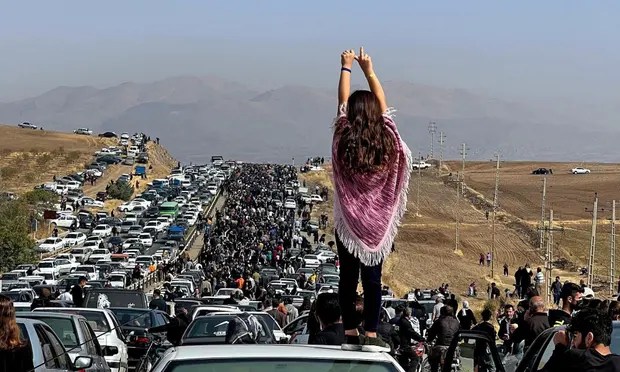
Protests continue across Iran in spite of the regime’s crackdown
Since the murder of 22 year old, Mahsa Amini, by the Iranian morality police in September, nearly 400 protesters are known to have been killed, including 57 children, while over 16,000 people are known to have been arrested. At last count, 990 separate protests had taken place across 146 cities and 140 university and college campuses around Iran.
Protests have continued in earnest in defiance of a warning by the head of the Islamic Revolution Guard Corps (IRGC) that they must stop. A vote by 227 of Iran’s 290 legislators in November, decreed that the death penalty be applied to those protesters brought before the courts on charges of serious crimes against the state.
The charges against the protesters have included vaguely defined national security charges such as enmity against God, corruption on earth, and armed rebellion. All of these vaguely worded crimes are capital offences. The trial proceedings are rushed and defendants are prevented from having a lawyer of their choice, falling well below accepted international standards.
The first two death sentences have already been carried out by the regime. In Mashhad the regime has publicly executed 23-year-old Majid Reza Rahnavard, found guilty of enmity against God, for the alleged killing of two security officers, and injuring four others.
The regime is also reported to have executed 23-year-old Mohsen Shekari, who was sentenced to death for enmity against God for allegedly “using a weapon to spread terror and violate the public’s freedoms and security” and for injuring a police officer.
Courts in and around the Iranian capital, Tehran, alone have jailed 400 people on charges related to recent protests, for terms of up to 10 years. Ali Alghasi-Mehr, the judiciary chief for Tehran province, said,
“One hundred and sixty people were sentenced to between five and 10 years in prison, 80 people to two to five years and 160 people to up to two years.”
These arrests and executions follow a consistent pattern of behaviour by the Iranian regime over the past forty years and follow on directly from the anti-working class character of successive regime’s in Iran going back to the days of the Shahs.
The early years of the Islamic Republic set the tone for the ongoing record of the Iranian regime in relation to human and democratic rights in general, and the rights of political and trade union activists in particular. In draconian purges against those who opposed the establishment of a theocratic state, they arrested, tortured and exiled key sections of the Left, effectively driving underground any opposition to the consolidation of the rule of the theocracy.
It remains an appalling record, with many activists still exiled and trade union activity either restricted by the state or forced to operate clandestinely.
In December 2020, a group of UN human rights experts wrote to the Iranian government warning that past and ongoing violations related to the prison massacres of 1988 may amount to crimes against humanity and that they would call for an international investigation if these violations persisted.
Between late July and early September 1988, thousands of imprisoned political dissidents across Iran were forcibly disappeared and then extrajudicially executed under a shroud of secrecy. For more than 30 years, the Iranian authorities have systematically concealed the circumstances surrounding their deaths and the whereabouts of their remains.
During this brutal atrocity, the core structures and leaderships of the main Left opposition parties, including the Tudeh Party of Iran, were effectively annihilated, and any remnants of those organisations were driven either underground or into exile.
Following the violent suppression of the Green Movement after the rigged presidential elections in June 2009, it became clear, even to those who remained under any doubt, that the Iranian regime was beyond reform. The two-term Rouhani presidency, elected on a supposedly reformist ticket, attempted to paper over the cracks.
However, the sham of Iranian democracy which sees all candidates in parliamentary and presidential elections vetted for approval by the Islamic Guardian Council, and power ultimately in the hands of Supreme Leader Ali Khamenei, prevailed over any leaning towards change in the country.
Even according to the regime’s own statistics, almost 40% of the population live below the poverty line in Iran. This is the result of three decades of neo-liberal economic policies imposed by the regime, encouraged by the IMF and World Bank. The class interests of the regime are inextricably aligned with the interests of the country’s corrupt and parasitic big bourgeoisie which controls the entire economic and political direction of Iran.
There remains confusion in some left-wing and progressive circles in characterising the regime in Iran as an anti-imperialist force, owing to its record of posturing against the United States. However, despite the Iranian regime’s anti-imperialist rhetoric, the Islamic Republic has remained a faithful aid to imperialist designs and interests throughout its existence.
This ranges from its support for the Contras in Nicaragua, and secret relationship with the US and Apartheid South Africa, during the 1980s; through to its active participation in the US’ destabilisation and overthrow of the People’s Democratic Republic of Afghanistan; the civil war in Tajikistan; the subsequent invasions and occupations of both Afghanistan and Iraq; and its continued support for some of the most reactionary forces in the region, including the Taliban.
These are not the actions of a regime with which the Left and progressive forces can do business or count on as an anti-imperialist ally. The only true interest of the theocracy ruling Iran is in its own survival, whatever the cost to its own people and whatever expedient international relationships it may forge to perpetuate its own hold on power.
Supporting the demands of the people of Iran for peace, democracy and social justice is the only legitimate position for the Left to adopt in relation to Iran today.
For more information visit www.codir.net
Government dedicated to strike breaking
11th December 2022

Postal workers – on strike due to intransigent management
There are 50,000 vacancies for nurses across Britain. The Royal College of Nursing (RCN) is about to embark on the first days of industrial action in its history, planned for the 15th and 20th December. The RCN are asking for inflation plus 5% in their pay claim, to address the cost of living crisis and to get to a decent wage level for nurses to stop the outflow from the profession. As it stands Health Secretary, Steve Barclay, is refusing to meet nurses leaders to discuss pay.
Quite apart from the long hours, variable shifts and often emotionally draining nature of nursing as a profession, the fact is that nurses in many parts of the country are having to resort to using food banks to make ends meet. Having been applauded on doorsteps, including 10, Downing Street, as heroes throughout the COVID 19 pandemic, nurses are now engaged in struggle alongside many others to make a decent living.
Intransigence on the part of management, in the face of the legitimate demands of rail workers, is resulting in further transport disruption over Xmas and the New Year. As usual the supine BBC ran the headline that rail workers union RMT had refused an 8% pay offer from management. Quite apart from the offer being well below inflation at 11%+ anyway, and being tied to unacceptable changes in working practices, the offer was over two years. Not quite the headline the media want the public to believe.
Postal workers face similar issues with management insisting that any deal on pay has to be tied to changes to work practices, with the unions justifiably pointing out that working practices have been changed and it is only failings on the part of management that are resulting in them being forced to take action.
Royal Mail management have taken to social and traditional media channels to accuse the Communications Workers Union (CWU) of bullying tactics on picket lines, in the hope of breaking union and public support for the postal workers action. The strike action arises from the management of Royal Mail unilaterally reneging on an agreement reached with trade unions last year to deliver what the CWU described as “an historic pension solution, a mutual interest driven relationship and a joint vision for a successful postal service with social aims.”
Over 70,000 university staff at 150 universities took strike action for three days in November over attacks on pay, working conditions and pensions. The National Union of Students (NUS) has backed the strikes, which will be the biggest ever to hit UK universities and could impact 2.5 million students. The University and College Union (UCU) has said that further disruption can be avoided if employers make improved offers. If not, strike action will escalate in the New Year alongside a marking and assessment boycott.
In relation to pay and working conditions, the union’s demands include a meaningful pay rise to deal with the cost of living crisis and action to end the use of insecure contracts. Employers imposed a pay rise worth just 3% this year following over a decade of below inflation pay awards. A third of academic staff are on some form of temporary contract.
In relation to pensions, UCU is demanding employers revoke recent cuts and restore benefits. The package of cuts made earlier this year will see the average member lose 35% from their guaranteed future retirement income. For those at the beginning of their careers the losses are in the hundreds of thousands of pounds. This is at a time when the university sector generated record income of over £40 billion last year.
Further action is likely in the New Year with junior doctors having been given the go ahead to ballot for strike action in January, after the government failed to meet the British Medical Associations (BMA) demand for pay restoration to 2008/9 levels. Junior doctors have experienced real-term pay cuts of more than a quarter of their salaries since 2008/9. The Government this year gave junior doctors a 2% pay uplift, excluding them from the higher 4.5% pay uplift for other NHS workers which the BMA says is ‘still derisory’ given the ongoing cost of living crisis and following the COVID pandemic.
Two-thirds of trainee doctors responding to a recent General Medical Council survey said they ‘always’ or ‘often’ felt worn out at the end of a working day. The BMA said it is ‘deeply concerned’ that continuing pay erosion will drive doctors out of the profession at a time of record backlogs and when the NHS ‘can least stand to lose them’. The union believes the lack of a fair pay deal will lead to ‘a vicious cycle of crippling staffing shortages and worse patient care’.
Rather than looking to address the legitimate demands of workers across a wide range of sectors, Downing Street has set up a dedicated unit to coordinate its response over the waves of action, fearing a repeat of the “winter of discontent” of 1978-79, as the crisis grows. The Cabinet Office minister Oliver Dowden has been delegated by Rishi Sunak to plan for how the government responds to growing industrial unrest.
Already the army have been put on alert to act as scabs in order to try and break disputes. The government has said that military personnel, civil servants and volunteers are being trained to scab in a range of services, including Border Force at airports and ports.
A statement from Number 10 claims that the decision on whether troops would be deployed has yet to be taken, but that personnel “are part of the range of options available should strike action in these areas go ahead as planned”.
The government have a dilemma in that the usual tropes about greedy strikers and manipulative union leaders will not wash with a public who are directly engaged in industrial action, suffering from the cost of living crisis and are themselves, in many cases, resorting to foodbanks for survival. As the strike movement gathers momentum there is scope for the TUC to add to the government’s isolation by greater co-ordination of strike action. Positive support from the Labour leadership would also do no harm.
Clearly, the government sees the unrest as an arena for confrontation rather than negotiation. It does not see the wave of demands for fair pay as evidence of its own failings or as an endemic flaw in capitalism as a system. The government’s “dedicated unit” will be dedicated, as ever, to defending the interests of the class it represents and in making sure that its power and privileges are protected.
Poverty gets worse as the rich list swells
3rd December 2022

Food banks – on the increase across Britain
As the Winter begins to bite, energy bills continue to soar and the cost of living crisis takes a grip on many working class families, the realities of Tory generated rampant inflation are being exposed. As part of a recent report consumer magazine, Which?, and researchers from the Consumer Research Data Centre at the University of Leeds, have created a Priority Places for Food Index.
The index shows where people need extra support to find healthy and affordable food. It found factors such as low income, a lack of online shopping deliveries and circumstances such as not having access to a car, can make it hard for people to put food on the table.
The index shows almost half (45%) of local areas in the North East of England are in ‘dire’ need of extra support due to poor access to online shopping deliveries, being further away from supermarkets and the need for support such as food banks and free school meals.
Yorkshire and the Humber, the West Midlands and the North West of England all have about a third of local areas in the region in need of extra help. Birmingham Hodge Hill is considered the worst, as 100% of its local areas are in need of extra support.
The research behind the index shows that many people are changing their behaviour by trading down, buying cheaper products or shopping around. Some are having to take more drastic action, such as missing meals, with the impact being especially high on those who are struggling financially, for whom it is becoming much more difficult to eat healthily.
The report outlines a ten-point plan aimed at supermarkets, encouraging them to do more to help those struggling on low incomes to make healthier choices. The plan includes asking supermarkets to make pricing more transparent so that shoppers can more easily compare best value; offer straightforward price reductions rather than multi-buy offers, which require higher initial outlay; and making more promotions available on healthier foods.
Such suggestions help to raise the issue but whether they can impact upon supermarket strategies is another matter. While retailers have an interest in retaining their customer base they are also driven by the need to generate a profit. The latter is certainly the bottom line as far as shareholders are concerned and just how magnanimous local managers can be, faced with the pressure to turn a profit, is likely to be limited.
There is no doubt however that food poverty is on the increase. In May 2022, the Independent Food Aid Network (IFAN) surveyed 101 of its organisations representing 194 independent food banks across 94 local authorities in England, Scotland and Wales. At that stage 93% of organisations reported an increase or significant increase in the need for their services since the start of 2022. It is likely that demand will only increase as the start of 2023 looms.
It is estimated that there are over 2,500 food banks across Britain. In 2019-20, pre-pandemic, it is estimated that 700,000 or 2.5% of British households used a food bank. In February 2022, the Food Standards Agency published data on food bank usage in England, Wales and Northern Ireland gathered by IPSOS Mori between April 2020 and October 2021 showing that 8% of respondents had used a food bank or a food charity in April. This rose to 11% by October 2021. Once again, this data is only likely to be heading in one direction.
At the other end of the spectrum Britain’s super rich have grown their combined fortunes by 8 per cent to a record £710 billion in just 12 months, according to this year’s Sunday Times Rich List. A record 177 UK billionaires are identified in the 34th edition of the annual rankings, six more than in 2021. This year’s top 250 now have more wealth than the entire 1,000 entries of the 2017 Rich List.
Millions of households may be facing the sharpest rise in the cost of living for 40 years, but it is clear that a golden era for the super rich is continuing unchecked. Is it any wonder that rail workers, postal workers, teachers, nurses and many others on low wages are taking, or threatening to take, strike action just to make ends meet, just to pay for the rising cost of energy, just to put food on the table?
This is the reality of capitalism in the twenty first century, in many ways no different to the twentieth century, but even worse. More poverty, more struggle for the working class but more billionaires and a boom time for the super rich. A system which cannot address the basic needs of its people has clearly outworn its usefulness, overstayed its welcome and needs to exit the historical stage.
Planning for people, not for profit, in the context of a socialist economy is the only way forward. The present strike wave must be encouraged and supported but must be linked to the wider struggle for a change in the system, otherwise the rich will only continue to get richer, while the rest continue to suffer.
Fit and proper protest
27th November 2022

Iranian players – forced to sing the national anthem
As the most controversial World Cup ever draws to the end of its first week any doubt that politics and sport do not mix has been firmly put to bed. Arguably that bridge was crossed when the non footballing Qatari dictatorship was awarded the World Cup in 2010. Not that Qatar 2022 is the first controversial staging of an international sporting event. The 1936 Olympics in Nazi Germany is the most obvious reference point, setting the template for using international events as propaganda in Leni Riefenstahl’s film Triumph of the Will.
The Qataris have been building up to 2022 for 12 years, quite literally in the case of the range of stadiums built, controversially with cheap migrant labour, resulting in an estimated 6,500 deaths during the period. During that time they have also bought into the European Champions League, through the purchase of Paris St. Germain with a minority stake in Portuguese club Braga on the horizon.
The illusion that FIFA makes the rules in the international football arena has also been dissolved in Qatar. Solidarity with the LGBTQ community, through the wearing of rainbow armbands, hats or wristbands, either on or off the pitch, have been quashed by the Qataris either directly or through FIFA. In spite of the 12 years of planning the Qataris imposed an alcohol ban inside stadiums just two days before the first match. FIFA were powerless to resist, in spite of the multi-million dollar sponsorship deal with Budweiser, which may yet lead to court action.
The focus on the abuse of human rights in relation to the LGCTQ community and migrant workers has overshadowed the draconian approach that the Qataris have to half of its citizens, women. Medieval rules restrict women’s movement, right to work, right to education and, as for the right to vote, in common with the rest of the Qatari population, they cannot even go there.
There is an argument that it is a step forward to hold a World Cup in a Middle East and Muslim nation. If nothing else it has shone a light on human rights abuses and given otherwise marginalised communities more prominence. This may be an unintended outcome of the current situation but was certainly not planned.
With regard to Muslim nations hosting a World Cup both Egypt and Turkey are Muslim countries, though controversial too for a range of reasons, which have a far richer football pedigree than Qatar. However, neither possess the financial muscle of the Qataris and this World Cup is nothing if not a bought and paid for attempt at sportswashing by the unelected dynasty in Qatar.
Not to be outdone, the Qataris neighbours in Saudi Arabia are keen to make the most of their presence at Qatar 2022. Quite apart from any on pitch exploits the Saudis have carefully placed adverts advising viewers to experience the adventure that is Saudi Arabia, during commercial breaks in World Cup coverage on ITV. This follows on from the use of the ‘Fly Saud’ advertising around pitch side barriers at recent acquisition Newcastle United’s ground, St James’ Park.
In spite of the Qatari and FIFA efforts at manipulation on the pitch protests have been seen. Significantly, the Iran team refused to sing the national anthem before their game with England, in solidarity with 22 year old Mahsa Amini, murdered by the morality police in Tehran. They were subsequently forced to do so ahead of their game against Wales, following threats from the Iranian regime. The German team have covered their mouths in protest at being silenced by FIFA and the England team continue to take the knee, in protest at all forms of racism and discrimination.
As the tournament progresses it is inevitable that the football debates and issues will temporarily supersede the political issues. However, it is clear that whoever wins at Qatar 2022, no-one will really be covered in glory. From FIFA’s original award, to the Qataris attempts to clean up their international reputation the damage to football, as a potential unifying force, may have suffered a terminal blow.
With the Glazer family recently signalling that they will listen to offers for Manchester United, perhaps the world’s most recognisable football brand, it will be interesting to see how quickly the oil rich dictatorships move to add yet another title to their sports washed portfolio. It is likely that the FA’s fit and proper owner test will no doubt be swept aside as easily as FIFAs take on a fit and proper location to stage a football World Cup.
Budget confidence tricks
17th November 2022
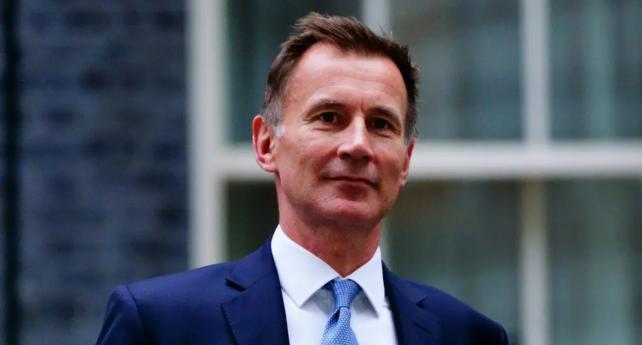
Chancellor Jeremy Hunt – no more than a confidence trickster
The lowest living standards for over half a century; the lowest growth rate of the major capitalist economies; wage restraint and draconian trade union legislation to shackle demands for higher pay; military spending amongst the highest of NATO members, with the exception of the United States, and set to increase by 50%; an eye watering multi billion pound bill in prospect for the renewal of Trident nuclear submarines; millions poured into arming the nationalist right wing government of Ukraine; twelve years of austerity and public spending squeezed under Tory governments.
This was the backdrop, though not mentioned, in the Autumn Budget Statement of British Chancellor, Jeremy Hunt, this week. However, all play their part in informing the carefully constructed political choices which Hunt tried to portray as inevitable when he delivered his statement to the House of Commons.
The Tory narrative preceding the budget has been built around fixing the outcomes resulting from the disastrous budget of former Chancellor, Kwasi Kwarteng; the need to restore market confidence; and the necessity of filling an alleged £50 billion economic black hole, through a combination of public spending restraint and tax rises. The BBC and the media in general have bought into this version of events and helped prepare the public for a ‘tough but necessary’ approach to the Autumn Statement.
The announcements made by Hunt, retaining the triple lock on pensions; raising benefits in line with inflation; and retaining some support for energy bills, even though the ‘average’ bill will rise to £3,000 per year; were all designed to create the illusion of a fair and balanced budget. This was offset by the highest tax rate band being dropped to include those earning £125,000 per year and the windfall tax on energy companies being increased from 25% to 35%, even though much of that can be claimed back if they invest in new gas or oil exploration.
Hunt did not close tax loopholes for those with non-dom status; levy a wealth tax on the wealthiest 1%; or reinstate the cap on banker’s bonuses, lifted by his predecessor. More tax will not be paid by the very wealthiest, while a freeze on tax thresholds till 2028 will draw more of those on low pay into the tax net.
The fiscal ‘black hole’ is nothing more than the usual Tory confidence trick dressed up as economic necessity. The so called black hole is effectively the gap between what the Office for Budget Responsibility (OBR) predict the national debt will be, compared to where Hunt would like it to be. This is not an economic necessity, it is a political choice. Borrowing to fund tax cuts for the rich, as proposed by Kwarteng, is one thing but borrowing to invest in renewing schools, hospitals, transport infrastructure, renewable energy and the digital future is not action that would spook markets, even in capitalist terms.
In theory these are political choices Hunt could have made. The reality however is that Hunt is no more a friend of the working class than Kwasi Kwarteng. Hunt has played a key role in Tory governments over the past 12 years and has sat in Cabinets which have presided over the demise of the British economy throughout that period.
Like the Cameron / Osborne years of austerity the Sunak / Hunt model is no different. It is being packaged as an antidote to the recklessness of the Truss / Kwarteng overnight stay but it is the same old Tory wine in not very new bottles.
The winter will be a tough one for working class families. Average energy bills at £2,500 were always going to be a challenge, as many of the poorest spend more than the average on energy. That average escalating to £3,000 will not help. Inflation now running at over 11% will continue to bite. Mortgage rates continue to climb for those buying their homes and rents look set to rise for those unable to save for a mortgage deposit.
Local councils will be allowed to raise Council Tax by up to 5%, which they may have to do to maintain essential local services but, once again, it is the communities who need those services the most who are going to have to pay more for them.
Yet again a Tory budget is a budget of the rich, by the rich, for the rich. However Hunt tries to dress it up, blame the Russians or blame the pandemic, that is the reality. Mass opposition, support for those on strike for higher pay, support for local communities struggling against service cuts, will all be key to building resistance as the General Election looms. That resistance is growing and must get stronger in order to expose yet another Tory confidence trick.
COP out 27
12th November 2022
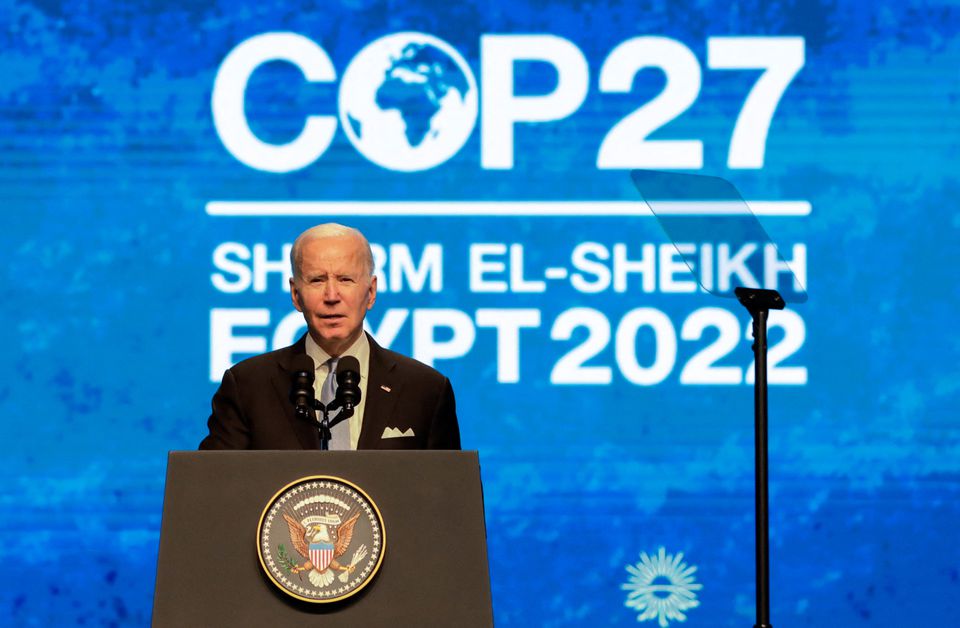
Hollow words – are US climate change promises to be believed?
“Pushing through the market square, so many mothers sighing.
News had just come over, we had five years left to cry in.
News guy wept and told us, Earth was really dying.
Cried so much his face was wet, then I knew he was not lying.”
The opening lines of Five Years by David Bowie from The Rise and Fall of Ziggy Stardust and the Spiders from Mars (1972). Nothing coming out of the COP27 conference in Egypt this week suggests that Bowie’s dystopian vision has been consigned to the realms of twentieth century musical theatre, as opposed to being a prescient narrative for our twenty first century future.
The recently published, Global Carbon Budget, an annual assessment of how much the world can afford to emit to stay within its warming targets, found that greenhouse gas pollution will hit a record high this year. Much of the growth comes from a 1% increase in carbon dioxide from burning fossil fuels. Emissions in both the United States and India have increased compared to last year, while China and the European Union will probably report small declines.
The report indicates that nations are likely to burn through their remaining carbon budget in less than a decade, if they do not significantly reduce greenhouse gas pollution. This will result in the world passing the critical warming threshold of 1.5C above pre-industrial levels in a mere nine years, resulting in catastrophic climate impacts.
Far from backing the call for greater investment in renewable and alternative energy sources, leaders at COP27 have been advocating natural gas as a transition fuel, from fossil based energy to renewables. At least four new gas projects have been announced recently, with African nations looking to export to Europe to plug the gap in supply, as a result of the reduction in supply from Russia.
A study by the research group Climate Action Tracker shows that currently planned projects would more than double the world’s current liquefied natural gas capacity, generating roughly 47 billion tons of carbon dioxide equivalent between now and 2050. While burning gas for energy emits about half as much carbon dioxide equivalent as burning coal, that is still a significant amount of carbon dioxide generation.
Climate scientists have stressed that planned expansion goes beyond what is needed to replace interrupted Russian fuel supplies. The proposals also fly in the face of findings by the Intergovernmental Panel on Climate Change and the International Energy Agency that there can be no new gas, oil and coal development if humanity wants to prevent dangerous warming beyond 1.5 degrees Celsius.
While an initial group of more than 20 countries had pledged to stop public investments in overseas fossil fuel projects by the end of this year, some are backsliding as the hunt for alternatives to Russian gas continues. The credibility of the COP27 process is further undermined by the significant presence of representatives from fossil fuel companies. An estimated 200 people connected to oil, gas and coal are included in country delegations, with another 236 with trade groups and other nongovernmental organisations.
Lorraine Chiponda, an environmental justice activist from Zimbabwe who co-facilitates a coalition of advocacy groups, called Don’t Gas Africa, summed up the fears of many climate change activists stating,
“This is supposed to be a space to discuss climate solutions, but instead it’s being used to drive fossil fuels.”
COP27 has also seen increasing pressure from developing nations for a loss and damage fund, through which large emitters would pay for irreversible climate harms like Pakistan’s recent floods. The demand however is struggling to make headway, meeting resistance from the United States and other industrialised countries. In addition, wealthy nations have not fulfilled their promise to provide $100 billion to help vulnerable areas reduce emissions and adapt to warming that is already underway.
It inspires little confidence that COP28 will be hosted by the United Arab Emirates, whose President has pledged to continue providing oil and gas “for as long as the world is in need.” Or at least for as long as the fossil fuel rich sheikhs can continue to make a profit!
US President Joe Biden addressed the conference on Friday. With the nuclear codes in one pocket and a first use of nuclear weapons policy in the other, Biden still had the audacity to suggest that the US was showing leadership on the question of climate change, stating,
“Countries that are in a position to help should be supporting developing countries so they can make decisive climate decisions, facilitating their energy transitions, building a path to prosperity compatible with our climate imperative.”
All of which is very well but ironic coming from the world’s most highly armed nuclear state and the world’s biggest exporter of weapons to anti-democratic forces and regimes worldwide. As far as saving the planet goes Biden’s words ring hollow.
The climate change process will only succeed with international co-operation but while resources are in the hands of profit hungry energy corporations the desire to make more money and avoid regulation will win out. Under capitalism the existential threat to profit still overrides the existential threat to the planet.
Only a revolutionary shift in thinking and economic systems can bring about the necessary changes. Until the world’s energy resources can be planned and investment in renewables agreed on a co-operative, socialist basis the dangers continually raised at COP gatherings will persist and the time for effective climate action will continue to get shorter.
Unity, solidarity, internationalism
5th November 2022

A victory for Lula in Brazil – resistance is possible
Capitalism has always sold itself to the public as being a system based upon democracy. In spite of the vast differences in wealth between the rich and the poor; the huge gulf in life opportunities; the systemic prejudices which working class people, ethnic minorities, women and others have to deal with; in spite of these things, capitalism is heralded by its apologists as the apogee of democracy.
The basis of this claim is that there are regular elections. Voters have the chance to change the party or President in office and return an alternative. The models across capitalist states vary. The British state has an unelected Head, in the form of King Charles III, who occupies that position across 14 Commonwealth countries.
The United States and France have Presidential systems with degrees of power federated to States or Departments. Germany has a President as Head of State but the real power lies with the Chancellor, usually the leader of the biggest party in the Parliament following an election and, in most cases, coalition negotiations. The system in Italy is similar.
Whichever version of ‘democracy’ capitalist states adopt, the underlying principle is that the system itself must not change or be challenged. The fact that there are elections gives the illusion of choice and possible change, so long as the edifice of capital itself is not challenged.
Any challenge from the Left is routinely dealt with by a mobilisation of state media to vilify or even criminalise leaders. The experience of Lula da Silva in Brazil, jailed for trumped up corruption charges, is one example. The anti-Semitism smear campaign launched against former Labour leader, Jeremy Corbyn, is another.
The prospect of the threat of disinvestment, a run on the banks and general economic chaos, is usually part of the armoury of the political establishment, seeking to head off any threat to their wealth and privilege.
The return to the Presidency of Lula da Silva in Brazil is a major step forward for the Left, consistent with much of Latin America, but outgoing President Jair Bolsonaro was slow to concede defeat and his supporters have continued to protest against the result. The forces behind Bolsonaro will no doubt be threatened by Lula’s pledge to end deforestation in the Amazon as well as shifting the emphasis of state policy towards helping the poor.
The forces of the Left, the poor and the dispossessed in Brazil will need to be highly organised to resist the inevitable challenges there will be to Lula’s return to the Presidency. The fact that Lula clearly won the election for the Presidency will not prevent the right wing from questioning his authority or seeking to overturn the result.
Other recent and up and coming elections challenge the claim of capitalism to be democratic in different ways. The neo-fascist Brothers of Italy polled the highest number of votes in recent Italian elections and, in coalition with the Forza Italia party of discredited playboy, Silvio Berlusconi, and the right wing League, now boast Italy’s Prime Minister in the form of Giorgia Meloni.
Meloni is an open admirer of former fascist dictator, Benito Mussolini, and her presence will strengthen a growing right wing bloc within the European Union. Meloni’s right wing agenda will do nothing to help Italy’s working class as well as actively pursuing an agenda which puts in question LGBT rights, abortion rights and immigration policies. Meloni was a protégé of Republican strategist and Donald Trump ally, Steve Bannon, who headlined her party conferences in Italy before the Covid-19 pandemic. Meloni may have won an election but can her rise to the top in Italian politics really be seen as a victory for democracy?
Similar questions arise from the return to the Premiership of Benjamin Netanyahu in Israel where recent elections have put a right wing bloc in power. The grouping includes Religious Zionism, the third biggest party in the Knesset. Its leaders, Itamar Ben-Gvir and Bezalel Smotrich, are known for their anti-Arab rhetoric. The former has called for the deportation of citizens deemed “disloyal”, while the latter has called for Arab political parties to be outlawed.
Netanyahu himself has never taken a progressive line on the question of Palestine but the inclusion of Religious Zionism in the new government will not only alarm many left-wing and centrist Israelis, but also Israeli Arabs, who make up a fifth of the population. That it will add to already tense relationships with the Palestinian Authority, due to Israel’s illegal occupation and settlement programme, is an understatement. Once again, an election victory, but a step forward for democracy?
The up and coming mid-term elections in in the United States will take place in the shadow of the attempted coup by Donald Trump supporters in January 2020. The Make America Great Again movement is still alive and is given ‘intellectual’ cover through the right wing America First Policy Institute (AFPI) think tank. In their own words AFPI priorities include “finish the wall, deliver peace through strength, make America energy independent, make it easy to vote and hard to cheat, fighting government corruption by draining the swamp.” The AFPI claim to have put ‘boots on the ground’ in 32 US states in advance of the mid-term elections in order to pursue its right wing agenda.
The right wing surge in the US is also characterised by the movement to ‘take America back for God’, a coalition of Christian nationalists, explicitly endorsed by Trump and, unsurprisingly, pursuing a similar right wing agenda. Victory for the Republicans in the mid-term, or worse still 2024 presidential elections, will see the US move even further to the right. The threat to workers and minorities rights will be significant, the threat to world peace will increase dramatically. Elections will ostensibly be the route to power but will this improve democracy?
These are not places which capitalism has not already visited, with tragic consequences. The rise of the Axis powers of Germany, Italy and Japan culminated in World War 2 when these creatures of the most reactionary elements of international capital slipped the leash. Capitalism is not adverse to toying with, or openly endorsing fascism, if it will serve its short term purpose.
That may involve using the path of elections to give a veneer of democracy. It may result in the more open use of force to assert its power against the challenge of the people. The Palestinians know this. Black and ethnic minority communities and migrants to the US know this. The migrants fleeing NATO sponsored wars to what they assume will be a safe haven in Europe know this.
Working class unity, solidarity and true internationalism of the people, not the phoney internationalism of the EU leaders and others, is the route to overcoming such outcomes. Building that unity, solidarity and internationalism is one of the most pressing tasks of the Left if a shift to the Right is to be resisted and ultimately defeated.
Stormy waters
29th October 2022

Sunak – the Tories’ latest hope to save the sinking ship
A week may well be a long time in politics but two weeks is not long enough in which to fix a broken economic system. The decision of Chancellor, Jeremy Hunt, with the backing of Prime Minister, Rishi Sunak, to delay the Autumn Budget statement from 31st October until 17th November smacks of desperation.
They claim that the economic indicators will look more favourable then. That markets will have settled following the ‘good news’ of Sunak’s ascension to the Premiership. That the Office for Budget Responsibility (OBR) will be able to make a more informed assessment of the economic future.
All of which is simply so must smoke and mirrors, characteristic of capitalist economics. The British economy has been unravelling due to a lack of strategic investment since the late 1970’s, a trend which has accelerated since the financial crash of 2008, since when the levels of productivity in the British economy have declined year on year.
While the gambling dens of the City of London have sucked the British economy into a false sense of reliance upon financial services and trading, the manufacturing base has either been closed down or sold off to overseas buyers, keen to take advantage of the capital friendly regime successive British governments have encouraged.
The current crisis is blamed, by the Tories, upon the war in Ukraine and the mistakes made by overnight Premier, Liz Truss, in her mini-budget of 23rd September. Labour routinely add Brexit to this list, not to criticise the Tories mishandling of the exit from the EU, but to suggest that leaving the monetarist straitjacket of the EU was, in itself a mistake.
All of which feeds the illusion that with some adjustments or a different set of policies, or even by re-joining the EU, that the system can in some way shape or form be ’fixed’. The ruling class, as part of their response to the crisis, need to feed this illusion or the reality that the crisis is in fact a systemic one may gain sufficient prominence to pose a threat. This was a strain of public realisation which Labour touched upon under the leadership of Jeremy Corbyn, hence the need for it to be ruthlessly crushed.
It is a strain which is resurfacing in the wave of strikes and strike ballots amongst workers demanding, not only wage rises to keep pace with inflation, but the maintenance of safe working conditions for themselves and the public.
These demands contrast sharply with the announcement of profits by energy giants such as Shell, reporting a record $30 billion profit in the year so far, and Exxon Mobil posting a quarterly profit of nearly $20bn. Shell has paid no windfall tax on the profit by exploiting a loophole which exempts companies that invest their surplus in increasing oil and gas extraction.
Clearly such investment will be with a view to increasing profits further. It will not contribute to the net carbon zero commitments of the government, a target of 100% clean energy by 2035, or do anything to support the necessary investment in renewable energy sources. The fact that multi billion dollar profiteering companies can get away with dodging tax, while contributing to the destruction of the planet, at a time when those responsible for rail, NHS, mail and other services struggle to get a decent pay rise, is not lost on the general public.
This level of hypocrisy is characteristic of the Tories in particular but is symptomatic of a system which has the defence of the banks, corporations and aristocracy as its raison d’etre. There is no doubt that the Tories have sailed the economy into stormy waters but however Hunt and Sunak choose to reshuffle the deck chairs in two weeks time, there is no avoiding the fact that, with them at the helm, the ship is sinking.
Resistance must continue to build to expose Tory lies, Tory hypocrisy and Tory economic mismanagement. Arresting the economic decline which has been the hallmark of the Tories over the past 12 years by investing for the public good, both in people and infrastructure, will only be the first step. A revolutionary reshaping of political, economic and environmental priorities is required to begin to turn around the damage done by capitalism.
It is not only desirable, it is possible, with collective action, a socialist programme, with mass popular backing, and the will to succeed. That message must be the one that is repeated to force Labour off the fence. It is vital that we continue to apply pressure for a manifesto which is not primarily aimed at assuaging the markets but is aimed at challenging the immediate inequalities in the system, which a view to overhauling it entirely. A manifesto for the many, not the few.
Anything to please the markets?
22nd October 2022

Kier Starmer – pleasing the markets not enough
The chaos in British ruling circles took another turn towards pantomime this week, with Liz Truss emerging from under her desk to resign as Prime Minister and the will he, won’t he speculation about the possible return of Boris Johnson. The fact that Johnson’s last stint ended ignominiously and that he is still under investigation for misleading Parliament, barely seems to be touching the radar. Add to that his mishandling of the pandemic, presiding over the highest death rate from COVID 19 in Europe, and any rational person would not rate his chances highly.
However, Tory MPs and the membership at large, if 160,000 members can be described as large, do not do rational. Otherwise, why elect Johnson in the first place? Why go on to elect Liz Truss as his replacement? Why even contemplate Johnson’s return?
The main driving force for Tory MPs is to retain their seats in Parliament. They will not vote according to anything resembling conscience or principle, anathema to Tory MPs anyway, but purely out of self interest. With a General Election little more than two years away the Parliamentary Conservative Party will be looking to the candidate who can best please the markets, the real power behind the British economy, and who can best translate the current mess into a recovery narrative which can be sold to the British public, in the face of the ongoing economic crisis.
Johnson has won elections before, many will think he can win them again.
Other hats are likely to be in the ring, with Penny Mordaunt and Rishi Sunak being the main potential contenders, alongside a possible return for Johnson. Whatever the uncertainties currently swirling around the party of the ruling class there are some certainties which the majority of the country can be sure will take centre stage.
The crisis in social care continues to deepen, with a shortage of 300,000 staff nationally and hospital beds taken up with many who are medically fit but cannot leave, due to the lack of availability of care packages. The squeeze on public spending is set to continue which will mean little respite for the NHS in real terms and none for local government, traditionally at the sharp end of Tory spending cuts.
Between 2010 and 2020 councils did most of the heavy lifting in terms of public sector cuts with a £15 billion real terms reduction in their budgets. The Local Government Association (LGA) estimate that,
“Spiralling inflation, increases to the National Living Wage and higher energy costs have added at least £2.4 billion in extra costs onto the budgets councils set in March this year. Since then, inflation has risen further.”
The LGA go on to point out that, if nothing changes, “councils are facing a funding gap of £3.4 billion in 2023/24 and £4.5 billion in 2024/25.”
Massive figures for sure but how do they translate in terms of real services to communities? The day to day work of emptying bins; filling pot holes in roads; providing arts, library and sports facilities; addressing social care for adults and children; and tackling homelessness, all become threatened once more.
Chancellor Jeremy Hunt, the last roll of the dice by Liz Truss, has already indicated that public spending cuts are coming. Whether or not Hunt survives in the Treasury makes no difference. The Tories are not going to tax the rich, nationalise the energy sector, railways or mail services to make them more efficient, or impose any constraints on the gambling activities of the City of London. They are not even going to cut the basic rate of income tax by 1p!
While inflation ramps up to 10.1% and energy bills soar for the winter, there can be little doubt that for many people who leads the Tory Party and, for that matter, who is Prime Minister is nothing more than a sideshow. The party of the rich, for the rich, run by the rich, will continue to do what it must to keep the rich in their positions of privilege, while the majority struggle to make ends meet.
Calls for a General Election are growing but it is hard to see why the Tories would concede this, unless they are set on political suicide, based upon current poll ratings. That can only mean that mass extra parliamentary action is more important than ever, to support the growing wave of strike action against meagre pay offers, to resist the looming cuts in public services, and to pressurise the Labour Party into taking a more radical stand in defence of the working class.
As things stand the manifesto of Labour going into a General Election could be summed up in one line, ‘Anything to please the markets’. When it comes to the crunch that will not be good enough. What is needed for the benefit of the working class is not pleasing the markets but radical action to transform the economy towards investment in health, homes, schools and jobs.
It will mean ditching the wasteful spending on Trident submarines and redirecting that money into socially useful investment, creating more jobs than nuclear submarines or warheads ever could. Doctors, dentists and decent homes over weapons of mass destruction; a better starting point than ‘anything to please the markets.’
The capitalist crisis deepens
8th October 2022

Calming the faithful? Liz Truss at Tory Party Conference.
The crisis of British capitalism, which became manifest with the banking crisis of 2008, continues to play out its latest act with the debacle of the Liz Truss premiership. The British ruling class has been divided in its response to the crisis for the past fourteen years and continues to struggle to find the best fit to maintain its power and privilege.
The David Cameron/George Osborne years of enforced austerity continued the drive to reduce spending on public services, in order to enrich further the already wealthy, but foundered on the question of Brexit. The more mainstream sections of the capitalist class recognised the benefits of continuing with the European Union’s public spending straitjacket and the free movement of cheap labour. A more jingoistic section of the ruling class saw exit from the EU as the chance to play up old tropes about immigration, empire and national identity to pursue their own chauvinistic agenda.
Neither saw coming the ground shaking impact of the change in Labour Party direction under the leadership of Jeremy Corbyn, which tapped into popular disaffection with the outcomes of both Tory austerity programmes and EU ineffectiveness to provide anything for the British working class.
With the pro-Brexit Tories in the ascendant, seeing off the Corbyn challenge was essential if a progressive Labour government, unchained from the monetarist constraints of the EU was not to be let loose. A combination of disinformation, character assassination of Corbyn and promotion of the blokey populism of Boris Johnson, contrasting with the robotic Theresa May, were the weapons of choice.
Success for Johnson in 2019 appeared to buy time but the incompetence of Johnson personally, and his administration in general, led to a crisis of confidence in Johnson’s ability to keep the Tory ship afloat. The leadership election marathon of 2022 ensued with Liz Truss emerging as the candidate of the political wing of the ruling class, though elected by a marginal demographic on a small percentage of the vote.
The first weeks of the Truss premiership suggest that her backing falls well short of unanimity in Parliament, with the Tory rank and file and certainly with the British public. The mini-budget debacle has been rapidly followed by the u-turn on the 45p top rate of tax proposal, which Truss openly blamed on Chancellor Kwasi Kwarteng in a BBC interview, failing even to show solidarity with her closest ally!
The go for growth agenda which Truss and Kwarteng, at least for the moment, appear to agree upon, has been met with a sinking pound, emergency action to shore up pensions by the Bank of England and an unprecedented wave of strike action in response to rampant inflation and rising interest rates. Truss has even sunk to the level of inventing the ‘anti-growth coalition’ which for her includes anyone who disagrees with the economic strategy she and Kwarteng are following.
The ‘cost of living crisis’ may be the phrase making the news and media headlines but the reality is that the crisis is one of capitalism and part of its ongoing decline as a political, economic and social system. Failing to tax the rich, the Truss government’s only recourse to fund the so-called growth programme will be to double down on public expenditure and continue to punish the poor by cutting back on public services.
The growth plan announced by Kwasi Kwarteng makes no mention of the farrago of ‘levelling up’ but instead dangles the carrot of Investment Zones. These are basically a Tory trick to privatise areas previously under local government control, much in the way that the Development Corporations of the 1980’s, the response of the Tories at that time to ‘inner city crisis’, distorted local economies.
Meanwhile recent research suggests that local councils are likely to be facing a financial black hole of £7.3bn by 2025/26. This week it was revealed Kent County Council faces a budget gap of more than £50m by June, enough to wipe out 50% of its total reserves if not reduced. An estimated 1 in 6 councils in England could run out of money as early as next year without further budget cuts or additional income.
Phillip Woolley, head of public services consulting at Grant Thornton UK LLP, said,
“Our research shows, the additional Covid-19 funding – while critical to support immediate challenges – has not addressed underlying systemic issues or the precariousness of councils’ financial sustainability in the face of economic instability. Local authorities are also now facing the risk of interest rate rises increasing debt financing costs and the real risk of reduced funding from central government, in response to the current economic turmoil facing the country.”
Wakefield Council has taken steps to close its County Hall building to save on energy costs and is considering its options for further building closures to keep costs down. It is unlikely to be the only council contemplating such measures in an attempt to preserve essential services for the most vulnerable.
However the ruling class twist, turn or shuffle the personalities in 10, Downing St installed to do their bidding, there is no getting away from the reality that, for the majority, capitalism is a moribund system that not only fails to meet their needs but makes them pay the price for the crises arising from its contradictions. If ever there was a time to build the call for a fundamental change in favour of a socialist alternative, that time is now.
Iran Erupts
30th September 2022
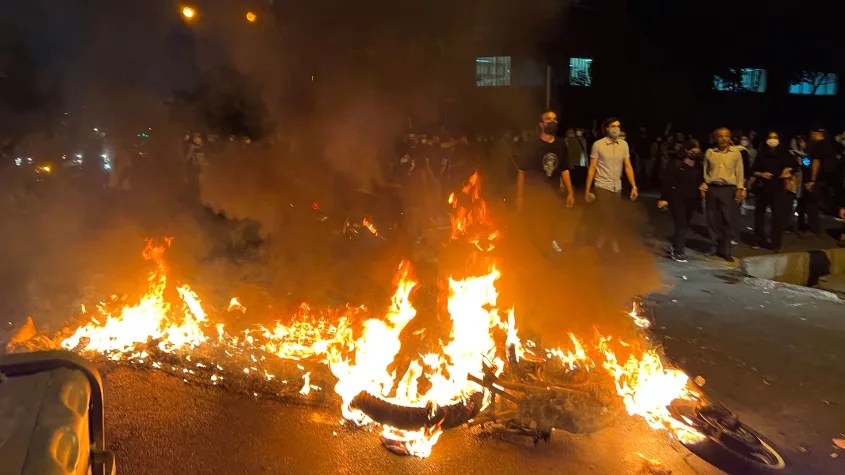
Iran in flames following the death in detention of Mahsa Amini
As protests grow across Iran following the murder in detention of 22 year old, Mahsa Amini, solidarity with the Iranian people is now more important than ever.
The grip of the theocratic dictatorship which has been in place in Iran since the early 1980’s has been tested several times but none more so than in recent weeks, following the death in custody of Mahsa Amini, for allegedly not following oppressive hijab rules.
Protests are taking place across all regions in Iran. Demonstrations of opposition to the regime have extended beyond the major cities and into the traditionally more conservative small towns and countryside areas. The degree of fury outstrips that expressed following the rigged election of 2009 which handed the hardline Mahmoud Ahmadinejad the presidency and spawned the Green Movement.
Recent protests have also surpassed those seen in November 2019, when a unilateral hike in fuel prices triggered angry scenes, leading to over 600 deaths and more than 7,000 arrests as the brutal security forces of the Islamic regime responded with force. The response to the death of Amini by the women of Iran harks back to the protests in 2017 when videos of women burning the hijab as a symbol of oppression were posted across social media, leading to further recriminations from the regime.
These incidents form a pattern of discontent and disillusionment with the leadership of the Islamic Republic, which has been simmering for some time, but can struggle to find expression through any normal democratic or media channels. Candidates for election to the Iranian Parliament are strictly vetted by the regime, as are presidential candidates. Trade union activity remains underground and illegal in Iran. The visual and print media are largely state controlled. Even social media and internet access can be restricted through government intervention, as has been seen in recent weeks.
However, recent events have seen the omnipresence of the regime challenged as protesters find new ways around media restrictions and the means to co-ordinate protest actions.
The accumulation of pressure upon the regime is also a result of forty years of human rights abuses, which has seen the arrest and execution of opposition political leaders; the imprisonment of trade union activists; the arrest and harassment of women protesters and student activists; and the use of lethal force against those taking to the streets in opposition to the regime.
Much of the recent outcry against the government in Iran has focussed upon corruption, as the regime’s leaders and members of the Islamic Revolutionary Guards Corps (IRGC) continue to fatten their bank accounts while increasing numbers of Iranians face unemployment and poverty. Ongoing sanctions imposed by the Western powers to restrict Iran’s ability to manufacture weapons grade uranium also exacerbate the economic crisis. Iran’s leaders continue to claim that its nuclear programme is for purely civilian purposes.
The death of Mahsa Amini has tapped into a deep well of resentment felt by the women of Iran who are increasingly frustrated by the restrictions imposed upon their economic and social activity by the regime and the lack of protection from domestic abuse.
Iran’s mandatory hijab law, which has been in place since 1981 has been enforced through the so called ‘morality police’, a practice which has been challenged by many Iranian women. In recent years protests have escalated with some women appearing in public without the required head scarf and loose robe. Ms. Amini’s family, it must be said, dispute that their daughter was even breaking these rules.
Since 2017, when dozens of women publicly took off their headscarves in a wave of protests, the authorities adopted tougher measures. With the election of hardline President Ebrahim Raisi in 2021 enforcement has increased even further and the attitude of the regime towards women in public has become more repressive.
Protests across Iran in the past weeks have seen 70 reported deaths and widespread arrests. The death of Mahsa Amini, and the repressive attitude of the regime towards women, has been the trigger but the slogans being shouted on the streets of Iran are calling for regime change and an end to the theocratic dictatorship of the Islamic clergy.
Such sentiments are ones which have driven the campaigning of the Committee for the Defence of the Iranian People’s Rights (CODIR) for nearly 40 years and it is now more vital than ever that the Labour and trade union movement in Britain shows solidarity with the people of Iran in their struggle against dictatorship.
It is also vital that the call for regime change in Iran is a call for the people of Iran to lead and determine that change. The United States, Israel and Saudi Arabia have all, individually and collectively, expressed their desire to see the end of the Islamic Republic and the threat of external intervention has been a very real one for many years.
However, such an approach has resulted in catastrophe in Iraq, Libya, Syria and Afghanistan and will be of no benefit to the people of Iran or the wider Middle East. Solidarity with the Iranian people should be just that, with the people of Iran having the opportunity to determine a future based upon peace, democracy and human rights.
For more information go to www.codir.net
Deluge of opposition to trickle down economics
24th September 2022

Chancellor Kwasi Kwarteng – budgeting for the rich
Casino economics has been a key feature of capitalism since the late twentieth century. The idea that rewarding the rich would result in the ‘trickle down’ of wealth to the poor was a theory beloved of US President, Ronald Reagan, and British Prime Minister, Margaret Thatcher, in the 1980’s. It is stating the obvious to point out that poverty in the US and Britain has not been alleviated as a consequence and that while the poor continue to grow in number, so too do the numbers and wealth of billionaires.
The logical outcome of this economic model was the 2008 financial crash, which precipitated over a decade of austerity and the working class being forced to pay for the bankers gambling debts. In spite of this, the trickle down theorists suggest that liberating constraints on business and the wealthy will generate economic growth and job creation, in which we will all be able to share. The creation of jobs is a worthy objective, with which no one can argue, but those in the gig economy, on zero hours contracts or working at rates below the living wage may feel that not enough of that wealth has trickled in their direction.
The best guarantee of sustaining jobs with decent rates of pay is through trade union organisation at the workplace, yet the trickle down theorists do not seem to agree. While casino economics and deregulation are seen to be good for the bankers and corporations in the City of London, for example, this inevitably goes hand in hand with tighter regulation and constraint upon trade union activity, in an attempt to subvert workers accessing more of that trickling down wealth.
Prime Minister, Liz Truss, and her new Chancellor, Kwasi Kwarteng, are card carrying casino economists of the worst type, determined to enrich the wealthy and keep the poor in their place. The so-called mini-budget unveiled on Friday aims to do just that.
Even just calling it a mini-budget is a sleight of hand. An actual budget has to be scrutinised by the Office for Budget Responsibility and some assessment, independent of the government, made of its impact. The ‘fiscal event’, as the mini-budget has been described, does not require even this level of scrutiny. If Truss and Kwarteng were hoping to gain anything by this the plan has backfired as budget analysis fills the print media and the airwaves.
There are many headlines associated with the budget. The 45% tax rate for those earning over £150,000 a year is to be abolished. Income tax rates for all (who earn enough to pay them) will be cut from 20% to 19% from April 2023. The cap on bankers’ bonuses will be scrapped. Corporation tax will remain at 19% rather than increasing to 25% as previously planned. The 1.25% increase in National Insurance, introduced to help fund social care, will be cancelled from 6th November. More stringent regulation on when trade unions can call out members on strike will be introduced.
The net effect of these measures, according to the Resolution Foundation think tank, is that the lowest income households will save £22.12 per year, while the richest households will benefit by an extra £9,187 a year. For anyone earning over £1m the effect of the combined measures will be to net them an extra £55,220 per year. Perhaps they will use some of that wealth to help pay the energy bills of those gaining little more than twenty quid? Perhaps not.
The trickle down theorists assert that companies paying less in corporation tax will use that money to invest in growing their business. Evidence suggest that it is likely to result in bigger dividends for shareholders, further increasing the wealth of those at the top.
Speaking about the creation of 40 investment zones, with tax breaks for businesses and ‘relaxed’ planning regulations, Kwasi Kwarteng asserted,
“If we really want to level up, we have to unleash the power of the private sector.”
Of course, Kwarteng and his cohorts have no desire at all to ‘level up’ and the unleashed ‘power of the private sector’ led to the 2008 financial crash. Investment zones in whatever guise have no great track record of success in terms of sustained job creation and have often led to local infrastructure crises as they are outside of the control of local planning authorities.
Casino economists like Truss and Kwarteng fail to recognise that the real engine of economic growth is public sector investment. Modernising schools, hospitals, making homes more energy efficient, expanding the digital infrastructure, building council houses, expanding the electric vehicle charging network, would all create jobs and boost growth. Going further, the nationalisation of key sectors such as energy, mail and transport would give more control over capital investment and bring consumer benefits.
Even these steps are possible within the constraints of a capitalist economic model and, with the right political leadership, could be the first steps on the road towards a fully fledged socialist economy. They are the very least the Labour Party should be arguing for in response to the mini-budget and in the lead up to the next General Election. Opposition to the mini-budget and the new government should not be confined to a trickle, it should be a deluge.
Class struggle is still the key
17th September 2022

Not my King – anti Monarchy protesters in Edinburgh
As the state media frenzy surrounding the death of Queen Elizabeth II builds to its conclusion with her funeral on Monday, a salutary reminder of the realities of life for many of the new King’s subjects has been delivered in a report by the Living Wage Foundation.
In a poll of 2,000 workers earning less than the real living wage of £9.90 per hour, 78% said that this was the worst financial period they had ever faced. More than a fifth (21%) said that they had no disposable income after paying out for essentials such as rent and food. Over half had used a food bank in the past year and over 40% had skipped meals as they could not afford them.
According to the Resolution Foundation thinktank nearly 5 million British workers earn less than the real living wage. With the cost of living crisis only set to get even more severe there is every likelihood that many will join them in sinking into poverty and desperation. With inflation still at 9.9% according to latest figures there is little on the horizon to mitigate the threat to Britain’s poorest families. The energy cap announced by Prime Minister Liz Truss, at £2,500 a year, is still higher than the current £1,900 and twice as high as bills were this time last year.
Meanwhile, newly appointed Chancellor of the Exchequer, Kwasi Kwarteng, has moved quickly to endear himself to the bankers and the City of London by suggesting that the cap on banker’s bonuses, put in place after the 2008 financial crash, may be lifted. Kwarteng argues that the cap restricts the recruitment of the best talent into the City of London, failing to acknowledge that it was the risk taking gambling of such ‘talent’ that brought about the financial crash and heralded over a decade of austerity in the first place!
Still, the Tories are nothing if not consistent in defence of the privileges of the class they are bankrolled to support. With a mini-budget earmarked for the 23rd September it will be interesting to see how Kwarteng proposes to address the pain and poverty 12 years of Tory government have brought to the British working class. Little if anything is expected for the poor, while further tax cuts for the rich are already being trailed.
The pound is currently trading against the dollar at its lowest rate for 37 years. Given uncertainties around energy costs and the war in Ukraine, investors are defaulting to the world’s main reserve currency to protect their assets. The US Federal Reserve decision to push up interest rates also makes the dollar more attractive to the international money market gamblers, as higher rates mean a better return. The fall in the pounds value may make British exports cheaper but also makes imports dearer, adding to the pressure on inflation.
The drop in consumer spending last month, both in shops and online, is largely a result of consumer anxiety about inflation and higher costs, including rising energy bills.
Nevertheless, the BBC in particular continues to feed the world a rich diet of revelry in the social progress made during the reign of Queen Elizabeth II. Such progress as there has been in the past 70 years however is in spite of, not because of the Monarchy, which has never played any part in advancing life for the working class.
The establishment of the NHS, initially opposed by the Tories; the post war nationalisation of key industries; the establishment of comprehensive education; the building of affordable Council housing; the achievement of legislation on Equal Pay and Sex Discrimination; none of these things were achieved as a consequence of the Monarchy. By the same token the Monarchy has played no role in trying to defend such gains, as they have been swept aside by successive Tory governments. On the contrary, the Monarchy has been more concerned with ensuring its own privileges are protected, such as the exemption on payment of inheritance tax for example.
The reality is that social gains are made as a result of struggle by working class political, trade union and community organisations applying extra-parliamentary pressure upon the establishment. Once the manufactured suspension of everyday reality created by the period of so called National Mourning is over, that struggle will continue. No amount of fake bonhomie on the part of the Royal Family, as the figureheads of the British ruling class, will change that.
What must change are the terms on which the struggle in Britain is conducted. It is not about regional disparities as the apologists for levelling up suggest. It is not about national disparities as the Scottish Nationalists and Plaid Cymru insist, other than in the north of Ireland, where the six counties should become part of the Republic of Ireland. It remains always and everywhere about class distinctions, class disparities and class struggle.
The outpouring of emotion from some sections of the population over the death of Queen Elizabeth II does not change the fact that the Monarchy is an embedded part of the ruling class. In the 21st century the Monarchy is, like capitalism itself, an anachronism which serves no purpose other than to perpetuate the privileges of the few over the rights of the many. The struggle to change that does not stop with the death of a Monarch.
Monarchy, manipulation and the media
10th September 2022

The Queen is Dead – crowds outside Buckingham Palace
If the Monarchy was an anachronism following its restoration in 1660, over three hundred and fifty years ago, it certainly is now, well into the first quarter of the twenty first century. Yet for the British ruling class the institution remains central to its grip on power, both through its actual constitutional role and its carefully stage managed narrative, designed to play to an audience brought up with mass media, functioning as a soap opera for the nation.
The Monarch is not only the unelected Head of State but also the Head of the Church of England. As Head of the Commonwealth, the Monarch is also Head of State in fourteen other nations, including Canada, Australia and New Zealand. All of this without a single vote being cast as to who should take on the role.
The term of office is for life and you get the job by being the first born of the previous title holder. If such a system were to have been instituted in the former Soviet Union, or in present day China, the outcry across the BBC and British media would have been deafening, with demands for democracy and denunciations of dictatorship ringing across the airwaves.
Apologists for the Monarchy will say that Britain is different, a constitutional monarch does not wield real power, the role is symbolic, it is a representation of national unity. Still, every Act of Parliament must receive Royal Assent. The Leader of the majority party in the House of Commons has to be granted permission by the Monarch to form a government or dissolve a Parliament. The Queen’s Speech (soon to be King’s) outlines the parliamentary legislative programme. The Prime Minister of the day has a weekly audience with the Monarch. Even the opposition in the House of Commons is Her (His) Majesty’s Loyal Opposition.
These protocols are so embedded within the British state that they are either taken for granted or are invisible to most of the population. While they may not be direct levers of power they are certainly channels of influence, latent should there be a constitutional or political crisis. There can be no doubt that in any revolutionary situation in Britain the Monarchy would not remain ‘above the fray’ and would do all it could to protect its power, privileges and influence on behalf of the class which it represents.
The public narrative around the Monarchy does not dwell on these things. The drama of the Royal Family is played out in births, marriages, tragic deaths, inappropriate relationships and moments of national celebration, which feed not only the tabloid press but the BBC and other media in their presentation of the nation’s longest running soap opera.
Like all drama there are moments of comedy and tragedy, there are heroes and villains, there are cliffhanging moments, there are scenes of joy and scenes of sorrow. However, like all drama this is a careful construct, designed to manipulate the message in favour of the main players and sideline those who do not fit the narrative. Not everything can be controlled of course, not least the audience response, but the ramping up of the role of the Queen in particular in recent years has provided a focal point to the action and ensured her star billing.
The analogy may seem a little stretched for some but the Queen playing opposite James Bond actor Daniel Craig, in the 2012 London Olympic ceremony, and alongside Paddington Bear in the recent Platinum Jubilee commemorations are almost designed to hide the fiction of the Royal Family as drama in plain sight.
Death is always a heightened moment of drama and, after seventy years of careful management of the interests of the aristocracy and ruling class, the demise of Queen Elizabeth II, even at the age of 96, was always going to be greeted with shock. The media frenzy, the carefully curated images of family grief, the vox pops of grieving members of the public outside Buckingham Place and Balmoral, the declaration of ten days of National Mourning, are all part of the stage management of the transition by the ruling class to maintain stability, provide the illusion of continuity and characterise any resistance to this as somehow unworthy or unpatriotic.
National strike action by rail and postal workers has been postponed in response to the prevailing mood, Premier League football suspended and radio stations reduced to playing ‘relaxed’ programmes, so as not to cause any outrage or offence. The House of Commons was, of course, ‘united in grief’. Planning for proclamations, church services, lying in state and the State Funeral began in earnest, all under the umbrella of Operation London Bridge.
However, none of the ruling class propaganda in favour of the Monarchy, which is already engulfing the nation, will change the fundamental realities of life in Britain today. Only 48 hours before her death the Queen approved a new Prime Minister, Liz Truss. Top of the in tray for Truss was the energy crisis and the need for homes and businesses to get some relief from escalating energy costs. The new Prime minister promised action. What she actually delivered was an energy price cap of £2,500, almost double that of bills for the past year and no windfall tax upon the energy supply companies which are making such vast profits.
Instead, Truss has promised to meet the gap between the energy cap and what companies are paying on the international market, from the Treasury. In effect this means company profits will not be affected but the national debt will increase and with it the percentage of the country’s GDP that the government must spend on debt interest repayments. In effect less money for public services, the NHS and other essentials. Add to this the commitment of Truss to increase military spending from 2% to 3% of GDP and it is already clear where the new Prime Minister’s priorities lie.
When the pomp and ceremony of the State Funeral has passed and the sheen of the new King has faded, the realities of hardship and struggle for the working class will continue to be faced this winter and beyond. The death of the Queen may have broken the spell of the Monarchy for many. The ruling class have lost a principal player and the understudy has proved to be a harder sell with the public. The Monarchy will do everything necessary to change the storyline however, if that ensures its survival.
On the subject of survival, the only real interest of Liz Truss over the next two years is to save her premiership. By the time of the next election the Tories will have been in office for fourteen years. Their record of fourteen years of austerity and hardship should be indefensible. The real national interest is not the changing of the leadership of the aristocracy, it is the changing of the system which gives rise to them in the first place.
One step towards that change must be mass extra parliamentary action to press for a progressive Labour government, which will move Britain in a new direction, free from austerity for workers and handouts for the rich. At its core should be the vision of moving towards a socialist republic.
No nuclear proliferation in the Middle East
3rd September 2022

Iranian President Ebrahim Raisi – under pressure to make a deal
Earlier in June, the UK, Germany and France released a joint statement saying that they were ready to conclude a deal with Iran. That would have restored the joint comprehensive plan of action (JCPOA), the basis of the Iran nuclear deal which held until May 2018, when the United States unilaterally walked away from the agreement. Following the statement by the European powers it was revealed that indirect talks between the United States and Iran had resumed in Doha.
By mid-August reports were circulating that a final text had been agreed. Tehran had indicated that, from its perspective, progress has been made but there are still outstanding details to be finalised. There is a sticking point for Tehran on the status of the Islamic Revolutionary Guards Corps (IRGC), which the US regards as a terrorist organisation. Tehran also wants guarantees that any agreement will be binding on future US administrations, so the deal cannot be reneged on as it was in 2018 by President Trump.
It is unlikely that either of these positions will be palatable to Washington. Some observers also see a final agreement as being unlikely given Iran’s increasingly close co-operation with both Russia and China. Recent co-operation with Russia in particular, on satellite and weapons technology has been frowned upon in the West.
The need to reach a deal is widely recognised however as a prerequisite for any chance that Iran may be engaged more positively with the international community. The lifting of sanctions could not only reduce Iran’s uranium enrichment programme, confining it for purely civilian purposes, but also be used as leverage to address the regime’s appalling human rights record. Both issues would send positive messages across the Middle East by reducing the likelihood of conflict and bringing the issue of human rights to the forefront of the debate.
In the context of the geo-political situation in the Middle East, and the increased international uncertainty due to the war in Ukraine, an agreement which could be the beginnings of a more stable region would be worth aiming for.
The situation inside Iran remains finely balanced. The punitive sanctions imposed following the unilateral withdrawal from the 2015 deal by the United States has seen the Iranian economy contract by 6% year on year according to the IMF. Social unrest has been gathering momentum as a result of the impact of sanctions upon the economy. Widespread job losses have plunged many into poverty with inflation running at over 40% according to the World Bank.
The imperative for the regime remains to secure a deal. It is believed if US sanctions are lifted, this will bring some economic relief for the government. Tehran would be able to access tens of billions of petrodollars trapped in foreign central banks and rapidly ramp up oil exports. For recently elected President, Ebrahim Raisi, a nuclear deal is seen to be the opportunity to deliver on economic promises and hopefully keep the country calm.
Some hardliners within the Iranian regime however are willing to risk a no deal situation arguing that, what they term a “resistance economy” has prevailed, in spite of the severity of the sanctions regime to date, and that they could continue with this while maintaining social stability.
The extent of social discontent in evidence across the country may contradict such an assessment but the fact that some inside the regime see toughing it out as an option will be of concern to much of the Iranian population. Tehran has been forced to freeze many longer-term development plans to tackle issues such as water shortages, and the number of protests over the past four and a half years suggests a clear correlation between economic pressure and social unrest.
The situation in Ukraine has already had an impact upon the likelihood of a deal being agreed. The talks in Vienna which started in April 2021, aimed at reviving the Iran Nuclear Deal, were suspended recently when Russia insisted that the US sanctions should not be an impediment to its trade with Iran. The Islamic Republic relies on the import of grain, fertilisers, cooking oil, and meat from Russia, which have been abruptly halted. Ironically, the US and its European allies are attempting to leverage pressure on Iran to step-in and provide oil and gas to the West to fill the void in supply from Russia.
There is little doubt that the regime in Iran is under pressure due to the deteriorating economic situation. At the same time the West is under pressure to find some accommodation as a result of its issues with Russia. A revival of some form of the JCPOA may well be expedient for both, while at the same time alleviating some of the pressures of poverty from the people of Iran.
Certainly, any deal should be linked to the wider issue of nuclear non-proliferation in the Middle East, as that really would be a major step forward for peace in the region.
The full text of this article was first published by Liberation and can be found here
JCPoA: No to escalation with Iran and nuclear proliferation in the Middle East!
Workers joining the dots
31st August 2022

Postal workers – part of the growing numbers of workers demanding action on pay
The war in Ukraine has become a convenient shorthand for the cause of the economic crisis currently engulfing the capitalist world. The script suggests that the conflict has seen oil and gas prices soar, putting pressure upon Western economies. Sanctions imposed upon Russia, with Western European nations inviting pressure upon themselves by refusing to take Russian energy, has exacerbated the situation.
The reality however is somewhat different. The surge in oil prices actually began well ahead of the conflict in Ukraine, which started in February 2022. Oil prices however began their surge in April 2020 and have in fact dropped from $130 per barrel in May to $95 per barrel in July. The oil price surge over the past two years has inevitably been paralleled by a commensurate rise in commodity prices, resulting in an increased cost for goods and services. The current cost of living crisis certainly did not begin in February.
The real source of the current economic instability is the United States, where a massive increase in money supply into the economy, coupled with a lack of investment has combined to increase commodity prices. As the Socialist Economic Bulletin (12th August 2022) notes,
“Furthermore, because of the weight of the US in the global economy and especially because most globally traded commodities are denominated in US dollars, then this inevitable surge in prices was bound to have a global impact. This is the source of the current global surge in prices, the period we are still in.”
It is to this extent that the current economic crisis and rampant inflation in Britain can be put down to international factors. The war in Ukraine has certainly exacerbated the situation but it is by no means the root cause. If anything, the US has taken advantage of the reduction in Russian gas supplies to coax European consumers into purchasing liquefied natural gas (LNG), from the United States. This is having a particular impact in Germany, the biggest EU economy, and will tie Western economies even more tightly into the dollar dominated international trade system.
Sanctions against Russia and an increasingly belligerent attitude towards China from the US are increasing the chances of further military conflict, of which Ukraine may just be the precursor, but also of an economic showdown. The Chinese and Russians are already exploring alternatives to the dollar dominated international banking and payments system and it may not be long before dual financial structures are in place.
In Britain the Tory leadership candidates, Rishi Sunak and Liz Truss, give every appearance of equivocating over how to address the issues as they affect the economies of the UK. However, their main concerns are focussed upon cushioning the profits of the energy suppliers and producers, the real purpose of the so called energy cap, rather than reducing the cost of energy to the consumer. To the extent that the Tory leadership hopefuls worry about the impact on working class people it is confined to the threat of losing votes and seats, with a General Election no more than two years away.
The rising tide of working class action in response to the crisis is however helping many join the dots between the super profits of the energy companies, the excessive salaries of Chief Executives in the corporations which dominate the economy, and the mendacious line pedalled by the Bank of England and Tory Ministers that it is the demands of workers for increased wages that fuels inflation.
Given the real life experience of the working class, there is an opportunity for the Labour Party to show decisive leadership and back workers wage demands, articulate a vision for a society not based upon profit and greed, and push the new Prime Minister, from the moment they take office, to drop any plans for tax cuts to the rich in favour of addressing the needs of the poorest in society.
The momentum in the trade union movement is certainly heading this way and is even reflected in positions adopted by the TUC. The Labour leadership has at least come out and backed a freeze on the energy price cap, which is a step in the right direction.
However, while this is one small step for the Labour Party it is not a giant step towards socialism. Across the G7 economies Britain is the only one with predicted negative growth in 2023, has by far the highest rate of inflation in 2022 and is predicted to have the highest inflation rate across the G7 in 2023. Only radical action can change this.
Whatever ‘differences’ the Tory leadership hopefuls profess they remain committed, as does their party, to a low wage economy, reduced public service funding, constrained trade union activity and tax cuts for the rich. The past twelve years of Tory government has seen exactly that and follows the pattern set down by every Tory government in history.
In addition to the price cap freeze Labour needs to reassert its call for the nationalisation of water, energy, mail and transport services, in order to address the needs of communities rather than profiteering shareholders. Pay demands must at least keep pace with inflation, a realistic minimum wage should be established and demands for investment in green infrastructure must be accelerated.
Labour should not be afraid to call for the scrapping of the Trident nuclear programme as unaffordable and unnecessary. An end to weapons supplies to Ukraine and the call for a negotiated end to the conflict must also be a priority if an escalation of the war is not to continue.
As the world is configured international factors will always play a part in determining the economic landscape. That is not to say that national governments have no control, even within a capitalist economy, or that they cannot lay the groundwork towards the transition to a socialist economic model. Whatever the difficulties or obstacles faced, it is at least imperative that the vision of an alternative society is both outlined and fought for. If the current Labour leadership does not have the stomach for such a fight mass pressure from the grass roots must push them in that direction.
12th August 2022
Cap the price cap

A dog’s life? More children will face poverty as the economic crisis deepens
Energy prices are soaring. Gas in particular has increased in price by 400% in the past year and 1000% since 2019. As well as direct gas supply, gas accounts for around 45% of electricity supply, through gas fired power stations. In 2019 the energy price cap set by regulator Ofgem stood at £1,254; latest estimates suggest that this may hit £4,200 in the New Year, rising to £5,000 according to some calculations.
The energy cap was introduced by Ofgem in 2019 to help those on standard variable tariff dual fuel energy bills, meaning the price paid is subject to changes beyond the consumer’s control. The price cap sets a level beyond which consumers under its protection cannot be charged. At present it covers around 23 million households in Britain.
The debate in the media and between Prime Ministerial hopefuls, Rishi Sunak and Liz Truss, has focussed upon the illusory notion of putting more money into people’s pockets, the better for them to decide how to spend it. If that is a choice between heating and eating, which for many it will be, an extra few bob to feed the gas meter is hardly likely to win out.
Quite apart from the fact that Truss’s tax cutting mantra will not assist the poorest anyway, there is always the option of not taking the money out of people’s pockets in the first place! This of course is not very Conservative, as robbing the poor to give to the rich is part of Tory DNA. Rishi Sunak may put more of a clever spin on his proposals than Truss but they still amount to the energy producers getting rich while the most vulnerable in society pay.
So, what can be done in the world of neo-liberal capitalist market economics, where the market dictates and we all have to live with the consequences? Well, if you are a bank which has run up over its credit rating in gambling debts, as happened to many in 2008, the State can step in to save you. ‘Too big to fail’, was the phrase commonly bandied around then.
If you are a Tory Party supporter with no experience of public health, pandemic protocol or quality control over PPE equipment, you can get lucrative government contracts and walk away rubbing your hands in glee at your lucky payday.
Under capitalism the myth that the State does not play is a con trick, pedalled by pro-capitalist politicians who want to ensure they retain control, or to circumscribe the activities of those bits of the State which might show signs of resistance, local government historically being a case in point.
The reality of course is that the State always plays. The State is run by the ruling class in the interests of that class and can manipulate markets and make adjustments to its advantage at certain times, should it choose to do so.
The government could choose to fix the price cap so that energy bills in households affected did not increase massively and plunge more families into poverty. This would put the pressure back onto energy suppliers, even the energy producers, who may have to reduce their profits and cut the dividend to shareholders; but it could be done. With half of the current inflation rate being down to rising energy costs there would even be the benefit of prices across the economy not rising so quickly.
Energy companies would weep and demand a bail out, as the banks did in 2008, but taking them into State control would settle that issue. The French government owns energy supplier EDF, is keeping prices capped and has an inflation rate of less than half that of Britain at 5.8%. The French economy is no less capitalist than Britain, so there are options.
In the short term a windfall tax is another option. When he was Chancellor, Rishi Sunak raised a levy on the industry’s windfall profits that raised £5 billion. Less widely publicised was the fact that Sunak softened the blow by allowing firms to offset 80% of their new investment costs against tax. The outcome of this was that, combined with existing tax breaks, oil and gas firms get 91p off their corporation tax for every pound spent on investment.
However, there is no evidence that windfall profits are actually being invested. On the contrary higher dividends to shareholders is the reality, while energy bills soar. Another windfall tax, levied to put that money into the pockets of consumers, is an option. Estimates suggest that raising £15 billion would be a reasonable outcome.
Without any significant action it is estimated that those in fuel poverty could rise to 39 million people by next January, over half of the population of the UK. After a visit to Britain in 2018, the United Nations Special Rapporteur on extreme poverty and human rights, Philip Alston, expressed great concern that “14 million people, a fifth of the population, live in poverty. Four million of these are more than 50% below the poverty line, and 1.5 million are destitute, unable to afford basic essentials.”
Those figures will not have improved since the pandemic and will only worsen as the economic crisis deepens. To suggest that this is a scandal in the world’s fifth richest nation does not even come close.
The scandal is compounded by the absence of any real fightback from Labour on the issue of energy costs. Kier Starmer is on holiday, which could be the Labour Party’s strapline on this, as on so my other issues. His last set piece speech on anything significant saw him resurrecting the Theresa May mantra that there is no magic money tree, as he tried desperately to assure the banks and corporations that capitalism will be safe in Labour’s hands.
The fact is that there is a money tree. Working class families water its roots throughout their working lives in the payment of taxes. The problem is that its fruits are not fairly distributed.
The energy crisis, the cost of living crisis, are just euphemisms for the capitalist crisis, which is the real long term issue that must be dealt with. That will only be resolved with a socialist economy, planned and organised around people’s needs, not the desire for profit of a minority.
Until then measures which ameliorate the suffering of the poorest and prevent millions more being plunged into poverty are the least we need to achieve. That will require pressure from the trade unions, community organisations and the Labour Party. That means Labour getting off the fence, and into action to force the government, once there is one, to act swiftly.
6th August 2022
Pelosi provocation pours fuel on the fire

Nancy Pelosi – a willing tool of US imperial designs
In one sense the question of Taiwan is complicated. Part of China for over two hundred years it was captured by the Japanese in the nineteenth century before being returned to China as part of the Japanese surrender at the end of World War 2. The return was to the nationalists then ruling China, shortly to be overthrown in the 1949 revolution, which established the People’s Republic of China with the leadership of the Communist Party of China.
The defeated Chinese nationalists, who were opposed to the march of the People’s Liberation Army, retreated to Taiwan and proclaimed it to be the Republic of China, claiming sovereignty over the whole of mainland China, as well as the outlying islands of Taiwan. This nonsense was perpetrated internationally until 1971 when the People’s Republic was finally recognised by the international community as legitimately being China.
The policy of the Chinese government has therefore always been that the returned province of Taiwan is part of China and the self proclaimed government of the province has no standing in international law. In this sense the question of Taiwan is not complicated at all, it is part of China, albeit run by an anti-communist clique proclaiming it a democracy. Echoes of Hong Kong.
Only a handful of countries across the world, 14 at last count, recognise the so called ‘government’ of Taiwan; the United States is not one of them. However, this is a classic case of US imperialist smoke and mirrors.
More than 400 American diplomats and staff are based in recently built American Institute of Taiwan offices in Taipei, a $250 million compound built into a lush hill with security provided by marines. Employees offer American citizens in Taiwan consular services and help Taiwanese obtain visas to visit the United States, just as they would anywhere else in the world. In effect this is an embassy in all but name.
Although not officially recognised by the US it is the case that Taiwan is the 11th biggest trading partner of the United States and plays a crucial role in the supply of semi-conductors for Silicon Valley.
The US interest in Taiwan is not about its claims to be supporting or promoting democracy, it is entirely about maintaining its economic interests, restricting China’s role in the Pacific, maintaining a foothold in the region close to the Chinese mainland, backed by its regional allies in South Korea and Japan. Direct Chinese control over Taiwan would, in the view of the US, threaten their economic supply chain for key components as well as potentially diminishing the military leverage the US has in the region.
The US position towards Taiwan is enshrined in the Taiwan Relations Act 1979 (TRA), just over forty years old now, and described by right wing Senator, Marco Rubio, as “the cornerstone of U.S.-Taiwan relations”. Rubio has gone further, effectively articulating the US position towards Taiwan and its geo-political importance, stating,
“We must continue to strengthen our alliance with Taiwan, a fellow democracy, in the face of China’s rising aggression in the region. Taiwan is a critical security partner in achieving our shared goal of a free and open Indo-Pacific.”
The TRA commits the US to acknowledge but not recognise, Beijing’s claim to Taiwan; to consider Taiwan’s status as ‘undetermined’, but something that must be resolved peacefully; to view any attempt by China to coerce Taiwan into unification as a grave threat to American security; to authorise the sale of military equipment of a defensive nature to Taiwan in order to keep China at bay; and to establish the de facto embassy under the front name the American Institute in Taiwan.
In July the Biden administration agreed arms sales to Taiwan worth $108m, the fifth of the Biden administration so far, following six separate deals under previous president, Donald Trump. When asked by a reporter in May whether he would be willing to get involved militarily to defend Taiwan, Biden answered with a clear ’yes’.
China has made its position clear on numerous occasions, with General Li Zuocheng, chief of the Central Military Commission’s joint staff department, advising his U.S. counterpart, General Mark Milley, recently that Washington should end military relations with Taiwan, and “avoid shocks to Sino-U.S. relations and the stability of the Taiwan Strait,” warning that “if anyone provokes arbitrarily, it will inevitably be met with a firm counterstrike by the Chinese people.”
Against this background it is hard to see the visit of the US House Speaker, Nancy Pelosi, as anything but a provocative piece of sabre rattling by the US. Pelosi occupies a position second in line to the US Presidency, behind Vice President Kamala Harris and, in spite of protestations to the contrary from the White House, could hardly undertake such a visit without official sanction.
Against the background of the US role in provoking and helping sustain war in Ukraine, the Pelosi visit adds a dangerous new twist in the threat to world peace, which the imperialist political and military ambitions of the United States represents.
As Andrew Murray has warned, writing for the Stop the War Coalition, a US – China clash is not a scenario to contemplate as,
“This would be a still more momentous clash than the one over Ukraine. The “proxy” element of the latter war would be missing. It would constitute a direct clash between two great powers, both armed with nuclear weapons.”
The Western media inevitably promotes only the US position and continues its embedded anti-China rhetoric. The anti-war movement must call out Washington’s provocation and win the wider public to the recognition that the status of Taiwan is an issue for China to resolve. Pouring more weapons into Taiwan will simply continue to add fuel to an already raging fire.
29th July 2022
Protest wave continues to engulf Iran
Growing unrest in Iran has been spilling over into open street protest against the regime as Western sanctions continue to bite and the economy struggles. Jane Green assesses how the struggle against the theocratic dictatorship in Iran is unfolding.

Protest met with violence on the streets of Iran
Very often Iran makes international headlines as part of the debate regarding the Iran nuclear deal talks, the agreement reneged on by Donald Trump in 2018, a form of which US President Joe Biden is seeking to resurrect. The situation facing ordinary workers inside the country rarely breaks into the headlines of the international media.
However, the extent of violence this year has even prompted the United Nations to comment. Recently, UN human rights experts issued a statement condemning the “violent crackdown against civil society in Iran,” urging “those responsible for using excessive force to be held to account through comprehensive and independent investigations.” The UN went on to condemn the “excessive use of force against protestors, with what appears to be an active policy to shield perpetrators and prevent accountability.”
The UN has been compelled to comment as since May, hundreds of workers, teachers, and other activists have been arrested for peaceful protest. At least five protesters have been killed and the Iranian government has imposed internet shutdowns, as the protests have rocked Iran.
While workers in many sectors across Iran have participated in growing protests, teachers have been at the forefront of the current wave rocking the country. Since late May, more than 230 teachers have been arrested by security forces throughout the country, including 23 who were summoned before the judiciary to face charges. Protesters’ grievances have included sub-poverty-line wages as well as the arrest and imprisonment of their leaders, among other basic labour rights issues.
Prominent teachers’ rights advocates Rasoul Bodaghi and Jafar Ebrahimi have not been heard of for several weeks, after their arrests by Intelligence Ministry agents. They are being held in solitary confinement in Tehran’s Evin Prison where their families have been denied permission to visit them.
In spite of the obvious injustices being perpetrated by the Iranian regime resistance continues inside the Islamic Republic’s prisons. Ten teachers have been on hunger strike since June 18 in Saqqez, western Iran, to protest their unlawful detention.
The Syndicate of Workers of Tehran and Suburbs Bus Company (SWTSBC) has issued a statement demanding an end to the harassment of the families of its imprisoned activists, Reza Shahabi and Hassan Saeedi. The statement condemns the pressure on the families of teachers, workers and other detainees to make false confessions. It goes on to demand “an immediate medical examination of Reza Shahabi and Hassan Saeedi and the unconditional release of all workers, teachers and other detainees in this case.”
The current wave of protests and imprisonments is part of a pattern which has been consistently growing within Iran over the past five years. Over that period the theocratic dictatorship ruling Iran has been experiencing arguably the most acute and multidimensional crisis in its forty-year-plus reign, a crisis that shows no sign of abating anytime soon.
It is estimated that around 45% of Iran’s population are under 35-years-old and who comprise the system’s most ardent opponents. This demographic group, having never known anything other than the Islamic Republic, demand a functioning and viable economy.
Those demands include real jobs, decent wages and prospects, alongside human and democratic rights and political freedoms. The fact that youth unemployment is currently estimated to be running at 30% to 60% in Iran, depending on the particular age group and locale concerned, only adds fuel to an already raging fire.
The simmering widespread discontent has continuously manifested itself from summer 2020, with the country reeling from a collapsing economy and the disastrous handling of the COVID-19 pandemic. The hugely popular and effective teachers’ protests are the latest example of this and are regarded as particularly significant in that they pertain to a youth-facing sector. Essentially, the teacher’s demands and objectives are as much for the good of Iran’s students and future generations, as they are for the teaching and educating sector itself.
Global unions and teachers’ organisations, including Education International and the ITUC, have also expressed solidarity with the teachers in Iran and have written to the authorities there demanding that they respect the rights of the teachers and release all imprisoned teacher and union activists.
Independent trade unions remain unrecognised in the Islamic Republic in spite of the fact that Iran is a signatory to a number of key international treaties.
The Committee for the Defence of Iranian People’s Rights (CODIR) has called upon the trade union and labour movement internationally to rally around, and stand in solidarity with, the detained Iranian trade unionists and teachers. CODIR is calling upon all those standing for human and democratic rights to write letters of protest to the Iranian authorities, via the diplomatic missions of the Islamic Republic of Iran, demanding the unconditional release of their innocent counterparts currently languishing in the theocratic regime’s prisons and detention centres.
For more information visit www.codir.net
23rd July 2022
The hollow sound of crisis
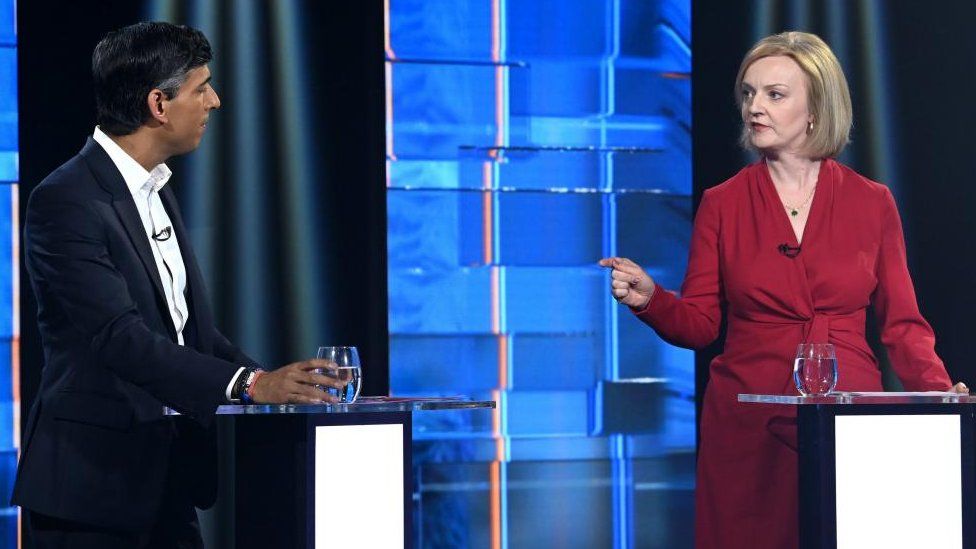
Hollow sounds – Sunak and Truss seek to further their political ambitions
The war between factions in the Conservative Party, fronted by leadership contenders Rishi Sunak and Liz Truss, continues on in its avoidance of addressing any of the issues which will improve the lives of working class people.
Debates around income tax, corporation tax, even national insurance levels, important though they are, will not tackle the structural issues which face many suffering at the sharp end of the capitalist system. The Tories, whoever is leader, have no strategy for tackling the housing crisis, driven by escalating prices and the ongoing desire for profit from house sales.
The de-population of many rural areas, is an increasing concern, as houses bought for holiday homes puts them beyond the reach of young people, who might otherwise want to stay in the area in which they were born. High rents make saving for a deposit challenging, especially with house prices artificially high, and with the Air B&B market for staycations expanding.
The urban alternative is often houses in multiple occupation and restricted disposable income, with salaries eaten by rent and transport costs. This situation often prevails in London but is becoming true of many other metropolitan centres. With job insecurity, temporary contracts and the gig economy on the increase the danger of homelessness is often just around the corner for many young people.
The new Tory leader may or may not stick with the ‘levelling up’ concept, beloved of Boris Johnson as a means to keep so-called ‘red wall’ seats, mainly made up of working class voters, onside with false promises before the next General Election. It is quite possible that Sunak and Truss would find it expedient to do so. History shows however that Tory promises are not only cheap but easily broken, sacrificed in the name of some other, more pressing crisis.
The housing charity, Shelter, is clear on the needs any new Prime Minister should address, stating,
“There has to be a plan to make sure local people benefit from the growth that comes from levelling up. And that means investing in good quality, energy-efficient social homes. Social homes with rents pegged to local incomes that stay affordable over time.”
Setting to one side the assumption that growth will come from levelling up, the rest of the Shelter statement makes perfect sense. Good quality local homes for local people at rents they can afford. It would not be a bad start. Add to that the repeal of the government’s right to buy legislation, which obliges local authorities to sell off Council housing stock, and a significant start to tackling the housing crisis would be underway.
The right to a home should be a guaranteed human right and in the world’s fifth largest economy it is a scandal that anyone should be homeless.
This situation is consistent with the privatisation of social provision, which has been key to the Tory agenda since the 1970’s. Comprehensive education has been replaced by the private sector driven academy system. Care for children and the elderly is run by private companies, primarily interested in profit rather than the people they are supposed to look after. There is no indication that either Sunak or Truss would seek to reverse any of that. On the contrary they are falling over themselves to prove who is the most consistent Thatcherite.
The BBC reported only this week on the scandal of children in care being housed in temporary accommodation, including boats and caravans, exploiting a legislative loophole that permits the use of such locations as ‘holiday accommodation’.
Carolyne Willow, director of the children’s charity, Article 39, stated in response,
“A young child moving from caravan to caravan defies understanding of what a holiday is. The government needs to amend the legislation to make it absolutely clear what constitutes holiday accommodation for children in care.”
Sunak and Truss have made no attempt to out compete each other in promises to more effectively support social care provision, through the proper funding of local authorities, or tackle the crisis in hospital waiting lists through making social care free at the point of use and NHS staffing levels realistic.
Both will bleat that this is all unaffordable, as they do when it comes to decent pay rises for rail, postal and public sector workers. That this will fuel inflation and worsen the economic crisis. It is convenient in many ways that the pandemic over the past two years allows the Tories to reference only recent history when it comes to the reasons for the looming recession. The fact is that the crisis runs far deeper and is a consequence of Tory economic mismanagement over the past decade.
Liz Truss did appear to break with convention this week when she stated that,
“We have had a consensus of the Treasury, of economists, with the Financial Times, with other outlets, peddling a particular type of economic policy for 20 years. It hasn’t delivered growth.”
However, her recipe to tackle this was an entirely conventional Tory play; cut personal taxes, cut corporation tax, reverse the increase in national insurance, suspend green levies on energy bills. All of which may put some money in the pockets of some individuals but will not address the structural problems born of the capitalist system, that the drive for personal wealth and corporate profit is always at the expense of the public good.
The leadership contest gives the Tories a chance to spread disinformation about the economy and dodge the hard measures required to address social need. The reality is that neither candidate has the answers because they remain beholden to maintain the system, which only ever operates in the interests of the ruling class and their cronies. For the working class, promises from the Tories will only ever have a hollow ring.
Labour has a great opportunity to expose the Tories lies, exploit their divisions and put forward a real alternative in favour of the working class. An agenda for the many, not the few perhaps?
17th July 2022
Biden on the offensive
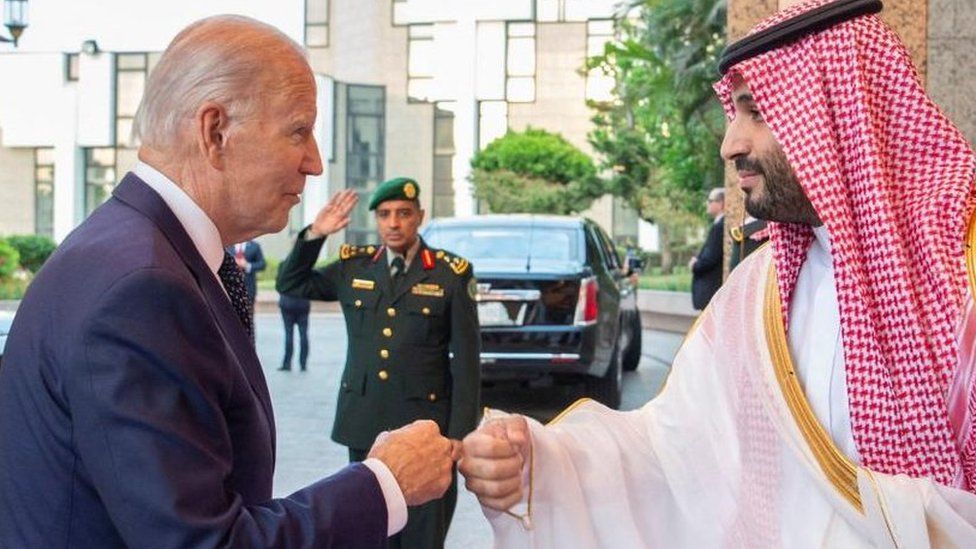
US President Joe Biden and Saudi Crown Prince Mohamed bin Salman – who is the pariah?
To suggest that US President Joe Biden is speaking with a forked tongue on his current propaganda tour of the Middle East is an understatement. The fist bump, with Saudi Crown Prince, Mohamed bin Salman, who even the famously mendacious CIA regard as having given the order for the execution of journalist Jamal Khashoggi, made a lie of Biden’s promise to treat bin Salman as a pariah following the journalist’s murder.
Clearly, such considerations cannot be allowed to obstruct the desire to persuade the Saudis to free more oil onto the world market, to compensate for the shortfall in Russian supplies, or to continue to build rapprochement between Saudi Arabia and the region’s other US client state, Israel, in opposition to the perceived threat from Iran.
Leaders of six countries of the Gulf Cooperation Council (GCC) – Saudi Arabia, Qatar, Bahrain, Kuwait, Oman and the United Arab Emirates – plus Jordan, Egypt, and Iraq held talks on regional security and bilateral relations with the US at a summit in Jeddah over the weekend. Biden pledged that the US “will not walk away” from the Middle East and leave a vacuum to be filled by Russia, China or Iran. Biden also told the summit that the US is committed to ensuring Iran never gets a nuclear weapon.
Biden is in the region to sell the repackaging of US Middle East policy which has been outlined by National Security Advisor Jake Sullivan, who emphasised Washington’s desire to promote “regional stability” through diplomacy. Top White House official on the Middle East, Brett McGurk, has talked of a desire for “returning to basics” through the “3D approach” of deterrence, diplomacy and de-escalation.
Considering the extent to which the US has destabilised the region, through promoting Islamic fundamentalists in Afghanistan, to invading Iraq, Syria and Libya, while arming the Saudi state to bombard Yemen, many in the region would welcome the US walking away.
However, the right of nations to self determination and the principles of non-interference in the affairs of sovereign states, are not values that the US has even deigned to pay lip service to over the years and are certainly not ones which fit into the US imperialist unipolar world view.
It is in the strategic interests of the US to see an expansion and strengthening of the Abraham Accords, agreements between Arab countries and Israel, initiated under former President, Donald Trump, which seek to deepen Israeli influence over the Arab world. Biden is using his visit to press this agenda through promises of security and technology investments.
Biden will use all of his political charisma to make these promises sound magnanimous but, in effect, they are about consolidating the role of the US as the main arms supplier to the region and clearing a path for US technology companies to be the region’s main supplier of communications infrastructure.
On the question of Palestine, Biden is paying lip service to a two state solution while at the same time bolstering Israel’s military capability and effectively turning a blind eye to the atrocities committed against the Palestinian population on a daily basis. In the effort to airbrush the question of Palestine from the international agenda the Saudis are complicit. They are keen to ensure both Israel and the US remain on board with their virulent anti—Iran position, born out of the Sunni/Shia schism in the Muslim world, but increasingly hardening into a classic nationalist power struggle.
While the Saudis and Israelis in many ways appear to be unlikely allies, their mutual perception of Iran as an existential threat brings them together. The US desire for regime change in Tehran means that they are happy to both encourage and arm any Israeli/Saudi alliance. While Biden professes to want to win over the Iranian theocracy by diplomacy, some state of the art weaponry under US control in the region is seen as a minimum backstop.
While the Iranian dictatorship struggles to free itself from US sanctions imposed when Donald Trump reneged on the Iran nuclear deal in 2018, resulting in more trade with Russia and China, Saudi Arabia enjoys the largesse of the US and its allies on a number of fronts. The recent Saudi backed LIV Golf tour, which has generated such controversy in the sports world, continues the Saudi sportswashing agenda, following the recent bankrolling of Newcastle United.
The Saudi Public Investment Fund (PIF), chaired by Crown Prince Mohamed bin Salman, has bought shares worth £78m in Aston Martin, adding to its investment in other blue chip companies and car makers including Lucid electric start up and McLaren.
Western arms manufacturers continue to see the Saudi dictatorship as a lucrative customer and weapons continue to pour into the kingdom. Campaign Against the Arms Trade (CAAT) noted that the published value of UK arms licensed for export to the Saudi-led coalition since the bombing of Yemen began in March 2015 is £8.6 billion (including £7.1 billion to Saudi Arabia alone); however, CAAT estimates that the real value of arms to Saudi Arabia is over £23 billion, while the value of sales to the Coalition as a whole (including UAE and others) is nearly £25 billion.
As staggering as those figures are Britain is, as ever, a junior partner when it comes to any relationship with the US. A total of 73% of Saudi Arabia’s arms imports come from the US and 13% from Britain. The Saudis annual spend on weapons is close to $50bn. Lucrative business indeed.
Biden’s visit will do little to assuage the fears of many people in the region that the US has its own military and economic interests to the forefront, while the interests of the people of the Middle East are not a significant concern. US military interventions and backing for unelected dictatorships has often been at the root cause and, at the very least, fuelled conflict in the Middle East.
Biden may see his four day tour of the region as part of a charm offensive but for the people of the Middle East, until the US allows them to determine their own futures, free from domestic dictators or foreign intervention, the presence of a US President in the region will simply be offensive.
11th July 2022
Into the revolving door

The rogue’s gallery line up for the keys to No.10
It should come as no surprise that the leadership of the Conservative Party is a revolving door. Since the knives were sharpened for the hapless William Hague, in 2001, the Tories have had a further five leaders since the turn of the millennium. Whoever succeeds Boris Johnson as Tory leader will be the seventh this century. Not so much no win, no fee with the Tories as no win, no job.
Not that any of the former leaders have had to sign on for Job Seekers Allowance or Universal Credit. A cushy number in the House of Lords is the worst that happens, or a lightly taxing round of after dinner speeches to feather the retirement nest egg if they are lucky. Johnson’s particular Tory form of backslapping bonhomie and camaraderie will probably see him earn a fortune with the latter.
The current rogue’s gallery, lining up for the keys to No.10 as it currently stands, does raise one or two questions. Like, who is Rehman Chishti? Is Jeremy Hunt seriously running again? Would Liz Truss just be the continuation of Boris Johnson by other means? Will any of them improve the lives of working class people? That one is rhetorical, and finally, where is Defence Secretary, Ben Wallace?
The last question is intriguing as Wallace has all of the key credentials to be a Tory leader. An anti working class, jingoist, militarist and ex-soldier, popular with the Tory rank and file, you would expect him to at least be in the running. That he is not could suggest a lack of ambition. It could equally suggest that Wallace is playing a political long game. Whoever takes over now will not only have to clear up the mess created by Johnson, and the previous ten yars of austerity, but turn the Tories into an election winning prospect in the space of two years.
Given the wooden nature of the opposition they are facing with Kier Starmer’s leadership of Labour, that is not impossible, but it is still a challenge. Johnson’s successor may get the keys to No.10 for a mere two years, hardly time to change the wallpaper, before they are out on their ear. Not a great look for the political CV, and Tories are not known for hanging on to election losers, so the party leadership would soon be up for grabs again.
It may simply be that Wallace does not have the ambition, it may be that there are skeletons in his closet that he does not want a leadership context to expose. It may also be calculated that a Labour government under Kier Starmer would simply keep the seat warm for an incoming Tory leader, while not breaking anything as far as the ruling class were concerned.
Quite a lot of Tories could live with the breathing space Starmer would bring while they reorganise. It may not be Johnson’s successor who is key for the Tories longer term, but their successor, as the leadership door revolves once more.
2nd July 2022
NATO’s strategic con trick
The NATO military alliance last week published its Strategic Concept 2022 document, outlining the objectives and priorities of the alliance over the coming decade. The document was agreed at a meeting of NATO leaders in Madrid on 29th June. The Strategic Concept is reviewed and updated regularly. Since the end of the Cold War, it has been updated approximately every 10 years to take account of changes to the global security environment and, in NATO’s own words, “to make sure the Alliance is prepared for the future.” The previous Strategic Concept was adopted at the NATO Lisbon Summit in 2010.
NATO sees the document as one which describes the security environment facing the Alliance, reaffirms values, and spells out NATO’s self proclaimed key purpose of ensuring collective defence. It further sets out what NATO sees as its three core tasks, those being, deterrence and defence; crisis prevention and management; and cooperative security.
In terms of where NATO sees the major threat to “collective defence” over the next decade the Strategic Concept is categorical,
“The Russian Federation is the most significant and direct threat to Allies’ security and to peace and stability in the Euro-Atlantic area. It seeks to establish spheres of influence and direct control through coercion, subversion, aggression and annexation.”
This assessment is based on the recent Russian action in Ukraine, an action NATO fails to acknowledge as one in response to increasingly provocative acts on the part of NATO itself. The quid pro quo between NATO and the Russian Federation at the end of the Cold War was that NATO would not seek to extend its influence into the former Socialist states bordering upon Russia. The Russians saw such expansion as potentially posing a threat to their own security and, in a world supposedly free from mutual enmity, argued that NATO had no need to extend its sphere of influence.
However, the period since 1995, when NATO published a Study on NATO Enlargement, has seen significant expansion of the military alliance’s membership and sphere of influence. In fact, since its inception in 1949 NATO has expanded from 12 to 30 countries, with 5 others on the waiting list, including Ukraine.
In 1999 NATO saw the accession of the Czech Republic, Hungary and Poland. Five years later Bulgaria, Estonia, Latvia, Lithuania, Romania, Slovakia and Slovenia joined NATO’s ranks. Five years after that, Albania and Croatia. None of this was in response to any Russian “coercion, subversion, aggression and annexation”, it was purely about ensuring military dominance on the European continent and making sure NATO had key strategic bases for its operations beyond Europe’s borders.
NATO has certainly taken every opportunity to flex its muscles in that regard, from the dismemberment of Yugoslavia, the invasions of Iraq, Afghanistan and Libya, followed by the fuelling of opposition and direct intervention in undermining the government of Syria.
As threats “to peace and stability in the Euro-Atlantic area” go, the Russians certainly have a lot to do to catch up with NATO’s record! This is in spite of the unsupported statement in the Strategic Concept that,
“Moscow’s behaviour reflects a pattern of Russian aggressive actions against its neighbours and the wider transatlantic community.”
From a Russian perspective it is not hard to see how the scale of NATO’s interventions, combined with its creeping presence up to the borders of Russia itself, may be seen as threatening.
The dismemberment of the Soviet Union, following the Cold War, inevitably resulted in anomalies across the former Soviet states, with historically Russian speaking areas finding themselves in post Soviet arrangements which did not necessarily accord with their history or their future desires. The so called annexation of Crimea in 2014, following a referendum vote to cede from Ukraine and become part of Russia, of which Crimea had been a part for 300 years prior to a Soviet administrative change in the 1950’s, is one such example.
The mainly Russian speaking Donbas region of Ukraine, the area which is the focus of much of the current fighting, is another. The Minsk agreement of 2015 saw all sides agree to a ceasefire in Donbas but in reality, Ukrainian forces have continued with their offensive in the area, resulting in over 14,000 deaths over the seven year period. The desire of the governments of the Donbas to resist this ongoing aggression precipitated the current Russian intervention.
NATO however is not only concerned about Russia, it also has China in its sights, stating that,
“The People’s Republic of China’s (PRC) stated ambitions and coercive policies challenge our interests, security and values. The PRC employs a broad range of political, economic and military tools to increase its global footprint and project power, while remaining opaque about its strategy, intentions and military build-up. The PRC’s malicious hybrid and cyber operations and its confrontational rhetoric and disinformation target Allies and harm Alliance security.”
It is not hard to see where this is going and true to form NATO pitch straight into the international conspiracy playbook with,
“The deepening strategic partnership between the People’s Republic of China and the Russian Federation and their mutually reinforcing attempts to undercut the rules-based international order run counter to our values and interests.”
It is without any hint of irony that NATO makes reference to the “rules-based international order”, which they have transgressed on multiple occasions, yet still want the world to believe that they regard it as the touchstone of how to behave in the international arena.
It would be too much to expect NATO to come straight out and say that their Strategic Concept is in fact world domination for the “values and interests” it seeks to defend; the banks, corporations and military industrial complex of Western imperialism. Yet that is clearly the objective. A unipolar world in which US military might, backed by the economic strength of the dollar, dominates is clearly at the heart of where NATO wants to be.
An impoverished Russia and an economically and militarily constrained China would certainly be at the top of NATO’s wish list for the next ten years and beyond. The encirclement of Russia, the weapons being poured into Ukraine and the warning signals sent out to China, over that country’s legitimate claim to Taiwan, are all indications of NATO’s aggressive posture.
Strategic Concept 2022 can put the gloss on portraying NATO as “a defensive Alliance” but the realities of its actions give the lie to that claim. Far from being a force for peace, NATO remains a major threat to world peace and a drain on resources, which could be used for the benefit of the people of Europe, rather than lining the pockets of the arms industry and escalating the arms trade.
25th June 2022
Reversing the right to choose
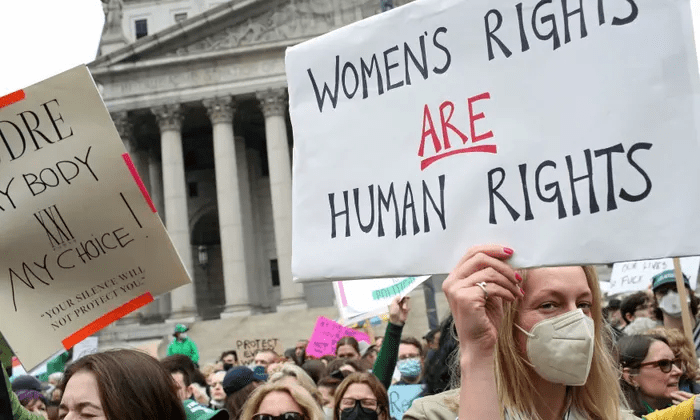
Protests against the Supreme Court ruling will not end in the US
Few works of fiction truly deserve the epithet ‘prophetic’ but yesterday’s Supreme Court ruling in the United States is in danger of tipping Margaret Atwood’s The Handmaid’s Tale into that category. The decision to overturn the Roe vs Wade ruling in 1973, which guaranteed a woman’s constitutional right to abortion, means that abortion rights will be determined by individual states in the US. Thirteen of the 50 US states already have so called ‘trigger laws’ in place in anticipation of the Supreme Court ruling, making abortion instantly illegal. A further thirteen are expected to follow soon.
The medievalist Bible belt in the United States, opposing a woman’s right to choose at all costs, have vowed to continue the fight until abortion is outlawed in all states in the US. The ruling provides no mitigation in cases of rape or incest. The fight is already on to ensure that women in need of treatment can travel to states where abortion is not banned. It is estimated that at least 36 million women will find themselves in states where they have no right to abortion.
As those defending the right to choose have pointed out, the ruling will not prevent abortion happening, it will simply increase the likelihood of illegal abortions and women dying as a result of having to resort to back street medical interventions.
The new abortion bans will make the US one of just four nations to roll back abortion rights since 1994, by far the wealthiest and most influential nation to do so, with Poland, El Salvador and Nicaragua being the others.
The ruling flies in the face of public opinion in the US where it is estimated that 85% of Americans believe abortion should be legal. State abortion bans can be overturned at a national level if there is majority support of the House of Representatives, a 60-vote majority in the Senate, and endorsement from US President, Joe Biden.
However, Republicans will block abortion rights laws in the Senate, which is evenly split with Democrats. One Democratic senator, Joe Manchin of West Virginia, has crossed party lines to vote against abortion rights. That would leave just 49 Democrats, far short of the support needed to pass such a measure.
Joe Biden has stated categorically that he is not in favour of the Supreme Court decision and urged the US public to make their votes count in the up and coming mid term elections in November. However, this would require Democrats to win landslide victories, including taking conservative states, an outcome which is not regarded as being very likely.
The reactionary forces in the United States, which coalesced around the election of Donald Trump in 2016, will scent a further victory with this Supreme Court ruling. Joe Biden’s selection for the Democratic candidacy was only ever going to be a stopgap and was successful insofar as it stopped a second Trump term.
Biden has attempted to shore up his position with more conservative voters by showing himself to be as reactionary as most of his predecessors in foreign policy, failing to address the crime of Guantanamo Bay or the 60 year long illegal blockade of Cuba; failing to address the issue of Palestinian rights for fear of antagonising the Israeli lobby in the US; and pouring fuel on the fire of the conflict in Ukraine, by promising increasing supplies of US weapons, rather than working towards a negotiated settlement.
Ultimately though, this is the default position expected of any US President, and is unlikely to cut any ice with the base who supported Trump, or those on the conservative margins. Biden’s position on social issues and his strong position on Roe vs Wade will certainly galvanise some Democrat support but it will equally harden the position of many Republicans. A second Democrat term, whoever the candidate may be, is by no means guaranteed.
It is ironic that so many so called pro-life Republican Senators are the very people who are opposed to gun control, blocking measures to stop the highest source of child deaths in the US. The right to bear arms, as enshrined in the Second Amendment, is regarded as an inalienable right, whereas a woman’s right to choose is denied.
The illusion of democracy in the US has for decades been that of choice with the same outcomes. The differences have been of nuance between Democrat and Republican presidential candidates. The difference being that a Democrat president would at least be expected to be a little more progressive on social issues. The Supreme Court ruling has however made those fault lines sharper and put the already uneasy consensus around some social issues in the US, in danger of fracturing entirely. Ongoing protests overnight across the US, against the Supreme Court decision, are the latest manifestation of that division.
Trump’s election in 2016 exposed the polarisation of much of the United States. The presidential election in 2024, whatever happens in the mid terms, is likely to see that polarisation exacerbated even further. In the meantime the poor, the hungry, the dispossessed and those women who cannot afford to travel for abortion treatment will be the ones who suffer.
19th June 2022
Stop the extradition of Julian Assange

Protesters oppose the extradition
Yesterday (18th June) was a tricky day for newspaper headline writers. What to go with? The economy continues to go downhill; rail strikes look set to proceed next week; Boris Johnson had left the Northern Research Group of Tory MPs in the lurch in Doncaster, to fly off to Kyiv for a photo opportunity with Ukrainian President, Volodymyr Zelensky.
Johnson made the front page in the FT Weekend and Daily Express but the economy tended to dominate.
Big wage increases too risky, bosses told, made it for The Times.
We must not bow to strikers, says Treasury, was the call from The Daily Telegraph.
Public tell Johnson: Act now to help UK economy, was the i weekend call.
Rate rises send global stocks diving, alarmed the FT Weekend.
The Guardian went with Schools, pools and libraries face massive cuts, drawing attention to the potential local government crisis looming from next April, as inflation bites into already tight Council budgets.
Only the Morning Star went with the headline, A Dark Day for Justice, highlighting the decision of Home Secretary, Priti Patel, to extradite journalist and WikiLeaks founder, Julian Assange, to the United States where he will face charges of espionage for exposing US war crimes in Iraq and Afghanistan.
Assange spent seven years of imposed exile in the Embassy of Ecuador in London, after which he was arrested by British police in 2019 when Ecuador withdrew his asylum status. Since then, Assange has spent nearly three years in Belmarsh prison, fighting a lengthy battle against extradition. The Home Office said the courts found extradition would not be “incompatible with his human rights” and that while in the US “he will be treated appropriately”.
“The UK courts have not found that it would be oppressive, unjust or an abuse of process to extradite Mr Assange,” the Home Office added.
Given that Assange’s alleged ‘crime’ is to have exposed documents revealing how the US military had killed hundreds of civilians in unreported incidents during the war in Afghanistan, and that leaked Iraq war files showed 66,000 civilians had been killed, and prisoners tortured, by Iraqi forces, it is shuddering to think what the US may regard as “appropriate” treatment. The leak in 2010 included 250,000 US diplomatic cables containing classified diplomatic analysis from world leaders.
Amnesty International said enabling the extradition of Assange to take place “would put him at great risk and sends a chilling message to journalists”. General Secretary, Agnes Callamard added, “Diplomatic assurances provided by the US that Assange will not be kept in solitary confinement cannot be taken on face value given previous history.”
Assange now has 14 days in which to appeal and WikiLeaks has released a statement saying it will appeal the decision stating,
“Today is not the end of the fight. It is only the beginning of a new legal battle. We will appeal through the legal system; the next appeal will be before the high court.”
Beyond that there is already talk of a further appeal to the European Court of Human Rights.
The implications of Assange being convicted in the US, given that he has committed no crime are profound, especially for investigative journalists and whistleblowers. In effect, any journalist seeking information that governments do not want to disclose for reasons that have little to do with “national security” could be indicted and prosecuted under the criminal law. This could apply to any government and any journalist. Assange, is Australian, not an American citizen, yet may face extradition and trial in the US.
In an interview with Nils Melzer, the UN’s Special Rapporteur on Torture, published on 31st January 2020, Melzer states,
“In 20 years of work with victims of war, violence and political persecution I have never seen a group of democratic states ganging up to deliberately isolate, demonize and abuse a single individual for such a long time and with so little regard for human dignity and the rule of law.”
The ‘democratic states’ in question being the US, the UK, Australia, Sweden and, latterly, Ecuador.
That the Assange case is not getting the coverage in the UK press that it deserves is a scandal in itself. Given the implications that the extradition and any outcome in the US, should it get that far, would have for investigative journalism, outrage from journalists across the spectrum should be the minimum response.
The National Union of Journalists have taken a clear position of support for Assange with General Secretary, Michelle Stanistreet condemning the decision of Priti Patel, stating,
“Any journalist who is handed a classified US document, or is contacted by a whistleblower to expose criminality and wrongdoing will now fear that they too will be extradited, and put at risk of spending the rest of their lives in prison.”
The International Federation of Journalists has described the decision as “vindictive and a real blow to press freedom.”
In France where parliamentary elections are taking place over the weekend, Jean-Luc Melenchon, leader of the left-wing La France Insoumise, told a press briefing,
“If I am Prime Minister on Monday Julian Assange will be made a naturalised French citizen and given a medal.”
The real ‘crime’ which Assange has committed is to expose the realities of imperialist engagement in foreign wars where the manipulation and suppression of information is the norm. WikiLeaks exposed the reality of that in Iraq and Afghanistan but similar tactics continue to be employed in relation to Libya, Syria and especially at present in Ukraine. The misinformation campaign around the war in Ukraine may be the biggest the West has yet undertaken, given the ubiquity of social as well as traditional forms of media.
Preventing the extradition of Assange would at least indicate that resistance to such manipulation will continue and, with enough pressure, at least send a message to imperialist powers engaged in conflicts that any cover ups they attempt, will eventually be found out.
12th June 2022
Blustering in Blackpool

Johnson blusters in Blackpool, without illumination
It is said that the Roman Emperor Nero played upon his violin while Rome burned around him. Hence the phrase, ‘fiddling while Rome burns’. Whether the phrase does Nero an injustice or not, it can certainly be applied quite accurately to the attitude of British Prime Minister, Boris Johnson, with regard to the economy. Johnson, who it is now evident only enjoys the support of 59% of his own MPs, many of whom will be on the payroll, attempted to dodge his recent tribulations with a set piece speech in Blackpool on Thursday. However, anyone looking for illumination will have been left pretty much in the dark as to what Johnson’s solution to the economic crisis might be.
“Sometimes the best way that government can help is simply to get out of the way”, blustered Johnson at one point, ironically echoing the views of millions that the sooner his administration gets out of the way, the better. The Tories do not do irony though and Johnson, in true blue fashion, was talking about that old chestnut, deregulation. Less state intervention, less regulation for the private sector, more cutting corners on health and safety.
Tax cuts, aways the cornerstone of Tory populist rhetoric were promised at some point, in an attempt to appease the 148 MPs who voted no confidence in Johnson. The revival of an irresponsible Thatcherite policy, the right to buy, extended to housing associations was also trailed. The dire consequences of Thatcher’s 1980’s policy, of taking significant amounts of housing stock out of the Council sector and into the market place, are still being felt in communities across Britain, where the concept of ‘affordable’ housing is for many a pipe dream.
In a further example of Johnson’s distance from reality he suggested that those on housing benefit should be able to use those benefits to get mortgages and buy their own homes. Clearly Johnson has not had to deal with the realities of the property market recently, the difficulty of saving for a deposit while paying exorbitant rent, or the likelihood of lenders committing to support a mortgage application based upon your housing benefit income!
There is also the small matter of banks overreaching themselves, by lending to those who could not actually afford to pay, being a key factor in the 2008 financial crash. Not a detail to concern Johnson though nor was the fact that it has been twelve years of Tory government, as the architects of austerity, which has seen the economy tank in such a way.
The OECD predicts that, of the world’s twenty leading economies, only Russia will have weaker growth than Britain next year. In the face of this Johnson claims that voters can be “confident that things will get better, that we will emerge from this as a strong country with a healthy economy.”
As ever with Johnson, the detail was thin. Quite who would emerge and in what state from ‘this‘ was left to the collective imagination, though it is a fair bet that it will be Johnson’s cronies who come out of it in better shape than most working families.
With petrol heading for £2 a litre and energy bills set to soar further in the autumn it is hard to see where any real solace for working class families will come. Where efforts to improve terms and conditions are made, as with rail strikes called by the RMT union at the end of June, workers are immediately demonised by the right wing press and the political establishment as ‘irresponsible’. The action of the 50,000 RMT members could be joined by members of the clerical and professional staff union in the rail industry, TSSA, who are soon to take a vote in opposition to compulsory redundancies and in support of a cost of living pay increase.
A leader who has presided over the highest pandemic death rate in Europe, while throwing house parties; extended Tory mismanagement of the economy; is prepared to tear up international treaties to appease Unionists in Northern Ireland; and who is incapable of sticking to a policy line from one week to the next is apparently good enough for 211 Tory MPs.
There should be scope for Labour to tear apart a Tory Party so divided that it cannot find an alternative leader more coherent than that. However, Labour led by Kier Starmer has hardly strayed into such territory. While Johnson was backing the architecture of austerity for the past decade, Starmer was one of the architects of Jeremy Corbyn’s demise, as Labour sought to make itself safe for the political establishment once again.
So, Labour is not proposing to reverse the disastrous ‘right to buy’ policy and insist on new council housing being built. Labour is not proposing to stop pouring weapons in to the right wing nationalist government of Ukraine in order to de-escalate the conflict with Russia and seek a peaceful solution. Labour is not proposing to nationalise energy companies in order to take back control and moderate prices for the consumer. Labour is not proposing to nationalise the entire rail network in order to ensure health and safety standards are met for staff and the travelling public. Labour is certainly not likely to be supporting striking rail workers.
All of these things are just modest adjustments within the terms of the capitalist economy. They are not revolutionary, though a commitment to them might at least indicate a willingness to contemplate such a path.
With a leader like Johnson it is little surprise that the Tories fiddle while Rome burns but for Labour simply playing second fiddle should not be good enough. A plan to rise from the ashes of austerity is required, a sense of purpose, which will galvanise extra-Parliamentary action to force the Tories out and demand real change. A manifesto for the many, not the few.
5th June 2022
The heavy price of US hegemony

US advanced missiles to fuel the conflict in Ukraine
The closer the foreign policy of the United States can be made to appear like the plot of a Hollywood Western or modern action movie, the better the White House likes it. Complex issues can be reduced to simple black and white options, good guys vs bad guys, the old style cowboys and Indians. How the West was won. How the US and its allies continue to maintain it. Conveniently air brushed from history is the fact that the West was only won through genocide and enslavement. It is also not in the script that similar methods are deployed as the means for the West to continue the defence of its privilege.
The methods are not always as direct. If it has learned nothing else over the course of decades imperialism has certainly learned the art of subterfuge. Direct military intervention, while still in the tool box, is seen as a position of last resort when economic coercion, stranglehold or blockade have failed. Ostensibly benign front institutions, such as the World Bank and International Monetary Fund (IMF) are the initial troop deployments, imposing neo-liberal policies of privatisation, wage restraint, free rein for Western corporations, as the price of financial support for struggling economies.
The economies continue to struggle but are beholden to the US and the vagaries of the dollar as the international currency for their survival. Very often economic support is followed through with the siting of US military bases, along with further financial inducements and the promise of the protection of US arms.
The absorption of the former socialist states of Eastern Europe into both the European Union and NATO, over the past 30 years, has been such a process of inducement in both economic and military terms. For the West there could be no ambivalence. Any states not directly part of the NATO/EU alliance would be in danger of being sucked into a Russian sphere of influence and potentially undermine the US position as the world’s single superpower.
Alongside the fear of perceived growing Russian influence the West has also had to consider the reality of the economic growth of China over the same period. Worst case scenario for the West would be any potential co-operation, political, economic or military, between the two states that could challenge the pre-eminence of the dollar, or result in the formation of an alternative power bloc to the NATO/EU alliance.
Both Russia and China are the source of massive natural resources. In the case of Russia there is also the question of its significant nuclear arsenal. In relation to China there is the growing challenge to the West in the field of technology, hence the exclusion of Huawei from any 5G technology consortia. This means that neither state can be ignored and economic relations cannot be entirely severed.
Reliance on Russian fuel and gas has been key to recent debates on EU sanctions in relation to the war in Ukraine. The EU position adopted recently to end reliance on imports of Russian energy, with some exclusion for Hungary and Slovakia, flies in the face of the calculations of the German Central Bank’s recent assessment. That suggested that a complete halt to energy imports from Russia could result in an annual deficit to the German economy of 180 billion Euros. Such an impact upon the EU’s most powerful economy could only mean dire consequences for the rest of the bloc.
Meanwhile US President, Joe Biden, has approved a further escalation of arms to Ukraine, including long-range precision rockets. Ukraine will be provided with a mobile rocket artillery launcher by the Pentagon. The weaponry has a 40-mile range, compared to the U.S.-provided M777 howitzers with a range of under 20 miles. Other western allies have provided similar howitzers, also known as High Mobility Rocket Systems.
The rocket systems are part of a new $700m tranche of security assistance for Ukraine from the United States that will include helicopters, Javelin antitank weapon systems, tactical vehicles, spare parts and more.
In a piece for the New York Times Biden attempted to justify his decision claiming that it is in “our vital national interests” to make sure Russia pays “a heavy price for its actions.”
The US cannot have any “vital national interests” in Ukraine, other than its desire to maintain and extend its economic and political control in the area, to complete the military encirclement of Russia in order to contain any perceived expansion of Russian influence.
Similarly, the US is already making clear to China that any attempt to ‘reclaim’, Taiwan, legitimately a part of China, will meet with resistance. The US State Department in its official documents is clear that,
“Consistent with the Taiwan Relations Act, the United States makes available defense articles and services as necessary to enable Taiwan to maintain a sufficient self-defense capability -– and maintains our capacity to resist any resort to force or other forms of coercion that would jeopardize the security, or the social or economic system, of Taiwan.”
The current conflict in Ukraine may just turn out to be one step in the US bid to maintain its status as the world’s only economic and military superpower. The “heavy price” Biden intends to make Russia pay has yet to be worked out, other than in the suffering of the people of Russia and Ukraine, the victims of US ambition. The price of a direct or proxy US conflict with China, to maintain US hegemony, could be heavier still.
28th May 2022
Twenty first century capitalism – lies and deception

Boris breaks the law – bring your own boos
In 2012 the total wealth of billionaires in the UK was estimated at £211.7bn. By 2022 that figure had more than tripled to £653.1bn. Over roughly the same period the New Economics Foundation, in a paper published in February 2021, found that the poorest 20% of households were worse off by £750 a year (6%) than they were in 2010, adding that,
“We’ve found that if the system inherited by the coalition government had been maintained, 1.5 million fewer people would be in poverty. Maintaining the £20 uplift in universal credit and tax credits would go some way to reversing the reduction in payments to households over the past 10 years — but even with the uplift, the poorest households will still be on average £260 a year (2%) worse off than they would have been under the 2010 system, whether in or out of paid work.” https://neweconomics.org/2021/02/social-security-2010-comparison
As we now know, the £20 universal credit uplift was not maintained, thus plunging the poorest families into deeper poverty and facing a greater struggle to tackle the cost of living crisis.
It is against this background that Chancellor, Rishi Sunak’s “temporary, targeted energy profits levy”, or a windfall tax in plain English, needs to be measured. The package includes a £650 one-off payment for families on means-tested benefits, and an extra £200 for all energy bill payers that will not have to be repaid. All of which just about puts back the £750 a year these families have already lost, without actually addressing inflation currently at 9% and set to rise further.
So, the Tories hand back part of what they have already robbed from the poor, and dress it up as magnanimity, while the billionaire rich are able to sit back and watch the wealth pile up!
Crocodile tears poured forth from the Rich Listed Chancellor who claimed that, the public would understand that ministers could not offset all of the increase in prices but,
“This government will never stop trying to help people.”
What is increasingly apparent to most is that the people the government are trying to help are the rich and entitled.
With the price cap on household energy bills having risen by £700 in April energy regulator, Ofgem, expect it to rise by another £800 in October. It is clear that Sunak’s intervention, however he tries to dress it up, is going to result in little more than small change rattling around in the pockets of Britain’s poorest families.
The one rule for the rich and entitled, while the actual law of the land applies to the rest, was underlined this week with the publication of the Sue Gray report into shenanigans in 10, Downing St, during periods of Covid restriction for the majority of the population. Prime Minister, Boris Johnson, brushed aside any criticism of his participation in these Downing St soirees by suggesting that it was a quality of great leadership to appear at leaving parties!
Further justification was forthcoming when Johnson addressed the 1922 Committee of backbench Tory MPs this week and allegedly claimed that Britain wouldn’t have won the second world war if Churchill hadn’t been pissed. Quite a lot to unpack in that one, not least the issue of who played the major role in defeating the Nazis (Battle of Stalingrad anyone?), and which particular war Johnson thinks he has won, having just presided over the highest pandemic death count in Europe.
Still, what is a little lying, cheating and deception at the heart of government? After all, this has been the Tories stock in trade for decades, Johnson is simply more flagrant than his predecessors. He has also taken steps to ensure the bar is lowered for his successors by rewriting the Ministerial code rules. These previously suggested that any minister breaching the code of conduct, for misleading parliament for example, should resign. Under Johnson’s new improved version they could just apologise or temporarily lose their pay.
A government statement justifying the new code suggested that it was,
“disproportionate to expect that any breach, however minor, should lead automatically to resignation or dismissal.”
It is surely pure coincidence that Johnson faces an inquiry by the privileges committee into whether he misled parliament over lockdown parties in Downing St…..
While the bastions of British capital continue to ensure that every aspect of the system is rigged in their favour the situation is no less alarming in the self-styled world’s greatest democracy, the United States of America.
It would be remiss not to mention the murder of 19 school children and two teachers in the city of Uvalde, Texas this week. Sadly, in the so-called home of the brave, democracy US style does appear to emanate from the barrel of a gun. The National Rifle Association (NRA) also held its annual meeting this week in Houston, Texas and in reflecting on the Uvalde killings suggested that the arming of more citizens to combat evil was required.
Keynote speaker, one Donald Trump suggested that,
“The only way to stop a bad guy with a gun is a good guy with a gun.”
Trump echoed measures other Republicans had proposed at the conference including schools with a single entryway, with armed guards stationed there, and exit-only fire escapes. He also said some teachers should be allowed to carry firearms.
Republican Texas Senator, Ted Cruz, blamed a “cultural sickness,” including fatherless children and video games, for mass shootings. He said schools should have a single entry point defended by multiple armed guards. Just in case anyone was in any doubt about the extremism of the NRA, South Dakota Gov. Kristi Noem, in defending the constitutional second amendment which gives Americans the right to bear arms, attacked advocates of gun safety legislation, stating,
“Let me tell you the truth about the enemies of the Second Amendment. They are schooled in the ways of Marx and Lenin,” she said.
The NRA remains a powerful lobby in US politics, effectively blocking any real attempt to legislate to introduce restraints on gun ownership. Until that issue is addressed, the killings of innocent children as happened in Uvalde, will continue.
Twenty first century capitalism, on both side of the Atlantic, remains mired in a culture of lies and deception. The alternative, which the ruling class in all capitaist economies cannot countenance, is that working people may realise that they are the real wealth creators, that they are the mainstay of the communities in which we live and that, one day, they realise that they should be the ones who are in control.
22nd May 2022
Worlds Apart

Sunak at the CBI – tough times ahead for those not on the rich list
Having scraped through the so-called party gate farrago with only one fixed penalty notice and most of the hit being taken by his office juniors, Boris Johnson and his Cabinet cronies have yet to wake up to the cost of living crisis which is engulfing the country. Not the country they live in of course, with Rishi Sunak and his wife having just made the Sunday Times rich list, and most of the Cabinet being financially well cushioned from any prospect of having to sell The Big Issue on street corners any time soon.
Out in the real world though, things are a little different. Inflation has hit a 40 year high of 9% this week. The Bank of England expects it to go higher. Food bank queues are expected to grow longer. The cost of energy and fuel will continue to soar. Heating or eating may no longer be a choice for many, who may struggle to do either without significant financial support.
As ever the Tories have imaginative solutions. Buy basic food brands, stay on the bus all day to keep warm, learn how to make a meal for just 30p at your local food bank. Finally, and this is the clincher, one Tory even suggested that people ought to go out and get better paid jobs! If they were joking there would be little enough cause for laughter but the fact is they are not. These are all serious suggestions from Tory MPs.
Speaking at a CBI business dinner this week Chancellor Rishi Sunak warned that “the next few months will be tough”, before proceeding to give no clues as to what he or the government propose to do about it, suggesting,
“There is no measure any government could take, no law we could pass, that can make these global forces disappear overnight.”
The debate continues about a possible windfall tax on the profits of energy companies, which Sunak suggested he may impose unless they come up with credible investment plans, but the weeping of shareholders, desperate for their dividend pay out, may yet trump the needs of the average consumer. Labour continue to press for a windfall tax which, while bringing some short term relief to consumers, falls far short of the real need to nationalise the energy and utilities sector, in order to ensure that it is managed in the interests of the people and not the bank balance of shareholders.
On which note, the Institute for Fiscal Studies (IFS) this week illustrated the extent to which the rise in energy prices meant inflation was much higher for poorer households, as they spend more of their household income on gas and electricity than the rich. In effect this means that inflation for the poorest 10% of households was at 10.9% in April compared to 7.9% for the richest 10% of households. Add to this the fact that state benefits only rose by 3.1% in April, most likely less than many shareholder dividends, and the real terms cut to living standards is clear.
Like the government, the Bank of England this week also shrugged its shoulders in the face of the cost of living crisis with Bank Governor, Andrew Bailey, saying that, in the face of the global shocks he blamed for rising prices, that there was “not a lot we can do about it.” Bailey went on to suggest that food price rises in the months ahead would be “apocalyptic”, blaming the war in Ukraine for that one, and that the Bank felt “helpless” in the face of price growth.
In the short term the government must be pressed to find more support for the poorest and do more to mitigate the rising cost of food and energy. Once the winter months approach this will become even more urgent.
The Covid 19 pandemic and the war in Ukraine are convenient excuses for the current crisis and the government is quick to use them at every opportunity. However, the fact of 12 years of Tory government, much of which has been driven by an austerity programme designed to squeeze the public sector, drive down wages and attack workplace terms and conditions, cannot simply be airbrushed away. While scandalous levels of profit have been made at one end of the social spectrum, abject poverty for many has been the reality at the other.
As the Institute for Public Policy Research have observed,
“Now there are more billionaires in the UK than ever before and the collective wealth of the richest has grown again.”
The only mitigation for the apparent helplessness of the government in the face of global forces is the reality that there is much that they cannot directly control. Capitalism is a system within which inequality is endemic. Overproduction will result in crises and waste, inter-imperialist rivalries will result in wars, all of which will generate migrant crises and the familiar boom and bust cycles to which capitalist economics is prone.
No amount of fiddling with policy levers and proclamations to be levelling up will change these fundamentals. Of necessity short term measures must be fought for, such as more support for those on benefits and the struggle for better wages and conditions. The real struggle however remains that of exposing the capitalist system for what it is, one driven by the need to maximise the profits of the few at the expense of the many.
The real struggle is that for an altogether different approach, a socialist economy, where the needs of the people come first and any profit generated in reinvested for the social good. Until then we will continue to live under a system where the richest and poorest in society remain worlds apart.
14th May 2022
End Apartheid, Free Palestine

Israeli forces attack funeral of murdered journalist, Shireen Abu Aqleh
The killing this week by Israeli soldiers of Al-Jazeera journalist, Shireen Abu Aqleh, is the latest tragedy in the struggle of the Palestinian people to claim their rights under international law. Since 1948, with the establishment of the State of Israel, Palestinians have been subject to what is effectively a system of apartheid, through ethnic cleansing, settler colonialism and discrimination at all levels of daily life.
While Palestinians endure discriminatory treatment and the systematic denial of their human rights, Jewish Israelis enjoy full rights under the law within a system of institutionalised ethnic privilege.
Meanwhile seven million Palestinians live in exile, many in refugee camps in Syria, Jordan and Lebanon, being the descendants of those forced to flee during the nakba or catastrophe, when Israel was being created. Under international law these refugees have a right to return to the lands from which they were expelled. However, Israel has continuously denied them this right.
Other Palestinians are variously dispersed across Israel, where they live as second class citizens; the occupied West Bank, with discriminatory laws and restrictions on movement; and Gaza, which has been under land, sea and air blockade imposed by the Israelis since June 2007. Gaza is regularly described as the world’s largest open air prison.
The killing of Abu Aqleh, known for her stand on supporting Palestinian rights, was compounded by the attack upon her funeral by Israeli forces. A statement put out by Al-Jazeera stated,
“In a scene that violates all norms and International laws, the Israeli occupation forces stormed the French Hospital in Jerusalem and attacked the mourners of the late Shireen Abu Akleh at the start of the funeral procession,” said the statement. “They severely beat the pallbearers of the late journalist,” it added.
The behaviour of the Israelis in relation to the murder of Abu Aqleh and the subsequent behaviour at her funeral has brought international condemnation. UN human rights experts have condemned the killing of the journalist and called for a prompt, transparent, thorough and independent investigation into her death. Palestinian President, Mahmoud Abbas, has called to go to the international criminal court over Abu Aqleh’s death.
The International Federation of Journalists has expressed concern that Israel’s ongoing targeting of the media amounts to war crimes and has submitted evidence to this effect.
The death toll of Palestinian citizens in general continues to mount under Israeli occupation, with 76 dead, including 13 children, since the present government took office last June. This adds to the thousands who have lost their lives directly or indirectly in the 74 years since the nakba. During ‘Operation Cast Lead’ alone, in 2008-09, Israel bombed Gaza for three weeks, destroying 25% of buildings and killing over 1,400 Palestinians including 300 children.
While the West in particular focuses upon the unfolding disastrous situation in Ukraine, with Russia being condemned for breaking international law and having sanctions imposed to strangle its economy, Israel continues to behave with impunity, ignoring UN resolutions, occupying Palestinian land and all the while enjoying the protection and active support of the US, EU and the British government.
According to figures published by the Campaign Against the Arms Trade (CAAT), between 2016 and 2020, Britain issued Single Individual Export Licenses (SIELs) for arms sales to Israel to a value of £387 million, compared to just £67 million from 2011 to 2015. These figures do not include the sales of components for US-made F-35 stealth fighters sold to Israel, worth hundreds of millions of pounds to British arms companies.
CAAT and other NGOs, including War on Want and Palestine Solidarity Campaign, have long called for an arms embargo on Israel, as well as a halt to all British links with the Israeli arms industry, including British arms purchases from Israel and joint arms development projects.
Israel claims to be a democracy. That measure is based upon the fact that elections are conducted in which different parties compete for seats in the parliament. However, that is the narrowest measure of how a democracy can be defined. If a significant proportion of the population are denied basic human rights to heath care, housing and employment is that a democracy? If that population is systematically robbed and its land occupied in defiance of international law, is that democracy? If that same population is subject to arbitrary arrest, imprisonment and killing, is that democracy?
Israel’s claim to be democratic holds little more credence than the theocratic dictatorship in Iran, where elections may shuffle who sits in the parliament, or even become President, but the real power lies with the religious zealots who determine the orthodoxy under which the population live.
Not all Iranians accept this, there is resistance. Not all Israeli’s accept the actions of the apartheid government which purports to act in their name. Opposition to the religious orthodoxy which taints both Iran and Israel is to be encouraged and supported.
This weekend protests will take place across the world to mark the 74th anniversary of the nakba and in support of the rights of the Palestinian people.
In Britain the Palestine Solidarity Campaign is working to support justice and human rights for Palestinians. Find out more here www.palestinecampaign.org.
The boycott, disinvestment and sanctions (BDS) movement is working to put pressure upon Israel to respect international law. Find out more here www.bdsmovement.net
7th May 2022
Dis-United Kingdom

Boris Johnson – counting the cost of local election results
What is going on in Britain? There is a cost of living crisis, bad already and set to get worse. Energy bills have been building and are set to increase further. The impact of increased energy prices always hits the poorest the hardest. The Bank of England has just increased interest rates so even those with a mortgage do not escape. The Bank continues to spread the joy with a prediction that inflation, currently at 7%, looks set to hit 10% any time soon. In a triple whammy the Bank ices the cake with the prediction of a “sharp economic slowdown” this year.
All of this, quite apart from the quietly forgotten but still circulating Covid 19 virus, is the sort of pressure which should lead to a meltdown at the polls for an incumbent government.
The local elections across the UK last Thursday were not a good night for the Tories, who lost 500 seats across Britain, but they were hardly a knockout blow landed by the Opposition, especially at a time when they have plenty of ammunition at their disposal.
Labour did make progress in London, taking control of flagship Tory strongholds such as Westminster and Wandsworth. They managed to edge the Tories back into third place in Scotland, though the SNP tightened their grip overall, and Labour held their ground in Wales. The situation in Northern Ireland is largely one contested by Sinn Fein and the DUP so has less impact upon the reading of possible General Election outcomes. However, Sinn Fein’s victory in becoming the biggest party at Stormont is likely to be sabotaged by the DUP refusing to participate in the Assembly, as part of their ongoing protest against Brexit regulations.
It is always dangerous to extrapolate too much from local election results into how a General Election may turn out. However, what the results do confirm is that the concept of the ‘United Kingdom’ is increasingly a fiction. Northern Ireland has been an annexed territory, which should rightly be part of the Republic of Ireland, for a century now. It must surely be only a matter of time before a referendum on unifying the island of Ireland is triggered.
Labour’s failure to get to grips with the issues facing the Scottish working class has seen Scottish nationalism spread like a poison. While the SNP still remain short of a decisive majority for independence, they remain a powerful presence and are not going to fade quietly. Plaid Cymru have less of a hold in Wales but the once powerful support Labour could historically count upon from the Welsh working class is no longer a reliable source of votes.
In all of these cases the nationalists paint themselves as progressives, in opposition to the reactionary forces of conservatism. This is closest to the truth in the case of Sinn Fein, who are at least seeking the re-unification of their country. Even then Sinn Fein’s position on EU membership is hardly radical, though they do have a positive charter for worker’s rights within the context of a capitalist economy.
The nationalists may all want change but that does not automatically imply progressive or socialist change. Nationalism can often be an active diversion away from the real issues which need to be addressed, based upon class and the relationship to the ownership of the means of production.
This ground was abandoned by Labour with the revision of Clause IV in the Labour Party constitution in 1995 under Tony Blair.
The original clause had stated that it was one of Labour’s objectives,
“To secure for the workers by hand or by brain the full fruits of their industry and the most equitable distribution thereof that may be possible upon the basis of the common ownership of the means of production, distribution, and exchange, and the best obtainable system of popular administration and control of each industry or service.”
The revised Clause IV has an altogether different emphasis, committing Labour,
“to work for a dynamic economy, serving the public interest, in which the enterprise of the market and the rigour of competition are joined with the forces of co-operation to produce the wealth the nation needs”
While Labour leaderships prior to Blair did not exactly wear the original Clause IV as a badge of honour, the shift to the new clause is sadly symbolic of the dilution of Labour policy over decades and its propensity to follow social trends rather than set out a programme for social transformation. The brief window of opportunity, afforded under the leadership of Jeremy Corbyn, to reverse this trend was quickly snuffed out by the political establishment.
One of the key architects of Corbyn’s political demise was Kier Starmer, now hoping to prove his electability and acceptability to the ruling class by not offering anything too radical, threatening or progressive. The local election results from Thursday do not suggest that Starmer has moved sufficiently in that direction yet for the ruling class.
Given the travails of the Tory Party in general, and its leader in particular, it is almost as if Boris Johnson is waving the keys to No.10 under Kier Starmer’s nose, yet he still cannot grasp them!
Prior to the 2017 General Election Labour was building momentum, overturning Theresa May’s parliamentary majority. The last time the current seats were up in local elections in 2018, results were Labour’s best since 1974. Rather than focussing on the lessons of the 1990’s maybe Starmer needs to revisit more recent Labour history to find a way forward
1st May 2022
Keeping the politics in May Day

The political history of May Day as International Worker’s Day stretches back into the 19th century. The first May Day was called for at an 1889 international conference in Paris by workers’ organisations and early Marxist-oriented socialist parties calling for an international day of demonstrations, for an eight-hour working day and other workers’ rights. The date was chosen by the conference to honour demonstrations which had taken place in the United States on 1st May 1886 demanding a working day of eight hours.
From 1890 onwards 1st May demonstrations spread and grew, becoming part of a new International of Marxist socialist parties, which called for the building of socialist parties to advance political democracy allied to trade unions to build economic democracy.
May Day became an official holiday in socialist countries and in many other parts of the world where strong Communist Parties and workers movements were present. Elsewhere, May Day became an unofficial holiday, seen as a day for workers to hold marches and meetings which focused on the most pressing issues facing the working-class movement.
In Britain, unlike most of Western Europe, May Day itself is not a public holiday but the first Monday in May is designated a Bank Holiday, an initiative taken by the Labour government in 1978, too timid to declare 1st May itself a public holiday.
This radical association and significance of May Day is often deliberately blurred in the public consciousness in Britain by two things. The first is the historic association of May Day as a traditional celebration of spring and the resurrection of nature after the winter months. It is normally associated with flowers, dancing and Maypoles, with celebrations sometimes including the crowning of a ‘May King’, or ‘Queen’.
Promoting such an association for May Day is clearly much more desirable for the capitalist class than the notion of red flag waving workers, demanding their rights and calling for the overthrow of the system in order to meet their needs.
More subtle, but growing in prominence in recent years, is the promotion and engagement in International Workers’ Memorial Day. This day was designated as the 28th April in 1989 by American trade union confederation AFL-CIO to commemorate and remember workers killed or injured on the job and to renew the fight for strong health and safety protection.
The date has been taken up with some enthusiasm by the TUC and a number of trade unions in Britain. Local councils are often involved and memorial services are held in local churches to mark the day.
It is vitally important to challenge unsafe working practices and to acknowledge those who have died as a result of unscrupulous employers, cutting corners on health and safety practices in order to reduce their costs and push up their profits. It is equally vital however that such practices are acknowledged as being endemic to capitalism as an economic system, that the drive for profit over meeting public need will always mean that corners will be cut and employers will rail against so called ‘red tape’ and regulation.
The original demands which led to the establishment of May Day, including that for an eight hour working day, had their origins in the need for workers to have safer conditions and more leisure time. The economic demands put forward by workers were always seen as a first step towards the need to more comprehensively address the failings of capitalism and build a society which would address the needs of the many not the few.
The danger of emphasising International Workers’ Memorial Day over the historic International Workers Day is that the political dimension becomes lost or diluted. Demands for reform within capitalism will only ever be able to take us so far. Until the demand to change the entire system is more widely understood and taken up, any gains are destined to be limited.
23rd April 2022
A better world is possible

Macron or Le Pen? French voters between a rock and a hard place
The French presidential elections to be held tomorrow (24th April) are in many ways a more significant referendum on the future of the European Union than the Brexit debate in Britain ever was. For a long time Britain had no truck with Europe, hoping to hang onto the last vestiges of Empire, even when the writing was in bold letters on the wall, and the initial six members of the EEC were as happy to keep Britain out, the French being the most vociferous in that respect.
The ruling class in Britain has always been split over the question, hence the divisions which are played out in the Tory Party over the issue. The Tories’ most ideologically driven Prime Minister of the post war period, Margaret Thatcher was, with some reservations, pro British involvement in Europe as it gave British capital access to a wider market, the City of London a key financial role and, increasingly important as the EU developed, a pool of cheap East European labour.
The economics of the EU has essentially been Thatcherism on a Europe wide scale, with the richer European nations benefitting at the expense of the poorer, that disparity becoming more evident as the EU has expanded.
It has been clear to workers across the European continent for many years that the EU has done nothing to enhance their wages, rights or working conditions. On the contrary the expansion of the gig economy, short term contracts and job insecurity has flourished under the EU. Payments, pensions and prosperity cannot be guaranteed under a system which continues to be run for the benefit of the banks and the corporations, rather than in the interests of the people of Europe.
This level of dissatisfaction and uncertainty are historic breeding grounds for social unrest, often exploited by the far right through racist and xenophobic slogans, while mobilisation on the Left seeks to unite the working class and break down the barriers of race, ability and gender, in the face of the real enemy in the form of the capitalist class.
The break down of the established order of Socialist and Republican Party domination at the last French presidential election in 2017 was hailed by the benefactor, President Emmanuel Macron, as a victory for a new politics of the Centre, which would overcome the old divisions and allow for rule in the interests of all of the French people.
Warm words, but the reality of Macron’s period in office has been that this self styled Centrist has behaved exactly as the former establishment parties did and sought to secure the best deal for French capital and capitalists, whatever the cost to French workers. Since the Covid pandemic between 5 and 7 million people in France, 10% of the population, have had to ask for help at a food bank.
Alternatively, Marine Le Pen, darling of the far right, has been making every effort to restyle herself and her National Rally (formerly National Front) party as the voice of the French people. Le Pen has built a populist platform around French jobs for French workers, opposing an increase in the retirement age to 65, as proposed by Macron, and promised to tackle the cost of living crisis faced by French workers, by limiting the jobs and welfare benefits open to non-nationals living in France. The issue of immigration has not featured as prominently in Le Pen’s campaign but her job proposals, along with that to ban Muslim women wearing the hijab in public, indicate that Le Pen has not strayed far from her Fascist roots.
Le Pen has been coy about proposing a referendum on France leaving the EU but has described the choice facing French voters as,
“…fundamental. It is in the hands of the French people. It is Macron or France.”
suggesting that a Le Pen presidency, given the clear backing of the EU by Macron, would make the question of EU membership an open one.
Other EU leaders have been quick to express support for Macron with leaders from Germany, Spain and Portugal rallying to urge French voters to support “freedom, democracy and a stronger Europe”, oblivious to the irony in that contradiction.
The untold story of the French election however is that 7.7 million voters cast their ballots for Left wing candidate Jean-Luc Melenchon, who was only beaten for second place by Le Pen by two percentage points, and was only five percentage points behind Macron’s first round vote.
Melenchon’s programme to lower the prices of basic necessities such as food, fuel and energy; reinstate the retirement age at 60; pursue an organic farming and food production agenda; initiate a programme to rebuild public hospitals; and to increase the national minimum wage; all found resonance with large sections of the electorate.
Inevitably, as the far right often do, Le Pen has stolen some of Melenchon’s policy ideas but mixed them with a toxic cocktail of racism and xenophobia.
Whatever the outcome of the vote in France the issues facing the French people, in particular those in its poor areas, will not go away. In facing a choice between the right wing extreme of Le Pen and the corporatist bureaucrat Macron, many voters will feel that they are between a rock and a hard place. Abstention rates in many French neighbourhoods are expected to be 30%+ making the outcome as to who will become President too close to call.
Unfortunately, the outcome for the French working class is all too predictable. The divisions between rich and poor in France run too deep for social unrest not to be a continuing feature for some time to come. Those backing Melechon campaigned around the slogan “A better world is possible”; that is true in France as it is elsewhere. The struggle continues.
16th April 2022
Offshoring proposals inhumane and no protection for asylum seekers, says Liberation

The British government’s decision to offshore asylum seekers to Rwanda is clearly aimed at intimidating those fleeing from harm into not attempting to enter Britain. The government’s policy is effectively an extension of the ‘hostile environment’ approach, which sought to make life difficult for asylum seekers who reached Britain, by preventing them from getting here in the first place.
The British government’s proposals have raised alarm bells at the United Nations’ Human Rights Commission (UNHCR), the UN’s refugee agency, which is the guardian of the 1951 convention relating to the status of refugees and to its 1967 protocol. This is international legislation to which the UK is a signatory. There is no evidence that UNHCR has been consulted on any plans to send asylum seekers abroad.
The government are planning to adopt the measure to demonstrate that they are tough on immigration and that the UK is not a ‘soft touch’ for those seeking asylum. However, as Rossella Pagliuchi-Lor, the UK representative for the UNHCR has pointed out,
“…what’s often forgotten amid all the recent noise around Channel crossings is that asylum claims in the UK have been falling, and remain far lower here than in countries like France and Germany. The situation in the UK is manageable.”
British Prime Minister, Boris Johnson, claims that the proposals are “humane” and that they will “stop the abuse of these people by a bunch of traffickers and gangsters.”
The evidence to date suggests quite the opposite.
The Australian government initiated a policy of placing asylum seekers in detention centres on Nauru and Manus Island in 2001. The policy ran until 2007, and restarted in 2014. The result has been that thousands of asylum seekers have found themselves in detention camps, at a cost of around $12bn in the eight years to 2021.
The centres have been characterised by harsh physical conditions, with detainees suffering from poor mental health due to prolonged detention and uncertainty about their future prospects. Inadequate and unhygienic living conditions, as well as poor standards of healthcare have also been well documented.
The detention centres were also plagued by violence, with rape and sexual abuse of unaccompanied female detainees rife – enabled and often perpetrated by local islanders and even the very personnel subcontracted to oversee and manage the facilities by the Australian government. Not only does this highlight the danger of these policies particularly for lone women asylum seekers, but also that posed by at best opaque subcontracted arrangements where safeguarding, proper oversight, and accountability become weaker with every rung down in the structure.
In a submission made to an Australian Senate inquiry into conditions at the Nauru detention centre, Ms. Charlotte Wilson, a former Save the Children worker, stated, “I firmly believe that the level of trauma that asylum seekers have been subjected to has caused profound damage to nearly every single man, woman and child who has been arbitrarily interned in Nauru.”
A migration deal between Rwanda and Israel in 2014 saw an estimated 4,000 people leave the country immediately, many attempting to return to Europe through people smuggling routes, and falling prey to trafficking and human rights abuses. Not quite as “humane” as Prime Minster Johnson would suggest. This is aside from the long-held concerns regarding the human rights record in Rwanda itself and the autocratic nature, to state the least, of the regime of President Paul Kagame.
By 2018 the Israeli government claim that around 20,000 of the estimated 65,000 asylum seekers who had arrived in the country had been deported under one scheme or another.
The government’s proposals have been opposed by bodies as diverse as the British Red Cross, the Immigration Law Practitioners Association and the Refugee Council.
Enver Solomon, the chief executive of the Refugee Council, has been direct in his criticism of the proposals stating,
“It is an inhumane policy that undermines our nation’s proud tradition of providing protection to people fleeing persecution and terror, many of whom have gone on to work as doctors and nurses in the NHS.”
There is no indication that the policy will apply to those deemed to be seeking asylum from the war in Ukraine, who have been given active encouragement through the government’s Homes for Ukraine scheme, with an estimated 12,000 Ukrainian refugees so far in the UK. It is also worth noting here the recent rebuking by the UN of the Homes for Ukraine scheme and its warning that the current system of pairing female refugees with single male hosts is ‘massively open to safeguarding and abuse issues’.
Ukrainian refugees who come to the UK will receive a visa giving them the right to remain for an initial period of three years. They will have the right to work, to receive public funds such as Universal Credit, and access to public services such as schools and health care. By contrast, nationals of other countries claiming the right to asylum in the UK are not normally allowed to work while their claim is being processed.
The new proposal appears to prioritise the offshoring of non-European asylum seekers, many displaced from areas such as Iran, Iraq, Syria, Libya, and Afghanistan as a result of foreign military interventions, occupation, economic sanctions and NATO interventions in those countries.
Quite apart from the obvious humanitarian concerns already outlined, such a differentiation of asylum seekers, depending upon their country of origin, can only be deemed as racist.
As an organisation rooted in opposing colonialism, opposing unjust wars and supporting those in need of assistance and political asylum, Liberation has added its voice to those opposing the government’s proposals.
We are urging the government to reconsider its policy towards asylum seekers and, in line with international conventions to which it is a signatory, drop any measures which could be deemed hostile or inhumane to those seeking asylum in the UK.
That means, in addition to dropping the current proposals, in line with the views of the UNHCR, demanding a better-designed UK asylum system, properly resourced, with simplified procedures that will result in fairer and faster assessments.
visit http://www.liberationorg.co.uk
10th April 2022
Tax dodging, privilege and power

Sunak and Murty – too many more also evade taxes
The Rishi Sunak story, which has been dominating the news this week, is not really about Rishi Sunak. It is not even about his multi-millionaire heiress wife, Akshata Murty, though both are clearly implicated as individuals. The headlines have centred around the fact that Murty, by virtue of holding an Indian passport, has claimed non-dom status in the UK for tax purposes, effectively avoiding taxes of an estimated £4.5 million per year, on dividend payments from shares she owns in her father’s IT company.
All of this while she has snuggled beneath the sheets at 11, Downing Street next to her Chancellor husband, the perpetrator of a massive tax hike for the majority of the population, whatever type of passport they hold. Following the furore which has followed the revelation that the Chancellor’s wife is essentially a tax dodger, Murty has said she realised many people felt her tax arrangements were not “compatible with my husband’s job as chancellor”, adding that she appreciated the “British sense of fairness”.
How very magnanimous! However, while Murty has promised to pay UK tax on all income from last year and subsequently, she will retain her non-dom status, which could in future allow her family to legally avoid a significant inheritance tax bill. UK taxpayers are required to pay 40% on inheritance (above £325,000), while non-doms are exempt from the tax. Murty has assets of at least £690m held in shares in her father’s IT company, tax charged on this at a rate of 40% would be £276m.
Exposing hypocrisy at the heart of government is never a bad thing and Sunak has been twisting and turning over this issue, with his political aspirations clearly turning to dust before his eyes. As the main political beneficiary of this uproar, Boris Johnson has been suspiciously quick to say that he knew nothing, denying that anyone in his office was briefing against the Sunaks, and praising the chancellor for doing an “outstanding job”.
Sunak’s “outstanding job” in delivering Tory policy, it should be remembered, includes a 54% price rise in the energy cap with average household energy prices hitting an estimated £2,300 by October. In order to deal with this, according to the Resolution Foundation, the typical working age household will experience a 4% reduction in income this year, an estimated £1,100. With inflation running at 8% and the cost of living crisis hitting the poorest hardest, an unemployed person will see a 15% drop in income, a further 1.3 million, including 500,000 children will drop below the poverty line.
The political judgement of Sunak, in attempting to defend the indefensible, has led many to write his political obituary, including many in the Tory press and those on Tory benches in the House of Commons.
The reality for the working class at the sharp end of Tory policy however is that replacing Sunak will make little difference, as there are any number of “Sunaks” waiting in line to take his place. The character and judgement of individuals has its role in politics but the real issue is not the political judgement of Rishi Sunak, or even the tax arrangements of his wife. The real issue is the system which allows millionaires to exist while others are unemployed, starving or homeless. At some point Sunak will be replaced but the system which allows the rich to launder their wealth, protecting the privilege and sense of entitlement of the ruling class remains firmly in place.
The response from the Labour Party has been led by Louise Haigh, shadow transport secretary who, when interviewed on BBC Radio 4 stated,
“The chancellor has not been transparent. He has come out on a number of occasions to try and muddy the waters around this and to obfuscate. It is clear that was legal. I think the question many people will be asking is whether it was ethical and whether it was right that the chancellor of the exchequer, whilst piling on 15 separate tax rises to the British public, was benefiting from a tax scheme that allowed his household to pay significantly less to the tune of potentially tens of millions of pounds less.”
Haigh makes a fair point but it does not go far enough. Labour consistently fail to raise questions about the whole system of capitalism and the extent to which the privileged few continue to protect their position at the expense of the many. This is the role and raison d’etre of capitalism as a political system. The role of the Tory Party within that system is to defend wealth and privilege, however much they may try and divert attention with warm words about levelling up.
Labour’s attacks upon Rishi Sunak will only be of value if they go beyond the criticism of even Tory supporters who cannot defend Sunak’s position. Labour need to be mounting a challenge which questions the system which gives rise to millionaires and tax dodgers while at the same time tolerating mass poverty.
‘For the many, not the few’, as a political slogan and an actual aspiration has not outworn its relevance by a long way.
2nd April 2022
The Levelling Up Illusion

Secretary of State for Levelling Up, Michael Gove, attempts a conjuring trick
So called independent think tanks are rarely the place to look for a radical critique of government policy. The Institute for Government (IfG) styles itself as “the leading think tank working to make government more effective.” It is mainly funded by the Gatsby Charitable Foundation, one of the Sainsbury Family Charitable Trusts, hardly a hotbed of revolution.
The IfG has recently published a report considering the government’s flagship levelling up agenda, which Secretary of State, Michael Gove, attempted to give some credibility recently with the publication of a White Paper. The White Paper contained 12 levelling up ‘missions’. The government web site proclaims that delivering these missions will see them,
“…investing billions in our railways, rolling out next generation gigabit broadband and moving more government functions and civil servants out of London as part of investment across the country.”
The government have followed up with the UK Community Renewal Fund, the Levelling Up Fund, the designation of 109 local authority areas as Levelling Up for Culture Places. It would appear that there is no end to how level British society can become!
Voices on the Left, which have cast doubt on just how redistributive a plan the White Paper really is, have been shouted down as doom mongers who have failed to get on board with the government’s vision.
The IfG hardly fall into the Left camp but have been critical nonetheless of the levelling up agenda reporting that,
“Most of the missions are poorly calibrated because they do not set the right objectives, provide clear direction, or show the right level of ambition.”
Hardly a ringing endorsement. In its summary of the White Paper’s missions the IfG claims:
- Five of the missions lack ambition
- Three are too ambitions to be realistic
- Four fail to define what success looks like
- Two have too narrow a focus
- One – on R&D spending – fails to line up with the overall policy objective
The IfG critique follows on from that of another think tank, the IPPR which noted that allocations in 2021 from the levelling-up fund added up to £32 per person in the north of England. That compares with a £413 per person drop in council spending on services during the austerity decade. If levelling up is defined by leaving communities flat on their backs then Gove may be on the right track!
The long held suspicion that the levelling up rhetoric of the government is little more than a smokescreen was confirmed when millionaire Chancellor, Rishi Sunak, revealed his Spring Statement recently. Sunak juggled with a combination of taxation measures and rebates, wrapped in language designed to suggest that the worse off were, in some way, being helped.
However, the net effect of the Chancellor’s measures mean that someone on around £27,500 a year will be about £360 worse off in the next financial year than in the current year. Someone earning around £40,000 will be getting on for £800 worse off. On top of which the Office for Budget Responsibility are forecasting the biggest hit to real household disposable income per person since comparable records began in the 1950s.
With inflation set to hit 8% and energy bills set to rocket, with the cap on energy costs being increased by over 50%, there will be little if anything spare for those at the sharp end of the current cost of living crisis.
The economic upheaval of Brexit and the impact of the pandemic provide handy excuses for the Tories at the present time, even though the failings associated with both are largely of their own making. The current war in Ukraine adds further cover. However, Tory economic mismanagement goes way back to 2010 and the austerity programme forced upon local communities, to pay for the gambling debts of the banks, caught out in the 2008 financial crash.
Whether the illusionist is Michael Gove, Rishi Sunak or even illusionist in chief, Boris Johnson, no amount of trickery can disguise the fact that the Tories continue to look after their own class at the expense of the rest.
Mass collective action to displace the Tories and demand a lasting change in society, which will address the real needs of the many, not the few is urgently required. The current Labour leadership continues to let the Tories off the hook on the cost of living crisis by seeking to present a united front with the government over the issue of Ukraine but, as usual, that is a diversion.
The real problem is systemic. Capitalism is set up to defend the privileges of the rich and protect big business. No amount of choosing between different ways of managing the system will avert its inevitable degeneration into crisis as class antagonisms come to the fore. The Tories are fighting to defend the power and privilege of their class. Only when the working class are conscious of the need to overturn the system, in favour of their class interest, will we see any real levelling up.
27th March 2022
Hung out to dry with the sports washing

Qatar 2022 – a World Cup built on slave labour
The Formula 1 (F1) Grand Prix in Jeddah, Saudi Arabia, scheduled for later today was under threat of cancellation for a while due to a rocket attack which hit an oil refinery less than ten miles from the circuit. The rocket was part of the response of Houthi rebels in Yemen to the seven year long bombardment of that country, by a Saudi led coalition, supported and largely armed by NATO member countries.
The Houthis do not have such eminent international support, their main allegiance coming from Iran, a beleaguered Islamic dictatorship whose economy is being crushed by US led sanctions. As a dictatorship the West approves of, the oil rich Saudi regime enjoys access to the political elite in the West; its finance is approved of to buy a Premier League football club; and it plays host to a prominent Formula 1 event.
Of the 377,000 people the United Nations estimate have died since the bombardment of Yemen began in 2015 it is further estimated that 70% are children under 5 years old. The Houthis have targeted economic installations in order to hit Saudi Arabia economically. There is no evidence that they have hit schools, hospitals or any other civilian locations. This stands in stark contrast to the record of the Saudis in Yemen.
Seven years on much of this is no longer deemed ‘news’ and the Saudis continue to enjoy a place at the top table with other members of the ‘international community’.
A discussion with F1 race organisers and drivers did follow the oil refinery attack but does not appear to have resulted in much soul searching on the part of those involved. The main concerns ahead of the race appear to be those for driver safety, given the tight cornering on sections of the track, a fact underlined by the withdrawal of Mick Schumacher following a major crash in qualifying.
British driver, Lewis Hamilton, has been vocal in raising concerns about human rights in Saudi Arabia, demanding that F1 organisers do more to press for reform if the sport is to continue to race there. Given that this weekend’s race is going ahead, in spite of the Saudi authorities having recently executed 81 people in a single day, is a measure of how seriously Hamilton’s concerns have been taken.
Elsewhere England footballers, or at least Liverpool’s Jordan Henderson, were reported to be shocked at the human rights record of 2022 World Cup hosts, Qatar. Henderson is quoted to have said,
“It’s horrendous really when you look at some of the issues that are currently happening and have been happening over there.”
Henderson’s awakening is not to be dismissed and no one expects professional footballers to have their fingers on the political pulsebeat. However, the realities of human rights abuse in Qatar, including the use of slave labour to build football stadia for the tournament, have been on the record for some time. None of this should be news to the FA or to FIFA.
In 2017, the charity Human Rights Watch (HRW) issued a report into the conditions of migrant workers in Qatar. It found that regulations meant to protect workers from heat and humidity were woefully inadequate. It found that hundreds of migrant workers were dropping dead on construction projects every year. However, HRW stated that it was hard to be sure exactly how many and how they were dying, because Qatari authorities would not say, or even carry out post-mortems. The few deaths that were officially accounted for were given vague descriptions like “unknown causes”, “natural causes” or “cardiac arrest”.
Like Saudi Arabia, the Qatari links to the British state are far reaching, from major property investment, including the Shard in London, to Qatari Holdings being the largest shareholder in Sainsbury’s. The Qataris also own major French football club, Paris St Germain.
The Gulf Arab states have poor human rights records going back decades but are closely tied into the dollar driven international finance system, are major purchasers of Western weapons systems and are major suppliers of oil and natural gas to the Western economies. So, a little sportswashing to distract from some of the more unsavoury aspects of the day to day realities in these regimes clearly goes a long way.
The same rules do not appear to apply in relation to the action of Russia in Ukraine, where the exclusion of Russian teams from international tournaments was swift, the exclusion of individual Russian athletes from competition almost as rapid, and the cultural boycott of Russia has even extended to orchestras refusing to play works by Tchaikovsky and other Russian composers.
The recent comments of US President, Joe Biden, that Putin must go, have widely been interpreted as the US calling for regime change in Russia, though the White House Press Corps have been quick to suggest that these remarks were off the cuff and should not be interpreted as a policy change.
The reality however is that Russia represents an oligarchic regime which is not in full compliance with the US view of the international order, while the Saudis and other Gulf States, whatever their human rights records and war crimes, are prepared to fall in line. Also, in terms of their geo-political position and relative economic strength, they pose no threat to the US. Given the rapid retreat of Roman Abramovich from ownership of Chelsea Football Club, there is also little likelihood of Russians being able to match their Middle Eastern counterparts in the sportswashing stakes any time soon.
However much the White House back pedal there is no doubt that the US would dearly love to see a compliant regime in place in Russia. It may not yet be politic to openly say so but the NATO encirclement of Russia over the past 30 years and the trap Putin has walked into in Ukraine tell another story. An economically strong Russia, with a significant nuclear capability, which is not prepared to follow the Washington line, is not a scenario the US wants to contemplate.
The growing economic strength of China is enough for the US to worry about at the moment. The mounting body count in Ukraine may be seen as a price worth paying by the US, if the outcome is an economically weakened and politically isolated Russia.
20th March 2022
Yemen – a war not to be forgotten

Yemen – the death toll continues to climb
This week marks the seventh anniversary of the Saudi Arabia led coalition bombardment of Yemen. As the world focuses upon events in Ukraine, and the action taken by the NATO led sections of the international community in that conflict, there is still a need to ensure that the war in Yemen is higher up the international agenda.
The bombing of Yemen by the Saudi led coalition has devastated infrastructure across the country. Hospitals, clinics and vaccination centres have been amongst the targets. The blockade imposed by the coalition has resulted in widespread starvation and prevented hospitals from getting essential medical supplies. Such supplies would be vital at any time but have exacerbated the issues faced by the people of Yemen during the Covid-19 pandemic.
Britain, the United States and nations across the European Union are complicit in the ongoing war in Yemen. The US and Britain are providing intelligence and logistics while the use of British-made fighter jets and British-made bombs and missiles has had a devastating impact, including the loss of many civilian lives. The British government has supported the coalition with billions of pounds of arms sales.
While anti arms trade groups across Europe have highlighted the role played by a number of other European countries in sustaining the war in Yemen, over half of the combat aircraft used for bombing raids by the Saudis are supplied by Britain. There can be little doubt that these weapons have been used in the attacks upon civilian targets and researchers on the ground in Yemen have retrieved material which backs this up. This has included the retrieval of material from education establishments, warehouses and hospitals, none of which could be described as military targets.
Britain has also supplied precision guided missiles and cluster bombs resulting, not only in devastating loss of life, but life altering injuries for those who do survive attacks. With the medical infrastructure in a state of collapse, due to a combination of the bombings and the blockade of essential supplies, the United Nations has described Yemen as the world’s most urgent humanitarian crisis. UN Secretary General, Antonio Guterres, has described Yemen as being in “imminent danger of the worst famine the world has seen for decades”.
Taking into account deaths directly as a result of the war and those from indirect causes, such as lack of food, health services and infrastructure, a new United Nations report has projected that the death toll from Yemen’s war will have reached 377,000 by the end of 2021.
In the report published in November, the United Nations Development Programme (UNDP) estimated that 70 percent of those killed would be children under the age of five. In 2020 the UN launched a $3.4 billion appeal for Yemen to address the humanitarian catastrophe.
The Saudi led airstrike on a prison in the city of Saada in Yemen in January, resulted in an estimated 80 dead and over 200 injured. At the same time, in a strike on the port city of Hodeidah in the south, three children were killed.
The British government has attempted to defend its position by pointing to the £1 billion in aid that has been provided to Yemen since the conflict began in March 2015. However, as the Campaign Against the Arms Trade (CAAT) point out,
“The most recent government statistics show that the UK has licensed at least £6.5 billion worth of arms to the Saudi-led Coalition since the start of its ongoing bombing campaign in Yemen. The figure covers the period from March 26 2015, when the bombing began, until March 26 2020.”
In June 2019, the Court of Appeal ruled that the government acted unlawfully when it licensed the sale of British-made arms to Saudi-led forces for use in Yemen without making an assessment as to whether or not past incidents amounted to breaches of International Humanitarian Law. This followed a case brought by CAAT. The government was ordered not to approve any new licences and to retake the decisions on extant licences in a lawful manner.
In July 2020 the government announced that it was resuming arms sales. Secretary of State for International Trade at that time, now Foreign Secretary, Liz Truss, in a written statement to Parliament, said that the government had completed the review ordered by the Court of Appeal, and had determined that any violations of international law were “isolated incidents”.
In October 2020 CAAT launched a new Judicial Review application into the legality of the government’s decision to renew arms sales. In April 2021 CAAT was granted permission for the appeal to proceed to the High Court, with the hearing likely to be later this year.
It is vital that the CAAT legal challenge is supported in order to challenge the position of the British government. Trade unionists and peace activists are being encouraged to lobby their MPs in order to highlight the extent of the humanitarian crisis in Yemen and put pressure upon the government to stop the sale of arms to Saudi Arabia and its allies.
It is clear from the speed of response of the international community to the crisis in Ukraine that where there is the political will it is possible to take action, target sanctions and generate widespread public sympathy. For NATO the Russians are regarded as a threat and their action in Ukraine a potential brake upon NATO’s expansion plans.
The Saudi dictatorship, conversely, is seen as an ally as well as a major purchaser of British and US arms. The fact that more action has been taken in relation to Ukraine in four weeks, compared to the response of the international community to the seven year long crisis in Yemen, in itself speaks volumes.
The threat to gas and oil supplies due to the Ukraine crisis and the desire of the West to reduce its energy dependence upon Russia, has seen British Prime Minister, Boris Johnson, touring the Middle East in recent days in an effort to drum up an energy deal. With prices rising fast the potential for destabilisation of Western economies is real and the usual blind eye is being turned to the domestic atrocities in the Arab states, as well as their international transgressions.
Peace and reconciliation based upon a ceasefire and a negotiated settlement is vital in Ukraine. Seven years on it is no less vital in Yemen. While the international community chooses to focus upon one area of conflict in the world, it should not be allowed to forget that there are others equally deserving of attention.
An online event to mark the seventh anniversary of the war has been organised by international solidarity organisation, Liberation. Further details are here https://liberationorg.co.uk/events/yemen-a-7-year-long-crime-end-the-conflict-now/
13th March 2022
Money for wages not missiles
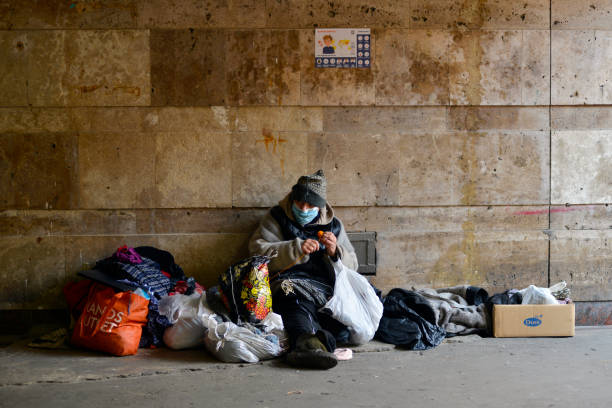
Homelessness – likely to increase due to the current crisis
Tenant referencing agency, HomeLet, indicated recently that the average rent across the UK rose to £1,069 per month in February, up 8.6% on the same month last year when the figure stood at £984 per month. This average masks regional variations, with Greater London rents up by 11.8% over the year, to an average £1,757 per month at the highest end of the spectrum.
Over the same period lender Nationwide have indicated that house prices have hit a high during February, with the average passing the £260,000 mark for the first time. The increase of almost £30,000 over the past year is, according to Nationwide, the biggest cash increase in house prices in the past 30 years. The cost of buying a house is now equivalent to 6.7 times average earnings, an increase from 5.8 in 2019.
As inflation rises, the Bank of England base rate also increases, with added pressure to be faced by those on variable rate mortgages.
At the same time those struggling to cope with the increase in energy bills, most of whom will not be living in £260,000 houses, are facing quotes as high as £3,500 a year for fixed price tariffs. British Gas have dropped fixed price tariffs completely on the basis that it cannot offer customers “fixed prices based on this price volatility right now.”
While British Gas are clearly hedging against the impact of current events in Ukraine the rent, house price and current energy cost rises cannot be laid at the door of the Russians, however much the government may which to deflect blame in that direction.
Osama Bhutta, campaigns director at Shelter summed up the situation for many stating,
“Our emergency helpline is taking call after call from people who just don’t know how they’re going to keep paying sky high rents and make ends meet. People on lower incomes are being squeezed so hard they’ve got nothing left, and when people can’t afford their rent they face eviction and the very real threat of homelessness.”
The TUC have called upon the government to address the squeeze on wages faced by most workers by ignoring calls from Andrew Bailey, Governor of the Bank of England, for pay restraint but by adopting a programme of boosting wages for the lowest paid. In a statement ahead of the Treasury’s Spring Statement on 23rd March, the TUC stressed,
“…that workers are now being asked to bear the brunt of rising global prices, having already borne the brunt of a decade of austerity, the hardship of the pandemic, and the longest pay squeeze since the Napoleonic wars.”
The TUC statement calls for a different approach, which recognises that boosting workers pay will also boost the economy, without leading to an inflationary spiral.
The TUC statement outlines a means by which the government could choose to tackle the crisis within the confines of the capitalist economy and can be found in detail here https://www.tuc.org.uk/research-analysis/reports/ending-pay-crisis
However, while the measures outlined by the TUC form the basis for putting pressure upon the government to change course, they by no means go far enough.
The current crisis is fundamentally one of the capitalist system, which is based upon inequity and exploitation, which is making private landlords, energy companies and arms manufacturers rich at the expense of the many, who generate that wealth through their labour.
The danger for working people does not come from increased wages, it comes from spiralling rents, inflated house prices and the threat of war, which has become more of a reality through the combination of the provocations of NATO and the expansionist designs of the oligarchs in Putin’s Russia.
The crisis in the Ukraine has resulted in calls from leading Tories to increase military spending, already at obscene levels in Britain. This can only add a further burden upon working people as more money for guns and missiles will mean less for health, homes and education. An increase in profits for arms manufacturers will also do nothing to bring about a diplomatic settlement to the crisis in Ukraine, vital for both the people of that country and for the Russian people, hoodwinked by the nationalist designs of Putin and his cronies.
There is little doubt that Boris Johnson and his cronies in Britain will do all that they can to use the crisis in Ukraine to divert attention away from the domestic issues which continue to plague workers in this country.
On the international front, war in Ukraine has undoubtedly generated a humanitarian crisis which must be responded to, as there should be a response to the Saudi bombing of Yemen, using British missiles; the daily tribulations and land grab faced by the Palestinians; the migrant crises resulting from NATO interventions in Afghanistan, Libya and Syria; and the illegal 60 year long blockade initiated by the United States against the people of Cuba.
The only one of the above, about which the British establishment see fit to express outrage, is the situation in Ukraine. Nothing about this conflict should be taken at face value. The agenda is very much about re-aligning the security architecture in Europe and that will not benefit the working people of any of the nations involved. In the short term more emphasis upon peace talks and a negotiated settlement, rather than pouring weapons into Ukraine, would at least be a start.
5th March 2022
Russia Today, gone for good?

Culture Secretary, Nadine Dorries, chokes back crocodile tears for the BBC
For those who like to get their world news from a variety of sources it has been a bad week. This is not the case if you want to access France International or Al Jazeera; one of the many news channels from the United States; or indeed the BBC. However, if you want to compare and contrast information on the current situation in Ukraine from the Russian point of view, you will find that Russia Today (RT) had vanished from your TV channel options.
The withdrawal of RT from the airwaves is, apparently, a victory for free speech as it prevents Russian propaganda from polluting the living rooms of Europe. The ban is EU wide but enthusiastically endorsed by the British government, not least by Culture Secretary, Nadine Dorries, who stated,
“It is my absolute position that we will not stop until we have persuaded every organisation, based in the UK or not, that it is the wrong thing to do to stream Russian propaganda into British homes.”
Dorries shed crocodile tears in the House of Commons as she praised the bravery of BBC journalists ‘risking their lives’ to cover the conflict, in spite of Dorries herself being the biggest threat to the BBC, as she presses ahead with plans to abolish the licence fee and cut budgets.
Dorries’ zeal to stamp out the Russian broadcaster was matched by Labour leader Kier Starmer who backed the ban on the basis that Russia’s “campaign of misinformation should be tackled” and that RT must be prevented from “broadcasting its propaganda around the world.”
The fig leaf for the banning of RT, which it is not in the government’s gift, is that the regulator Ofcom must make such decisions and, having received a number of complaints about the channel’s coverage of events in Ukraine, Ofcom duly declared that,
“All licensees must observe Ofcom’s rules including due accuracy and due impartiality. If broadcasters break those rules, we will not hesitate to step in.”
It is unclear as to whether Ofcom’s position includes omission as well as observance with regard to its definition of “due accuracy aand due imprtiality”. One of the issues RT has raised consistently over the past week is the failure of Western media to give the current conflict any context. In particular RT coverage questioned why the West gave no coverage to the coup which took place in 2014 in Ukraine, resulting in a conflict in which 14,000 people have lost their lives in the past eight years.
The subsequent agreement in 2015, when the presidents of Russia, Ukraine, Germany and France met in Minsk to sign an interim peace deal gets scant attention in the West. At the heart of the deal was Ukraine’s agreement to give autonomy to the Russian speaking Donbass region, now the self declared republics of Donetsk and Luhansk. The fact that the Ukrainian government failed to honour the Minsk agreement, and perpetuated an ongoing war against the Donbass region, is key to the two republics declaring independence and to the Russian intervention.
In the interests of “due accuracy and due impartiality” it would be reasonable to expect the BBC to provide some airtime to explaining this. It may even be reasonable to expect the BBC to highlight the agreements made following the demise of the Soviet Union, that NATO would not impinge upon the borders of Russia or recruit East European states into the military alliance. Agreements which NATO has flagrantly breeched.
While none of this is an excuse for the actions of nationalist oligarch, Vladimir Putin, in launching military operations against Ukraine it does at least help understand the Russian mindset and the security concerns which lie behind the decision. In any conflict situation understanding the concerns and viewpoint of your adversary is part of the way towards knowing what may be possible by way of a negotiated settlement.
This is assuming that NATO is looking for a settlement in the short term. Embroiling Putin and his cohorts in a protracted conflict in Ukraine may actually serve the longer term purpose of regime change in Russia, which NATO, the EU and the United States have clearly been building towards for some time, as troop deployments move ever closer to the Russian border and Eastern Europe states become absorbed in the EU.
US President, Joe Biden, concluded his State of the Union, speech this week with a peroration on the war in Ukraine which culminated in the proclamation, “Go get him!”, hardly a call to negotiate.
Ukrainian President Zelensky is stepping up the demand for a NATO no-fly zone over Ukraine, which would draw the military alliance into direct conflict with Russia, potentially having to shoot down Russian aircraft, and escalate the conflict further.
The propaganda war is as much a part of the conflict as troops on the ground and missile attacks. The characterisation of the war as one of good vs evil is firmly established in Western media and is reflected in the actions of much of the population. In Britain alone buildings are lit in the colours of the Ukrainian flag, municipal buildings fly the flag itself and collections are being organised to support refugees from Ukraine.
Having previously attempted to build a steel ring around the EU when migrants fled NATO inspired conflicts in Iraq, Libya and Syria, even the states most hostile to migrants, such as Hungary and Poland, are prepared to admit any number of Ukrainians. White Europeans appear to get an easier pass than anyone from the Middle East or North Africa.
The BBC and its sister stations across the EU continue to give such actions high profile coverage and, far from being duly accurate and impartial, take an active and clear side in the conflict. The BBC has also launched two new short wave radio frequencies to reach Ukraine and Russia.
Which is not to say that RT would be completely impartial in its coverage from a Russian perspective or that its reportage of the conflict as it unfolds would be any more accurate. It would be naive to think that the propaganda war does not cut both ways. However, it would appear that the much vaunted ‘freedoms’ of the West do not stretch to being able to access both sides of the debate.
28th February 2022
Ukraine – weapons pour in to fuel the conflict
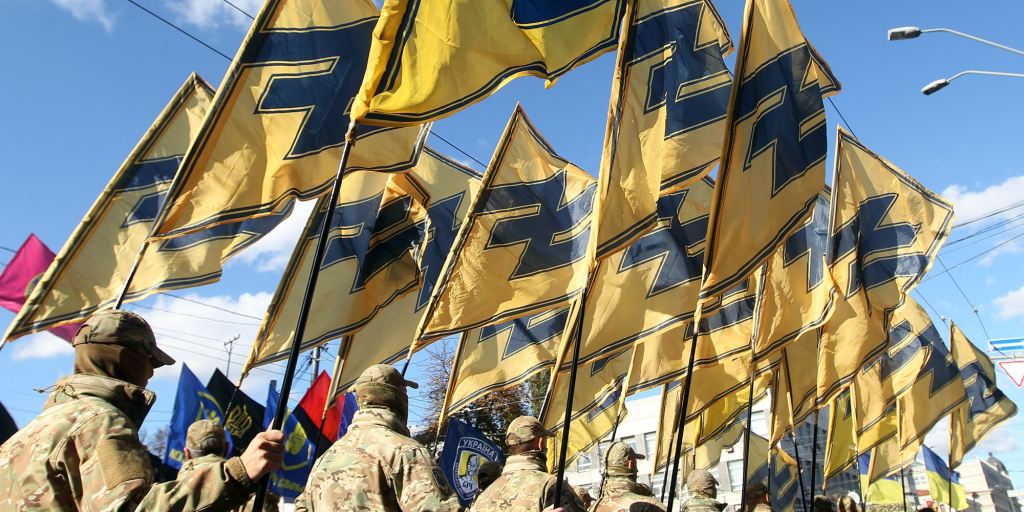
Members of the neo-Nazi Azov Battalion march in Kyiv
Transgressions of international law have been legion in the period since the defeat of the Soviet Union in 1991. The NATO led bombing and dismemberment of Yugoslavia in the 1990’s resulted in fragmentation, civil war and thousands of deaths, counter to international law. The US led bombing of Iraq in 2003 flew in the face of international law, resulting in thousands of deaths and the collapse of the Iraqi state. The same applies to the US bombing of Libya, the twenty year long US occupation of Afghanistan and the Saudi led bombardment of Yemen, which has gone on since 2015.
The United States continues to illegally blockade the Cuban economy in the face of massive international opposition. The British government will not release to Venezuela gold reserves which legitimately belong to that country. The Israeli government continues its illegal occupation of Palestinian land, counter to United Nations resolutions and international agreements.
None of which justifies Russia’s decision to launch a military operation in Ukraine but certainly makes Western holier than thou proclamations of defending democracy and being a bulwark against tyranny sound particularly hollow.
The West has always taken a pragmatic approach how it handles ‘tyrants’. Saddam Hussein was courted for many years, his pilots trained by the RAF and his regime tolerated as a lesser evil in the Middle East than that of the Islamic Republic of Iran. The eight year long Iran-Iraq war, which raged from 1980 -1988 and left over a million dead, was encouraged by the West in the hope that the Iranian revolution would be thwarted.
The plan backfired. The war ended in stalemate but the Iranian clergy used it as cover to purge those progressive elements who had been against the Shah, but were equally opposed to the establishment of an Islamic Republic, and consolidate the medieval theocracy which continues to oppress the Iranian people to this day.
The Taliban in Afghanistan emerged from opposition groups, armed by the CIA and Saudi Arabia, to undermine the 1978 revolution in Afghanistan, which freed the country from feudal overlords and which the Soviet Union was asked to assist in defending. The recent retreat of Western forces from Afghanistan, defeated by the very same Taliban, is another instance of the plan backfiring.
Opposition to the Bashir al-Assad government in Syria was fuelled by the West pouring into the country vast quantities of weaponry, which encouraged ongoing violence and degenerated into civil conflict. The attempt to undermine Syria failed, though not without the people of that country paying a significant price.
Agreements were made following the defeat of the Soviet Union that NATO would not take advantage and extend its influence into Eastern Europe and threaten Russia’s security. The exact opposite has happened. NATO influence and membership now extends to Latvia, Lithuania, Poland, Czech Republic, Romania and beyond. The United States territory of Alaska shares a border with Russia.
The NATO and EU backed coup in Ukraine in 2014 was followed by the banning of a wide range of political parties, including the Communist Party, attacks upon the ethnically Russian dominated areas of Odessa and Mariupol and the inclusion of fascist elements in both the government and armed forces.
The ‘democratic’ Ukraine, much vaunted by the Western media and liberal opinion, is little more than a façade for the influx of weapons which the current crisis has precipitated. Arms are flowing into Ukraine at an alarming rate, including an alleged 30,000 weapons handed out on the streets to Ukrainian citizens for their ‘defence’ but has actually resulted in gangs looting in the capital Kyiv. The EU has just agreed weapons deliveries of €500 million to Ukraine, further fuelling the likelihood of extending the conflict rather than moving towards a peaceful resolution.
Russian and Ukrainian peace talks have been initiated in Belarus offering the opportunity that an agreement may be reached. However, it is unlikely that Russia will accept any agreement which does not result in Ukraine’s neutrality, while Ukraine’s President Zelensky is reported to be demanding an unconditional ceasefire, the withdrawal of Russian troops and immediate EU membership for Ukraine. Both sides may remain apart for some time.
A special session of the UN General Assembly has been called, only the tenth in the past seventy years, to discuss the crisis. In his speech the Ukrainian ambassador to the UN has described the Third Reich as the “spiritual mentors” of the Russians. He further went on to question whether Russia is even a legitimate member of the United Nations. Such rhetoric does not augur well for negotiations.
Putin has made it easy for the West to ramp up the demonisation of both himself and Russia with the miscalculated invasion of Ukraine. It may be that the unintended consequence is his own downfall, as the gangster capitalists he represents will no doubt be quick to find an alternative, if Putin is not seen to be serving their best interests.
The West will seek to exact a price to defend its own position but may still tolerate a more compliant, resource rich Russia, desperate to do business with the West to rebuild its profit base. Feelers will no doubt be out already for an alternative to Putin, not least from the British Tories, who benefit significantly from donations of dirty Russian money, and the City of London, which has played a key role in laundering the asset stripping of the former Soviet Union.
It may not play out that way, Putin may yet step back and find a way to survive. In any event, he is unlikely to emerge from the crisis stronger. Whatever the outcome the West will need to remember, seeking reparations from a weakened rival may seem like a good outcome in the short term but, as twentieth century history shows, it my store up greater dangers in the future.
23rd February 2022
Tories throw in the towel
Living with Covid or dying to make a profit?
Any pretence that the Tories have been involved in anything but a de facto strategy of herd immunity during the Covid pandemic was cast to one side this week. The minimal protections in place, such as mask wearing on public transport and in crowded public spaces, will go. Access to regular free lateral flow tests will go, other than for the most vulnerable and social care staff, though not health workers.
Remarkably, the necessity to self isolate when testing positive for Covid will disappear, with responsibility being passed to employers and individuals. To describe this as a monumental abdication of responsibility on the part of the government is an understatement. While many employers in the public sector will acknowledge their duty of care, and advise staff who show symptoms to stay at home, the same cannot be relied upon in the small business and private sector.
Setting out its plans the government states that from 24th February in England:-
- The legal requirement to self-isolate ends. Until 1 April, people who test positive are advised to stay at home. Adults and children who test positive are advised to stay at home and avoid contact with other people for at least five full days and then continue to follow the guidance until they have received two negative test results on consecutive days.
- From April, the Government will update guidance setting out the ongoing steps that people with COVID-19 should take to be careful and considerate of others, similar to advice on other infectious diseases. This will align with testing changes.
- Self-isolation support payments, national funding for practical support and the medicine delivery service will no longer be available.
- Routine contact tracing ends, including venue check-ins on the NHS COVID-19 app.
- Fully vaccinated adults and those aged under 18 who are close contacts are no longer advised to test daily for seven days and the legal requirement for close contacts who are not fully vaccinated to self-isolate will be removed.
Infection rates remain high and the death rate across Britain remains the highest in Europe, with over 160,000 deaths to date. Britain is second only to France in the number of cases. Only the United States, Brazil and India are ahead on both cases and deaths from Covid. Yet the Tories’ adherence to private wealth as opposed to public health remains unshakable. Without a hint of irony the Tories call their plan Living with Covid, though their entire strategy to date could best be characterised as Dying to make a Profit, a strategy from which the latest announcement is no departure.
The latest rules only apply to England, for the moment, but it is hard to see how the other UK governments will not follow sooner or later.
It is clear that the impact of the changes, as at each stage of the pandemic, will hit the poorest the hardest. Those who have no choice but to work, often at more than one job, will have no safety net and no incentive or encouragement to stay at home when they display Covid symptoms. Those on temporary or zero hours contracts or surviving in the gig economy will be faced with impossible choices. This is underlined by the fact that guidance also states that from 1st April the government will,
- Remove the health and safety requirement for every employer to explicitly consider COVID-19 in their risk assessments.
In response to the government plan Prof Anthony Costello, professor of global health and sustainable development at UCL, told the BBC:
“The worry about lifting the legal restrictions is that we are telling not only our population, but the world, that there is really nothing to worry about, that it’s all over when it isn’t.”
The new Covid plans would also see councils in England become responsible for managing outbreaks using existing powers, although there is no indication that any additional resources will be allocated.
Several scientists and clinicians – including Prof Anthony Costello, Dr Kit Yates and Prof Christina Pagel – have signed an open letter to Sir Chris Whitty and Sir Patrick Vallance, urging them to “clarify the extent to which the planned policies are consistent with scientific advice and what specifically that scientific advice contained”.
Further concern was expressed by Dr Chaand Nagpaul, chair of the British Medical Association, who stressed that infections need to fall further before the rules were relaxed, stating,
“It does appear as if the government is trying to pretend that Covid doesn’t exist in the day-to-day lives of so many people.”
The right wing press and the hard core right wing in the Tory Party may well crow that the “shackles are off” and trumpet loudly the removal of so called “restrictions” but for many people this is simply a case of stripping away protection and increasing their sense of vulnerability. The pressure upon the NHS remains, the working class continue to suffer disproportionately and Tory donors, with their fast track contracts, walk away with fat profits on the backs of us all and the deaths of many.
This is the true face of capitalism in 21st century Britain. It is time for a change.
19th February 2022
Iran and US on a short runway in Vienna
As the negotiations between Iran and the P5+ 1 world powers to revive the Iran nuclear deal progresses Jane Green considers the issues and the prospects for peace in the Middle East

Talks on the Iran nuclear deal continue in Vienna
Negotiations to revive the Joint Comprehensive Plan of Action (JCPOA) or Iran nuclear deal, have been ongoing since early December 2021. Vienna has been the venue for these negotiations involving the Islamic Republic of Iran, the United States, Britain, France, Russia, China and the European Union, in an effort to avert a devastating new war in the Middle East.
Ned Price, the US state department spokesperson, has warned that, “The runway is very, very short – weeks not months.” This assessment is confirmed by US Secretary of State, Antony Blinken, who has added that any hope of a deal is dependent on getting agreement on reductions in Iran’s nuclear programme. With Iran achieving levels of uranium enrichment at 60%, the US argue that faster progress is needed.
Under the 2015 JCPOA, the Obama administration agreed to remove economic sanctions on Iran in return for the latter’s guarantee that it would keep the enrichment of uranium at lower levels. Iran remained in compliance with the terms of the JCPOA but, a year after the Trump administration unilaterally withdrew from the deal in 2018, reimposing sweeping sanctions on Iran, the Iranian regime began to suspend some of its commitments, including the cap on uranium enrichment.
The regime in Tehran argues that it had no choice but to go down this path, to find ways to generate leverage to revive the deal, especially after other signatories to the agreement failed to counter the effects of the reimposed sanctions or tackle the unilateral withdrawal of the US.
The sanctions have had a crippling impact upon the Iranian economy and the regime is acutely conscious of the growing popular unrest in the country, stemming from the sanctions. This is as a result of factories and industrial complexes folding, unemployment skyrocketing and a rapid severe devaluation in the national currency.
As a consequence, the regime has begun to moderate its demands and preconditions to ensure the current negotiations do not collapse. The Islamic Republic more than anything is concerned about the survival of the theocratic regime rather than worrying about the direction of Iranian social and economic policies.
In spite of negotiations not showing any signs of immediate breakthrough, in Tehran the official statements attempt to show that the negotiations are progressing. The Iranian position appears to be that if the negotiation is threatened, the leadership will change tack and proclaim an “heroic compromise” for the negotiations to go forward. Iran seriously needs the sanctions to be lifted.
There has been some movement recently with the US agreeing a waiver on some of the sanctions. The latest US move lifts the sanctions threat against foreign countries and companies from Russia, China and Europe that had been cooperating with Iran under the terms of the JCPOA.
The waivers permit foreign countries and companies to work on civilian projects at Iran’s Bushehr nuclear power station, its Arak heavy water plant, and the Tehran Research Reactor without triggering US sanctions. The US position is that the waivers are being restored in order to move forward the negotiations in Vienna.
However, Iran is attempting not to rely entirely upon the outcomes of the negotiations to address its economic crisis. The Iranian foreign minister, Hossein Amir-Abdollahian, travelled to China recently to secure a 25-year partnership agreement. Ebrahim Raisi, the Iranian president, has travelled to Moscow recently with the same purpose.
Nevertheless, neither China nor Russia can economically or politically protect Iran’s position. Neither can help to save Iran from the economic catastrophe confronting it if the US and UN economic and banking sanctions continue, or if negotiations fail and Iran continues with its uranium enrichment to weapons grade, 95% purity.
The Iranians are also concerned that any deal will not be subject to the vagaries of any change in US administration. Tehran wants binding commitments that if the US quits the deal, the EU will do more to defy secondary US sanctions by injecting real cash into the abortive trading mechanism, Instex, set up by the EU to bypass US sanctions.
The outcome of the negotiations is further complicated by the position of Israel where the Israeli prime minister, Naftali Bennett, has warned that his country will not be bound by any agreement. This underlines once again the precarious balance in the Middle East and the danger that, even if agreement is reached in Vienna, the hardline mavericks in Israel may still plunge the region into conflict.
For the US Biden’s policy is in essence the same as Trump with a softer cover. It aims to tame Iran to play a “constructive” part in the Middle East, as the US aims to give its full attention to China and the challenges it faces there. In short, US favours a multilateral confinement approach, as introduced by Obama, with the difference that Biden is protective of Israel and Saudi Arabia. The ideal scenario from a US point of view is that the balance of power between the four big Middle Eastern powers, Iran, Saudi Arabia, Turkey and Egypt, will keep US interests protected.
The ongoing actions against trade unionists and the political opposition, a feature of the Islamic regime for over 40 years, are leading to increasing resistance and protests, as the corrupt practices and economic incompetence of the clergy become more evident. More than 60% of Iranians live below the poverty line, there is no economic growth and inflation continues to climb.
While the regime makes a show of resistance to US demands in Vienna all indications suggest that the theocratic regime is running out of options. An agreement behind closed doors with the United States may be all that is left. This is certainly an option that can firmly tie Iran to the global capitalist system.
It may not be the outcome that the US or the Islamic Republic will admit to publicly, but it may yet be a solution both are prepared to live with in the short term.
For the full text of this article go to http://www.codir.net
12th February 2022
Unthinking conservatism
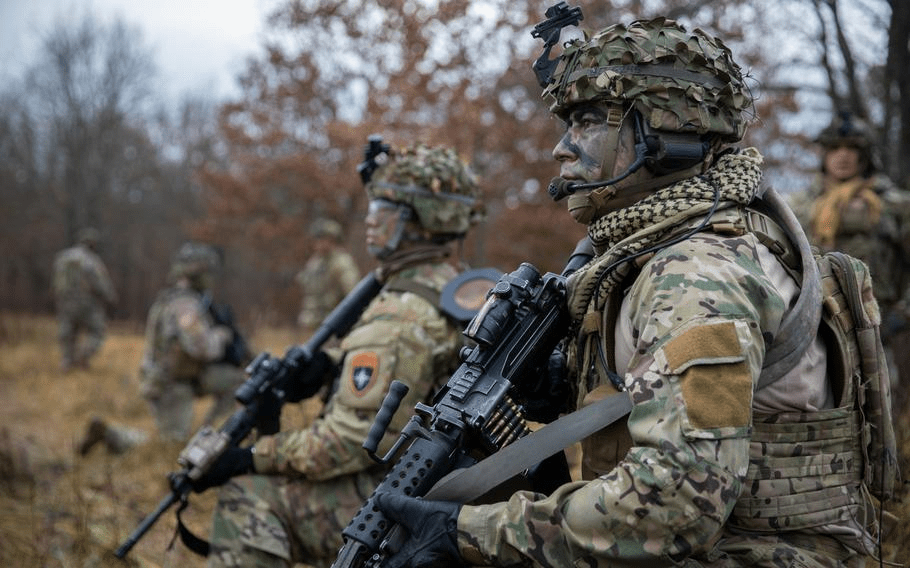
Kier Starmer’s leadership of the Labour Party sank to an all time low yesterday when he took the opportunity in an article for The Guardian (My party’s commitment to NATO remains unshakable – 11/2/22) to lambast the Stop the War movement for being critical of the approach of NATO in relation to Ukraine.
Starmer went further and nailed his leadership of Labour firmly to NATO’s mast by proclaiming the formation of the military alliance, during the post war Labour government of Clement Attlee, as being on a par with the formation of the NHS. Starmer concluded his article with the assertion that.
“…I regard both the Ns – NATO and the NHS – as legacies of that transformational Labour government that we need to be proud of and to protect.”
On one level it appears that Starmer falls into the trap of the politically naïve, assuming that the opposition of those who see NATO as an aggressive military alliance, designed to protect imperialist interests around the globe, are automatically supporters of the ‘enemy’, whether that enemy is deemed to be Beijing or Moscow.
The put down of the ‘liberal Leftie’ who is soft on authoritarian regimes, does not understand the need for defence and security and is, by inference, on the wrong side, has been a standard trope of the capitalist press and right wing Labour leaders for decades. In that sense Starmer is not being naïve but is following a long tradition of demonising the Left in order to burnish his own credentials to be seen as a ‘safe pair of hands’ when the prospect of a General Election looms.
The more sinister undertone to Starmer’s position is the implicit and at times explicit anti-communist tone to his words, commenting that,
“Attlee, Bevin and Healey saw communism for what it was and were prepared to stand up to its aggression. Today’s Labour party has the same clear-eyed view of the current regime in the Kremlin. We know as they did, that bullies respect only strength.”
The Russia of the 21st century is not the Soviet Union of the 20th century, though it is convenient for Starmer and his ilk to convey that impression, as it serves their one dimensional view of the world as divided into simply the good guys and the bad guys. Hence, the anti-Sovietism of the late 20th century has been transformed into the anti-Russian propaganda of the 21st century by those seeking to present the world in simple black and white terms.
That is not the position, whatever Starmer may assert, of those who support Stop the War or who regard both NATO and Britain’s membership of it as problematic. True, many have regarded NATO as an aggressive military alliance since its inception. Its initial stand to refuse membership to the Soviet Union was an early indication that it was not “a consecration of peace and resistance to aggression” but a defence of imperialist power against the threat of the spread of communism.
The creation of NATO was arguably the first act of the Cold War and precipitated a nuclear arms race which sucked resources away from the needs of working class people across the world, only making rich the arms manufacturers and warmongers.
NATO forces have been deployed across the globe to defend imperialist interests in Iraq, Libya, Afghanistan, Syria, and Yemen. They continue to establish advanced forward bases in Poland, the Czech Republic and the Baltic states; all of these moves are regarded as a threat by Russia. Adding Ukraine to this perceived encirclement is the source of Moscow’s fear for its own security in the present stand off.
To characterise NATO as the guarantor of “democracy and security”, as Starmer does, is simply to fly in the face of history. Those in the peace movement opposed to war in Europe are no more in favour of Russian aggression than NATO aggression but the evidence of where such aggression has usually been initiated in recent history is clear. Starmer further caricatures the Left as being guilty of unthinking conservatism, stating,
“The kneejerk reflex, “Britain, Canada, the United States, France – wrong; their enemies -right”, is unthinking conservatism at its worst.”
Correct, if true, but the only unthinking conservative in this instance is Starmer himself, who fails to grasp the world in its complexity and insists on the classic good guys, bad guys scenario.
The fact is that the Ukraine situation is one of bad guys versus bad guys. There is no more to commend the Putin regime and its gangster politics than there is NATO’s defence of its imperialist interests and desire to extend those. The issue is one of assessing where the threat of initiating conflict is more likely to come from and what the consequences would be for world peace should such a conflict erupt.
There can be little doubt that the reach and firepower of the combined NATO arsenal far outweighs that of the Russians but also that Russian firepower is sufficient to inflict significant damage should a conflict erupt.
Rather than unshakable commitment to NATO it would be good to hear Starmer proclaim his unshakable commitment to peace and conflict resolution, to de-escalating tensions across the world, to wanting to see Britain in the forefront of arms reduction and banning arms sales to dictatorships.
As for equating the formation of the NATO military alliance with the life saving NHS, Starmer really is plumbing the depths. The objectives of both could not be more diametrically opposed. The comparison is a shameful one and an insult to all of those NHS staff working tirelessly to save lives and who have been at the forefront of doing so over the past two years in particular.
The same cannot be said for NATO, its Generals or its many apologists.
5th February 2022
Levelling Up or just another bumpy ride?
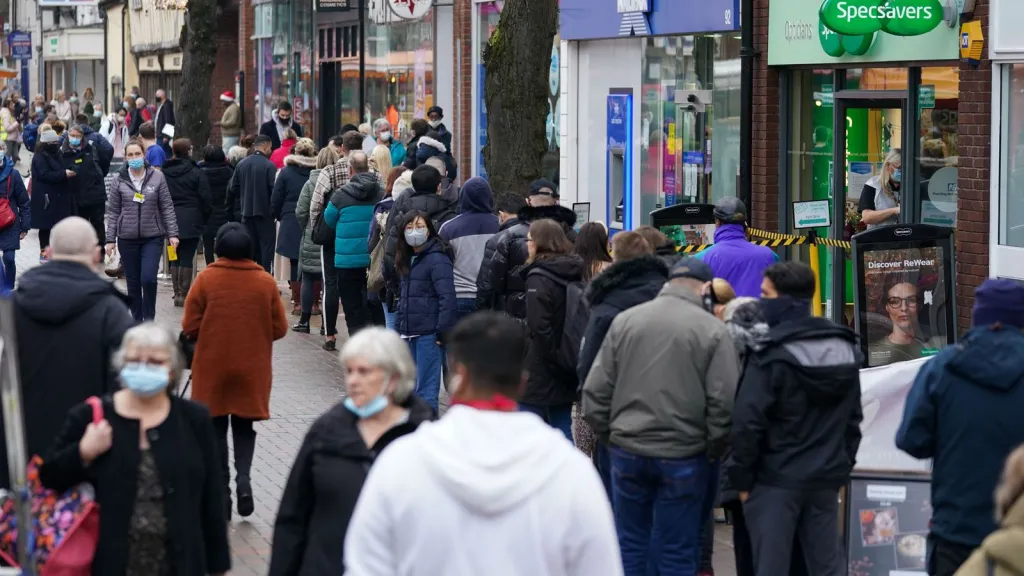
If the policies and practices of the British government were not littered with such tragic outcomes for working class people they would have to be regarded as a comedy. Schooled in the finest and most expensive institutions the ruling class can muster, the Eton heavy Cabinet, having rid themselves of Head Girl, Theresa May, could do no better than put the boy who sniggers at the back of the classroom in charge, in the form of Boris Johnson.
For those who do not move in such ‘enlightened’ circles it was clear from the off that Johnson, as with any other Tory Prime Minister, would have nothing to offer the working class other than poverty, insecurity and broken promises. In this, if in nothing else, Johnson and his diminishing band of cohorts, can at least claim to be consistent.
Yet they still attempt to pedal the illusion that, if they are patently not of the people, they can be trusted to be for the people. That this is nonsense, propagated by every Tory huckster since time began, is unfortunately no guarantee that some will not fall for it. Sadly, Johnson would not have an 80+ majority in the House of Commons without that being the case.
The Levelling Up White Paper, published this week, is the latest Tory attempt to hoodwink the people. The Minister in charge of this nonsense is Levelling Up Secretary, Michael Gove, who has claimed that the British economy had been ‘like a jet firing on only one engine’.
Gove goes on to proclaim the virtues of the strategy claiming that,
“This White Paper is about ending this historic injustice and calling time on the postcode lottery. This will not be an easy task and it won’t happen overnight, but our 12 new national levelling up missions will drive real change in towns and cities across the UK so that where you live will no longer determine how far you can go.”
Gove fails to point out however that ‘how far you can go’ will still depend upon which class you are born into and how fast a car, helicopter or private jet, presumably with more than one engine, that you can afford!
So, what does this marvel of modern equality contain?
First off there is more bureaucratic dismantling of local government through an expansion of the Heseltine style city Mayor idea, imported from the US. This will consist of nine county deals, two new combined authorities and a host of new powers for existing metro mayors in England.
The Government has also pledged a ‘simplified, long-term funding settlement’ for devolution while the UK Shared Prosperity Fund, the replacement for European regional development funds, will be decentralised across the whole of the country.
In existing mayoral areas, Greater Manchester and the West Midlands will become ‘trailblazers’ with extended powers, providing a blueprint for others to follow. The North East Combined Authority is also due to expand.
For all of those huddled up in a rented flat, faced with the choice of whether to heat or eat, this will all surely come as a welcome relief! A new layer of government with an Elected Mayor should be just the ticket!
In addition to the devolution plans the White Paper outlines proposals, marketed as 12 ‘missions’ to be met by 2030, to increase education and skills attainment, boost research and development, improve transport and broadband, and improve pay and employment. In theory, tackling all of the things which have been cut back or reduced following more than a decade of Tory austerity.
Of course, with inflation now bordering on rampant levels the Bank of England is already whimpering about pay deals being too high, so it will be no surprise if that one is the first to go out of the window. Let’s face it, why would levelling up prioritise giving people better pay and conditions?
There is little in the government’s levelling up missions to disagree with. Who does not want increased life expectancy, better schools, better transport, better housing, better broadband connectivity? In short it is a wish list of things that obviously need to be addressed but have suffered because the private sector has been more concerned with making profits for shareholders than meeting people’s needs.
Nothing in the proposals suggest that putting the private sector first will change. Nothing suggests that the energy companies, making vast profits on the back of hiked up energy prices, will be nationalised. Nothing suggests a more effective and efficient rail network, publicly owned rather than in private hands. Nothing suggests the return of local housing control to local authorities and the abolition of the iniquitous ‘right to buy’ scheme.
Nothing suggests that the private school system, with the sham of educational establishments for the rich being able to claim charitable status, will change. There is no mention of abolishing university fees, the introduction of which has become a barrier to access for working class students. While we are on, anyone care to look at the gender equality pay gap?
For most ordinary people the promise of levelling up looks a lot like being just another bumpy ride from the Tories.
It is safe to say that there is more levelling up to be done than is dreamed of in Michael Gove’s philosophy. In fact, there is more levelling up to be done than is possible under any capitalist philosophy as inequality, exploitation and expropriation are at the core of the system. Levelling up, in any real sense, is a socialist proposition and can only be delivered when the system is under the control of the people, run by a government for the people and committed to meeting the needs of the people.
Anything less than that, including the government’s White Paper, is little more than hot air and will not change the real balance of power one jot.
30th January 2022
Remembering Bloody Sunday

The history of the British presence in Ireland has always been one of violence, oppression and exploitation. For centuries Ireland only mattered to the British ruling class as a source of cheap food, feeding the British army during the Napoleonic wars and being turned into a largely corn growing economy as manufacturing began to grow in Britain in the early nineteenth century.
The struggle for control of the land was integral to the national struggle in Ireland throughout the nineteenth century. English landlords profited from the extortionate rents charged to the Irish peasantry, who were forced to either pay up or be evicted. Essentially the peasant grew wheat to pay the rent and potatoes for food.
When the potato crop failed, leading to the so called Irish famine of 1845 – 1850, food to the value of £17m was exported from the country, in 1847 alone, under the protection of English troops. As A. L. Morton observes,
“The million and a half people who died in these years did not die of famine but were killed by rent and profit.” (A People’s History of England – Lawrence and Wishart 1938)
Different movements including the Young Ireland Movement, the Fenian Society and the Land League attempted at various times to defend the economic interests of the peasants, fight evictions and foment risings against English exploitation without significant lasting success.
The parliamentary route was represented through the Home Rule Party, formed in 1872, which quickly found an able leader in the form of Charles Stuart Parnell. Parnell had some success in delivering a significant body of nationalist MPs into the Westminster Parliament. However, even this route was barred when Parnell was discredited as part of a conspiracy to successfully split the nationalist position, and any attempts to introduce Home Rule for Ireland were blocked by the landlords, keen to hold onto their profits.
By the time of the Easter Rising in 1916 it was clear that significant sections of the Irish working class were against both English domination and participation in the Imperialist war. While the rising itself was unsuccessful, and its leaders, including James Connolly, executed by the British, the rebellion triggered a steady growth of labour and nationalist activity.
The guerrilla warfare against the English which lasted from 1919 – 1921 resulted in the establishment of the Irish Free State but at the expense of the annexation of the six counties which became Northern Ireland, incorporated into the so-called United Kingdom.
Northern Ireland itself was essentially an enclave of English occupation, managed on behalf of the English industrialists who controlled the economy, by the Protestant majority at the expense of the Catholic minority. Working class Protestants, who should have had more in common with their working class Catholic counterparts, were bought off by preferential access to jobs, housing and dominance of the police and security services. Voting rights for Catholics were also restricted in order to ensure an inbuilt Protestant majority in any governance arrangements in the province.
Catholic areas were regularly under attack and resistance was met by the British state with a policy of internment, arrest without evidence or trial, which further inflamed Catholic and nationalist sentiment.
Internment was, in effect, the repressive response by the British state to the growing challenge of popular resistance to defend nationalist areas from assault by sectarian Protestant forces. It was also the British state’s attempt to stem the rising tide of a civil rights movement demanding their rights against decades of repression, discrimination, and gerrymandering.
As the Communist Party of Ireland (CPI) note,
“The British and Orange state saw the resistance of the people and continued demands for civil rights as a direct challenge to the very existence of the British-imposed political settlement of 1922, which partitioned Ireland.”
The civil rights march in Derry, which took place on 30th January 1972, fifty years ago today, was called to protest against the policy of internment which had been introduced in August 1971.
As the CPI go on to point out,
“The activities of the Parachute Regiment in Derry on 30 January 1972 followed the state-organised killing of at least nine people in Ballymurphy in Belfast between 9 and 11 August 1971, all part of Britain’s military strategy of “low-intensity conflict,” a strategy for quelling and subduing local working-class resistance to its political, economic and military strategies of control.”
The ’activities of the Parachute Regiment’ on 30 January were the murder of 13 unarmed civilian protesters, as the British soldiers opened fire on a peaceful demonstration. A fourteenth innocent victim died later as a result of injuries inflicted on the day, which has gone down in history as Bloody Sunday.
The actions of the British state on Bloody Sunday undermined the peaceful protests and class solidarity being built through the civil rights movement and drove many nationalists into the arms of the Irish Republican Army (IRA).
The misguided guerrilla campaign of the IRA, targeting civilian as well as economic and military targets, played into the hands of the British state. It was easy for the media to whip up opposition to IRA ‘atrocities’ and difficult for the Left in Britain to generate solidarity with those seeking a genuine working class solution to the partition of Ireland, achieving unity across all 32 counties.
The violence of British imperialism in Ireland did not end with Bloody Sunday and the economic grip upon the six counties of the Northern Ireland statelet continues to this day. The debate over the border in the Irish Sea, which has erupted as a result of Brexit, has underlined ruling class differences over the statelet’s position as part of the increasingly fragmenting United Kingdom, or whether it can be incorporated into the safe hands of the Irish ruling class and be absorbed into the neo-liberal arms of the EU as part of a united Ireland.
Neither solution will benefit the Irish working class in the short term but an Ireland united will at least have the opportunity to shape its own future on its own terms rather than having to fight on two fronts. As the CPI conclude,
“The best way to remember the victims of imperialism is to struggle to end imperialist control and domination, to take up the challenge and struggle bequeathed to us by James Connolly, to struggle for and build a Workers’ Republic, from Derry to Kerry.”
For more info go to https://communistparty.ie/en/2022/01/bloody-sunday-1972-statement/
22nd January 2022
Stop the NATO war drive!
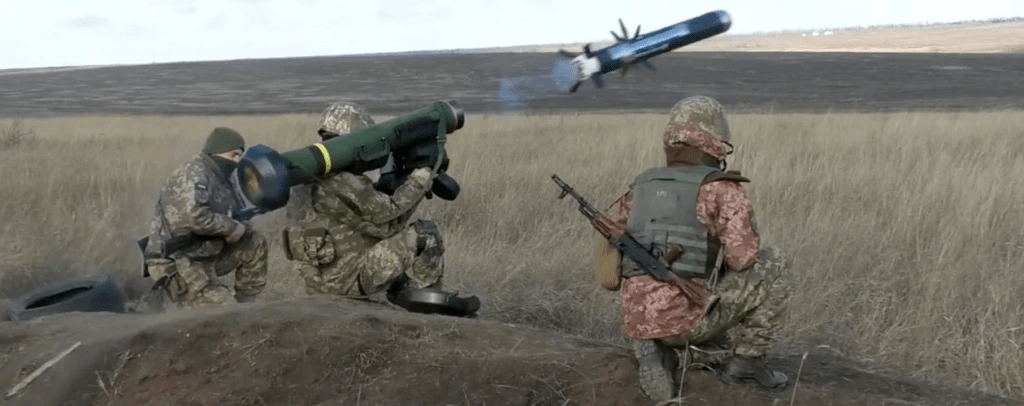
Ever since the defeat of the Soviet Union in 1991, followed by the slide of the Russian Federation into gangster capitalism and the rightward shift of many former Soviet and Eastern European states, there has been the potential for conflict with the West. Inter-imperialist rivalry has been a key feature of world politics since before World War 1 and however it is currently dressed, in talk of globalisation for example, it has not fundamentally changed.
Capitalism is driven by expansion, whether that is through territory, economic influence, strategic resource control or sheer military force, new conquests and new markets are always on the agenda.
The opening up of markets and influence which ‘victory’ in the Cold War afforded Western capitalists has been reflected in the incorporation of former socialist states into both the European Union and NATO; the annexation of the former German Democratic Republic into a ‘unified’ German state; and the creeping economic and military encirclement of Russia.
The flaw in the West’s plan for the post Soviet era was a failure to recognise that the beast it had unleashed in the East, in the form of the gangster capitalists of Russia, may have demands of their own and may not take kindly to the diktats of the West. There is also the fact that Russia’s new regime inherited a substantial military arsenal, as well as a not insignificant economic capability and major geo-politically important resources, in the form of oil and gas reserves.
Inheriting the Soviet Union’s seat as a permanent member of the UN Security Council also meant that, whoever was in the post Soviet driving seat in Russia, was always going to be a key strategic player. In European terms Germany, always keen to maintain its economic and political dominance of the EU, does not seek an economically strong rival to the East.
Germany has been well placed to benefit from the pool of cheap labour, which the incorporation of the former socialist states in Eastern Europe was designed to achieve for the EU. The free movement of labour has merely been a cover for the easier exploitation of cheap labour by the established EU states.
This has also allowed German market expansion into Poland, Romania, Bulgaria, Czech Republic and the Balkan states, with Ukraine firmly in the sights, as both a key market and source of strategic resources.
NATO troops and heavy weaponry are already positioned as far forward as Poland and in the Baltic states, with military exercises in those countries having been a key feature of recent years. Additional Western firepower has been provided to the Ukrainian government today, to counter the much hyped ‘threat’ of a Russian invasion.
Russian President Vladimir Putin is by no means an innocent player, as Andrew Murray states,
“…he presides over an authoritarian regime run mainly in the interests of the oligarchic groups which have seized the wealth of the USSR. It is a brazenly corrupt system, which has concocted an ideology mixing Russian chauvinism and Orthodox-influenced social conservatism…” (The Empire and Ukraine Manifesto Press 2015)
For Putin though, a Ukraine on the Russian border, as a member of the EU and armed by NATO, is regarded as unacceptable, the equivalent of Russia forging an alliance and stationing troops in Mexico.
The relative decline of the United States as the world’s dominant economic force, challenged by China on that front; the struggle of the EU to maintain both political unity and economic influence; and the reassertion of Russia as a force on the European front, make Ukraine a very real potential flashpoint, in both economic and military terms.
The ever compliant Western media focus upon the number of Russian troops on the border with Ukraine, failing to point out that these troops are actually in Russia, unlike the troops and weaponry which NATO has been amassing for years in countries neighbouring Russia, as part of its strategy of encirclement.
The roots of the current crisis run deep. In November 2013 the elected president of Ukraine at the time, Victor Yanukovych, was negotiating with the EU to move Ukraine closer to the EU but not by directly joining. His aim was to broker an economic deal that would benefit Ukraine, the EU and Russia, if possible. Via Ukraine, the EU could access Russian energy resources and Russia would gain new customers. As the intermediary, Ukraine could win financially by playing the pipeline middle man and getting cheaper gas for itself.
However, the EU wanted Ukraine to keep paying inflated prices and to stick to a burdensome debt repayment schedule. Putin then offered Ukraine a better deal than what the EU was offering, with Russian gas for up to a third less and help paying off debt. Yanukovych, who did not want to impose the austerity on his people that the EU was demanding, accepted Putin’s offer.
In response, the nationalist right wing in Ukraine, led by openly fascist organisations, began to whip up protests. Yanukovych overreacted with police violence against demonstrators, and many were killed. Things spiralled out of control, and he fled to Russia as a fascist coup openly backed by the U.S. seized control in Kiev under the guise of “restoring law and order.” Again, EU and NATO expansionist desires were resulting in bloodshed.
Clearly a military conflict will not benefit the people of Ukraine, Russia or the West, as any escalation is in danger of degenerating quickly into a Europe wide conflict or worse. The moves towards more arms and ammunition being supplied to Ukraine by the West must be stopped and exposed as the provocation they clearly are.
Opposition to further imperialist war must be the priority for progressive organisations across the world. Opposing NATOs war drive is by no means an endorsement of Putin but mass opposition to it may just save thousands of lives.
The position of the Stop the War Coalition should be widely circulated, stating,
“Stop the War demands an end to the relentless expansion of NATO, which has only added to international tension, particularly as NATO has played a more aggressive role internationally in the Balkans, the Middle East and South Asia. We oppose the deployment of British forces to the borders of Russia as a pointless provocation. “
For more info go to https://www.stopwar.org.uk/article/stop-the-war-statement-on-tensions-around-ukraine/
15th January 2022
Dancing in the dark

The news this week has been dominated by narcissists trying to wriggle off the hook. In Australia, tennis star, Novak Djokovic, has been wrangling with the immigration authorities about his vaccination status, or rather his entitlement to an exemption, given his widely known anti-vaccination views.
Djokovic is aiming to win his tenth Australian open and surpass the world record by recording his 21st Grand Slam, remarkable achievements by any measure, but not ones which entitle him to be treated differently to the average Australian citizen. Australia in general, and Melbourne in particular, has seen some of the most severe lockdown restrictions during the pandemic and many are justifiably outraged that Djokovic is trying to flaunt the rules and trade on his status.
The Australian government have finally seen sense and withdrawn Djokovic’s visa, an action which should send a message to anyone in the sports and entertainment world that fame should not be an assumption of entitlement. Nevertheless, the Serb’s legal team are launching a final appeal which may yet take the saga into early next week.
The British national embarrassment which is the Royal Family compounded its anachronistic status this week with the Queen being compelled to strip her son, Prince Andrew, of a slew of military honours and to withdraw use of his His Royal Highness (HRH) status. Quite what the Prince had done to accumulate his military accolades is a moot point. Given a life of sponging off the hard earned taxes of the working class, which continue to bankroll the pampered lifestyle of the aristocracy, it is hard to see what useful purpose Andrew and his retinue serve.
Without any real purpose, and no challenge to earn a living, the Prince has indulged himself as an international playboy, using his royal status as a passport to the closed world of the rich and famous. Whether Andrew is guilty of sex trafficking or sex with children will be for the US courts to decide but, whatever the outcome of the case brought against him, associating with criminals of the nature of Jeffrey Epstein and Ghislaine Maxwell shows, at the very least, poor judgement.
The Prince’s legal team have jumped through every possible hoop to prevent the case coming to court, all of which gives off the smell of something rotten being hidden. Another narcissist, another week of squirming and months more ahead.
Then there is serial liar and narcissist in charge of the British government, Boris Johnson. It is becoming increasingly difficult to enumerate with any brevity the catalogue of lies, misdirections and disasters which characterise Johnson’s premiership. Not long after the official pandemic death toll in the UK passed 150,000 it turns out that Johnson and his cronies have been cavorting around the garden at 10, Downing St, enjoying the “lovely weather” while others could not visit dying relatives.
To date at least 13 parties have been identified as having taken place at Downing St when lockdown rules covered the rest of the country. Johnson’s miserable excuse for an apology, that he stumbled upon a ‘works event’ on 20th May, with his fiancé, stayed for 25 minutes then went back to work in his Downing St office is paper thin. In any event, stumbling upon 30 people boozing in your back garden when you were only allowed to meet one person outdoors should have elicited a slightly different response, whether or not the boozing was ‘work related’.
The Metropolitan Police, the ones who famously do not investigate past illegal acts, no wonder their reputation is in tatters, are awaiting the outcome of PM appointed bureaucrat Sue Gray’s investigation before deciding whether to act. Tory MPs are similarly sitting on their hands, waiting for the outcome of Gray’s report before deciding which way to jump, though their local parties may be sending them a more robust message.
Most bizarrely, Boris Johnson is awaiting the outcome of Gray’s pontification, before deciding how badly he or his staff may have behaved and whose head may have to roll as a consequence. Martin Reynolds, the bureaucrat who sent out the e mail invite to the infamous 20th May party, looks like his punishment will be an ambassadorship in the Middle East. That will top up his Civil Service pension nicely no doubt.
While the noise around parties and personalities continued the real judgement on the government’s monumental pandemic money laundering operation sneaked out almost unnoticed. The billions of pounds worth of contracts awarded through the VIP fast lane during the pandemic, many to Tory friends, donors or associates was deemed illegal in the High Court.
An estimated 32 billion items of PPE, worth in the region of £14 billion, were bought through VIP fast lane contracts to companies given preferential treatment due to their political connections. To add insult to injury, many of the materials supplied by these companies were unsuitable for use in the NHS or were defective.
Jo Maugham, Director of the Good Law Project, one of the companies which brought the case commented,
“Never again should any government treat a public health crisis as an opportunity to enrich its associates and donors at public expense.”
Dancing in the dark at parties in Downing St is just the tip of an iceberg. Lurking beneath the surface is the real world of the political establishment, a closed world of back handers and back scratching, which keep the pampered and privileged in their positions and makes sure that it is the rest of us who pay.
Johnson’s error, and the reason why his head may be on the block as Tory leader, is not that he has departed from the expected norms of his peer group but that he has made this too obvious. There has been too much braggadocio for many beyond his diehard supporters and those on his payroll to defend.
To do this in a pandemic, when people are dying; your inept procurement is increasing the chance that more will die; and you do it while flaunting your own rules by indulging in back garden boozing is beyond the pale.
Johnson clearly has to go but his departure will only lance a boil, it will not cut out the cancer. The political establishment in Britain truly is rotten to the core, however much they try to mask or masquerade. Getting to the root will take time but the reality is gradually being exposed and the need for fundamental change will resurface. The Left must continue to make that case and continue to argue for a system which works to the benefit of the many, not the few.
8th January 2022
Wallpapering over the cracks

The long running farrago over who paid for what, when and what they received in exchange, to redecorate Boris Johnson’s Downing Street flat came to a head this week. In typical fashion it did not conclude in the colourfully bold, some may say garish, style of the Johnsons’ chosen decorator, Lulu Lytle, but settled into the usual whitewash of bluster and apology which has characterised Johnson’s premiership.
In a series of WhatsApp exchanges it is clear that Johnson was prepared to accept cash from one of his cronies, Lord Brownlow, in exchange for entertaining Brownlow’s pitch to stage a Great Exhibition 2 in 2022. Brownlow’s cash was to be laundered through a so-called blind trust, thus washing it through a ‘legitimate’ route which could not be construed as a donation or, worse still, a bribe.
When the whole scam came to light, last April, Johnson appointed another pal, Christopher Geidt as an ethics adviser and suggested that he look into whether or not Johnson had acted in breach of the ministerial code. It was no surprise to anyone that Geidt did not find any breach and assured the public that Johnson did not know where the cash was coming from.
The Electoral Commission also got involved and launched its own inquiry, finding that the Tories should have reported Lord Brownlow’s donation and fined the Conservative Party £17,000, a notional slap on the wrists.
In the meantime, it turns out that Johnson had not come clean with Lord Geidt and had forgot to mention a couple of WhatsApp exchanges with Brownlow, which were clear evidence that he had a very good idea of where the cash was coming from, how it would be laundered and what Brownlow was after as a pay off.
Geidt subsequently took the hump and accused Johnson of acting “unwisely”; Johnson offered a “humble and sincere apology”; Brownlow did not get GE2 but a diluted version branded as Unboxed, which will be rolled out over 2022; and Lulu Lytle oversaw the £58,000 flat redecoration, including the now famous £800 per roll gold wallpaper – tasteful.
Out in the real world, the pandemic continued to rage, the body count in Britain continued to outstrip most of the rest of Europe and the new Omicron variant had made its appearance, just when everyone thought that some degree of normality was on the horizon.
While Johnson shrugs off justifying his £58,000 flat refurbishment many across the country are struggling to feed and clothe their children, or meet the rising cost of energy bills, which impact disproportionately upon poorer families.
The average annual salary for workers in North East England in 2021 was £27,500, the lowest in the UK and less than half of the cost of Johnson’s designer flat makeover. Once tax and national insurance contributions are deducted take home pay is likely to be less than £2,000 per month, which is how much the average annual energy bill is likely to be from April, according to recent estimates.
Take that calculation down to the level of part time work and those surviving on Universal Credit and the impact of energy costs alone looks alarming. Add to that rising national insurance costs for those in work, inflation across the economy, leading to rising costs for food and fuel, and the cost of living crisis begins to take on real shape.
Chancellor Rishi Sunak has immunity to the impact of these changes, due to his millionaire status, but has said that the Treasury are looking at ways to mitigate the impact of rising prices. The Treasury do not appear to be open to that mitigation including a windfall tax upon the profits of the major energy companies or a wealth tax on profits and property ownership, or even making the major beneficiaries of the pandemic, in the form of Google and Amazon, pay their fair share of the tax burden.
Still, we must not lose heart. The Secretary of State for Levelling Up, Michael Gove, has written to all local authority Chief Executives this week encouraging them to begin planning for the Queen’s Platinum Jubilee, with a four day Bank Holiday weekend scheduled for the 2nd – 5th June and extended pub opening hours in prospect for the first three nights.
Beacons will be lit, music will be commissioned, street parties will be organised and much alcohol will be consumed, in a collective effort of the will by the ruling class to keep us believing that we really do need a monarch, “long to reign over us”.
Whatever state the British economy is in by June we can be sure that the rich will continue to get richer and the poor will continue to pay the price. Playing the patriotic card is often the last refuge of the few in diverting the people’s attention away from the day to day realities of life in capitalist Britain for the many.
The bigger reality is that no amount of wallpaper will cover the cracks in the capitalist edifice, even at £800 a roll, and the corruption that is at the heart of the system. That is a system which is designed to maintain power and privilege in the hands of those who continue to own and control the means of production, distribution, exchange and communication.
That must change, the whole structure which sustains such inequality must be challenged and the emergence of the people as citizens, not subjects, with control over their own destiny, will be the measure of a real shift in the balance of power. That would really be a step towards levelling up.
1st January 2022
Light in the darkness
Brexit – getting Johnson done?
Historically, capitalism has so far found ways to reinvent itself, intensify its exploitation of human, animal and material resources across the world and still exert control over large swathes of the planet. The heroic efforts of the Soviet Union and its allies, to take human history in a more progressive direction, lasted little more than seventy years. The defeat of that effort has undoubtedly set the clock back and, despite the growing aeconomic power of China as a counter weight to US imperialism, the momentum of the Soviet alliance through the world communist movement has clearly been diminished.
That is not to say that all is lost. Capitalism is inherently a cutthroat business made up of shifting and unstable alliances, with each player out to gain the upper hand. The banks falling over themselves to lend more and generate more profit led to the 2008 financial crash and the subsequent austerity drive to make the working class pay off the banks’ gambling debts. That scramble saw some banks go to the wall while others had to rely on state bail outs. The free market is ultimately only as free as the capitalist system wants it to be.
Similarly, the British exit from the neoliberal strait jacket of the European Union has not only exposed the faux internationalism of the bloc but also illustrated that international relations must be based upon mutual respect if they are to work. The British position in recent negotiations has been to get one over on the EU while, likewise, the EU cannot be seen to let Brexit work. The impasse means that the British people end up with the worst of both worlds, unable to be fully free of the EU, while equally failing to carve out an independent position in the world, based on mutual respect and a true socialist internationalism.
The British political establishment has been divided over Brexit for a long time. Up and coming challenger to Boris Johnson, the recently appointed Foreign Secretary, Liz Truss, was a pre-referendum Remainer but has since reinvented herself as a darling of the Tory right wing with growing support amongst grass roots membership. Far from ‘Getting Brexit Done’ as Johnson proclaimed at the 2019 General Election, it may yet be that Brexit gets Johnson done, sooner than he would have liked.
The assertion of foreign policy independence by the Johnson government, through proclaiming its Global Britain policy, would be laughable if it were not so tragic. The only sense in which Britain is remotely global is in tying itself to US foreign policy objectives and tagging along as a junior partner. This has been the case for many years, with Britain functioning as little more than a US airbase and a forward base for US nuclear weapons, through the Trident nuclear submarine programme.
The lunacy of the so called independent nuclear deterrent is only surpassed by the billions it is proposed to spend to replace Trident. More money in the pockets of the US military industrial complex, less in the Treasury pot for schools, housing and the NHS, surely all more pressing priorities for the British people.
Just as the Tories do not speak with one voice on EU membership, the military establishment is similarly divided over Trident. Not that the Chiefs of Staff are arguing for more hospitals, they would much rather see increased spend on conventional weapons, but there are divisions there which a skilled Opposition could exploit.
Sadly, the major skill the Opposition appear to possess at the moment is that of supporting the Tory line on most major questions. Certainly, there is no dissent on the Labour Front Bench regarding spending billions on Trident. There is no departure from the Tory line on NATO membership and kowtowing to the United States in foreign policy priorities.
Having conspired to lose the 2019 General Election, through ditching Labour policy to honour the referendum outcome, as well as playing a leading role in the so-called People’s Vote campaign, Kier Starmer is looking increasingly well placed to play a caretaker role as Prime Minister, should the Tories not sort out their leadership issues in time for the next General Election.
The Labour Front Bench does not however reflect wider opinion in the Labour Party, with a range of more progressive policies being adopted at Labour Conference providing the basis for a continued push from the Left, for policies which will serve the interests of the people and challenge the vested interests at the heart of the political system in Britain.
The broader international picture also holds out some hope. China continues to travel an anti-imperialist path of development, as does Vietnam and, in spite of the ongoing illegal US blockade, so too does Cuba. The wider picture in Latin America remains encouraging with progressive governments continuing to hold sway in Venezuela, Bolivia, Nicaragua and more recently Chile.
The surge in Labour membership in the 2015-17 period in particular, with progressive policies being articulated during Jeremy Corbyn’s leadership, also shows that policies in favour of the many, not the few can gain traction beyond the confines of Party conference, even in reactionary Conservative Britain.
The year ahead will certainly hold challenges for those arguing for a shift in the balance of power in Britain in favour of the working class. In spite of the positions taken by the Labour Front Bench there remain key allies in Parliament among progressive Labour MPs. Their voices, combined with mass extra Parliamentary action, will be vital in shifting the debate towards the real needs of the British people, rather than continuing to defend the interests of the banks and corporations which the Tories represent.
Now is no time to dwell in darkness, it is time to shine a light into the murky corners the Tories wish to hide and flush them out!
Avanti in 2022!
 Avanti Populo