

12th April 2025
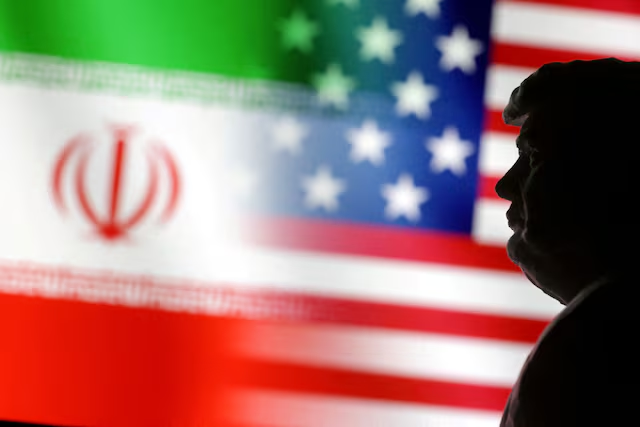
US President, Donald Trump, will cast a long shadow over US/Iran talks
While US President, Donald Trump, continues to play ping pong with the world economy representatives from the US and Iran will meet in Oman this weekend to explore the prospect of a deal between the two countries, which could raise the possibility of de-escalating tension in the region.
The Committee for the Defence of Iranian People’s Rights (CODIR) has welcomed the proposed talks between the United States and Iran as a possible first step towards relieving the pressure upon the Iranian people, caused by ongoing sanctions against the country.
While the solidarity organisation continues to highlight the human rights abuses of the theocratic dictatorship in Iran, CODIR also recognises that the sanctions regime, which is crippling the economy, is a massive pressure upon the Iranian people.
“We are under no illusions that the engagement of the Iranian regime in talks with the US is about little more than self preservation”, said CODIR General Secretary, Gawain Little, “but any opportunity for dialogue which will reduce tension in the region and avert the possibility of military intervention in Iran must be welcomed, however cautiously.”
The latest report from Amnesty International concerning executions worldwide, Death Sentences and Executions 2024 identifies over 1,500 executions worldwide in 2024, the highest figure since 2015, with Iran, Iraq and Saudi Arabia being the main offenders.
In Iran alone executions increased by 119 from the previous year, a total of 972, accounting for 64% of all known executions.
The Secretary General of Amnesty International, Agnès Callamard, was trenchant in her opposition to the death penalty, stating,
“The death penalty is an abhorrent practice with no place in today’s world. While secrecy continued to shroud scrutiny in some countries that we believe are responsible for thousands of executions, it’s evident that states that retain the death penalty are an isolated minority. With just 15 countries carrying out executions in 2024, the lowest number on record for the second consecutive year, this signals a move away from this cruel, inhuman and degrading punishment.”
However, the Islamic Republic of Iran appears to be going against this trend, not only with increasing executions, but also continued extra judicial torture and imprisonment without access to legal counsel.
This has particularly been the case in the last two years with the rise of the “Women, Life, Freedom” movement, which has seen mass protests throughout Iran, as well as the wave of industrial action across the country, in response to the impact of state corruption and the repressive sanctions regime imposed by the West.
The Amnesty report goes on to indicate that over half of the executions in Iran are for offences that should not result in the death penalty under international law, such as drug related offences. Also, there is clear evidence that the use of forced confessions has been widespread and that trials carried out by the Revolutionary Courts are grossly unfair and likely to have been based upon torture tainted confessions.
The talks in Oman will not focus upon Iran’s human rights record but will primarily be concerned with reaching agreement around Iran’s uranium enrichment programme for nuclear power generation. However, the reality is that arrest torture and execution remain key tools used by the regime to silence opposition and are an indication of its narrow public support.
The current tension in the region, due to the Israeli genocide in Gaza and the weakening of Iran’s so called Axis of Resistance of Hamas, Hezbollah and Houthi organisations, has increased the likelihood of a further military strike against Iran, either directly by the US or by Israel.
With regard to talks with the US, Iran’s Foreign Minister, Abbas Araghchi, was sounding bullish a couple of weeks ago, saying,
“Our policy is still not to engage in direct negotiations while under maximum pressure and military threats, however, as it was the case in the past, indirect negotiations can continue.”
However, the discussions in Oman will clearly be more direct than Araghchi suggests.
While Iran may grandstand to impress its regional allies, it remains in a relatively weak position. While a strategic partnership treaty was signed with Russia in January, it does not obligate either side to support the other if under military attack, only an agreement not to help any country that attacked the other.
The so called Axis of Resistance has been significantly weakened by the actions of the Israeli Defence Force (IDF). The demise of the Assad regime in Syria has robbed Iran of a key regional ally. Close relations with China, based upon a twenty five year agreement signed in March 2021, does not imply any military support and has yet to yield any significant boost to the Iranian economy.
While links with Russia and China can by no means be dismissed, and a direct attack upon Iran could change the dynamics of those alliances, the Iranian regime cannot expect military support as a matter of course.
Added to the relative isolation of Iran on the international stage is the growing internal pressure, arising from the economic crisis resulting from sanctions, endemic corruption and economic mismanagement. Increased production was once again a theme of the address by Khamenei to mark the Iranian new year in March but this has been rhetoric from the dictatorship for many years, without any significant investment or strategy for increased industrial production materialising.
While the Iranian regime seeks to avert any military conflict to save itself, the US will also recognise that being embroiled in an overseas war in Iran will bring no advantage while a deal, which opens up access to the potentially lucrative Iranian market, would be of far greater benefit to US capital.
As the US relationship with Saudi Arabia shows, the US is by no means adverse to doing deals with theocratic dictatorships if the calculation is that it will bring a strategic advantage for US imperial ambitions.
Further info at http://www.codir.net
 Avanti Populo