

18th February 2025
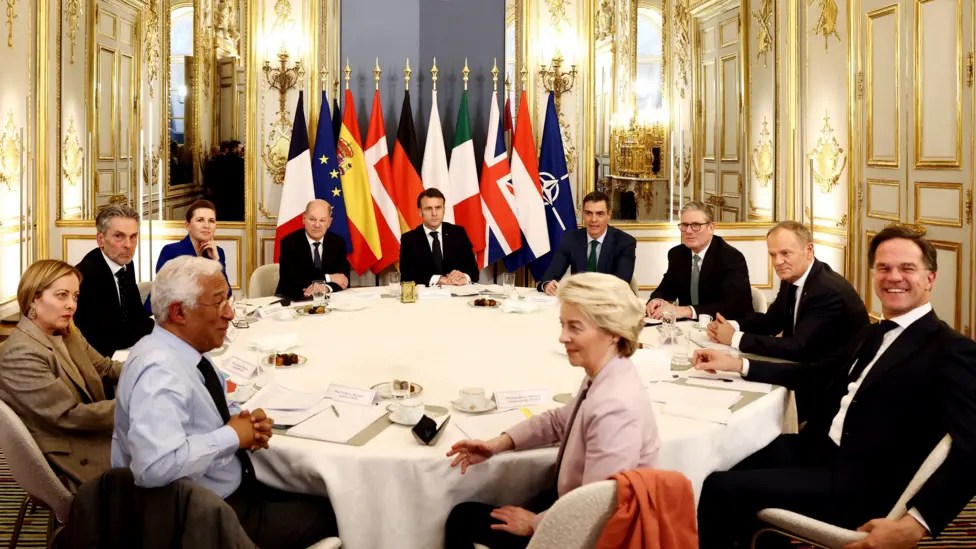
European leaders ponder what to do as the US pushes for a deal with Russia
European leaders have been in Paris this week wondering what to do about the apparent maverick actions of the United States, in relation to the NATO proxy war in Ukraine. What at first seemed like a straightforward NATO vs Russia scenario, in defence of right wing nationalist Ukraine, has been complicated by the return to office of Donald Trump. Not that Trump’s attitude to Ukraine should come as a surprise, he has been trailing it on his campaign journey for over a year, but Europe, including Britain, has been taking an ostrich like approach to the possibility of Trump’s return and they are now having to face the consequences.
The US has signalled bi-lateral discussions with Russia, underway in Saudi Arabia, in order to achieve a settlement, no doubt to be followed by conversations with Ukraine to persuade them to accept any deal. There will inevitably be a quid pro quo in terms of US arms being sold to Ukraine, in exchange for access to resources such as mineral wealth. Russia will incorporate the Crimea and Donetsk regions, in line with the stated wishes of those populations.
The European Union plus Britain may tub thump about the prospect of Russia extending its reach and invading the Baltic states and Moldova etc but this is largely a bogie of NATO’s own creation for internal consumption, to justify the persistent increase in arms spending. The likelihood of Russia precipitating a response from NATO by overstepping its existing boundaries must be rated as very small in reality. Europe’s Cold War anti Russia scaremongering is likely to wear thin as US priorities change.
So what is the endgame of US imperialism? Russia, as it has been historically, is the weak link in the imperialist chain. While rich in resources and still a significant nuclear power it does not pose a direct threat to the dollar based economic order. However, in alliance with China, an actual economic threat to the US, and the wider BRICS network of nations, the role of Russia is more significant.
It is certainly in the interests of the US to drive a wedge between the current alliance of Russia and China. Trump has also made it clear that the aim of the BRICS nations to move away from the dollar as the default international currency is not something he will tolerate. Bearing in mind that Trump speaks, not purely as an individual but as the mouthpiece of US imperialism, his words take on greater significance.
The potential market which Russia represents for US firms, and the resources which it controls, are vastly greater than anything Ukraine can offer and certainly more than the European Union can lay claim to.
European leaders in Paris have continued to bleat about the abandonment of Ukraine, British Prime Minister, Kier Starmer, referring to a “generational” security challenge posed by Russia and reiterating his commitment to deploying British troops if necessary. The continued warmongering on the part of Starmer and other European leaders, with talk of a 5% of GDP spend on the military, is a recipe for a massive crackdown on public services which will hit working class families hard. The economics of war may work for the military industrial complex, it will not work for the working class citizens of Europe.
Against this backdrop it may just be that the US has its eye on the bigger goal of competing with the rising economic might of China and positioning itself to reassert its grip on the international economy.
Ironically, it may be that Zelensky’s wild call for a European army, at the Munich Security Conference last week, may be the first recognition of this possibility. While the media, as ever, portray things in terms of personalities it is not a Trump/Putin love in that we should be wary of but a strategic US/Russia alliance which would truly redraw the map and reshape the international order, creating a powerful economic and military bloc containing most of the planet’s nuclear arsenal.
What the EU/Britain could do in the face of this would be very tame and even China’s economic strength would pale by comparison. They could huff and they could puff but it would be quite a house to try and blow down.
 Avanti Populo