

29th September 2024
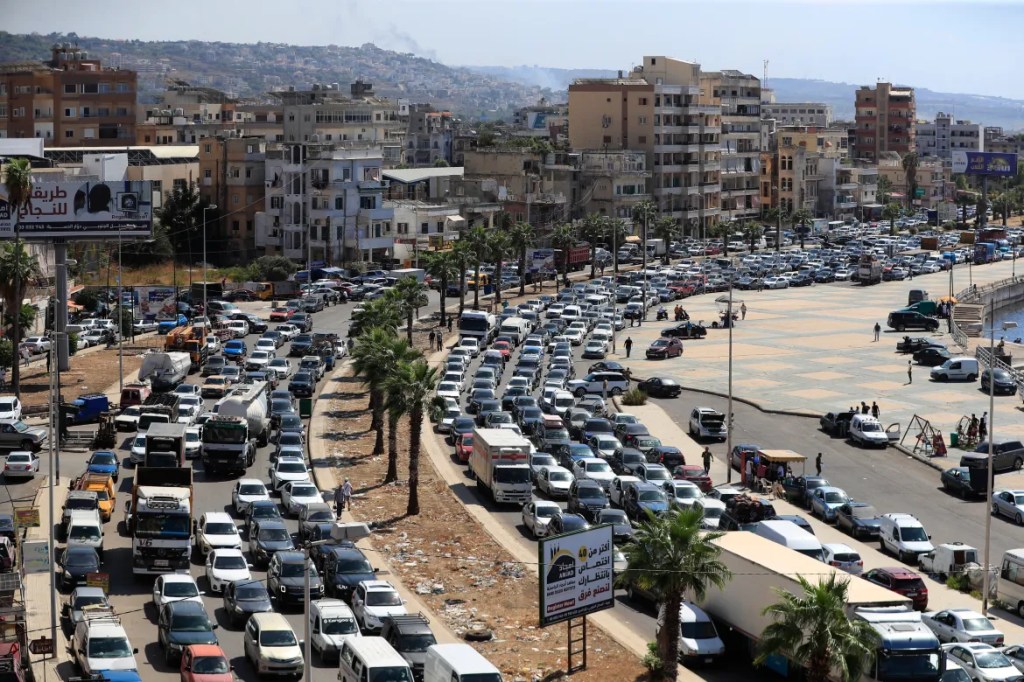
Thousands flee Lebanon to escape Israeli air strikes
The assassination of Hezbollah leader, Hassan Nasrallah, has been described by Israeli Prime Minister, Benjamin Netanyahu, as a ’turning point’, describing Nasrallah as “the axis of the axis, the central engine of Iran’s axis of evil”.
The killing and the ongoing bombing of civilian areas of Beirut may well prove to be a turning point but not necessarily in the way that Netanyahu means. Iran’s leader, Ayatollah Ali Khamenei has called for five days of mourning following Nasrallah’s death and vowed that his ”blood will not go unavenged.”
Lebanon’s Health Ministry has estimated that 800 are dead so far as a result of the actions of the Israeli Defence Force (IDF), while 50,000 people are estimated to have fled to Syria and an estimate 1 million are displaced, many having to sleep on the streets.
The bombings follow on from the indiscriminate attacks, not denied by the Israelis, upon Lebanese citizens by planting explosives in electronic communication devices, which killed 37 and injured thousands. This action has been widely condemned as a war crime precisely due to its indiscriminate nature.
While the IDF claim that the current bombing campaign consists of precision strikes, the reduction to rubble of buildings in clearly civilian areas gives the lie to this claim, costing the lives of non-combatant women and children in the process.
The latest strikes have even seen surprise expressed by the United States, Israel’s staunchest ally, with President Joe Biden claiming that the US had no prior knowledge of the attacks. Efforts by US Secretary of State, Antony Blinken, to engage Israel in the search for a diplomatic solution have so far abjectly failed.
It is becoming increasingly clear that the Israeli government, under the leadership of Benjamin Netanyahu, is out of control and driven by its own religious fundamentalist agenda. Devastating strikes on Beirut followed on almost immediately from Netanyahu’s widely boycotted speech at the UN General Assembly in New York and flew in the face of widespread calls for a negotiated settlement and ceasefire to be discussed.
Israel’s contempt for the will of the international community, as articulated by the UN, has been evident for decades in its illegal treatment of the Palestinian people and their just demand for national self determination and a fully sovereign state of their own. It is evident in its recent action in Gaza and the West Bank and is becoming more flagrant in its attacks upon the Lebanese capital.
Such actions increase the threat of widening the conflagration in the region, with escalation beyond the Middle East into a global war within the realms of possibility.
With the presidential election in the United States looming Netanyahu is clearly taking advantage of the hiatus this represents to press home his fundamentalist agenda, to the detriment of the people of the region and in spite of the opposition from many of his own citizens. Parliamentary elections in Israel are not scheduled until October 2026 and Netanyahu is gambling that he can hold together his right wing fundamentalist coalition at least that long, to present himself as a victor in the fight against both Hamas and Hezbollah.
The fate of the Palestinian people and the people of the Middle East generally should not rest upon the political survival and opportunism of one man.
Pressure upon Israel to come to the negotiating table must be increased through concrete actions. The British government must immediately cease all arms sales to Israel. Trade union and cultural organisations should support the Boycott, Disinvestment and Sanctions (BDS) campaign to isolate Israel internationally, until it is prepared to negotiate meaningfully on a way forward.
The US, as Israel’s major ally, must take a stronger line in bringing the IDF to heel and opening the way for negotiations. The turning point in the current conflict has to be to turn back. The coming days could well be crucial in determining the future of the Middle East and whether or not the world is plunged into a wider conflict.
 Avanti Populo