

5th August 2023
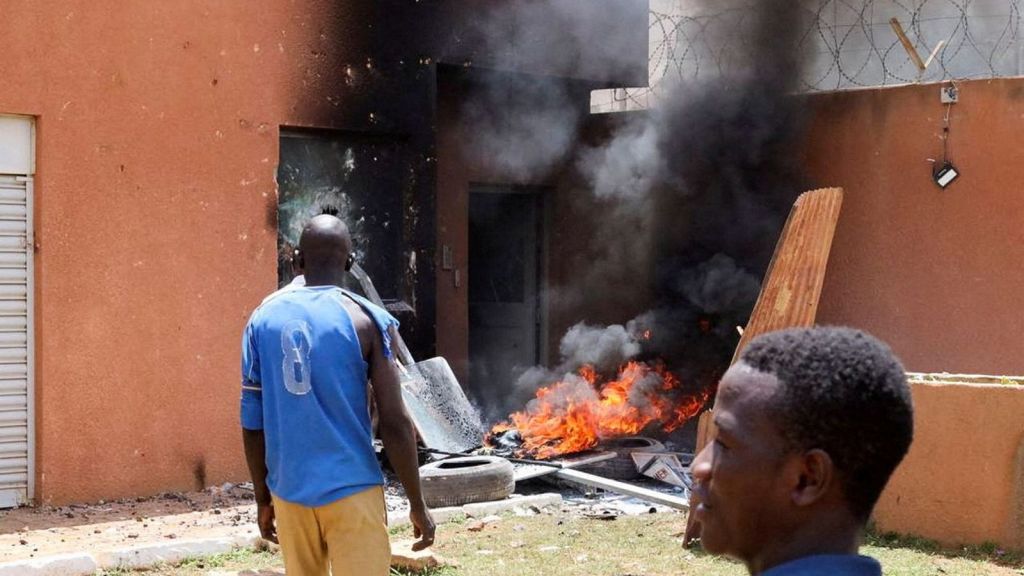
Protests in Niger have already targeted the French Embassy
The state of Niger garners little in the way of international headlines and for many is not likely to be on the political radar. The recent coup d’etat has changed that and Niger now finds itself the focus of international attention, not least in the context of the intentions of imperialism to redivide the African continent and extend its spheres of influence.
In terms of natural resources, political and economic control of Africa is a huge prize. The continent has 30% of the world’s mineral reserves, crucial components in the manufacture of electronic goods and armaments. Africa also has 8% of the world’s natural gas and 12% of the world’s oil. In a period where energy costs are soaring and control over energy resources is at a premium, reserves on such a scale are significant.
Not surprisingly the United States has been at the head of the Western charge to gain or retain control of African resources. While neo-colonial pressure has consistently undermined the efforts of African nations to fully assert their independence, in the past the presence of the former Soviet Union was a significant counter weight to the machinations of imperialism to fully dominate the continent.
The political and material support of the Soviet Union to many national liberation movements, struggling to free themselves from colonial domination, was often a crucial factor in many African nations gaining and sustaining their independence.
While the demise of the Soviet Union has by no means meant African allegiance has transferred to the nationalist oligarchy in Russia, it nevertheless ensured a strong anti-imperialist legacy in many African states, determined to be free of the neo-liberal diktats of the International Monetary Fund and World Bank. For example, trade between Africa and China rose to a record high in 2021. The jump was massive: 35% between 2020 and 2021, reaching a total of $254 billion. China is by far Africa’s biggest trade partner.
It is increasingly clear that, given the West’s colonial past, and Russia’s historic association with various liberation movements on the continent, in many African states, intelligentsia and ordinary people are eager to break free from the grip of western hegemony.
However, Western interference in the affairs of African nations continues to hamper development in many parts of the continent. There is growing evidence that the United States is attempting to increase its hegemony in Africa, with a significant presence of the US Africa Command (AFRICOM), with 29 bases across the continent, and military drills, often in cooperation with the EU and NATO. France also continues to have a military presence in about ten countries on the continent.
The US has two military bases in Niger, with an estimated 1,100 soldiers, while the French presence in the country is estimated at 1,500 military personnel.
According to the latest report from the World Bank, Niger has a poorly diversified economy, with agriculture accounting for 40% of its GDP. More than 10 million persons (41.8% of the population) were living in extreme poverty in 2021. Niger is one of the poorest countries in the world, receiving close to $2 billion a year in official development assistance.
Niger is also grappling with an influx of refugees fleeing conflicts in Nigeria and Mali. As of 31 August 2022, the United Nations High Commissioner for Refugees (UNHCR) had identified 294,467 refugees and almost 350,000 displaced persons in the country.
While President Mohamed Bazoum, was successful in elections held in December 2020 and February 2021, marking the first democratic transfer of power in the country’s history, Niger remains at the mercy of former colonial power France and the United States, which have sought to use the country as a regional base, supposedly for the purposes of safeguarding the area from and countering the threat of Islamist insurgent groups, in West and Central Africa’s wider Sahel region.
Niger also struggles with a security crisis in the areas bordering Nigeria, Burkina Faso, and Mali, where armed groups carry out repeated attacks against the security forces and civilians.
The coup d’etat initiated by the military on 26 July has resulted in the arrest of Mohamed Bazoum and the declaration of Colonel Major Abdourahmane Tiani as the country’s new leader, the closure of all land and air borders and the establishment of a curfew.
The United States has called for the release of President Bazoum, describing Niger as “a crucial partner” for the United States. Former colonial power France, which relies upon Niger as the main source of uranium for its nuclear power plants, has condemned the coup and demanded the release of President Bazoum.
There is the clear danger that destabilisation in Niger could extend to further uncertainty in the wider Sahel region. While the coup or the suspension of constitutional processes is not a solution to Niger’s desperate situation, nor is the continuation of the situation in Niger before the coup, as one of the most destitute and impoverished sovereign nations in the world, remotely tenable.
The people of Niger, already facing a desperate situation, are now further threatened due to the withdrawal of vital humanitarian aid from the country in response to the latest developments. France has cut financial support, and the European Union has suspended security aid. This is clearly a case of exploiting the aid as leverage, even though such considerations should be entirely independent of the political developments in the country.
This undermines the very notion that the provision of such aid should only be conditional on whether there exists a humanitarian need for it and it can be provided safely, as opposed to being used as a tool of punishment by Western powers. However the political situation in Niger unfolds, the humanitarian needs of the people must be addressed independently of any geo-political considerations.
There is also danger of an armed intervention, which must be rejected, as must any foreign interference in the sovereign affairs of Niger, whether by former colonial power France, the US, EU or NATO. The main regional bloc, the Economic Community of West African States, gave Tiani a week to restore Bazoum, or it would consider using force.
The governance of Niger and the course of its future development are the sole remit of the long-suffering people of Niger. In the short term a political resolution of the current crisis, brokered by the United Nations, is paramount. This must put front and centre the needs of the Nigerien people as well as urgently addressing the dire humanitarian situation which has been allowed to go on unchecked in Niger for far too long.
 Avanti Populo