

29th April 2023
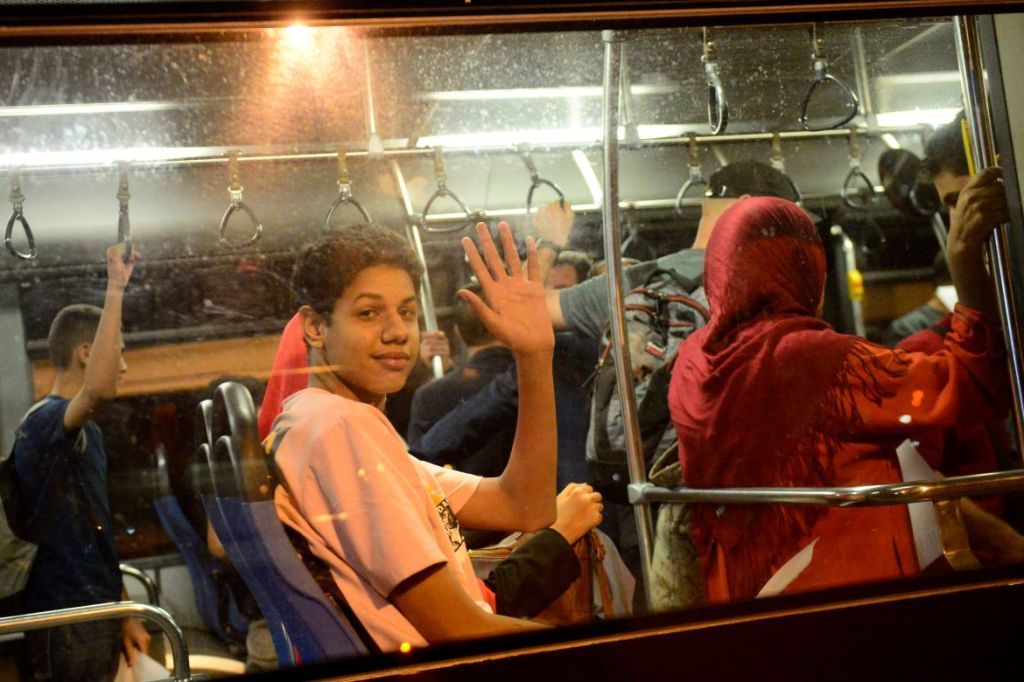
Passengers being bussed from war torn Khartoum – not all are so lucky
As the crisis develops in Sudan reporting from the BBC takes on its usual character of obfuscation rather than illumination. The only concern of the BBC appears to be the fate of British nationals and the scramble to evacuate British passport holders from Khartoum as quickly as possible.
The roots of the current situation in Sudan however inevitably have their origins in the neo-colonial grip of transnational corporations, which exercised control over Sudanese resources and were happy to prop up the corrupt government of Omer Al-Bashir from 1989 until his popular overthrow in 2019.
The forces behind the revolution which overthrew Al-Bashir in April 2019 included the Professional Alliance, the Civil Society forces and the Sudanese Communist Party, part of an alliance of 80 organisations which signed a Minimum Programme for democratic change.
Any progress towards shifting the balance of power in Sudan was thwarted however with the civilian led government being ousted in a military coup in October 2021. While the pro-democracy movement responded with a civil disobedience campaign the military responded with live gunfire resulting in hundreds of deaths.
The pro-democracy movement was demanding the transfer to state ownership those companies controlled by the army and security forces, which have a monopoly over the export of Arabic gum, cattle, gold and various agricultural products. Demands for a new labour law, democratic liberties including the right to peaceful protest and the handing over of Al-Bashir and other war criminals to the International Criminal Court were not implemented.
These progressive measures were stymied by the reactionary elements of the civilian government, even before the October 2021 coup, but have had no chance of being progressed under the generals. Many of these elements were members of Al-Bashir’s security forces and some reactionary Islamic groups. The military in Sudan has very much reflected the position of the former regime’s National Congress Party, the Islamic Brotherhood in all but name. The chance for democratic or progressive change under the revolutionary forces’ slogan, freedom, peace and justice, have been severely setback by the present infighting.
The recent phase of conflict, which began on 8th April is effectively one between Sudan’s military and the country’s main paramilitary force. It is a proxy war led by the Rapid Support Force (RSF) and its leader General Mohamed Hamdan Daglo, or Hemeti as he is known, on the one hand, and the Security committee “of the National Islamic Front” in the Sudanese military headed by Al-Burhan on the other. Both sides are supported by their foreign allies.
The RSF was able to build its resources under the previous regime through an arrangement with the EU implemented in October 2014, known as the ‘Khartoum Process’. The funding under the agreement was given to various African countries to halt the flow of African migrants reaching the European Union. Sudan alone had received €215 million from this fund by 2017, much siphoned off by the RSF to fund its activities.
In effect the war, in which the main victims are the Sudanese people, is a power struggle between two reactionary military and political factions, who were previously united to prevent civilian rule through initiating the October 2021 coup. However, the lure of control over Sudan’s significant resources, not least its gold deposits, has proven too difficult for the reactionary factions to resist. The progressive Sudanese resistance committees have evidence, in the form of videos and documents, that shows both the Russian mercenary Wagner group and the Egyptians involved in smuggling gold.
The resistance committees are calling for the formation of an alliance against the war, and the restoration of civilian government, for the army to return to barracks and the militia to be dissolved. Further than this the resistance is calling for the Sudanese revolution to continue, demanding the people’s control of their wealth, progressive economic development, and the building of a strong public sector that serves the people.
While the United Nations has previously been involved in some attempt at negotiations, key sections of the progressive forces have refused to negotiate with the military, who they regard as having no legitimate role, having seized power from the elected government in the October 2021 coup.
The progressive forces in Sudan have made calls for support and international solidarity to back the goals of the revolution and demand a return to civilian rule. The Sudanese Communist Party, as part of the progressive alliance has issued a statement which includes the following,
“We condemn the military escalation between the two counter-revolutionary military forces. This is certainly an expected outcome of these factions’ leaders’ power struggle aimed at controlling the country’s resources at a time when their four years alliance in power has proven to have failed in running the country…”
The statement goes on to request support from politicians and trade unions in Britain in order to halt the current crisis, refuse to arm or train either of the forces involved and press the UN to initiate discussions towards a meaningful transition to civilian government.
The situation on the ground in Sudan is clearly complex and Western companies along with regional powers such as Saudi Arabia, Egypt and the United Arab Emirates will undoubtedly feel that their own positions are threatened if there is a successful popular revolution in the region. The idea may spread!
For that reason it is vital that the demands of the Sudanese people are made known, reported and supported. Any attempts to thwart the progressive demands of the revolution will only reinforce the reactionary armed forces engaged in fighting at present, as well as the reactionary regimes supporting them. For the sake of the people of Sudan and those of the wider region the current slaughter must stop.
 Avanti Populo