

21st January 2023
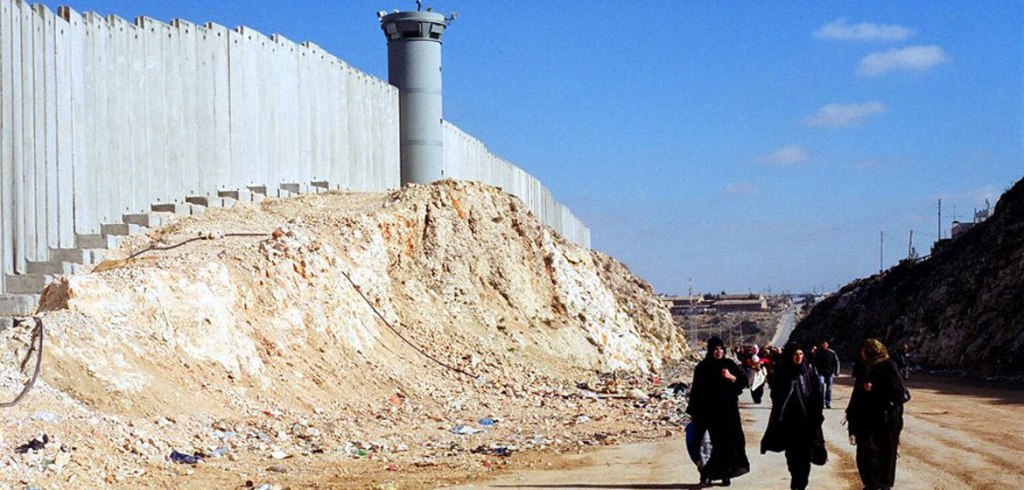
The illegal Israeli wall on the West Bank part of the land grab from Palestinians
Fifty nations, either part of or allied to the NATO military alliance, have been meeting in Germany to decide how much more weaponry they can pour in the conflict in Ukraine. High on the agenda is how many German built Leopard 2 tanks can be channelled to the right wing nationalist Ukrainian government to extend the war with Russia.
The meeting did not end in agreement, with Germany reluctant to send more tanks, or grant export licences for other countries to do so, unless the United States committed to sending more of its own tank weaponry.
As a result of NATO’s expansion over the past thirty years, extending its reach ever closer to the borders of Russia year by year, there are thousands of Leopard 2 tanks across Europe. In spite of the recent failure to reach agreement, there is every likelihood is that they will be mobilised for action in the not too distant future. With the first anniversary of the Russian intervention looming on 24th February, there can be no doubt that the Ukrainian public relations machine, fronted by President Zelensky, will shift up a gear to pressurise NATO members.
In the meantime, Leopard tanks or not, there is no shortage of weaponry pouring into Ukraine. The United States, already world leaders in fuelling the conflict, have promised a further $2.5bn in weaponry to prolong the war. In addition, Britain has committed a further 14 Challenger 2 tanks, while Poland is threatening to go against the Germans and export a similar number of Leopard 2 tanks anyway.
In spite of this firepower heading their way the Ukrainian pitch is for 300 tanks, necessary they claim, to resist a Russian Spring offensive. Any talk of peace or a negotiated settlement appears to have evaporated in the frenzy to supply more arms to Ukraine and the increasing tendency for NATO to fall behind the line, articulated by Zelensky, that nothing short of military victory over Russia will be an acceptable outcome.
The Western allies have long contested Russia’s claim to the Crimea, as well as that of the largely Russian speaking Donbas region of Ukraine. Any chance of reverting back to the Minsk agreements, negotiated with German arbitration in 2014, seems to have been torn up. While that deal appeared to have a settlement in place, around the largely Russian speaking Donbas, Ukraine never stuck to the deal and thousands have died as a consequence. This fact was not big news in the West and the Ukrainians, including the neo-Nazi Azov battalion, were given free reign to carry on with their civil conflict in the Donbas region.
The Western response to Russian intervention in Ukraine contrasts sharply with the response of the Western world to the Israeli treatment of the Palestinians. In spite of United Nations resolutions calling for a two state solution in Palestine the illegal occupation of the West Bank, Gaza and Golan Heights by the Israeli military has continued, without any significant challenge from the West, since 1967, nearly 60 years.
Following elections in November, the Israeli Parliament in December swore in what is widely acknowledged to be the country’s most far-right, religiously conservative government in history. The coalition sees the return of Benjamin Netanyahu as Prime Minister. Netanyahu, who was prime minister between 1996 and 1999, and then between 2009 and 2021, has said that an end to the “Arab-Israeli conflict” would be his top priority, as well as stopping Iran’s nuclear programme and building up Israel’s military capacity.
The new government includes far-right leaders who have been given top posts, such as Religious Zionism leader Bezalel Smotrich, and Jewish Power leader Itamar Ben-Gvir, who previously expressed support for Baruch Goldstein, a Jewish Israeli man who killed 29 Palestinians in a shooting at Hebron’s Ibrahimi Mosque in 1994. The result is a coalition that has explicitly called settlement expansion in the occupied West Bank, its top priority, in spite of such settlement being illegal under international law.
Even before the new right wing coalition takes office the United Nations estimates that Palestinians have already faced their deadliest year since 2006, after Israel’s outgoing government launched an offensive in Gaza in August, as well as near-daily raids in the West Bank that have led to dozens of killings and arrests.
UN Middle East envoy, Tor Wennesland, told the Security Council in December that more than 150 Palestinians and over 20 Israelis have been killed in the West Bank and Israel in 2022, the highest number of deaths in years.
The UN envoy also said Israeli settlement expansion in the occupied West Bank, including East Jerusalem, remains deeply concerning. The number of housing units advanced in occupied East Jerusalem more than tripled: from 900 in 2021 to 3,100 in 2022.
“I also remain deeply concerned by the continued demolitions and seizures of Palestinian structures,” said Mr. Wennesland. “I am alarmed, in particular, by the demolition of a donor-funded school in Masafer Yatta and the stated intention of Israeli authorities to demolish additional structures in the herding communities of that area, which would have a significant humanitarian toll, if implemented.”
He called on Israel to cease advancement of all settlement activities as well as the demolition of Palestinian-owned property, and to prevent possible displacement and evictions. In calling for an end to the conflict the UN envoy stressed that,
“There is no substitute for a legitimate political process that will resolve the core issues driving the conflict.”
The same message could equally be applied to the conflict in Ukraine.
Not surprisingly there is no international contact group considering how many tanks can be provided to the Palestinians to defend themselves against Israeli aggression and to uphold international law.
On the contrary, the United States is by far the biggest exporter of arms to Israel. Between 2009-2020, more than 70 percent of the arms Israel bought came from the US. Between 2013-2017, the US delivered $4.9bn (£3.3bn) in arms to Israel.
Under a security assistance agreement spanning 2019-2028, the US has agreed, subject to congressional approval, to give Israel $3.8bn annually in foreign military financing, most of which it has to spend on US-made weapons.
Conflict resolution is clearly not part of the political lexicon of US imperialism. Whether it is the right wing nationalist zealots in Ukraine, or the right wing religious zealots in Israel, US imperialism is in the thick of fuelling conflict, war and misery for thousands across the globe.
Anti-war and anti-arms trade activism must continue on all fronts, to combat the malign impact of US machinations. Exposing the role of the US and its allies in fuelling conflicts is the first step on the road to finding solutions based upon peace and mutually agreed boundaries, before escalation goes too far.
 Avanti Populo