

14th January 2023
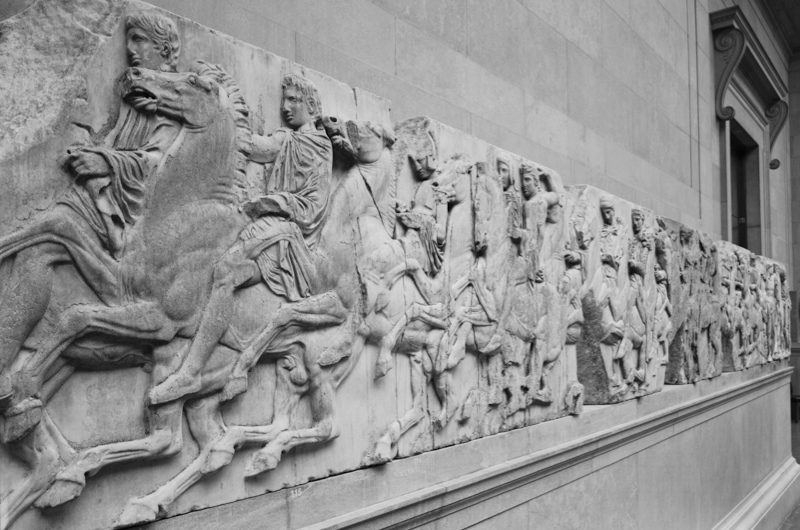
Parthenon Sculptures – not part of ‘our culture’
British Secretary’s of State for Culture rarely make the headlines and the previously unknown and largely anonymous incumbent, Michelle Donelan, has stayed true to form until this week. What has brought Ms Donelan into the spotlight is the question of the Parthenon Sculptures, known by many to date as the Elgin Marbles.
The sculptures have been in the ‘ownership’ of the British museum since 1816 having been removed between 1801 and 1812 from the Parthenon in Athens, then part of the Ottoman Empire, by British diplomat and soldier, Lord Elgin. The claim by Elgin that he had permission to take the sculptures is hotly contested. That they are historical artefacts of significance to Greece, dating back to the 5th century BC, is not disputed.
It should be no surprise that the Greeks have a long standing claim for the sculptures to be returned to Greece, where they rightly belong. Successive British governments have disputed the Greek claim, on the basis of backing Lord Elgin’s assertion that they were legitimately acquired, and are therefore legally in the ownership of the British Museum.
In an interview with the BBC Culture and Media Editor, Katie Razzall, this week Michelle Donelan went to great lengths to defend the current position. Donelan claimed that the sculptures “belong here in the UK” and that sending the sculptures to Greece would be a “dangerous road to go down”, going further to suggest that such a move would “open the gateway to the question of the entire contents of our museums.”
Perhaps most significantly Donelan claimed that “it is important that we stand up and protect our culture”. When being interviewed by news anchor, Sophie Rayworth, about her interview with the Culture Secretary, Katie Razzall picked up on this point in defence of Donelan, suggesting that she ‘mis-spoke’, as the sculptures are clearly part of Greek culture.
As a piece of challenging journalism this is poor in the extreme. Razzall did not challenge the ‘our culture’ comment in the interview but compounded the error by subsequently going out of her way to leap to Donelan’s defence.
While this underlines much of what we already know about the supine journalism of the BBC it also confirms what we know about the Tory definition of culture. The culture that Donelan refers to is clearly that of the British ruling class, who have robbed, pillaged and enslaved huge areas of the globe in order to enrich a select few, maintain a privileged aristocracy, and claim any loot they could lay their hands on for personal gain.
The Parthenon Sculptures are part of a long list of artefacts claimed by the ruling class as part of ‘our culture’ including tombs robbed in Egypt, the bronzes from Benin and jewellery from across the world. Most famous in this regard is the Koh-i-noor diamond, sitting at the centre of the British Monarch’s crown but effectively swindled from the Indian Sikh community by British Imperialism’s 19th century advanced guard, in the form of the East India Company.
The British working class have on various occasions been press ganged, dragooned or duped into engaging in ruling class wars of adventure or plunder. The frontline in the armed forces are inevitably drawn from the working class, who also bear the brunt of the casualties in any conflict, from the two World Wars of the 20th century to more recent occupations in Iraq and Afghanistan.
That does not mean that such actions are either in the interests of the working class or widely supported amongst the population, though the ruling class mouthpieces of the Mail, Express, Telegraph and The Sun do their best to persuade us otherwise.
Working class culture is founded on collective action resulting in the formation of trade unions, the Labour Party and a whole range of educational, welfare and community based organisations. Which is not to say that elements of sexism, racism and jingoism are not present in working class communities, infected by the prevailing orthodoxy within capitalism.
The difference is that progress to change society in a positive direction comes from working class struggle and collective action. Such action is always resisted by the ruling class until they are compelled to make concessions. Any concessions that are made are as quickly eroded when working class organisations are weakened or lacking militant leadership.
This is not what Donelan is referring to when she talks about ‘our culture’. On the contrary this is precisely the culture that she and her class want to suppress, in favour of a definition of culture which is distinct from the concerns of working class communities, has a rarefied boundary and is essentially the preserve of an educated elite.
Working class culture does emerge however, in the form of writers, artists and musicians who articulate the realities of lives for the underprivileged and oppressed, the victims of capitalism who can only peer in at the window of the world of culture, as defined by Donelan, but who continue to generate their own cultural space in which to survive.
The fate of the Parthenon Sculptures may not be to the forefront for those struggling in the streets of Bolton or Belfast. Whether they go back to Greece or stay in the British Museum is not going to put food on the table or pay the energy bill. In the long term however, how we interpret history has a profound effect on the present and is key to shaping the future. Reclaiming that history for those who have struggled to improve the world, rather than make a personal fortune from it, is a vital first step.
 Avanti Populo