

17th December 2022
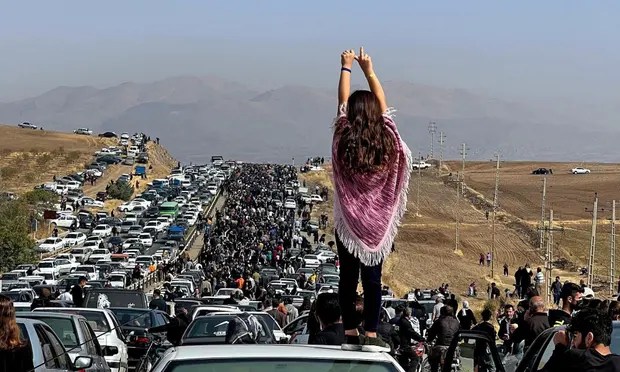
Protests continue across Iran in spite of the regime’s crackdown
Since the murder of 22 year old, Mahsa Amini, by the Iranian morality police in September, nearly 400 protesters are known to have been killed, including 57 children, while over 16,000 people are known to have been arrested. At last count, 990 separate protests had taken place across 146 cities and 140 university and college campuses around Iran.
Protests have continued in earnest in defiance of a warning by the head of the Islamic Revolution Guard Corps (IRGC) that they must stop. A vote by 227 of Iran’s 290 legislators in November, decreed that the death penalty be applied to those protesters brought before the courts on charges of serious crimes against the state.
The charges against the protesters have included vaguely defined national security charges such as enmity against God, corruption on earth, and armed rebellion. All of these vaguely worded crimes are capital offences. The trial proceedings are rushed and defendants are prevented from having a lawyer of their choice, falling well below accepted international standards.
The first two death sentences have already been carried out by the regime. In Mashhad the regime has publicly executed 23-year-old Majid Reza Rahnavard, found guilty of enmity against God, for the alleged killing of two security officers, and injuring four others.
The regime is also reported to have executed 23-year-old Mohsen Shekari, who was sentenced to death for enmity against God for allegedly “using a weapon to spread terror and violate the public’s freedoms and security” and for injuring a police officer.
Courts in and around the Iranian capital, Tehran, alone have jailed 400 people on charges related to recent protests, for terms of up to 10 years. Ali Alghasi-Mehr, the judiciary chief for Tehran province, said,
“One hundred and sixty people were sentenced to between five and 10 years in prison, 80 people to two to five years and 160 people to up to two years.”
These arrests and executions follow a consistent pattern of behaviour by the Iranian regime over the past forty years and follow on directly from the anti-working class character of successive regime’s in Iran going back to the days of the Shahs.
The early years of the Islamic Republic set the tone for the ongoing record of the Iranian regime in relation to human and democratic rights in general, and the rights of political and trade union activists in particular. In draconian purges against those who opposed the establishment of a theocratic state, they arrested, tortured and exiled key sections of the Left, effectively driving underground any opposition to the consolidation of the rule of the theocracy.
It remains an appalling record, with many activists still exiled and trade union activity either restricted by the state or forced to operate clandestinely.
In December 2020, a group of UN human rights experts wrote to the Iranian government warning that past and ongoing violations related to the prison massacres of 1988 may amount to crimes against humanity and that they would call for an international investigation if these violations persisted.
Between late July and early September 1988, thousands of imprisoned political dissidents across Iran were forcibly disappeared and then extrajudicially executed under a shroud of secrecy. For more than 30 years, the Iranian authorities have systematically concealed the circumstances surrounding their deaths and the whereabouts of their remains.
During this brutal atrocity, the core structures and leaderships of the main Left opposition parties, including the Tudeh Party of Iran, were effectively annihilated, and any remnants of those organisations were driven either underground or into exile.
Following the violent suppression of the Green Movement after the rigged presidential elections in June 2009, it became clear, even to those who remained under any doubt, that the Iranian regime was beyond reform. The two-term Rouhani presidency, elected on a supposedly reformist ticket, attempted to paper over the cracks.
However, the sham of Iranian democracy which sees all candidates in parliamentary and presidential elections vetted for approval by the Islamic Guardian Council, and power ultimately in the hands of Supreme Leader Ali Khamenei, prevailed over any leaning towards change in the country.
Even according to the regime’s own statistics, almost 40% of the population live below the poverty line in Iran. This is the result of three decades of neo-liberal economic policies imposed by the regime, encouraged by the IMF and World Bank. The class interests of the regime are inextricably aligned with the interests of the country’s corrupt and parasitic big bourgeoisie which controls the entire economic and political direction of Iran.
There remains confusion in some left-wing and progressive circles in characterising the regime in Iran as an anti-imperialist force, owing to its record of posturing against the United States. However, despite the Iranian regime’s anti-imperialist rhetoric, the Islamic Republic has remained a faithful aid to imperialist designs and interests throughout its existence.
This ranges from its support for the Contras in Nicaragua, and secret relationship with the US and Apartheid South Africa, during the 1980s; through to its active participation in the US’ destabilisation and overthrow of the People’s Democratic Republic of Afghanistan; the civil war in Tajikistan; the subsequent invasions and occupations of both Afghanistan and Iraq; and its continued support for some of the most reactionary forces in the region, including the Taliban.
These are not the actions of a regime with which the Left and progressive forces can do business or count on as an anti-imperialist ally. The only true interest of the theocracy ruling Iran is in its own survival, whatever the cost to its own people and whatever expedient international relationships it may forge to perpetuate its own hold on power.
Supporting the demands of the people of Iran for peace, democracy and social justice is the only legitimate position for the Left to adopt in relation to Iran today.
For more information visit www.codir.net
 Avanti Populo