

12th November 2022
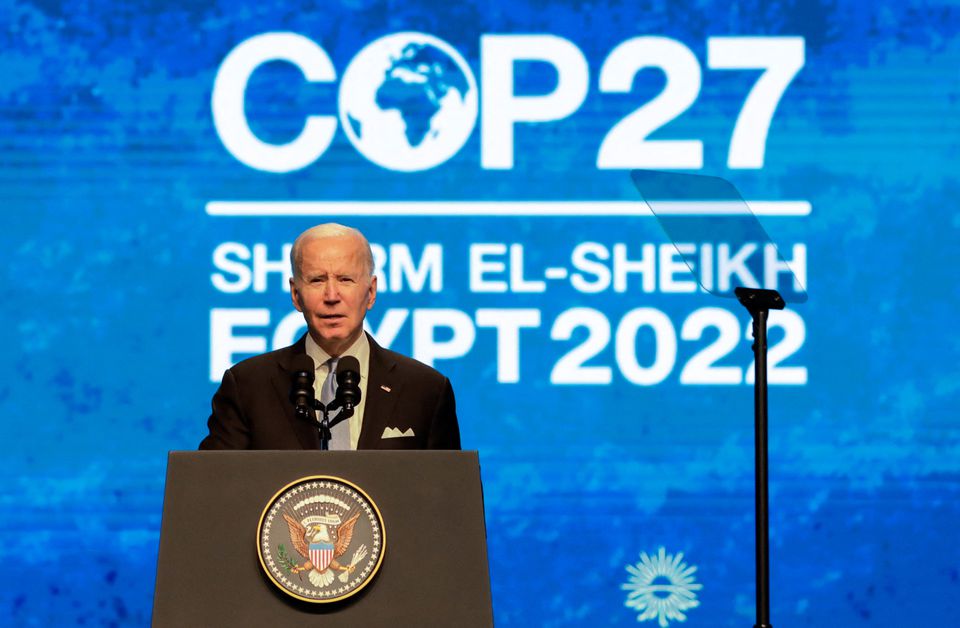
Hollow words – are US climate change promises to be believed?
“Pushing through the market square, so many mothers sighing.
News had just come over, we had five years left to cry in.
News guy wept and told us, Earth was really dying.
Cried so much his face was wet, then I knew he was not lying.”
The opening lines of Five Years by David Bowie from The Rise and Fall of Ziggy Stardust and the Spiders from Mars (1972). Nothing coming out of the COP27 conference in Egypt this week suggests that Bowie’s dystopian vision has been consigned to the realms of twentieth century musical theatre, as opposed to being a prescient narrative for our twenty first century future.
The recently published, Global Carbon Budget, an annual assessment of how much the world can afford to emit to stay within its warming targets, found that greenhouse gas pollution will hit a record high this year. Much of the growth comes from a 1% increase in carbon dioxide from burning fossil fuels. Emissions in both the United States and India have increased compared to last year, while China and the European Union will probably report small declines.
The report indicates that nations are likely to burn through their remaining carbon budget in less than a decade, if they do not significantly reduce greenhouse gas pollution. This will result in the world passing the critical warming threshold of 1.5C above pre-industrial levels in a mere nine years, resulting in catastrophic climate impacts.
Far from backing the call for greater investment in renewable and alternative energy sources, leaders at COP27 have been advocating natural gas as a transition fuel, from fossil based energy to renewables. At least four new gas projects have been announced recently, with African nations looking to export to Europe to plug the gap in supply, as a result of the reduction in supply from Russia.
A study by the research group Climate Action Tracker shows that currently planned projects would more than double the world’s current liquefied natural gas capacity, generating roughly 47 billion tons of carbon dioxide equivalent between now and 2050. While burning gas for energy emits about half as much carbon dioxide equivalent as burning coal, that is still a significant amount of carbon dioxide generation.
Climate scientists have stressed that planned expansion goes beyond what is needed to replace interrupted Russian fuel supplies. The proposals also fly in the face of findings by the Intergovernmental Panel on Climate Change and the International Energy Agency that there can be no new gas, oil and coal development if humanity wants to prevent dangerous warming beyond 1.5 degrees Celsius.
While an initial group of more than 20 countries had pledged to stop public investments in overseas fossil fuel projects by the end of this year, some are backsliding as the hunt for alternatives to Russian gas continues. The credibility of the COP27 process is further undermined by the significant presence of representatives from fossil fuel companies. An estimated 200 people connected to oil, gas and coal are included in country delegations, with another 236 with trade groups and other nongovernmental organisations.
Lorraine Chiponda, an environmental justice activist from Zimbabwe who co-facilitates a coalition of advocacy groups, called Don’t Gas Africa, summed up the fears of many climate change activists stating,
“This is supposed to be a space to discuss climate solutions, but instead it’s being used to drive fossil fuels.”
COP27 has also seen increasing pressure from developing nations for a loss and damage fund, through which large emitters would pay for irreversible climate harms like Pakistan’s recent floods. The demand however is struggling to make headway, meeting resistance from the United States and other industrialised countries. In addition, wealthy nations have not fulfilled their promise to provide $100 billion to help vulnerable areas reduce emissions and adapt to warming that is already underway.
It inspires little confidence that COP28 will be hosted by the United Arab Emirates, whose President has pledged to continue providing oil and gas “for as long as the world is in need.” Or at least for as long as the fossil fuel rich sheikhs can continue to make a profit!
US President Joe Biden addressed the conference on Friday. With the nuclear codes in one pocket and a first use of nuclear weapons policy in the other, Biden still had the audacity to suggest that the US was showing leadership on the question of climate change, stating,
“Countries that are in a position to help should be supporting developing countries so they can make decisive climate decisions, facilitating their energy transitions, building a path to prosperity compatible with our climate imperative.”
All of which is very well but ironic coming from the world’s most highly armed nuclear state and the world’s biggest exporter of weapons to anti-democratic forces and regimes worldwide. As far as saving the planet goes Biden’s words ring hollow.
The climate change process will only succeed with international co-operation but while resources are in the hands of profit hungry energy corporations the desire to make more money and avoid regulation will win out. Under capitalism the existential threat to profit still overrides the existential threat to the planet.
Only a revolutionary shift in thinking and economic systems can bring about the necessary changes. Until the world’s energy resources can be planned and investment in renewables agreed on a co-operative, socialist basis the dangers continually raised at COP gatherings will persist and the time for effective climate action will continue to get shorter.
 Avanti Populo