

30th September 2022
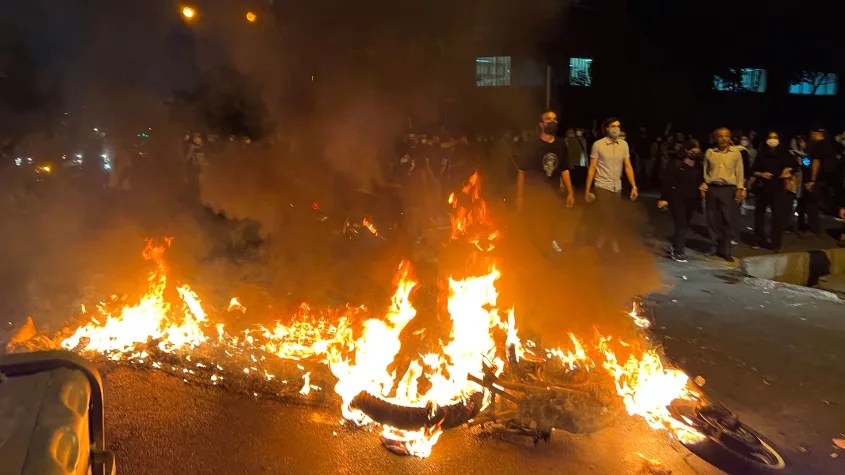
Iran in flames following the death in detention of Mahsa Amini
As protests grow across Iran following the murder in detention of 22 year old, Mahsa Amini, solidarity with the Iranian people is now more important than ever.
The grip of the theocratic dictatorship which has been in place in Iran since the early 1980’s has been tested several times but none more so than in recent weeks, following the death in custody of Mahsa Amini, for allegedly not following oppressive hijab rules.
Protests are taking place across all regions in Iran. Demonstrations of opposition to the regime have extended beyond the major cities and into the traditionally more conservative small towns and countryside areas. The degree of fury outstrips that expressed following the rigged election of 2009 which handed the hardline Mahmoud Ahmadinejad the presidency and spawned the Green Movement.
Recent protests have also surpassed those seen in November 2019, when a unilateral hike in fuel prices triggered angry scenes, leading to over 600 deaths and more than 7,000 arrests as the brutal security forces of the Islamic regime responded with force. The response to the death of Amini by the women of Iran harks back to the protests in 2017 when videos of women burning the hijab as a symbol of oppression were posted across social media, leading to further recriminations from the regime.
These incidents form a pattern of discontent and disillusionment with the leadership of the Islamic Republic, which has been simmering for some time, but can struggle to find expression through any normal democratic or media channels. Candidates for election to the Iranian Parliament are strictly vetted by the regime, as are presidential candidates. Trade union activity remains underground and illegal in Iran. The visual and print media are largely state controlled. Even social media and internet access can be restricted through government intervention, as has been seen in recent weeks.
However, recent events have seen the omnipresence of the regime challenged as protesters find new ways around media restrictions and the means to co-ordinate protest actions.
The accumulation of pressure upon the regime is also a result of forty years of human rights abuses, which has seen the arrest and execution of opposition political leaders; the imprisonment of trade union activists; the arrest and harassment of women protesters and student activists; and the use of lethal force against those taking to the streets in opposition to the regime.
Much of the recent outcry against the government in Iran has focussed upon corruption, as the regime’s leaders and members of the Islamic Revolutionary Guards Corps (IRGC) continue to fatten their bank accounts while increasing numbers of Iranians face unemployment and poverty. Ongoing sanctions imposed by the Western powers to restrict Iran’s ability to manufacture weapons grade uranium also exacerbate the economic crisis. Iran’s leaders continue to claim that its nuclear programme is for purely civilian purposes.
The death of Mahsa Amini has tapped into a deep well of resentment felt by the women of Iran who are increasingly frustrated by the restrictions imposed upon their economic and social activity by the regime and the lack of protection from domestic abuse.
Iran’s mandatory hijab law, which has been in place since 1981 has been enforced through the so called ‘morality police’, a practice which has been challenged by many Iranian women. In recent years protests have escalated with some women appearing in public without the required head scarf and loose robe. Ms. Amini’s family, it must be said, dispute that their daughter was even breaking these rules.
Since 2017, when dozens of women publicly took off their headscarves in a wave of protests, the authorities adopted tougher measures. With the election of hardline President Ebrahim Raisi in 2021 enforcement has increased even further and the attitude of the regime towards women in public has become more repressive.
Protests across Iran in the past weeks have seen 70 reported deaths and widespread arrests. The death of Mahsa Amini, and the repressive attitude of the regime towards women, has been the trigger but the slogans being shouted on the streets of Iran are calling for regime change and an end to the theocratic dictatorship of the Islamic clergy.
Such sentiments are ones which have driven the campaigning of the Committee for the Defence of the Iranian People’s Rights (CODIR) for nearly 40 years and it is now more vital than ever that the Labour and trade union movement in Britain shows solidarity with the people of Iran in their struggle against dictatorship.
It is also vital that the call for regime change in Iran is a call for the people of Iran to lead and determine that change. The United States, Israel and Saudi Arabia have all, individually and collectively, expressed their desire to see the end of the Islamic Republic and the threat of external intervention has been a very real one for many years.
However, such an approach has resulted in catastrophe in Iraq, Libya, Syria and Afghanistan and will be of no benefit to the people of Iran or the wider Middle East. Solidarity with the Iranian people should be just that, with the people of Iran having the opportunity to determine a future based upon peace, democracy and human rights.
For more information go to www.codir.net
 Avanti Populo